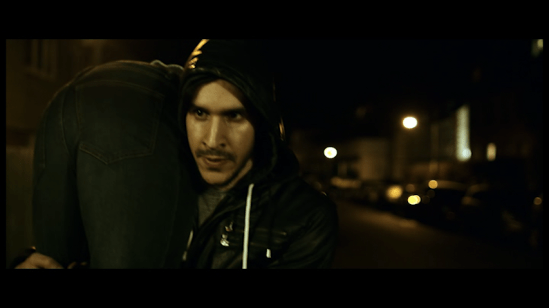
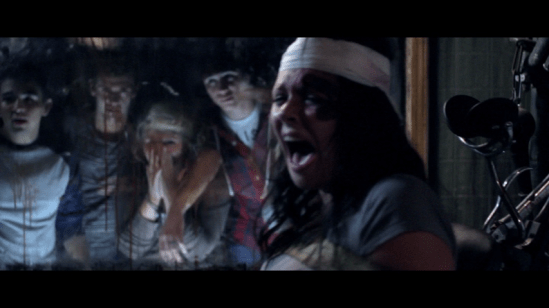
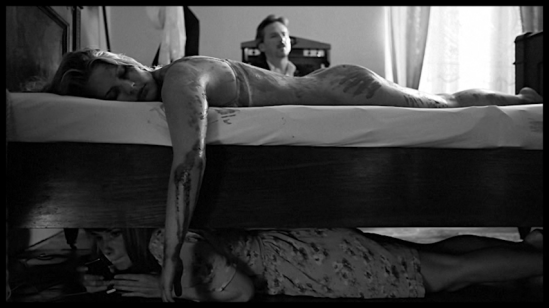
An absent Séverine wants to take a holiday away from her boyfriend Tom after she awakes from a dream where she has fallen in love with a man in a top open, white car. Frustrated and desperately in love with her, Tom agrees to a pact with a bar room stranger to stage a faux kidnapping of his lovely girlfriend and Tom would her hero, swooping in to rescue her from “evildoers” and hoping to rekindle her passion for him, but the Tom’s newfound stranger friend has a more devious agenda up his nicely tailored coat and white collared shirt sleeves; one that involves kidnapping young women to star in their snuff movie productions. When the plan begins the unravel and actual intentions are exposed, Séverine’s forced into a deadly cat-and-mouse game against unsympathetic sadists who have laid the prep work foundation into getting to know their victim and know every inch of her youthful body, but Séverine won’t submit without an unflinching, vicious fight as she trudges through areas of an old villa compound, looking for to escape or kill her captors.

If you search for a combination of the classic Hitchcockian style with a smidgen of cold blooded savagery, Mathieu Seiler’s “True Love Ways” would be at the top of the search result. The 2015 German, black and white thriller surpasses being a surprising sleeper film and goes directly into a notorious favorite category helmed by the Switzerland born director who integrates a complex lead character into an unfathomable story of selfishness, unscrupulous power, and sheer determination. Despite the sepia overlay, the colorful venomous of the characters explodes brilliantly, adding vim and vigor to a story that begins with a slow burn to quickly escalating in an anxiety-riddled and captivating narrative pivoting to one harrowing moment to the next. Seiler, who also wrote the script, blends a detailed art house thriller with feminist undertones that surface the severe ugliness in man whose either selfish with his needs, sexually deviant, or insecure. There’s even a case where Séverine’s father isn’t safe from being scrutinized. Séverine’s the strongest character in the bunch by overcoming one obstacle over another while managing each male driven situation with disregard and hostile improvisation.

Steering Séverine’s reactive and survivalist rampage is Berlin native Anna Hausburg. The then 25 year old actress embodies a major milestone in maturity for her physical performance. The entire film is driven by physicality, not dialogue, and Hausburg prove her grit and sexuality seemingly effortless. Hausburg is joined by Kai Michael Müller as Séverine’s unassertive husband Tom. Together, Hausburg and Müller couldn’t be more distant from each other while David C. Bunners interjects with a sly director of snuff film operations. Bunners has a modest performance, but if you accept it, let it sink in, you’ll experience his devilishly, rugged good looks and sophisticated business intelligences just ooze out into a white collar sleaze, perfectly suitable with Bunners’ method on his character. His production crew, played by Michael Greiling, Axel Hartwig, Beat Marti, and Marcel Schneider, are equally skeezy in a choreographic manner whom each have a role to play. Rounding out the cast is Christian Samuel Weber, Anja Margoni, Alina Sophia Wiegert, and Margarita Ruhl.

Seiler’s “True Love Ways” is open to many different interpretations. One that seems to bubble up over and over again in the analytical gear works is that could the entire ordeal, Séverine’s ordeal, be all a lie. Not just a single cell lie, but a couple of angles that undercut the linear option laid before the viewers. For instance, the first lie would be that the dark, heinous snuff producers are all in Séverine’s head. Too many coincidences from the specifics from her dreams to come true in such a manner and she always has this mysterious ailment, near the beginning, that’s never explicitly explained. Second lie would be is this Séverine embraces the darkness of her captors; is she herself unstable after the ordeal that the very sever boredom of regular life? The predictability of it all from her vivid dreams have turned her to seek the man who wants to exploit her and who “freed” her from the incompetent men in her life – Tom, her father, etc. Seiler’s abstract bookends shed light upon slithered clues that reveal potential possibilities of where Séverine’s stands as a hero or anti-hero lead character.
MVDVisual and Synergetic Distribution present “True Love Ways” onto home video DVD. Like the monochrome tone, the DVD cover is elegantly simple with blood covered Anna Hausburg, looking disheveled and holding a blood stained axe, standing in front of a white background encasing the 95 minute film. Presented in a 1.85:1 aspect ratio, the black and white appears absolutely timeless, especially with Mathieu Seiler’s directorial style. However, slight aliasing can be detected in fast paced scenes that liquify the detailing and there’s a bit of digital noise amongst the black objects, like the Old Villa door. The German 2.1 stereo has slightly lower fidelity, but has a still absolute and manageable to understand. There wasn’t really much to test for dialogue depth or range as the film progresses physically rather than with dialogue so many woodsy chase sequences, running through the Villa house, and cars speeding down an isolated road to which all ambient nicely enough. There are no extras included on this release. What starts out as a melodrama between a withering couple turns barbaric under a perennial style of filmmaking. “True Love Ways” provides two-tone carnage with some gore, some sexuality, and a lot of inhuman nature that signifies what’s great about this German indie picture with cascading undertones.
Category Archives: Death
Evil Climbs the Cut-Throat Corporate Ladder! “Mayhem” review!

In a world under sieged from a highly contagious virus, known as the ID-7 virus, that blocks the uninhibited and explosive impulses, workaholic Derek Choe attempts to make a footprint at his ruthless, white collar firm, but lands on the receiving end of a frame job that results in a pink slip and being escorted out of the building. Before being able to walk through the exit by security, an ID-7 invasion as quarantined the office and symptoms are seeping to the surface. All hell breaks loose amongst co-workers, exacerbating the already highly caffeinated, extremely strung out, intensely coked up, and amoral aggressive behaviors of a volatile workplace environment, and an infected Choe aims to reach the top floor to violently express to the firm’s board on why they should reconsider his termination, but a drug-fueled, and also infected, boss strives to make that endeavor challenging with the assistance of his lower tiered, corporate suits.

“Mayhem” is a HR nightmare! The Joy Lynch 2017 directed action-horror film is “The Firm” meets “The Raid: Redemption!” Luckily for the viewers, “Mayhem” is a hardcore insight into unlocking all of your deepest, darkest inhibitions to the tun of explicitly telling off your boss with every four letter expletive in the book, giving your rotten colleague a firm piece of your mind, or just knocking everyone’s teeth down their smug throat. Yeah, it’s that kind of movie. Lynch (Wrong Turn 2: Dead End) runs with the first time feature film from screenwriter, Matias Caruso, who designs a virus, called the ID-7, that removes or ceases to function what defines us as human, from compassion to sympathy, in order to frankenstein a demented rendition of Donkey Kong and Caruso’s characters basically all have singular mode – asshole – but that subversive level stems from an infection induced state and the characters, deep down, maintain a slither of their original selves in an extremely dark comedic sense.

On the coattails of his character’s brutal demise on AMC’s “The Walking Dead,” Steven Yeun remains in an dimension plagued by a different kind of viral infection. Instead of blowing the brains out of walkers, Yeun brilliantly and entertainingly fills the ambitious workaholic shoes of account manager Derek Choe who literally battles his way to the top after being canned by his unscrupulous consulting firm and when the ID-7 overwhelms each and every employee. Choe is a far cry from Glenn on “The Walking Dead,” a pure hearted character with a good moral compass. Yeun’s character’s moral compass is skewed without doubt and double skewed with introduced by the virus. Choe forms an unlikely pact with a desperately disgruntled borrower Melanie Cross fighting against the firm, and the firm’s bank, looming foreclosure and the sassy, blond ass kicker, embraced by “The Babysitter’s” Samara Weaving, can chew gum and kick tail all at the same time. The pair are pitted against the some of the office’s most ruthless suits, such as a sociopathic HR enforcer known as The Reaper (played by “The Walking Dead” vet in Dallas Roberts), a manipulative snake charmer Cara Powell (Caroline Chikezie of “Æon Flux”) and at the top is none of than the big boss played by “Hellraiser: Revelations'” Steven Brand. Not only does “Mayhem” have colorful, well-scribed anchoring characters, but the supporting parts are just as well-quick-e-quipped too with Kerry Fox, Claire Dellamar, André Eriksen, and Mark Frost (“Faust”).

“Mayhem” relishes in the ferocity of that of a Mark Neveldine “Crank” franchise, but lacks a certain coherency untuned to seamlessly sustain the story to the end. Moments of purely poor editing don’t convey the full message intended, leaving much desired when considering the hero and heroine’s plight through the firm’s ruthless hierarchy to the top. These moments don’t make or break the story and are minuscule in portion size but are large enough to thwart going unnoticed. Another annoyance of how the story is told is the off screen violence. With a feature entitled “Mayhem,” by very definition states, “violent or damage disorder, chaos,” one would imagine that any and all violence would be in full display, showcased proudly and exhibited without ambivalence, and the beginning starts off energetic enough with an explosive scene of a conference room brawl involving the attendees in a all out melee, a half naked couple sexing right on the conference table, and ending the scene with a murderous gashing of one’s carotid artery. Narrating why these berserkers are killing and humping each other is Steven Yeun’s Derek Choe, setting up the ID-7 as the uninhibited virus. The violence that pursues goes into a hot or cold state where the latter involves off-screen violence, especially between Chikezie and Clarie Dellamar’s characters in a fight to the death between boss and assistant, but in a heated exchanges that had more girth in the dialogue, their actual bout screens over to Choe and Cross’ blank stare expressions and the determination of who bests who goes into a big question mark status.

RLJ Entertainment releases “Mayhem” onto various formats include a not rated DVD, Blu-ray, and streaming platforms. I am unable to comment or critique on the audio and video qualities of the film as I was provided a streaming link that didn’t include bonus material; instead, I’ll comment on how Lynch and the rest of filmmakers did a remarkable job constructing an ambiguous building structure along with the help of the two Stateside based production companies Royal Viking Entertainment and Circle of Confusion. Though the film was shot in Bulgaria, the location could have been right in downtown of your nearest city and that fairs in “Mayhem’s” success to establish anywhere as a victim to the virus or a workplace go array in the world. The next time you want to take a heavy duty Swingling stapler to you’re supervisor’s noggin for assigning to many TPS reports to you, check out “Mayhem” to instill that visceral courage and audacity to do so all the while being entertained by utter, unadulterated violence and violent thoughts and actions that usually spur underneath the breath of a common office environment.
The Myth. The Legend. The Evil…. “Leatherface” review!

Texas 1955 – the pride of the Sawyer family was not their tattered farm, but a bloodline taste for something else – callous murder and a penchant for human flesh. Verna Sawyer sought to instill that pride into her children, especially her youngest, Jed, but when Hal Hartman, hard nose local Sheriff, learns that his daughter becomes victim of the Sawyer’s suspect nefarious carnage, he executes the law to his advantage, deeming the Sawyer house unfit for children and removes Jed from his labeled degenerate mother Verna. Ten years later, a group of teenage patients escape a mental hospital, kidnap a young nurse, and reek bloody havoc in their voyage to Mexico in an attempt to elude the very same lawman who put them away, but this time, Hartman isn’t adhering to the law, straying off his moral compass to pursue a vengeance mission against unprincipled youth that’s personally driven by Jed and the Sawyer family. Once the embattled Hartman catches up with his prey, a series of gruesome events lead to the creation and the construction of one of the most notorious killers Texas will ever see.

I love a good origin story. There’s something to be said about understanding the commencement of character, to be in the shoes of a long running icon, and to be able to sympathize with their story no matter how atrocious. Directors Alexandre Bustillo and Julien Maury’s 2017 “Leatherface” does just that with the film’s own origin enlightenment on how the chainsaw wielding, human skin mask wearing psychopath came to fruition inside a home of unspeakable brutality and influenced externally by a unforgiving society. From a script penned by Seth M. Sherwood, “Leatherface,” serving as a direct prequel to Tobe Hooper’s “The Texas Chain Saw Massacre,” briefly touches upon the preteen years to setup the catalytic road trip from hell, birthing a monster in a time of adolescence and if part of a legacy spanning over forty decades inspired by Ed Gein, the real life human skin wearing and notorious serial killer, then you damn well know “Leatherface” has to be genetically predisposed to be ultra-violent drenched in blood splatter. The French filmmaking duo, who’ve helmed 2007’s “Inside” and had directed the “Xylophone” segment in “The ABCs of Death 2,” nail the dark and gritty tone that not only breathes a gassy and exhaust fumed life into a massive flesh-ripping chainsaw, but also inflicts heartlessness across the story board into a heartfelt homage to the characters and to the story fathered by Kim Henkel and the late Tobe Hooper, both of whom were attached as executive producers.

Over the years, many actors have held the mammoth power-drive cutting tool in their hand that’s ready to chip away at flesh such as Andrew Bryniarski (“The Texas Chainsaw Massacre” 2003 remake), Bill Johnson (“The Texas Chainsaw Massacre 2”) and, most famously, Gunnar Hansen, the original Leatherface. However, I’m not going to divulge who the pubescent Leatherface is in the story because the film plays out as a who out of the group of degenerate teens is the son of Verna Sawyer, even though you can easily obtain the information in a simple click and search on Google. Instead, Sam Strike, James Bloor, and Sam Coleman portray the three escapees who are accompanied by an equally insane sociopath in Jessica Madsen and an eagerly novice kidnapped nurse by Vanessa Grasse. Amongst a sea of English actors are a pair of vets to shepherd the young cast and be the embattled bookends to the dawn of an icon. Lili Taylor (“The Haunting”) and Stephen Dorff (“Blade”) face off as Leatherface’s mother, Verna Sawyer, who butts horns with a longstanding sheriff, Hal Hartman, with a steadfast vendetta against the Sawyer family. Christopher Adamson (“Razor Blade Smile”), Nathan Cooper (“Day of the Dead: Bloodline”), and Finn Jones (“Wrong Turn 5: Bloodlines”) co-star.

Usually with a pair of directors, two different styles spawn to an end result. With Bustillo and Maury, styles merge into a seamless effort of elegant wonders. Each shot emerges a purpose to the story whether it’s painting an image of the Sawyer’s death house to pulling a one-eighty with characters, the filmmakers ability to combine each element into a single story, that has such a close knit cult following, and still manage to cinematically pull off the atmosphere, the grit, and the gory carnage of a Texas Chain Saw Massacre film is impressive. Cinematographer Antoine Sainer, whose worked previously with the directing duo on the “The ABCs of Death 2’s” segment “X,” has the ever so poised eye that’s able to well-round and solidify Leatherface’s terror tenor, particular exampled in a foot chase scene through a moonlit forest, smoke bellowing out of a growling chainsaw, and a tattered young girl bawling, screaming, and fleeing for her life from a deranged masked killer whose huffing, snarling, and growling during the pursuit.

Lionsgate Home Entertainment presents the Millennium Films produced “Leatherface” onto Blu-ray + Ultra-violet combo disc, a MPEG-4 AVC encoded disc with a 1080p resolution and presented in a widescreen, 2.38:1, aspect ratio that displays the Bulgaria landscape in a yellowish-brown, Texas-like backdrop. Details are noticeably fine that exquisitely reveal the death and destruction of the Sawyers and those who unfortunately surround the family. The English DTS-HD Master Audio 5.1 track evenly distributes and consistently a range of engrossing fidelity, ambient, and dialogue layers. Bonus material includes a play feature with an alternate ending that’s less superior in contrast to the final product, deleted scenes, and a behind-the-scenes making of that includes brief interviews with directors Alexandre Bustillo and Julien Maury, actors Sam Strike, Stephen Dorff, Lili Taylor, and others, and goes behind the scenes in creating the tone and style of “The Texas Chain Saw Massacre” while implementing their own vision. “Leatherface” forces the unsavory and unpleasant down the throats of TCM fans, jamming an attempt to exposition a futile chance to a destined maniac of cannibalistic proportions and manages to mix up the Tobe Hooper’s weathered franchise with a barbaric bruiser of a tale.
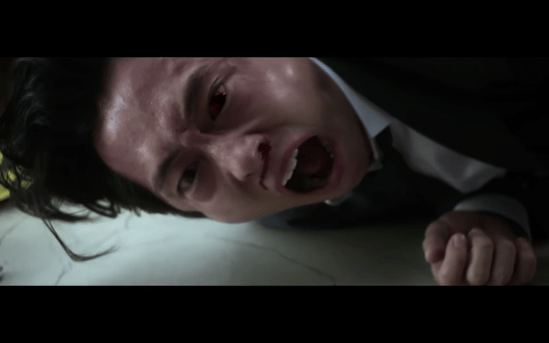
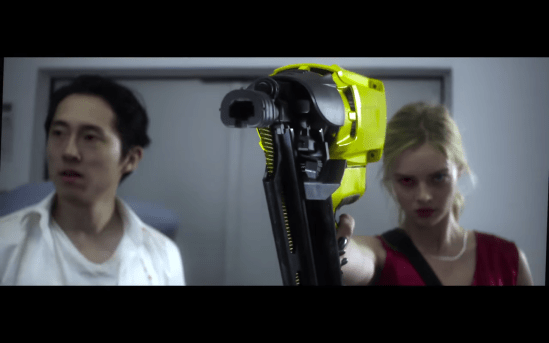
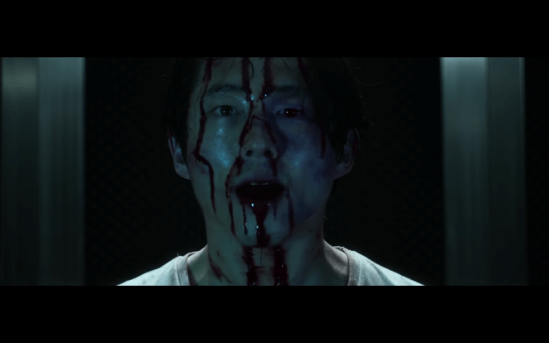
Kebabs Made From Drunken, Evil Patrons! “K-Shop” review!

Zaki owns a small kebab shop in England’s vern own party central in Bournemouth on the South Coast. Every night, Zaki withstands the late night drunken antics of the local party goers in the hope his son, Salah, would continue his graduate studies and to also, maybe, one day own his own fine dining restaurant, but when he becomes involved in a scuffle with a late night rowdy bunch, he’s killed in a fit of alcoholic whims. Salah takes over his father’s shop, neglecting his studies, and continuing the serve the intoxicated public in his father’s memory, but when he accidentally kills one stubborn customer, he mincings his body parts into kebab meat instead of calling the police and whenever a deplorable enter his shop, he serves them the newest menu item. One sloppy drunk customer after another, Salah wages a vigilante’s war on party world, especially toward a new dance club that masks over a drug trafficking ring.

“K-Shop” is the 2016 horror from writer-director Dan Pringle in his first helmed feature that aims to explore the troublesome nature of the after party, intoxicated human plagued upon sensible people. Pringle strengthens the social commentary by implementing actual footage of drunken debauchery filmed right on England’s South Beach that range between spewing chunks onto the sidewalks to heated back and forth fisticuffs. Pringle’s script tackles that insatiable inner urge everyone has felt at least once in their life when dealing with unreasonable nightlife and that is to raise a fist against them to show how to act like a decent human being. “K-Shop,” which denotes being a double entendre for Kebab Shop and Kill Shop, takes the act one step further, introducing a cannibalistic element to the mix as Salah rids scrum from the earth by slicing and dicing them into his kebab mixture. Salah’s father, Zaki, is a Turkish refugee and him and his son are essentially immigrants that becomes another script undertone brought up the club owning, drug trafficking, all over bad guy Jason Brown.

Salah is brilliantly executed by Ziad Abaza who brings a cache of raw emotions to his character. “K-Shop’s” trailer hinted at a horror-comedy feature, but there’s nothing funny about Abaza’s Salah who seems that life is wholeheartedly against him as a downtrodden college student in a search for basic human decency and compassion. Salah is pitted against an egregious Jason Brown played by Liverpool native Scot Williams and Williams embodies and embraces being a person of high social status and fame, a person of who lavishes in luxury, and epitomizes being a slime ball. Brown’s a stark contrast against Salah who has to slave away and earn his living while Brown takes his life for granted. The supporting cast are also very interesting starting with Reece Noi as Malik who voyeuristically takes an interest in Salah’s vigilantism and who also, perhaps, shares common cultural aspects, but Malik is just a kid acting beyond his age at times and then drastically at his age at the most crucial moments during his dynamics with Salah. Another character is Salah’s potential love interest in Sarah portrayed by Kristin Atherton. Atherton provides a sweet, quiet, and intelligible demeanor to Sarah that projects onto Salah whereas other women in Salah’s life, mostly his patrons, are loud, obnoxious, and corrupt. Lastly, “Doomsday’s” Darren Morfitt instills a catalytic character in fallen from grace Chaplin Steve. There’s a bit of a confessionally staged event between Salah and Steve that offers a realization and a tale-end twist that just puts that unwanted pit into the bottom of stomachs.

Now “K-Shop” isn’t totally perfect, especially in the flow of the film. Pringle doesn’t clearly provide a timeline of progression. Between the holidays Christmas and News Years is perspectively prominent, but Salah’s calling, or mission, seems to extend weeks, if not months, and that isn’t clearly communicated. Plus, there’s slight difficulty understanding turn page moments that dilute the significance of events whether it’s through too much exposition or choppy editing. Where “K-Shop” is weak, Pringle makes up with gore and story. The gore is absolute from scorching an inebriated man’s face sizzling in a vat of hot oil to chopping up limbs with a butcher’s knife in order to make his delicious kebabs. Pringle’s conclusion is absolving, satisfying, and also, at the same time, fruitless because even though Salah makes a stand against immorality, a realization washes over him that nothing will ever change despite cutting the head from the snake.

Breaking Glass Pictures distributes “K-Shop” on to an unrated DVD home video. The DVD is presented in a widescreen 2:35:1 aspect ratio and the overall quality is stunning sporting a dark painted picture and still convey a healthy color palette even if lightly washed in a yellow hue. The’s no attempt to enhance the image as the natural color tone comes right out and off the screen and that dark gritty matter really speaks to Pringle’s capabilities to create shadows. The English Dolby Digital 5.1 audio track is surprisingly hanging around par level as, some of those key moments once spoken about, are lost in a muddled heap in the dialogue track, but there’s range and fidelity thats good on the output amongst a balanced five channel track. Bonus material includes a behind-the-scenes segment and deleted scenes plus Breaking Glass trailers. “K-Shop” is dark, gritty, and eye opening backed by a versatile lead in Ziad Abaza and helmed by newcomer filmmaker Dan Pringle, seeking to entertain and unearth our inner and deadly vigilante doppelgänger in the midst of social indecencies.
Take A Stroll Through Evil’s Scream Park! “Talon Falls” review!

While embarking through Kentucky on a camping road trip, four friends make a pit stop at a Kentuckian scream park called Talon Falls, suggested to them by squirrelly and unusual gas station attendant. As they work their way through a labyrinth of gore and torture, the realization that the local attraction harnesses realistic inflictions of pain hits them squarely in the jaw as they become unwilling participants instilled into the hyper-horrific entertainment that’s recorded onto a snuff tape. In order to not be strapped to a jerry-rigged electrocution chair or be the guinea pig for a sadistic mad doctor with a niche for painful exploratory surgery, they must fight the entire company of Talon Falls’ scream park in order to not be a piece of recorded snuff.

“Talon Falls” is the 2017 torture and survival horror named after and shot on location at the real life scream park located in Melber, Kentucky and written, directed, and co-produced by indie filmmaker Joshua Shreve. Shreve’s story tip-toes around being a familiar narrative that might not seem so different from other works ranging from Nimród Antal “Vacancy” to maybe even Rob Zombie’s murder-world fun-n-games “31,” but if you take a step back and take a long, hard look at “Talon Falls'” gore scenes that don’t just secretly record the assortment of death, but exhibits the ghastly torture for the entire public eye to see. If you’ve been to a Halloween Horror theme park, you know very well the adrenaline pumps, the hearts thump, and the fear tops into a knot in your throat and “Talon Falls” simply adds that what if factor. What if it’s not fake? What if these people being dismembered and vilely tortured are ultimately put to death right before our eyes, like some Captain Spaulding backwoods horror show with a side bucket of his famous fried chicken?

In any case, the four friends, made up of two couples, don’t have one ounce of star power behind their name, but each one of them spearhead the project with enough enthusiasm and gusto that there’s no short fall of trepidation even if the level of fear stalls slightly on overkill at times. Brad Bell, Jordyn Rudolph, Sean Rudolph, and Morgan Wiggins don’t necessary have the on-screen chemistry as friends or couples, even if Sean and Jordyn Rudolph are an offscreen husband and wife, but the palpitating consternation dynamic solidly sells when all hell breaks loose inside the walls of Talon Falls. Between Jordyn Rudolph and Morgan Wiggins, either actress could be a vocal stretching scream queen, especially Wiggins who reaches ranges that could pierce eardrums.

When the spectrum-filled makeup palettes and every single destructive deconstruction prop is laid out at your finger tips, the special effects comes as second nature and to introduce a high level of design detail to the already elaborate set, inside a really monstrous horror park, then “Talon Falls” without a doubt will walk, talk, and look like a top-notch horror film. However, not all aspects are perfect with the Shreve film, produced by Kent Hammond and Todd Ferren, as the story progression with the characters becomes minimized that result in haphazard camaraderie between the friends who are more turnstile acquaintances than lustful lovers or deep-rooted long time friends. Also, characters make hot-headed or stupid-minded questionable decisions when in hot pursuit of an axe-wielding, piggy-masked killer and the scribing of the irresponsible decisions when safely stowed away when being pursued, roots out Shreve’s inexperience in a time of a building block career.

MVDVisual and Lost Empire present “Talon Falls,” the Terror Films and Flashback Pictures production, onto DVD home entertainment in a widescreen 2.35:1 that atheistically gritty in the detail. Even the darker scenes, with well established and positioned shadowing, bring substantial substance to liven up and level up this independent feature from Kentucky. The 5.1 surround sound track has stable range through and through with a caustic toned score to convey terror and a clear and prominent dialogue track that doesn’t muddle through a surplus of ambient tracks. Bonus material include a behind-the-scenes featurette that runs through a randomizer of footage markers and some bloopers. A theatrical trailer is also included. Josh Shreve can only get better from his Sophomore film as a director whose hot off his solid genre entry in “Talon Falls” with the aid of the scream park’s unlimited horror resources and though popping with toe-nail pulling moments, the extremely short runtime of 75 minutes suggests a stiffened premise with undercooked character development that diminish that high production value and bloody effects.