EVIL Relaxes in the Serenity of a “Full Body Massage” reviewed! (Unearthed Films / Blu-ray)

Lube Up and Get Ready for “Full Body Massage” on Blu-ray!

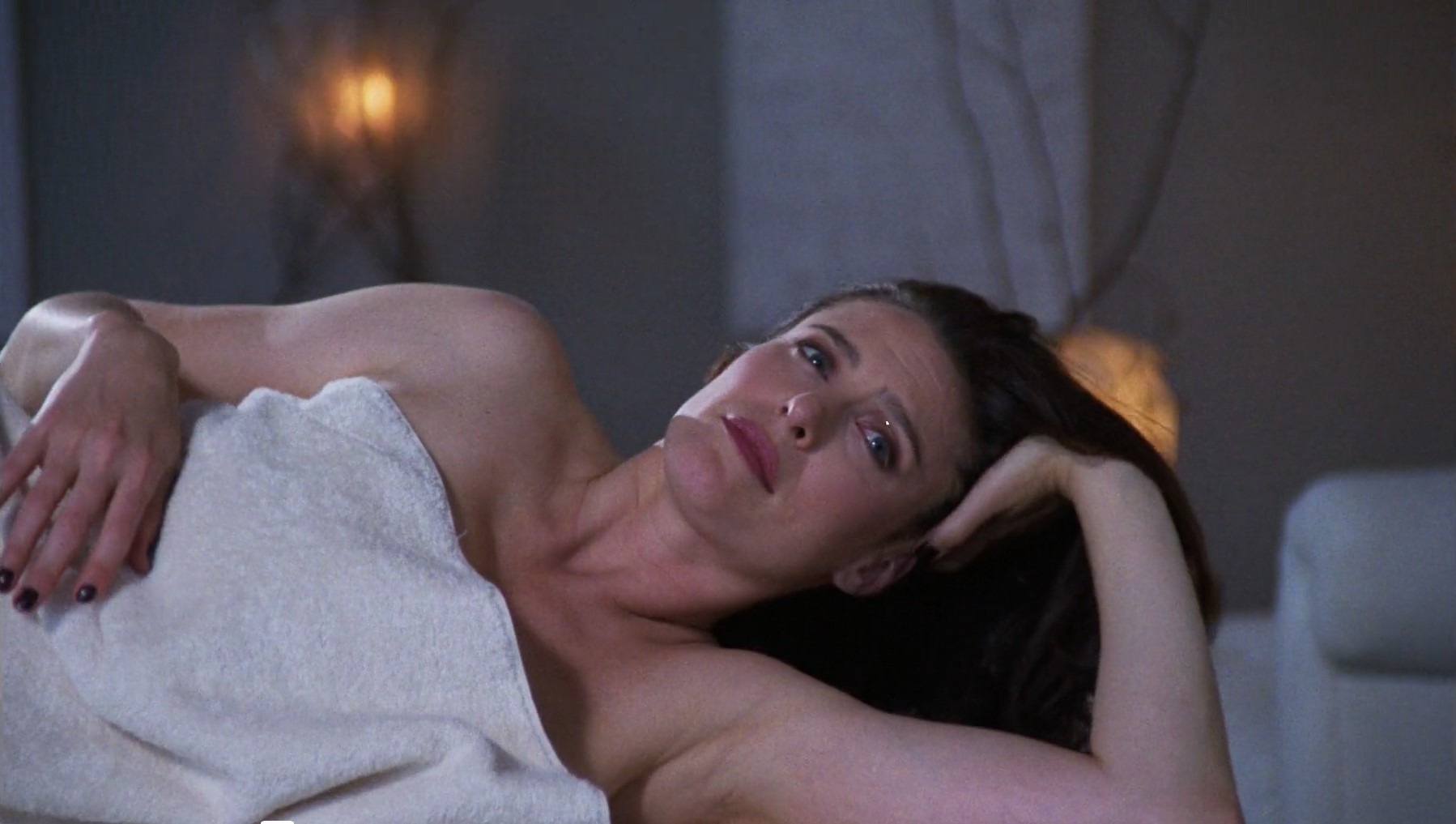
Nina, a middle-aged affluent art dealer, has just returned from a long business trip.  Settling back down into her own nature morte decked home, Nina pampers herself with a hot shower, a glass of wine, elegant music, and a soak in her open aired, backyard hot tub as she relaxes before for her masseur, Doug, a handsome young man she finds herself comfortably attracted to outside their professional relationship, arrives to put his oiled up hands up and down her naked body but when Fitch arrives, Doug’s more seasoned stand-in, Nina finds herself blindsided by the change and slightly disappointed in her sudden erotic deflation.  Fitch’s worldly approach to life conflicts against Nina’s narrow perspective on various topics, including art, happiness, and love.  Willing to be fully open with each other during the intimate and unorthodox massage, Nina and Fitch debate deep into their session without holding anything back with flashbacks on their experiences that led them to this very moment of unexpected connection.

Director Nicholas Roeg, the late acclaimed English director, is known for his in-depth humanizing of flawed or downcast protagonists, often times surrounded by desire and obstacles, having helmed such renowned features as “Walkabout,” “Bad Timing,” and “The Man Who Fell From Earth.”  Roeg has also dipped his directional toes in horror with films like “Don’t Look Now” and “The Witches,” running the gamut between adult and children thrills.  Later in his career, Roeg slowly moved away from theatrical features and into the realm of television, shorts, and TV movies with one of those made-for-TV films being “Full Body Massage” for the premium cable network Showtime.  Penned by “The Stranger’s” Dan Gurskis, “Full Body Massage” trades in a problematic mystery or obstacle for more of the unravelling of philosophical viewpoints of two strangers wounded in their own obvious way only to have the air purified each other’s different life paths and mere presence of mind.  The 1995 released U.S. network movie is produced by erotic thriller operators Julie Ahlberg and Michael Nolin of “The Pornorgrapher” under the LLC of Full Body Productions and Showtime.

Though a made-for-television movie likely marketed for and airing as a late night skin flick for the premium network channel in the cable box era of the 1990s, “Full Body Massage” was anything but your ordinary after dark tits up production with two well-known stars substantially casted and not just for the headline attraction.  “Ginger Snaps” and “Hider in the House” American actress Mimi Rogers is joined by Australian star and “F/X” leading man Bryan Brown who undertake the respective roles of world-weary Nina and worldly-candid Fitch.  While “Full Body Massage” has the hallmarks of softcore programming, an titillating title, sexy sax soothing tones, and a very naked Mimi Rogers, the machinating devices have more bark than bite as Rogers and Brown never engage into sexual intimacy albeit a lot of sensual massage manhandling by Fitch on Nina’s more than happy to be naked body with a stranger she just met.  The two mainstays are pundits for the story, verbally expelling their own viewpoints and experiences that have shaped their choices in life, molding them to who they are, and nearing the edge of gospel when in rhetoric with each other.  Their conspicuous dispute is nearly all narratively all consuming but not as nearly all argumentative in it’s very adult approach to discussion of just two people seeing the world through two very different eyes.   Other characters are told through mostly flashbacks and never interact in the same aortic piece with Rogers and Brown with Christopher Burgard (“Syngenor”), Elizabeth Barondes (“Night of the Scarecrow”), Gareth Williams (“Striking Distance”), Patrick Neil Quinn (“Swamp Thing” television series), Heather Gunn (“Ed Gein”), and Gabriella Hall (“The Erotic Adventures of the Invisible Man”) and Brian McLane playing younger versions of Nina and Fitch. 

“Full Body Massage” is not an intense, edge-of-your-seat nail biter bursting with action and suspense.  In fact, I struggle with film’s point and overall message to the world in what in essence boils down to a character study.  Fitch’s disapproving father no matter how perfection Fitch achieved, Nina’s continuous search for approvals in love, Fitch’s losing love that sends him on a spiritual journey, and Nina’s failed marriages between fast-and-loose husbands and hard to connect with ones make the two underlyingly wounded adults rigid and confidence in that unyielding measure until they meet each other and experience pliability out of a long-winded dialogue in not only a face-to-face manner, but also in the healing power of touch and massage that’s feels erotic per Roeg’s direction but also works out every kink in their twisted, knotted pasts to where they end in an uncertain but good place, a place they’ve never been before or have long forgotten.  By the course of two people talking, which most the world does every day, there had to be buzzier bright light to attract swarming audiences to the premium cable network’s thirst for viewership and that would be Mimi Rogers going nearly full-frontal for nearly the entire runtime and Roeg really plays into that erotic prance of unabashed confidence and comfortability while also, contrariwise, the dynamic progresses platonically. 

A newly scanned 2K transfer of 1995 film comes from an unlikely boutique distributor known mainly for extreme horror, gore and shock, and controversial material. Unearthed Films proudly presents “Full Body Massage” on Blu-ray as title lucky number 13 on their Unearthed Classics label. The AVC encoded, high-definition 1080p, BD50 exhibits cable vision veneer in a television widescreen 1.66:1 aspect ratio. Roeg’s choice to go virtually without style really hinges on the substance for success. The natural approach consumes any low-lit or candle-lit warm interiors exclusively for flashback sequences. The 35 mm print has been cared for and it shows with pristine HD transfer that keeps the natural grain and doesn’t need to really sugarcoat any sour patches. The English lossless PCM 2.0 stereo mix offers exact fidelity of the original discourse and milieu ambience of an innate digital sound capture. With the dialogue heavy story, the discourse is clean, clear, and prominent, comprehensible in every which way. Depth provides expansion and echo inside Nina’s vastly roomy mansion, but range is limited to talking and not the sensual, sexy, arousing kind. English subtitles and SDH subtitles are available on this release. Special features include the television version presented in 1.33:1 aspect ratio, a minute still image gallery that’s mostly Bryan Brown behind Mimi Rogers giving her the massage, and the original trailer. While not a great selection of bonus content, the physical exterior succeeds slightly favorable with a cardboard O-slipcover with flat, yet beautiful, illustration of, again, Bryan Brown and Mimi Rogers in massage therapy that could be misleading as sensuality. The Amaray Blu-ray cover sports the same image on the cover art and even compressed even further on the disc art. The Blu-ray is rated R, locked in region A playback, and has a runtime of 93 minutes. I’m not going to try and kid you with what is and will be “Full Body Massage’s” immediate appeal, a very well-endowed and nude Mimi Rogers, but this anomalous Unearthed Classic brings a different highbrow criterion class to the extreme horror label in what is a brazen change of pace. 

Lube Up and Get Ready for “Full Body Massage” on Blu-ray!

Playboy Discovers Vengeful EVIL’s Hidden BDSM Room A Little Too Snug. “Emanuelle’s Revenge” reviewed! (Cinephobia Releasing / DVD)

Emanuelle’s Revenge now on DVD from Cinephobia Releasing!

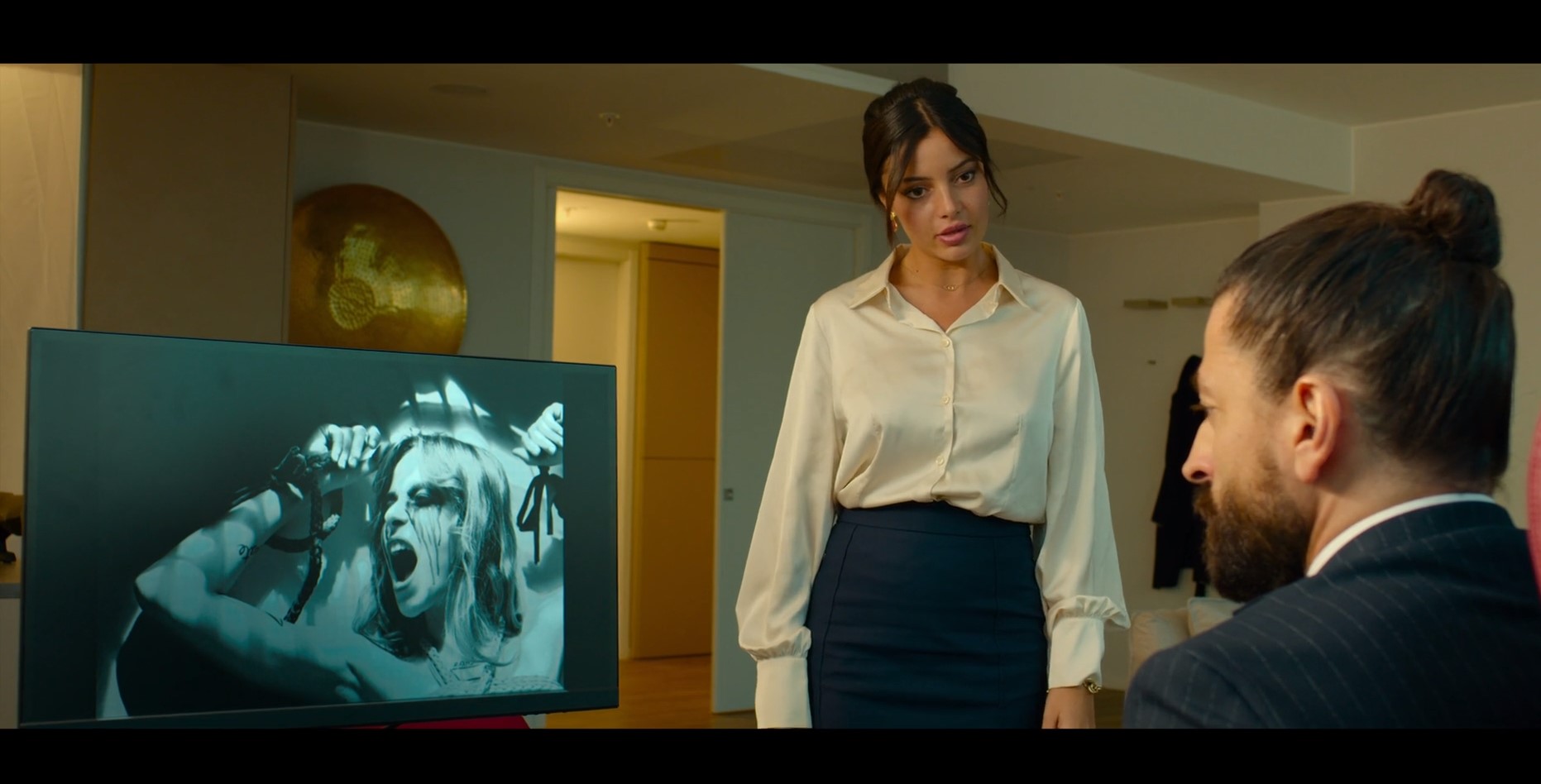
A wealthy businessman philanders his way through woman in a pursuit of satisfactory conquest.  The formidable challenge of bedding a hard-to-get woman arouses him and the chase is all that more thrilling and erotic.  His persistence and perfect man act pays off with up-and-coming model Francesca, but for the playboy, Francesca becomes another notch in his belt and quickly implodes Francesca’s romanticized relationship after a sexual tryst in the public eye.  A year later, he begins his surmounting quest again with Emanuelle, a renowned writer in a lesbian relationship.  The beautiful and darkly seductive woman catches his eye and the game begins as he uses every excuse to rendezvous with her despite the Emanuelle’s partner standoffish opposition, but as his tenacity appears to be paying off as she leads him on, awarding his constant charm with favorable kittenish returns, Emanuelle is actually leading him straight into the jaws of a deceitful plan.

Italian co-directors Monica Carpanese and Dario Germani are copiously inspired by the heyday of Italian Eurotrash cinema.  The actress-turned-debut director Carpanese has starred in a handful of erotic and horror thrillers of the prolific trashy filmmaker Bruno Mattei, such as “Dangerous Attraction” and “Madness,” while also having a principal performance in the 2022 sequel to Joe D’Amato’s notorious cannibalism film “Anthropophagus.  Her colleague Dario Germani is also the cinematographer for the spaced-out follow-up as well as establishing himself in the genre not as a filmmaker behind the lens but also a director with genre films under the belt with “Anthropophagus II,” a dissimilar lover’s anguish in “Lettera H,” and a snuff-slasher “The Slaughter.”  Carpanese and Germani’s next collaborating venture continues with another D’Amato influence mixed with the popular erotic series, and its tangent spinoffs, of Just Jaeckin’s “Emmanuelle” that has official and unofficial sequels spanning all through Europe with enticingly, titillating erotic stimuli and thrills.  Their explicit explication of the near 50-year-old sexy-laced franchise comes in the form of “Emanuelle’s Revenge.”  Dropping the second “m” along with the choice of similar story and title moves the film closer to being a remake of the Joe D’Amato “Emanuelle and Francoise,” aka “Emanuelle e Francoise” or “Emanuelle’s Revenge.”  Carpanese pens the Marco Gaudenzi and Pierpaolo Marcelli produced script under the production flags of Flat Parioli, Haley Pictures, and TNM Productions. 

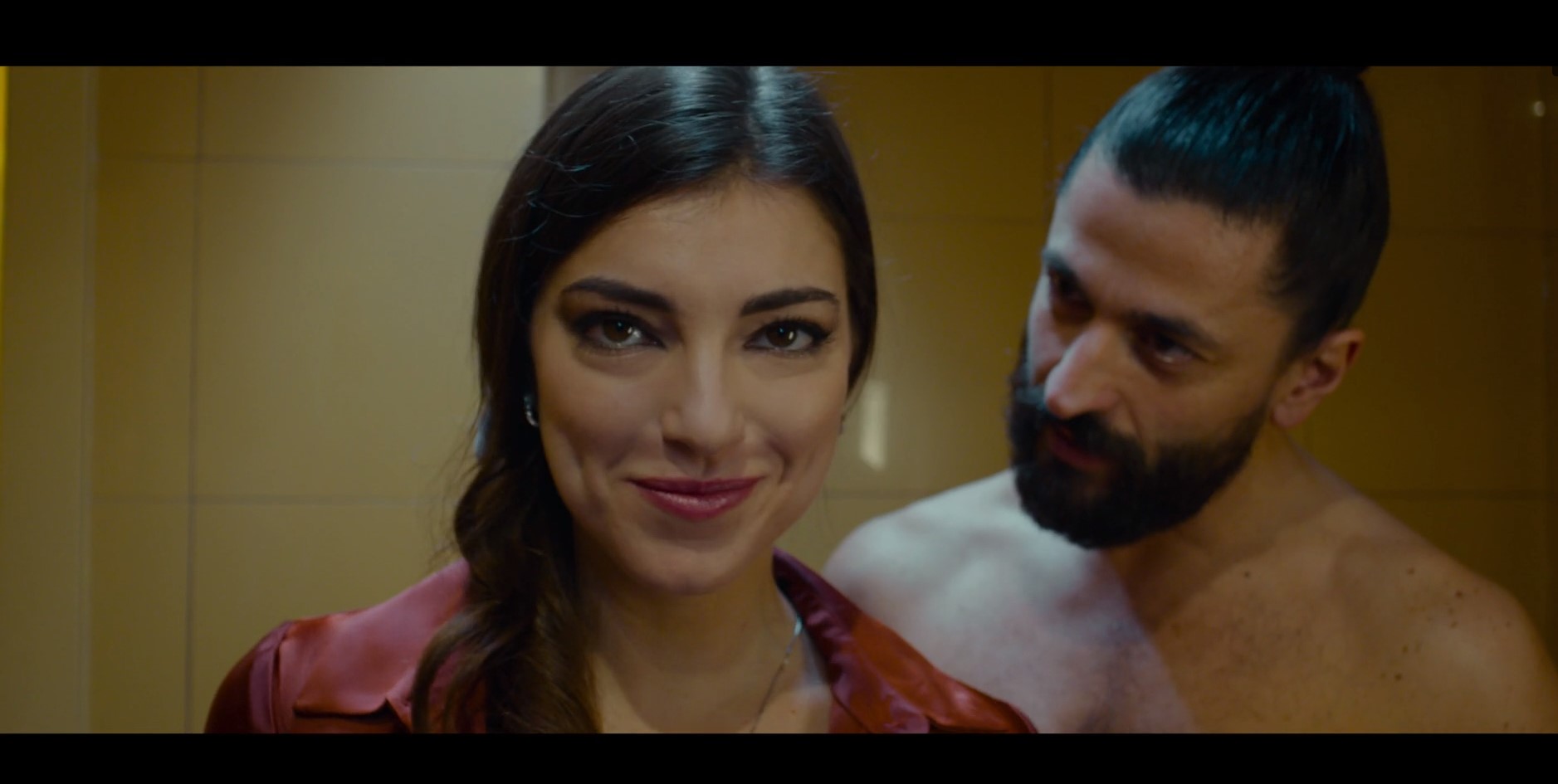
“Emanuelle’s Revenge” is carried by a small, four-person principal cast and half that for peripheral players within a dual-timeline story that provides the same cat-and-mouse game but with different, yet shocking outcomes on both of them.  At the tip of the spear is playboy Leonardo played by Gianni Rosato.  Sporting his best bandholz beard and pony bun, Rosato’s aggressive entrepreneurship extends beyond the working stiff hours and into the extracurricular activities of hunting down and dominating the opposite sex to sate his kicks for kink.  As the primary principal, Rosata receives the screen time that digs further into Leonardo’s psyche and what’s revealed about Leonardo’s nature is obvious trouble with an aggressive flirtation to the point where his whole game is akin to a stalker, showing up unannounced where he knows his targeted woman will be, obtaining their property that he has no right to, and essentially sucking their face with really bellicose kisses that look like they hurt.  Okay, maybe the latter is more overzealousness on Rosata’s part but certainly adds to Leonardo’s alarming behavior to which women seem to be attracted to as if giving into the idea that women prefer bad boys.  Such as the case in the first narrative with Francesca, a promising model with a now sex-relationship smart attitude after a previous relationship went terribly wrong with revenge porn.  Played by Ilaria Loriga in her own credited role, the young actress isn’t quite the epitome of innocence but is understandably weary to fall in love again with the persistent Leonardo but with all the foretell warnings of a disaster in the making, Francesca’s penned as sorely naïve and having learned not one single lesson of her past relationship with promiscuous men.  A year later, in the second act’s story, Emanuelle strolls into the picture under the olive-skin and deep eyebrows of Beatric Schiaffino who bats enticing eyes of the titular character’s hidden agenda. Schiaffino’s crafts a demeaner starkly different against her previous year counterpart as Emanuelle’s coquettishness doesn’t refrain from the fact she’s already in a hot-and-heavy relationship and matching Leonardo’s hot-to-trot escapade with a come-hither that’s just out of his reach. If a rake beckons a game of amorous desire, then Emanuelle enacts a game of her own, one of a lure to lead the blind right into her spider’s web and Schiaffino properly tightropes pleasure and purpose to a somatosensory stimulation level. “Emanuelle’s Revenge” rounds out with Luca Avallone as Leonardo’s licentious friend and business understudy, Ilde Mauri as Emanuelle’s lesbian partner, and Miriam Dossena as Leonardo’s 20-something daughter who suddenly pops into play in the Emanuelle story.

Even though “Emanuelle and Francoise” has never traipsed across my eyes, from what I’ve read the Joe D’Amato and the coproduction of Monica Carpanese and Dario Germani share a lot in common, but the modern-day version of this sordid tale of lust and revenge sticks to the venereal veneer only whereas D’Amato engages a cannibalism and other ghastly horrors. “Emanuelle’s Revenge” seduces with melodramatics, frisky fantasies, and contemptible thralldom because of one man’s wandering libido, focusing tremendously on the building game of mostly pavalar rather than diving into shock value. The narrative begins with a suicide of Francesca, jumping half nude off a busy passenger vehicle bridge, and this segues into Leonardo’s assertive activity into Francesca’s life and so the tale’s non-linear format is already incredulously fated with tossed in opening scene just to grab attention. When following Leonardo’s uncomfortable pursuit, and uncomfortable henpeck kissing, of Francesca, the audience is just along for the ride up to the point of incident where they’re abruptly blue-balled by cut-to a year later without knowing why Francesca decided to throw in her life towel. The brain and our movie-watching experience eventually catchup with the fact everything will be explained at the climatic, but the format jars the assimilating process a tad. Throughout the narrative, there’s plenty of a T&A to go around as I believe nearly every actress with speaking lines drops at least her top, living up to the long history of “Emmanuelle’s,” or “Emanuelle’s” fleshy affluence and erotic elements. Considering the plot twist, Carpanese’s approach doesn’t compel any creativity into the mostly remade erotic-revenger and makes contact with formulaic properties that poison any kind of novel ideas that might have been indited in the inner story layers.

Arriving at number 8 on the spine for Cinephobia Releasing, “Emanuelle’s Revenge” is now on DVD, presented in a widescreen 2.35:1 aspect ratio. The MPEG-2 encoded DVD9 has a sleek look albeit tumbling through a bitrate spread of 5 to 7 Mbps. Some surface coloring suffuse, especially on skin where similar tones seep into the adjacent due to block boundary artifact, but the amount is very little and doesn’t sully much to render the picture an admixed wash in the lion’s share of soft lighting. Details are okay here with the stunning urban landscapes and more opened metropolitan venues, such as a rooftop party, opening up audiences to the chic levels of high society’s profanation of control and sex. The release offers two Italian language audio tracks: A Dolby Digital 5.1 surround and a 2.0 stereo. If asked, I would suggest less channels as they are redundant and useless and go for the 2.0 stereo as there’s not much frequential range in what is essentially a talking head film with an exposition driven narrative. Dialogue is clearly and cleanly stated overtop other audio layers with a powerfully boosted stock file soundtrack in parallel unison to the theatrics. English subtitles are optionally available and the error-free translations keep up with dialogue pacing. Only other Cinephobia Releasing film trailers, including “Brightwood,” “The Goldsmith,” “The Human Trap,” and “Amor Bandido,” are available bonus content. The black background front cover delineates deliciously Beatric Schiaffino as the titular Emanuelle sitting open robed, in thigh-high laced stockings, and on her wicker chair throne. This image reminds me of a mistake in this revealing scene with the very first image of Emanuelle sitting in the oversized back chair resembling closely the front cover image, but the subsequent scenes have her once flesh exposed chest to midriff covered up with censurable continuity. Inside the DVD Amary case lie no insert and the same provocative front cover Emanuelle image more centrally cropped down and blow up to emphasize the seductive siren. The not rated, 83-minute feature is limited to a region one playback. “Emanuelle’s Revenge” spices up the contemporary franchise with erotic entails, exorbitant egos, and illicit indecencies despite its sacrificing of pacing and organization for sleaze, skin, and a side dish of kink.


Emanuelle’s Revenge now on DVD from Cinephobia Releasing!

A Teacher’s Raunchy Romance is Not the Only EVIL Being Committed! “Amor Bandido” reviewed! (Cinephobia Releasing / DVD)

Forbidden Love and Severe Malefactions in “Amor Bandido” on DVD July 18th!

A remiss 16-year-old Joan is the son of a wealthy magistrate who doesn’t see eye-to-eye with his father’s wishes.  What was supposed to be the last day of school before Easter break turns into Joan’s most anxious day when he learns that his mistress, his teacher Luciana, is exiting her position at the school that very day.  Pleading to Luciana to take him with her, she reluctantly accepts his tagalong despite him being underage and her being more than double his age.  Their unlawful affair leads them to an isolated manor where they can romantically explore themselves in a paramour tour of passion.  A couple of days have past and Joan is completely smitten until Luciana’s brother arrives and the whole getaway has been a trick at Joan’s expense.  Now, the adolescent is being held captive and has to fight for his very life before he’s executed for being nothing more than a wealthy judge’s son and a naïve, jilted lover. 

More by more, news stories are printed of older women, specifically women in education, having intimate relations with a young, student boy – sometimes, another girl as well.  Men have always been the archetype of the infamously ugly term pedophilia, but women can be just as predatory despite the lack of widespread printed and televised attention.  Mostly, these new bites are mostly obscured in the newsfeed of an online aggregated newsreel, hyper-regionalized to the area where the crime was committed, but the story is nearly always the same – young (often good-looking) 20-30 year old teacher abuses young, under 18-year-old boy in the car, at her home, via text with lewd pictures, etc.  Honestly, boys have long been hot for teachers, but there is an inherent sliminess to the idea that has been rooted in steamy fantasy pubescent minds.  Iconic films like 1967 Mike Nichols’s “The Graduate” starring Dustin Hoffman aroused the notion of forbidden lust while others like George Bower’s 1983 “My Tutor” and even the more recent “No Hard Feelings” with Jennifer Lawrence, to an extent, makes light of the subject matter; however, no other filmmaker really captures the act’s grooming nature like director Daniel Werner.  Werner’s “Amor Bandido,” or “Bandit Love” depicts minor exploitation like never before with fellow screenwriter Diego Avalos in their feature film together after the production of their 2019 short, another contentious teacher-student relationship, entitled “Nadador.”  The Argentinian film is a co-production of The National Institute of Cinema and Audiovisual Arts (INCAA) and Werner Cine, produced by Werner and Nicolás Batlle.

The film opens up to Joan, a 16-year-old student with a bit of a chip on his shoulder as he glues together a volcano-like model in slapdash fashion.  Spoiled further into his innate teenage angst by his own abundance of wealth, Joan is able to get away with essentially disrespecting his empty-threatening father and boozy mother.  The extent of his entitlement spills into the classroom when learns his teacher, Ms. Luciana, is leaving the school at the end of the day and this is where we learn that Luciana and Joan have been in a forbidden affair as they meet in a storage room where she caresses his crotch as they kiss.  Though looking very much like a 16-year-old brat, Renato Quattordio is actually in his early 20s when the Buenos Aires born actor becomes passionately intertwined on screen with early 40’s actress, Romina Ricci.  The noticeable age difference places a stamp of scuzzy approval as the principals really put on a show of sensuality that defies the numerical age gap while also defining the maturity and the experience of individuals.  Quattordio hits the mark as the naïve teen eager to jump at the behest of his older, curvaceous companion.  And, boy, is Romina Ricci curvaceous, luring Joan in as the wanton teacher cautious of their alluring affair.  The erotic thriller quickly turns into a survival thriller when Joan’s eagerness to grow up comes face-to-face with Luciana’s past, embodied by Rafael Ferro (“Terror 5,” “White Coffin”) and Sergio Prina as two money greedy thugs eager to milk Joan for all that he is worth.  “Amor Bandido” rounds out with a few more bandidos in Mónica Gonzaga, Carlos Mena, Jurge Prado, and Santigao Stieben.

“Amor Bandido” is a coming-of-age tale with a pair of dichotomizing facades strung together by opposing forces in choosing between love or money.  Essentially, those two driving forces boil down to the relationship’s core and that is what director Daniel Werner simmers on, a test of idolatry strength between two people.  Werner pretenses the narrative with a forbidden love escaping to the rurality to make passionate, unjudged lust in a love context, well, at least for one of them.  The absconding is only a diversion for another unlawful act and is palpable in the undertone that something isn’t quite right with Joan and Luciana’s relationship, something that you can’t quite put your finger on and it’s not the surface fact that she’s a mid-30 something-year-old teacher screwing her 16-year-old student.  Werner leaves a breadcrumb trail of concerning clues that make sense when all is exposed but keeps those hints closed to the chest, protected to not giveaway too much until the summiting turning point of the exiting passion and entering perpetration.  Yet, despite our intuitive inklings of the funky air, the pivot still hits hard like a blindsided punch to the jaw that dislodges the mandible and rattles the teeth when the two lovebirds are struck with one payday load.  The only aspect that could be narratively tweaked is the introduction of the wounded stranger whose motives are understood but not quite absolutely clear his connections and how he became wounded in the first place with a gnarly gash on the calf that looks like a Great White shark attack had a snack on.  Digressing to figure out where he fits into it all becomes a distraction and a divergence from the main story that has now snowballed into additional but unwanted molestation, possible incest, and a ransom deal that won’t be faithfully upheld. 

“Amor Bandido” is the first feature to be covered by us courteously supplied by our friends as Cinephobia Releasing, a new distribution label from original world-searching and independent cult worshipping cinephiles of Artsploitation Films.  Coming soon to home video on July 18th, the single-layer DVD is presented in a widescreen 1.85:1 aspect ratio from a digitally recorded print and renders an expected damage and dust/dirt free picture with nature, yet smoothed out detail, skin tones and natural coloring.  There’s not a ton of visual risk here from cinematographer Manuel Rebella (“A Taste of Blood”) with the stimulation coming strictly from performances and the erotic, forbidden spirit.  The DVD5 format falls below par for darker portions within the frame that are seen with splotchy banding as well as the aforementioned smoothness around facial features.  The Spanish Dolby Digital 5.1 surround sound and a Spanish Dolby Digital 2.0 are equally comparable with the focus primarily on the dialogue and less on the sound design to warrant extra channels so both tracks output relatively the same.  There are scenes or sequences all other tracks are muted or receded to make way for a vivacious musical soundtrack to accentuate the moment.  Dialogue comes across clean and clear without any interference in the balance of the little ambience of rustling leaves, water splashing, and gun shots.  Option English subtitles are available, but I did spot a pair of typographical errors.  Bonus features include a 3-minute sale and promotional make-of with director Daniel Werner, the original trailer – separated from the bonus features on the static menu – and trailers for future Cinephobia Releasing films, such as “Sublime,” “Emmanuelle’s Revenge,” “Brightwood,” “The Latent Image,” and “The Goldsmith.”   Pressed with the cropped but same image as the front cover, the DVD comes in a standard tall snapper with the front cover sporting that crotch-fondling moment of intimacy.  The Cinephobia Releasing title comes unrated, runs at 80 minutes, and is has region 1 playback.  The coming-of-age arc prevalently scores into the naïve, angsty adolescent tale but “Amor Bandido” also suggests that maybe maturing too quickly should be left off the table, keeping fantastical temptation at bay and keeping innocence intact for kids to be kids just a few years more.

Forbidden Love and Severe Malefactions in “Amor Bandido” on DVD July 18th!

Being Bored at Home Turns into an EVIL Enterprise! “Moonlighting Wives” reviewed! (Dark Force / Blu-ray)

They’re Housewives.  They’re bored.  They’re…”Moonlighting Wives.”  Now Available at Amazon.com!

Unsatisfied with her distressed husband’s meager wage as a third shift switchboard operator, Joan Rand strikes up a new Stenography business to bring in a little extra cash for the household.  When her new boss makes salacious advances toward her, she explores the opportunity of making more money than just on a stenographer’s wage.  Roping in her only contracted typist, Joan begins to bring in beautiful, bored housewives seeking to earn dough no matter how sexually scandalous and instead of perfecting their short hand skills or their ability to read back letters aloud without error, the determined entrepreneur revamps her stenographic business as a front for perfecting prostitution.  Infiltrating her way into every bar, hotel, and country club, even partnering with the country club’s golf pro, Joan’s call girl ring rides a profitable high and expands into new men-oriented territories but how long can the lucrative venture last when two vice cops are inching to bring down the elusive ring and one of her girls become scorned by the affectional eyes of love. 

Sexploitation has come a long way since 1966 when director Joe Sarno helmed the scene-efficient and bored housewife subversion “Moonlighting Wives.”  Before embarking full-fledged into the adult industry, Sarno blazed the trail for the economically friendly dicey skin flicks of the 1960s through the 1970s, retrospectively finding a cult base amongst observers and academics of subversive cinema and underground exploitation. “Bad Girls for Boys” producer Robert M. Moscow serves as associate producer on the Morgan Picture Corporation production, founded by George J. Morgan, producer of “The Thrill Killers” and “The Lemon Grove Kids Meet the Monster.”

Credited as Diane Vivienne, Tammy Latour (“The Naked Fog”) plays the business savvy Mrs. Joan Rand turning her dictation craft as a storefront for a more provocative and promiscuous profession to keep men happy and her pockets plush.   Latour’s a cool and calculating in her performance that makes Mrs. Rand a pragmatic kingpin of her quick-to-success prostitution ring but in doing so with her performance, that is much like everyone else’s in the film denoting a sign of the time period in which the story is constructed, Latour comes off extremely monotone like her large 60’s hairdo houses a little green man at the control of her cerebral center, calling out commands flatly, coldly, and without a slink of emotion behind her absent inflections or thousand yard stares.  Instead, much of the emotion, if any, is produced by her ashamed-driven to alcohol abusing husband and emotionally exploited bored housewife (Gretchen Rudolph, “The Dicktator”) brought to shambles after cheating on her husband and losing her paramour at the same time due to Rand’s scheming into the operational fold to rake in more rakes and cash.  We’re treated to Mr. Rand’s bottoming out as he’s no longer the bread winner and he’s suspicions overwhelm him to drink himself into a stupor.  The emotional pull that the Rand swindled housewife goes through is callously cut deep when her country club lover, Al Jordan (John Aristedes, “My Body Hungers”), becomes in cahoots with Mrs. Rand, taking her own as not only a business partner but a side-by-side lover, and coaxes his former mistress’s desire for him into doing naughty things with other men to keep him out of a deceived lie of debt.  A rollercoaster of fear, doubt, acceptance, and emotional evolution goes to full arc spectrum with the one cog in the machine that ends up breaking down the whole organization into a crumbling heap.  Aforesaid, the other performances don’t stray too far from Tammy Latour’s matter of fact and is more just a sign of the times in which “Moonlighting Wives” is produced, especially on a microbudget as early sexploitation couldn’t break into mainstream or even with welcoming arms in a more accepting niche public as a more right-wing, puritanical society was starting to be on the brink of uninhibited free love model.  “Moonlighting Wives” has a sexploitation friendly cast with June Roberts (“The Pink Pussy:  Where Sin Lives”), Marla Ellis (“Sin in the Suburbs”), Joe Santos (“Flesh and Lace”), and George Winship (“Teenage Gang Debs”).

How does a racy U.S. cinematic story beat the odds of staying out from the sleazy cinemas, like the sheltered exterior and tacky carpeted 42nd Street of the 1980s, and from being blackballed from the blue balled public looking for a little titillating release?  Innuendo in film became a thing of the past once the film boards ruled film nudity was no longer to be considered obscene a few years before 1960 and this opened up an opportunity for filmmakers to tap into the salacious half of the American population, experimenting with primal carnalities depictions that burrowed into the deepest of desires.  Since financing was scarce as the newly appointed sexploitation genre was too much of a risk for return, movies like “Moonlighting Wives” were made for next to nothing and director Joe Sarno quickly became quickly an expert in churning out licentious cinema commodities on a dime at the turn of the decade.  Having completed moderately successful films of this nature with “Warm Nights and Hot Pleasures” and “Pandora and the Magic Box,” Sarno built a rapport with actors and actresses who would return film-after-film.  John Aristedes, Joe Santos, June Roberts, and Tammy Latour, to name drop a few, regularly frequented Sarno’s casting call – and, hopefully, not his casting couch. Much like the rest of the lot, “Moonlighting Wives” serves as a lesson learned, a steep cost if you will, when morals mingle with perversity and blur the lines of right and wrong.  However, these types of films didn’t come tense action either, or rather much of any type of action because of it’s hand-to-mouth (or in related terms – any orifice to mouth) leanness in funds.  Sarno masters the exposition scene with what I like to label as high school sexual education discourse in where talking heads explain in detail every single action and do it in a tone that’s somewhere between mundane and deadpan.  Objectively, “Moonlighting Wives” is a cold-hard look at cause-and-effect with the loosening of standards jeopardizing what’s most dear to you after the deed is done. 

As a 2k restoration from the uncensored 35mm original negative, “Moonlighting Waves” has been paradoxically upgraded by adding back in original content that initially hit by censors with the lost nude scenes, a summation of 5 minutes’ worth of film, has be reclaimed for the Dark Force Entertainment Blu-ray release.  Yet, Dark Force’s release also competes with a Sarno double feature in “The Naked Fog” from Film Movement that was coincides with a similar market date.  Unfortunately, we’ve yet to land our hands on the Film Movement version to compare.  The Dark Force Blu-ray is AVC encoded with high definition 1080p resolution and presented in the letterboxed 1.33:1 aspect ratio. Back cover lists the ratio at 1.33:1 but also list an anamorphic widescreen and while I concur with the anamorphic lens, the presentation is firmly in a square box of 1.33:1.  Prefaced with a black title card warning regarding the additional image quality, more than just the additional footage has weathered under the test time to sometimes appearing more yellowish and with vertical scratch lines and speckled dust. For the most part, the overall image presentation makes the grade with an unimposing, yet steady color grading and most of the frames free from visual blights. If there were any digital enhancements done during the restoration, DNR appears to be the present culprit as facial features often appear too smooth for 35mm stock that should be developed with a fine layer of grain. The English 1.0 audio mix furnishes the appropriate single channel output for an exposition heavy feature. Distinct sound relativity is shot and the Stan Free score is lounge music 101 with rhythmic snare and hi-hat raps but the dialogue fairs rather strongly with forefront, clean, and clear conversing. Film historian Michael Bowen bookends a pair of included special features with an audio commentary track and an on-webcam interview discussing Sarno’s life coursing the newfound sexploitation genre pre his adult industry tenure. Also included is a deleted nude scene that involves no familiar actors from the trunk narrative in a seemingly out of place couple swap of the topless kind. I’m a little taken aback by the loss of some of the special features that were a part of the Alternative Cinema DVD release that are not present here on the Blu-ray, such as the Joe Sarno interview before his death. What’s neat about the physical features of the Dark Force release, aside from the clear Blu-ray snapper, is the retrograded, stark yellow and black, low-key cover art that builds up the hype with exclamational points about how obscene “Moonlighting Wives” is and not recommended it for the modestly shy and most prude moviegoers. The bold marketing attempt really perks up interesting in checking out the title that ultimately finishes with antiquated impressions, but the idea is neat, and the word heavy front cover is very representational of the exposition drenched dialogue in the narrative. Disc art is pressed with a wanted ad for young attractive women, which is also a nice touch. the region free release comes not rated and has a runtime of 86 minutes. Without a doubt scandalous in any decade, “Moonlighting Wives” encapsulates the seedlings of sexploitation with Joe Sarno at the helm of cultivating ripe, round melons out of barely any dirt and succeeding with a lust-heavy pursuit under a profession that now, ironically enough, only exists mainly in law-abiding courtrooms.

They’re Housewives.  They’re bored.  They’re…”Moonlighting Wives.”  Now Available at Amazon.com!

Never Weekend on Sadomasochists’ EVIL Private Island Alone! “Eugenie” (Blue Underground / 4K UHD and Blu-ray)

“Eugenie” is Waiting to Tell You Her Story of Perversion!  See It Now on 4K UHD at Amazon.com

A wealthy, sexually sadistic Madame St. Ange, a specialist in the Marquis de Sade’s teachings, entices to coerce the father of a young and beautiful innocent girl, Eugenie, St. Ange befriends to permit the naïve teenager to visit Madame’s private island for the weekend.  Excited and overjoyed with the idea of feeling like an adult indulging in mature activities, Eugenie is unaware that Madame and her equally as cruel stepbrother and lover Mirvel, who has been beguiled by Eugenie’s beauty, have ulterior motives and lured the unsuspecting youth into a ritualistic trap of sexual corruption and sadomasochism.  The step-siblings drug and rape Eugenie for their unspeakable gratifications only for her to awake in what only be explained as horrible nightmares of phantasmagorical encounters but when the nightmares unveil a disturbing reality when the dogmatic Dolmance and the rest of his Marquis de Sade acolytes arrive to initiate Eugenie into more than just pain and pleasure educations but to be a pawn in a murder scheme that tears the very fabric of virtue. 

Spanish director Jesús Franco, or widely known as Jess Franco, helmed an excessive number of provocative-pushing films over his nearly 60-year-career as a filmmaker before his death in 2013.  Many of the once labeled video nasties director were crafted on a tight budget with an even more so tight timeline as Franco churned out regularly mostly trashy horror and sexploitation that would more than often wind up in the projection booth of local red light district theaters for a dime and a wank.  Yet, “Eugenie” strokes a different kind sensation, one that lies in the ethereal concept of sexploitation and the ruin of youth made to order by the Marquis de Sade himself and artfully stitched by Jess Franco’s profundo knowledge of cinematic sculpturing.  “Eugenie,” or “Eugenie…. The Story of her Journey into Perversion” in the extended title, is based off the French 1795 novel, La Philosophie dans le boudoir (Philosophy in the Bedroom) written by de Sade and the script adaptation is penned by “99 Women” and “Christina” screenwriter and profound producer of film, Harry Alan Towers.  Towers also produces “Eugenie” under the pseudonym of Peter Welbeck for Video-Tel International Productions and was theatrically distributed by Distinction Films.

At the frayed edge of an already soul crusher subject matter, “Eugenie” repels against the grain of easily digestible roles,  Marquis de Sade’s characters are sadomasochist with abhorrent qualities of deception, malintent, and insatiability for a cathartic release from sexual pleasure and punishing pain.  On the other side of the coin, Franco and Towers film calls for the characters to push beyond the limits of their comfortability around the idea of drugging and raping, or being the victim of such, as well as violence and murder as part of a cult normalizing and rationalizing unrestrained freedom and ideology.  Swedish born actress Marie Liljedahl had a brief stint in erotica, as a power-seductress as the titular Inga, and only dabbled with sexploitation, “Eugenie” being that dabbled powder only once snorted to warrant a sudden disinterest in the theme altogether.  Liljedahl plays the titular character and she looks every bit the age later-aged teen with a round, youthful face, vibrant demeanor, and curvaceous like a ripe peach.  Like that knot forming in your gut spurred from anxiety, watching Eugenie exploited while in a stupor is the equivalent imaginations of what the deplorable effects and actions of a roofied drink that produces vague and foggy recollections and disbeliefs in what is reduced down to a vivid dream gone wild.  The two inveiglers at the heart of Eugenie’s virtuous destruction quickly become despicably loathed by not only their debauchery plans to corrupt good embodied but also by their snooty affluency and their acrid arrogance with the help.  “The Blood of Fu Manchu” and “99 Women” blonde beauty, Maria Rohm, and the stern faced “Succubus” and “The Vampires Night Orgy” actor Jack Taylor exemplify the essence of evil as the de Sade principled lovers and step-siblings Madame Saint-Ange and Mirvel.  The opened-ended lust Mirvel has for Eugenie morphs into a determined, nagging desire to have her at all costs, kept close to the chest by Taylor but knowing it’s simmering quickly to a head, and you can see in the Madame’s eyes that she’s either really internally pissed about Mirvel’s narrowed focus on a new toy or she’s basking in her ideology’s unchained gratification.  Rohm’s nonaligned decision maintains Madame’s sensual composure and undisclosed intentions until the shocking end.  The presence of Sir Christopher Lee in a Jess Franco film isn’t all that surprising.  The legendary, late British actor – “The Blood of Fu Manchu,” “The Bloody Judge,” and “Count Dracula” – where a handful of euro trashy and exploitative horror that were released around the same time as “Eugenie,” but “Eugenie” garishly bathed in the idea of sexual misappropriations and Lee being a last minute addition due to another actor’s ill-fate, agreed to fulfill the role without knowing how involved the nudity would ultimately land perverted cuts of the film into spank cinema houses.  Lee’s red smoking jacket, elegantly stoic composure and dialogue delivery, and his incredible ability to perform an intimidating figure without as much as lifting a finger compounds the value of Franco’s filmic adaptation to the point where I firmly believe with the original slated actor George Sanders (“Village of the Damned, 1951) in the ringleader and adherent role of Dolmance would likely have not have been half as good.  Anney Kablan, Paul Muller (“Vampyros Lesbos”), Uta Dahlberg, and Maria Luisa Ponte (“El Liguero Mágico”) costar.

Through an ocean of film filth, “Eugenie” may be the very film that proves Jess Franco is a cinematic genius in his own rite by capturing de Sade in the flesh, so to speak, with a plain-sighted fetish that diabolically hatches a scheme within a scheme.  In addition, “Eugenie,” dare I say it, almost feels like a Hammer film, especially with Lee in the picture.  The interior sets are modernly gothic with sleek and sterile furniture but garnished with large candle holders and the Marquis de Sade era sartorial worn by Dolmance’s muted followers. There’s a cadence to Franco’s story, one that leaves breadcrumb plot aspects to go against divulging a straightforward story right from the start, and the history between acquainted characters is contentious and fraught with unpleasant emotions in the act nice, play nice master sadists and the subservient help hierarchy that hints at a fraction of degrading minorities. Saint-Ange and Mirvel boatman Augustine, a black man who has his life reborn from the ashes of poverty only to be toiled as their attendant and frivolous plaything when the mood is right. There’s also deaf and mute woman brought on to be the new maid in a moment’s conversation between the siblings just to drop a dab of her presence amongst them. Augustine and the maid represent the lower class of people, a man of color and a woman of disability, to easily take advantage of just like Saint-Ange and Mirvel do with Eugenie’s innocence. France shies away being overly showy in slipping in this unjust dynamic that unfolds bit by bit as mentioned earlier of Franco’s revelation design. “Eugenie” not only dangles the attractive set locations and nudity carrot to draw attention but also invests in its talent as Frnaco the cherishes the cast of individual portrayers with longer shot moments to speak volumes of their unique objective or to pedestal them in their own keynote scene of power and, subsequently, obliteration that makes every occurrence worth noting and not just something to write off. “Eugenie” has no tears or apologies to spare but only inhuman indecencies separated by a blurred, unfettered line of sex and sadism satisfactions. This is Jess Franco at his finest.

The 1970 “Eugenie” print takes on more pixels, 2180p to be exact, with 4K UHD transfer and a re-release 1080p high-definition Blu-ray in a 2-disc set from Blue Underground. The 4K restoration from the original camera negative with Dolby Vision Hi-Def resolution on a 66GB, double layer UHD and is also on an AVC encoded Blu-ray that are both presented in an anamorphic widescreen 2.40:1 aspect ratio. Both transfers execute their respective program, offering an average frame rate of mid-high 30s Mbps, but there’s a focus issue with the transfer brought upon likely at the origin of filming and we know this because the frame rate never drops, staying consistent throughout the issue. Periods of unfocused detail come and go between edits and often in the same shot as if attempting to render delineation between the foreground and the background in order to get the shot on the fly (there are many instances Franco had limited time to shoot). Color grading, including skins tones, are natural appearing until the red tint, a symbol of when the subject matter becomes dark, eliminates and reduces vast color palette to one single hue. Both formats offer an English and French dub language 1.0 mono mix that buff enough to be ample; in fact, the mix is rather good considering the single channel with substantially clarity with no hissing, popping, or other blights on the dialogue track, Foley, or any track for that matter. Subtitles are offered in English, French, and Spanish. If you’re looking for special features, they mostly encoded onto the second disc, the Blu-ray, with Perversion Stories, a retrospective interview with the late Jess Franco, writer Harry Alan Towers, and stars Christopher Lee and Matrie Liljedahl discussing the behind-the-scenes measures and understandings of the sexploitation classic, Stephen Thrower on Eugenie, an interview with the author of “Murderous Passions: The Delirious Cinema of Jesus Franco,” a new interview with costar Jack Taylor Jack Taylor in the Francoverse, a newly expanded poster and still gallery, and theatrical trailer. The 4K disc also has a new commentary with film historians Nathaniel Thompson and Troy Howarth, plus a theatrical trailer. A two-disc UHD case holds a disc on each side of the interior and the case itself sports the class naked Eugenie pose with her brown locks draped over her shoulders, covering her chest. Speaking of covering, the snapper case is sheathed in a O-slipcover with oval cutout of the front to display Eugenie with a Victorian-aged mirror border. The darkened slipcover is also prominently titled under Marquis de Sade’s novel English moniker, “Philosophy in the Boudoir” that has a regal and classic aesthetic. The unrated, 87-minute film has an all-region playback. Jess Franco distills revolutionary extravagance and couples it with the notion that youth will inevitably be corrupted by family, friends, and a group of cruel Marquis de Sade cultists in what can be construed as one of the director’s most prestigious sexploitation and melodramatic films of his oeuvre.

“Eugenie” is Waiting to Tell You Her Story of Perversion!  See It Now on 4K UHD at Amazon.com