Adolescence isn’t Innocence. Adolescence is Evil! “We” reviewed! (Artsploitation Films / Blu-ray)


Four teenage boys and four teenage girls decide one summer to live free, without inhibition, and to make as much money as possible. Discovering an abandoned caravan in the middle of nowhere, they set up their home away from home where doing what they want, and who they want, becomes a way of life. Sexual freedom and adolescent independency quickly leads the friends down a path of miscreant wandering and sordid pornography and prostitution. When one of the teens accidently dies, four accounts of what happened are told aloud to the court and with each version, the truth becomes indistinct amongst the slander, exploitative sex work, and their anarchist ways that surround a seemingly corrupt politician.

Debased youth bored with the common fabrics of society stitch their own downfall into extreme moral degeneration in Rene Eller’s 2018 dramatic-thriller from the Netherlands entitled “We.” Also known as “Wij” in the Belgium tongue, Eller tackles the cinematic adaptation of an Elvis Peeters’ novel of the same name from 2009 with not only directing a compelling and frightening image of idle hand youth, but the filmmaker’s also credited as penning the non-linear script told in four chapters that highlight four out of the eight teens’ versions of events and how that fateful summer not only saw their ethics become shattered, but also their close-knit friendships. Eller also co-produces the film, working alongside production companies Pragma Pictures and New Amsterdam Film Company.

“We” consists of a young cast, in age and in experience, bred from the Netherlands and though virtually credit-less, powerful performances from the lot all around that touch not only the venereal stimulators, but also reaches the twisted knot inside the gut of how being human equals being depraved. The four chapters begin with Simone, a young man smitten by the Femke (Salomé van Grunsven) who becomes a catalyst for the trial, played by an Anton Yelchin lookalike, Tijmen Govaerts. Govaerts gleams in Simon’s adolescent jubilee of love, sex, and carefree attitude. His story is followed by Maxime Jacobs’ Ruth, a 16-year-old who can’t seem to step beyond the line into total reckless abandonment, Yet, Ruth’s game for risky her own body to gain approval from her friends and for her shadowed love for Simon. Jacobs gapped teeth act as imperfect perfection upon her slumping figure sheathed in plaid, screaming purity inside her outcast shell, but Jacobs proves she can be more naughty in her character than that of her co-stars. Liesl’s third chapter paints a more grotesque picture of her friends summer. Pauline Casteleyn acts in the role of Liesl, an aspiring artist with that tough inner and outer shell Ruth aspires to but ultimately lacks. Casteleyn can cast a deadpan stare with the best of them that offers more of a chilling vibe off of Liesl, but neither of these roles could outwit, out-dominate Thomas. Aimé Claeys concludes the fourth chapter as the ringleader of the friends, or, more accurate, as the pimp and the kingpin. Thomas’ manipulate hand fosters questions about his past left purposefully open for a subjective opinion on whether his actions were that of his own boredom or being pushed to his limit by external forces. “We” rounds out with Friso van der Werf, Folkert Verdoorn, Laura Drosopoulos, Lieselot Siddiki, Gaia Sofia Cozijn, and Tom Van Bauwel.

Let me start off by saying that when the teens’ entrepreneur pornography ambitions comes to fruition, these reviewers’ eyes widened at the surprising site of explicit penetrations and fellatios; however, the unexpected hardcore isn’t the act of our already very naked actors who probably stood out for stand-ins as the story leads the friends to think of using masks for anonymity and all explicit scenes of sex involve masked performers or implied scenes are angled just right from the cruel and smart tactics of Rene Eller and cinematographer Maxime Desmet. “We’s” unreserved sexual boot up the censorship’s tight behind is this junkie’s drug of choice that gets the blood pumping in all the right places; yet, “We” garnishes a heavy topical subject serrated with generational and societal gaps of corrosive virtue and speaks in volumes of what entitlement entails for a body of minors spoiled by the very community that either nurtured or tormented them and then, finally, turn on them all, parental or not, with harsh repudiation. As a sincere compliment to director Rene Eller, “We” belongs in the maladjusted family tree that also bears the rotten teenage fruit of Larry Clarks’ “Kids” and Catherine Hardwicke’s “Thirteen” and harks back to the Golden Age of Dutch Cinema with the Dutch Sex Wave from the 1970’s which produced controversial erotica with “Blue Movie” and “My Nights with Susan, Sandra, Olga and Julie” from Scorpio Films. “We” has a friendly look and feel of a 70’s film despite modern devices, making the resemblance to the Golden Age that much striking.

From the Netherlands’ festival circuit comes the highly engrossing, explicit drama “We,” distributed stateside by the Philadelphia based Artsploitation Films onto an unrated director’s edition Blu-ray home video release. Presented on BD-25 in full HD and in a widescreen, 2.65:1 aspect ratio, impressive textures flourish every inch of skin of the actors and in the panning ariel shots, which are, at times, hard to obtain. Despite some early on aliasing during the opening scene and a bit of warm washed coloring that doesn’t pop with a colorful hue range, I’ve still become satisfied with the end result that sells the illusion of Summer (you can see the hot breath during some outdoor scenes), the immense use of natural lightening, and the skin tones announce a fresh feel for the flesh aplenty. The Dutch language DTS-HD Master Audio mix holds nothing to ill speak of with a rendered clear dialogue, ample range and depth, and subtitles that sync fine with clear delineation and no mistakes. Other than a static menu, the only other bonus on this feature is the explicit reversible Blu-ray cover that displays the bare ass(ets) of half the cast from one particular scene. There’s also the PG cover that you’ll see below to not offend any sensitive souls. Coinciding with being a great story, “We” is also an important film of human callousness hidden within the prospect of free love, an age-old infiltration and exploitation concept captured by Rene Eller’s subversive eye and Elvis Peeters sage mind.

“We” Available for Artsploitation Films!


The Pangs of an EVIL Movie in “Virgin Cheerleaders in Chains” reviewed!


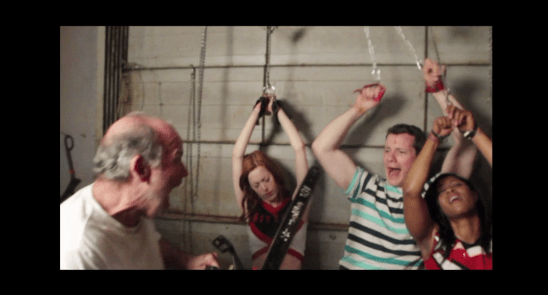
Shane desperately desires to be a part in the making of a low-budget horror movie. Failure after failure of submitting to production studios who opt out rather than option his scripts and the discouraging financial hits with each festival entry, Shane and his girlfriend Chloe decide to venture into producing, writing, and shooting a film themselves. With the script still a work in progress, the promising title alone scores a film crew from his friends and roommates, generate a small fortune of crowdfunded cash, a leading scream queen from the skanky residue poles of a strip club, and a set location provided by a local video store clerk and schlocky indie horror filmmaker named Machete Mike. As the young film crew bumbles through raising more money and the headaches of production woes without a completed script, a demented clan of hardcore snuff and cannibalistic filmmakers seek a hostile takeover of their ambitious endeavor that’ll produce authentic screams and real blood, the very basic foundations of a good horror movie.

You have to admit it. “Virgin Cheerleaders in Chains” is an appetizing, exploitation glazed carrot of a title, a salivating lure that’s hard to ignore for any enthusiast for licentious material. Brazilian born director, Paulo Biscaia Filho, helms the Big House PIctures and Vigor Mortis Apresentam production of an ostensibly horror-comedy that leisurely alters into a slasher-survival-esque structure courted with all the admirations of torture porn with a pinch of homage toward the iconic Sawyer family without a Texas size chainsaw wielding maniac wearing a flesh mask. Blueprinted as a meta-horror with twists and turns galore, “Virgin Cheerleaders in Chains,” by name alone, doesn’t take itself seriously as an inebriated version of the genre it represents and layers to weave a non-linear, outlier story into the heart of the plot, sewn together by the co-producer Gannaway and went in and out of production in 20 or so days to finally hit festival markets a year later in 2018.

While Shane might feel like the focus of the story, Amber and Chloe undercut his presence and steal his thunder as the naïvely ambitious filmmaker with their final girl fight and vengeance. Amber’s the stripper whose yearning for her spot in the limelight no matter how small and she’s portrayed by prominent Manga voice actress Elizabeth Maxwell (“Dragon Ball Super”) and Maxwell is paired with “Last Girl Standing’s” Kelsey Pribilski in Chloe, initially as a mortal enemy toward Amber when the issue arises of the most common, basic, and core division between women – men. Yet, Amber and Chloe dominate the principal antagonists whose subtle quarrels frame an mulishness and aversion relationship build a stronger support for one another when they come toe-to-toe with utter sadism that threatens what collectively matters most to them. Maxwell and Pribilski demonstrate the conventional markings of the popular final girl trope, acting as a single unit, while Ezekiel Swinford bares the helpless victim and ignorant filmmaker, Shane, to be in the crosshairs of death and for the two corners of his semi-triangular love affair to be his saviors. Swinford acts the giddy fool well enough to warrant his character’s witless person in distress calling. Machete Mike lastly, but not at the least, rounds out the core four personas from Don Daro. The “Sex Terrorists on Wheels” actor has little-to-no kindness in his face, marking him intriguing and guileful as the video store clerk whose more than what meets the eye. Ariana Guerra (“Hollow Scream”), Lindsey Lemke, Gary Kent (“Bonehill Road”), Ammie Masterson, Larry Jack Dotson (“Humans vs Zombies”), Kaci Beeler, Michael Moford, Woody Wilson Hall, Ken Edwards, and professional bassist musician in the band Drag, Dominique Davalos “Howard the Duck”), co-star.

“Virgin Cheerleaders in Chains” resembles a movie inside a movie that tries to pull a fast one over the audiences with an open for interpretation of the true nature of events and leaving those once thrilled at firsts sight of the title moviegoers kind of stun like a mouse batted over the head right before being fed to the famished pit viper. Filho and Gannaway’s film does swallow you whole, down it’s gullet, and dropping you right into the stomach acids that begins to dissolve the disillusion of what was imagined from the get-go. Nothing wrong with some slight of hand, but the overall result meanders on the promise of being hyper meta; an attempt to disrupt the conventional and tummy tuck in the tropes from being too loose and obviously exposed. The attempt is well intentioned, but that’s where the summiting the mountain ceases, at attempted, with a great, low-budget desired, premise aimed to upheave the genre and the audience’s expectations, whirl them all into a massive maelstrom, and spit out a “I fooled you!” expose. One aspect that made the grade were the Creeper Labs FX’s Andy Arrasmith and artist Shelly Denning’s special effects work that held a modest candor of blood and severity when the proverbial shit hit the fan. Heads being lopped off, eviscerated stomachs with guts oozing out, and just enough chainsawing and machete work to go around to properly finish the beautifying of “Virgin Cheerleaders in Chains” appropriately.

Rack’em and hack’em those chaste cheerleaders with a Blu-ray copy of “Virgin Cheerleaders in Chains” distributed as the 10th spine from the wild cinema aficionados of Darkside Releasing and MVDVisual. The Blu-ray is presented unrated and in 1080p on a BD-25 with a widescreen 1.78:1 aspect ratio. The estimated $70,000 crowdfunded budget has a rather aesthetic and sleek digitally recorded imagery, perky with natural lighting and dark tint where appropriate, and is an overall pleasant outcome on a moderately robust budget for indie horror out of Austin, Texas. The English language Dolby Digital 2.0 stereo track maintained a balancing act between dialogue and score where the two fought for priority. Dialogue should always have right of way unless intended not, but for the sake of “Virgin’s” story, there’s doubt that drowning out the dialogue momentarily was purposeful. Bonus material includes Brazilian promotional videos, a behind-the-scenes tour of the Bloorhouse Tour with Gary Gannaway being the tour guide himself, a Machete Mike introduction version of the film, and a 16 page booklet that includes stills, original sell sheet cover art, and the birth of the project penned by Gannaway. “Virgin Cheerleaders in Chains” is meta-sexy, meta-slasher, and meta-fun, but wanders into meta territory a little too long for comfort while still positioning a piecemeal survival horror with fine talent and high kill count.

“Virgin Cheerleaders in Chains” available on Blu-ray!

There is no EVIL like the Firefly Family! “3 From Hell” reviewed!


A bullet-riddled shootout with police left Baby Firefly, Otis Driftwood, and Captain Spaulding full lead, but not dead! The trio barely survives despite getting shelled by 20 gunshot wounds a piece and are tried and incarcerated for over a decade in maximum security prisons. After Captain Spaulding’s wears out his welcome on death row and becomes the first one executed, a merciless escape carried out by Otis’ half-brother, Winslow Foxworth Coltrane aka The Midnight Wolf, leaves a trail of blood and violence in their wake up to freeing Baby Firefly who can’t wait to play and unleash her uncontrollable crazy cyanide upon the world. However, there’s only one itsy-bitsy problem – they’re faces are about as dangerous to themselves as they are dangerous to others. The three from hell vamoose to a dumpy Mexico town to start afresh, but little do they know, no place is safe for long.

Over the span of 16 years and 14 years since “The Devil’s Rejects,” shock rock and rockabilly, metal rocker Rob Zombie returns to write and direct the third and highly anticipated sequel film in the Firefly trilogy with “3 From Hell.” The 2019 continuation of the Baby, Otis, and Captain Spaulding rejuvenates interesting in returning hellions that’ll undoubtedly wreak havoc across the midwest plains, splatter some brains, remove some flesh, and, well, you get the gist of their unholy hobbies. “3 From Hell” had to literally dig out these characters from the grave since being shot to shreds at the end of,***spoiler alert***, “The Devil’s Rejects” and Zombie was able to sell Lionsgate and Saban Films on the story divergent from the last film, much like “House of a 1000 Corpses” horror show went straight into exploitation extravaganza with “The Devil’s Rejects.” “3 From Hell” is a whole new animal, an anti-hero’s indulgent fantasy of crime, action, and still barely kickin’ to kick ass through the rampaging blood.

The three in “3 from Hell,” Baby Firefly, Otis Driftwood, and Captain Spaulding, return for one more three amigo misadventure through hell and brimstone and the original cast, respectively include Sheri Moon Zombie, Bill Moseley, and Sid Haig, suit up to be a depraved family once again. Sadly, Sid Haig’s health rapidly deteriorates in the midst of filming, leaving Zombie no other choice other than to write him quickly from the script and introduce a new character, a transgression tyrant to pass the torch to, with Winslow Coltrane played fittingly by “31’s” Richard Brake. As though like never missing a backwoods bumpkin beat, Richard Brake embraces the Midnight Wolf and breaks in the character with such ease and fortitude that the question never arises if the Midnight Wolf should be a part of the sacred Firefly pack. Sheri Moon Zombie steps out of a time machine and right into Baby Firefly, despite being a little aged around the eyes. The quirky and unpredictable Baby doesn’t reinvent the wheel, which should please the fandom, and is a wonderful sadistic mecha with Sheri Moon at the helm. The same can be said about Bill Moseley who, goes without saying, has a unique voice that’s been rebranded as Otis Driftwood. Every other movie, old or new, with Bill Moseley starring, or not starring, will forever be tainted by Otis Driftwood for when Moseley monologues or even just speaking one or two words of dialogue, the spine starts to twinge and tingle, the hairs shoots straight up, and that stepping on your grave feeling of cold desolation swallows you in an instant. The “3 From Hell,” plus Coltrane, face the world with a big knife and lots of guns and those who stand in their way are played by co-stars Danny Trejo (“Machete”), Jeff Daniel Phillips (“31”), Emilio Rivera (“Sons of Anarchy”), Richard Edson (“Super Mario Bros.”), Pancho Molar (“Candy Corn”), Dee Wallace (“Cujo”), Sean Whale (“The People Under the Stairs”), Clint Howard (“Evilspeak”) and Bill Oberst Jr. (“Dis”).

Rob Zombie has mentioned in a behind the scenes featurette that he didn’t want to recapture the magic of the previous Firefly cruelty and the rocker-filmmaker has done that just, straying away from the horror of “House of the 1000 Corpses” and the exploitation vehemence of “The Devil’s Rejects,” which the fans groveled for, and going bravely, or blindly, into crime action with the “3 From Hell” that still’s beholden to Rob Zombie’s hillbilly swank. Rob Zombie risks a new path and also gambling on more of Lionsgate’s capital with showing off more visual effects than in the former films. Bullets tearing through flesh and flying straight toward the camera lend to example of the computer imagery effects that, from a fan’s perspective, dilute Rob Zombie’s adoration for horror who takes less and less chances with this film that not only feels rather ordinary and just another piece of maize in the field, but “3 For Hell” also doesn’t feel to have substance to all the madness. Baby, Otis, and Coltrane go from point-to-point, aimlessly pondering what’s next, and just happen to fall into a barrage of bullets and blood, rather than being the epitome of evil bring vile upon mankind. Just being a Rob Zombie film that resurrects his beloved and beguiling modern iconic characters, “3 From Hell” coopers the longing with a fierce show of violence that opens the door for one more installment.

Lionsgate and Saban Films, along with Spookshow International, proudly presents Rob Zombie’s “3 From Hell” onto a R rated DVD and an unrated, 1080p Blu-ray sheathed inside a slipcover. The two disc, dual format release are both presented in a widescreen, 1.85:1 aspect ratio, and the image is about as sleek as they come with an ARRIRAW formatted 2.8k ARRI camera that shoots 48fps. Zombie reins back on the color palette and hones onto more natural coloring. The details are delineating, as aforesaid with Sheri Moon Zombie’s crows feet. The English language 7.1 Dolby TrueHD audio track is lossless with a crisp dialogue and ambient mix. The range and depth are robust with explosions and gunfire. The release comes with Spanish subtitles and English SDH subtitles. In accompaniment with the 115 runtime, bonus features include To Hell and Back: the Making of 3 From Hell which is a 4-part documentary on the Blu-ray only and both formats include an audio commentary from writer-director Rob Zombie. Also included is a digital copy to instantly stream and download onto personal devices. The horror element might be gone, but the inexplicable chaos surges through death row to desperado Mexico in Rob Zombie’s “# From Hell!”

Own “3 From Hell” on Blu-ray/DVD!

The Lord Examines the Righteous, but the EVIL, Those Who Love Violence, He Hates with a Passion! “Holy Hell” reviewed!


Father Augustus Bane is a go-by-the-book type priest and through his unlimited optimism and passion, grudgingly turns the other cheek when life’s bitterly cold callousness bends him over a barrel and pulls his hair until bruised and raw on that very same turned cheek. When the God dedicated man of the cloth is pushed too far after the merciless slaughter of God worshipping parishioners and he is left for dead by a gang of demented family members, the surviving Father Bane is reborn and becomes destined to a vindictive life path with a six-shooting revolver he baptizes as The Lord. Hell hath no wrath like a priest scorned to obliterate all sinners from every walk of life in a blaze of the almighty glory (and gory) of The Lord and those explicitly responsible for the death of his congregational followers and much of the city’s crime and corruption will have nowhere to hide from their lethal penance.

What could be considered as the pious Punisher on steroids, Ryan LaPlante’s offensive-laden, satirical grindhouse exploitation feature, “Holy Hell,” is a confirmation of that films like LaPlante’s are sorely needed and pleasingly free in speech inside the dominion of today’s sensitive and politically correct cultural society. Surely not a product of the U.S. and will certainly piss some viewers off (especially zealots), this Canadian made production could only exist outside a conservative dome, looking inward for a weakness to seep and taint the sometimes too wholesome American cinema market that’s tiptoeing around what should expressively blunt and in your face. Let’s face it, folks, it’s a movie! LaPlante writes, directs, and stars in this movie of comedy, action, and exploitation that’s even too controversial for some of the supporting cast who used pseudonyms, such as punned Yennifer Lawrence and Zooey Deschansmell, as their stage names because of the deviant material.

The man with many hats, Ryan LaPlante stars as Father Augustus Bane, a cheerful priest with a firm belief of charity instead of violence, and as LaPlante’s first and only feature as a writer and director, “Holy Hell” snuggly fits the filmmaker’s contemning, vindictive, “autistic rage monger,” as another character described accurately. Satirically stoic, Bane reminisces the days of yore when severely slighted protagonist broke and the endured trauma became a journey of eye for an eye, tooth for a tooth. LaPlante, whose career pivoted to the video game world and could so seamlessly, understood the mentality of once was with harden, good men turned relentlessly anti-heroic. Father Bane’s opposition had parallel penchants of aggressive stamina, but in a more deplorable and deviant calling. The MacFarlane family is about as coarse and as ruthless as they come ran unflinchingly by Dokes, the head of the family, with his wild eyes and skull earring atop his fishnet undershirt and open Hawaiian button down. Dokes is truly satanic as a ravishing villain from in co-producer’s Michael Rawley’s in his sardonic performance of the father of three. The “Disco Pigs” actor revels as Dokes in not only being the kingpin, but also a special daddy to his three rotten and just as maniacal kids – Trisha (Rachel Ann Little), Buddy (“Red Spring’s” Reece Presley), and, the more flagrant of the trio, Sissy, a labeled sadistic he/she of boundless perversion and a flair for the theatric played vivaciously by Shane Patrick McClurg and McClurg’s Sissy MacFarlane is difficult to dislike and is favorably one of the best and best portrayed characters alongside Father Bane and Dokes MacFarlane. The entire “Holy Hell” cast amazes as deviant delectation and round out with love interest Amy Bonner played by Alysa King (“Slasher” television series), Luke LaPlante, and Austin Schaefer.

While “Holy Hell” trails the established trope about a vindictive good man, a thrilling theme consisting inside half the grindhouse genre films of 70’s to 80’s, Ryan LaPlante doesn’t really offer much new to audiences whom are well versed; however, since “Holy Hell” is one big punch-to-the-face nod toward grindhouse and the filmmaker constructs a complete caricature picture, the shocking, the disgusting, and the hilarity mold almost an entirely new brand of grindhouse or, as I’ve coined, mockhouse. A mock-grindhouse film have natural degrading quality where filmmakers remain on the fray of getting the right look and feel of a grindhouse film, but LaPlante accomplishes the task, echoing the effect while adding his own brand of comedy. Also LaPlante’s bludgeoning of taboo is no holds barred comedy, especially on surface level narratives such as with Father Bane who has a tremendous arch to hurdle as a priest fueled with guilt and rage against an army of inhuman and derange psychopaths, plus all the other miscellaneous miscreants roaming the streets at all hours of the day, but the script is penned like the Divine retribution as the priest endures, almost in a supernaturally reborn or resurrected kind of way, after being shot six times in the form of a cross by Dokes that, ironically, acts as a blessing for Bane to declare war on evil.

Indican Pictures presents a Rogus Gallery production with “Holy Hell” onto a not rated DVD home video. The widescreen, 16:9 aspect ratio, has a warm toned coloring grading from digital grader Defiant and also embellishes the natural grain and blemishes to assimilate into the grindhouse collective. “Holy Hell” is intent only appealing to a comic book illustration that makes definition fuzzy, but not totally cleared from the playing field. The closes up of the gore is nicely displayed with a drenching and gruesome effect. I couldn’t detect a lot of girth from the Englih language 2.0 stereo track which makes me think LaPlante intended on suppressing much of the ambiance and up the soundtrack quality from composer Adrian Ellis, whose upbeat, synch-rock has killer intentions whenever the MacFarlane’s are rolling heads. DVD extras include a director’s commentary and a blooper reel. Chockfull with affronting one liners, “Holy Hell” is utterly sound being well-rounded with the best intentions paved in hooker blood and indecent exposure, as well as being highly entertaining, in one holy redeemable package of horror exploitation blessed by Ryan LaPlante himself.

The Scene Isn’t Over Until EVIL Yells Cut! “Incredible Violence” reviewed!


After squandering a shady investment group’s money, a struggling filmmaker stages a last attempt effort in writing and directing an all-out and profitable horror movie. Isolated on a stretch of private land sits a house which his movie will be set. The director installs camera monitors, archaic printers in each room, and fashions a room for himself in the confining attic space, turning the house into a platform for five young actors to perform at his instructional, omnipotent influence without having to ever personally interact with the actors, a group he strongly loathes. His despise for actors and the financial pickle he finds himself in with shark investors places him at the centerpiece of his slasher film as the masked killer. With the stage set and the actors all in place, the directing maestro helms unsuspecting actors to their violent deaths in the name of art, self-preservation, and actor genocide.

As a film that turns the slasher mythology on its head, G. Patrick Condon’s “Incredible Violence” is a serrated vision of bleak, dark comedy too sharp to really fully digest and that’s okay. Filmed in Canada of 2018 and released this year on SVOD from The Hunting Party Inc., production studio, “Incredible Violence” strays away from the young, naive victims points of perspective and opens the path up for a nihilistic killer to control the narrative around his desperate motives. Though having complete control over most of the factors and planning ahead of time, “Incredible Violence,” as a partial comedy, folds miscreant mishaps and caricatured flaws on top of, indeed, incredible violence and while that vehemence is focused primarily on actors as a while, a good portion pivots and breaks down even further to the individual level that can be personal and can be insensitive for women who have to best themselves, sometimes together and sometimes separately, against two different antagonistic foes of the opposite sex.

The largely based Canadian cast begins with Stephen Oates playing the hack director and self-imposed killer, named after director G. Patrick Condon, of the titular film and though that might seem egotistical of the Condon, enough humiliation smothers the self-assuring and struggling character to the point of utter satire with even going as far as poking fun at his last name in a brief quip of dialogue. Oates, who has starred alongside Jason Mamoa on the historical Canadian action Netflix series, “Frontier,” is an intriguingly no-shame filmmaker who hustles together a plan schemed to save his life. Sporting a wife beater, long fur coat, and an unadorned mask, Oates exhibits Condon perfectly as a hack artist in filmmaking and in being a badass serial killer. Then there’s Grace, the lead character bound for stardom as an untrained actor taking a role in, what she considers, a performance art film and naively goes into the project with such gusto that she blatantly ignores all warning flags from the beginning, a role very well suited by the striking eyes of M.J. Kehler. Grace endures shots left and right, from friends and foes alike, as a hopeful artist, but like “Incredible Violence” shows, a true inclination comes out of people when push comes to shove and Grace, through Kahler’s physical bombarding of a final girl trope, doesn’t need acting school or any other doubters to trump her will, passion, and ferocity. One scene to note is between Foster, Kahler, and Kimberly Drake and Kahler’s Grace is just stricken by fear over being ask to kill someone, she’s screaming and is essentially rooted to her spot. The moment is grippy and terrible empathetic to know that true fear does freeze one’s fundamental functions of survival and of morality. “Incredible Violence” co-stars Michael Wotherman, Kimberly Drake, Erin Mick, Meghan Hancock, and Allison Moira Kelly.

“Incredible Violence” bursts with a talented cast with deserving of a curtain call performances and lives up to the title with incredible, if not whole heartily gratuitous, violence and some brief macabre nudity, but Condon’s story has a lot of zeal that doesn’t properly switch tracks when characters break under their obscure tormentor’s direction. Condon, the director, builds the tension more through the repetition of violence with a slight tweak every time rather than crafting a breaking point, a catalyst that dissembles sanity and refigures patchwork insanity, making characters alliances difficult to place that ultimately crumbles the dynamics into just a bunch of people beating each other to a pulp. The same kind pivoting told differently can be said about the strange, public television show Celebrity Autopsy paralleling as intra-story that often feels disconnected to Oates and his film. I guess with a film entitled “Incredible Violence,” a substance merit to the narrative would be a long shot, but as an exploitive, self-described meta-horror centerpiece, “Incredible Violence” is made up of all sorts of gut-checking goodness with torture, madness, and cynicism helmed by sadism without the presence of slasher-esque, blank evil.

1091 Films, in partnership with G. Patrick Condon’s The Hunting Party Inc., presents “Incredible Violence” that runs 89 minutes onto a plethora of media streaming platforms, such as Amazon Instant Video, iTunes, Google Play and Vudu, and on-demand cable services. Unfortunately, “Incredible Violence” is a streaming only feature so image and audio qualities will vary across streaming devices. There were also no bonus material or special features present, but as an extra tidbit about production, the film took approx. 2 years to complete with the unpleasant misfortunate of one of the original cast members passed away during rehearsal. This forced the script to be re-written, delayed, and ultimately triggered G. Patrick Condon to write himself, as a character, into the script. Futhurmore, the cast and crew had agreed to stay in the house set location until filming wrapped which resulted in some actual anxiety and stress to spill out into the performances. Contextually sound in the confines of violence, “Incredible Violence” finds footing staggering abroad the cascading carnage of horror-comedy with a single character arch involving making it big in the acting world only to just make it out alive and in one piece of this film.

Stream “Incredible Violence” on Prime Video