The Blind Leading the EVIL. “Oddity” reviewed! (Acorn Media International / Blu-ray)

“Oddity’s” Blu-ray from Acorn Media International is Here!

Dani Timmins spends many nights renovating her and her husband’s new country home.  While her psychiatrist husband Ted works long nights most nights at the mental hospital, Dani spends her time in solitude and isolation to fixup their future home.  When a strange man knocks on her door and warns someone is inside her house, Dani must make the difficult decision to either trust the stranger into her home or dismiss his warnings as subterfuge to get inside.  The next day Dani is dead, brutally murdered.  A year later, Ted and his new girlfriend reside in the country home and Darcy, Dani’s twin sister with retrocognition abilities, arrives at the country home with supernatural suspicion toward the couple, bringing with her a trunk containing a family heirloom of a life-size wooden mannikin.  Threatening to expose him, Darcy appetite for blind justice is stronger than Ted’s need to convince her otherwise when the plot against her sister thickens beyond the plane of the corporeal world.  

“Oddity” is the 2024 release supernatural haunt and golem thriller from “Caveat” writer-director Damian Mc Carthy.  The sophomore feature from the Ireland born filmmaker is a mishmash of culture inspired heavily on the Jewish folklore of the inanimate, human formed material being commanded to animate a task, such as being bewitched for wicked transgressions and this commingles with twin superstitious beliefs of extrasensory connection, and, I’m going to stop your train of thought right there, just because this is an Irish production with an Irish actress playing twins doesn’t make this a movie about the derogatory Irish twins concept.  Filmed in the County Cork, Ireland, “Oddity” is produced by “Come to Daddy” producers Evan Horan, Katie Holly, Laura Tunstall, and Mette-Marie Kongsvad with Lisa Kelly as co-producer and Keeper Pictures and Shudder serving as co-productions presenting as a Shudder Exclusive film.

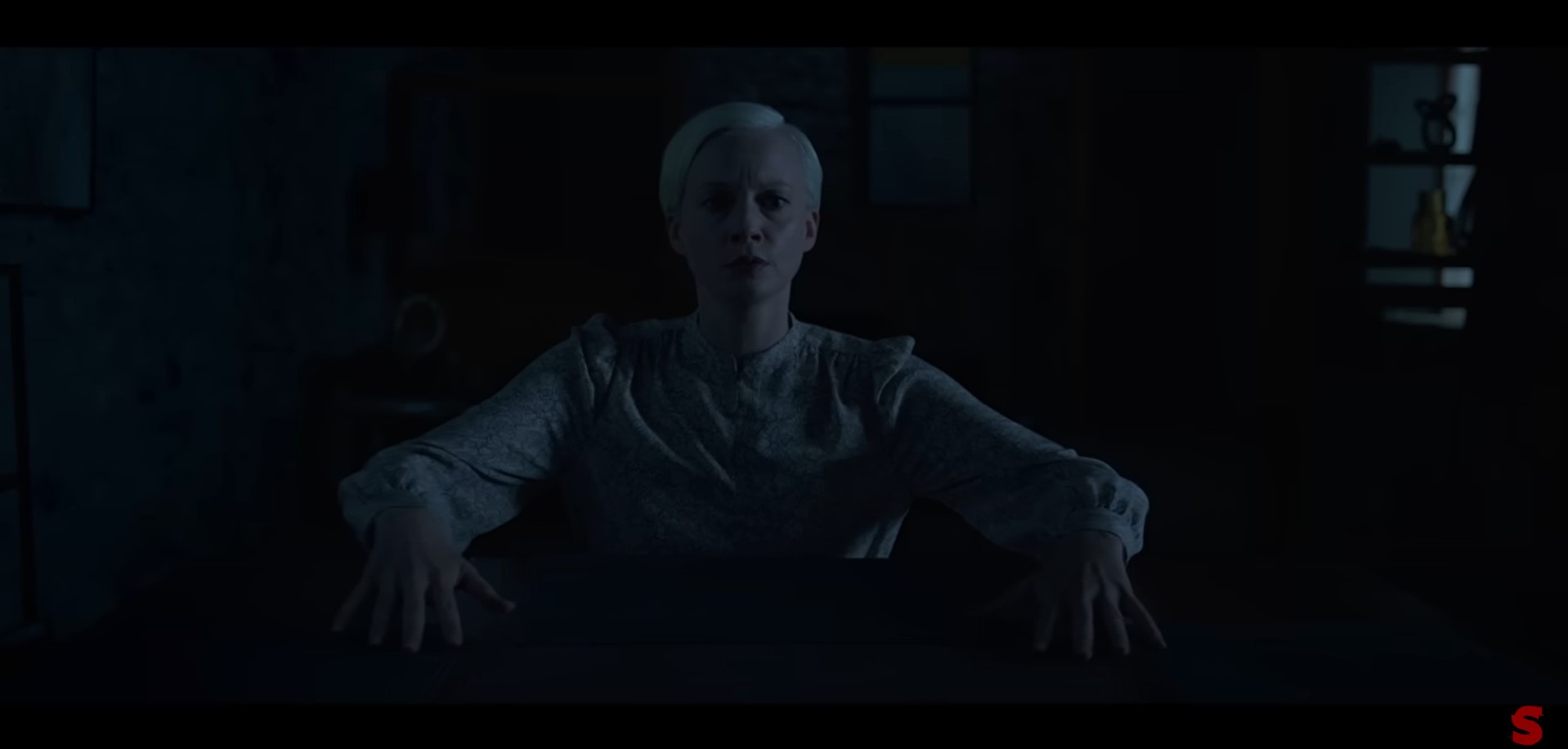
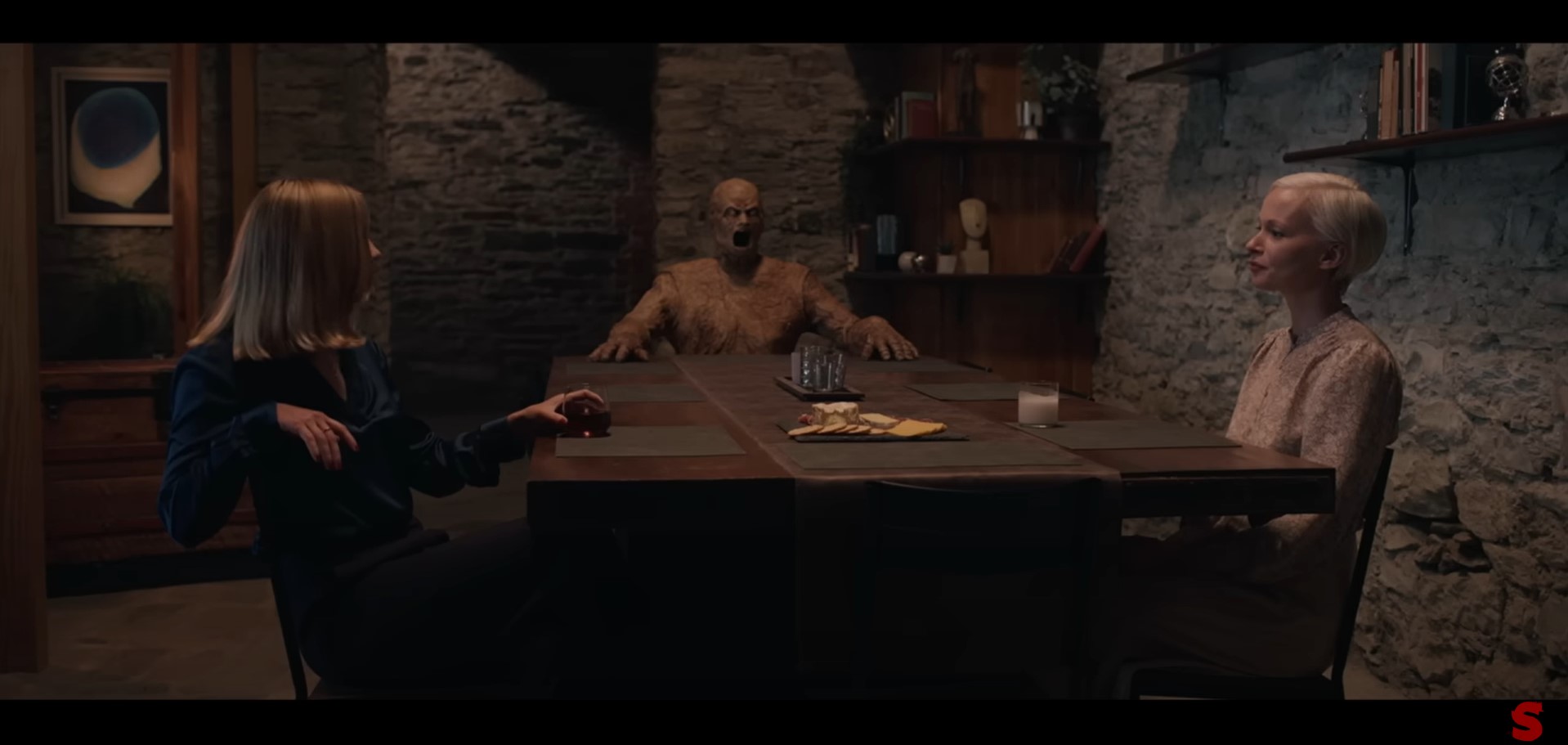
Carolyn Bracken (“You Are Not My Mother”) dons the double role of twin sisters Dani Timmins, murdered housewife to doctor Ted Timmins, and Darcy Odello, a blind psychic who owns an oddity emporium called Odello Oddity, as partly in the title.  When we think of twins in films, we think identical down to the very last mannerism and hair fiber, but for Dani and Darcy, they’re similarities are in blood and face structure alone.  The differences are stark with Dani sporting dark, long hair whereas Darcy’s is nearly white and cut pixie short., Dani’s health is more intact whereas Darcy’s afflicted with blind caused by a brain tumor, and the aforementioned results in Darcy’s gift whereas Dani lacks in that department.  Lastly, Darcy exudes more confidence for a blind woman who’s able to read the room without her known unnatural ability, possessing a separate superhuman knowledge left without the power of sight.  While Bracken only plays Dani for a short period of time a lot can be said between the two women who are portrayed perfectly contrasted; yet a connection between forms an invisible bond through Darcy’s practice of learned witchcraft that involves the wooden manikin.  Opposite Bracken is Gwilym Lee as Ted Timmins, a man unable to escape the haunting of his deceased wife and start again with new girlfriend Yana (Caroline Menton).  Lee’s an absolute pragmatic when it comes to being psychiatrist Ted Timmins in a good display of when a rational doctor plays a rational plan on how to do something irrational and while Timmins and Bracken share not a ton of screentime together within either of Bracken’s dual roles, the thick tension formed between their characters is palpable wrought.  Yet, the real award-winning performance should be handed to Ivan de Wergifosse, the unsung face and movements of the wooden man.  Menacingly still like a large Pinocchio doll ready to come to life at any second, Wergifosse’s golem movements erratically alter the tone of drama-thriller to creature-thriller, coupled with an intense sound design that will resonate in nightmares.  “Oddity’s” principal cast fills out with Steve Wall (“Dune:  Part Two”) as an unscrupulous orderly and Tadgh Murphy (“Boy Eats Girl”), who really does have an artificial eye, as the red flagging mental patient.

A confluence of componential folklores doesn’t stale “Oddity’s” unique brand of Mc Carthy storytelling.  Shrouded deep in shadows, an underlining sense of intense dread, and colorful in diverse characters, the film truly represents the meaning of the title despite its adopted resources and, to be honest, that’s how most stories survive nowadays when the familiar is rebranded with fresh frights dwindling every second.  Sometimes, being too novel can have the reverse consequences of being too odd for most general fans.  “Oddity” provides balance with a slow burn buildup by chopping out exactly what happens to Dani, creating a cliffhanger right at the beginning to get the investigative wheels turning.  Where I do believe Mc Carthy suffers to retain a truth uncovered is in the story’s predictability.  We already know who the bad guy and we’re just waiting to see how he did it.  That takes a good chunk of suspenseful whodunit away from the narrative when it’s practically spelled out for you.  The mysteriousness around witchcraft and the supernatural twin sibling bond, coupled and accentuated with the manmade blunt force apathy, carries the weight, and can overshadow what’s missing and purposefully omitted to keep a sense of the unknown palpable. 

Acorn Media International presents “Oddity” on an AVC encoded, 1080p high resolution, BD50. Mc Carthy and director of photography Colm Hogan’s first collaboration together in a horror feature that results in the graveness of blanketing shadows and an aged, speckled, and muted color scheme solemnity. Graded in undertones of green, blues, and yellows, “Oddity” contrasts nicely and frighteningly against an object, like the brown wood of the mannequin, is in juxtaposition of the norm.  Detailing is superb around said golem with tree notices and grooves despite looking like a man in a suit in certain angles.  There’s also finesse detailing around skin textures, costuming, such as Darcy’s intricate green and white outfit, and other concepts implemented into the story’s narrative, such as Tadhg Murphy’s false eye that’s been accentuated with a bright iris or the leathery strap around another patient’s ravenous mouth.  The British and Brogue English DTS-HD Master Audio 5.1 courses through the individually marked rear, side, and front channels for full surround effect of the mannequin’s wailings and joint creeks, relying more on the discordant higher pitches than minor chord LFE to scare wits.  Oppositely, an earnest and tense stillness is achieved when all sound ceases to exist without the faint hint of interference and or other noticeable popping, humming, or generated soft noise.  English subtitles are available under the static menu selection.  Special features include a behind-the-scenes with cast and crew, a storyboard to screen vignette of one’s scene’s storyboard conceptual illustration compared to the final scene’s cut, and the the making of the wooden mannequin told through an image gallery.  The standard release comes in a thicker than normal North American Amaray Blu-ray case with Darcy and the wooded mannequin in spiritual positioning cloaked partly in darkness, similar to the shadow work in the film.  Inside does not contain any inserts or other physical accompaniments but there is a more detailed facial depiction of the mannequin’s face on the disc pressing.  Hardcoded for region B PAL playback, Acorn Media’s Blu-ray clocks in at 98 minutes and is UK certified 15 with no certification qualifications but the story has violence, strong language, and intense situations.

Last Rites: “Oddity” may not feel like nothing new but it’s nothing new done well in its reenvisioning of folklore and the standard horror tropes to give this Damian Mc Carthy’s filmmaking career an open door and a blank check to scare us with something far more novel and next level in the Irishman’s films yet to come.

“Oddity’s” Blu-ray from Acorn Media International is Here!

Beware of Friendly Strangers, They Just Might Be EVIL! “Speak No Evil” reviewed! (Acorn Media International / DVD)

“Speak No Evil” has Speechless Horror! Now Available at Amazon!

A Danish family on holiday in Tuscany meets a family from Holland.  The two families hit it off enjoying each other’s company on the final days at the getaway villa.  Weeks after returning home, a postcard arrives from the Dutch family, inviting the Danish family to stay with them for a weekend at their home.  What starts off as the pleasant beginnings of friendship slowly degrades to an unsettling suspicion something is not right with the Holland family.  Abel, the Dutch couple’s mute son, is held to a higher standard with uncompromising, punitive measure, the husband and wife’s acute uncouth behavior sets an uncomfortable stage, and their attention toward the Danes’ daughter, Agnes, is unconscionably overstepping parental boundaries.  An attempt to call out or even leave the home altogether has been met with disbelief, guilt, and pleads for stay and enjoy under their guise of sincerest apologies soon to be dropped for something far more sinister. 

Before James McAvoy grew a beard, got jacked, and attired himself in buffalo plaid for his manly maniac performance in the 2024, usurpative family thriller, “Speak No Evil,” directed by “Eden Lake’s” James Watkins, the Netherlands and Denmark were the original blunt forces behind the sociopathic caprices of those assumed normal and amiable adults.  Only released two years ago, the 2022 film that spurred the American remake and the feature’s namesake is directed by the Copenhagen-born Christian Tafdrup (“Parents’) and co-written between Christian and brother, Mads Tafdrup, as one of their numerous collaborations since 2017, beginning with a manipulative tale of a viperous female in “A Horrible Woman.”  Profile Pictures (“Holy Spider”), in a co-production association with OAK Motion Pictures, serves as the production companies on the Jacob Jerek, of Profile Pictures, and Trent, of OAK Motion Pictures, produced motion picture shot primarily in the southern portion of Netherlands in the Friesland region.

The Danish father and mother, Bjørn and Louise, are played by Morten Burian and Sidsel Siem Koch and before becoming ingrained into the crux of the story, the couple reflect a complicated complexion all on their own, especially and specifically with the focus toward Bjørn who seems unsatisfied or unhappy with his life as he’s shown staring off in the distance or mentally checking out at the dinner table.  The Danish are represented as a couple who are too nice to a fault, unable to say no most of the time, and try to keep to themselves mostly when a problem arises, skirting away without notice in a dust of avoidance.  That’s not so much the case with the Holland father and mother, Patrick and Karin, bordering as an equally amiable couple performance by Fedja van Huêt and Karina Smulders.  That is until the outer appearance of friendly strangers turns into an uncomfortable nightmare of being caught between a rock and a hard place of how other people live and do things, especially from another culture or country.  Patrick and Karin show more passionate displays of anger, sexuality, and bohemianism that wasn’t on display on their shared holiday with the Danes.  Then, there are the children.  Agnes (Liva Forsberg) is a lovely young daughter perhaps too coddled by her parents, especially by Bjørn who can’t resist saying no in going to find Agnes’s beloved stuff animal when she constantly loses it.  Abel (Marius Damslev), on the other hand, is shy and can’ talk due to a tongue malformation, but the overly critical parenting by Patrick and Karin keeps Abel on a silent edge.  The Holland family’s outer haul slowly regresses, facades drop, but still the Danes are reeled back in by their own niceties despite all the red flags.

I can’t help but think those comportment particulars are somehow a reflection of the Denmark peoples’ true nature as a statement to their culture and social relations between themselves and, in this case, their neighboring countries.  The Tafdrup brothers prelude the script with verbal contrast between the two countries, such as their similarities, but the Tafdrup’s firmly stamp that just because you’re similar doesn’t mean you’re the same.  The notion can be applied to anybody of people from groups to individuals living amongst each other in a neighboring fashion and that their differences are being conducted right under your noses.  Of course, the script then embellishes more a distributing sensationalism of a spider leading the innocent moth to it’s sticky web by an attractive, orienting glow of light.  The analogy is right up Bjørn’s alley as a man who is looking to loosen the chains of parental and marital, perhaps even inherent to his nationality, suppression in a misguided notion that his promises have put a limitation on freedom; he finds himself attracted to Patrick’s freewheeling way of life and wants to emulate that in some sort of way.  The psychology behind “Speak No Evil” runs rampant with a paralyzing inability to let wicked do what it wants without confronting it head-on or without fighting it.  “Speak No Evil” is a chilling story of the all too familiar Edward Burke phrase, the only thing necessary for the triumph of evil is for good men to do nothing

“Speak No Evil” arrives onto UK DVD from Acorn Media International co-presented as a Shudder Exclusive and IFC Midnight production.  The MPEG 2 encoded, upscaled 1080p, DVD9 is presented with an anamorphic aspect ratio of 2.35:1 that encompasses an array of landscapes from vast fields, rocky dunes, and Tuscany vistas.  Contrastingly, director of photography Erik Molberg Hansen goes for an austere, harsh grading with little less light to give everything surface a rough edge from skin to fabric to natural to synthetics.  Colors a held at neutral browns, tans, grays, and blacks to accentuate the severity that continues to increase as the story progresses when moving away from holiday in Italy to the morose, rock-strewn dunes in Holland and while details are generally lost in dense nighttime exteriors, the more brightly lit corners excel in isolated spots.  The Danish-Holland-English audio comes in only one format, a lossy Dolby Digital 5.1 surround sound mix.  Adequate for this type of interpersonal awkwardness, the score and sound design offers a plentiful mix free from compression issues or physical obstacles on the recording in post.  “Speak No Evil” is person-on-person violence in the most primal form that leaves the possibility of added effects from violence next to nothing in what is more of a less is more design under a suppressive audio format that’s akin to trying silence a low-talker.  Dialogue is clean, clear, and at the bow of all the other layers in the audio boat.  What’s interesting about the encoded English subtitles is that they’re only available for the Danish dialogue and not the Netherlanders’, which adds an additional layer of intrigue and suspension as the non-native Dutch speakers with not understand what Patrick or Karin are communicating between each other.  The static menu offers no special features option and there is no stinger at the end of the credits.  The clear DVD case showcases that austere black and gray look with one of the story’s most engagingly odd scenes involving Abel.  The insides are standard edition bare as well with this disc pressed with the same primary image.  THE PAL disc is hard coded with region 2 playback, has a runtime of 93 minutes, and is certified 18 for strong violence and injury detail.

Last Rites: The original “Speak No Evil” speaks volumes of the dangers of societal pleasantries that turn a blind eye to caution for the sake of not hurting the feelings of others, but those subconscious hints are a part of the innate, primal early warning system in us all. Once we ignore those insinuations, we might as well dig our own grave.

“Speak No Evil” has Speechless Horror! Now Available at Amazon!

A Little Space Can Asunder the Strongest Bond. “Alien Love” reviewed! (Sector 5 Films / Blu-ray)

Its Not Strange Love, It’s “Alien Love” now on Blu-ray!

Ryan Van Hill-Song and his wife Sadie are a happily married couple despite their age gap.  Ryan’s ardent journey and dream to reach beyond the clouds and into space is on the verge of coming true while Sadie decides to take a break from the vocational rigmaroles of her young life.  Ryan’s NASA mission goes without a hitch except for a brief loss in communication with headquarters.  Upon his return home, Sadie notices a behavioral difference in her once loving husband who now acts strange in his own surroundings and around her.  Despite a few amorous encounters, Ryan becomes strangely obsessed with the extraterrestrial concept through alien themed movies, local artistic murals, and anecdotal accounts that are engrained into their home city’s culture.  As Sadie begins to suspect Ryan is no longer her husband after learning about her pregnancy, NASA agents move in to chase down Ryan and capture his true being.

Strap yourself in to blast off into the great unknown of extraterrestrial copulating with Simon Oliver’s 2024, Sci-Fi romance-drama, “Alien Love.”  The serial Australian documentary director puts a pause on the confluence of beings from the space frontier, the mysticism of the occult and supernatural, and historical contexts to land terrestrial blending-aliens amongst us, hiding under human skin as our family and as our lovers; in this case with “Alien Love,” as astronaut and husband Ryan Van Hill-Song with a concealed agenda.  The script, that presses themes of usual relationships and their potential inertia, is penned by the principal male lead, Nathan Hill, and Simon Salamon, both of whom are coming hot off the script press of their last feature “Lady Terror” from the previous year.  Hill dons the producer hat as well under his production company NHProductions with Sector 5 Films’ Warren Croyle footing and distributing the microbudget feature. 

Nathan Hill producers, co-writes, and stars in most of his pictures.  However, for “Alien Love,” the accomplished filmmaker breaks up the routine monotony by taking a backseat in the director’s chair to enhance focus on Ryan Van Hill-Song, the astronaut who returns to Earth and is not the same man who left his planet.  Aside from a few lines in flashbacks and a quick, laconic replies here and there, Hill mostly lounges about or takes a run while in character, leaving the brunt of the dialogue and emotional work in the hands of Ira Chakraborty, a model-actress in her full-length feature debut in the role of Sadie.  Ira carries the story that mostly just stagnates with scenes of Ryan’s wandering alien obsession and absence seizure indifference all the while Sadie frustratingly can’t decipher her husband’s acute loafing and lack of any kind of emotion in contrast to the flashback lovey-dovey affections.  The craftier part about this devolving dynamic is the theme it represents between fantastical expectations and grim reality, especially between two considerably different people on a collision course of marital decline.  Throw a baby in the mix, a more calamitous cocktail ensues.  NASA agents, supervised by Colonel John Smith (Edward Mylan), are on the hunt for the close encounter, and if you’re wondering what the hell is NASA is doing in Australia, well, let me school you on that there is a NASA deep space communication center in the land of Oz to allow seamless communications to spacecrafts when the Earth rotates.  The more you know…  “Alien Love” fills out the cast with Eleanor Powell, Demz Lato, Sam Ready, Chase Kauffman, John Robertson, Robert Rafik Awad, Ben Bramwell, Savita Bungay, Emily Farrell, and Dan Heubel.

Preboarding the “Alien Love” ship saw an audience collective view of similarities toward the Rand Ravich directed, Johnny Depp and Charlize Theron-starring “The Astronaut’s Wife,” and after soaring through “Alien Love’s” story, that general consensus is spot on as the Simon Oliver helmed, Nathan Hill production is a remake of the 1999 New Line theatrical release on a much smaller scale.  Going into the film knowing this, there ironically emerges less subjectivity because expectations were set and the cognitive ability to examine “Alien Love” for more than just a remake is formed.  The aforementioned theme of wedging differences between two people is characterized by the age gap and ambitions.  Ryan’s an older man, this fact is mentioned a few times early on, chasing a space dream and Sadie is somewhere 20-30 years his junior and judging with conversations with friend Abbey, Sadie is or was in university.  Love at first is healthy, vibrant, exciting, and hopeful like any first-time marriage but the gap, symbolized by Ryan’s change, becomes alienating, literally, and the once strong bond between the two lovers is now reduced to the occasional sex and just being in proximity of each other as interests change and connections become stale.  This unfortunate walk-through of life is told through the sensationalism of an alien inhabiting human form, but the message of marital decay is loud and clear with all the hallmarks of a souring union between two very different people.  When the alien does make the screen, the simplistic mask man works here with a decent alien archetype look without it being overly schlocky; however, the need more for more context is sorely missing as Oliver goes for more style than substance as the need for digital lens flares and art compositions unbraid the build of the story.

From Sector 5 Films comes “Alien Love” on an Australian Blu-ray home video.  The AVC encoded, 1080p high-definition resolution, BD-R has lossy picture quality simply because it’s a BD-R; however, the bandwidth appears to be adequate to suppress artefact issues and sustain a stable, reliable quality throughout.  Details and colors are generally soft, textures lack distinction, in what is more of a hazy aura veneer with muted colors and no dense shadows, over kneaded by warm pink and rich blue gels to heighten the dreamy affect.  Delineation works for the cityscapes and some handful of land planted with powerlines and towers coupled with interesting camera angles and work.  The only audio option is a lossy English Dolby Digital 2.0 Stereo mix that heavy on exposition and Jamie Murgatroyd’s mingling with epic soundtrack.  Dialogue layer has dynamic change depending on how cavernous rooms can be or if background ambience levels are higher that suppress vocal projection.  Overall design diffuses fine from a stereo output with clean and clear dialogue.  Special features include a feature parallel audio commentary with stars Nathan Hill and Ira Chakraborty, an interview with Hill and Chakraborty going over fan questions, interview with esteemed John Hipwell (“Lady, Stay Dead”), deleted scenes with commentary from Nathan Hill, a blooper reel, still gallery, and trailer. With the encoded special features packed with goodies, the Blu-ray design and package leans toward more standard fare with a traditional Amaray case with no inserts or other tangible accompaniments.  Primary cover art looks inexpensive, air brushed, and circa science films of the 1950s.  Disc is pressed with the same image.  The 75-minute feature comes unrated with region free playback. 

Last Rites: “Alien Love” will not be the knock-your-socks-off science fiction film of the year nor will it dazzle with awe-inspiring special effects. What Simon Oliver and Nathan Hill specialize with their latest film is storytelling of a disintegrating couple during alienating times, plain and simple, with a heavy emphasis on the plain and simple.

Its Not Strange Love, It’s “Alien Love” now on Blu-ray!

EVIL Doesn’t Take Rejection Well. “Village of Doom” reviewed! (Unearthed Films / Collector’s Edition Blu-ray)

“Village of Doom” now on Unearthed Film’s Collector’s Edition Blu-ray!

Tsugio Inumaru is considered the smartest young man in his village.  Illness took the life of his parents, and he raised by his grandmother and lives off her land’s income, looking after him and dreading the day Tsugio becomes drafted as a soldier in war service, which bestows great honor from the villagers.  While husbands are away serving their country, bored and lonely housewives and bachelorettes desire the carnal company of the men remaining and with Tsugio’s youth and his own sexual yearnings bubbling to the surface, he’s prime Kobe beef for the hungry village women.  When Tsugio’s health examination reveals a tuberculosis diagnosis, he’s acutely shunned by the villagers, drying up his sexual escapades, as well as potential betrotheds.  Rejection by his village, and even his country, sends the young man into plotting a massive killing spree, targeting all of those who’ve forsaken or scorned him to a life not worth living. 

In the Tsuyama outskirt village of Kamo of 1938, 21-year-old Mutsuo Toi cut the village’s electricity, strapped flashlights to the side of his head, and took a mini arsenal that included a Browning shotgun, a katana, and an axe to 30 villagers, including his grandmother, in an act to revenge killing for being rejected socially and sexually because of his tuberculosis diagnosis.  What is known as the Tsuyama Massacre, Mutsuo Toi’s cold and merciless act of carnage was the basis for Noboru Tanaka’s “Village of Doom.”  The pinkupsloitation director of “Rape and Death of a Housewife” and “Angel Guts:  Nami” helms the Japanese, semi-biographical tale, penned by Takuya Nishioka (“Tattoo,” “Female Teacher:  Chain and Bondage”), that follows closely the bullet point events of Mustuo Toi but with different named characters and a strong pink eiga touch.  “Village of Doom” is one of Kazuyoshi Okuyama’s (“R100,” “Self-Bondage:  All Tied Up with My Own Rope”) first produced ventures and is a production of the Fuji Eiga and Shochiku Eizo Companies. 

While Mutsuo Toi is not directly portrayed, his downward spiraling steps are indirectly followed by Tsugio Inumaru, played by the late Nikkatsu actor Masato Furuoya.  Furuoya’s relationship with director Noboru Tanaka is well established within their director-actor collaborating context with Furuoya having roles in Tanaka’s previous credits of “Rape and Death of a Housewife” and “Angel Guts:  Nami.”  There’s a blanket of comfortability within Furuoya who must treat his character as one-part pink paramour and one-part biographical massacrer, seducing with a tantamount tease of fantasy and authenticity.  Furuoya’s beleaguered performance is a jagged mountainous range of emotions from confidence and compassion to hormonal desires, to the stressed misgivings from cold shoulders and bad fortune mishandled by Tsugio’s own sense of worth to his himself and the village that has turned its back on him.  In keeping with the simulated practice of Yobai, the night crawling sexual escapades amongst young men and women, typically unmarried men and women, Tanaka portions heavily toward Tsugio’s internal grievances with the suddenly thrusted into the primitive and stimulated needs of a young man’s novice sex drive awaken with a morsel nude photograph.  Furuoya’s costars are the collective antagonist from the perspective of Tsugio with their geniality turned hostility of the TB diagnosis.  Sexualized warmth and freedom run rampant, peppered in between with subdued duty to village and country, that cradles an shy Tsugio’s into his manhood but when his manhood is threatened and the village neglects and rejects his contributions, Tsugio’s acute ostracization from within the only community circle he’s ever known disfigures his rationality into revenge.  The cast is surprisingly pink vet lite with the actors coming from other Japanese oriented popular subgenres like samurai films, erotic but tasteful comedies and romance, and horror with Misako Tanaka, Isao Natsuyagi (“Female Prisoner #701: Scorpion,” Kumiko Ôba (“Hausu”), Shino Ikenami (“Evil Dead Trap 2”), Midori Satsuki, Yashiro Arai, Renji Ishibashi, and Izumi Hara (“Island of the Evil Spirits”).

“Village of the Doom” is a two-toned down spiral to build up only to crash down the hopes of an impressionable young person.  Similarly seen in later works like Gus Van Sant’s “Elephant” where the visually intense, raw, and viscerally slicing culmination of enough-is-enough points back to the series of occurrences that significantly mile mark every step lead to the slaughter.  Set inside a valley surrounded by green mountains, the idyllic and rural riverside village impresses more backdrop tranquility than doom with slower pace and dutiful lifestyles but like most cutoff societies, the slow, insidious corruption of morality courses with infectious infidelity under the guise of Yobai, upends rightful justice and trades in for lynch mobs, and wanes promises for easy streets and exploitation run out dates that run its course for one but not the other.  All these aspects have relevant translatability to today’s cliques and inner circles that oust the unusual to where a sense of belonging feels hopelessly frustrating.  The isolation is so engrained that it highlights, in a very matter-of-fact way but does speak to it quite a bit, is the incestuous relationships between related villagers with the instances of Tsugio and cousin Kazuko’s flirtatious meetups and talk of marriage as well as Tsugio accidental arousal around his cousin’s aunt.  This adds to the tension and the corruption of that old idiom of don’t shit where you eat and the evident sourness spoils relationship ties when family is important to lessen the blows of life’s subsidiary problems.  For Tsugio, who is already dealt a bad hand with both parents deceased and his illness, the whole village rots what’s left of his innocence and ambitions and, in turn, aims to exterminate those who’ve foiled his purity.

A wicked, notorious true crime story now for the rest of the world to visual in “Village of Doom” on Blu-ray, courtesy of Unearthed Films on their Unearthed Classics sublabel.  The new Collector’s Edition Blu-ray is format encoded onto an AVC encoded, 1080p high-definition, BD50.  The picture is tempered with the muted colors, or rather the scaled grays, of an archaic Japanese village coupled by the browns and straw hued housing set amongst in and surrounded by a sea of green foliaged valley, and while objects are delineated nicely without any saturation bleeding or compression issues, the colors don’t necessary pop.  What does pop are the textures of the same articles mentioned above.  The groves of thatched wooden abodes are remarkable deep, the greens, though seamless, are nicely touched upon in the foreground, and skin consistencies vary person-be-person within idiosyncratic personal brackets with dynamic sweatiness and emotion-delivery contouring to accentuate.  The Japanese LPCM 1.0 mono has no problem discerning elements.  Though all funneling through a single channel, the dialogue and ambience works together thanks to the clean, more immersive ADR.  Mashanori Sasaji’s tests the soundscapes of traditional Japanese drum rhythms of Oo-daiko with then modernized synthesized notes to create a forebodingly, entrancing composition.  With any post-production voiceover work, dialogue is very robust, and the synchronized English subtitles offer an error-free and organic translation.  The original audio file is compressed cleanly with no issues with crackling, hissing, or any other damage for noting. Unearthed Film’s 17th spined Classics title supplements with an audio commentary by Asian film experts Arne Venema and Mike Leeder, a look at the Tsuyama Massacre in Dark Asia with Megan: Case #57 Japan’s Darkest Night, a promotional gallery, and the theatrical trailer. The Amary Blu-ray case is housed in a cardboard O-slipcover featuring Mutsuo’s iconic night-crawlin’ getup on Masato Furuoya’s Tsugio in colorless black-and-white. The case has the same image used for the cover with no reversible sleeve and the inside does not contain any tangible inserts or materials. The disc is pressed with not the same image but the same head flashlight Tsugio, this time looking right at you in unison with his shotgun barrel. The not rated feature has a runtime of 106 minutes and is region A locked.

Last Rites: “Village of Doom” depicts the same sad story that strikes the hearts of today’s mass shootings, spurred by the dispel from those in proximity, intimate, and friendly. “Village of Doom” is a true classic of casted out carnage relit by Unearthed Films to retell the notorious narrative of Japan’s deadliest mass killing ever.

“Village of Doom” now on Unearthed Film’s Collector’s Edition Blu-ray!

Cartagena’s Secrets are Mountainous EVIL Aliens! “Top Line” reviewed! (Cauldron Films / Blu-ray)

When Everyone’s Out To Get You, You Get “Top Line” on Blu-ray!

Washed up, alcoholic feature journalist Ted Angelo drinks himself into a stupor on the porticos of Columbia.  Having just been fired by his magazine editor for lack of content, Angelo scores big when led down the path of ancient tribal artifacts that proves the terminus of one of Europe’s famous new world explorers, rewriting history of the disappeared pioneer, but what he truly discovers is bigger, and more frightening, than history itself as he unearths a large alien spacecraft hidden within the Columbian mountains, big enough to enclose the explorer’s lost mast ship.  The discovery of a lifetime becomes the bane of Ted Angelo’s existence as he’s suddenly on a kill list and every organization, from the C.I.A., to the K.G.B., to former Nazis, is hunting him and wanting him dead.  Unable to trust anyone and nowhere to run and hide, the desperate writer is determined to expose the secret-to-kill-for to the world but not if the aliens have anything to say about it. 

Let’s talk about a film that is a bit of a smorgasbord with tapas plate tastings of just about every genre that exists.  That’s one way to serve the description of Nello Rossati’s “Top Line” with an inarguable action coating menu overtop the varietal lifeblood veins of science fiction, espionage, drama, parody, horror, and driven by a sensationalized historical context.  Directed under Rossati’s Americanized pen name, Ted Archer, and known alternatively as “Alien Terminator,” “Top Line” tries to appeal to western audiences with brazenly broad script cowritten by “The Woman in the Night” director and Roberto Gianviti (“Don’t Torture the Duckling,” “Murder Rock”) at the height of Italian ripping of popular American movies.  Filmed on site in Cartagena, Colombia, the Italian production was produced by Luciano Martino (“The Island of the Fishmen”) and productionally sanctioned under companies Dania Film, Reteitalia and the National Cinematografica. 

What’s likeable about Ted Angelo is he’s simply a writer.  He’s not a crack-shot, he’s not a world-class fighter, and he’s not one for conjuring up a complex master plan.  Instead, Ted Angelo is a flawed man under the influence of a bottle and is a low-level womanizer where the bedroom interests are more about local information than about the sexual activities.  Franco Nero (“Django,” “High Crime”) goes against his multifaceted ruggedness and muscular physique to be the more of an adaptable and instinctual hero that tries to make up for slouching about Columbia’s drink selection.  Nero’s the hero while Deborah Moore, of “Warriors of the Apocalypse” and daughter of former James Bond Roger Moore, tiptoes about the love interest trope after her character’s senior colleague, who is also Angelo’s good friend, is murdered in the plot and the two become intwined and more goal oriented in unearthing the reason in a minor ploy of revenge.  Yet, the trick is on them after discovering a U.F.O. right in their mountainous backyard and the hunt for their lives is on by a former Nazi and antiquities collector Heinrich Holzmann (George Kennedy, “Naked Gun”), a whole slew of clandestine organization spooks, and Rodrigo Obregón (“Savage Beach”) doing his best Arnold Schwarzenegger “Terminator” act as a large cybernetic man with a stoic and half-exposed face.  “Top Line” supporting cast includes William Berger (“Devil Fish”), Sherly Hernandez, Larry Dolgin (“Caligula:  The Untold Story”), Steven Luotto, Robert Redcross, and Mary Stavin (“House”) as Ted Angelo’s ex-blonde beauty editor girlfriend.

“Top Line” has one of those cinematic stories that’s all over the place pieced together by western inspiration like some sort of genre stitched together Frankenstein’s monster.  Unlike the flat top and bolt-necked creature born of electrical current and held together by suture and mad scientist sorcery, “Top Line” doesn’t have any hideous scars or an unfavorable attitude deterrent but what the Nello Rossati film does feature similarly are the monstrous best parts, such as unpredictability, a pendulum of excitements, and an everyone has grabbed their pitchforks and is out to get you sentiment.  “Top Line” is a wild, exciting, volatile ride set in the heart of a landscape and culturally showcased Cartagena and the ever game, Italian actor Franco Nero at the helm steering what at first appears to be an adventurous escapade of treasuring hunting and covert coverups in act one and two suddenly careens into an assault of astro-terrestrials forces to the tune of the fourth Indiana Jones film, “The Kingdom of the Crystal Skull, by crescendoing third act.  “Top Line” is just as theatrically thrilling without the whipcrackin’, fedora-wearing, family friendly archaeologist with multiple blood squib shootouts, a superb tongue-and-cheek car chase down winding mountainside road, and the hydraulics-driven special effects transfiguration your eyes need to see to below.

Cauldron Films proudly presents “Top Line” onto Blu-ray for the first time, the resulting 2K transfer sourced from the camera negative. The AVC encoded, 1080p high-definition, BD25 decodes a clean, color stable picture that feels organic around the diffused color scheme, and that palette pops without being artificially enhanced. Grain appears in check, natural, and consistent throughout. Presented in the original aspect ratio, a widescreen European ratio 1.66:1, does capture the grandiose of a 17th century exploration ship inside the cavernous mountain without a squeeze of the frame, providing more depth with the help of the art direction to visualize and construct an actual set. Textures, fibers, and other tactile s are limited around the jungle setting that does offer a nice leafy and lush setting that depicts a thicket of a developing country without just being a smear of the same color arrangement but outside of that, what does source de facto is sumptuous textural material. Two audio options are available to choose from with an English DTS-HD Master Audio 2.0 mono and an Italian DTS-HD Master Audio 2.0 mono. The Italian is done in post with ADR and has that nagging space between action and voice while the English track goes through less dubbing, or more exact dubbing, with Franco Nero, and other cast, having their voice heard in scene and in synch. The only issue concerning comes with George Kennedy’s dialogue which is dubbed to be more archetypical German of the Nazi-era; however, this route was not heavily travelled with very few lines being delivered by Kennedy, or rather Kennedy’s voiceover actor. Ambience travels amply and disseminates well for a single signal to travel through a stereo output and this jumps the eclectic range of action from the speakers to your ears. Granted, the action is very selective as you don’t every nuisance of jungle skirmishes and the other village landscapes, but there is enough and what’s not covered is often overlayed with Maurizio Dami’s tribal, tropical paradisio percussion and parallel synth with echoing vocal snips, such as whistling, and peppered with scene bytes – the chase sequence where the first batch of armed men running down Ted Angelo is audio composition gold. Special features on Cauldron’s standard Blu-ray contain an exclusive, new interview with lead man Franco Nero Black Top!, an interview with Eugenio Ercolani The Strange Case of Ted Archer, parapolitic researcher Robert Skvarla takes at examples of known alien sightings and speculations in Alien Terminated: The Alien Theories, an audio commentary by film historian Eric Zaldivar that includes interviews from Deborah Moore and Robert Redcross, and with additional insight on Italian cult films from actors Brett Halsey and Richard Harrison. The clear Amaray Blu-ray houses reversible cover art, both representing original artwork from the film’s release. The primary art is more adventurously exciting with Angelo’s arm wrapped around Moore and a rope, reminiscent of “Romancing the Stone,” while the interior cover plays to the science fiction side of the story, more “Terminator-y” to be exact. There are no inserts or other tangible items included. The 92-minute feature is presented unrated with a hard encoded region A playback.

Last Rites: “Top Line” is a top tier title with a little bit of everything for everybody that’s accentuated by a on-the-run Franco Nero performance with a new, gorgeous 2K transfer Blu-ray packed with special features from our friends at Cauldron Films.

When Everyone’s Out To Get You, You Get “Top Line” on Blu-ray!