To EVIL, Death is Only the Beginning. “Girl With a Straight Razor” reviewed! (Darkside Releasing / Blu-ray)

“Girl With A Straight Razor” available on Blu-ray and DVD at Amazon.com!

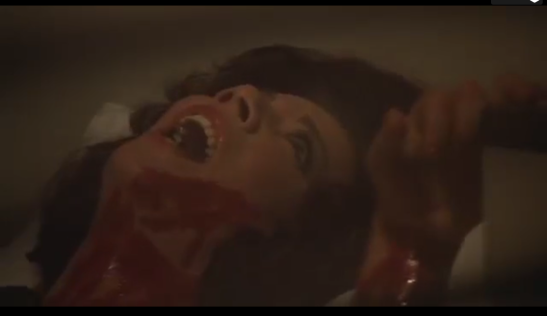
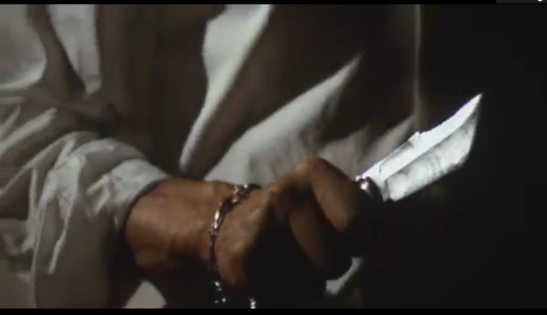
A placid woman waits in her modern chic apartment until dark. She ritualistically dresses elegantly and exits her apartment building wearing sunglasses, a bright red coat, and an unsheathed straight razor. As she wanders the streets, she locates a target, another woman, and stalks her with a bloody thirst in her eyes. When approaches from behind to only turn around her victim and come face-to-face with an exposed neck, she slashes away at the jugular, slicing crudely a blood-splattering spree that manifests a smile across her face. She returns to her apartment where she’s visited in between her straight razor murders by a lady dressed and veiled in black, priming the elegantly dressed woman for the next kill. The blade continues to slash through napes nightly, memories of the woman’s past seep into her psyche to a terrifying outcome of how she became a killer.
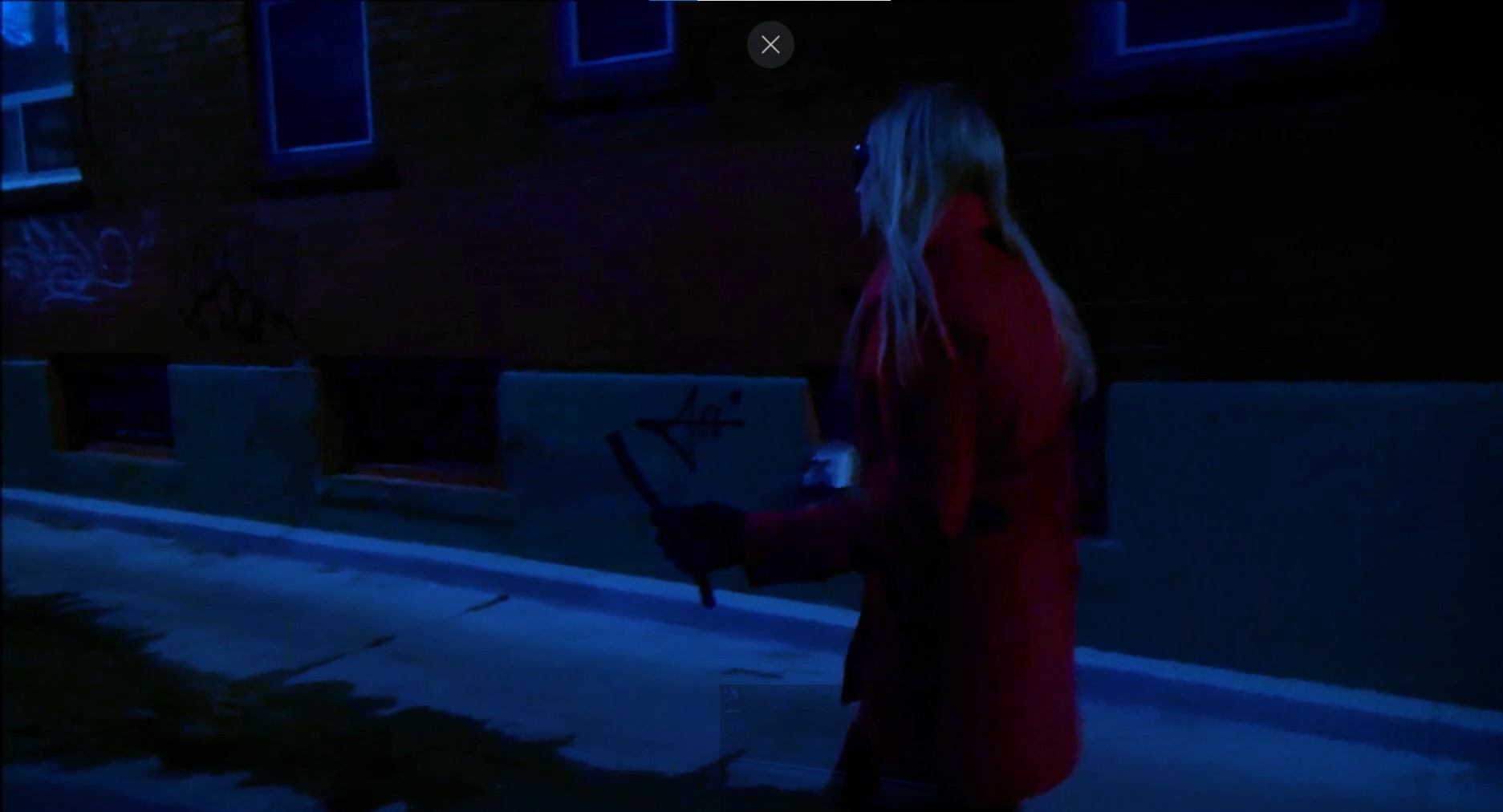
“Girl With a Straight Razor.” Simple, yet effective. The eye-catching, razor-sharp title certainly has a couple of key words combined together audiences often drool over just by the very straight-forward approach and appealing word sequences that make the appearance of an idiosyncratic title that much more desirable. Canadian horror-filmmaker Chris Alexander seizes advantage writing-and-directing a script that’s a numbing-gaze reminiscent in homage to giallo by assembling the trademark motifs of stark red coloring, gloved hands shot in a first-person view, and the use of a melee blade familiar to the Italian-made mystery-thriller genre for a fever dream highlighted as a pain-pleasure principled purgatory. The “Female Werewolf” and “Necropolis: Legion” director also composes the film and controls the overall look of the colorfully prone to epilepsy cinematography that jars sense the visual cortexes. “Girl With a Razor Blade” is the first feature production of the Vancouver based Molemen Entertainment and is produced by Vince D’Amato, the founder and managing partner of Darkside Releasing who released the film on home video this year.
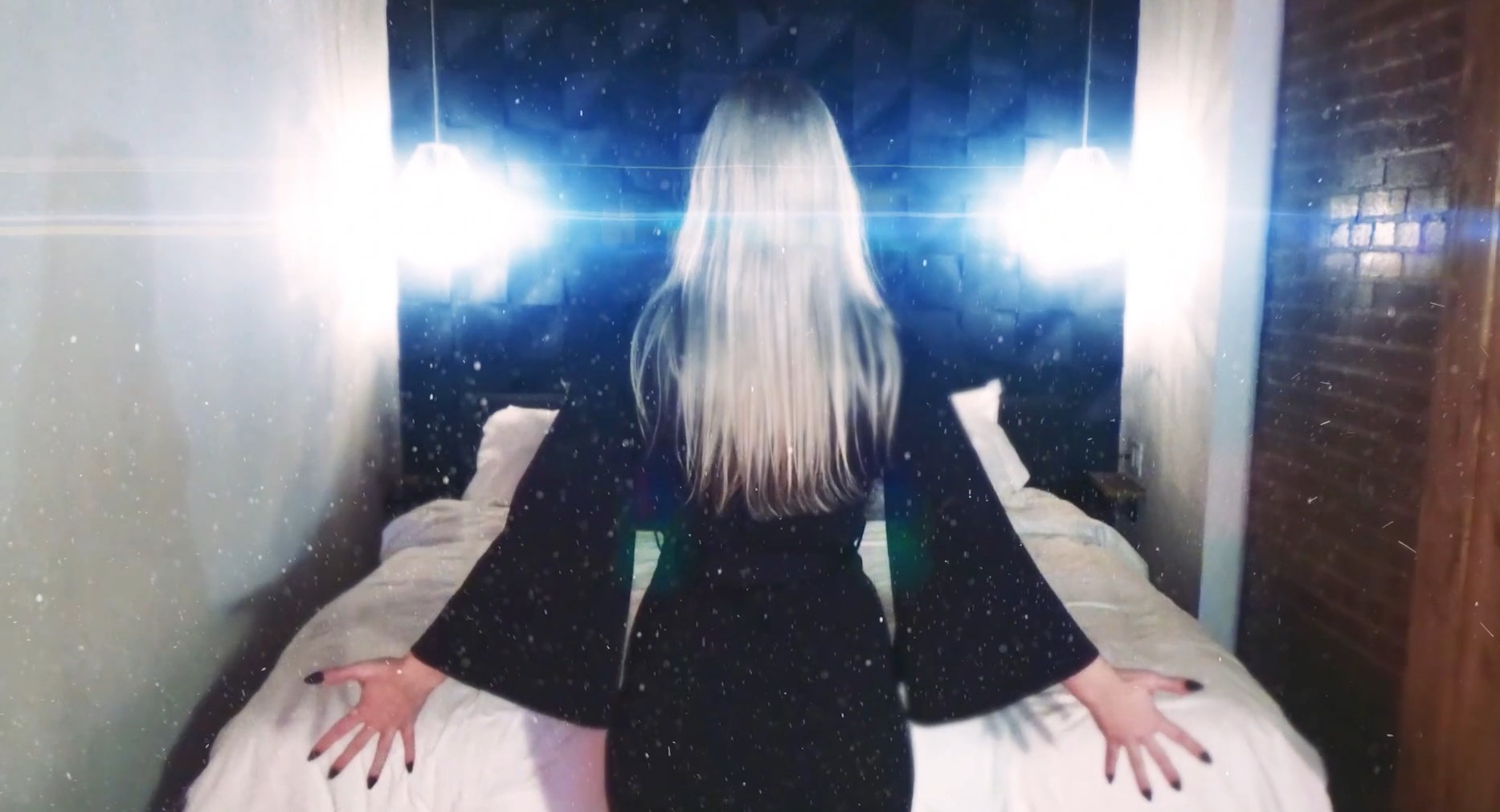
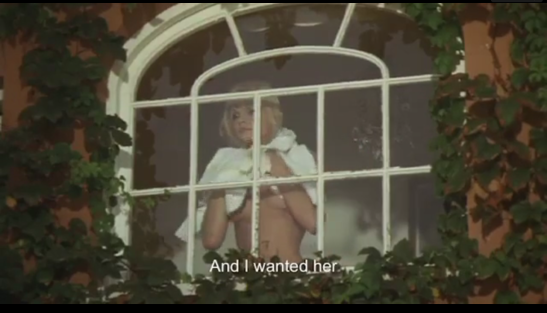
If you want to make a low-budget film and keep a lot of change in your pocket, hire only a handful of decent, well-rounded actors and actresses to maintain the spirit of independent filmmaking that balances the budget as well as balances the filmmaker’s creativity with semi-creditable performances. If you want to make a low-budget film and keep dollar bills in your pocket, hire two actresses where one only has two to three scenes max with no dialogue and the other have them play four different versions of themselves with very little dialogue. The minimal dialogue forces Alexander into a creative environment where express the principal’s emotional deluge, or lack thereof, can be displayed in a range of camera angles, his musical composition, and the variegated kill scenes contrasted against contrasting black and white visuals. In these scenes are a pair of Chris Alexander regulars. Having had roles in some capacity 2019 re-imagining of Bruce Hickey’s “Necropolis” from 1986, Thea Munster finds herself again in front of the director as a ghostly, haunting figure costumed in an old-fashioned lacy black dress as if going to a funeral, to which she’s properly playing a character called Lady Death so there’s no ambiguity about the status and intentions from the grim reaper concept, and Ali Chappell who isn’t foreign to leading lady role with Alexander and has the nearly the entire story on her shoulders with scenes of her as the lady in red cutting the throats of window shoppers on a nightly basis that becomes reverse engineered into the deconstruction of her as a killer with humanizing sympathy. Despite not much dialogue, both Munster and Chappell hit their marks and cater to Alexander’s idea of posturing expression that mostly involves Chappell laying topless in an egg-shaped chair, an animal skinned carpet, or on a black mannequin chair.
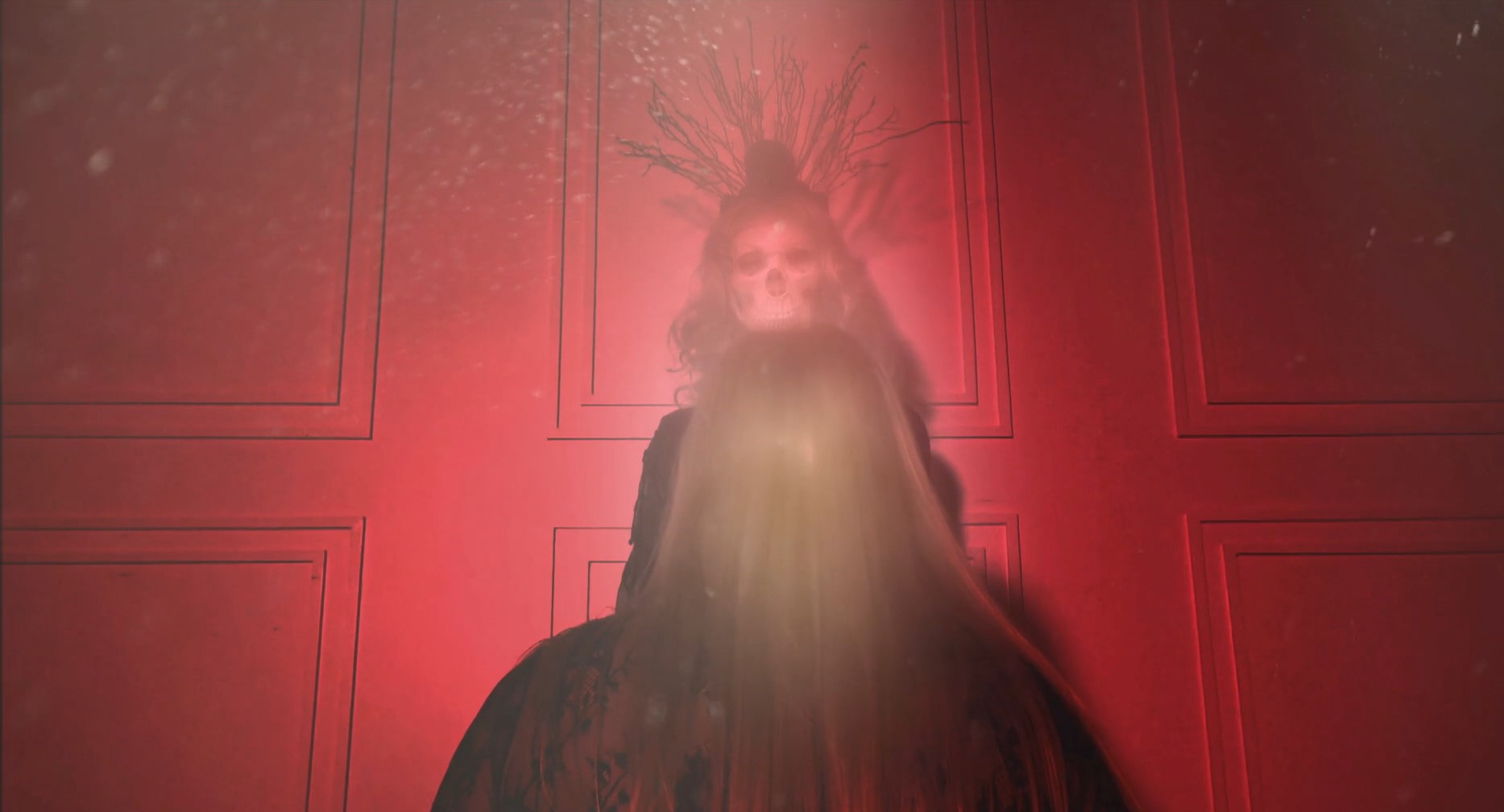
“Girl With a Razor Blade” is cutting-edge existentialism and novel re-imagining around the idea of death’s plans for us all. Alexander dives into the depths of mortal consequences that limbo the soul into a loop of insensible pain and suffering.  As we learn more about this woman and her marital troubles, presumably separated by legal force and a resentfully angry husband, from her child, Chappell’s character has no other place to go than down into darkness, mentally and physically.  Its during that time Lady Death approaches to become a harbinger of death, puppeteering her subject’s will to conduct more self-harm as the villain and the victim in a mind warping illusion that’ll fool the viewers’ perception of the woman’s insatiable lust for red jugular juice.  Alexander’s cinematography style is simply ethereal and elegant with a touch of precise choreography in the characters positions and movements to reflect a vivid dichotomy between the present stillness of surrealism and the past’s stressful reality. “Girl With a Razor Blade” is grim bordering the line of certain religious doctrines in condemning oneself to an unsavory existence, if you can even call it an existence, of facing yourself, your fate, over and over again until no longer the feeling the need to spill blood is gnawing at the marionette strings and waking up to the truth, facing it, can be free. There are moments the blade is a sexual object, almost like an obsession with what it represents, which would be death, that can be addicted, can’t be ignored, and won’t let you forget it.
Stylish, cryptic, and thought provoking, Chris Alexander’s seventh film “Girl With a Straight Razor” cuts onto a high-definition, AVC encoded, Blu-ray home video courtesy of Darkside Releasing. Two versions of the film are available – a Darkside Releasing expanded cut with a runtime of 67 minutes and a director’s original cut of the film with a runtime of 57 minutes. Both produced during the pandemic films are presented in a widescreen 1.78:1 aspect ratio. Picture quality wasn’t the best for Darkside Releasing with a shaky, often banding, image mostly throughout due to compression issues. You can see the blurry splotches in the darker portions of the scenes. Delineation is also difficult during rainbow strobe effect when the woman slices at away during a kill moment in a fit of haziness that leaves barely an outline of the contours. In fact, Alexander’s style is all over the map with filters, lens flares, and gel lighting that can be a little too much and gaudy to digest. The English language 5.1 surround sound has a lossy framework that’s more of a soft crunch than a sharp crisp. There isn’t much dialogue to be hand in the film, but the clarity is there, it’s just not robustly defined. Aside from two versions available of the film, bonus features also include an audio commentary on the director’s cut, three short music videos by co-star Thea Munster and her band “Night Chills” as she spotlights her niche playing of the theremin instrument, and Darkside Releasing 2021 Giallo and Surreal trailer reels. A character-driven and introspective “Girl With a Razor Blade” laments as an acquiescent nightmare breaded lightly in giallo features and fried heavily in the abstract qualities of surrealism. Don’t expect Chris Alexander’s film to be straight forward giallo with a straight blade razor and you’ll come out with only a close shave nick into your expectations.

“Girl With A Straight Razor” available on Blu-ray and DVD at Amazon.com!

EVIL Lights Up When Peeling Skin! “Human Lanterns” reviewed! (88 Films / Blu-ray)


Own this beautiful release from 88 Films of the “Human Lanterns”

Two respected and wealthy Kung-Fu masters have a long rivalry, trying to one-up each other at any cost even if that means stooping into their personal life to gain the most public admiration.  With the annual lantern festive approaches, to have the best and brightest lantern would sustain at least a year of gloating over the other master.  When a lantern maker with a retaliation mindset against one of the more boastful masters is hired to make his festival entry, the lantern maker exacts horrifying revenge by fueling their feud behind the scenes. Kidnapping beautiful women who are dear to each master and exploiting their soft delicacies for his crazed creations, the maniac lantern maker turns the village upside down, forcing the local constable into an impossible investigate into the village’s most popular residents when none of the evidence points to the other.

“Ren pi den long,” aka “Human Skin Lanterns,” aka “Human Lanterns” is a grisly Kung-Fu murder-mystery that’ll make your skin crawl right off from your body. The stylishly colored and ethereally varnished 1982 Hong Kong film is written-and-directed by Taiwanese director Chung Sun (“Lady Exterminator) that blended the likes of a giallo mystery into the well-choreographed martial arts mania with the profound Kung-Fu screenwriter, Kuang Ni (“The One-Armed Swordsman,” “The Flying Guillotine”), co-writing the script alongside Sun. While not as ostentatiously gory or as cinematically profane as the 80’s released Category III certified films that rocked Hong Kong audiences, and the censor board, with shocking, gruesome imaginary and content, “Human Lanterns” does sit teetering on the edge with mostly a tame Kung-Fu feature that quickly turns into the blistering carnage of a basket case, or in this a lantern maker, who uses hiding as a double entendre. “Human Lanterns” is a Shaw Brothers Studio production executively produced by the oldest of two brothers, Rumme Shaw, and, then new to the Shaw Brothers’ board of directors, producer Mona Fong.

“Human Lanterns” starred two the renowned names in martial arts films from the 1970s and well into the 1980s with “Fist of Fury” and “The Swordsman and the Enchantress’s” Tony Liu as the impeccably arrogant Lung Shu-Ai with a self-image to protect more than the women in his life and “Bloody Monkey Master” and “Return of the Bastard Swordsman” Kuan Tai Chen sporting a sweet mustache as Lung’s longtime rival, Tan Fu. Shu-Ai and Chen have really spot on, well-versed, fight sequences together braided into their play off each other’s character’s haughty personas. While behind the curtain of overweening and defiance between the two masters, Chao Chun-Fang unceremoniously sneaks into the fold by happenstance as Lung offers him money for the best lantern this side of the lantern festival. Lung and Chao Chun-Fang, played with a demented, idiosyncratic duality from Leih Lo (“The Five Fingers of Death,” “Black Magic”), another master in the art of fighting in his own style, have an inimical past…well, at least thought so by Chun-Fang. In a sword dual over a woman, Lung defeats Chun-Fang and purposefully scars him above the left eye, causing him the inability to look up, and while the lantern maker has stewed for many years, training all the while to be the best fighter, his tormentor Lung Shu-Ai has nearly all forgotten about the incident and found trivial enough to ask Chung-Fang to make him a lantern and offer him out for drinks for being old buddies of yore. However, this yard pulls the wool over the eyes of self-centered, the upper class, and the unruffled nonchalant as Chung-Fang takes advantage of the Kung-Fu masters naivety and uses the rival as a screen to cover up his kidnapping deeds of the women in their lives, played by Ni Tien (“Corpse Mania”), Linda Chu (“Return of the Dead”), and Hsis-Chun Lin. “Human Lanterns” rounds out the character list with a hired assassin in Meng Lo (“Ebola Syndrome”) and a competent but out of his league village constable in Chien Sun (“The Vampire Raiders”).

The look of “Human Lanterns” is often dreamy. No, I don’t mean dreamy as in gazing into the strong blue eyes of your tall and dark fantasy man. The dreamy I’m speaking of is produced by cinematographer An-Sung Tsao’s luminescence that radiates of background and the characters through the wide range of primary hues. Tsao’s colorful and vibrant eye doesn’t clash with the vintage era piece consisting of impressively detailed sets, a costume design plucked straight from the 19th, and hair, makeup, and props (which I’ve read some of the blades were authentic) to bring up the caboose of selling the completed package of delivering a spot-on period film. When Leih Loh dons the skull mask, an undecorated and unembellished human skull, with wild, untamed hair sprouted from every side of the eyeless mask, Loh transforms into a part-man, part-beast jumping, summersaulting, leaping, and seemingly flying through the air like a manically laughing ghost. The visual cuts petrifyingly more than described and if you add an extensive amount of Kung-Fu to the trait list, “Human Lanterns” has a unique and unforgettable villain brilliantly crafted from the deepest, darkest recesses of our twisted nightmares. “Human Lanterns” has a wicked and dark side that balances the more arrogantly campiness of Lung and Tan’s hectoring rivalry. When Lieh Loh is not skinning in his workshop or Lung and Tan are not bullying each other into submission, there’s plenty of action with the heart stopping, physics-defying martial arts that just works into the story as naturally as the horror and the comedy. With shades of giallo and fists of fury, “Human Lanterns” is Hong Kong’s very own distinctive and downright deranged brand of good storytelling.

88 Films lights the way with a new high-definition Blu-ray of the Shaw Brothers’ “Human Lanterns” from the original 35mm negative presented in Shawscope, an anamorphic lensed 2.35:1 aspect ratio that more than often displays the squeeze of the picture into the frame. One could hardly tell the upscale to 1080p because of the very reason I explained in the previous paragraph of the airy An-Sung Tsao façade that softly glows like bright light behind a fog. Nonetheless, the image quality is still stunning and vivid, a real gem of conservation and handling on this Blu-ray release. The Mandarin dubbed DTS-HD 1.0 master audio is synched well enough to the action for a passing grade. The foley effects, such as the swipes and hits, are often too repeated for comfort, but adds to “Human Lantern’s” campy charm. The newly translated English subtitles are synchronous with the picture and are accurate but, in rare instances, come and go too quickly to keep up with the original language. The release comes not rated with a run time of 99 minutes and is region locked at A and B. Why not go full region free is beyond me? Licensing? Anyway, special features include an audio commentary by Kenneth Brorsson and Phil Gillon of the Podcast On Fire Network, “A Shaw Story” interview with then rising Hong Kong star Susan Shaw who talks about the competitive and easy blacklisting Hong Kong and Tawain cinema market, “The Beauty and the Beasts” interview with in story brothel mistress played by Linda Chu often harping upon not wanting to do nudity despite directors begging her, “Lau Wing – The Ambiguous Hero” interview with Tony Liu that comes with its own precaution title card warning of bad audio (and it is really bad and kind of ear piercing) as the lead man really regales his time on set and in the industry between Golden Harvest Productions and Shaw Brothers Studios, and rounding out the main special features is the original trailer. The package special features is a lantern of a different color with a limited edition cardboard slipcase with new artwork from R.P. “Kung-Fu Bob” O’Brien, a 24-page booklet essay entitled “Splicing Genres with Human Lanterns” by Barry Forshaw accompanied by full colored stills, posters, and artwork by O’Brien, a double-sided fold out poster, and reversible Blu-ray cover art that can be flipped from the same, yet still awesome, O’Brien slipcover art to the original release art. The new 88 Films’ Blu-ray set conjures a renaissance satisfaction like none other for a highly recommended, genre-ambiguous, vindictive affray.

Own this beautiful release from 88 Films of the “Human Lanterns”

Kissing Cousins and a Foreboding EVIL Feline in “Seven Deaths in the Cats Eye” reviewed! (Twilight Time / Blu-ray)


“Seven Deaths in the Cat’s Eye” now available on Limited Edition Blu-ra from Twilight TIme!

Set in the 1970s, the aristocratic McGrieff is on the verge of collapse with financial ruin that’ll cost the once respectable family their castle set in a small Scottish village.  Full of intrigue and ominous mystique, foreboding supernatural superstitions surrounding the McGrieff name, but that doesn’t frighten the young London residing Corringa from visiting her aunt Lady Mary’s castle.  Not before too long, Corringa’s mother, Lady Mary’s sister, mysterious dies in her bed and in the wake of her death more bodies are found with their cut throats all in the presence of the Castle’s roaming domestic feline.  Suspects range from Lady Mary herself in desperation for her sister’s sudden fortune to her unstable, gorilla-saving son James to also her in-house doctor lover who’s also sleeping with a live-in promiscuous woman intended for the young James.   Melodrama runs rampant and so does a killer who cuts down McGrieff Castle residents one-by-one in the dark corridors and gothic-laden rooms.

The Gothic-“Clue” of the 1970’s, “Seven Deaths in the Cat’s Eye” is the wildly entertaining Italian-produced giallo horror from the “Castle of Blood” and “The Long Hair of Death” director Antonio Margheriti credited under his more English-sounding pseudonym of Anthony Dawson.  Otherwise known with more animal ferocity as “Cat’s Murdering Eye,” as well as simply “Corringa, or in the native tongue as “La morte negli occhi del gatto, this mad family murder-mystery thriller is speculatively based off a novel by Peter Bryan, an extremely English sounding author whose original novel has yet to be revealed as the adapted base for Margheriti’s film or if a book even ever actually existed on what is more than likely, in my opinion, based off an obscure Italian author’s oral narrative or short story since the country at that time had laxed or nonexistent copyright laws – a method that produced a mass amount of unauthorized piggyback sequels for quick cash in on the popularity.  Either way, “Seven Deaths in the Cat’s Eye” is a thrilling, uncontained, and verbose black letter giallo co-written by Margheriti and Giovanni Simonelli (The Crimes of the Black Cat), produced by Luigi Nannerini (“A Cat in the Brain”), and is filmed in Italy under Capitole Films who appealed to westernized audiences with low-budget popular genre films at their peaks. 

At the heart of the story is Corringa, a progressive and modern Londoner travelling to join her mother and aunt at Castle McGrieff a few days earlier than expected after being kicked out for sneaking out on late nights from her all-girl Catholic boarding school and consorting with boys.  The “Dark Places’” English actress Jane Birkin embodies Corringa’s free-loving and innocent spirit becoming the white sheep amongst the Castle’s broody and plotting inhabitants.  Corringa is thrusted into the happenstance heroine of unravelling a mystery that causes her to freak out upon every discovery whether be the gruesome and distressing visual she walks into to the mere mention of someone’s throat being sliced open that sends her running and screaming into the arms of her cousin James, played confidently cool with a hint of madness in a red herring role by American actor, Hiram Keller.  The “Smile Before Death” actor had a small stint working in the Golden Age of Italian cinema with “Seven Death’s in the Cat’s Eye” being one of those projects, but his role of James is an interesting one as the Lord of the Castle who is considered mad, uninterested in either women or continuing the family lineage, and keeps a former circus gorilla caged up in his room.  One other at a loss and gross side of James, and also of Corringa, is their incestuous affair.  Yes, that’s right, the first cousins get it on like Donkey Kong as they share the bedsheets whilst embroidered in another arcana that’s more in the life and death taboo category.  Yet, all the characters are essentially in some wanton fashioned relationship with each other.  While cozying up to the Lady of the Castle, French actress Françoise Christophe (“Fantômas”) in order to gain favor within lordliness, physician Dr. Franz (Anton Diffring, “The Man Who Could Cheat Death”) also porks the “French Tutor” Suzanne on the downlow for some lust and relaxation.  German actress Doris Kuntsmann plays nomadically alluring to the dark-haired red herring outlier who is hired off the streets from her solicitating sex position by Lady Mary and Dr. Franz to be James’ break from his internal shell, bedfellow companion.  Meanwhile, the promiscuous Suzanna tries to sack up with Corringa in this full house of varied sexual appetites.  The ensemble cast continues with Dana Ghia (“My Dear Killer”), Serge Gainsbourg, Luciano Pigozzi, Venantino Venantini, Konrad Georg, and Bianca Doria. 

With an international cast, “Seven Deaths in the Cat’s Eye” enlists heterogeneous talent to continuously keep one on their toes surrounding every dead body that winds up throat mangled or moved from the original death stroke spot and Margheriti certainly has a firm grip on our attention between the polyamorous and dissolute sexual anarchy and the tension toned suspiciousness that ceaselessly keeps not only the characters on edge of each other but also rattles audiences anxiously squeezing their pressurized minds wrapped tightly around a castle-sized amount of distrust and suspects. “Seven Deaths of the Cat’s Eye” evokes the mad family subgenre with Margheriti’s family contending to be one of the most psychosexually and depraved group of backbiters and backstabbers of its time. Margheriti and Simonelli’s story is sensationally complex without being terribly complicated by beginning with the death of an unknown man where rats gnaw and eat away his decaying flesh. From then on, the narrative works ever so hard to purposefully not touch upon or identifying the mystery man’s demise until the bitter encounter end with a revealing finale exposure of a shocking killer that speaks volumes on the filmmakers’ intrinsic misdirection, a machination that keeps characters endlessly on the fence with their motives, and a conversation that is indecorous in a gothic setting.

If you’re looking for a different kind of giallo, “Seven Deaths in the Cat’s Eye” is that atypical wild card and now the Antonio Margheriti 1973 film has been released onto a limited-edition Blu-ray from Twilight Time and distributed by MVD Visual. The unrated, region A Blu-ray runs 95 minutes long in a 1080p high-definition resolution, presented in a widescreen 2.35:1 aspect ratio. I wouldn’t say the image is a complete polished look, but the transfer restoration from Rewind Film and the Screen Archives Entertainment has excellent detail surrounding the textural complications of the cast, interiors, and exterior settings, especially the graveyard. There are minor instances of banding around the skin in low lighting and the illuminating contrasts is rather low, leaving quite a few frames in the dark so to say. Although an Italian production, English is the language spoken and amongst an international cast, dubbing over certain performances was more than likely done, but the overall dialogue track didn’t match precisely the image in about a quarter of a second delay on the English LPCM 2.0 stereo track which also very muffled like being underwater. However, the “Cannibal Holocaust” composer Riz Ortolani has a score of majestically inspirational proportions as far as horror soundtracks go with a tingling guitar riff that sits heavy in the pit of your stomach as the master of orchestration compositions brings this feature to ahead with this arrangement. The Italian LPCM 2.0 is a more obvious lips out of synch dub but offers an equally robust Ortolani soundtrack. While there are no bonus features on the release, the Blu-ray package itself comes with a 11-page color booklet with images and an essay by author Mike Finnegan along with a reversible Blu-ray cover art containing images from the film and a snazzy disc cover art designed by Twilight Time. Much deserved and sorely underrated, “Seven Deaths in the Cat’s Eye” is back on the prowl with a new limited-edition release to sink your teeth into.

“Seven Deaths in the Cat’s Eye” now available on Limited Edition Blu-ra from Twilight TIme!

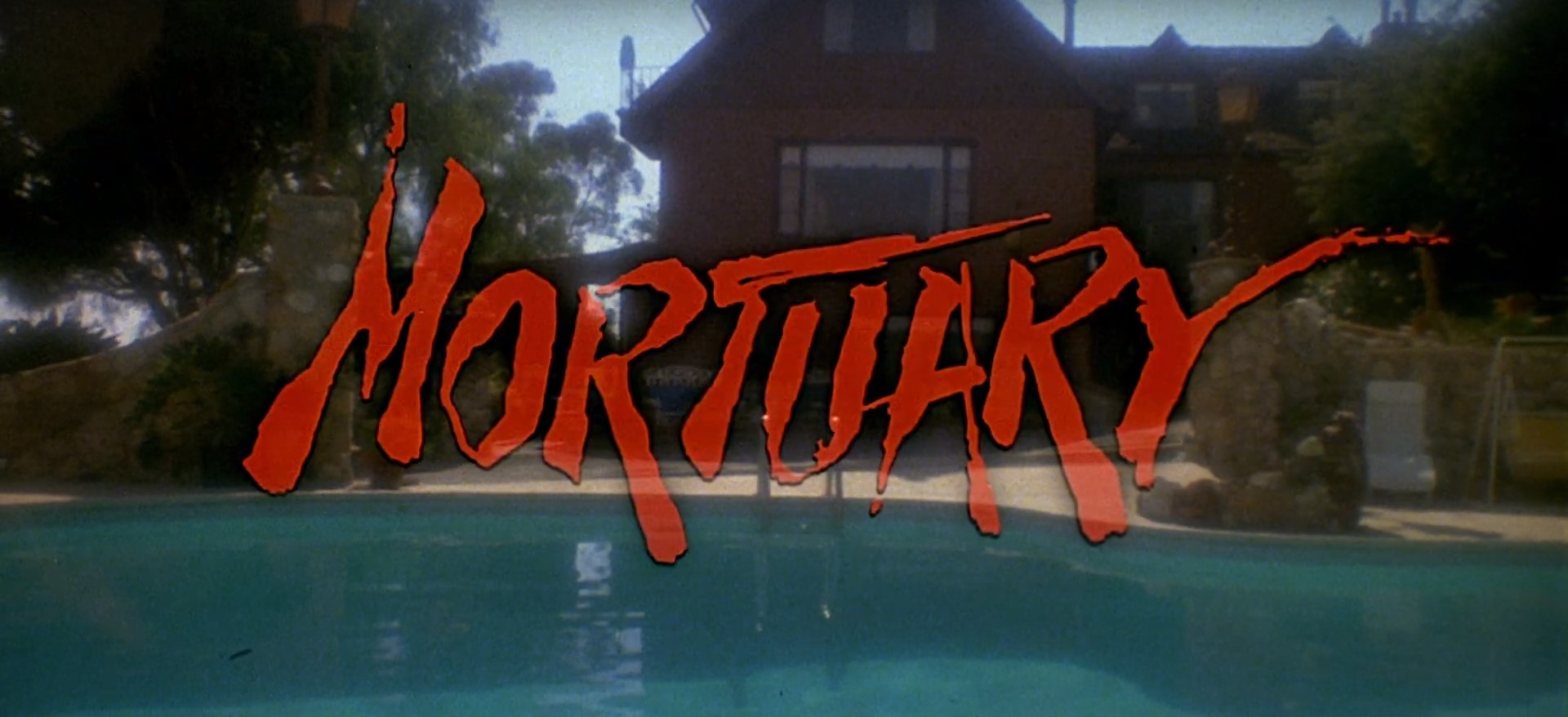
Early Bill Paxton EVIL in “Mortuary” reviewed! (MVD Visual / Blu-ray)

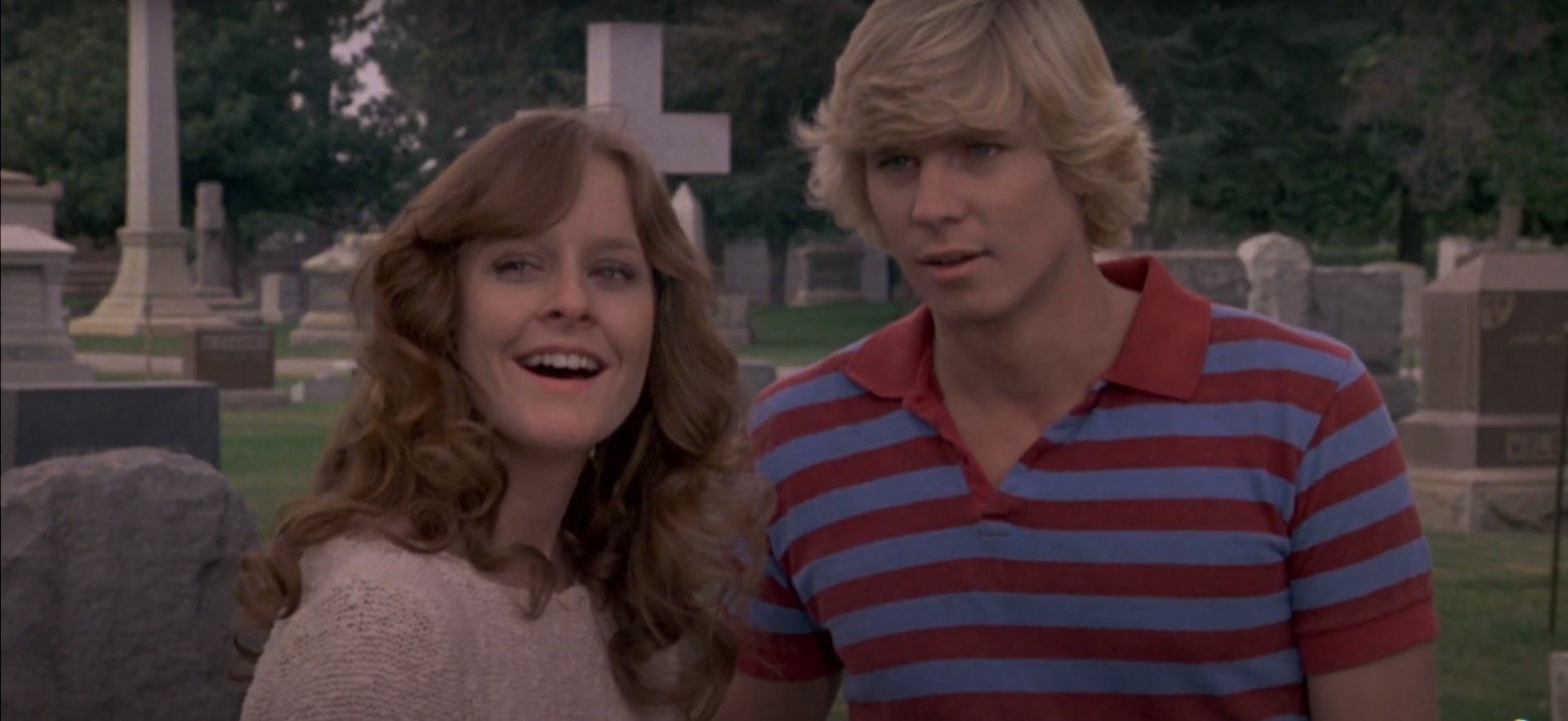
The tragic swimming pool drowning of Dr. Parsons might not have been an accident as determined by the police.  At least that is what his daughter, Christie, believes and she is for certain her mother has some involvement in the so called accident.  Plagued with nightmares followed by a stint of sleepwalking a month after her father’s untimely demise, Christie tries to maintain a semi normal life as a high school student romantically involved with boyfriend Greg Stevens.  Meanwhile, Greg’s best friend disappears after the two trespass onto local mortician Hank Andrews’s storage warehouse.  Christie and Greg unwittingly become embroiled into sinister intent by a masked and caped ghoulish killer stabbing victims with a detached embalming drain tube and at the center of it all is Hank Andrews and his son Paul’s family morgue that processes and possesses all the dead’s secrets. 

Before Wes Craven’s “Scream” mega-franchise turned caped killers revolutionary cool with meta-crafting horror tropes of the genre slasher, there was the little known “Mortuary” that perhaps paved just a slab of keystone for the Ghostface Killer who has become the face of slasher films for more than 20 years, much like Jason Voorhees or Michael Myers back in the 1980s and early 90s.  Written and directed by the Baghdad born filmmaker, Hikmet Labib Avedis, credited under the more westernized stage name of Howard Avedis, the 1983 film nearly had all the hallmarks of a peculiar macabre dance that skated around the slasher sphere.  “Mortuary” had seances, pagan rituals, a shrouded murderer, and, of course, the embalming of dead, naked bodies that are the inevitable, natural, mortality reminding entities in movies regarding morgues.  The late director, who passed away in 2017, cowrote the film with wife, producer, and actress Marlene Schmidt who had a role in every single piece of his body of work.  “Mortuary” was self-produce by the husband and wife filmmakers under their Hickmar Productions company and by grindhouse producer Edward L. Montoro (“Beyond the Door”).

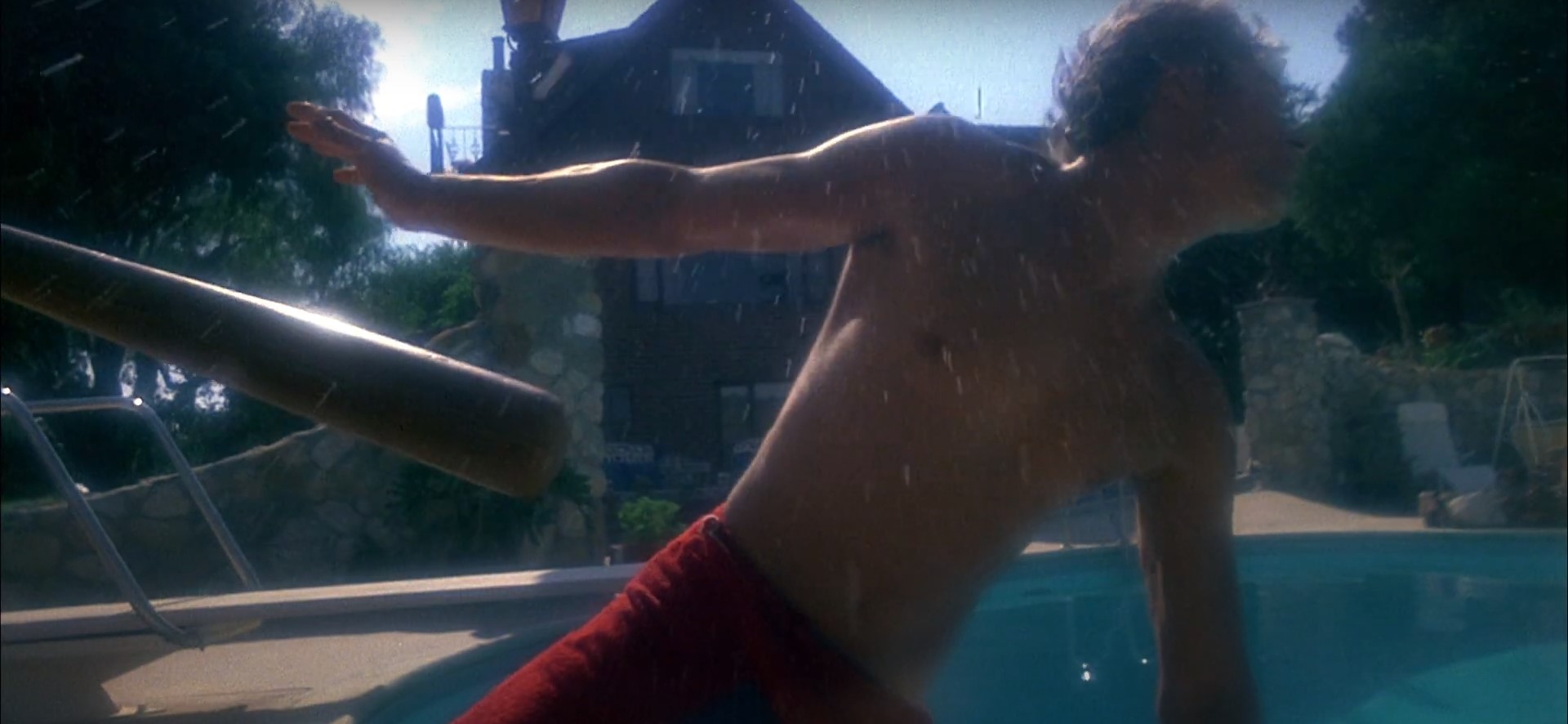
Though the post-credit opening scenes begins unscrupulous enough with Greg Stevens, played by television soap opera star David Wysocki whose credited as David Wallace, and his best friend Josh (Denis Mandel) stealing tires from Josh’s ex-employer, morgue owner Hank Andrews, the late “Day of the Animals” and “Pieces’s” Christopher George’s last cinematic role, because of being fired without being paid for his services, “Mortuary” inconspicuously moves from Stevens’ infringing on local law to surround itself more aligned with Stevens’ girlfriend Christie Parsons who feels more like a backseat character upon introduction.  Yet in a flurry of exposition with her mother, Christie, who is played by “Mom” actress Mary Beth McDonough, circles back and ties into the opening credit scenes of an unknown man being bashed over the head with a baseball bat and falling into his pool.  We learn that the man is Christie’s father whose death has been rule an accident (no evidence of baseball bat related injuries? Was evidence collecting really that low-tech in the 1980s?), but Christie begs to differ as she point blank accuses her mother, Christopher George’s life co-star Lynda Day George, being involved in his poolside death.   While performances statically hover inside the wheelhouse of teen horror with Greg and Christie seemingly unaffected by the mysterious incidents happening all around them until someone literally is grisly murdered in their adjacent bedroom, a fresh-faced Bill Paxton (“Frailty”) inevitably steals the show with this enormous presence on screen as Paul Andrews, the town’s mortician loony son working for his father as an embalmer.  Paxton’s zany act borders “Mortuary” as either a diverse trope horror with an awkward outlier character stuff into the eclectic mix or a seriously unserious bluff of being a serious horror film – see what I did there?  Paul listens to Mozart on vinyl, has an obsession for Christie, and likes to prance and skip through the graveyard as a son broken by his mother’s unhinged suicide.  “Mortuary” rounds out with Curt Ayers (“Zapped!”), stuntwoman Donna Garrett (“The Puppet Masters”), Greg Kaye (“They’re Playing With Fire”), Alvy Moore (“Intruder”), stuntman Danny Rogers, Marlene Schmidt, and Bill Conklin as a walking contradiction as a beach town sheriff wearing an unabashed cowboy hat like a sorely out of place rootin’-tootin’ lawman from the West complete with country draw lingo. Also – don’t miss the bad nude body double used for McDonough when Christie is lying on the morgue slab.

Now, I’m not saying “Mortuary” is the sole inspirational seed that sowed the way for the “Scream” franchise, as I’m sure many, many other iconic classics inspired Kevin Williamson, but, in my humble opinion as an aficionado about the genre components and how they’re all connected by a few or many degrees of separation, “Mortuary’s” villain could be the long, lost ancestral sperm donor responsible for the origins of Ghostface.  The purposeful movements and actions align very closely in a parallel of deranged defiance and floaty black and white costumes.  However, “Scream” is just packaged nicer as “Mortuary” continuously drips all over the place like a three scoop ice cream cone on a hot summer day.  Containing Avedis’s arc on Christie was nearly impossible as each act jumps and focuses on someone entirely different while also exposing the killer blatantly without even trying to misdirect or repel any kind of suspicion.  It was as if Avedis and Schmidt swung for the fences with a convoluted giallo mystery plot but couldn’t figure out how to build that into the narrative without drawing from and drowning in exposition and that’s how the cards came crashing down by unfolding with talking head pivotal plot points that steered to a rather quick, yet pleasant, climatic head of a total mental meltdown that’s much more cuckoo than Billy Loomis and Stu Macher will ever be. 

If you didn’t score a copy of Scorpion Releasing’s limited edition release of “Mortuary” on Blu-ray, then sing the praises of second chances with this Scorpion Releasing Blu-ray reissue through the MVD Visual Rewind Collection line. The all region release is presented in a high definition, 1080p, widescreen 1.78:1 aspect ratio of the Scorpion Releasing AVC encoded transfer on a BD25. Quality-wise, the release delivers the perhaps the full potential of a cleaned up 35 mm restore with no sign of cropping, edge enhancing, and a healthy amount of good grain, but there are noticeable gaffes with select scenes that seemed to have missed or left out of the restoration all together, reverting back to the rough, untouched image. Coloring, skin and objects in the mise-en-scene, come out lively, naturally, and without a flutter of instability with transfer damage at a minimum. Probably the most surprising is the original 2.0 mono LPCM track. The English language mix does the job without climbing the audiophile corporate latter, leaving in the wake a soft dialogue that’s a struggle to get through if you’re not wearing headphones. Depth seems a little slim, but the range keeps progressing nicely that often feeds into the late John Cacavas score. Cacavas operatic film score is bigger than the movie itself, often grandiose the Gary Graver one-note cinematography. The overexposed ethereal flashback has slapped redundant fatigue plastered all over it but, then again, the film is from the 80’s. Option English subtitles are available. Special features include only an interview with John Cacavas from 2012, from the original Scorpion Releasing print. Two upsides to the MVD Visual release are the cover art mini-poster tucked inside the casing and the added cardboard slip cover that resembles a tattered VHS rental tape slip box complete with a faded Movie Melt yellow caution sticker, a Be Kind, Remind sphere sticker, and a Rated R decal. If you’re a big Bill Paxton fan, “Mortuary” reveals another shade of talent from the late actor. Other than that, the Howard Avedis production often haphazardly stumbles bowleggedly to a giallo-errific-type ending made in America.

EVIL Hatches a Plan Against EVIL! “Death Laid an Egg” reviewed! (Cult Epics / Blu-ray)

The Chicken farm and trading association industry lies on the fringe of near collapse and poultry scientists are hastily working on a solution experimenting with chicken embryos to create more meat for a nosediving commerce, but that doesn’t concern farm owner Marco whose more interested in having an affair with his wife’s young and beautiful cousin, Gabrielle, as well as moonlighting in his perverse side hobby of killing prostitutes at a hotel room.  Marco’s wife, Anna, who runs the farm single handily with the assistance of newly purchased machines, is ignorant of Marco and Gabrielle’s more-than-casual dalliance.  When a genetic modification accident produces the bulbous, meaty parts of live chickens without the heads, necks, and wings, the chicken association sees this changing event as the potential saving grace for chicken farmers everywhere and a financial reconciliation from foreboding ruin, but Marco wants nothing to do with the horrors of livestock manipulations and abominations.  Unable to understand his hesitation, Anna’s frustration is compounded by an anonymous note about Marco’s “affairs” with prostitutes that sends a simmering love triangle into a deadly internal coup.

What came first, the Chicken or the Egg?  In Giulio Questi’s inverted giallo thriller, “Death Laid an Egg,” the insoluble question parallels another question, who is deemed more sordid, an unchaste husband with a decadent desire for killing prostitutes or those conniving a plot involving murder to expose his vices and overthrow his wife for total control of their budding chicken farm? The 1968 Italian Giulio Questi and Franco Arcalli (“Tis Pity She’s A Whore”) written collaboration roosts at the edge of being an Italian murder mystery because of the atypical structure not terribly familiar to the genre and it’s fandom. Instead an unknown, gloved hand killer with a switchblade reflected with gleamingly terrified eyes of a barely clothed young woman screaming at the very top of her lungs, “Death Laid an Egg” is an Italian-French coproduction between Summa Cinematografica, Cine Azimut, and Les Films Corona.

At the epicenter of this switcheroo intrigant and strange triangular love affair are Marco, his wife Anna, and Anna’s younger cousin, Gabrielle, and only one of them, one of the three inside and out of the chicken farm, don’t entangle themselves in illicit activity.  French born actor, Jean-Louis Trintignant, stars as the diverging Marco with infatuating love sickness for his wife’s secretarial cousin, Gabrielle.  The “So Sweet… So Perverse” and “Malevil” star emits a pressurizing performance, ready to melt down and volatilely combust, when Marco agitatedly paces between Anna (Gina Lollobrigida of the French versions of “The Hunchback of Notre Dame” of 1956) and Gabrielle, played by a relatively newcomer to the silver screen from Sweden in Ewa Aulin (“I Am What I Am”) to traverse from an old love to a new love despite the possibility of losing his entire livelihood.  The two female principles’ distinct personalities make for a great Trojan horse of shocking betrayal that goes against the grain and against the proverb that blood is thicker than water and Questri exploits with hard unstrung scenes of choppy segues that leave behind granular clues to their intentions in an almost abstract, auteur series of events.  When the love triangle because a quartet and actions become clearer with the clarity in advertisement specialists, Mr. Mondaini’s, underhanding involvement, a role shrouded in apprehensive mystery by Jean Sobieski, the enigma dissipates rapidly into a more tempered narrative of ill-tempered acts.  None of the four actors are cherished with equivalent screen time, orbing around more Marco’s ping-pong, zig-zag unconventional philandering and Gabrielle’s supporting role as Anna’s relative confidant, and this creates a visceral tension in the forefront of a economic crisis in the chicken farm market.

Giulio Questi always seemed to be pulling back the, excuse the pun, yoke to never let “Death Laid an Egg” fully nosedive into a blaze of a gruesome glorified giallo full of sleuth paranoia and scantily-cladded female victims stalked, hunted, and, eventual, murdered, but the Italian film, which saw a fair share of censorship cuts bordering around those aforesaid attributes, had no pretense about being a part of the traditional sense of the genre in the first place.  I wouldn’t even consider Questi’s film a typical example of the giallo’s Poliziotteschi subgenre though may have been more of a byproduct of the time period with the chicken economic crisis being a metaphor for the socio-political unrest, known as Years of Lead, that began in Italy in the 1960s.  The story’s crestfallen poultry association and it’s desperation for a godsend out of the newfangled embryotic manipulation procedures parallel, or perhaps even dominate, the plotline with a subplot coiled around Marco and Anna’s estranged life together in an allegorical fashion; the bastardization of genetically altering embryos is forcing the chickens’ hands to unravel a certain, horrible way and the same can be said for Marco and Anna who succumb to duplicitous external forces manipulating their every move toward an outcome that’ll likely destroy and takeaway not only their nest egg farm but could also cost them their very lives.  “Death Laid an Egg” does present a substantial amount of sexualization where Questi focuses, and sometimes lingers on, the half-naked portions of the actresses bodies.  The established Gina Lollobrigida and the up-and-coming Ewa Aulin, plus a handful of bit role prostitutes, show a fair amount of skin without ever baring the tongue-lapping essentials with Questi, in a stream of elegance, captures their shadowy curvatures and even loiters on the more publicly unpopular parts of women, such as around the abdomen or the shoulders, while obscuring more private areas with on set censoring, perhaps due in part of the Italian censor boards guidelines of the time.  In a feverish attempt to unclog Giulio Questi’s inscrutable character exploits, “Death Laid an Egg” shrouds itself with pygmy themes of obsession between death, lust, and control that tip-toe over a cracking, crackling egg shell in a rouse of debauchery indiscretions.

Releasing on a very special edition Blu-ray release, genre label Cult Epics proudly issues a limited edition, Hi-Def package of “Death Laid an Egg” with two versions of the Giulio Questi avant-garde giallo on a region free BD50, a 105 minute director’s cut and a 91 minute alternate international giallo Plucked version. Both versions of the film went through a 2K HD scan from the original 35mm negative, that’s been preserved quite well, renders a touch of pristine celluloid with hardly a flaw in it’s crisp technicolor perspicuity amongst the natural, stressed grain in a widescreen 1.85:1 aspect ratio presentation. The Italian-English mono 2.0 LPCM casts a lively track across it’s broad audio spectrum with clear, forefront dialogue leading the charge with the purposeful and prosaic ambience and the harshly dissonance of viperous synth-and-string soundtrack from Bruno Maderna in strong supporting roles. Bonus features are aplenty with no only the alternate Plucked version of the film, but also with exclusive content such as a director’s cut commentary with Troy Howart & Nathaniel Tompson, a review by Italian critic Antonio Bruschini, a final interview with Giulio Questi entitled “The Outsider,” the short film by Questi “Doctor Schizo and Mister Phrenic” from 2002, with English and Italian language trailers, a reversible sleeve, and a limited slipcase printed with Fluoro inks! “Death Laid an Egg” dispenses more than just an effectual variation of giallo being also an odious bullet piercing the ramifications of modern technology and played on the blinding perversions of the weak minded that became the seeds that sowed their own ruin.

Own SE of “Death Laid an Egg” on Blu-ray!