Black Mamba Wriggles Only for EVIL! “Venom” reviewed! (4K UHD and Blu-ray / Blue Underground)

Slither into “Venom” on 4K UHD and Blu-ray Combo Set!

American family, the Hopkins, live in London and while Mr. Hopkins travels the globe to attend to his international hotel business, Mrs. Hopkins and son Philip, live wealthy in their three-story row home along with visiting, Safari-expert grandfather Howard Anderson.  When Mrs. Hopkins plans a trip to see her husband after a month a part, she’s worries for Philip’s severe asthma attacks but with the assurances of the grandfather, the housekeeper, and Philip’s rudimentary zoo in his room, full of furry creatures in vivarium cages, Mrs. Hopkins half-heartedly boards her international flight.   Not everything is going to fine, however, when the housekeeper schemes with the family chauffeur and an Interpol criminal Jacmel to kidnap Philip for ransom.  The foolproof plot commences to plan with departure of Mrs. Hopkins and the arrival of Jacmel but one little mishap causes the plan to quicky unravel when a Black Mamba, one of the most aggressive and poisonous snakes in the world, is mistakenly crated and provided to exotic animal enthusiast Philip instead of his harmless ordered common variety garden snake and when the Black Mamba gets loose, it slithers in the house’s ventilation system, the house they’re all hold up in when the police swarm the outside perimeter. 

What was once going to be a Tobe Hooper (“Texas Chainsaw Massacre”) directed production before his eventual and sudden departure from the film after a few weeks, the 1981 crime-thriller with a creature feature twist, “Venom,” is then picked up by the late director of  “The Blood on Satan’s Claw,” Piers Haggard, to finish the Robert Carrington (“Wait Until Dark”) adapted screenplay off the Alan Scholefield novel of the same title.  The American screenwriter Carrington writes nearly a faithful iteration of the Scholefield novel but with more emphasis on the serpent’s over-lurking presence as an important reptilian character to the story, serving as a catalyst for the upended kidnapping plot and determining the fate of certain characters.  The UK film is American produced by Martin Bregman, the spear runner for “Dog Day Afternoon” and “Serpico” as well as “Scarface” and “The Bone Collector” later in his career.  Morison Film Group served as production company on the mostly LLC entrusted venture.  

If the American Tobe Hooper did helm this picture, directing Leatherface as an actor would been child’s play in comparison to what would had been if he had to corral a pair of strong-willed, A-type personality Europeans in Germany’s Klaus Kinski and Britain’s Oliver Reed, both with well-known and formidable career of not only in genre films but also to be problematic and difficult to work with.  The “Nosferatu the Vampire” and “Aguiree, the Wrath of God” Kinski was perhaps mostly misunderstood for his not understanding of inflections, innuendos, and gestures of the English language that made him often sounds gruff and antagonistically questioning the director’s every choice whereas the “Paranoiac” and “The Brood” Reed was plagued with alcoholism and was equally gruff in his own right as a dedicated actor saturation with austere method stratagem.  Yet, on screen, Piers Haggard manages to get the two hurricane forces to be on-the-edge cooperating, backed-into-a-corner kidnappers without cutting any tension when interacting with each other.  Distinct in demeanor, Kinski as a calm, trench coat KGB-type and Reed as an anxiously and trigger-happy, hotheaded brute put on a good show in their respective performances and beat the odds of two notorious personas colliding.  Haggard doesn’t coddle them either and lets them loose to exact the carrier in their own right even if off-book and they’re even more vilified by taking hostage a young boy Phillip, the introduction of Lance Holcomb (“Christmas Evil,” “Ghost Story”), his Safari-seasoned grandfather Howard Anderson, played by beard-laden and serial gesticulating Sterling Hayden (“Dr. Strangelove,” “The Long Goodbye”), and a zoo toxicologist named Dr. Marion Stowe who is caught in the middle when checking up on the mishap switcheroo of the snake, played by Sarah Miles (“Blow-up”), neither in shape or in vigor to be a proactive hero.  The no-nonsense Police Commander William Bulloch, shoed with “The Exorcist III” actor Nicol Williamson, a brazen candor and stoic expression with Williamson offering frank wit and a sarcastic dryness that barely gets him one step into the house; instead, it’s the Black Mamba that’s the real and unintentional hero that seemingly only has a fork tongue and fangs for villains, leaving the other hostages alone.  “Venom’s” also has Susan George (“Straw Dogs”) as the traitorous housekeeper, Mike Gwilyn, Paul Williamson, Hugh Lloyd, and the first Butler of the 1980s-1990s Batman quadrilogy Michael Gough playing real life snake wrangler David Ball in tribute. 

From the pages of Alan Scholefield’s novel to the big screen, “Venom” has a slithery way about slipping into between the crosshairs of a crime-thriller and a venomous creature feature.  Leading “Venom’s” charge is an undoubtedly great, if not iconic, cast giving their all to a farfetched plot of bad luck Ophidiophobia.  While the snake seems to have heat vision eyes only for the Klaus Kinski, Oliver Reed, and Susan George trio of kidnap-for-ransom criminals, who amongst themselves are in a deceitful love triangle that’s doesn’t quite come to a head as one would expect, there’s no animal kingdom peril to the other victimized threesome who, on a physical, first glance surface, are less equipped to handle a dangerous snake with a young, asthmatic-plagued boy, an elderly grandfather, and a nerve-bitten woman but, in reality, Phillip Hopkins, Howard Anderson, and Dr. Marion Stowe are respectively the best equipped to handle the black mamba as an small animal atrium hobbyist, a former African safari survivalist and animal expert, and a venomous snake toxicologist.  Perhaps, this is why the Black Mamba avoids these three at all costs and never interacts with them on a perilous level.  The fantastical mist that’s sprays us lightly with a crimefighting snake has comical properties that standout against what is a palpable thriller involving an international criminal, cop killing, child abduction, and the mutilation of a corpse. 

Blue Underground continues to update their catalogue with a 2-disc, 4K UHD and Blu-ray combo set of ‘Venom.” The UHD is HVEC encoded, 2160p ultra-high-definition, BD66 and the Blu-ray is AVC encoded, 1080p high-definition, BD50. In regard to picture quality, both formats are nearly identical transfer that’s stems from an all new 4K 16-bit restoration from the original 35mm internegative, with the UHD receiving Dolby Vision HDR. UHD is slightly sharper around delineation when gliding between dark and light, which is often inside a merge of a half-lit house to draw more tension toward the potential presence of a deadly snake. The 1080p presentation also provides a pleasing clarity that offers little to negatively note. Color grading and saturation between the two formats show signs of varying quality by a thread with the 4K saturating that much more intently across the board with a better control over the grain levels with the Blu-ray appearing a touch thicker for the pixels to flare optically. The native 4K and 1080p come with an English Dolby Atmos as well as options for either an English DTS-HD 5.1 or a DTS-HD 2.0 stereo. Speaking only to the Atmos, the all-encompassing mix shepherds in a clean, discernible quality without any audible seams. Skirmishes, dialogues, and all the commotions in between find isolated channels of distinction that can put you immerse you into the action. And there’s plenty of action to be had coupled with a Michael Kamen’s brass horn and string score that’s both memorably building with excitement and thrilling that preludes Kamen’s orchestrated composition work of “Die Hard,” starring Bruce Willis. Despite the circumference of sound spaced mostly in interiors with a hodgepodge medley of a street full of police, reporters, and gawkers, the dialogue is equally distinct, discernible, clean, and clear without signs of hissing and crackling strains. Subtitles included are in English, French, and Spanish. The 4K special features include a new audio commentary with Film Historians and Blue Underground commenting regulars Troy Howarth, Nathniel Thompson, and Eugenio Ercolani, an archived commentary with director Piers Haggard, and film trailers. The Blu-ray disc contains the same commentaries and trailers but extends further with new exclusives in an interview with editor-second unit director Michael Bradsell Fangs For the Memories, an interview with makeup artist Nick Dudman A Slithery Story, a film historian point of view interview with British critic and author Kim Newman, and an interview with The Dark Side’s Allan Bryce providing his in-depth two cents and historical surveying. TV Spots are finish out the encoded extras. “Venom” 4K and Blu-ray combo set is physical appeasing to hold and behold with a muted black slipcover with tactile elements on both sides of embossed letters and stark coloring that’s striking in its simple snake fang design arraignment. The black, thick Amaray case has the original “Venom” artwork with the optional reverse cover art. I’m not a fan of the inside design that houses a disc on both sides as there is no room place for 18-page collectible, color picture booklet which just floats inside. The booklet features an essay by Michael Gingold, cast and crew acknowledgements, and chapter selection on the back. The discs are pressed with one or the other cover arts. This gorgeous-looking release, on the outside and inside, comes region free, has a runtime of 92 minutes, and is Rated R.

Last Rites: “Venom” might have been snakebitten back when selling book adaptations of crime capers stopped by a single snake might have seemed farfetched but, today, the 1981 film remains a cult classic of the ophidian nature being one of the earliest serpentine creature features with an imposing, impressive cast. Blue Underground proudly presents the film with a new, and improved, ultra high-definition release.

Slither into “Venom” on 4K UHD and Blu-ray Combo Set!

This Serial Killer Clown is Nothing More than an EVIL Romantic. “100 Tears” reviewed! (Unearthed Films / Blu-ray)

“100 Tears” Extended Director’s Cut Available Here!

Mark Webb and Jennifer Stevenson are two tabloid journalists looking to cover something more substantial than chasing cheap thrill information for quick cash.  When Jennifer raises the topic of covering serial killers and their cases, she focuses onto the Teardrop killer, a local serial killer who savaging murders and leaves behind a blood-stained mark in the shape of a teardrop as a calling card.  The deeper they dig into older and new cases, some of the incidents cross reference with a circus act was in town, believing the killer to be somehow involved with the travelling carnival but their investigation leads them to Gurdy, a deranged maniac dressed as a clown, fueled by a wrongfully accused of crimes past that resulted in the separation of him and the woman he loved.  Decades of slaughter culminate to the journalists’ confrontation with not only the killer clown but also his estranged, equally demented, daughter. 

A reconfigured inspiration of John Wayne Gacy, “100 Tears” is the extreme blood-soaked and vehemently violent killer clown picture from ultraviolent special effects artist and filmmaker Marcus Koch.  The 2007 feature is directed by Koch from a script penned by writer-actor Joe Davison (“Experiment 7,” “The Bell Keeper”) and more-or-les solidified Koch and Davison as independent artists in their own right, launching Koch orchestrating behind the camera instead of hands deep in practical gloop and glop of special effects as well as giving Davison a voice as a writer and a chance as an actor to which continues onto this day.  “100 Tears’ is a coproduction between Manic Entertainment, Pop Gun Pictures, and Starving Kappa Pictures initially released under the now defunct Anthem Pictures, but a legal issue with Unearthed Films eventually landed the extreme horror boutique label the rights for at-home release and would be not the only Marcus Koch film to be distributed by Unearthed Films under founder Stephen Biro as the two entities would reteam for the American Guinea Pig series with Koch directing “Bloodshock” and supervising special effects on the Biro-directed “The Song of Solomon.”  Davison would produce the film with Melissa K. Webb.

Not a direct replica of John Wayne Gacy, who’s modus operandi was to lure men and boys to his home to force unspeakable acts on them before eventually killing them, the Teardrop Killer, Luther Gurdy, shares with Gacy a large and portly frame, a full clown getup with makeup, and an indeterminable coldness when whacking and slicing into victims with an oversized cleaver.  Whether or not actor Jack Amos (“Unearthed,” “Experiment 7”) channels Gacy’s black heart spree is not exactly clear, but Amos does fashion Gurdy’s black-and-white patchwork bag of tricks when it comes to molding a formidable facade and approach to an unstoppable killing machine of malaise, hence the teardrop calling card soaked in blood.  Gurdy’s a sad, angry, and vengeful clown, the very antithesis of what the usually zany circus performance is supposed to be, and the gothically stitched macabre of an empty shell man is ultimately what Amos can strive to make of it as Gurdy is completely mute and exacts very little-to-no emotion other than an occasional smile when interacting with estranged daughter Christine (Raine Brown, “Nightmare in Shallow Point”) as they merrily slaughter, catching up for lost time after two decades.  Gurdy and Christine’s bond doesn’t quite reach a level understanding or development to quench ties of nature over nurture when it comes to their sociopathic tendencies in what is a more happenstance run that’s not fleshed out fully by the script.  A better, more robust duo, but still lacks the finer details is journalist colleagues, best friends, sexually pressurized roommates, or however they define their living arraignment and relationship status, Mark Webb (Joe Davison) and Jennifer Stevenson (Georgia Chris, “Vampire Biker Babes”), the tabloid founders chasing the Teardrop Killer story for more substantial, worthwhile content.  Their motivation is clear after a minor conflict of what to investigate and publish next and as they hit the streets, cross-reference facts, and interview persons of interest, Mark and Jennifer effectively become well-oiled investigators under the table of an ongoing police case that has seemingly hit dead-end after dead-end by clueless detectives Spaulding (Kibwe Dorsey, “Dead End”) and Dunkin (Rod Grant, “Noxious”).  “100 Tears” fills out with mostly with a kill fodder cast of adults playing troubled teens or rave party revelers but there’s Norberto Santiago as the carny connection to Gurdy’s baleful past that made him who he is now and the tabloid investigators looking to score substance.

Rooted by its sought after extreme gore, “100 Tears” is not just a simpleton story gorged with guts and blood.  Davison does his due diligence building character backgrounds, especially around Gurdy, despite his clown’s marginal motivations for going maniacally murderous the last 20 years in what was essentially unsubstantiated gossip that got out of hand with retaliation real quick under the circus tent in a black-and-white filtered backstory of carny love and loss.  Marcus Koch, however, didn’t want to make a drama about hurt feelings and harsh reactions of a melancholic clown but rather a melancholic clown that hurts people in a show of extreme prejudice and in an arbitrary, randomized course of mass murder for the sole purpose of our viewing pleasure, and when I say “our,” I mean viewers with visceral responses to decapitations, dismemberments, and spewing blood splatter.  The opportunity for Koch to show off his special effects talents are then delivered tenfold as a charcuterie of cuts, literal slice and dice cuts of Gurdy’s cleaver and the editorial process of cut and taping footage, not only excel Koch into the world of underground practical gore effects but also certifies him as a filmmaker-director that can be cohesive, coherent, and a challenger against censorship and convention, as we see later in his career with the American Guinea Pig films amongst others.

As far as killer clown movies go, “100 Tears” is pleasingly brutal in a stoic maniac manner in its less than spirited, disjointed story.  In a continuing effort of updating their DVD catalogue to high-definition, Unearthed Films release “100 Tears” onto AVC encoded, 1080p, 50 gigabyte Blu-ray.  Barebones information regarding the transferring process on the back cover doesn’t shed any light on the upgrade but the film, the extended director’s cut presented 1.77:1 widescreen aspect ratio and dropping the NC=17 rating, retains a lot of the grittiness inside a lack of color saturation, likely a Koch stylistic choice rather than a print concern, but this also retains a darker, indefinable image that becomes murky around low-lit scenes.  Even the lit scenes have a paleness about them, almost twinning the black and white clownish trappings and makeup of Gurdy’s jester attire.  There are miniscule posterization issues in the deeper negative spaces that makes me think the BD50 is not enough space to handle the feature plus all its bonus content, which includes the original NC-17 cut of the film.  The English language LPCM 2.0 track has lossless fidelity culminating through the front two channels.  Dialogue is clean and clear, but commercial grade equipment and unfiltered sound design does product a consistent buzz or hush of electro-interference.  Not a ton of range or depth to note in shots that are limited to closeups and mediums but a great amount of dominating squishy hacks when the big cleaver is brought down on limbs and heads with a blunt force hit that sounds, well, blunt.  English subtitles are optionally available.  Aforementioned, extras include the NC-17 original cut  as well as a feature length audio commentary with director Marcus Koch and Unearthed Films founder Stephen Biro, a lengthy online video interview with Koch, the making-of “100 Tears” in Blood, Guts & Greasepaint, the original and raw behind-the-scenes footage, bonus behind-the-scenes footage 16-deleted scenes, outtakes or goofed takes, Marcus Koch’s childhood short films, and a pair of “100 Tear” trailers.  Physical package is not much different from the DVD with a standard Amary with the same front cover image of Jack Amos in full Gurdy attire, holding a giant clever, and a tied-down body at his feet.  Disc is pressed with a similar image of Gurdy, and no other bonus material included.  The extended director’s cut Blu-ray has runtime of 95 minutes and is region A locked for playback.

Last Rites: “100 Tears” is all special effects, moderately dialogued, and feeble in story and this upgrade dominates more so with encoded special features with an A/V staying the course in the jump between formats.

“100 Tears” Extended Director’s Cut Available Here!

Three Million and Staying One Step Head of the Cops is EVIL’s Masterplan! “The Cat” reviewed! (Radiance Films / Limited Edition Blu-ray)

“The Cat” Limited-Edition Blu-ray From Radiance Films Now Available!

Two ex-cons hold up a Düsseldorf bank for 3 million German marks.  Armed with handguns and brazen with their daytime theft, the two men hold hostage a handful of alarmed employees, rounded up before the bank opens for business, including the bank manager.  Going into the heist with a money figure in mind, the vault is discovered with only 200,000 inside, but that was to be expected as the arrival of the police surround the building adjacent to the towering Nikko Hotel where a third man, the mastermind, spies down from one of the upper floors, instructing the two armed men inside of his plan as well as spying on the police activity aimed to thwart the robbery.  Always one step ahead, police, bank employees, and even the bank manager’s wife are all a part of the organized crime for the riches, and maybe even exact a little retaliation in the process too. 

The 1988 released, German crime-thriller “Die Katze,” or “The Cat,” is an intense ruse engrained with deception, affairs, and a saturated with emotional weight.  Helmed by directed Dominik Graf (“The Invincibles”) put the Munich-born, drama-comedy filmmaker to the test with the Christoph Fromm script, adapted from the 1984 novel Uwe Erichsen, entitled Das Leben Einer Katze, aka The Life of a Cat.  “The Cat” would be Graf and Fromm’s second feature together who, four years previously, collaborated on the slice of life for carefree, bike friends suddenly finding themselves in the unemployment lane of “Treffer” and who would then go to after “The Cat” with the gambling comedy “Spieler” two years later.  “The Cat” is a production of Bavaria Film and Zweites Deutsches Fernshehen and is produced by George Feil and Günter Rohrbach (“Das Boot”), shot on location at the Hotel Nikko in Düsseldorf as well as in studios in Munich.

“The Cat” contains a hierarchy amongst the thieves with Britz (Ralf Richter, “Das Boot,” “Sky Sharks”) being at the bottom as a hot-headed hired gun, Jungheim (Heinz Hoenig, “Das Boot,” “Antibodies”) is next step up as the managerial ex-con looking to score big with reprisal, untamed purpose, and, lastly, the only man who can keep Jungheim from spiraling out of control and the spying eye from the tower radioing orders is the mastermind behind the heist plan with a calm as a cucumber demeanor and a cool cat, or katze, finesse and his name is Probek (Götz George, “The Blood of Fu Manchu,” “Scene of the Crime: A Tooth for a Tooth “).  But, as we all know and as the old proverb goes, there is no honor amongst thieves, yet Graf’s filmic adaptation does instill some counterbalance against that adage by keeping a sliver of diligence within their circle but there is an underlining truth well-hidden under-the-table, only informing those down the ladder what they need to know, when they need to know.  As tension ebb and flow from each personality type, throw into the mix an equivocal loyal woman (Gudrun Landgrebe, “Rosinni”), an intelligent officer in charge of hostage operation (Joachim Kemmer, “The Vampire Happening”), and a stubborn and quick to catch-on bank manager (Ulrich Gebauer) and the ensembles ensues an edge of your seat volatility elevated by the steadfast performances with the actors unhinged and let loose to exact their roles.  With lots of moving pieces to the characters’ actions, supporting parts are key to the success, adding flavor to their persona types and unravelling more about who they are and how audiences are supposed to perceive them as either friend or foe.  Sbine Kaack, Heinrich Schafmeister, Claus-Dieter Reents, Iris Disse, Water Gontermann, Bernd Hoffman, Uli Krohm, and Klaus Maas co-star. 

Hardboiled in a game of pursuit and evasion, Dominik Graf finds without difficulty the essence of Uwe Erichsen’s thrilling crime novel staying mostly in one location, evolving the story as the police try every trick in the book to thwart who they believe to be ordinary bank robbers and as the confidence, and perhaps a little brazen cockiness, slowly builds self-assured success. This constant stream of checks and balances between the hard focused, unobservant antitheft division of Germany’s finest and the cooperative crooks consisting of brawns following instructions of the brain keeping ahead of a fate less fortunate never lets down, never idles, and never diverts attention. “The Cat,” in a way, feels very much like 1988’s “Die Hard” from director John McTiernan, a steady source of one-upping the good guys peppered with moments of unvarnished, graphic violence and dark, unforeseen levity, minus a lone wolf John McClane hero behind enemy lines. The very opening scenes of Götz George and Gudrun Landgrebe engaged sexually are raw, sensuous, and sweaty but are under top a jaunty soundtrack that mismatch the heat of the moment in its cheerful, breezy Eric Burden and the Animal’s tune “Good Times,” a track with lyrics that speak of regrets of negating better moments with unsavory choices finds more of a potent meaning at the gun blazing finale where facing death is an inevitable outcome for one’s poor decisions.

UK label Radiance Films releases “The Cat” in the North American market for the first time with English subtitles in a limited-edition Blu-ray with a Dominic Graf approved high-definition transfer, newly graded by Radiance Film, onto an AVC encoded, 1080p, BD50. While the heist concept may be familiar conceptually to “Die Hard,” the look of the film also has that natural grading of “Die Hard” as well with Radiance infused punctuations on skin tones with a natural hardness. The print used was a digitized file, likely already spruced from an extracted print used by Euro Video in 2017, but Radiance retains the organic grittiness as well as the grain in their own sprucing up that sees a muted hues appear more intense. Presented in a widescreen 1.85:1 aspect ratio, I’m curious to know if “Die Katze” was cropped in post to avoid nudity in the love scenes between George and Landgrebe that appear stretched with more pixelation and are oddly framed, as if portions were sliced off and positioning did not change. The German audio mixes include lossless DTS-HD 5.1 Master Audio and a stereo 2.0. The surround mix lets loose and gives way to all to all of “The Cat’s” range in securing side and rear channels with ambient police activity, fireball explosion crackling, and the echoing of cavernous settings juxtaposed against more intimate and cozy locations. Dialogue renders clear, robust, and prominent with a seemingly errorfree, newly translated English subtitle synchronicity albeit the pacing being a little rapid. No signs of compression issues nor any print damage or unpleasant hissing or crackling. Special features include new German-languaged, English subtitled interviews with Dominik Graf, screenwriter Christoph Fromm, and producer George Feil, a scene-select commentary with Graf, and the film’s trailer. Like the rest of Radiance’s catalogue, “The Cat” comes with a clear Amaray with an OBI strip overtop the reversible cover art. The reverse side displays the original home video and poster art. A 19-page color picture booklet features an essay by freelance culture writer and film critic Brandon Streussnig All the Good Times That’s Been Wasted, plus cast and crew credits and transfer information and acknowledgements. The region A/B encoded playback release has a runtime 118 minutes, is not rated, and is limited to only 3000 copies.

Last Rite: A masterful crime thriller, “The Cat” claws away the fuss to unsheathe realism and Radiance Films delivers the Germanic, harrowing heister in all its glory with a Hi-Def release.

“The Cat” Limited-Edition Blu-ray From Radiance Films Now Available!

EVIL Wants You Tour Your Own Personal Hell! “Trapped Ashes” reviewed! (4K UHD and Blu-ray / Deaf Crocodile)

4K and Blu-ray “Trapped Ashes” from Deaf Crocodile. Available Here!

The VIP package for a historical studio backlot tour gives seven strangers a behind-the-scenes look at how movies were made and the background behind them.   When their cart pulls up to one of the more infamous movie houses for Desmond Hacker’s fright flick Hysteria, the tour group are eager to explore what’s typically off limits for normal, non-VIP tour attractions.  Once inside the backlot house, much of the Hacker’s funhouse tricks and odd designs are although covered in cobwebs are still very functionally practical as the group separates and goes room-by-room to peruse a movie house.  When they all gather in what looks to be the commune dining area, they find themselves unable to locate the way out no matter which unlocked door they choose, which circles them back.  The tour guide mentions Hacker’s movie had similar parallels and that the only way to free themselves would be to tell their own personal horror story.  With nowhere to go and nothing to lose, the stories begin their descent into terror. 

For someone who doesn’t go out of their way to watch horror anthologies, I’ve been on a kick lately with a decent string of short film compilation feature, starting with the latest entry from the popular “V/H/S” franchise, “V/H/S/Beyond.”  Next up takes us back to 2006 with “Trapped Ashes,” a campy horror anthology that not only brought together legendary genre directors, such as “Friday the 13th’s” Sean S. Cunningham, “Gremlins’s” Joe Dante, “The Matrix” visual effects arts John Gaeta, “Silent Night, Deadly Night 3:  Better Watch Out’s” Monte Hellman, and the late director of “Altered States,” Ken Russell, but also brings together aged, yet still legendary, familiar faced actors that have since past that short time between 2006 and 2025   Dennis Bartok wrote the anthology piece and is his brainchild, producing the film.

Those aforesaid actors have a combined nearly centuries (plural!) of experience with careers spanning an average of 50 years each.  Henry Gibson (“The ‘burbs”), John Saxon (“A Nightmare on Elm Street”), and Dick Miller (“Gremlins”) all together in one film.  Granted, Dick Miller’s cameo was so short that all three were only together for a brief scene but the trio alone should bring in genre fans to witness Henry Gibson in a persona he does best, a round faced under stark white hair and with puppy dog eyes that draws one closer to his innocence only to have the rug snatched right from under you when he turns sinisterly dark as the seemingly harmless tour guide.  Saxon also plays true to his conventional character archetype as a wise-cracking tough guy too cool for school; this time, he plays a screenwriter haunted by his own betrayal toward his best friend while being infatuated with a bewitching beautiful woman.  Unlike most horror anthologies, “Trapped Ashes’” individual tales contain mostly the same cast as the wraparound with Saxon, Jayce Bartok (“Founder’s Day”), Lara Harris (“The Dogfighters”), Rachel Veltri (“Pray for Morning”), Michèle-Barbara Pelletier (“Brainscan”), and Scott Lowell as the tour guests with personal hell to tell.  The heterogeneous group convey their supernatural-laced anecdotes that mingle inside the context of their being or life whether body image, marriage, friendships, and childhood, subjective intimacies that shape their excruciating experiences that, if audiences see them on screen for the first time, wouldn’t be clear how deeply burdened or troubled they are at first glance.  Once the story is told, moods and personalities shift, or perhaps seemingly normal habits are made clearer, and this is made possible by the eclectic bunch of actors to carve away their characters’ exterior shells to see who they really portray.  Ryo Ishibashi (“Audition”), Yoshinori Hiruma, Mina E. Mina (“Eastern Promises”), Winston Rekert (“Eternal Evil”), Ken Russell, Tahmoh Penikett (“Trick r’ Treat”), Tygh Runyan (“Disturbing Behavior”), Amelia Cooke (“Species III”), Luke Macfarlane, Deanna Milligan, and Matreya Fedor (“Slither”).

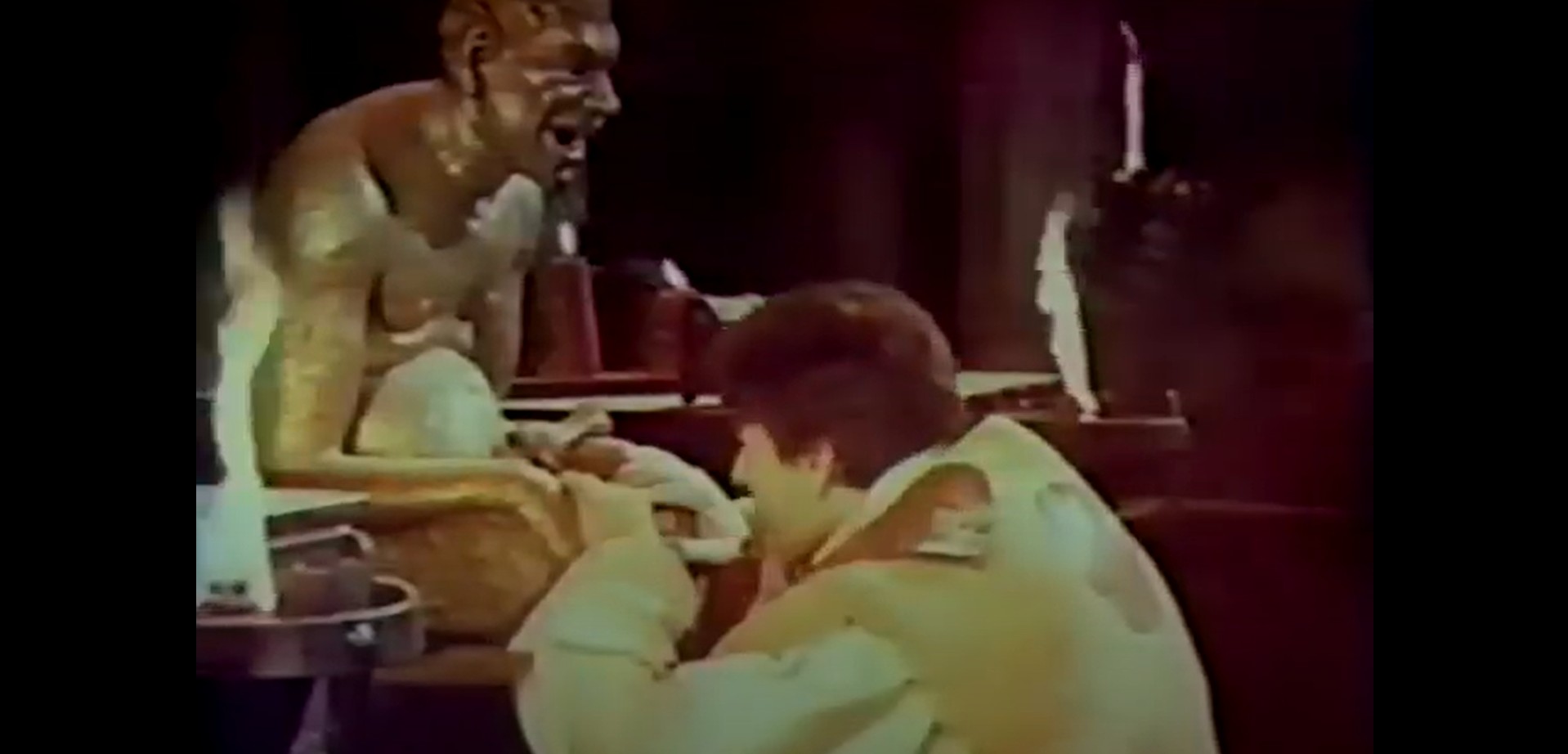
Riffling through the obvious camp “Trapped Ashes” touts very proudly, there are nuggets surrounding the unsavory themes.  Body dysphoria within “The Girl with Golden Breasts” is one of these topics, where an actress feels compelled to enhance her bosom for better, younger roles, and that speaks the relevance ill of the movie industry’s perverse tidings of late as actors and actresses continue to fill, inject, scar, and manipulate themselves into being their unnatural self to satisfy producers, execs, and audience likes and expectations when, in reality, hurts nothing but themselves.  Dissatisfaction marriage, or perhaps better labeled stagnant marriage, leads into invasive third party to sate long neglect passion and in this case, that third party is an ancient Japanese demon named Seishin (Japanese for Spirit) who lures the wife’s sexual appetite down to the pits of the netherworld.  From there, themes love triangles, obsession, cheating, and dysfunctional family structures formulate a pod of personal pate smeared with victimization, the victims being the storytellers stuck in the Desmond Hacker’s Hysteria backlot house.  “Trapped Ashes” isn’t about being victim, it’s more about playing the victim and those playing may not be victims of their own tales at all that adds a morsel of supernaturality to the recipe that changed the course of the idiosyncratic anecdotes that are close to their emotions and mental well-beings as well as proximally physically hazardous. 

Our first time covering the Dennis Bartok and Craig Rogers founded Deaf Crocodile release and it doesn’t disappointment with a sleek new 2-Disc 4K UHD and Blu-ray of “Trapped Ashes,” scanned and restored in 4K for its Blu-ray debut.  Presented in a widescreen 1.85:1 aspect ratio, the Deaf Crocodile UHD is HVEC encoded, 2160p Dolby Vision, BD66 and the Blu-ray is AVC encoded, 1080p high definition, BD50.  For an early 2000 production, “Trapped Ashes” doesn’t have the digital veneer of early 2000s film besides some visual effects work of the image manipulation drooping effect.  The extra pixels of UHD really brighten and elevate the image to today’s standards to surface the most inconspicuous details lost in standard definition.  Color saturation and skin tones appear natural and organic with no signs of compression issues or imbedded problems with the digital equipment.  Depth has really opened up in areas like the funhouse illusions of the Hysteria house in the wraparound segment and or in “Twin” when reality of the situation is made clear to put the explanation in one single medium-to-medium closeup frame.  Blu-ray copy mimics a lot same UHD accolades with a less fine tune edge around the background.  The English DTS-HD 5.1 surround sound is the only audio option available on both formats.  More than ample, the lossless provides a deepening immersion the deeper you go into stories with balanced side and back channels complimented by an even-keeled LFE to register the bass near the front while whispery events hover around a surrounding backside, such as with Cunningham’s “Jibaku’s” drawing-in hallucination moment of a Japanese painting that instills reverberating echoes and Shepherd tones.  English SDH subtitles are available.  Bonus features include threw new interviews – Dennis Bartok moderates a feature-length, online platform interview with director John Gaeta, cast members Jayce Bartok, Scott Lowell, and Lisi Tribble, producers Yuki Yoshikawa and Yushifumi Hosoya, and cinematographer Zoran Popvic, a second feature-length interview with cast members Tahmoh Penikett and Tygh Runyan and production designer Robb Wilson King, and the last approx. 40-minute interview is with producers Mike Frislev of Nomadic Pictures.  Extras do not stop there with a director’s cut of Monte Hellman’s “Stanley’s Girlfriend,” the original full-length cut of Ken Russell’s “The Girl with the Golden Breasts,” and a 5-part making-of with cast and crew archive interviews, a new visual essay Hollywood Parasite:  Hysteria in Trapped Ashes by journalist and physical media expert Ryan Verrill and film professor Dr. Will Dodson.  This is the so-called standard release compared to its Deluxe Limited Edition companion release, but this release is also pretty deluxe physically.  There’s no limited O-slipcover but the unique, almost 70’s-eseque cover design is appealing yet simple with a reverse side depicting an image of the wrapround characters inside the Hysteria house dining room or commune area.  The UHD and Blu-ray overlap each other in their differentiated locking mechanism on the ride of the clear Amaray case while the left insert portion holds a Deaf Crocodile QR code for access of the transcribed bonus content.  This release has the rated R cut with a runtime of 104 minutes and is region encoded A playback only.

Last Rites: Anthologies can be the antithesis of horror – building and dropping tension, an innate broken narrative, different stylistic choices that disunify the entire film, etc., but if campy enough, if not taken too seriously, if cast John Saxon, Henry Gibson, and Dick Miller, “Trapped Ashes” can find a home in the genre and in our collections with a new and extra-loaded Deaf Crocodile 4K UHD and Blu-ray set.

4K and Blu-ray “Trapped Ashes” from Deaf Crocodile. Available Here!

Not a Plague of Rats Could Stop EVIL’s Obsession. “Nosferatu” reviewed! (Universal Films / Extended Cut Blu-ray)

Experience “Nosferatu” in 4K UHD or Blu-ray. Purchase Here!

Wisborg, Germany, 1838 – Thomas Hutter is a promising real estate apprentice appointed travel six weeks to the Carpathian Alps to settle on Wisborg real estate for the reclusive and mysterious Count Orlok.  Thomas Hutter is also a newlywed, married to the lovely Ellen Hutter whom together Thomas plans to solidify their proper social status with the wealth of this trip away from his wife despite her pleas for him to stay.  Upon meeting Count Orlok in his dark castle, Thomas is overcome by his host’s undying evil presence that confines him to the grounds while Orlok psychically holds spellbound Ellen’s mind to a fretful state.  When Thomas escapes, he makes it back home at the same time Orlok arrives by ship that brings a plague of rats to the city of Wiseborg as well as a nasty blood-loss disease affecting population.  As Thomas warns of Orlok’s intentions, discredited Prof. Albin Eberhart von Franz knowledge of the occult sees through the rat-plague and into the dark heart that has cast its shadow over the city and into Ellen Hutter’s soul.   

The acclaimed folkloric horror director of “The Witch” and “The Lighthouse” sinks his teeth into one of the most renowned classical villains of our time, a vampire known to most as Dracula and revised, at times, up to the Robert Eggers take on the timeless “Nosferatu” tale.  Eggers’s 2024 adaptation of Bram Stoker’s novel and the 1922 F.W. Murnau silent picture, “Nosferatu:  A Symphony of Horror,” written by Henrik Galeen, is also penned by the director, revamped to tell both classic narratives in a way that is his own and that’s reflective of his slow burn gothic dread style.  “Nosferatu” is a Focus Features presentation from the productions of Birch Hill Road Entertainment and Studio 8 as well as produced by Eggers alongside the industry esteemed Chris Columbus (“Home Alone,” “Harry Potter”) and daughter Eleanor Columbus under their Maiden Voyage Pictures co-founded company.

Stepping into the tall, slender, blood slurping role of the titular character, under a full-body prosthetic suit of what is essentially a rotting corpse with a wicked mustache, is Bill Skarsgård, the actor who is quickly rising to the top of heavy makeup and effects characters while making the star-studded Skarsgård name synonymous with horror in his breakout film playing the maniacal demon-clown Pennywise in the film remake adaptation of Stephen King’s “It.”  Skarsgård’s baby face is completely enveloped in the ancient Transylvania nobleman Count Orlok with a high-bridge nose, protruding and high cheekbones, a vertically elongated face, and a sparse hair straggling through presumably a latex mock of decaying skin.  Skarsgård also modulates his vocal chords to reach deep, resonating levels that gives Count Orlok an additional tier of terror.  Undoubtedly, Count Orlok is an omnipotent, powerfully entrenched presence brought to existence by Skarsgård and accentuated and elevated even further by Lily-Rose Depp in Orlok’s obsessive muse of Ellen Hutter.  Through choreographed body manipulation and control, the daughter of Johnny Depp has since put the gum-chewing, wise-cracking, convenient story clerk “Yoga Hosers” role behind to redefine herself as an austere period and physical role actress willing to go the extra mile for the story.  Nicholas Hoult (“Warm Bodies,” “Mad Max:  Fury Road”) updates his Dracula film resume with another after having just come off the heels of playing the titular character in “Renfield” to Nicholas Cage’s grotesquely campy version of the Prince of Darkness, but there’s nothing intentionally campy about this Stoker story nor his role as Thomas Hutter with first-hand experience of Count Orlok’s monstrous dysphoric plague in what would be, too, another physical, yet less so, role for Hoult as a concerned husband fighting for his wife.  Speaking of roles, or films, that come around again for certain actors, Willem Dafoe passes the torch of Count Orlok from his Max Schreck performance in “Shadow of a Vampire” and takes on the elder Professor von Franz, a once esteemed learned man of science and knowledge now a discredited scientific explorer of the occult brought in to see to Ellen Hutter’s feverish nightmares and hallucinations.  Dafoe’s just as spasmodic and expressive as ever to be a part of those knowledgeable opposition of the vampyr realm, giving prominence to the character Dafoe has bordering as a mad genius of sorts with eccentric behavior that never allows to be compassionate or otherwise emotionally driven, like a true scientist.  Principal cast rounds out with Aaron Taylor-Johnson (“Kickass”), Ralph Ineson (“The Witch”), Emma Corrin (“Deadpool & Wolverine”), and Simon McBurney (“The Conjuring 2”).

As much as Eggers wanted to make “Nosferatu” a scary film while staying to the themes of obsession and Stoker and Munrau’s core elements, the film only manages to scare up a couple of true moments of hold-your-breath terror with panning shots and swelling scores that composition a seat jumping jolt.  Like most of Egger’s previous work, a continuous course of dread, which the filmmaker produces well in droves, meanderingly streams through the narrative that slowly builds with each closing in step Count Orlok takes toward obtaining Ellen Hutter’s willing submission to him.  Between the 1922 and 2024, both films play the love-triangle card of a married couple’s happiness being compromised by a tall and dark outsider entrancing, enthralling the wife, diverting her loyalty by any means possible.  In this case, those means are to blackmail her by holding the city hostage to plague of rats and draining her of the loved ones surrounding her.  However, the genesis of Orlok’s obsession is built upon brittle sticks with a prologue that hamstrings a powerful, psychic ability unwittingly used by Ellen Hutter to awaken the ancient evil.  The whole origin of events feels threadlike and happenstance, perhaps to instill more mysterioso of the antediluvian universe on a smaller scale obsession story.   Aesthetically, “Nosferatu” follows the Robert Eggers’ cinematography trend of blacks, grays, and a reduction to dull of primary colors for a gloomy period piece of cold weathered melancholy and bleakness under the continuous collaboration camerawork eye of Jarin Blaschke, marking their fourth feature together that implements inventive, complicated shots to sell practicality as fantasy in an early 19th century European context.  Blaschke’s aesthetic style would not have worked without the makeup and prosthetics for Count Orlok as a decrepit evil nobleman juxtaposed against the period costuming and elevated higher by the massive set designs of creating the Wisborg city as well as all of the other sets built to scale on acres of movie lot land. 

Robert Eggers and “Nosferatu” is the match made in dark heaven to give that classical rebirth the kick in the Dracula cape it desperately needed for Universal.  The at-home, Blu-ray release brings the darkness into living room television sets and other media players with an AVC encoded, 1080p high-definition, BD50.  Eggers is also so fine and particular on detail, such as with all the production value listed above and the retro design company opening credits, “Nosferatu” is also presented in a European widescreen 1.66:1 aspect ratio used in antiquated times of the 60s to early 90s in Europe, to which this story is fictionally set.  The Universal Films release houses both the theatrical version and extended cut at their respective runtimes of 132 minutes and 136 minutes, which is pretty incredible being both versions compressed onto one disc and, in the same breadth, had me concerned for artefacts in what’s surely a beautifully dark and tenebrous veneered Egger feature.  However, low and behold, no signs of posterization or banding to speak of with a saturated void to keep the shadows menacing rather than murky or milky.  The overall grading is quite dark with a deep bluish hue that enriches the time piece as well as the gothic tones.  The unnatural density of color saturation leaves natural skin tones to sake of reality, but the details do emerge here and there when shadow play, mostly around the presence of Count Orlok, is abridged for quotidian life without the encroaching dread of supernatural omnipotence.  Both formats are encoded with lossy audio mixes, a quite of a bit of them actually, with an English Dolby Atmos, Spanish Dolby Digital Plus 7.1, a French Dolby Digital Plus 7.1, and, lastly, an English Dolby Virtual Speaker (DVS) 2.0.  The Dolby Atmos is tuned for a 7.1 configuration, emitting immersive and resonating sound to which “Nosferatu” laps up in luxury.  The most notable aspect of the entire design goes, without question, to Skarsgård voice modulation for Count Orlock, a deep, guttural, European-accented assertion of all-encompassing faculty highlighted in every scene when, even more so when Orlock is not physically in frame.  I like to think Robert Eggers is the Wes Anderson of horror when it comes to dialogue and entourage of ensemble casts and with dialogue range and depth that’s dynamic to flow with the ever-presence of physical change or to swell or diminish a moment.  Dialogue is also stable, clear, and without dodgy interference, the spatial environment diffuses and disperses nicely through side, back, and even upper channels in Atmos and, the illusion provided, in DVS, and LFE finds a proper level without overwhelming cataclysmic plagues, fever dreams, or Orlok’s dreadful lust.  Opted subtitles are available in English SDH, Spanish, and French.  Bonus content includes a feature length parallel commentary with writer-director Robert Eggers, a lengthy behind-the-scenes featurette with interviews from cast and crew, and deleted scenes that can be seen in the extended cut.  The Blu-ray, plus digital code, release comes with white-black and grayscale in between cardboard O-slip with the same Lily-Depp Rose’s face being caressed by Orlok’s sharp-nailed and decrepit hand image also as the cover art on the Amaray case.  Inside, you’ll find the digital code stage right while the disc is pressed like most of all of Universal’s home video Blu’s with a near translucent quality to them.  Theatrical cut is rated R for bloody/violent content, graphic nudity and some sexual content and the extended cut comes not rated.  Though not listed anywhere on the cover or disc, the Blu-ray is encoded with region A playback only.

Last Rites: Robert Eggers shoots his shot working his dream story under a major Hollywood studio providing him with a major Hollywood sized budget. “Nosferatu” is every bit of Eggers, carved out and etched to the gothic and folkloric perfection that has quickly skyrocketed his brief career and the eclectic cast stuns in their own right with otherworldly and creepy performances that revives ole’ Count Orlok back to from the celluloid dead.

Experience “Nosferatu” in 4K UHD or Blu-ray. Purchase Here!