

In the wake of losing their father and husband, Leah and her mother struggle to cope and are at their wits ends with each other. Leah, an impressionable and angst-filled teen, embraces the occult lifestyle after her father’s untimely death despite her mother’s distaste for it. Leah’s mother also battles the everyday familiar feelings of her constant surroundings that remind her of her dear husband and the sensations compel her to move her and Leah more than an hour away, away from Leah’s only friends including a boy she’s become fond of, but the constant and languishing heated disagreements invoke Leah to act impulsively, gathering her ritual articles, and while in the woods, naively summon a witch, named Pyewacket, to kill her mother. Regretting her actions almost immediately and fearful of what’s to come, Leah is cautiously ever attentive to her surroundings as each passing night a presence makes itself known and is eager to not only harm Leah’s mother, but also intends to rise it’s wickedness toward Leah.

“Pyewacket” is a 2017 Canadian horror-thriller from writer-director Adam MacDonald. The Montreal born MacDonald constructs an impressive and suspense-riddled sophomore film that offers a beautifully bleak atmosphere while touching upon layered themes that are relatable to anyone who grew up with an overbearing parent. “Pyewacket” succeeds as a stark melodrama of a hurting mother and daughter who are looking for some kind of pain relief and a fresh start. MacDonald takes it to the next level, churning out a cautionary tale, by implementing the theme of being careful for what you wish for because you just might get it. Oh, and there’s spine-tingling moments involving a ghoulish witch with an appetite for deception and have you squinting yours eyes in fearful anticipation of when she’ll strike.

Another Canadian, the Vancouver born Nicole Muñoz stars as the disquieted Leah. Muñoz dark assets heighten her disdain and resentment she evokes out from her character toward her mother, played by the former “The Walking Dead’s” Laurie Holden. Tall and blond with a more verbose attitude in putting her feelings outward, one would have difficulties placing Muñoz and the “Silent Hill” star as daughter and mother on screen. Holden manages to be the glue that keeps the story moving as Leah rarely has much to the say and is only reactive instead of proactive about her situation, making the two actresses dynamically challenging that purposefully sparks uneasiness in every scene. Leah’s friends serve as her lifelines to the world outside her new country home that her mother has unfairly displaced her to. Her best friend Janice, the Toronto born Chloe Rose, whose alternative appearance and nonchalant, cocky persona encourages her to be Leah’s confidant. Rose seemingly enjoys the role that offers vibrantly colorful stripes of hair with lots of gothic makeup that comes complete with leather and plaid outerwear. I was a little disappointed with Leah’s love interest that was Aaron, shoed by the tall and thin Eric Osborne. Aaron really wasn’t showcased much though MacDonald’s script attempts at hinting more to the character, but unfortunately for Osborne, Aaron falls the ranks of a back burner boyfriend trope.

What might be the undoing of “Pyewacket” is simply the timeliness. Robert Eggers’ “The Witch” and André Øvredal’s “The Autopsy of Jane Doe” completely overshadow the JoBro Production & Film Finance (which is kind of funny because the same production company also did some funding for “The Witch” so in essence, “Pyewacket” is “The Witch’s” little cousin) with two already fantastic tales of non-broom riding and mind tampering witches that share the same intense ferocity of pure hatred and dark magic on a much bigger and grander scale when considering production value that relies on a viewer relatable story. A story involving a mother-daughter warfare is inarguably human to us all, but in competition with that, MacDonald seems to embrace that side of the story with slight favoritism as the director is light with a slow burn of the catalytic turn of events that evokes the titular character despite it being the most gripping portion of the film; instead, the focus is more honed in on Leah’s experience that intimately distances her from each of those that are closest to her: Janice, Aaron, her mother. Left in the wind is much of the witch’s background and how the witch becomes familiar to Leah which goes relatively unknown. And, also, not to forget to mention that the witch, or familiar spirit, is screened through shadows, long shots, and quick takes so to get a shape or a image around the appearance, all I can suggest is that Pyewacket resembles Samara from “The Ring” with stringy, filthy hair, slender figure, and moves around like a spider. Aside from a popular teeny-bop occult novelist, Rowan Dove played by “Bitten’s” James McGowan, the only facts touched upon about “Pyewacket” are that the spirit is extremely malevolent and can deceive the perception of people and events.

From Signature Entertainment, the DVD and Digital release of Adam MacDonald’s “Pyewacket” hits retail shelves April 23rd and digital retail shelves even earlier on April 16th. Since a digital screener was provided for this review, an in-depth critique of the video, audio, and bonus material will not be covered. Though clutching to the money-bagged coattails of bigger, better witch films from the last three years, “Pyewacket” is still a mighty story with complex characters complete with sheer dread from an obscure and grievously sorcery crone pure with black heart that will definitely elicit shortness of breath and rapid heart palpitations if watched alone in the dark.
Category Archives: Just fucking awesome
Free Your Soul With the Evil Mad Doctor! “The Soultangler” review!
Experimental doctor, Anton Lupesky, invents a controversial drug that can free a human soul from its vessel and travel through into the lifeless eyes of a corpse, possessing the body to reanimation. The only side effect is grotesque hallucinations that are so horrible, few survive the experience. After a stint of missing persons and a string of mysterious deaths at the Whitebriar Institution, Lupesky is fired from his position, banned from the medical board, and brought up on criminal charges. His acquittal sparks him to embark on a journey overseas to continue his radical medical experiments, away from regulations and tremendous oversight. The doctor returns six months later for far superior medical innovations in America and begins practicing again in his own basement with the unscrupulous help from a couple of lackey acolytes that leaves Lupesky’s supply of “patients” not in short demand. One reporter keeps investigative tabs of the good doctor as she suspects a connection between him and her father’s death at Whitebriar and when her and her friends starts to snoop around, Lupesky has no choice but to use any means necessary to thwart her investigation, even if that means secretly administrating the drug to her in hopes that her soul can fly with his – if she survives.

Thirty years ago, “The Soutangler” hit the cinema market. A low-budget gruesome mad scientist flick with a penchant for some fantastically grisly practical special effects. The 1987 shocker was directed by Pat Bishow, penned by John Bishow and Lance Laurie, and shot on location on Long Island, New York. The Do-It-Yourself and Lovecraftian macabre does a bit of soul-searching to find resurrection from the video graveyard. Luckily, Bleeding Skull! Video and the AGFA come to the rescue with a chock-full of extras release that digs up the Bishow’s lost creation, dusts it off, cleans it up, pats it on the butt, and sends it back out into the world onto DVD home video. “The Soultangler’s” niche envisioning goes against the grain of traditional filmmaking, bordering experimental, but definitely a must-see for those interested in existentialism horror: the removal of free will to be replaced by another’s.

Pierre Devaux stars in his only credited as the mad Dr. Anton Lupesky that resembles along the lines of a Dr. Herbert West from that little known trilogy of the H.P. Lovecraft inspired “The Re-Animator.” With a wiry frame, stringy shoulder length hair, and government-like issued classes, the very animated Pierre Devaux casts the ideal character whose maniacal and perverse in his medical malpractices. The only one willing to stop the Lupesky’s experiments is investigating journalist Kim Castle of The Daily Chronicle. Castle, played by Jane Kinser, is about as ferocious as her beautiful as an aggressive reporter, unwilling to stop to unearth the truth of her father’s tragic death. Kinser’s not much of an onscreen force to reckon with as she’s quite timid, but she manages to hold her own up against Devaux wild eyed lunacy. Rounding out the cast is Bob Cederberg as a Carl the drugged addict henchman, Louise Millman as a loyal minion to Lupesky, and Tom Ciorciari as Castle’s concerned friend who battles the zombified corpses embodied by Dr. Lupesky.

While a strong appreciation exists from the outstanding attention to detail with the decayed bodies and the explicit violence in the finale that nightmarishly flourish in a heap of ghastliness, the rest of the film is as disjointed as the dismembered bodies in Lupesky’s basement of horrors. Despite being submersed in various talking head scenes that divulge significant backstories between Dr. Lupesky and Kim Castle, the story struggles to keep the straight line focus, swerving erratically between subplots and the main premise. Castle’s horrific dreams of aggressive zombies loosely makes a connection other than prepping Castle’s subconscious when ingesting Lupesky’s soul freeing drug. The story of Dr. Simpson also flounders to the waist side with her and Dr. Lupesky’s love affair, the only women he would even consider getting close to and not slaughter for his own amusement.

“The Soultangler” arrives onto full-bodied, graphically illustrated DVD from the B-movie collaborators Bleeding Skull! Video and the American Genre Film Archive (AGFA) and distributed by MVDVisual from the original 1″ master tapes. Shot on 16mm, but edited on video, “The Soultangler” has a SOV experience in it’s original aspect ratio of a full frame 1.33:1. Quality varies from the source material, including some tracking and edge flare issues, but overall a solid transfer with a sizable color palette that includes tints, natural skin tones, and visceral dream sequences that show little-to-no sign of diminishing. Stereo mono track does the job despite poor mic placements to get the full girth of dialogue. HypnoLoveWheel’s indie synth/rock soundtrack has more popularity on the B-level than in the mainstream music, but serves “The Soultangler” with broad depth to solidify a wedge between “The Soultangler’s” whimsical charm and the Gothicism that is Stuart Gordon’s “Re-Animator.” Bonus features include, for the first on any release, the Unseen 62 minute alternate director’s cut, a commentary track with director Pat Bishow, behind the scenes footage, trailers for “The Soultangler” and “Dead of Night Town,” music video for “wow” by HypnoLoveWheel, and liner notes by Bleeding Skull’s Zack Carlson. Conceptually, “The Soultangler’s” premise oozes originality and creativity involving soul transformations through the portal eyes of a dead body and that’s simply brilliant and what today’s horror genre certainly craves. Constructionally, Pat Bishow couldn’t push the momentum to pickup the pace to overripe an engaging story, but the climax, out of left field, unsheathes a bloodbath of ultra-stellar, DIY proportions!

At Amazon, The Soultangler, Right now!

The Evil That Doesn’t Kill You Makes You Stronger! “Jungle” review!

Yossi Ghinsberg yearned for more than the comfy, cushy life he was born into and being young and adventurous, Yossi travels abroad to backpack in Bolivia to pursue self-discovery and beauty in places far less travelled despite his father’s wishes. He quickly befriends fellow backpackers Marcus and Kevin and together, they lay tracks through the eclectic terrain of the breathtaking Bolivian landscape, but wasn’t until an Austrian geologist named Karl approached Yossi about a promise of unearthing gold and experiencing hidden tribes deep inside the lush jungle. After some convincing, the three friends venture into the jungle with only Karl to guide them and, at first glance, the wilderness is an escape from the noise and pollution of human corrupted inhabitations, but a drastic realization quickly washes over them when they’re force to separate and that the jungle is a cauldron of constant survival. Along with captivating beauty, fire ants, poisonous snakes, symbiotic organisms, jaguars, and torrential rains tip the iceberg of everything that embodies the sequestered jungle and Yossi must endure the trials and tribulations alone in order to make it out alive.

Based off the book of true events from Yossi Ghinsberg comes the motion picture retelling of Ghinsberg harrowing tale of survival in “Jungle.” The 2017 biographical adventure-thriller is penned by Justin Monjo (teleplay writer for TV hits like the sci-fi odyssey “Farscape”) and directed by “Rogue” and “Wolf Creek” director Greg McLean. “Jungle” showcases the night and day environment of one of the world’s most beautiful, yet deadliest locations, cascaded with awesome uncharted landscapes with an augmentation of great mortality once man is introduced. However, the thing with the jungle is that no matter what man’s objectives may be with the rainforest, whether it’s to destroy it or to embrace it as were Yossi’s intentions, nature treats all with the same merciless brutal as it’s kill or be killed. Yossi is in the midst of a man versus nature thematic element where Darwin’s survival of the fittest lays all well true and from his book, Yossi Ghinsberg went through a nearly three weeks of severe isolation, stomach-devouring starvation, and vigilant hyperawareness against the local wildlife. Yet, somehow, he survived.

To play such as downtrodden character needed an actor committed wholeheartedly to the story and, luckily for McLean and the rest of the crew, Daniel Radcliffe encompassed Yossi Ghinsberg and his plight with passion and dedication. So much dedication that the Harry Potter famed actor lost about 14 to 15 pounds in order to mimic starvation and really put his body close to the hazards Yossi had faced. “Jungle” has certainly solidified his range as an actor inside the genre of not only fantasy films, but also thrillers as well. From “Horns” to “Imperium,” the English-born, 5’5”, 28-year-old actor has placed a major footprint in the industry that stretched from low-budget to Hollywood stardom and doesn’t seek to stop in the near future. Radcliffe is joined by a pair of Australian actors in Alex Russell (“Chronicle” and “Bait”) as American photographer Kevin Gale and Joel Jackson as Swiss teacher Marcus Stamm on sabbatical. A standout performance, one that really rivals Radcliffe in cliffhanging suspense with cryptic intentions, is that of Thomas Kretschmann (“Blade II”) playing the Austrian geologist Karl Ruprecther. Fantastic chemistry between all four men with spot-on performances, especially not portraying their native heritage.

While Greg McLeans has no fear in getting gritty where gritty needs to be get, “Jungle” has a tame nature about it for a director well-known for Outback cruelty. McLean doesn’t exact the right amount of perilous attitude that was unfortunately bestow upon Yossi. Much of Yossi Ghinsberg’s book was not translated to screen such as his rectum being impaled by a large stick when he falls down a slope. The hard stop editing and pivot bounces the viewer around being out of control on a trampoline. When we meet Yossi for the first time and he encounters Marcus Stamm, a cascading event of one jointly pursuit with another that string along and attach Kevin Gale to a web of awkwardly editing scenes of traveling through Bolivia in what felt like a slapdash montage with the sole purpose of setting up the trio’s friendship in an unsympathetic way. Another issue with the editing was that the film had to keep reminding the viewers about previous events, such as when Yossi was bitten by a fire ant, and those scenes ended up being a redundant time filler that points audiences to being naive and inattentive to cherry pick previous actions.

Umbrella Entertainment releases “Jungle” on a rated mature, region B Blu-ray with crystal clear full high definition, 1080p presented in a widescreen 2.35:1 aspect ratio. Image quality bares no marks of compression issues nor any flagrant fouls in the coloring, whether natural or generated. Aliasing is also a non-issue. The 5.1 DTS-HD English soundtrack has moments of low fidelity at the beginning of the film where making out the dialogue can be challenge, but the jungle ambiance and the Johnny Klimek (“Land of the Dead”) score bring alive the eclectic atmospherics of the wild, wildlife. Bonus features include a featurette that extends up Danial Radcliffe becoming Yossi Ghinsberg, the making of the Yossi Ghinsberg story, cast and crew interviews, and the theatrical trailer. “Jungle’s” adventurous first half sets up the catalytic downfall into desperation and despair of a man versus nature thriller in the latter half, splitting Daniel Radcliffe into two auspicious roles of enchanting self-discovery and a fight for survival. The movie most certainly encourages one to read the book of Yossi Ghisbergs edge of death misadventure.
This is One Evil Pussy! “Hell’s Kitty” review!
A Hollywood screenwriter named Nicholas owns a very special household feline. Angel, his Cat, has a unique relationship with her owner Nicholas. Yet, their unbreakable bond has put a severe damper on Nicholas’s intimacy with women as Angel slaughters any and all who becomes close with her beloved human. When Nicholas finally catches wind of the reason behind his love life woes and learns that Angel is actually possessed by an obsessive and dangerous demon, he and his friends Adam, whose also his downstairs neighbor in the apartment complex, seek to exorcise Angel back to being a nice kitty, but all who’ve challenged Angel thus far have been unlucky enough to be scratched to death. A medium, two priests, and even a cat therapist haven’t seem to help Nicholas through the bombardment of weird dreams and death that surround him in his lonely and tiny one bedroom apartment.
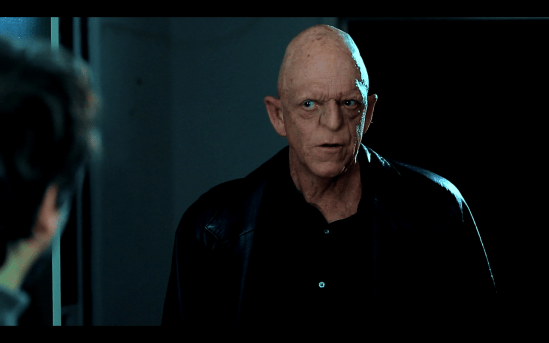
Cat lovers beware! “Hell’s Kitty” is purring up your leg to claw you in this new horror-comedy by writer-director Nicholas Tana. If you had thought cats were already contemptible enough to begin with then sit down in your air freshening kitty litter and get a can of Friskies out because you’re about to take a 666 ride with this demon kitty. “Hell’s Kitty” is original a web series created by Tana that began all the way back from 2011 to 2015 and, since then, has been immensely popular through the inter-webs with the extra special casts of genre vets ranging from “The Hills Have Eyes'” Michael Berryman to “The Fog’s” Andrienne Barbeau. From the web series, the episodes were pieced together, forming one hairball adventure of Nicholas and his demon cat, Angel.
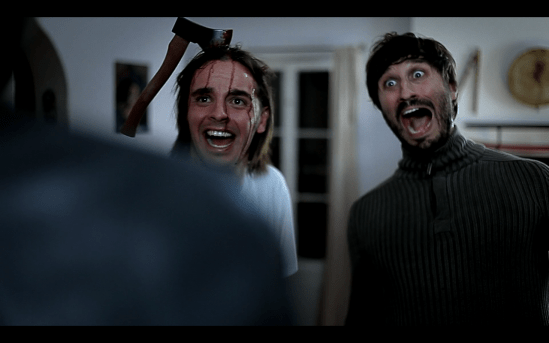
Aforementioned, Nicholas Tana headlines as himself because, essentially, “Hell’s Kitty” is based off true events of his turmoiled love life. Series regulars also become essential players in the film, such as Nicholas’s downstairs loafing neighbor and best friend Adam (Adam Rucho), Lisa Graves (Lisa Younger of “Cold Creepy Feelings”), and Dr. Laurie Strodes (Nina Kate of “Snake Club: Revenge of the Snake Women”). Then, there’s a slew of special guests that, at times, pay homage to the works that made them household names in horror or relating genres. Special guests that include “Children of the Corn’s” John Franklin and Courtney Gains semi-reprising their roles as Isaiah and Mordicia. Lynn Lowry (“The Crazies”), Doug Jones (“The Shape of Water”), Bill Oberst Jr. (“Coyote”), Kelli Maroney (“Night of the Comet”), Dale Midkiff (“Pet Sematary”), Lee Meriweather (Catwoman from “Batman” television series), Victoria De Mare (“Killjoy” franchise), and porn star goddess, and legend, Nina Hartley (“Pleasure Maze”)! That’s one heavy-hitting lineup! As a cherry on top, even a Killer Klown, you know, the ones from Outer Space, made an appearance!
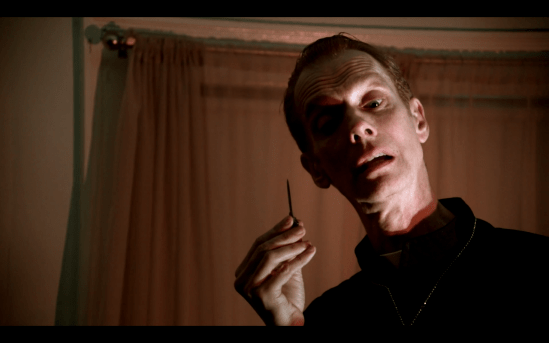
If a viewer didn’t know of or research into “Hell’s Kitty” web series past, the thought of low-budget junk just might scroll across a judgmental mindset. Let’s be honest for a second; “Hell’s Kitty” is grade-A camp with schlocky special effects and the editing quality of a ramshackle shackled ram. Along with the unique cast being intertwined into the story, other aspects of the Frankenstein-glued together film, such as the sharp pivoting subplots, stir up Nicholas ever so chaotic life into a new and interesting fold. From his fruitless sex life with various attractive women to the friend who always makes himself welcome in Nicholas’s apartment, Nicholas only has one consistent thing in his life and that is his relationship with the cat from hell and that journey is explored from episode-to-episode that climaxes with an ultra-drag musical rendition of something out of the “Birdcage.” Another quality to watch for, and enjoy, are the homages to fan favorites like “Children of the Corn” and “Killer Klowns From Outer Space” as mentioned before, “The Exorcist,” and “Psycho.”

MVDVisual and Wild Eye Releasing presents the Smart Media LLC,. production of “Hell Kitty,” as a whole, on DVD home video that’s visually subpar when considering the quality. The low bitrate crudely displays blotchy image quality, leaving details to the waist side. The 5.1 surround sound is the best attribute to the DVD with clear dialogue and a modest soundtrack. There are no extras included aside for the film’s trailer. While technically incompetent, “Hell’s Kitty” meows murderously onto DVD in a cultivation of cult actors and hellacious comedy by writer-director Nicholas Tana that does sometimes feel rehashed or borrowed from previous films, but the quirky evil pet element gnaws on an inner layer to be enjoyed and enthralled in a day-and-a-life of one man’s skewed, if not deranged, version of events of a lackluster romantic lifestyle blamed toward one jealous feline.

Add “Hell’s Kitty” to your collection!

The Evils After World War III! “The Aftermath” review!

On the space shuttle Nautilus, three astronauts are returning home after one year in deep space. Their outbound transmissions to Earth are not being returned nor are they being received and as their ship draws closer to Earth, the only option for reentry is to take a risky crash landing into the Pacific Ocean, just off the coast of California, hoping someone, anyone, would see their shuttle coursing downward from the sky. Only two survive the crash and swim to shore where no boats, no planes, nor onlookers were around to receive them. They soon find out why. World War III had engulfed much of the Earth during their time in space, reaping the land of the urban jungles and making food and living conditions scare. Germ warfare had mutated much of the population to cannibalistic creatures and when torrentially raining, acid rain pours from the war torn atmosphere from ferociously brilliant and deadly clouds. Only a small band of good people remain and the two astronauts seek to keep them safe from the harsh elements, even against a merciless gang of thugs.

In the early 1980s, an ambitious and visionary filmmaker sought to produce, write, direct, and star in his very own modest budget feature film that would rival Hollywood’s glamourous and expensive effects while still maintaining a down-to-Earth independent production. That filmmaker was none other than Steve Barkett, creating his debut film, the 1982 science fiction post-war catastrophe, “The Aftermath.” “The Aftermath” is like if the “Planet of the Apes” met “The Walking Dead,” a sheer blunt for trauma of returning to your home to discover the world in shambles with different factions of hard nose killers ready to plunder all that you own and all that you will ever have. Barkett, with assistance from the brothers Dennis and Robert Skotak, who’ve went on to work on major studio films such as “Aliens” and did the matte work for John Carpenter’s “Escape from New York,” create a destroyed Los Angeles landscape through the power of some serious movie magic considering the time period and the budget.

Steve Barkett is Newman, one of the three astronauts with no first name, and the tough hombre’s hard disposition comes from his background exposition where he lost his wife and child before going up into space. Newman’s cold, but not heartless, and Barkett taps into that fairly well despite some robotic and formulaic performances. However, Christopher Barkett, Steve’s son, was a complete first generation cyborg, a regular toaster oven with teeth and eyeballs that monotones through all the lines and actions. The most interesting casting here is Lynne Margulies, who at the time of this release, was or was not yet the late Andy Kaufman’s girlfriend. Margulies, who previous worked on an adult film entitled “Young, Hot ‘n Nasty Teenage Cruisers,” continued the racy trend with a shirt-pokey role in Sarah, Newman’s quick-to-sack love interest with a briefly, well-endowed nude scene. Yet, Sig Haig manages to steal the Barkett’s film from right under his nose. The young and ruggedly muscular “The Devil’s Rejects” star sports his trademark shaved head and thick, dark goatee, labeling him the perfect casting choice in gang leader Cutter. Alfie Martin, Forrest J. Ackerman (“Dead Alive”), Larry Latham, Linda Stiegler, and Steve’s young daughter, Laura Anne Barkett costar.

One aspect that’s really appreciated in Barkett’s enterprising venture through post-war commentary and morally righteous themes is the special effects matte work from the Skotak brothers. Detailed paintings, such as exampled in the war-ravaged metropolis that was formerly L.A. embodying the once towering buildings, are now destructively cut short in a mangled heap in a matte effect with live actors. Practical effects work wonders for Barkett’s large scale premise despite the small scale performances, except from Sid Haig. The detail in the violence dawns a newly restored faith in early 1980’s sci-fi films; violence that was more prevalent in the genre later in the decade, in such films as “Aliens” or “Robocop,” making Barkett’s film a trail blazer that paved the way to deliver more sensational savagery and lots of blood of a high body count to a already fantastic genre.

MVDVisual and VCI Entertainment release Steve Barkett’s “The Aftermath” onto a dual format, DVD and Blu-ray, combo pack. Presented in 1080p on a MPEG-4 AVC encoded BD-50, the post apocalypse never looked so good in a widescreen 1.78:1 aspect ratio from a 2K remastered transfer of the original 35mm negative. VCI has bested the rest with colorfully enriched scenes and untouched framing. Slight grain more so over the matte special effects that optically contrasts between the two different layers where a little touchup could have smoothed out the indifferences, but other than that, the details are quite stark. The clean and untarnished English LCPM 2.0 mono track is also vastly well constructed that contains minuscule hissing and the occasion pop, clearly making the dialogue a prevalent force. Composer John Morgan’s traumatically dramatic score is full-bodied and robust that coinciding renders well with the action sequences and tranquil moments. The extras offer the original laserdisc bonus material that provide snippets of interviews from cast and crew, Steve Barkett’s short film “Night Caller,” over an hours’ worth of John Morgan’s soundtrack complete with title information, VCI promo announcement for Barkett’s other director “Empire of the Dark, and the original theatrical trailer. A retrospective journey to the early 1980’s science fiction indie sector is also a visually stunning resurrection of “The Aftermath” courtesy of VCI Entertainment and with impressive effects and a bigger-than-life concept despite an underwhelming performance as an actor, director Steve Barkett’s legacy as a filmmaker remains stronger than ever with this prominent and well-deserved upgrade of the lazer-gun and mutant inhibiting world reckoning.

The Aftermath available at Amazon.com!


