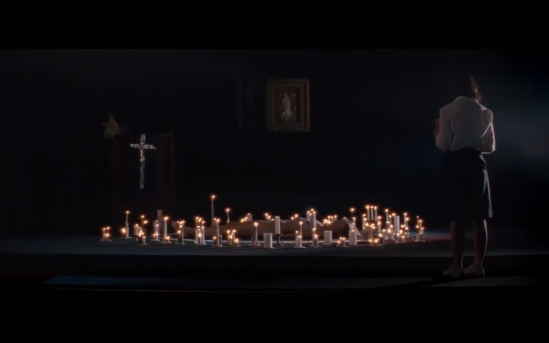
Igor and Polina suffer through every parents’ worst nightmare; their son, Vanya, has gone missing. Three years later, Igor arranges an orphanage visit on the outskirts of Moscow to make Polina happy again by possibly adopting a young child, but their visit is cut short when Polina discovers the gruesome dead body of a basement keeper and a savage child barred away in a dungeon-like room. Polina is instantly imprinted by the child and convinces Igor to adopt him despite the difficult malnourishment and animal like behavior, but over the course of time, the child exhibits signs of behaving like their missing son and even starting to look like Vanya, their missing son’s name Polina has now bestowed upon the child against Igor’s wishes. As the feral child shows more signs of acclimating to his new life, Igor and Polina sense something more sinister from the child whose resembling more and more like Vanya every day and begin investigating into their adopted son’s origins, a well-kept dark secret guarded by the convent orphanage.

From examining horror films from our Northern neighbors in Canada to crossing the oceans and landing in Eastern Europe of the birthplace of Vodka, Russia, we’ll be taking a look at two recently released and storied dissimilar upcoming horror movies from Russia Federation, beginning with the belief that no country is exempt from the creepy kid genre in this Russian 2019 allegory entitled “Evil Boy” as the debut film from writer-director Olga Gorodetskaya. Also known as “Stray” world-wide or “Tvar” in the original dialect, “Evil Boy” is straight-forward, focus group approved, vanilla title of a story from one of Russia’s celebrated modern novelist and screenwriter, Anna Starobinets. Also dubbed as Russia’s “Queen of Horror,” Starobinets is a prolific adolescent thriller writer whose credits includes the compilation of short, chilling stories entitled “The Awkward Age” with the featured tale of a young boy’s life diary expressed through the voice of an ant colony living inside his body and the queen his brain as a conduit for her commands. “Evil Boy” is a production from a conglomeration of companies including Yandex Studio, Cinema Foundation of Russia, Dublab, and Reason 8 Films.

The titular character of Stray or Vanya allows no audience insight and we’re impelled into the perception of the grieved parents, Polina Belova (Elena Lyadova) and more so with the father, Igor Belov (Vladimir Vdovichenkov). While director Olga Gorodetskaya is new to the scene, the chemistry of Lyadova and Vdovichenkov have well been established from a baseline foundation set from their prominent collaborative roles in Andrey Zvyagintsev’s powerful small town corruption film, “Leviathan.” Their dynamic transcends a range of individual performances from crime into the horror realm with parents going through the stripping loss of a child that has compromised their marriage to the point of desperation to the eventual short term passion that has rekindled with the adoption of the Stray, a primal role befitting young Sevastian Bugsev in his introductory feature film. Giving Bugsev credit would be such an underwhelming praise as the eight year old not only nailed the savage child performance, but also endured an aggregation of makeup that gradually transforms his character over time. What’s interesting between the three actors is that they form this family love-triangle of sorts, where Polina embraces the child, but then is frightened of it and in a role reversal, Igor is skeptical of the child, but then tries to love him unconditionally. Just in that square footage, the amount of flux emotions and mindsets can favor one side over the other; yet, the actors pull it off, almost too well, creating a an unrest of feelings, conversations, and approaches to their characters. Key supporting roles include performances another fellow “Leviathan” thespian, Evgenly Tsyganov, as well as Roza Khayrullina, Konstantin Topolaga, Anna Ukolova, and Evgenly Antropov.

“Evil Boy” has some psychology behind it. Hell, even a few of the film’s posters are composited of Rorschach tests and what “Evil Boy” ultimately boils down to is how we interpret our grief of a loved one. Polina and Igor are written to exhibit multiple signs of the clinically coined Complicated Grief that follow the patterns of avoiding the reality of death, persisting nothing has changed, and a bleak numbness to the event. The motif of trying to replace something dear with something else, as a comforting mechanism, is consistently brought to attention and goes as far as leaving a forlorn image of the same motif as a finale twist to drop an atomic loop of melancholic isotopes on you. The psyche portion of the “Evil Boy” is as equally important as the evil boy himself as it’s only a representation of our characters’ will and grief, but whether it’s Starobinets story or Gorodetskaya’s script or both, “Evil Boy” has a yawning plot hole regarding the boy’s origins that’s briefly represented with a dialogue-less scene of cataclysmic and ritualistic images jumbled together for your mind to piece. This sort of passive logic translates equally to the unpalatable editing that plunges the story into a fit of turnaround key moments unable to linger and build upon and stress character developments and form audience relations. Much of the psychology the “Evil Boy” tries to impress is squandered by Gorodetskaya fleeting approach structure that can’t even be tied together by the genuine abstract creature itself when it’s grossly mutilated CGI blunder finally makes a grand entrance.
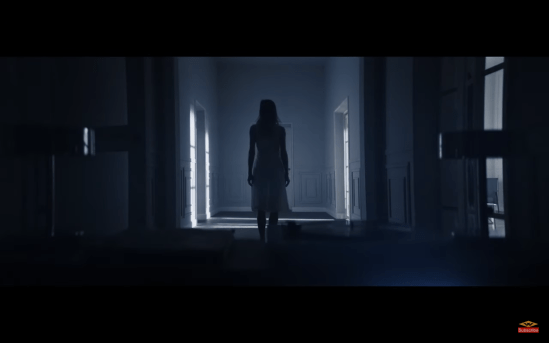
In the height of the “Sputnik” invasion that’s currently sweeping the Russian horror charts world-wide, explore into the inner space of an anguished mindset melded with conjured up changeling European folklore and you get “Evil Boy” on DVD courtesy of Well Go USA Entertainment come September 8th. The DVD is presented in a widescreen, 16:9 aspect ratio, that renders Ilya Ovsenev’s eerie and shadowy atmospherics, distinct in their own rite, between the sterile urban Moscow and the wooded outlier town where the parenting couple has a home in each to be alien to not only the child but also to the inhabiting parents. Ovsenev’s framing is poignant and harrowing, adding dread much needed to stir into the creature child. The image quality is relatively sharp, but there are moments of obvious color banding, such as around headlights, that suggests a lower bit compression that comes and goes with the nature of the scene. The Russian language Dolby Digital 5.1 surround sound rollicks in an immense range of sounds from the primal animal snarls of the young boy to car wreckage to the soft cries of a whimpering mother despite seemingly having a even-keeled tone storyline that should simmer with tension rather than overflow with nonstop action. The dialogue is clear and forefront available and the soundtrack lulls as a sleepy version of standard genre fare. English subtitles and dub track are available with the former show no sign of asynchronous harmony and no sign of errors in spelling or in timing. The only bonus feature available in the static menu is the trailer amongst trailers for other Well Go USA Entertainment releases. Perhaps, what could be construed as the Russian equivalent to Stephen King’s “Pet Sematary,” “Evil Boy” buries to reanimate suppressed grief through inclinations of folklore and psychosomatic ringers embodied by one creepy as hell kid.
Category Archives: psychological horror
EVIL is One Big Vagina Looking Stain on the Wall! “Dead Dicks” reviewed! (Artsploitation Films / Blu-ray)

Becca’s careworn life, concerning for her mentally unstable brother as well as maintaining her expenses through the up and down cashflow of a bartender’s tour, suddenly gleams with a ray of hope when a prestigious opportunity she’s earned calls for her to move across country in a matter of weeks, but when her brother, Ritchie, leaves multiple distressing messages on her phone, Becca’s continuing efforts to care for her troubled older brother forces her to abandoned the bar’s night shift duty and check on him. What Becca finds is Ritchie’s dead body strung up in the closet, and another Ritchie dead body electrocuted in the tub, and a very much alive Ritchie walking around naked. The perplexing phenomena all stems around a vaginal resembling wet stain on the bedroom wall that birth’s another copy of Ritchie after each death, but with every copy comes copious amounts of provocative questions that keep Becca from leaving Ritchie’s forlorn and tormented side or is it something much more paranormal detaining her?

Welcome back to our part two of the unofficial look at independent Canadian horror with a totally different and existential horror entitled “Dead Dicks” from the dynamic directing duo of Chris Bavota and Lee Paul Springer. Also possessing creative control of their own script, Bavota and Springer flex their filmmaking muscles by initiating themselves into the feature film market with an alternative impression on the lingering effects of mental illness and suicide, which Bavota and Springer preface the film responsibly with a public service announcement for audiences where those struggling with suicide or those who know someone struggling can reach out for information and help via a suicide prevention hotline telephone number. Believe it or not, ItsBlogginEvil has been exposed to some script work by Chris Bavota who penned the tyke-terrible, otherworldly beings in “Ghastlies,” helmed by Brett Kelly, and while I admire Kelly’s legendary practical effects ambitions on a microscopic budget and “Ghastlies” praise to the cult of small creature features villains, like “Gremlins” or “Critters,” I ultimately found the film and the screenplay to be fragmented and unflattering that doesn’t live up to honoring the retro creature ideals in a heavily slapstick and erroneous attempt. However, from 2016 to 2019, Bavota has shown to have an increased level of story maturity in his writing with, perhaps, an assist from his colleague Springer for their subject matter and execution of “Dead Dicks,” a production of Bavota and Springer’s Postal Code Films company in association with Red Clay Productions and distributed by Devilworks and Artsploitation Films.

The low-key cast brings a blanket of intimacy that’s synonymous with how suicide is often a loner’s internal battle with themselves. In this regard, Bavota and Springer needed an alleviator for the somber material with a pitch perfect front man in order to radiate the dry humor and convey the relatively taboo message of speaking up, speaking out, and speaking for suicidal tendencies. They found that man to be Heston Horwin who the filmmakers had had in mind to play the role of Ritchie. Bringing the quick wit and exact timing to Ritchie’s compromised soul, and serving also as executive producer on the film, Horwin becomes the vexed tinkerer trying to problem solve the causality of his own immortality who is stuck in a loop, a motif of in death there is life that continues to pop up, and also contorts his personality to make Ritchie a Rubik cube of anxiety, twisting and turning with tacit body language that serves as a roadblock to his frequently burdened little sister, Becca, played by newcomer Jillian Harris. The strong female role is outlined with meticulously sage from a new actress submersed for the first time credited in an existential and cosmic horror with a genitalia fascination. The duo becomes a trio when Matt Keyes enters the fold as the annoyed apartment neighbor one floor door to be jostled into Ritchie and Becca’s abundant death dilemma. Also known in character as Matt, Keyes deceives as a snarky, impatient prude masking his nice guy principles but when enough is enough, Keyes goes into angry neighbor mode whose fed up with Ritchie’s loud music and building shaking incidents.

“Dead Dicks” doesn’t boil down to simply suicide as the main theme to digest, but sharpens the graphite toward a much broader point that incorporates the lingering shockwave effects of severe mental illness while touching upon the bitter aftertaste of post-suicide. Becca’s caught in Ritchie’s woeful web that results in her always picking up the pieces left in her big brother’s wake. The act of unreciprocated love for Ritchie stems from almost losing him when they were younger, an anecdotal story brought up a couple of times between Becca and Ritchie, and the image of his lifeless body in the hospital has been forever seared in Becca’s mind and body matrix to the point she feels indebted to protect him. It took Ritchie to die, multiple times, for him to understand the inflexibilities of the loop Becca is coiled into with his own unhinged state and can’t proceed forward with her own life. Each copy of his former self slices away a layer of unstable irrationality that have become blinders detrimental to his and his sister’s life and once he’s reached the core of his true self, clarity forms around processing the chaos around him, but doesn’t ever remove the sadness and pain that has been imprinted onto him over the years from family and friends distrust and disdain and that makes his argument to die that much more logical to himself because for Becca to be free from the loop, which is represented by being trapped inside Ritchie’s apartment and objects around him that go into restart mode like the earshot cacophony of heavy rock music starting over after every death, one of them must die and the other be reborn. All of this is in encompassed with a display of in your face genitalia, a discolored wall that suspends death, and grimly funny gore that seamlessly blend computer imagery and practical effect, making “Dead Dicks” a taut downcast, dark comedy full of ostentatious and provocative symbolism from our Canadian neighbors!

The seismically cosmic “Dead Dicks” is intrinsic to the creative fluidity of the indie film culture and is now available on an Artsploitation Films’ Blu-ray release. The release is presented in in a widescreen, 2.39:1 aspect ratio, captured with an Arri Alexa camera providing a clean digital picture vivid in detail and distinct depth. The entire color package denotes warm atmospherics, more so from Ritchie’s off white and mustard yellow apartment to the hot soft pink of the vaginal canal scene, that becomes a consistent and engrossing product worked by cinematographer Nicolas Venne to still be able to find the humanizing angle of each individual character. The English language Dolby Digital 5.1 surround sound for the first half is quite wonky that perhaps stems from mismanaged discerning the vocals properly, leaving the dialogue depth obscured from background to foreground and from foreground to background. On the story’s flipside, the issues are worked out which would suggest the cluster of shots and audio takes were eventually adjusted or tweaked to sync appropriately. Julien Verschooris’ score and the introduction of Tusk and Bruiser on the soundtrack is an eclectic mix of dramatic synth and grunge rock that impeccably keeps the nearly one-location film from getting stale with a coagulating of an energizing and mellow temperment which would usually have a counter-effective result. Bonus features include commentary by directors Chris Bavota and Lee Paul Springer, four video diaries from the directors that span from pre-production to after the first week of production, a FX featurette that exhibits Matt Keyes going through a cast mold for his head and how his wonderfully gore scene was accomplished, and, lastly, four trailers from films distributed by Artsploitation Films. “Dead Dicks” is pneumatically bursting with the compressed scent of David Cronenberg; a deluxe doppelganger dark comedy bound with provoking the consequences surrounding death in a surrealistic effort to ease in and move past an inexorable acceptance.
EVIL’s Infectious Paranoia and Fear Spreads Rampant in “She Dies Tomorrow” reviewed! (Neon / Digital Screener)

A despondent Amy is convinced she will die tomorrow. Wanting nothing more than to be useful in her death, she wishes for her skin to be sewn into a leather jacket, much like hardwood floors are elegantly fabricated from cut down trees. When her friend Jane checks in on her once alcoholic friend to ensure that Amy hasn’t fallen off the sober wagon, she brushes off Amy’s death talk as nonsensical, ruminating verbiage, but Amy’s intense convictions of imminent death spread like a contagion, serving up paranoia, fear, and hopelessness to every ear reached. Like wild fire, the prospect of death begins to infect a chain of people directly and indirectly connected to the source, Amy, and there’s no stopping the terror that looms knowing that’ll their fate is sealed in an ill-fated predestination that is seemingly coming tomorrow.

What if you knew you were going to die tomorrow? What sensations could possibly overwhelm your rationality? Are there differences in how we react between apparent death and actual death? These are all questions posed without much elucidation in Amy Seimetz’s 2020 sophomore full-feature film directorial, “She Dies Tomorrow,” coming eight years behind the writer-director’s 2012 debut road trip thriller, “Sun Don’t Shine.” Seinmetz, who has battled Xenomorph’s in Oliver Stone’s “Alien: Covenant,” tried to escaped animal masked killers in “You’re Next,” and burdened the supernatural forces of a Native American burial ground in the remake of Stephen King’s “Pet Sematary,” has wriggled her way in front of the camera with indie and big budget thrillers in the last decade, but has also found a small, but significant, auteur niche behind the camera as well, exploring the human dynamic in an avant garde veneer that involves the very core of what affects us all – death – in what Seinmetz describes it’s spread as an “ideological contagion” and how processing our determined for us death date can morbidly spill into what little life is left. “She Dies Tomorrow” is majorly self-funded project by Seinmetz, whose quoted that “Pet Sematary” paid for the film in full, and it gave the filmmaker nearly total autonomy in stylizing her vision of a dry, dark comedy with science fiction and horror elements that bridge the reality and fantasy gulf. Also, Rustic Film’s Aaron Moorhead and Justin Benson also serve as producer. Moorhead and Benson, two filmmakers who I admire quite a lot, have proven to invest and create new and fresh otherworldly features, such as “The Endless” and “After Midnight.”

Returning to collaborate with Seinmetz is the director’s lead star from “Sun Don’t Shine,” Kate Lyn Sheil, portraying “She Dies Tomorrow’s” first despaired, Amy. The New Jersey born actress has built a career working with Seinmetz, co-starring alongside her in such as “You’re Next” and in television with “The Girlfriend Experience,” the latter being co-created by Seimetz, but Sheil has also established a wealthy career on her outside the Seinmetz bubble, landing a reoccurring role on the Kevin Spacey turmoiled Nextflix series, “House of Cards” and staying steadily busy with filmic roles over the last five years that has been continues even into the new decade. As Amy, Sheil decompresses Amy’s gloom upon the world in a manner of a stumbling, lost soul trying to find ways of being useful after death. Amy’s alcoholic issues are relatively on the backbunner, adding past strife to her character, but not really the centric focus of Amy’s communicable mellow anxiety. Each of the infected express their contract in a multitude of different ways. “Poltergeist” remake’s Jane Adams engrosses Jane’s fear around how she’ll die that then spreads to her on-screen brother, Chris Messina (“Birds of Prey”) and his snarky wife, Katie Aselton (“Black Rock”) who process as a natural parental fear and duty to comfort and control what they conceive as the inevitable. As the spate of infections increase, the fear lineage evokes honesty, regrets, sympathy, acceptance, and wonder from the support cast that includes Josh Lucas (“Session 9), Michelle Rodriguez (“Resident Evil”), Adam Wingard (director of “The Guest” and “You’re Next”), Jennifer Kim, Tunde Adebimpe, Olivia Taylor Dudley (“Dude Bro Party Massacre III”), Kentucker Audley (“V/H/S”), and Madison Calderon.

“She Dies Tomorrow” cultivates responses to the spreading of the ideological contagion rather than express just exactly how these people will die. Are they so sure they’ll die tomorrow to the point of inflicting self-harm? The story never really takes it that far to exhibit where the individuals, riddled with anxiety, their mortal status will land, whether it’s gratuitous gruesome or just nature taking course. Seinmetz makes light their becoming stricken with dying. While I mean in a more dry humor context, I also literally mean the filmmaker makes light, like the luminescence emitting from a rainbow firefly, glow upon characters’ faces inside Jay Keitel’s cinematography when death strikes their senses like an epiphany. The grim future washes away everything in their past, a key point of obsession honed in by the filmmaker that platforms the short span till death overshadows much, if not all, of our past achievements in life. The obsession is so strong and overwhelming that you, yourself, will start thinking about your own demise, whether it’ll be tomorrow or another 50 years from now, to which then sympathy for each of these characters will begin to set in and remain until the credits roll. “She Dies Tomorrow” seethes as a colorfully cosmic thanatophobia amplified by the current pandemic climate and common death anxiety, furthering Amy Seinmetz’s growth as a gifted filmmaker.

Neon presents the distribution of Amy Seinmetz’s “She Dies Tomorrow,” coming to drive-in theaters on July 31st and landing on video on demand the following week, August 7th. Since this was a digital screener of an upcoming move, there are no home video specifications to review, but Jay Keitel’s scenes are softly lit, down to Earth, and turn ethereal during the flashing of lights. The score by the composing duo, Mondo Boys, reteams Seinmetz with the soft, haunting melodies that can invoke a classical sadness and presage inside princely compositions that included interweaving Mozart’s Requiem into the mix. There were no bonus features included with this screener nor were there any bonus scenes during or after the credits. “She Dies Tomorrow” is a well-crafted, well-timed harrowing allegory on the psychological properties of coping in the face of death.
[https://www.youtube.com/watch?v=hcMFjCPkP3M]
When EVIL Gets Inside Your Head…

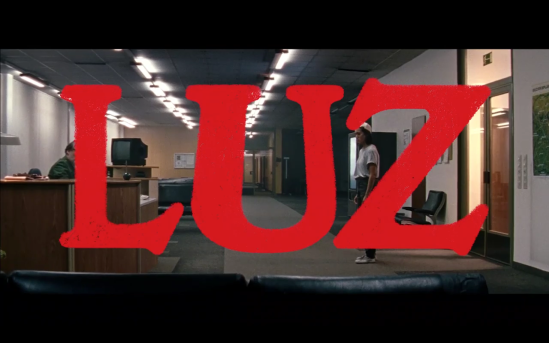
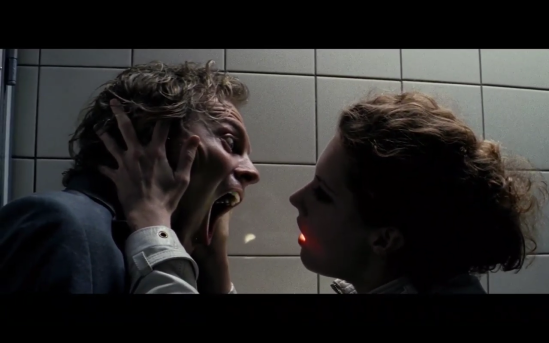
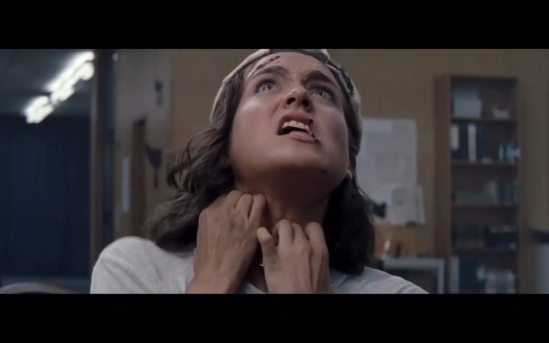
An immigrant cabby named Luz stumbles dazed into a German police station, repeating a profane distortion of a religious prayer to a couple of baffled detectives. Meanwhile, in a nearby bar, a forwardly chatty woman is diving seductively into a spiel about her Catholic schoolgirl friend who just recently jumped out of her moving taxicab to a psychoanalysis specialist on the edge of his seat. Drunk enough to take advantage of, the Doctor falls for the woman’s alluring trap, beguiling him to do her bidding as an unwilling host. As the now possessed doctor arrives to evaluate Nora for the police, he instigates a hypnosis recreation of the details events leading up to Luz’s ravings and disillusions. What happens next goes beyond human comprehension and rational as the doctor desires more from the stupefied Luz than what meets the eye.

Undoubtedly a strong skiff of demonic peculiarity weathering forth against an unforgiving maelstrom of spiffy-glamourous and yacht-sized counterparts is Tilman Singer’s memorizing tale of demigod deception in “Luz.” As the German born filmmaker’s first written-and-directed full length feature film, a film school project shot entirely on 16mm color negative, Singer dazzles with a throwback grindhouse glow set ablaze with a neon flare that adds to the perilous seduction and violation of the mind and primal infatuation. “Luz’s” was filmed in Cologne, Germany, where Singer studied film at the Academy of Media Arts Cologne, during the production year of 2018 and saw success at various Germany festivals, including it’s debut at the Berlin Film Festival and the Fantasia Film Festival. The Academy of Media Arts Cologne also serves as the production company, as it was, after all, a school project, and listed as Kunsthochschule für Medien Köln (KHM).

“Luz” wouldn’t be what as staggering as it is if it wasn’t for the invested cast who brings Singer’s vision to the spectrum. Luana Velis’s seamless grasp of the editing has remarkable wealth when playing a disoriented cab driver coming in off the street and Velis as Luz, in the ebb and flow of reality when Dr. Rosinni (Jan Bluthardt) entrances her with a blend of hypnosis and psychoanalysis techniques, sustains character through various transitions present inside a large police board room, reality, and the subconscious recollection of places and events inside her mind that Singer constructions for visualization, not reality. Singer melds together places, people, and events, throwing audiences for loops and casting misleading signals and just where the hell our characters are gathered. Bluthardt is equally captivating post transformation, coming off like a calculated maniac, resolved in his wild role. Perhaps, my favorite of the cast list goes to Julia Riedler as Nora Vanderkurt, Luz’s icy former bedfellow from Catholic School who slithers into Dr. Rosinni’s ear like a bewitching asp while seeming like a normal bar patron, but Riedler’s spin on Vanderkurt breaks the construct beyond that of the sleazy barfly and into something more conniving, wicked, and alcohol infused while still steamy with sexual emissions. All three performances are keystones to “Luz” success while fellow cast mates Johannes Benecke, Lilli Lorenz, and Nadja Stubiger, offer some spot on support.

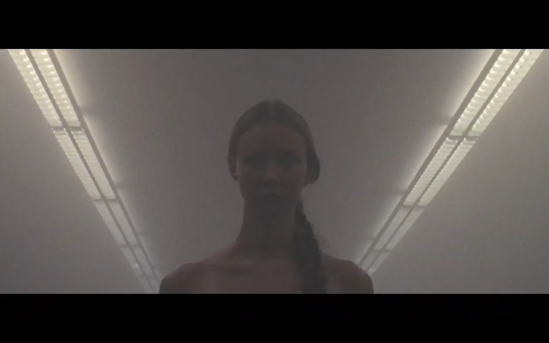
“Luz” summits fear with intrinsic performance art of hazy, but colorful, atmospherics and off-kilter shapes and lines, making the most routine settings feel unsettling. It’s a strong cinematography showcase by Paul Faltz who was able to frame and fright a scene from a sterile and fatigued, wood paneled office environment; essentially put, Faltz turned coal into a diamond while Singer brought a keg of European horror to the party. Unconventional, of course, with a profound arthouse quality about it, “Luz” is very much inspired by the European masters of horror, but pulls quite a bit from the vibrancy of American filmmaking too, pulling inspiration more noticeably from John Carpenter’s overwhelming sense of apocalyptic doom from such a scale down narrative and the terror looms like a chandelier hanging by a single thread just waiting from the startling crash of glass and metal. There are themes related Catholicism, homoeroticism, guilt, and obsession through the venomous innate nature of demon, as if unknowingly leaving an open invitation for evil by way of spiritual clairvoyance and Catholic defiance. Full of abstract visuals and melodious dialogue, “Luz” still burns the scary story lantern with a flickering of imminent existential combustion.

While the theatrical release has been officially canceled, “Luz” will still live on through the digital world, being released by Sharp Teeth Films, who released the POV slasher horror “You Are Not Alone,” on June 1st in the United Kingdom. With this being now a digital release, critiquing the audio and video quality will be limited to the artistic direction. Video-wise, Singer sought the use of a 16mm film stock with the speckle and grain texture of that beloved, yet enveloping imperfection and shooting in an anamorphic widescreen aspect ratio of 2.35:1, using an Arri Alexa and RED cameras that supported an anamorphic lenses. The result is phenomenal to digest with some serious depth when considering how small the sets are, turning mere pockets of space into the likes of grand ball rooms. The German, Spanish, and very little English dialogue tracks are clear and prominently abutted against a well adjusted ambience mix; in all, the audio package has good depth and range. There were no bonus features included with the digital screener. “Luz” is weird, mystifying, and can wriggle into your favor with a chilling essence taking a leisurely stroll along your back, propping up the hairs one strand at a time. Highly recommended.
EVIL is the Carousal Centerpiece of Hell! “The Devil’s Fairground” reviewed! (MGI Films and ITN Distribution / Screener)

A pair of struggling paranormal investigator groups have been reduced to the gimmicky capturing and recording pay schemes of alleged ghost and spirit interactions, but when a hack actor is hired to setup a meet and greet with an apparent demon possessed girl, their investigation leads Freaky Link’s Jacob and Shawn and Spooky Links’ Lace and Rob to an abandoned and dilapidated fairground as the source of the girl’s possession. Upon arrival, they’re immediately sucked into the epicenter of Hell to battle for their very souls.

Jacob and Shawn return to confront the ruthless terrors of supernatural forces once again in “Anna 2: Freaky Links,” aka, ITN distributed titled “The Devil’s Fairground,” and aka, better known as simply, “Anna 2,” in this low-key horror-comedy sequel from the Crum brothers, director Michael and screenwriter Gerald, delivering infernal Hell straight out of the Lonestar state of Texas. Honestly, I’ve never seen the prior film, “Anna,” and at first glance, “Anna” was seemingly a rip from the successful coattails of “The Conjuring’s” universe sub story, “Annabelle,” involving a doll embodying the forces of evil. However, despite the comparable titles and a shade of the narrative, “Anna” and “The Devil’s Fairground” veer into a novel realm of the deep and ultra-surreal that became the basic construction materials needed for lush nightmares. The Dallas-Fort Worth based production company, MGI Films, founded by Michael Crum, backed the film saw fit to update the title form “Anna 2: Freaky Links” to “The Devil’s Fairground,” a simple, yet improved title change that landed some viewing confusion when the original title graced the scree when the original title graced the screen, like for myself who enjoys going into a movie knowing nothing. MGI Films has also produced “Lake Fear” and “Blood Vow.”

Returning as paranormal private eyes, Jacob and Shawn, are Justin Duncan and Gerald Crum as the hapless duo who barely survived the first demonic doll encounter and team up with the Spooky Links investigators Lace (Mercedes Peterson) and Rob (John Charles Dickson, “Meathook Massacre 3: First Hunt”) to combine their joint efforts and their holy water filled water guns up against an unknown evil. Initially, Jacob and Shawn are written without much consideration of the first happenstance with only brief hints that mean little to the layman toward the Crum pagan pageantry. There’s obvious history between the two groups beyond being competitive supernatural sleuths that’s difficult to sift through to make a full, clearer picture on their quarrelsome nature, but one thing is certain, both Freaky Link and Spooky Links are desperate to be validated ghost hunters. Gerald Crum’s script might have dissected the thick tension between the characters, but the poor audio quality and the loose preface that dots the eyes between both predecessor and sequel is about as abstract as the Hell they find themselves swallowed in. Daniel Frank, Kenzie Pallone, Shannon Snedden, and Vandi Clark fill out the cast list.

“The Fair Ground” is a tricky trickster when judgement comes during the credit roll. With all the audio issues during the story setup, as aforementioned, connecting with the characters and the story proved dreadfully challenging conjoining against the fact that I have never seen the film’s antecedent, “Anna.” I was lost, confused, and struggling to keep up with the exposition that didn’t circulate visibly a perfect picture of “Anna” to bring the viewer up to speed. Also, the very fact “Anna 2: Freaky Links” title is displayed and not “The Devil’s Fairground” threw me for a loop; I had to pause and look back at the press release to see if I was watching the correct feature. However, in the end, “The Fair Ground” became an absolute diamond in the rough with a delectably profound scare factory of terror imagery, wallowing in the timely executions in Michael Crum’s editing and Gerald Crum’s imaginative visual and special effects. Though some will see the effects being rough around the edges, the shock-horror discordances work without question with a pack of ghoulish bug-eyed zombies, a carousal of shuttering specters, a foreboding carnival PA system, an aborted past lurking in dark waters, and an overgrown monster with the biggest butcher blade you’ve ever seen while peppering with scenes of powerful gore interjections. It’s something very reminiscent of the cinema adaptations of “Silent Hill.” A lot of the imagery doesn’t make sense, like the jarring slivers of a bad dream, but I wouldn’t expect Hell to be or need to be a place of complete rational and our minds are able to grasp the nuts and bolts of it. “The Devil’s Fairground’s” interpretation is just as real, as scary, and as aptly damning without the grounded laws of physics to ease the dispiriting attitude of multi-faceted and gratifying torture and soul swallowing the investigators are subjected to. Whatever was left of a meaningful plot is whittled down to a more basic posture, a group of people engulfed by the fiery Abyss, and the movie is all better for it.

Get sucked into the depths of the blazing inferno thrill ride with “The Devil’s Fairground” on DVD home video, announced by MGI Films and distributed by ITN Distribution. Unfortunately, the video and audio specs won’t be reviewed due to being an online screener, but I did mention the dialogue is limited, capturing very little of the softly laid discourse leading up to all hell breaking loose. There are no special features included with the screener or incorporated within the feature itself. There were times I knew the jump scare was coming and, still, I couldn’t contain the tension as a little part of me died from the inside. “The Devil’s Fairground” is an up and down roller coaster of feeble and fright with a weak story abutted against concentrated horror and gore in a must-see film.