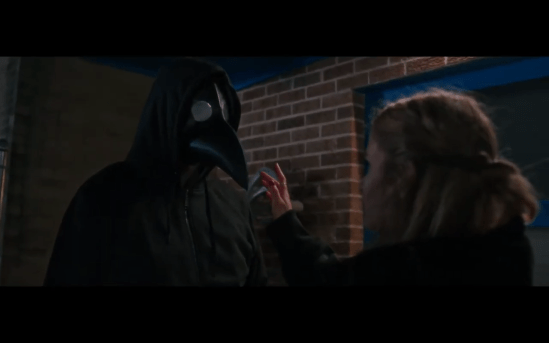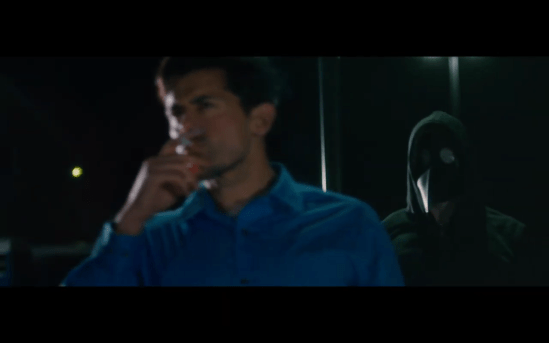
Giving EVIL the Electric Chair Only Gives EVIL a Buzz! “Destroyer” reviewed! (Cheezy Movies/DVD)


The unspeakable 23 rape and murder crimes of psychopath Ivan Moser grant him a seat of honor at the electric chair. As soon as the switch is thrown, a massive prison riot ensues and what happens next becomes unexplainable, confusing, and indeterminable. One thing is clear, the prison’s Warden Kash loses his position as the trashed penitentiary is forced to shut down. Eighteen months later, a film crew acquire permits to shoot a women-in-prison exploitation film inside the prison with the help of it’s one time custodial employee, Russell, who is just as creepy as the abandoned maximum security penitentiary that housed the infamous Ivan Moser. As production grapples with townsfolk opposition, electrician’s timing miscues, and some seriously bad acting, there’s one unexpected obstacles not accounted for…a living, breathing Ivan Moser still living inside the iron cladded prison.

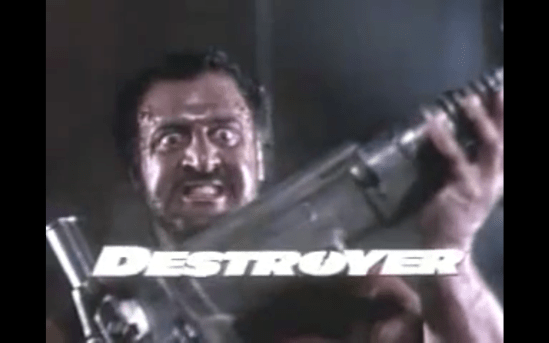
Horror fans from all walks of life to the age gaps of multiple generations can all agree on one thing, that the 1980’s is the gilded age of horror to which inspired and/or captivated us all. The decade was also an industrious change for political climates that saw the fall of the Berlin and saw musical artists like Michael Jackson break the conventional molds of how music was orchestrated, sung, and danced too. For movies, the change came with technical innovation in elaborate special effects, such as in John Carpenter’s “The Thing,” and undogmatic view of how we perceive plots which opened the flood gates to a slew of unexplored ideas no matter how far-fetched they may seems. One plot such as this would be from the 1988 prison massacre film, “Destroyer,” directed by Robert Kirk as is one and only non-fictional feature before an extreme career solidifying shift to historical movie and television documentaries. Written by Peter Garrity (“The Forgotten One”), Rex Hauck, and Mark W. Rosenbaum, “Destroyer’s” a gritty tale of endless, black obsession fueled by insanity, revved up with inexplicable half-alive malice, and juiced with strength of an indestructible force without being overtly supernatural.

With an 80’s movie comes an 80’s cast and the popular reteaming of Clayton Rohner and Deborah Foreman from 1986’s holiday themed horror, “April Fool’s Day.” “Destroyer” isn’t based on a certain holiday, but converges more toward meta approach where Clayton Rohner and Deborah Foreman play the romantic couple, grindhouse screenwriter David Harris and stuntwoman Susan Malone, on film set of their women in prison movie – Death House Dollies. A typecast switcheroo is engaged as the physicality falls upon the female role while Rohner takes a reserved backseat as a writer and that entails Foreman to face off against Lyle Alzado as the unspoken titular character Ivan “Destroyer” Moser. Alazdo’s crazy eyes and muscular football build provides the suitable basic elements of a crazed killer; probably doesn’t hurt that Alzado was also juiced up on steroids throughout his career in the NFL and beyond his exit from sports entertainment. Alzado has been quoted in Sports Illustrated having uncontrollable anger from roid-rage and that pressurized anger seethed, one could assumed, in the eyes of Ivan Moser, forging a superhuman monster under the parental guardianship of Richard Brake lookalike, Tobias Anderson (“Harvest of Fear”). “Psycho’s” late Anthony Perkins co-stars a the director of the WIP film as an unusual placemat only to serve as a hot moniker in horror to be contextual candy for one big scene and not providing much else. Lannie Garrett, Jim Turner (“Pogrammed to Kill”), Pat Mahoney (“Strangeland”), and four Death House Dollies in a gratuitous shower fight scene co-star!

A purebred American slasher of eccentric electrifying devices, “Destroyer” chooses punitive measures against the concept of capital punishment, sending the cryptic message that the dead will haunt you and those that you touch forever in some warped guilt trip nexus. The message is only further hammered in by the embossed haunting atmosphere of Robert Kirk’s opening sequence of a priest walking down the hazy cellblocks toward Moser’s cell, sitting with twitchy Moser while he madly raves and rambles about the game show that plays on a television set in front of his cell, and going through the steps of a chaired electrocution echoes a utilitarian dystopia that fathers in the cold, ungenial tone of the prison and Moser’s psychotically feral thirst to kill. Ivan Moser’s vitality is infectious, a hail-mary shot you’ll be rooting toward the finale, as the serial killer undertakes undertaker duties with extreme perversity while chocking up his body count with unsystematic eliminations, such as with a conveniently placed jackhammer in the prison basement. The jackhammer’s scene is “Destroyer’s” bread and butter, the showpiece of the whole film, but Moser only snag a couple of some real good on screen kills. All the rest are off screen or channeled through another device, such as an electric chair, and that softens and stiffens Moser’s, if not also Alzado’s, ultimate larger-than-life presence. Still, “Destroyer” rocks Lyle Alzado’s short-lived indelible monster making movie talent and confines the space to a breathless solitary confinement death house ready to devour more victims.

“Destroyer” shocks onto DVD home video release distributed from Cheezy Movies, MVDVisual, and Trionic Entertainment, LLC. If you’re not willing to shell out big bucks for “Destroyer” on Blu-ray from Scream Factory, check out Cheezy Movies’ economy region free DVD presented in an academy ratio, full frame 4:3. A beginning title card mentions that Cheezy Movies attempts to find the best transfer available when searching out titles and I believe that was done here with this release, but unlike Scream Factory, funds were not poured into an expensive upscale as moments of banding start right at the title credits. The transfer instances of dirt and cigarette burns are immaterial enough to not falter viewing, but there’s a bit of hefty color posterization in the basement scene that nearly blends the entire white scheme together and causing difficulties defining individual objects. The English language single channel mono mix maintains a lossy connatural sell topping out at the it’s as good as it gets ceiling with an economy release, but the dialogue is surprising clear, soundtrack sounds good, and the ambience, though needing a fine tuning, shapes out depth and range nice enough. With this release, no special features are available. Much like “Destroyer’s” tagline, Robert Kirk’s feature won’t shock you, but will give a great buzz with a nightmare coiling around your brain performance from Lyle Alzado and a super 80’s execution-from-the-grave slasher that’s just a guilty pleasure to behold.

Buy “Destroyer” on DVD! Or Watch on PRIME VIDEO!

EVIL Knows No Off-Limits! “Restricted Area” reviewed! (ITN Distribution/DVD)


Four blue-collar friends are being laid off from their steel mill jobs; family generations are engrained with the blood and sweet of the mill, but the somber moment is humbling and harsh when responsibilities come to collect. They decided to throw one last hurrah, a boozy camping trip into the rocky wilderness, before life hits them hard. The calm and tranquil getaway turns deadly when acolytes of Unionology, a cult secluded to the restricted areas, sets sights on trespassing campers with the four friends right in the middle of the hunt. After teaming up with another hiker and the disappearance of one of the friends, a fight for survival ensues against armed masked men and an unhinged cult leader along the mountainside where it’s not only man versus nature, it’s also man versus man.

The great outdoors continues to be synonymous with a hot spot for murder, mayhem, and overall doom and gloom in Christopher M. Don’s debut backwoods cult thriller of survival entitled “Restricted Area.” Dons pens as his second script behind the savagery, snowy slopes of his ski-sploitation horror, “Minutes to Midnight,” where masked men with a cryptic agenda hunt down patrons of a ski lodge set upon a mountain. Don must have an fondness for producing screenplays where masked killers stalk in wilderness elements as “Minutes to Midnight” plot is essentially the same as “Restricted Area” without the sound-damping snow. Produced by Gear Up Productions, which I assume is Christopher Don’s company, climbs very little up to being a modest budget feature and retains around camping along the super low financial terrain based off the already exaggerated beliefs of Scientology that, if at all, lightly treads to more escalating and thrilling heights.

With being an indie feature on a microbudget, Don implements his cast to being his actors as well, including himself as Cody, the nearly silent onscreen brother to his real life brother, Robert Don, as the film’s lead, Tyler. Tyler’s a rough and tough steel mill worker with his biceps bulging from his sleeveless, black puffer jacket and hunting knife strapped to his waist side, but as far as depth goes, Tyler lacks significant worth from little backstory and no character arc. Whatever Tyler does isn’t exactly bursting with energy by Robert Don’s deadpan manner. Who recoils from inexpressiveness is West Murphy playing Axel, the goofy and boastful friend whose really blowhard, and though Murphy sprinkles flavoring upon and around most of the monotonically adrift slop, Axel’s one-trick pony can’t even offer much else to the story, not even a glorious death that would be redeeming for such droll stereotypes. “Restricted Area” houses random entries and exits of characters that can make viewers anxious, concerned, and down right frustrated with the arbitrary fates of Harold (“Big Bad Bugs’” Phillip Andrew Botello) who disappears with only a little sliver of where he might be in the closing scene and the blank white masked cultist with a machete who leaves more intrigue of a boss level villain than is actually divulged in the story. Paige Lindsay Betts, Ross Britz (“Ozark Sharks”), Emily Gardt (“Satan’s Seven”), Nicholas Cole (“Stripped”), Randy Wayne, Gus Moore, Wilmer Hernandez, and schlock horror internet pundits and, Shawn C. Phillips and Danny Filaccio fill out the cast list.

“Restricted Area” already has a zillion things going against the meek and humble feature albeit the aforesaid above from the mishandling of characters, but the bearings, picked from the litter of many categories, never comes into focal clarity and shimmy their way to eek by toward a rather enigmatic end. Out of the 112 minute runtime, Christopher Don’s screenplay couldn’t consists of more than 60 to 70 pages of dialogue and scenes with the remaining footage for the feature being supplemented with overkilled filler scenes of Tyler and his band of survivalists wandering around an idyllic traipse, dysfunctional and unnecessary segue edits repeat nearly themselves and just extend into filler scenes themselves, and the bombardment of landscapes – lots and lots of landscapes. There was even one faux pas of a wooded mountainside that was shamelessly shot straight from a magazine advertisement with the advertised site text very visible in the scene. There’s also a scene with a real rattlesnake that, by chance, wandered into production and Don decided misplace this miracle amongst inside another wandering group montage. To continue on the script, the convoluted nature of the cult wanted to kill a young boy becomes lost as this boy comes and goes as he pleases, pleading without any dire sense of urgency for Tyler to save his life. Yet, this dubious boy never seems to be frightened, frantic, or even in cahoots when considering the cult’s dastardly plan to end his time on this Earth.

ITN Distribution and Mill Creek Entertainment’s call to the wild is a survivalist nightmare in Christopher Don’s “Restricted Area,” pitching a tent into the DVD market with a home video release. The DVD is presented in a widescreen 1.78:1 aspect ratio on a single layer, region one disc. Perhaps one of the worst presentations I’ve seen lately with the low bit rate, big compression artifact issues that denounces detail clarity right from the get-go, settling into a fuzzy and blotchy 112 minute, from start-to-finish, runtime. The color palette doesn’t pop either inside the parameters of a faded natural scheme that bares no attempt to use any shade of tint to offer more than just the bare minimum to survive. The English language Dolby Digital stereo dual channel mix plays the same rugged tune with lossy quality in dialogue, ambience, and Michael Levinson’s synthy soundtrack, which is perhaps one of the film’s few highlights in lieu of his debut. Still, a harsh feedback echo on the dialogue dampens the authenticity of the ordeal and poor mic placement dilutes the fidelity even more. Optional English SDH is available. Bonus features includes an audio commentary, trailer, and a quaint blooper and outtake reel. “Restricted Area” doesn’t have the authority required to be a gouging survival horror as all sides of the cinematic terrain are too rough for an visual and audio trek and the script lays to waste with drone dispositions and careless considerations that needs to be post noted and restricted from itself.

“Restricted Area” on DVD

Evocation of EVIL in “The Girl In the Crawlspace” reviewed! (ITN Distribution / DVD)


Jill escapes from the grip of a kidnapping-serial killer who kept her confined in a crawlspace under the house. Her courage brings lethal justice to the captor when the local marshal shoots and kills him upon confrontation. Jill struggles to reintegrate back into her local community in the aftermath, sleeping unconfined in the outdoors and withdrawing herself for social interaction, including from her weekly role playing game with friends. When Kristen moves back into her hometown from college, she aims to set up her therapy practice to assist families impacted by the serial killer as well as Jill by special request from the marshal, but Kristen’s rocky relationship with her substance abusive, off-Hollywood screenwriting husband on the mend drags out Jill’s much needed treatment. With Jill and Kristen preoccupied, they’re oblivious to the concealed threat that plots the next terrorizing exploit of kidnapping and tormenting young, beautiful women.

From under the grubby wooden floorboards to the strategic folding table of a role playing game, “The Girl in the Crawlspace” is the Midwest direct-to-video suspense thriller that tackles post-traumatic stress and marital strife while submersed in a looming trail left by a notorious mass murderer, written and helmed by first time director John Oak Dalton. Dalton, who has penned several low-budget grindhouse titles over the last decade and half, including titles such as “Among Us,” “Sex Machine,” and “Jurassic Prey,” returns once again to the genre with the repercussions of Podunk psychopath upon small town America, filmed in Indiana and release in 2018 hitting the ground running with film festival circuits. Indie filmmaker Henrique Couto, schlock horror director of “Scarewaves” and “Marty Jenkins and the Vampire Bitches,” signs on as producer, stepping back from his usual productional duties, and letting an occasional collaborator Dalton to completely engulf himself as the omnipotent auteur. Midwest Film Ventures serves as the production company, shot in Farmland, Indiana.

Erin R. Ryan has continuously sustained a low level hover on the indie horror radar after taking her in Dustin Mill’s “Bath Salt Zombies,” based on the Miami incident based on a naked man eating someone’s face induced by being high on bath salts, and the gooey-gory body horror, “Skinless,” that’s also a Mills production. Ryan expands her portfolio outside physical horror with Jill, a traumatized recluse derived from her abduction and torture, as a subdued component that’s contrary to previous roles, but Ryan capitalizes the opportunity of a scared kitten, recoiling from public gatherings, and slowly and silently emerging back into society while recalling chilling moments as the story progresses. However, there’s difficult pinpointing the head lead as the protagonist roles are shared between Ryan and depicted married couple, a pair of more Henrique Couto casted actors, in Joni Durian and John Bradley Hambrick as Kristen and her husband, John. Between the three, chemistry clicks better than cooking meth in a chemist’s unsanctioned laboratory and offer ample contention without the attending killer’s presence hanging over the whole town’s head. Rounding out the remaining cast is Chelsi Kern (“Scarecrow Count”), Joe Kidd (“Ouija Room”), Jeff Kirkendall (“Sharkenstein”), Clifford Lowe (“Scarecrow County”), and re-introducing Tom Cherry as the good old boy town officer, Marshal Woody.

With a title like “The Girl in the Crawlspace,” I would be remiss if I didn’t say there were some expectations of bodily torture, psychological terror, and teeth-clinching tension when sitting down to watch. The hype was high considering the post-after-post amount of positivity for “The Girl in the Crawlspace” on my Twitter feed. The catchy name and optimistic comments provided real temptation, but Dalton steers in another direction, the what follows in the state of everlasting shock and the reliving of moments seared into your psyche. The direction wasn’t as expected, but that’s necessary a bad thing. “The Girl in the Crawlspace” is exposition heavy with considerable amount of movie referencing peppered with some current event topics, such as the brief mentioning of killing of migrant children, throughout and continuously wanders off point, strolling more into Kristen and John’s crumbling marriage. Jill, the supposed centerpiece of the story, feels more like an afterthought, despite being the “girl” in “The Girl in the Crawlspace.” The cantankerous marriage supposedly jeopardizes those personally involved in Jill’s well-being as John exploits Jill’s idiosyncratic experiences from being a captive by turning them into inspirational junk food for his fading screenwriting career, but the catalyst incident doesn’t stick, becoming more of a weak opening for a more pronounced return of Jill’s haunting past.

From ITN Distribution and Mill Creek Entertainment, “The Girl in the Crawlspace” lands onto a not rated DVD home video release. The single layer DVD is presented in a full frame widescreen of an 1.78:1 aspect ratio. In a framing sense, Henrique Couto’s cinematography distinctly places small town in a spectrum view that highlights the soybean fields and farms, the rustic brick infrastructures, and the simplicities of a relaxed, old-fashioned town, using some drone shots to expose the green belt greenery. For an indie feature, the agreeable bitrate has a frank, clear image despite some consistent overexposure that softens details, especially on faces in the outside scenes. The Dolby Digital stereo 2.0 mix has also agreeable dual channel output. Some of the dialogue scenes suffer through an echo, but for the majority, the lines have clarity and unobstructed by ambient layers or the soundtrack. The depth discloses some distant ambiguities, such as in a train shot that’s not rendered in the background as it should, but the amount of range is palatable. English SHD subtitles are available. The only bonus features available on the release are the theatrical trailer and an commentary with producer Henrique Couto and director John Oak Dalton regarding their history together and going through the shot techniques as well as touching upon the actors. The road to recovery is paved in nightmares, psychological terror, and Midwest psychopaths in “The Girl in the Crawlspace,” but pitches away from the principal concern that turns second fiddle to one struggling screenwriter’s difficult assimilation into rural life while simultaneously rethreading a floundering livelihood and a tattered marriage.

Own “The Girl in the Crawlspace” on DVD

Follow EVIL’s Design! “A Psycho’s Path” reviewed!


In the sleepy Californian desert town of Brownsville, the peaceful way of life has been upended and thrown into chaos when a savage murderer embarks on a path of a seemingly random killing spree. Previously apprehended and transferred to a psychiatric hospital by court order, the psychopath’s easy and violent escape places him back into an already frightened society to the likes the town has never seen. With no leads to pursue and the townsfolk fearfully blaming the ill-equipped police force, Captain Peters and his squad of deputies must establish a pattern of slaying in order to track his next move, but all kill sites lead to being arbitrary – a motel on the outskirts of town, a isolated gas station, and a suburban home. Are these killings at random or is there a path the killer is following?

Mixed martial artist Quinton “Rampage” Jackson lives up to his professional epithet in Rocky Costanzo’s “A Psycho’s Path.” The credited writer and director filmmaker from Huntington Beach, California follows up his 2016 germane, American social, malignancy teenage thriller, “Ditch Party,” with the 2019 horror-slasher birthed from the spirit of independent filmmaking and produced by Noel Gugliemi, Matthew King-Ringo, and David Ramak. Despite the title’s wordplay on A Psychopath,”A Psycho’s Path’s” gritty and dark tone is anything but a pun-wit delineation as should be presupposed judged by the Mill Creek Entertainment DVD cover of a bloodied and wild-haired Jackson garnishing a blank death stare in the foreground of a moon and neon-lit ominous motel that just screams the trope scenario of nothing ever good is going to happen to that lady standing just inside her motel room’s doorway and wrapped in wet bathroom towels.

The former UFC lightweight Champion Jackson is no neophyte when concerned with the acting world. The big screen’s “The A-Team” adaptation proves just that with his break through rendition of the rogue militant, B.A. Baracus, famously portrayed by Mr. T in the early 80’s series of the same title and established the kind of role types Jackson’s built for outside the ring – large and in charge. In “A Psycho’s Path,” Jackson just has to appear like a 6’1″, 270lb monster without so much of one word of dialogue; it’s a role without a name other than John Doe and it’s a role Jackson was born to play as his physical attributes are naturally inherited and, dare I say it, scary. Character linked on the opposite side of the behavior spectrum is Captain Peters, played by Steve De Forest in one of the few prominent performances of his career, but Captain Peters doesn’t have enough oomph as a character to size up to John Doe. Thus, enters Noel Gugliemi, also known as Noel G., one of the most famous support character faces in all of the film industry from “Training Day” to “Bruce Almighty,” “The Purge: Anarchy” to “The Fast and the Furious” franchise, Gugliemi has the big name and personality in a joint forces operation with Steve De Forest as his on-screen right hand deputy, sergeant Torres. Barely recognizable with a bad wig and without his trademark facial hair, co-producer Gugliemi spits the snake tongued, whip-cracking lines of a jaded officer, lines that have solidified him as an all time fan favorite in his credentials. “A Pyscho’s Path” rounds out with Steve Louis Villegas (also in a bad wig), Kassim Osgood, Derrick Redford, Rowan Smyth, and with a lighthearted cameo from “Different Strokes'” Todd Bridges.

For fans of Michael Myers and the “Halloween” franchise, “A Psycho’s Path” has starkly obtained familiarities to The Shape’s universe with Jackson’s stoic performance of pure, unstoppable evil escaping a psychiatric setting intending to kill, kill, and kill and in also Costanzo’s ambitious direction, especially the track and follow camerawork that’s complimented by the cold tone cinematography of Dylan Martinez (“Ditch Party”), but that’s where the positives seemingly part ways with the rest of the film as a schlocky and campy shadow looming over what could possibly drive all these lunatics to the prospect of committing mass murder. Throw aside the already aforesaid production wardrobes with bad wigs and also ill-fitting deputy uniforms, “A Psycho Path’s” has lost more at stake with little string to yarn a strong woven story together that necessarily elevates John Doe’s affixed obsession to follow a blood-shedding zig-zag path loosely in a little-to-nothing conveyed context. “A Psycho’s Path” becomes a shell of other film’s former selves.

No One is Safe as the tagline warns on the DVD and digital download release of “A Psycho’s Path,” a production from Entangled Entertainment, Hourglass Pictures, and Stroboscope Studios, and distributed ITN Studios and Mill Creek Entertainment, a division of Alliance Entertainment. Presented in it’s original aspect ratio, an anamorphic widescreen 2.35:1, the image can be lost in a shadow-heavy contrast. Though praising his dark tone earlier alongside some well framed shots, Dylan Martinez, at times, goes full midnight at moments that hide events and eventualities from being discernible. The uplighting motif helps with cutting the overly dark picture and creates a sinister mood as slithers of shadows give a hard edged appearance. There’s also a menagerie of tint that doesn’t hone a theme. The English language Dolby Digital audio track renders palpable with clarity in dialogue and a decent range of ambience; however, the lack of depth throws some shade as characters, no matter whether in the background or foreground, live on an equal degree of volume. The release clocks in at 84 minutes, is not rated, and includes option English SDH subtitles. “A Psycho’s Path” has adequate acting, indie charisma, and one hell of a kill scene with a head in a vice like death grip and squeezed to pop like a ripe tomato in one’s hand, but can’t reproduce the slasher mystique well enough to earn it the trait.

Own it today on DVD!

EVIL Doesn’t Stop Until the Director Yells “Cut” reviewed!


In 1985, director Hilary Jacobs sets her sights to finish her Australian low budget horror film, “Hot Blooded,” at all cost, but the ambitious cast and crew struggle to compete with riley personalities that slow down production. The film’s masked killer goes mad and gores with an indefinite stake into the film’s heart after mercilessly murdering Jacobs before being violently killed himself by the film’s vain star, American Vanessa Turnbill. Fourteen years have past and the “Hot Blooded” reels have been deemed cursed for whenever they’re viewed, someone dies, but a group of determined film students are keen on finishing Hilary Jacobs’ last directorial and even gain the original leading lady, Vanessa Turnbill, to return and finish her staggering performance. With the partial, unfinished reel screened by all cast and crew and filming begins shooting on the original set premises, the evil masked killer returns to finish each one off diligently before they’re able to finish the film.

With the late Wes Craven pumping new spirit into the a life support stricken slasher subgenre in 1996 with “Scream,” masked killers surged into proper restoration once more right before the turn of the century and Mushroom Pictures, the cinematic banner of one of Australia’s most notable indie music publisher, Mushroom Group, asserts their debut title into the stratosphere grazing genre that who’ve now initiated a creative footing into film production and distribution with a commemorating meta-slasher entitled “Cut.” Directed by Kimble Rendall (“Bait”) and penned by Dave warner, “Cut” dares to ride the newly rediscovered genre wave early in the wake of establishing predecessors that strived to formulate an un-formulaic counter measure against the slasher status quo, but “Cut” doubles down with Warner’s script that meshes subgenres, compounding the horror to uncharted territories where filmmakers do not dared trek sitting comfortably in their less is more recliner. “Cut” relates more to Wes Craven than most genre fans would like to admit but the similarities the two directors’ characters and killer are compelling to explore and compare. The filming is mostly shot in the Adelaide region of South Australia; the same region that produced recent horror such as 2017’s zombie post-apocalyptic “Cargo” starring Martin Freeman and the great white shark thriller “The Reef.”

Comprised mainly of an Australian cast, “Cut’s” headlining leading lady is an American “Sixteen Candles” sweetheart taking a leap into unfamiliar territory and I’m not talking about of the Outback kind. Molly Ringwald has only ever starred in one other horror film in her 40 year professional acting career and after the dismally reviewed 1997 cubicle-cutthroat thriller, “Office Killer,” the “Breakfast Club” star steps into a more complex role that involves her multi-tasking two persona performances of essentially the same character spanning a story lined fourteen years apart. As a true testament to “Cut’s” makeup and stylist department, Ringwald, who was about 30 years old at the time of filming, goes incognito as she’s barely recognizable as Chloe, a role within a role played by Vanessa Turnbill playing the teenage character in the scrapped “Hot Blooded” slasher. Though a far cry from a coming to age film, Ringwald pivots to a coming to terms with her character’s handling of prolonged fear from the fateful and deadly night the masked killer almost ended Vanessa’s life by strongly playing to the character’s overpowering sense of self worth and brash Hollywood attitude against the one thing she can’t control…her past. Vanessa is not alone in her quest for finishing a scarring afterthought as “Hot Blooded’s” newest director, student filmmaker Raffy Carruthers, picks up where Hilary Jacobs’ left off after being butchered and is determined to wrap Jacobs’ legacy short of being a hack director. As the other half of the two resilient female characters, Raffy is played by New Zealand actress Jessica Napier who channels her inner Sidney Prescott as a strong feminine survivor unnerved by the macabre that’s closing in around her brought upon a sadistic masked killer and braves sacrificing herself to thwart pure evil’s carnage. The rest of “Cut’s” cast disperses the right amount of character building performances by Sarah Knats, Stephen Curry (“Rogue”), Matthew Russell, Erika Walters, Cathy Adamek (“The Babadook”), Steve Greig, Sam Lewis, and pop singer Kylie Minogue (“Street Fighter”) whose had collaborative projects with Mushroom Group and also a role in a Kimble Rendall 11-minutel short, “Hayride to Hell.”

The meta approach “Cut” takes might detach itself from the plot of “Scream,” but in essence, the Kimble Rendall film is derivative work of Wes Craven who aimed to expose and exploit cliched tropes of the slasher flicks to upheave audiences wits on what they know about the genre and where the plot might eventually boil down to in a orthodox simmer of uncreative sensationalism. “Scream” smartly broke down plot structures, revealed character flaws, and even name dropped popular directors and films that became the very foundational basis of the Renaissance slasher era that went unchanged for years, decades perhaps. “Cut” also reasserts shout outs as references, along with Rendall’s creative knack of making every character swim in the pool of suspicion, to build up a catalytic twist no one would or could predict despite all the subtle clues, generally abundant in slashers, toward revealing the killer’s true identity and motivation. I wouldn’t be bold enough to say Rendall’s “Cut” deserves to be above or on the same level as “Scream,” because, frankly, it doesn’t, but “Cut” has a singular, unique identity with all of its own loaded modern day slasher traits such as a high kill count and an intriguing self-referential plot. Where “Cut” shakes at the knees a bit is how the practical effects were accomplished and the scores of cheesy late 90’s-to-early 2000 visual effects bared an ugly resembles of something that could have come straight out of the Super Mario Bros. film adaptation. A minority of the kills were decently crafted to bring a honorable character death, but there were many that succumb to a quick edit or stemmed from an off screen cut down that took away the breadth of impact and left more to be morbidly desired. Where “Cut” struggles shouldn’t be deemed ineligible for attention because of those reasons and, in fact, “Cut” sustains a high entertaining rating with immense value in the replay sector to catch thematical intimations and do a comparative analysis on Crave and Rendall’s films on how they experiment, treat, and respect the greats that were once lost to success over a long period mediocre financial and routine blundering.

Umbrella Entertainment and Beyond distribution debuts the Blu-ray release of the Mushroom Pictures and Kimble Rendall’s “Cut” with a full HD, 1080p 4K restoration from the original film’s 35mm interpos and presented in a widescreen, 1.85:1 aspect ratio. The 4K scan illuminates the hard, dark lighting used primarily for tone setting, granting an extremely gothic look without being inside the parameters of inherently gothic set design and the scanned transfer also revitalizes the snaps of color where appropriate while still leaving the natural grain from the 35mm filmstock. The English language dual channel DTS-HD Master Audio track has lossy quality because there is such contentious and explosive moments that warrant audio quality; however, the 2.0 track is sufficient to lay simple groundwork of depth, range, and clarity and the soundtrack, no matter how generic, elevates to a concentrated level with the killer on the hunt. Dialogue murkiness is no issue here with a clear path of discernible lines. Special features seem limited and antiquated for a 4K, Blu-ray debut release, but do include archived cast interviews with Molly Ringwald, Kyle Minogue, Jessica Napier, and Kimble Rendall, behind-the-scenes of some of the shots, a commentary with director Kimble Rendall and writer Dave Warner, storyboard and concept art gallery, “Hayride to Hell” short from Rendall that stars Minogue and Richard Roxburgh, and the theatrical trailer of the film. The back cover states a region B disc, but my player was set on A and prior press releases suggested a region free release so this particular gem should play in any region. If a die hard Wes Craven fan, place the 20-years-young “Cut” into your queue as a forward thinking slasher with brass balls and a marred killer with modified gardener sheers that provokes the genre still to this day.

Why settle for standard definition when “Cut” makes a 1080p debut onto Blu-ray!!! Click to buy it now!