Honey’s Sweet, But There’s EVIL in the “Royal Jelly” reviewed! (Uncork’d Entertainment / Digital Screener)


Bee careful what you wish for in this apiary tale that tells a story of high school misfit, Aster, an easy target for unsympathetic pubescent bullies, including the continuing at-home abuse from her half-sister, Drew, and pitiless stepmother.  With neither school or home being a safe retreat, Aster finds comfort in an unorthodox and brash substitute female teacher who has taken a shine to Aster and provides her shelter when she’s distraught after discovering her collection of apiary beehives was maliciously destroyed in an act of malice.  After living with her teacher and her son for some time, they exhibit strange behaviors, develop skin rashes, and Aster begins to notice that she doesn’t quite feel like herself either as her safe haven is unveiled as a façade for her grooming to become the next hive queen.   

“Royal Jelly” isn’t exactly the killer bee movie you’d be expecting.  Writer-director Sean Riley invites a new take of the Apiformes horror subgenre outside the beehive of being per se a creature feature with his new film, “Royal Jelly.”  And, yes, even though tiny in size, bees are still tiny creatures with mighty (painful) stingers.  Those not familiar with the term royal jelly, other than it being an unique title for Riley’s sophomore feature, royal jelly is the honey bee secretion from glands located in the hypopharynx and is the chief nourishment for colony’s larvae.  See!  Who says horror movies can’t be education?  Somehow, someway the Baton Rouge, Louisiana-born director found malefic inspiration secreting from his metaphorical hypopharynx domiciled glands and packages with it a paralleling an all too familiar fairy tale crowdfunded by Indiegogo backers, second feature funded this way behind his breakout directorial of the comedy “Fighting Belle,” and Riley’s Integral Motion Pictures.

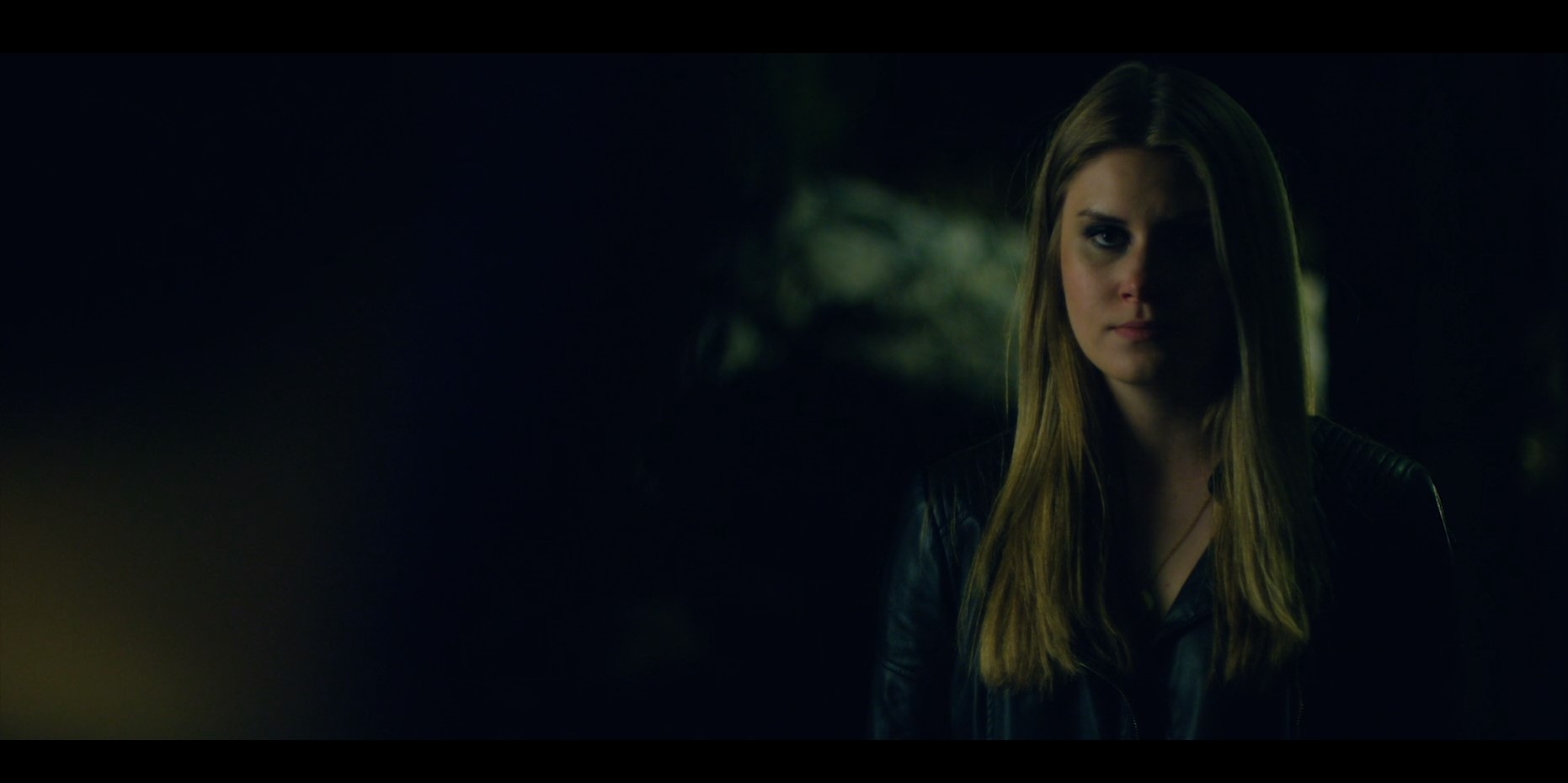
Now, who is this leading lady willing to be misled into a turned-out humanoid life sized queen bee?  The University of Southern Mississippi Fine Arts graduate Elizabeth McCoy, of course.  The Greater New Orleans actress slips into an quasi-goth cladded outcast Aster sporting fishnet stockings and a black graphic t-shirt promoting the band Queen, a bit of fitting foreshadowing if I’ve ever come across one.  Before being bequeathed the hive throne, McCoy has to render Aster a meek existence made small by the death of her beekeeper mother backstory and surrounded by loneliness stemmed by an abusive sister and stepmother and a coward of a father.  The only joy made clear in Aster’s life is her bees.  When her apiaries are decimated, that is when high school sub Tresa (Sherry Lattanzi) flies in and shelters Aster under her wing that makes for an odd couple combination that’s one part predatory teacher fraternizing with a vulnerable student and one part comical motherhood to see McCoy tower over a short Lattanzi who is in this insect sovereign role. Doesn’t Darwin always say the strongest always survive? I guess there’s nothing in Darwinism about the tallest. Lattanzi expresses Tresa about as audaciously enigmatic as they come with little-to-no story arc to move in accord with as Tresa just shows up, out of the blue, and after a scene where Aster’s teacher has had his throat slit and I’m still trying to fathom the plot hole of how the hell Tresa entered the frame so quickly, as a substitute teacher, without ever laying eyes on Aster until stepping into her classroom. Sparse is the name of the game as Tresa, as well as Aster, are poorly written without much density and neither actress can pull off miracles adding layers to already rotten onion. The rest of the cast includes Raylan Ladner, Lucas T. Matchett, Fiona McQuinn, Jonas Chartock, and Jake McCoy.

Pulling inspiration from Roger Corman’s “The Wasp Woman,” Riley’s “Royal Jelly” ditches the experimental cosmetics for timeless folk lore while still vaunting a Corman class cinema gooey with bee secretion center. Instead of an enchanting tale of rags to riches, this loose Cinderella adaptation comes with all the classic hallmarks like an evil stepmother, a wicked stepsister, and a fairy godmother manifesting Aster’s dreams on the spot, but instead of a magical wand and a pointy hat, this fairy godmother comes in the form of a personified bee queen wearing a façade of a presumptuous substitute teacher. Riley’s openly emblematic killer bee story could go one or two ways. 1 – Aster is actually being groomed by a bee queen to take over her hive as a homolog event to Aster’s earlier class presentation on the eusocial bee social organization or 2 – Aster has snapped due to bullying and she’s daydreaming, hallucination, or dead and the bee-havorial chaos she’s experiencing is either in her head or is sardonic Hell. I like the second theory better over the first as I don’t find Aster’s sprouting of inorganic and rigid Halloween costume bee wings and a makeshift stinger, that appears more phallic than necessary, to be enticing me with a freakish reality. I still can’t get over the possibility of a predator allegory as a big truck cruising Tresa targets Aster to mate with her “sons” “Henry” or “David” to produce a heir of sorts. Either way you slice into Sean Riley’s “Royal Jelly,” little feels right story-wise with the delimited, bareboned farmhouse and apiary analogy and with the flighty characters leaving all their aces on the table which Riley scarcely goes back to address, such as with Aster’s family who just disappear from the story altogether though scenes of her snide stepsister showing slithers of guilt and sympathy go unfounded.

The bee invasion has landed with Uncork’d Entertainment’s release of Sean Riley’s “Royal Jelly” this September on all digital platforms From the unhinged “Homewrecker” to the love you to death “Cupid,” Uncork’d Entertainment distributes a wide berth of independent horror, stretching to all home entertainment platforms, and acquires the bee-horror “Royal Jelly” that fits into the company’s catalogue. Since released digital, the audio and visual aspects won’t be given the once over. Jonathan Hammond (“Attack of the Southern Friend Zombie”) serves as cinematographer who’s overexposed day scenes are starkly contrasted by the night scenes’ hard lighting slathered with an unforgiven blue tint. The inconsistent visual styles and slips, such as unfocused, blurry scenes at the dinner table near the beginning of the story, clash in the 94 minute runtime. Joe Hodges lays down a common brooding industrial score that’s not half-bad as the melodies change with the extent of the solid sound design. Stay tuned post credits scene for a millennial targeted public service announcement to protect and support the bee way of life by scanning a QR code to receive information on how to exactly do that. Pleasantly informative and certainly unusual, “Royal Jelly” evinces more the echelons of bee society and lot less the terror of horror and that takes a lot of the sting of Riley’s film, making this bee killer movie a total buzz kill.

Own or Rent “Royal Jelly” on Amazon Prime Video

Fortuity Can Be EVIL’s Plaything. “Like A Dirty French Novel” reviewed! (Blvd. Du Cinema Productions / Digital Screener)


An organized crime and deceitful milieu sets the stage for a missing bag of stolen cash, an unscrupulous bunch of characters, and a mysterious omnipresence being persuasive behind the curtain of a rotary phone.  When ex-lovers Crystal and Hue are not in heated spats over past infidelities, trapped inside their quaint apartment, Crystal moonlights as an adult cosplaying model secretly having an relationship with a stranger while Hue locks himself away in the bathroom conversing secretively and flirtatiously with an unknown woman he knows nothing about.  They become entwined in a heist gone wrong by a group of halfwit robbers that leaves a trail of death, lies, and an evil charting their fates in the shadows. 

Desultory pulp basking in noir fiction, “Like A Dirty French Novel” flaunts a chicly awkward and brazenly unmethodical black comedy and crime drama front from Cuban-American writer-director Mike Cuenca.  The “By the Wayside” and “I’ll Be Around” auteur stitches together a vivaciously satire and minuscule budgeted drama comedy shot in the zero hours of a time crunching, less than a week, schedule with an editing style, edited by Cuenca himself as one of his many production hats, of five chaptered, non-linear tale of sectionalized cynicism and infringing transgressions.  Cuenca co-write the script with Ashlee Elfmann and “I’ll Be Around” co-writer, Dan Rojay, with Cuenca self-producing under the filmmaker’s East Los Angeles-based, DIY encouraging production company, Blvd. Du Cinema Productions.

With an ensemble cast, “Like A Dirty French Novel” spreads out with five chapters, two interludes, and a prologue that begins with three men walking in a desert and approached by a mysterious woman in a chintzy, but intrinsically detailed, Japanese resembling Oni mask.  Before we can invest into these bewildering circumstance that leave the three men screaming for their very lives, Cuenca whisks up away right into Chapter One, introducing bickering ex-lovers Crystal (Jennifer Daley, “Blood Born”) and Hue (Rob Vally, of gay themed Steven Vasquez pictures such as “Angels with Tethered Wings” and “Dancing on the Dark Side of the Moon.”) snooping into each other’s hidden extracurricular activities that leave Crystal daydreaming about romance and Hue surrendering to smutty phone talk.  Not much is revealed in the first chapter before segueing into the second with Forrester Dooley (Grand Moninger), an unhappily married man who switches places with his twin brother and the recently unincinerated Bugs Dooley (also Moninger), but, as fate would have it, Bugs turns out to be a standup, wonderful guy whereas Forrester need for a break ironically places a bullseye on back and he ends up stranded in the desert with two unsavory fellows, circling back to the film’s vague prologue.  The cause for their stranding is because of Lane, a manic drifter delightfully captured by “We Take The Low Road’s” Amanda Viola.  Lane is approached by cool cat Jake (Aaron Bustos) and what ensues next is a montage of innocent dalliance before he suddenly vanishes and is seemingly dead to the world.  Remaining chapters unravel more about the principle players, spilling their hidden agendas and their scheming roles surrounding a duffle bag of thieved cash pinched from a local ruthless kingpin Filmore Demille, played by Cuenca himself donning yet another hat.  The cast rounds out with Dominic Fawcett, Samantha Nelson, Laura Urgelles, Claire Woolner, Dan Rojay, Joey Halter, Miles Dougal, Steven Escot, Arko Miro, and “Murder Manual’s” Brittany Samson as the interlude’s stammering and obsessed fanatic of the masked and sexy graphic novel cosplay model.

“Like A Dirty French Novel” pulsates with pulpy fiction with hints of Lynchian notes through Cuenca’s back and forth pacing of connecting the dots to his equivocal crime thriller.   Cuenca’s gray area, faltering more than any other, lies in making that relating and understandable so important connection of reverting scenes back to earlier ones in order to have actions make sense.  A once over is not enough to fully grasp “Like A Dirty French Novel’s” abstract features and to be recursive would not be a sign of weakness or simplemindedness on our part.  Still, smoothing out the rough patches like with the peculiar finale, which I’m speculating to be the grounds of Hell, would have made “Like A Dirty French Novel” more of an easy read than a confusing one as well as completing most characters arcs with a satisfying tell all fate. Cuenca’s filmic message of what comes around, goes around comes across more clearly with those who reap what they sow. A faux book entitled Porter du Fruit or Bear Fruit yields to positive results and, in which this case, none of those characters who go to the grounds of Hell are saints by any means. Constrained by a shallow pocket budget, settings are simple outdoor public areas, small apartments utilized with polygonal angles, and, if you’re working in L.A. much like this shoot, then more than likely a scene or two, at the very least, is filmed in the desert, but seasoned cinematographer, Jessica Gallant (“The Control Group,” “Shevenge”) spruces up scenes with neon red lighting, dabbing in black and white, and centralizing characters with focal spotlight, adding little classic techniques that still pop in the camera’s eye. Gallant’s wide berth of techniques, from hot pink tints to emulating grindhouse celluloid grain and scratches, keeps a stylized profile wanting to be watched. However, most cast performances are not so debonair as they come across a bit prosy, staged, and without too much magnetism that usually trends with pulp-noir trademarks and, of course, trashy novels érotiques bon marché.   With the exception of the underused Amanda Viola and Cuenca’s solo-scene monologue, sleeping at the wheel performances drives no other standouts in this cast.

“Like A Dirty French Novel” premiered this past August at the independent showcase, Dances With Films film festival, held in Los Angeles at The Chinese Theaters as part of their Midnight lineup; however, no current confirmations on when the first home release – whether physical release or digital releases – will be available yet. Briskly paced at 78 minutes, Cuenca squeezes into one more hat among his list of production duties as author of the eclectic sometime brooding and sometime high energy score along with Carlos Colon composing the pieces that could resemble the minor league notes of Michel Legrand. Alas, Michael Cuenca’s “Like A Dirty French Novel” aims to be more bourgeoisie than an obvious low cut of a few francs with an ingrained pulpy style and more twist and turns than Grand Prix race car driver, but lacks that tour de force it strives to assimilate as because of stiff performances and a wildly untraceable storyline.

Reap the EVILS You Sow. “Wired Shut” reviewed! (101 Films / DVD)

The failings of a once famed novelist, Reed Rodney, have come calling after a horrific car accident leaves Reed with reconstructive surgery and his mouth wired shut.  Stuck in remote mountain home, sipping pain meds through a straw and hitting terrible writer’s block after the critically trashed last novel, fortune and distinction never seemed so lonely until his estranged daughter, Emmy, shows up at his front door, looking to spend some time with him before going to school abroad.  Their hoary embattled relationship, built on alcoholism, lies, and abuse, urges Reed for a change of heart, willing to reconnect with Emmy by any way necessary, even if that means being a punching bag for her bottled up emotional outpourings.  When an unexpected intruder exposes a callous secret and lives are at stake, Reed and Emmy must rely on each other to survive a twisted prowler’s sadistic games. 

“Wired Shut” is the teeth-clenching, family quarrelling, sociopathic surviving inaugural full-length feature from Vancouver born director Alexander Sharp.  The home-invasion thriller too hails from Vancouver, Canada with an old-fashion tale of an inside job story co-written by Sharp and the director’s steady collaborator Peter Malone Elliott in which the project is also the first full-length script for the two writers.  “Wired Shut” houses a single location with a small cast but indulges varying levels of crazy and a good amount of bloodshed initially pie-eyed by the immense build up of downtrodden characters.  Singed family relations, the ebb and flow of trust, and the untangling of an ugly knot to retether a stronger bond becomes the parallel of reconnecting in this GoFundMe crowdfunded film under Lakehouse Productions and Alexander Sharp’s Sharpy Films presented by Motion Picture Exchange or MPX.

In a role where you have to keep your trap shut at all times because you’re playing a former self-centered rake who crashed his Lamborghini and had to have your mouth wired shut, Blake Stadel (“Rise of the Damned”) has one of the easiest parts in all of move making history.  Thank about it.  Zero lines of dialogue, you’re feigning an ego that is as shattered as your character’s jaw, and you write or type if you have to communicate.  Now, I’m not belittling Stadel’s once famous novelist, Reed Rodney, as the actor has to absorb the pity, the verbal abuse, and the overall confinement resulted by his injury as a sort of surrender to unfortunate happenstance.  Reed’s moment of life-altering clarity came pre-introduction when crashing the Lambo that left him vulnerable and alone, two bad, pre-depression dispositions of mind and being.  Across the table stews the stark opposite with Reed’s daughter Emmy, played by Alexander Sharp’s sister, Natalie Sharp (“Baby Monitor Murders”).  Pent up with anger and seething with intent, Emmy is executed with these qualities with perfection by Sharp.  However, Emmy extinguishes her fiery eyed hate too quickly in the fate upturning twist that creates a dubious bubble around her and not in a good way.  Emmy’s defining moment of clarity is weakly pawned off just for her and her dad to have a slither of reconnection in a breakneck transition without any struggle or sacrifice to change her mind.  Her blurry change of heart quickly becomes moot by Behtash Fazlaili’s (“The Evil In Us”) unhinged performance as Emmy’s delinquent boyfriend, Preston.  Preston eclipses the entire father and daughter dynamic with a clichéd villain by monologuing and squandering wasted opportunities to end it all and getaway scot-free.  Fazlaili’s performance also doesn’t inspire terror or much of anything at all except for frustration with the cavalier, walk-on act that’s supposedly a mentally broken man fallen to and reshaped by life’s hard knocks.  What’s on screen is Joker-esque mush relating little backstory that drives him to scheme and to be completely off his rocker whereas, in contrast, we know what motivates Emmy and we know what motivates Reed.

The slow burn of “Wired Shut’s” first two acts attempts to humanize Reed as a dejected and alone with Emmy sparking life into an object he can now be fixated on to mend his meaningless, post-accident existence, but Emmy, herself, lugs her own daddy-issue baggage giving way for the two to buttheads in exacting their feelings upon one another.  Sharp fishes for sympathy but keeps loose with expressing Reed and Emmy’s contentious relationship; a relationship that truly never existed with an alcoholic Reed’s persona no grata behavior around Emmy’s mother and her that extends his jet setting lifestyle with the next mistress.  Though loose, you can see both stand and the foreseeable twist coming because of it in an unsurprising turn of events.  What is surprising is Preston’s sudden Jekyll and Hyde as if Reed’s salivated score is Sharp’s theme that for the love of money is the root of all evil.  The theme is peddled and not exactly discerned in Fazlaili’s character who’s more concerned with the cat and mouse game of unbelievable hilarity.  Part of the absurdity has to do with Reed’s three story house with a built-in elevator and if you’ve ever ridden an in-home elevator, the cramped, smaller versions of a regular Otis are slow as Hell dripping with molasses.  Yet, somehow, Reed and Emmy happen to beat Preston down a meager two stories with the push of a button while Preston stops to take an injury breather at the third story landing.  Getting in the elevator should have been easy pickings when exiting, but in entertainment for some, keeping the audience attentive is pinnacle even if that means sacrificing the story for cheap thrills by stretching the realism just a little bit.

“Wired Shut” will leave you speechless with a pedestrian anticlimax after watching the DVD. Distributed by the United Kingdom’s 101 Films, the region 2, PAL encoded, 91 minute thriller is presented in an anamorphic widescreen, 2.39:1 aspect ratio on a DVD5 and thoroughly soaked in a sea of tenebrous blue tint as the first, many firsts for these filmmakers, feature length cinematography for Martin Taube. Crystalized sleek and fresh with a modern, straight-edge finish, Taube main objective centers around personal space and to detox comfort with the strain and psychopathy, using close ups and up or down angling to exact an uneasy position during strenuous moments. The continuous tinting from start to finish could have been done without as it chokes the story in nearly an unviewable consumption. The English language Dolby Digital Stereo AC3, 5.1 surround sound mix, is a LFE sound cannon with a bass-heavy rattling industrial soundtrack by Oswald Dehnert and Rayshaun Thompson. The soundtrack’s sonorous tone crackles at the format’s compression, leaving granulated pops when the volume levels peak, which is really surprising for today’s digital and format spec cautious handling. Dialogue levels render nice and clear and the sound design’s not bad either with a complex range of soundbites inside a single setting, especially when Reed pops the wires when forcing open his mouth. The DVD is bare bones with special feature and the DVD cover itself is poorly misleading with a hooded figuring, standing backlit in the woods, with a large blade in hand. There is no such slasher figure in the movie. “Wired Shut” is not a slasher. I repeat. Not a slasher. “Wired Shut” is rated 15 for strong threat (gun pointing, knife to the throat), injury detail (stabbing, slicing, and surgical fastening coming undone), and language (Yes, foul language is present). As far as home invasion films go, “Wired Shut” says nothing new about the subgenre, but offers an intriguing ingredient of incapability and the strength to push through to the other side with the if there’s a will, there’s a way mentality underneath intruder chaos.

The Crossover EVIL Has Been Fearing! “Straight Outta Nowhere: Scooby-Doo! Meets Courage the Cowardly Dog reviewed! (Warner Bros / DVD)


“Warner Bros. Home Entertainment provided me with a free copy of the DVD I reviewed in this Blog Post. The opinions I share are my own.”

A sub-frequency sound sends Scooby-Doo into a crazed and booty shaking fit.  So much so, Scooby runs away from the mystery solving gang and straight into the quaint, bizarre rural town of Nowhere, Kansas where he bumps into another canine, Courage, whose experiencing the same soundx and sensations.  When a plague of monstrous cicadas dig from out of the earth, Scooby and his friends, plus Courage and his lovable human Muriel and grouchy old farmer Eustace, must understand the copious amounts of the longstanding strange and unusual happenings in Nowhere to solve the mystery of the giant cicada attack that goes deeper into Nowhere’s roots…literally.  The two dogs have to peel off their scaredy cat shells and face fear head on while chowing down some of Nowhere’s delightful delicacies!

Finally!  The two most famous, fright-filled dogs make their cinematic crossover debut in “Straight Outta Nowhere:  Scooby-Doo!  Meets Courage the Cowardly Dog” that brings the terror tenfold to toon town!  Under the supervision of the serial animation director, Cecilia Aranovic, who helmed two previous Scooby-Doo installments, “Scooby-Doo! And the Curse of the 13th Ghost” and “Scooby-Doo:  Return to Zombie Island,” and tackled the action-packaged animation of “DC Super Hero Girls,” finds herself tackling a short-lived, Cartoon Network created cult fan favorite, “Courage the Cowardly Dog.”  Returning to the Scooby-Doo universe is the televised “Mystery Incorporated’s” writer and editor Michael Ryan penning a script with Courage the Cowardly Dog and creative mastermind of John Dilworth in mind to maximize all the grandstanding personalities faithfully.  Both lovable and yellow-bellied pooches are produced by Hanna-Barbera Productions, who do more crossovers of their cartoons characters than NBA’s Tim Hardaway, and are joined by Warner Bros. Animation and Cartoon Network studios. 

“Straight Outta Nowhere” reteams the “Mystery Incorporated” voice cast of Frank Welker as Fred Jones and Scooby-Doo, Grey Griffin as Daphne Blake, and “Scream’s” Matthew Lillard as Shaggy Rogers.  The revamped “Ducktales’” Kate Micucci replaces Mindy Cohn as the voice of Velma Dinkley with an apt Velma impression that easily transitions without discording the mystery solvers.  Courage voice actor Marty Grabstein reprises his quirky exclaiming hound whose full of heart and also returning Thea White stepping into the boots of Muriel, one-half of Courage’s owners.  Sadly, like original voice actor for Eustace, the late Lionel Wilson, who passed away shortly after the original show’s discontinuance, Thea White also passed away but the sting of her death was more poignant as White past July at the age of 81 and this crossover is presented in White’s memory.  Bugs Bunny and Daffy Duck funnyman Jeff Bergman voices the grouchy and sarcastic Eustace without missing a beat and with about as much cynicism as his predecessors even when unloading a boatload of scares with his giant and unsightly boogey-boogey mask!  A Eustace classic! To preface my character opinion, this movie is obvious about the Scooby and Courage spellbinding the little viewers about location gumption in themselves to face their fears when it matters, but Scooby and Courage’s friends and family provide pivotal, building black support that should render each mystery solver and podunk rural-ite as a mini-lead within the story. That’s not the case inside this crossover that lacks specifics with certain characters, such as the straightforward Fred, Daphne, and Velma who instantly fall way behind without much dialogue or screen time in favor of the more caricatured Muriel, Eustace, and Shaggy. Eustace even gets his own rap music video. Some minor characters from Courage’s past return to scheme and terrorize with the voice work rounded out by Jeff Bennett (“Friday the 13th Part VII: The New Blood”), Chuck Montgomery, and Paul Schoeffler.

Who would have thought it? Scooby-Doo has been a staple of Saturday morning cartoons, television specials, spinoff movies, holiday events, and has been reimagined animatedly and in live-action since 1969. And Courage the Cowardly Dog? Well, Courage ran on Cartoon Network from 1999 to 2002 with little specials here and there in between, but virtually radio silent when compared to his over 50 year-old co-star. Yet, did you know, the 2021 film isn’t the first time these two hounds crossed paths? That’s right, Scooby and Courage (along with Shaggy, Mureil, and Eustace) were first seen in a brief Cartoon Network promo together that you current see on Youtube – search “Scooby and Courage Cartoon Olio.” To be honest, I had assumed Scooby-Doo, who has spanned over multiple generations, is practically known worldwide in every household, and has been an invaluable money-making machine for Warner Bros., would tip the crossover screen time into the animated Great Dane’s favor, but in a pleasant surprise, a good chunk and crucial portions of the story revolves around Courage and his immediacy characters who are brought to the forefront with Scooby and the gang clearly taking a backseat to the smaller, lesser known pup.  Even the animation sides more with Courage, preserving within a smoother veneer the intrinsically warped details familiar to the show, as seen with Eustace’s Courage-scaring mask or Courage’s fluid scared reactions, and we can be honest with ourselves that although Scooby works in Courage’s surrealistic macabre world, the Dane and his gang have been rendered countless times in many different animation styles throughout the last five decades.  Enigmatically familiar to one of the mysteries Scooby and his gang dive right into, the tale fashions a composite of two different protagonist dynamics to expose who or whom are behind the giant cicada attack and the hypnosis causing ruckus; however, like the original episodes of the early 2000s, Muriel and Eustace are present just for the ride as Muriel stumps a self-frustrated Velma with elementary riddles and Eustace mouths off like an old kook without as much as a care in the world around them or what’s happened in their own backyard of Nowhere. 

Witty, zany, and all of the above with a nostalgia high, “Straight Outta Nowhere:  Scooby-Doo!  Meets Courage the Cowardly Dog” will delight fans of both series with the hope for more team-ups in the future.  Warner Bros. Animation will release the film on DVD come Tuesday, September 14th with a G rating approved for all audiences and with a runtime of 78 minutes. The disc’s animation picture quality is about as animated and as lively in it’s vibrancy as the characters with no real cause for format concern as aside from a cleaner, more robust color palette, the colors translate nearly indistinguishably from it’s 1080, HD counterpart as the colors do saturate nicely, leaving little room for a potential washed or dull veneer. The English (and dog gibberish) language Dolby digital 5.1 surround sound mix boosts an energetic and immersive output with nonstop creature effects, explosions, laser zaps, etc. All the creepy ambience and score that make “Courage the Cowardly Dog” spookily alluring is right here on this DVD, filling out the channels with dichotic range and space with the depth. Screams take centerstage as the keystones to ever scary flick to maximize the intended feeling of fear and, in this case, laughter. One of the more disappointing aspects of the release is the special features and while three episodes, seemingly randomized picks – Scooby-Doo! Where Are You!’s – “Decoy for a Dognapper” and The Scooby-Doo/Dynomutt Hour’s – “The Gruesome Game of the Gator Ghoul” and “Chiller Diller Movie Thriller,” is a blast from the past and a bit of nostalgia watching reruns as a kid, I really wished there were interviews with the voice cast, especially Marty Grabstein, Thea White, and Courage creator John Dilworth to laud the show and let the fans their appreciate for the little guy…meaning Courage. “Straight Outta Nowhere:  Scooby-Doo!  Meets Courage the Cowardly Dog” wins on many levels: Courage the Cowardly Dog is back, Matthew Lillard is Shaggy once again, and the most petrified pooches in all of animation land bring two generations of people together for the whole family to enjoy their staple idiosyncratic gags and colorful personalities.

A Must Own “Scooby-Doo Meets Courage the Cowardly Dog” on DVD!

The EVILs of Slasherman! “Random Acts of Violence” reviewed! (Acorn Media / Blu-ray)

Comic book writer Todd has hit a writer’s block wall on the last issue of his one-shot, popular and extremely graphic series Slasherman based off the gruesome string of I-90 murders of the late 1980s where the killer murdered and mutilated his victims without ever being caught.  Looking for inspiration to conclude his life’s work, Todd, his girlfriend, investing publisher, and assistant head out on a road trip from Toronto to America, specially through the small town of McBain where the murders took place, but when recent mutilated bodies resemble the grisly deaths inside the colorful pages of his comics, the semi-fictional Slasherman story becomes full blown reality that places him and his friends in a maniacal killer’s path whose flipping through the pages of Todd’s murder-glorifying comic for inspiration of his own. 

Like many opinionated reviews before mine, I never imagined Jay Baruchel directing a horror movie.  The long time comedic actor with solid relationships working with other high profile comedians, such as Seth Rogen, Jonah Hill, and Danny McBride in some of the best notable comedies on the side of the century, has stepped into the shadows and professing his admiration for the genre we all love – horror. Baruchel cowrites and directs his first horror film, the big screen adaptation of Justin Gray and Jimmy Palmiotti’s “Random Acts of Violence” graphic novel. Fellow collaborator on the “Goon” movies, Jesse Chabot, branches out with Baruchel on the script and the two Canadian filmmakers yield an intense meta-gore picture focusing toward themes of lopsided public perspective and the glorifying of violence on other less physical mediums. Published in 2010 under Image Comics, the Gray and Palmiotti publication supplied a wealth of visceral material that unfolded faithfully in Baruchel’s Shudder distributed film as a stylish comicbook-esque narrative under the Toronto based Elevation Pictures, Wicked Big, and Manis Film production in association with Kickstart Comics and JoBro Productions. Palmiotti and Gray also serve as executive producers.


Struggling in the search for his perfect ending to Slasherman, Todd immerses himself in a cerebral fixation that envelops him more so then he would like to think.  Todd’s played by social activist and “Cabin in the Woods” actor Jesse Williams whose character is thrust into essentially making a choice, entertain his profession that earns blood money off the backbones of the I-90’s victims or subside his eagerness to finish his graphic novel and be team victim alongside his girlfriend Kathy (“The Faculty” and 2006’s “The Texas Chainsaw Massacre: The Beginning’s” Jordana Brewster) researching a novel that gives the slain victims a voice over their killer.  Brewster hasn’t changed one bit in a role that resembles a mature version of her “The Faculty” Delilah Profitt character complete with glasses and a thirst for reporting.  As a couple, Williams and Brewster hit little on their unconditional love  that’s apparent in the film’s final scenes.  Aside from their opening segment in their Toronto flat, their road trip is filled with Kathy berates Todd at times or Todd never seeming interested in Kathy or her work that’s seen counteractive to his own.  Affection is thin between them and I’m wondering if that’s more of the script writing than a flaw on Williams and Brewster who are credibility solid in their roles.  Same can be said about Jay Baruchel’s Ezra, the indie publisher sponsoring Slasherman, as the writer-director plays little to a publisher’s position of pushing the sales and marketing envolope and appears more to just be a tagalong friend with moments of quietly hawking.  Without much competition surrounding him, Slasherman is the most interesting character of the bunch from prolific stuntman, Simon Northwood.  With a 1000 yard stare that’s more menacing inducing than stemmed by trauma, Northwood brings the graphic novel character to all his glory as an aspiring artist in a contemporary parallelism to Todd who both see one another as their muse.  Northwood’s Slasherman is silently frightening, even more scary when he has to psych himself up to kill, and brings the physical stature of an unstoppable slasher genre maniac.  No one is safe from the merciless Slasherman, including those rounding out the cast in Niamh Wilson (“Saw III”), Clark Backo, Eric Osborne (“Pyewacket”), Nia Roam (“Polar”), Aviva Mongillo, and Isaiah Rockcliffe.   

The hyper violence lands more with a firm hand making good on film title.  Baruchel doesn’t hold much, if anything, back when rectifying violence as the monolithic theme while hitting a few thought-provoking notes involving the public’s perspective on the infamous legacy of serial killers and the tragic, forgotten memory toward their victims.  Somewhere in the gutting-clutter is a message of meta-existentialism tearing between that thin line of a person’s cause and effect actions.  Without the I-90 killer, Todd would not been stimulated into creating the deeply grim anti-heroic antics of Slasherman and, visa-versa, Slasherman would not have returned, coming out from retirement, if it wasn’t for Todd’s life’s work and lack of series conclusion for the Slasherman character speaking to Slasherman’s sanguinary artistic side.  One aspect stiffly hard to place your finger on is Todd’s connection with the town of McBain.  Other than a brief voice over exchange with Ezra, who mentions Mcbain is Todd’s hometown area, not much more of that pivotal connective tissue seizes grounding Todd, but the graphic novelist experiences a multitude of images streaming through his far off gazes, thoughts, and dreams. A boy, the boy’s mother who we know to be one of Slasherman’s victims because of Kathy’s research book, and the collateral damage of some great magnitude of violence surrounding them carry little weight to Todd’s psyche when struggling to piece his visions and these people’s bloodshed moment together and one reasonable theory that might explain that disconnect on our part is partially racially motivated, a detail indicative of gross assumption but a detail that can easily deceive you if you’re not knowledgeable enough about the cast you’re watching. My two cents is not randomized at all on Jay Baruchel’s “Random Acts of Violence” as it’s a brazenly deep and vicious first attempt horror in his own manic words from the glossy, leafy pages of the same titular graphic novel to the tellies of terror now on home media release.

Classified 18 for strong bloody violence and gore, “Random Acts of Violence” hits Blu-ray media shelves courtesy of Acorn Media International. The region 2, PAL encoded single disc BD25 has a runtime of 81 minutes and is presented in a slightly cropped widescreen 2.38:1 aspect ratio. A diverse hue palette of neon extricates Baruchel’s off-brand, real-time comic layout, creating a gritty, yet vibrant world all his own in a near window-blinds noir fashion. The tinkering of tints reaches almost Italian giallo levels without playing much with lighting and fog, relying heavily on the different neon vibrancy as if a colorist was right there pigmenting each scene as it played out. The English language Dolby Digital 5.1 surround sound discerns very well across the board with robust dialogue that even with Williams’ slight lisp, every single word can be hung on. I didn’t think there was a ton of opportunity for depth and range as much of the action is in staged front side of the camera, but for what little there was, those areas saw solid, identifiable outputs. Bonus features include a zoom interview with a very animated Jay Baruchel providing the in depth inner works of the conception of his film while sporting a retro Montreal Expos ballcap, a showreel-esque promo entitled More Than Just A Scary Movie offers brief opinions, thoughts, and highlights on the film edited from longer, on-set interviews, and a look inside how to make an action scene. An on-your-toes, gut-wrenching slasher with a juicy slice of meta proves Jay Baruchel can wander into any genre and come out on top, but “Random Acts of Violence” has kinks to straighten out in this young director’s sophomore feature.