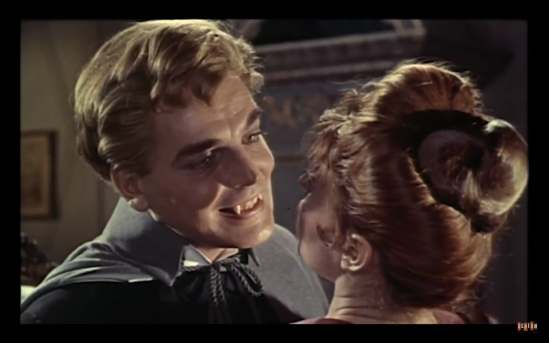
A Disciple of EVIL! “The Brides of Dracula” reviewed! (Scream Factory / Blu-ray)

Marianne Danielle travels alone on the mucky and fog-riddled roads of Transylvania, traversing from France to be a student-teacher at a prestigious dance school for girls. When her coachmen departs without warning, leaving her stranded at a village inn, the Baroness Meister extends an invitation for Marianne to stay with her an the illustrious manor house, but the sign of compassionate hospitality turns into a near deadly encounter as Marianne discovers the Baroness’ son, the Baron Meister, chained against his will in an isolated room. As Marianne is tricked into removing his shackle, she unwittingly releases a conniving vampire into the surrounding village who prays on young women, but, nearby, Dr. Van Helsing has been summoned the Transylvania countryside by the local priest to hunt down the disciples of Dracula, the most powerful vampire Van Helsing had fought and prevailed. In order for the vampire plague to not spread like a virus, Van Helsing will stop at nothing from slaying the Baron Meister to stop the metastasizing of Dracula’s curse against mankind.

Let’s take a step back into time, 1960 to be exact, when Hammer Horror brought a flair for the dramatic to iconic monsters, lush with not only vibrant color schemes, but also in elaborate production designs that scaled the imagination while evoking fear of Satan’s most prolific profaner, the vampire, in Terence Fisher’s “The Brides of Dracula.” The sequel to “Horror of Dracula,” starring Christopher Lee as the titular character, staked vitality two years after the first film’s success and sought to return Peter Cushing back into the good doctor’s shoes once again to battle evil. Shot on lot at Bray Studios and with the grand house exteriors of the nearby Oak Court, “The Brides of Dracula” had greatly masqueraded the elegance and sophistication of the gothic design, bringing settings to life with monumental attention to detail. Before the shooting draft was ready, the script saw numerous rewrites which caused the narrative to fall into numerous hands and, so, the script is built on an overlapping composition of writers, such as Jimmy Sangster (“Horror of Dracula”), Peter Bryan (“The Plague of the Zombies”), Anthony Hinds (“The Curse of the Werewolf”), and Edward Percy. Hinds financed the film under Hammer Film Productions in association with Universal International.

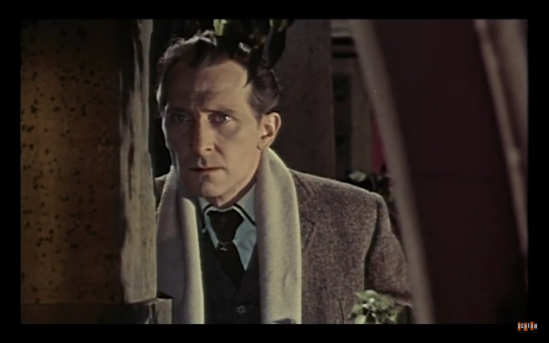
In stark contrast to Christopher Lee’s dark veneer that ennobled Dracula’s arcane and evil presence, David Peel brought a different kind of vampire stemmed off of Lee’s main bole as a disciple of the Prince of Darkness turned because of the Baron Meister’s uninhibited living the life of Riley. With blonde hair and a lighter complexion, Baron Meister became something of a pretty boy vampire that definitely propelled Peel into something of a sex symbol after the film’s initial release. While Peel’s terrific performance goes without wane, Baron Meister sticks out like a sore thumb with the lighter hair color and babyface dermis. The Meister is hunted down by the one and only legendary vampire hunter, Dr. Van Helsing, from Bram Stoker’s novel. Peter Cushing revives his performance from “Horror of Dracula” with a another meticulous and defining act that epitomizes the character’s nature as a knowledgeable and dignified combatant against the dark arts. Cushing versus Lee is the epic King Kong versus Godzilla faceoff that doesn’t leave much room for David Peel in a fight that’s more like King Kong versus King Koopa. The leading role went to French actress Yvonne Monlaur who, at the time, spoke really good English with a thick accent. The “Circus of Horrors'” Monlaur added beauty and innocence being ruthlessly taken advantage of as the hapless Marianne Danielle. With striking red hair and definitely a sex symbol, Monlaur was paraded as one of Hammer Horror’s finest leading ladies to ever grace their terrorizing tenure in genre. “The Brides of Dracula” has a supporting cast like none other with performances from Martita Hunt as the Baroness Meister, Freda Jackson as Baron Meister’s Renfield-like caretaker, Andree Melly as Marianne’s colleague, Gina, Miles Malleson as a greedy blowhard physician, and Mona Washbourne and Fred Johnson as the dance school’s proprietors.

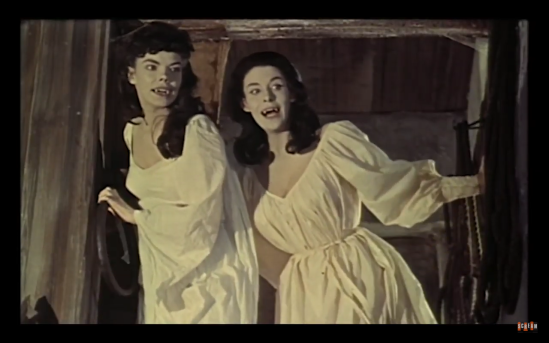
“The Brides of Dracula” has lush, expensive looking production designs from Bernard Robinson that delicately acknowledge a 19th century coach and buggy society and creates a gothic tincture to brood in the bat-flying, eye-catching, blond-haired vampire sinking his canine’s into the untarnished flesh of young women. Yet, Fisher’s follow-up doesn’t add anything to the vampire etymology nor does it tack onto the mythos and, instead, clings barely to a compelling good versus evil narrative closely suited more toward one of the working titles, Disciple of Dracula. “The Brides of Dracula” bewilders as a final title that not once broaches the women stalked by the bloodsucker who seems to attack the random village virginals and, also, barely references Dracula, whom the harem of titular vampires are not at the crook of his pale elbow, but the now 60-year-old film, which I can still remember seeing on television back 30-year-ago, remains as one of the most memorable Hammer productions. Was it because of the enriched looking, old-fashion look? I’d say yes. Was it because of the soap opera designed performances that lavished in melodrama? I’d say yes. Was it because of the undertones of lesbianism, rape, and other taboo-esque themes? I’d say it was all of the above that drove “The Brides of Dracula” in not only being an opening day success but also encapsulating the legacy of Hammer Horror.

“The Brides of Dracula” is the unholy, unceremonious matrimony from hell and has come far from its run on the television with a new high definition Blu-ray collectors edition from Scream Factory, the horror sublabel of Shout Factory! Presented in two formats, a widescreen 1.85:1 and standard 1.66:1, the Blu-ray sustains the deluxe technicolor through the high-res, 1080p, video image that went through a new 2k scan from the interpositive master and absolutely appeals to the visual cortexes with an extensive color palette and very miniscule film imperfections from a super preserved 35mm stock. The English language DTS-HD Master Audio mono track is a resounding success with a grand big band score from debuting composer Malcolm Williams that juxtaposes significantly with the dialogue to only be a support device rather than be a main stage act. With many Scream Factory releases, “The Brides of Dracula” comes with exclusive and previously recorded special features included a new audio commentary with film historian Steve Haberman and Constantine Nasr, a making-of the film that includes a graveyard introduction goes into interviews with the late Yvonne Monlaur, screenwriter Jimmy Sangster, assistant director Hugh Harlow, continuity supervisor Pauline Harlow, art director Don Mingaye, model maker Margaret Robinson, and producer Anthony Hinds, and rounds out with a still gallery and theatrical trailer. The Blu-ray is sheathed in a cardboard slipcover with a cover illustration by Mark Maddox and inside is a reversible front cover. Irrefutably a classic, despite some quirks, “The Brides of Dracula” is vintage vampire stock, a pedigree of it’s time, of hallmarking the classical villain in a different, blonder light.

Own the collector’s edition of “The Brides of Dracula” on Blu-ray!

When EVIL Strikes a Family Hard is When Fission Divides and Conquers. “Nuclear” reviewed! (101 Films / Digital Screener)

Emma witnesses her troubled brother violently beating their mother while dragging her through the woods.  After he leaves, Emma and her injured mother escape to the countryside, driving through the night until coming upon a village house, next to what was once a large power plant that now sits vacant, to squat for a few days.  Emma comes into an encounter with a local boy a little older than herself with a free spirit for illegal extreme sports and taking dangerous risks to new heights.  What was intended to be an isolating refuge has turned into an alluring interest for Emma who admires the boy’s nomadic lifestyle, but while her mother’s physical injuries heal, a lingering trauma begins to emerge and Emma’s violent brother is also hot on their trail seeking them out.

Lately, our reviews have been on a stretch of psychological thrillers by first time feature film directors expressing a compelling narrative in the worst of situations; we’ve tackled the unhealthy family relations while battling acute mental illness with Joe Marcantonio’s “Kindred” and have taken a step back in time into the Cold War era with isolation tension and uncontrollable violent outbursts in the “Darkness in Apartment 45,” directed by Nicole Groton.  Well, we’re going for the hat trick with Catherine Linstrum debuting her written and directed psychological drama, “Nuclear,” that deals with the fallout of an estranged, threadbare family under the looming shadow of a defunct nuclear power plant, upending a whole new meaning for the term nuclear family.  Co-written with longtime collaborator, David-John Newman. “Nuclear” is a radiating co-production funded by the British Film Institute, Fields Park Media, and Ffilm Cymru Wales, and Great Point Media with Stella Nwimo serving as producer and Paul Higgins as executive producer.

Much of the narrative hinges on Emma, “Locke & Key’s” Emilia Jones, as a 14-year daughter at the center of her brother’s terrible misdeed that sparks a flight of escape to the country and then befriends an eccentric boy who pulls her toward a more grounded frame of mind despite his extreme antics.  The boy, charmingly played by “1917’s” George MacKay, is exactly the distraction Emilia needed while sheltering in refuge. MacKay boyish good looks accentuates his character’s overweening attitude that renders a thin layer of mysteriousness about him as the boy,, and when I say boy I mean young man not much older than Emilia, lives out of his van near the power plant and does backflips on a stone bridge. With such a small cast, one would assume the boy would have interactions with Emilia’s mother or brother, but that’s not the case as the film purposefully uses evasive maneuvers intended not to mingle the boy with Emilia’s mother, played by another Resident Evil Jill Valentine actress (see review of “Darkness in Apartment 45”) Sienna Guillory, and brother Oliver Coopersmith (“It’s Alive” remake), who are weaved into different stages of Emilia’s cerebral reactions to events that unfold unexpectedly. Floating through the story, like a supernatural Japanese house wife, is Noriko Sakura who, much like most of the other characters, plays that is unidentified, but Sakura’s wraithlike presence attaches itself to Emilia’s mother as a telltale sign that something isn’t quite right with the mother’s mental state.

“Nuclear,” in regards to the term, can be interpreted and dissected on many levels within the film; two possible, and perhaps the more obvious, espies are a nuclear family (as a pun on the phrase that denotes nuclear fission) that goes through a chain reaction of dependent events after a horrible event and the other would be the blatant power plant sitting idle and empty in the background, a symbol of a ruin that once harnessed power and gave energy to all and an allegory to this young teenager Emilia’s handling of the crime committed against her one and only protector- her mother. “Nuclear” is very much a young girl coming of age film that strikes chords of self-reliance and free choice while also strumming to disconnect from her parents and family, but she must face them first in order to really let go of the past. But does Catherine Lindstrum pull all the elements together? Lindstrum’s brain-teasing drama will ultimately confuse the general masses. Hell, “Nuclear” even confuses me by not sewing the last threads to connect the stitches of hecatomb effects as the principles players somber through an inexplicit tapestry that’s not clear, present, and often feels distant. The end result does evoke a sense of a coming of age story, but how that adolescent scores through tribulation is about opaque as murky water.


“Nuclear” is a twisting cerebral topography tale comprised of seasoned actors and promising young talent from the United Kingdom being distributed courtesy 101 Films, releasing digitally November 9th. Behind the camera is French cinematographer Crystel Fournier with a harsh realism that delivers a natural, but bleak tone full of shadows and gray contrast. Fournier captures and differentiates Emma’s solitude and isolation, especially when she, inadvertently, searches for answers through the motif of faith centric crosses and messages that surround her in and out of the cottage. Stephen McKeon’s score compliments Fournier’s atmo-melancholic with beautiful synth piano and Celtic akin violin compositions. There were no bonus features included with this digital screener and there were no bonus scenes during or after the credits. Don’t expect a mushroom cloud of edge-of-your-seat drama and psychological torment, “Nuclear” is the breadth of anticipation of the Cold War, never knowing what, when, and where to expect the bomb to drop in Catherine Linstrum’s debuting quandary.

EVIL Gets Loopy in “Welcome to The Circle” reviewed! (Artsploitation Films / Blu-ray)

Greg and his young daughter Samantha are turning out the lights on a camping trip in the woods.  When a bear attacks in the middle of the night, Greg awakens in the care of a commune-like camp.  Injured but alive, Greg is given the grand tour of the encampment of a cult known as The Circle where he rejoins with his happy-go-lucky daughter and meets a few other strange and unusual members who worship the legacy and the omnipotent existentialism of The Circle’s creator, Percy Stephens.  What the father-daughter combo don’t realize is that The Circle is a demon worshipping cult bidding on the whimsical demands of Percy Stephen’s rancor and malice.  A group of outsiders led by Grady, a former cult member in his youth, are determined to rescue and reprogram one of the followers close to them, but step into an upside-down world, demonized with smoke and mirrors, set on swallowing their souls for the sake of Percy Stephens delight. 

A diabolical drip of disorienting deception, “Welcome to The Circle” is a roundabout from Hell, cordially ostracizing the love and blessings ideology for more sinister, soul-sucking profit of an unconventional demon film.  “Welcome to the Circle” is a Canadian-made debut independent feature from write-director David Fowler and Fowler, better known for his work on documentaries, knocks on the door of insanity with a tailspin narrative that collides John Carpenter’s “In the Mouth of Madness” with Clive Barker’s “Lord of Illusions” with Aaron Moorhead and Justin Benson’s “The Endless” rapping at the door and the results are an enigmatic nightmare full of stone faced mannequins, body inhabiting occupations, a series of blackhole peculiarities, and being eaten alive by crazed acolytes.  The Vancouver, British Columbia based Canadian company, High Deaf Productions, embarks into the feature film bazaar, with Mack Benz and Michael Khazen serving as company producers, with co-production association from Corvid Arts and Upfront Films.

Broken into two parts, the narrative opens the first portion up to familiarize with the cultist sheep in the stark white attire of wolves’ clothing that throws Greg and his daughter Samantha’s kismet into the uncertain pit of a demon’s impish thirst for souls.  When introduced to Greg (“Dragged Against Concrete’s” Matthew MacCaull), much of the character falls below the waist side as a single father detached from his own child and surrounded by conniving zealots that funnels into becoming weak, if not also immaterial when MacCaull is unable to explore Greg more in depth.  Nothing against MacCaull who performs well enough with an unsympathetic character that has a cold shoulder connection with his insubordinate child and no real background fuel a feed into Greg’s worth as one of the mainstay roles.  I also thought a little more on The Circle’s followers would be constructive to The Circle’s reason for fervor and appeal, but instead, Sky (“Supergirl” television series’” Andrea Brooks), Lotus Cloud (“Pacific Rim’s” Heather Doerksen), Rebekah (“The Wrong Daughter’s” Cindy Busby), and Matthew (“The Unspoken’s” Michael J. Rogers) are members developed only inside a crumbling hierarchy structure obtaining cryptic messages from a demon, Percy Stephens, from beyond their plane of existence.  Percy Stephens is perhaps the best complex character in the fold without having a stable foundational actor in his shoes and is played by various faces of the film’s cast able to reach back toward an immense and mysterious backstory that involves a slew of daring and impressive accomplishments and a demonic tiger shark that may or may not be Stephen’s aquatic damnation to Hell.  The second portion moves greatly away from Greg and his daughter and into a rescue operation, led by the unfiltered and unorthodox Grady, a former The Circle youth who landed in a psyche ward only to be hired to infiltrate the cult to extract Rebekah, paralleling his motives to understand the mechanics of the cult that led to the disappearance of his mother.  “Stan Helsing’s” Ben Cotton delivers a performance that is anything but vanilla as the sharp wit and cool as a cucumber Grady, dominating each and every scene in a disheveled and aloof veneer that becomes Grady’s best defense against Percy Stephen’s engaging entanglements.  The cast rounds out with Taylor Dianne Robinson (The Twilight Saga:  Breaking Dawn Part 2), Hilary Jardine (“Teen Lust”), Matt Bellefleur (“In Their Skin”), Christian Tessier (“Night of the Demons III”) and Jordana Largy (“Rememory”). 

It suffices to say that David Fowler’s topsy-turvy and boundless the fake-fake, a descriptor of the story’s in-between existences, is an alternate universe complete with hope chest portals and wraith approaches that will disrupt the audio and visual perceptions, disconnecting the straightforward wiring only to cross the stepping stones of normalized story structures to fissure what we know into a fractured reality.  The foyer to oblivion, the fake-fake, isn’t an easy one to digest and Fowler is very much aware of the real-real consequences of traversing into the world of the fake-fake.  Fowler forces you to pay a penance for crossing the threshold that will cause dizziness and nausea, the same affects the characters sometimes experience through the compressed spaces of time and planes of The Circle, soldering an unintentionally immersive experience with the combination of simple and natural cinematography infused effects that spun, tilted, and corralled acute fear and isolation from under the DP supervision of Sterling Bancroft. In regards to Fowler’s darkly imaginative story, the script a lively progression of diverse ideas and concepts that construct a little world within a bigger world, especially on a modestly tight budget that can’t afford mind-blowing special effects, but the cohesiveness is heavily reliant on the character’s to explain the actions that are occurring to progress an outline and much of that explanation falls into poetic prose and riddles. Characters Percy Stephens and Grady to much of the grunt work in vocalizing the visuals, but the course is a rocky road and with every bump there’s a meaning within a meaning and to know the meaning is to meaning to know. See what I mean? “Welcome to the Circle” chips away the substantial concrete barrier with a bombardment of incorporeal flak that comes in wave-after-wave of full blown auteur creativity.


To get caught in the loop is to loop in getting caught and that’s what Artsploitation Films has done by acquiring and distributing “Welcome to The Circle” on a Blu-ray home entertainment release. Presented in a widescreen 1.85:1 aspect ratio, the digitally recorded picture is about as immaculate as they come nowadays with tactile textures of grainy log of the cabins, the floral of the forest, and the scruff of Matthew’s bristly beard all looking particular sharply detailed albeit some minor fluctuations of softness seeping into the brush and into more dreamlike sequences and though flat, the colors due run unbridled with the forestry green and the eggshell color of mannequin “skin” that renders subtle differences more distinct. Darker scenes render nicely and smoothly without as much of a flicker of interference and Bancroft’s use of depth forces audiences to focus only on what’s extremely close up or what’s faraway by way of adjusting the focal length. The English language 5.1 DTS-HD Master Audio also has little-to-no complains with a well rounded discernible platter of clear, forefront dialogue, depth and range of vocals and ambience, and a combination score and soundtrack by Reid Hendry with original and haunting folk tracks by Jo Krasevich do an insidious one-two punch that bruises the soul. The not rated, 93-minute film comes with only a theatrical trailer in the bonus features. Despite the dense ambiguity that surrounds the film, the demonic ensnaring doom that accompanies “Welcome to The Circle” is, simply put, psychosis in a bottle that director David Fowler just effortlessly uncorked.

Own “Welcome to the Circle” on Blu-ray!

Never Had An EVIL Friend Like Me! “Come Play” reviewed! (Focus Features / Digital Screener)

Elementary student Oliver has autism that impedes his speech, requiring near obsessive use of the phone and tablet to communicate with touchtone words as well as using the device for recreational binge watching of SpongeBob SquarePants to calm him when agitated.  Unable to make friends, Oliver’s loneliness causes him to sink deeper into his devices while his parents bicker amongst themselves on the endless topic of caring, treating, and assisting with Oliver’s needs, such as speech therapy and daily routine.  On another dimensional plane, looking inside-out of Oliver’s devices, is Larry, an equally lonely, misunderstood monster trying to break into Oliver’s world and take him away to be forever friends.  It’s up to his overprotective mother and insouciant father to stop Larry’s aggressively desperate out reach into Oliver’s world and pluck him forever from a life of being misunderstood. 

Forget the monsters lying in wait underneath the bed!  Forget the monsters lurking inside the dark closet!  The monster in your phone, capturing your attention span on a glossy-eyed level, should be the monster we all fear from Jacob Chase’s written and directed tech creature feature, “Come Play.”  “Come Play” introduces Jacob Chase into feature filmmaking after being involved wearing multiple hats in a series of short films, spanning over in the last decade and half, with his 5-minute long short film, “Larry,” plotted out as one third shift bored parking lot attendant who discovers an abandoned iPad inside the lost and found box located in his booth and releases a disfigured titular creature that lumbers toward him after reading through  “The Misunderstood Monster” children’s tale on the device, becoming the foundational work inspiring a 96 minute, fully fleshed out narrative with dangerous undercurrents of voyeurism and loneliness coinciding with an equally-hazardous theme in the detriments of being a helicopter parent, hindering the independent growth and maturity of youth. “Come Play” is a co-production of Amblin and Reliance Entertainment.

When they’re in a career hot zone, child actors flourish and grow inside a broad base of horror, being nurtured either from or by the creepy child sub-category or from or by being the unlikely hero that has the save the oblivious adults (just look at the kiddie cast of “Stranger Thingsfor example). Azhy Robertson falls into the latter as the epitome of innocence in playing Oliver, a young boy with autism unable to communicate clearly the monster stalking him from a stratum between two existences. “Marriage Story’s” Robertson continues to gleam versatilely as an actor who can use his imagination to not only react to a rendered behemoth creature but also submerse into the characteristics of autism and not oversell beyond what’s needed. Robertson also continues his girth toward a well-rounded career that now has a notch for horror under his broadening belt. Like many monster-plagued kid horror, the parents are always oblivious and dismissive to the situation and “Come Play” continues the trope with a pair of quarrelling parents in the midst of separation that undoubtedly adds to the extramundane energy fueling Larry’s need for Oliver. Gillian Jacobs (“Bad Milo”) and John Gallaghar Jr. (“Underwater”) butt heads sorely on one topic: Oliver. As their marriage dissolves through unspoken subtleties under the Oliver epicenter, that missed mightier connection could have been more powerful on how the split up affects the reactionary consequences of Oliver’s developmental disorder, an affect so tremendous that it componentizes Larry and his aggressive and brazen abduction tactics that are not so discreet. However there characters are perceived, Jacobs and Gallaghar modestly pack a punch in what has been laid to be the Azhy Robertson show of a vulnerable, yet smart, child versus a relentless and grotesque monster. Winslow Fegley, Jayden Marine, Gavin MacIver-Wright, and Eboni Booth round out the cast.

Jacob Chase has proven to be able to handle building breath-holding suspense and tension with the otherworldly plane Larry, a Slenderman-like in appearance and character inspired villain lumbering around not only in Oliver’s house, coursing through the electrical currents in his sub-plane world, but also by peering from out of closets, shying away in the darkest corners of the house, and looming around in a parking lot’s graveyard shift hours only to be perceptible through the phone and tablet camera lenses and, at times, manifesting a translucent presence that has force behind, the latter being an added side dish, transcending from Chase’s short film, to Larry’s predacious tech-manipulating arsenal when obstacles stand in the way of his BFF.  Even if “Come Play’s” superlative thrills ride on the heels of potent jump scares and unnerving silence with bated breathed, hiccups do arise in a more alleviated roller-coaster that shreds holes into the well-established terror instead of nurturing the tone.  Now while I understand the rating is PG-13 to secure a wider audience and, maybe, be a little lighthearted at times, an awkward diluted dread douses the credibility of the characters in strife with actions, such a scene include Oliver’s parents striking down upon his tablet with alternating hammer blows.  In what almost seems like a joke with an archaic technique that old-timey railroad workers use when nailing in track spikes or when carnies – one being a clown – hammer in spokes in unison to erect the big top, the scene is just out of focus in regards to the rest of the scope and there are other scenes like these sprinkled in throughout that raises character quandary concerns.  Why not just one parent whack away on the destruction of the dag’on device?  A handful of the reactionary actions to protect Oliver are glazed with an unreasonable, panic-stricken defense that begs the question whether they’re fit to actually be parents, which, if looking on the flipside of the argument, might also play into more of the unbeneficial family structure that originated the Larry intrusion.  Speaking of originating and the monster, Larry’s exact origins is obscured from the audiences as no plot points touch in depth upon Larry’s background and, you know what, that’s okay here; the more mysterious path is sometimes the best and, in “Come Play,” Larry’s inexplicable being as a child seducing abductor relates much more frighteningly and unfortunately in real world occurrences. 

Predators come in all shapes and sizes.  In this case, Larry’s atrocious presence, trying to obscure his real identity innately, symbolizes the very personalities of the real monstrous predators living among us, trolling online to prey on the vulnerable.  “Come Play” is an oxymoronic subtle hyperbole that serves as a cautionary warning for parents and children molded with pure monster in the closet entertainment in mind releasing theatrically on October 30, pushed from its original July release due to COVID-19, courtesy of Focus Features.  Serving as director to photographer is French cinematographer and serial shadow worker, Maxime Alexandre, who was worked with acclaimed horror director Alexandre Aja on “High Tension,” “P2,” and “Crawl.”  Alexandra manipulates the space, melding wide, full and closeups, to work the perceptions toward a post-production visual design in adding Larry into the frames and honing in on the lighting to just show enough of the space to make the allusion of Larry’s presence even more ominous. The back and forth of the underused practical Larry and the mostly CGI Larry sparsely have any difference between the final product outcome. The visual effects team of Mr. X saunter with what could have been a clear disaster of composite creature imagery with all the trademarks of synthetic splicing; instead, Larry matches well to the point of an indistinguishable challenge between what’s real and what’s not. The score by the “Don’t Breathe” and “Evil Dead” remake’s Roque Banos does the job to subversively infiltrate the security earmuffs to wring your cochlea to an inch of its life, but doesn’t resonate with you much more than the length of the film; however, Larry’s clicking and snapping of his appendageal joints and his guttural clatters emanate vicinity apprehension, as if the audiences can hear the dun dun hook as a tall tale sign of a circling shark in the water.  Sound design is half the fun in the film as the monster is more than half there when it’s on screen. No bonus material accompanied the release and there were no bonus scenes during or after the credits, but I’ve included Chase’s short, “Larry,” below for your own comparison and enjoyment!  “Come Play” boosts many unsavory themes between the parameters of technology and children underneath a mask of a faceless friend willing to frighten and fight anyone into submission to obtain complete, domineering companionship to end his chilling fairytale story.

Larry: Short Film

EVIL is Out For Blood! “Attack of the Unknown” reviewed! (Gravitas Ventures / Digital Screener)

A Los Angeles SWAT team raids a syndicate congregating big narcotics deal that leads to the arrest of the local high profile drug lord named Hades.  In transporting Hades into federal custody, massive alien ships suddenly loom over the city, beginning a merciless extraterrestrial invasion that forces the close knit SWAT team, Hades, and a handful of low on the totem poll federal agents to take shelter at an inmate detention center housing dangerous criminals as everyone outside, fighting for their very lives on the streets of an ablaze metropolis, are swarmed and killed by tentacle spearing, blood sucking aliens.  Running low on ammo, cut off from any kind of rescue, and aware that an attack on them is imminent, the survivors must band together to plan their continuous survival and understand what the aliens want from them before being raided for their blood.

“Independence Day” meets “Assault on Precinct 13” in the blood marauding mayhem of the alien invasion action film “Attack of the Unknown” from writer-director Brandon Slagle (“House on Manson,” “The Dawn”) based off a story by producers Michael and Sonny Mahal of the Mahal Empire production company. The American made, Los Angeles and Las Vegas shot Sci-Fi embattled entanglement labors an intensive visual effects heavy bombardment that bares an unbiblical similarity of the David versus Goliath parable.  Instead of using stones and a slingshot to bring the formidable giant down, gunfire and hand-to-hand combat serve as the nearly useless weaponry of choice against these spacemen, with a slight inspiration of H.R. Giger’s biochemical flare, searching for the junkie’s high of medicinal hemoglobin.  Alongside the Mahal Empire, the company behind the artistry of supernatural-sins, “Art of the Dead,” Spicy Ramen Productions (“Murder Van”), FilmCore (“Clownado”), and Blain-Y-Bootleg Films also stick their producing tentacles into the narrative that entails expropriation of human blood by otherworldly beings.

“Attack of the Unknown” reunites “Art of the Dead’s” Richard Grieco and Tara Reid once again in a non-scene sharing feature, but, this time around, Grieco lands the lead role of Vernon, a long-in-the-tooth cop going through a brutal divorce, going through cancer, and must be the person to save during the invasion…wait, what? Yes, forget the women, children, and possible any other last hope for mankind, Vernon, through the eyes of his SWAT brethren, becomes early on the favorite for survival, but only later into the story does the fact of Vernon’s fatalistic, cancerous blood is the cure for dominion dominance, something that should have been noted when Vernon is labeled as must live. Grieco’s austere soul for Vernon disposes a man without a care or is unpredictable and while the role is overall solid, Grieco is a bit theatrical with the performance. On the short end of the stick is Tara Reid whose barely in a folklore tale told by Hades as a severely brief conclusion on why these malevolent space invaders have landed on planet Earth. Former “Hellraiser: Revelations'” cenobite, Jolene Andersen, and typecast bad guy, “Strangeland’s” Robert LaSardo, without an alternative, had the most intrigue without having a lick of depth with their characters. Andersen is the only female SWAT member, Hannah, with an unexplained connection between her and Vernon other than being colleagues, but Hannah is a bit of a Jane of all trades able to hold her own in a humbling kind of way, making her more likable. On the other hand, the mysterious temperament challenges us to figure out what LaSardo kind of person is Hades; obviously named after the lord of Hell, the drug kingpin isn’t devilish in the least and has the tendency to be more of a stubborn and angst tween. The cast list is huge but the main players involved rounding out the cast list is Douglas Tait, Robert Donovan, Paul Gunn, Mouine Omari, Clay Trimble, Gerardo de Pablos, King Jeff, and, not forgetting to mention as Featured Dancer #1, adult actress Tasha Reign.

Slagle has to reign over and rein in the slew of competing talents and the story’s first act of an indeterminate direction. When the narrative finally settles upon the alien encircled detention center with the survivors’ back against the wall, a harried subplot with two, nearly off the clock San Fernando cops encountering a crashed ship in the desert on the outskirts of town is pushed aside; instead of a smaller, parallel story alongside the SWAT’s predicament, the two cop encounter becomes a bookend story that feels sorely out of place and sheepishly wrapped up. Another out of place aspect, an unfillable character arc within the core story, is with an out of element survivor, a vlogger from Texas, who is the only unqualified defender against an attack and supposed to be on this tangent of earning his “got your back” badge (anyone from Texas, the Alamo state, should know a thing or two about a last stand), but by the time the vlogger musters the courage to shoot back at the bloodsucking tentacles during an elevator escape, the moment is way too late and way too underwhelming to make an impact, leaving his presence wasted amongst a motley crew of rough and tough officers and criminals. Luckily, the Mahal production has plenty of capital to go around to render a bolstering blend of practical and visual effects that tags “Attack of the Unknown” as Slagle’s Michael Bay attempt of a Sci-Fi action film. The visual effect composites are verisimilar in comparison to big budget Hollywood and the practical work, whether be with the fleeting gruesome deaths (ripping off the crown of the head scene was pretty nasty), the alien spacesuits, and the alien’s classic bug eyes and small mouth, harped back on a throwback science fiction alien attack sans the ray gun trope.

For an indie production, “Attack of the Unknown” has a palpable core story with promising visuals that has invaded all major VOD platforms this past August courtesy of Gravitas Ventures. The A/V qualities will not be reviewed due to the digital screener provided, but just to comment on the rigors of budget films, the depth perception issues in the composited effects and the sounds effects not always necessarily syncing properly with the action (i.e. explosions), cold cocks us back down a peg that “Attack of the Unknown” is an indie film. The music score is provided by Scott Glasgow (“Hatchet III”) and the shots are provided by Michael Su, who I thought garnished really neat scenes with smoke and brilliant light. Bottom line, “Attack of the Unknown” just ekes out being entertaining enough but the space vampire’s ground assault traverses a rocky road of dry performances and unfocused bearings that cultivates earnest dramatics progressing into one ginormous space ship-sized cliché.

Available to Rent on Amazon!