EVIL No Longer Swims Only in the Water! “Bad CGI Sharks” reviewed! (Sub Rosa Studios / DVD)


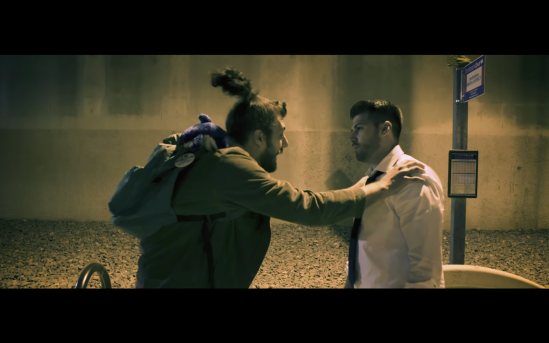
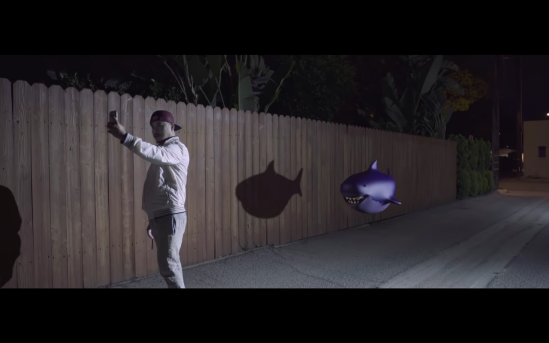
Living hesitant, unconfidently, and unfulfilled in Hollywood, California, Matthew finds himself fired by his employer after experiencing a promotion interview from hell, but that’s not the worst of his problems. Earlier the same day, Matthew learns his estranged older brother, a free-spirited and enthusiastic Jason, has been kicked out of his parents’ home, provided a plane ticket, and sent to live with him possibly forever. The estranged brothers finally reunite after years apart and Jason infiltrates back into Matthew’s uptight life their childhood obsession with sharks to try and finish a rough, shark-thriller script from their past, entitled “Sharks Outta Water.” When a magical movie muse decides to grant them their boyhood cinematic aspiration, the sudden appearance of a poorly render man-eating shark floats about their neighborhood streets, hunting down the brothers during a night of computer imagery terror limned with shoddy shark frenzies.

Out in the surf of the internet, a list lurks just beneath the dark waters of the web. A list containing a flooded genre of some of the worst shark movies detrimental to mankind’s inherent fear of a primordial aquatic creature that was once known to be the ocean’s apex predator. To save us from the cold, bleak shark banality, “Bad CGI Sharks” absorbs all toxic mundane trash skimming the vast global networks and big picture boxes to recourse from the singular trained thought that sharks are much more than a punching bag of relapsed rendered dogfish with jaws. Written, produced, and directed by MaJaMa, an alias for Matthew Ellsworth (Ma), Jason Ellsworth (Ja), and Matteo Molinari (Ma), “Bad CGI Sharks” flaunts a straight-to-video, no-budget comedy-horror in the face of whoever is willing to once again put themselves in front of a speeding bad shark movie train; yet, the filmmaking trio embark on a creative, meta journey risky with little blood shed and a swarm of animated things that mark somewhat of a resemblance to sharks. What crests is insightful satirical wit over the ostentatious flare of gratuitous explosion, nudity, and monstrous sharks.

In keeping to the budget, MaJaMa already wear many hats behind the camera. To extend even further their invested working capital, the filmmakers also star in the lead roles, virtually as themselves, to surely hammer down a film entitled “Bad CGI Sharks” in their own brand of humor. We begin with Matteo Molinari, the Genova, Italy born actor who had a small role in 1994’s “Silence of the Hams,” a spoof starring Dom DeLuise and Billy Zane derived from the Jonathan Demme’s Hannibal Lector thriller, “Silence of the Lambs,” if the title itself wasn’t self-evident enough. Molinari is the only main lead not using his namesake and, instead, becomes the magical movie wizard Bernardo with his muse movie clapper. Bernardo was built for Molinari as the two are synonymous to each other’s manners, speech, and quirky simpatico charm, resulting in an innocent, mischievous movie imp to be the bridge connecting the gulf between Jason and Matthew’s polarizing characters. Jason’s a severe caricature of hyperactivity and of someone whose stuck in the past and while Jason Ellsworth has his moments, without his brother Matthew’s stern, grown-up, and spruced up onscreen self, the dynamic just wouldn’t be as potent as Matthew is essentially the activator spray to Jason’s gluey personality. The cast concludes with Jenn Liu (“Stranger in the House”), Josh Sterling, and Shaun Landry.

Tiptoeing around the fringes of being a stoner film, “Bad CGI Sharks” pushes a hyper-meta reframe of how shark movies, or perhaps the film descends deeper into the water molecule level of just the shark representation itself, should be brought back to the shores of reality from the watery depths of Davy Jones’ poorly rendered locker. Coinciding with crystallizing the shark-sploitation category is a more tender note of embrace with relatable themes of rediscovering brotherhood and mending broken bonds. Matthew’s parental manufactured disgust with his older, yet childlike, brother casts a large, dark cloud that seizes up any kind of affection and the floating shark, the symbolic dream of their childhood, tests their relationship, motivating the the character arches in the face of “Bad CGI Sharks.” Amongst the witty banter and flying carnivorous fish, “Bad CGI Sharks” shows innate signs of no-budget difficulty such as story pacing where the middle sags with Jason and Matthew running around Hollywood for awhile in a progression stagnation and there lies some early editing miscues with audio mixing and mic work. Like a shark, “Bad CGI Sharks” needs to keep swimming or else it’ll upend and die; luckily, MaJaMa saves the cinematic beast with the shark devours the internet and all bets are off!

If you like your sharks floating and roaring, then “Bad CGI Sharks” DVD home video is for you, sailor, courtesy of SRS Cinema and MVDVisual. The not rated, region free DVD is presented in a widescreen, 16:9 aspect ratio, with, an IMDB listed, Sony a75 II Mirrorless camera complete with a “vintage” lens. Most of the image transpires cleanly and sharp, even the inorganic, floating sharks look fair in their farce facade, and with the specialized lens seemingly cornered to just around the Bernardo’s outer shell host duties and intermission skit and also in the initial attack sequence in which is the only scene with any kind blood shed. The English language audio tracks include a 5.1 surround sound mix and a stereo mix. The audiophiles will find solace in knowing “Bad CGI Sharks” doesn’t mean bad audio tracks. Dialogue has clarity throughout, depth and range remains steady, and there’s negligible hum electric feedback. Bonus features include a commentary track with MaJaMa, a retrograde toy commercial for all the characters, the teaser trailer, trailer, and SRS promoted trailers. Though lacking bloody chum, “Bad CGI Sharks” has bite albeit with more comedy than creature feature horror, fleshing out real world problems with hilarity in a cheapjack rendition of a killer shark.

Chomp! Chomp! Chomp!

The EVILs of Drugs, Addiction, and Art in “Bliss” reviewed!


Dezzy Donahue, a struggling Los Angeles artist, lives life ferociously with hard drugs and heavy drinking despite the cautionary advice of her quasi-boyfriend, Clive. Her current masterpiece falls behind on schedule and she hits a formidable creative block that results in being fired by her managing agent and with cash quickly dwindling, Dezzy’s losing the battle for inspiration that turns to an increasing narcotic intake surging through her system where any and all substances are fair game to explore. When she snorts a line of Diablo, a blissful, out of body experience drug, she finds herself in a rapturous three way with friend Courtney and her on-off side piece Ronnie that leave her with a post-high, post-sex altering inner body inexperience of opening the flood gates on her creativity to draw again as well as pang her with an insatiable need for a fix when no longer riding the high. Soon, Dezzy discovers the Diablo might not have been the drug that lit the fire inside her when a strong craving for blood becomes an inescapable addiction and a means to finally finish her greatest triumph work of art.

An audio/visual besieging rabbit hole shiplapped with braided beleaguering addiction and vampiric pathology in the stimulating aggressive, Joe Begos written and directed visceral horror, “Bliss,” set in the sordid Los Angeles metal scene. The “Almost Human” and “The Mind’s Eye” filmmaker hypnotizes on a stroboscope wave with his latest take on the vampire mythos with a drug-fueled, warmongering hell on a canvas tale of sex, drugs, and diabolical fiend cravings. Produced by Channel 83 Film, as are all of Bego’s works, “Bliss” is the director’s next notch up on the crazy, unrestrained belt that’s already garnished and weaponized with razor wire and three-inch cone spikes and while the story itself isn’t fashioned for originality, the way Joe Bego’s exfoliates the overripe garbage of rehashed formulaic filmmaking from the excessively strained eyeballs, sheepish with mawkish and dull stories, will be a new design to treasure as cult status.

Where’s “Bliss’s” 2019 nomination for best actress in a lead role!? Dora Madison seizes the performance of Dezzy Donahue by storm inside a role of careless abandonment that coils into viperous mode and lashes out with a deadly strike of unconventional fangs. Madison embraces the exotic Joe Begos route covered in blood, paranoia, and a sleazy shade of florescent neon and runs a willingness to express his mesmerizing vision with body cam harnesses. “Bliss” quickly establishes a hard-hitting tenor and Madison, whose credits include “The Loft,” “Night of the Babysitter,” and in the next upcoming Begos release, “VFW,” exacts a fortified layer of extreme sovereign, a do-what-I-want policy with a zero complaint department attitude, while stowing away what little hope and compassion Dezzy has in the forgotten corners of her plainspoken mind until the moment is too late to turn back. The story solely follows Dezzy’s perception of events as she encounters and reencounters characters before and after needing a junkie’s fix, an exaggerated play on an abusers volatile relationships. The cast affixed to roles of Dezzy’s vexing fix are Tru Collins, Rhys Wakefield (“The Purge”), Jeremy Gardner (“The Mind’s Eye”), Graham Skipper (“Carnage Park”), Chris McKenna (“King of the Ants”), Rachel Avery, Abraham Benrubi (“Wristcutters: A Love Story”), and that lovable “Cheers” regular, George Wendt.

At this point in the review, an overabundance of praise for Joe Begos’ “Bliss” has been logged by this reviewer, who is obviously a fan of the film, but more can be unquestionably explored. From previous reviews and comments I’ve come across regarding “Bliss,” a minority have displayed a disdain for the indistinct theme of drug withdraws and vampirism that resembles Abel Ferrera’s 1995 film “The Addiction,” but instead of being set in shadowy alleys of New York’s urban jungle, Bego’s relocates to the wayward esse of L.A. life. Perhaps Begos was inspired by Ferrera’s undiluted struggle and violence that makes “Bliss” a clone to “The Addiction’s” chief thread, but the film’s are artistically polar opposites. “The Addiction’s” black and white photography and slow-burn air tunes more into the story of the Shakespearian tragedy variety, especially when Christopher Walken provides lengthy life stance and coping monologues to establish his eternal dominance over Lili Taylor. “Bliss” proclaims a stimulus trip from the very beginning with a favorable thrashing metal soundtrack and an psychedelic filmic presence that comes with an opening epileptic warning. Both films compliment the figurative comparison for a fix in their own poetic ways and would make a fantastic double feature release or double bill midnight movie.

If this writeup has a jonesing affect, “Bliss” is cut and lined ready for blipping on an Umbrella Entertainment DVD home video presented by Dark Sky Films. The Channel 83 Films production is presented in a widescreen, 2.35:1 aspect ratio, being shot with a ARRI/ZEISS Super Speed Lenses, as credited on IMDB, that would explain the sharp image and stark contrasts on the colors. The visual perception of the seemingly humming-on-your-eyeballs neon lighting barely lets you experience the film in natural lightening during night scenes and only in the daytime that resembles the little normalcy left of Dezzy’s life, fade away with natural light the more she succumbs to blood cravings. “Bliss” feels and acts out like a 90’s film, slightly grainy for grindhouse seduction by way of shooting of actual film stock (35mm!), and forgoes the bubbly shine of perfection, coinciding damningly with Dezzy’s inner circle of sleaze, grime, and gore. The English language Dolby Digital 5.1 surround sound has a lot of kick and energy with a prevailing metal and punk/post-punk soundtrack feature Doomriders, Deth Crux, and Electric Wizard just to name drop a few. Dialogue is clean with an appropriate depth in the midsts of hard partying and live bands. Range is a little harder to discern since the soundtrack really is overpowering and dialogue sops up the remaining amount of audio track space, but when opted, the ripping of flesh and breaking of bones doesn’t disappoint. No subtitles are offered. Like many of Umbrella Entertainment’s standard releases, the single sided, singer layer DVD has no static menu or special features to offer other than the 80 minute runtime feature. “Bliss” is one coked-out, blood hungry hell of a vampire tangent from the norm that rectifies the optic and audible sanctuary for shock brilliancy to flesh out the Machiavellian in all of us.

[https://www.youtube.com/watch?v=5KdXU-n7qSg]

You want it, You need it, You desire it! Own “Bliss” today!

Follow EVIL’s Design! “A Psycho’s Path” reviewed!


In the sleepy Californian desert town of Brownsville, the peaceful way of life has been upended and thrown into chaos when a savage murderer embarks on a path of a seemingly random killing spree. Previously apprehended and transferred to a psychiatric hospital by court order, the psychopath’s easy and violent escape places him back into an already frightened society to the likes the town has never seen. With no leads to pursue and the townsfolk fearfully blaming the ill-equipped police force, Captain Peters and his squad of deputies must establish a pattern of slaying in order to track his next move, but all kill sites lead to being arbitrary – a motel on the outskirts of town, a isolated gas station, and a suburban home. Are these killings at random or is there a path the killer is following?

Mixed martial artist Quinton “Rampage” Jackson lives up to his professional epithet in Rocky Costanzo’s “A Psycho’s Path.” The credited writer and director filmmaker from Huntington Beach, California follows up his 2016 germane, American social, malignancy teenage thriller, “Ditch Party,” with the 2019 horror-slasher birthed from the spirit of independent filmmaking and produced by Noel Gugliemi, Matthew King-Ringo, and David Ramak. Despite the title’s wordplay on A Psychopath,”A Psycho’s Path’s” gritty and dark tone is anything but a pun-wit delineation as should be presupposed judged by the Mill Creek Entertainment DVD cover of a bloodied and wild-haired Jackson garnishing a blank death stare in the foreground of a moon and neon-lit ominous motel that just screams the trope scenario of nothing ever good is going to happen to that lady standing just inside her motel room’s doorway and wrapped in wet bathroom towels.

The former UFC lightweight Champion Jackson is no neophyte when concerned with the acting world. The big screen’s “The A-Team” adaptation proves just that with his break through rendition of the rogue militant, B.A. Baracus, famously portrayed by Mr. T in the early 80’s series of the same title and established the kind of role types Jackson’s built for outside the ring – large and in charge. In “A Psycho’s Path,” Jackson just has to appear like a 6’1″, 270lb monster without so much of one word of dialogue; it’s a role without a name other than John Doe and it’s a role Jackson was born to play as his physical attributes are naturally inherited and, dare I say it, scary. Character linked on the opposite side of the behavior spectrum is Captain Peters, played by Steve De Forest in one of the few prominent performances of his career, but Captain Peters doesn’t have enough oomph as a character to size up to John Doe. Thus, enters Noel Gugliemi, also known as Noel G., one of the most famous support character faces in all of the film industry from “Training Day” to “Bruce Almighty,” “The Purge: Anarchy” to “The Fast and the Furious” franchise, Gugliemi has the big name and personality in a joint forces operation with Steve De Forest as his on-screen right hand deputy, sergeant Torres. Barely recognizable with a bad wig and without his trademark facial hair, co-producer Gugliemi spits the snake tongued, whip-cracking lines of a jaded officer, lines that have solidified him as an all time fan favorite in his credentials. “A Pyscho’s Path” rounds out with Steve Louis Villegas (also in a bad wig), Kassim Osgood, Derrick Redford, Rowan Smyth, and with a lighthearted cameo from “Different Strokes'” Todd Bridges.

For fans of Michael Myers and the “Halloween” franchise, “A Psycho’s Path” has starkly obtained familiarities to The Shape’s universe with Jackson’s stoic performance of pure, unstoppable evil escaping a psychiatric setting intending to kill, kill, and kill and in also Costanzo’s ambitious direction, especially the track and follow camerawork that’s complimented by the cold tone cinematography of Dylan Martinez (“Ditch Party”), but that’s where the positives seemingly part ways with the rest of the film as a schlocky and campy shadow looming over what could possibly drive all these lunatics to the prospect of committing mass murder. Throw aside the already aforesaid production wardrobes with bad wigs and also ill-fitting deputy uniforms, “A Psycho Path’s” has lost more at stake with little string to yarn a strong woven story together that necessarily elevates John Doe’s affixed obsession to follow a blood-shedding zig-zag path loosely in a little-to-nothing conveyed context. “A Psycho’s Path” becomes a shell of other film’s former selves.

No One is Safe as the tagline warns on the DVD and digital download release of “A Psycho’s Path,” a production from Entangled Entertainment, Hourglass Pictures, and Stroboscope Studios, and distributed ITN Studios and Mill Creek Entertainment, a division of Alliance Entertainment. Presented in it’s original aspect ratio, an anamorphic widescreen 2.35:1, the image can be lost in a shadow-heavy contrast. Though praising his dark tone earlier alongside some well framed shots, Dylan Martinez, at times, goes full midnight at moments that hide events and eventualities from being discernible. The uplighting motif helps with cutting the overly dark picture and creates a sinister mood as slithers of shadows give a hard edged appearance. There’s also a menagerie of tint that doesn’t hone a theme. The English language Dolby Digital audio track renders palpable with clarity in dialogue and a decent range of ambience; however, the lack of depth throws some shade as characters, no matter whether in the background or foreground, live on an equal degree of volume. The release clocks in at 84 minutes, is not rated, and includes option English SDH subtitles. “A Psycho’s Path” has adequate acting, indie charisma, and one hell of a kill scene with a head in a vice like death grip and squeezed to pop like a ripe tomato in one’s hand, but can’t reproduce the slasher mystique well enough to earn it the trait.

Own it today on DVD!

Kindergarten Field Trips Was Never This EVIL! “Little Monsters” reviewed!


Dave, a failed, down on his luck musician with a penchant for doing the wrong thing, volunteers to chaperone a kindergarten field trip to a popular outdoor petting zoo park attraction intent on gaining the affection of his 5-year-old nephew’s perky teacher, Miss Caroline. Also at the attraction is an American children’s’ television personality, Teddy McGiggle, travelling the world with his latest stop in Australia. All seems well and dandy until the U.S. stationed Army base adjacent to the petting zoo loses control of the highly aggressive rejuvenation test subjects and are overrun by the lemming of slow, flesh-eating zombies that stagger bit by bit toward the park’s touristy patrons. With every last living, breathing thing either turned undead or eaten to the spinal cord, Dave, Miss Caroline, and Teddy McGiggle must fight against the outbreak for not only their survival, but for the troop of young and impressionable kindergarteners thinking what’s happening is nothing more than a prolonged game of tag before the gung-ho U.S. military sanction of eradicating airstrike right on their location.

The lumbering zombie canon enjoys a delightfully endearing and rousingly tucked zom-rom comedy, “Little Monsters,” with children being the heartfelt conquerors to slay the funk the genre has been stagnantly lingering inside. Written and directed by up and coming filmmaker Abe Forsythe, the internationally collaborated production from the U.S., United Kingdom, and Australia delivers a brashly funny film under the guise of long-pigged zombie horror shot primarily in Sydney, Australia at Centennial Park. Not to be confused with the Fred Savage children’s film of the same title from 1989 that also starred funny man Howie Mandel, Forsythe’s “Little Monsters’” head lopping, guts coiling, and every four letter word in the profanity bible goes to infinity and beyond the parental guidance rating.

Perfect performances all around from a dynamically intercontinental collaborative cast starting off with Lupita Nyong’o. The “Us” actress, who should have won an Oscar for her performance in the Jordan Peele film, astounds again with a delicately frank and beautifully sage performance as the alluring kindergarten teacher Miss Caroline whose number one priority is to protect her class of 5-year-olds, physically and mentally, at all costs. Counter to Miss Caroline seemingly having her stuff together, the raucously detached Dave immediate sets his whirlwind claws right into Miss Caroline, attempting to attract her with disinformation about his stable state of mind and being; however, Dave to the core is a good guy harnessed by Australian actor Alexander England (“Alien: Covenant”) who adds the rough edges around Dave’s stagnant and serrated lifestyle. Though different on the surface level, Caroline and Dave do have rooted similarities that spark romance after some convincing through zombie tribulations and scenario finesse; Nyong’o and England singe around the edge of attraction that’s goes from a seething disaster to being playfully coy and tender that works confidently on screen. When you through Josh Gad into the mix, you never know what to expect in terms of a wild card character. The “Frozen” star pulls off Olaf on hard drugs as Teddy McGiggle as Gad’s voice is unmistakably the overly friendly snowman who likes warm hugs but with a lot more F bombs and a dee seeded disgust for kids show personality that results him bedding many of his toddler fans’ moms. I wasn’t sure how Gad was going to pull off a zombie epic, but his gas-riot performance is a spiked drink compared to other who dances around the children’s innocence and the fact Teddy McGiggle is a kids show personality elevates his crude conduct to that more pungent. “Little Monsters” round out with Kat Stewart, Marshall Napier (“The Beast”), Diesel La Torraca as Felix.

The word from my inner circle of moviegoers, those who have little interest in horror and more interests in fast cars and vast explosions, say something along the lines that “Little Monsters” was “okay,” “Didn’t really do it for them,” or “I didn’t watch the last 20 minutes.” Disclaimer: These people are really not close friends, but barely colleagues, and since “Little Monsters” is being cut down by popcornist naysayers, their opinions have itty-bitty merit awarded to their poor judgement in taste of good, funny, and superbly acted eye-candy horror cinema with pocket messages of insufferable loneliness, hidden internal commonality, and the caliber in what makes us human that piece together as collectively relatable. If these aspects do not register with you, then you’re not human, but rather a 7-headed martian with tentacles and a pea-size purple brain. “Little Monsters” has some good gritty zombies at work here that juxtapose against the tender nature of children and the only thing between these children being lunch are three damaged adults searching for something meaningful. The apocalypse becomes a fork in the road, an ultimatum, that tests their worth and Aby Forsythe bombards that fateful decision with little notes of comedy, witty banter, and a clear case carnage.

“Little Monsters” takes a field trip to Blu-ray DVD home video, and digital download February 10th from UK distributor, Altitude Film Entertainment. “Little Monsters” is a production of Made Up Stories, Protagonist Pictures (“31” and “Lords of Chaos“), and Snoot Entertainment (“Dude Bro Massacre III” and “You’re Next”). Unfortunately, a DVD-R was provided for review so no audio or video quality critiques will be touched up, but the upcoming region B Blu-ray is listed as a BD-50, 1080p Full HD, and presented in the original 2.39:1 widescreen aspect ratio with an English language DTS-HD Master Audio 5.1 track. There were no special features listed in the press release and there were none available on the DVD-R. Finding a way to harness everything sacred from the zombie genre and then creating something new, interesting, and captive from start to finish to blend is a victory melange of wall-to-wall wit and feral monsters leaves “Little Monsters” as the horror romantic comedy that has it all.

The EVIL In Our Past Will Forever Plague. “Ever After” reviewed!


A plague has decimated the world, turning citizens into crazed, flesh eating zombies. In Germany, only two cities have survived the devastating apocalypse the last two years – Weimar and Jena. In Weimar, the infected are immediately eradicated on site without exceptions. In Jena, compassionate individuals strive for a cure for the diseased. Weimar residents, Vivi and Eva, sneak out of the authoritative camp for their own personal reasons and flee toward Jena’s safe-haven policy in hopes for a better way of life, but a perilous journey through the horde occupied Black Forest stands in between them and salvation. Without weapons, food, and one liter of water between them, chances of coming out unscathed are slim-to-none as long as nothing separates them from assisting their survival.

Based off the illustrated graphic novel of the same name written by Olivia Viewig, “Endzeit,” also known as “Ever After” in the English translation, hits the big screen in the 2018 film adaptation under the orchestration of a female, Sweden-born director Carolina Hellsgård as her sophomore feature with Viewig herself providing the script treatment. With pop culture entrenched and seemingly an extension of herself, Olivia Viewig is by trade a German cartoonist best known for her quirky “Why Cats…” series, a children’s book author, and regularly contributions to the world of Manga to which she was influenced. Viewig then turned to horror with “Endzeit” that served as a graduating studies project that earned her a University degree in 2012. The initially 72-page full-length comic became extended six years later in 2018 by a major German publisher named Carlsen and served as the basis of the script for the film about to be covered below that’s a coming-of-age film that also symbolizes passing of the torch for two young and dissimilar women scrambling between two opposing worlds with a common calamity.

Initially, “Ever After” focuses around the immense struggles of a shut-in named Vivi, a character instilled with paralyzing fear and guilt that has more or less clinically diagnoses her as an extreme agoraphobic whose been hasn’t stepped outside the last two years ever since the plague occurred. “Nothing Bad Can Happen” actress Gro Swantje Kohlhof envelopes herself as the “weakling” her character is ascribed by hardened and callous Weimar survivors, but as Kohlhof evolves Vivi’s fragile resolve into something more concrete, Kohlhof also opens a little more trait range for Vivi when she is finally pushed across the threshold of letting go her fear and guilt. Eva can be said as Vivi’s hard-bitten muse whose looking for a softer slice of life and as Eva becomes engulfed in Vivi’s massively sheltered circle by chance, the former Weimar grunt is able to crack through the hardened exterior and let someone like Vivi into be a calming force in her own anxiety riddled interior. Maja Lehrer compliments as the aggressor in an encouraging pair of diverse female characters driven by their regrettable past to never look back on it and keep moving forward to a better prospect that’ll wash their souls clean. Haired tied back tight, form-fitting mercenary-esque clothing, and a self-preserving attitude to match, Lehrer rounds Eva out well to arch her role hard when Vivi is ready to take the reins as an apocalyptic ranger of the Black Forest. In the forest, Vivi and Eva encounter a mystical being, a half-breed of sorts between living and dead, who doesn’t have a name but goes by The Gardener is played by Denmark actress Trine Dyrholm. Since “Ever After” references quite a bit about nature taking the world from man, I’d like Dyrholm represents Mother Nature as the character invites Vivi to her abundant tomato green house, a serene scenery of low-hanging fruit trees, and the character herself has vines and leaves growing out of the side of a human face and can temporary restore or extend life to a person. Vivi and Eva’s brief encounter prompt’s a change in them both that defines their destiny going forward toward Jena. The cast rounds out with minor roles from Barbara Philipp, Yuho Yamashita, Amy Schuk, Axel Warner, Muriel Wimmer, and Ute Wieckhorst.

If you’re looking for blood, “Ever After” is not that kind of zombie film that glorifies the flesh chomping violence but rather utilizes the violence as a motivator for Vivi and Eva to embark from safety, but that isn’t to say the sheer zombie terror is omitted or even diluted. The mass of running undead continues to be a force of concentrated fear with heart pounding side effects, much carried over from Danny Boyle’s “28 Days Late” and Zack Synder’s remake of “Dawn of the Dead,” and director Hellsgård seldomly relies on a crazed horde to be the mindless exploit of “Ever After’s” core message. Instead, the story clearly defines the growth and understanding Vivi and Eva as individuals and as part of something more, taught in part by their short time with The Gardener, and a highly reflective poignant past that ripples through their memory banks over and over again. Their ambitions nearly shot from existence at the beginning of the apocalypse to the start of their Black Forest voyage have found harmony in letting the past be the past by the end of the story. Once could call it a coming-of-age to see the two women elevate themselves from a place of inner turmoil and, in my opinion, the two women part of that is greatly important because “Ever After” is almost, about 95%, completely female cast driven. So, not only is the story a coming of age one, but also speaks upon self-reliance and empowerment for women.

The swotted comic of Olivia Viewig gains a visual odyssey amongst the undead catalogue with a Blu-ray release of the Das Kleine Fernsehspiel and Grown Up Films production, “Ever After,” distributed by MVDVisual and Juno Films. Stored on a BD-25 and presented in an anamorphic widescreen of it’s original aspect ratio of 2.35:1, “Ever After’s” 1080p full high definition image is sleek to every sensory receptor in the eye and captures the topographic thickets of Germany landscapes in grand wide angles. There is not a lot of tint work here, if any, and relies much on the luminescent and glowing beauty of natural light. The German language DTS-HD 5.1 master audio sufficiently taps into all five channels without overbearing results from zombie hordes. Instead, the focal points here discern more on the tiny tunes and tones of nature. Also included in the setup is an option for a 2.0 LCPM Stereo Audio track and English subtitles, which appear accurate but are hastily paced. Other than a static menu, the region free, 90 minute runtime release bares no special features other than the trailer. “Ever After” is an ascension from within the very weary genre oeuvre, encouraging the strength to stomach guilt and fear as important, but presently irrelevant if one wishes to change with a world that has redesigned around them.

Purchase Ever After on Blu-ray! Click the Cover to buy!