To Unearth a Lifesaving Plant, You Must Survive EVIL! “Yeti” reviewed! (High Flier Films / Digital Screener)

When a medical research team scouring the Himalayan mountains for a miracle plant that can cure cancerous cells disappears without a trace, a second team, armed to the teeth, venture up the harsh terrain to locate them and recover any evidence of the mythical plant dubbed the Yeti plant.  They discover the research station has been abandoned with examination equipment and notes left behind.  With a storm brewing and the topography jamming their radio signals, the only thing to do is push themselves to setup a triangulated perimeter in order to boost the radio strength and comb the mountainside for the plant before hunkering down from the storm, but little do they know that they’re being hunted by a primordial and fabled creature, the Yeti, stalking prey to protect his uncharted, stuck in time territory.
As the third film to be titled “Abominable” in the last 15 years, this particular 2020 creature feature on the ever elusive and mysterious Himalayan Yeti is helmed by the 2018 released scurrying little feet of those mischievously cursed “Elves” director Jamaal Burden might not be at the top of your search engine results, but if you search “Yeti,” you’ll see High Flier FIlms aims to detach from the previous moniker inhabitants.  Burden’s modestly budgeted, internationally shot, sophomore film returns the filmmaker right back into the mythic subhuman category with yet another timeless storybook creature living in legends slithered within the shadowy veil from a script written by J.D. Ellis (“The 13th Friday”) that’s of indie caliber with a touch of jaw-ripping, blood-sprayed snowy carnage in this post-Holiday, winter-horrorland super beast feature.  “Yeti” is the latest in a long line of horror schlock produced by Justin Price, Khu, and Deanna Grace Congo under Pikchure Zero production company and is filled in St. Petersburg, Russia. 
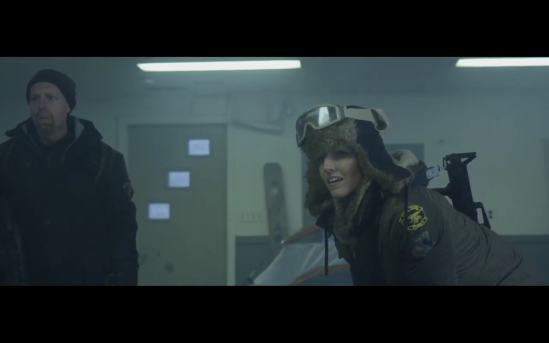
Confronting opposite the terrible Yeti is a cast of alien talent without so much as a recognizable genre name or face to anchor “Yeti’s” marketing success, beginning with Katrina Mattson in her debut lead performance as a young scientific assistant to the terminally ill-fated Dr. Helen whose played by Seattle born Amy Gordon.  The body of dialogue or visual communication didn’t flesh out Mattson’s assistant’s strong yearning to support Dr. Helen’s obsession in rooting out the never before seen Yeti plant other than stating she will do anything to help the Glioblastomas-doomed doctor by whatever means possible.  The disconnect in dynamic between the two supposed friends is not well established and completely melts away faster than the Himalayan snow on a Summery day when the two barely reunite after separating from the abandoned research station.  They’re each accompanied by a couple of mercenaries hired to be an armguard, for a reason why scientists needed M16 assault rifle toting ex-special forces types is beyond me, but actors Robert Berlin and Brandon Grimes serve as such, adding a tinge of military machoism that could have been amped up more against a Jason Voorhees worthy disappear and reappear act Yeti with the given inherent superhuman strength. Berlin wildly over performs at times just spouting out his lines as if reading off an instruction manual. Plus, his character is poorly developed as a money hungry Yeti hunter with an extremely naïve and arrogant personality to the point of yelling in the Yeti’s face when the Yeti is clearly not dead or incapacitated.  Victims pile up with the remaining cast becoming Yeti chow, including supporting performances from Justin Prince Moy, Magdaln Smus, Victir Ackeev, J.D. Ellis, and with Timothy Schultz passing as the scraggily titular abominable snowman.   
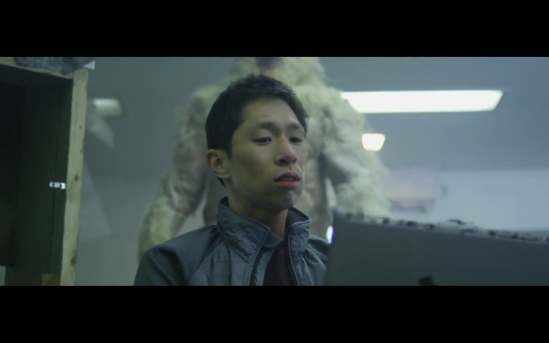
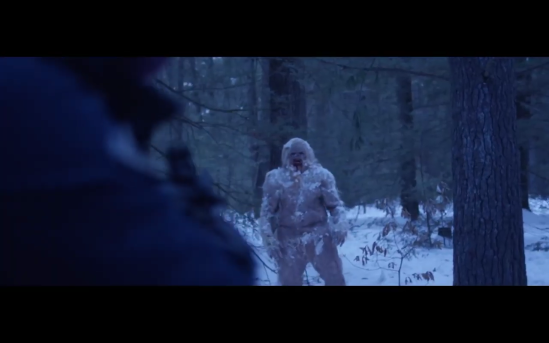
The reason why Burden’s “Abominable” might not be numero uno on your search engine results shouldn’t be total surprise, but even “Yeti” may not produced the same desired outcome.  Aside from not having any grade of star power attached to it, audiences will be awkwardly thrusted right into a perplexing point in the story of dropping us right into complication with a rescue team entering the abandoned Himalayan station and, from then on, a straight forward, uncompelling path of infinite chase with the ball incessantly in the Yeti’s corner trounces on any kind of hope or resistance for survival.  The man-in-a-suit Yeti and makeup effects are not too bad as an admissible effort for an indie production and what’s even more impressive is how Burden felt confident enough to actually show the creature. There have been Yeti, bigfoot, sasquatch, etc., films aplenty of that stray away from displaying much of the hairy beast, only providing glimpses of the large feet, ape-like hands, or fanged teeth to represent a presence, but for “Yeti,” the creature is proudly displayed in all it’s full glory despite being half hairless with patchy spots of snow-stuck fur. Joe Castro, an effects guru for off-the-wall horror for the past three decades with credits including “Night of the Demons III” and “Blood Feast 2: All U Can Eat”, created the Yeti suit while also dishes out some surprisingly decent gore effects that have a real palpable face mangling fetish and so bloody great. On the other hand, the visual effects and props are an abomination in themselves with obvious toy guns and lack of continuity and cause and effect visual effect givens.
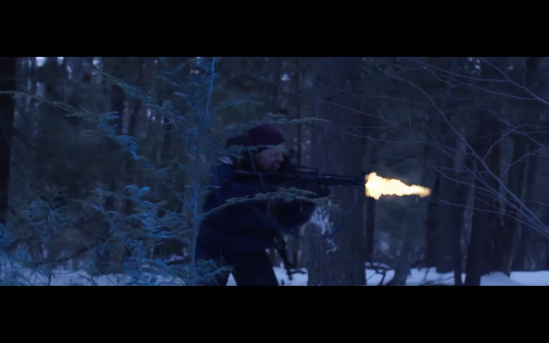
 

Is “Yeti” another filmic miss on the missing link or can there a slither of entertaining gore with creature lucidity amid a trite script? I do think the latter in Jamal Burden’s “Abominable” from High Flier Films slated for a January 11th DVD release in the United Kingdom. Producer Khu is also the director of photography, using the steady and handheld cams to capture a heap of medium and closeup shots without seizing the opportunity to get a lay of the actual snow covered forest which the characters are heaving hot breaths in the frozen air. Khu does exude the fact of actual frigid conditions with the use of a bluish tint in every outdoor scene. “Rave Party Massacre’s” Matt Jantzen composes a tense-situated, industrial epic score that doesn’t fit “Yeti’s” marginal story structure and can be nearly rave-like and repetitive at times while overpoweringly robust. Sound design is another favorable aspect in “Abominable’s” chaos with a discernible range and depth, especially when working with crunchy snow and a lot of bulky clothing that can be heard rustling when characters move around frantically. Gore scenes are laced nicely with gooey, gushy sounds that can be tangibly slimy. There were no bonus material included with the digital screener nor where there any bonus scenes during or after the credits. The great Yeti adaptation still eludes our ever curious eyes as “Yeti” quenches a only blood thirst through an over-trekked, over-defiled snowy path of the subhuman subgenre.

EVIL’s All Inclusive Resort. “Paradise Z” reviewed! ((Yet) Another Distribution Company / Digital Screener)

Sylvia and Rose are living the life of harmonious luxury together on a beautiful and serene Thailand resort. There’s only one tiny problem with their first-class accommodations: the world surrounding them is overrun by a population of rabidly crazed zombies. After establishing a rigorous routine of perimeter checks and pool time, food and gas are running dangerous low to keep a secluded and safe survival lifestyle sustained, leaving them no choice but to venture out to nearby villages in search for fuel, but the smallest of sounds could invite the hungry dead to storm their idyllic retreat. No matter how careful scouring outside the gated walls of isolated tranquility, the zombies’ insidious ways infest as bad resorts guests that turn Sylvia and Rose’s make-due habitation to their prospective tomb when all routes of escape are foiled by flesh-feasting zombies. The couple must rely on each other for survival.

There’s trouble in paradise from Wych Kaosayananda’s melancholic-apocalypticism horror “Paradise Z” focusing on two young women, romantically brought together by undead circumstances, to outlive the encompassing fatalist outlook. Marketed in the United Kingdom as a “Lesbian Zombie Apocalypse Gore-fest” and having been through the wringer with title changes from the original title of “Two of Us” to “Dead Earth,” as called in the States, the uptrend to incorporate the Z in any zombie film has been a musky motif ever since Max Brooks introduced the epithet for his 2006 zombie apocalypse novel, “World War Z,” yet that doesn’t stop writers Kaosayananda and Steve Poirier in dishing out a sanguine trilogy with “Paradise Z” laying the ground work as the first installment and “The Driver,” the third installment, following suit shortly after wrapping production on “Paradise Z.” With the second film, “The Rider,” is still in pre-production and the shot films released out of sequential order, Kaosayananda’s unconventional trilogy methods caters to a seemingly budget and location ready-timeline to which characters from all three films will interconnect the dissociated titles under the filmmaker’s self-funded production company, Kaos Entertainment.

Throughout the entire 1-hour and 35-minute runtime, there are only five speaking roles with three of those roles rarely comprising of about four minutes of combined dialogue, assigning by default much of the chitchat the principle characters, Sylvia and Rose. For the first nine and half minutes, Milena Gorum and Alice Tantayanon don’t say a single word as the day’s routine of waking up, showering, topless swimming, poolside yoga, lunch, and other recreational activities dominate the setup of quietude. When Gorum (as Sylvia) and Tantayanon (Rose) do utter a few words, they’re muttered projection is nearly unintelligible with little effort into the purpose of speaking. Born in Los Angeles and now, predominately, a New York city fashion model, Gorum has come across my radar before with a bit Succubus role in the 2017, Cleopatra Films produced demonic thriller, “The Black Room,” opposite Lin Shaye, Lukas Hassel, and Natasha Henstridge and though “Paradise Z” provides Gorum with her first lead role that showcases her immense beauty but limited acting range. The same wooden expressive opinion can be said for the little known Alice Tantayanon whose pigeonholed herself into a Kaosayananda celluloid corner with her only credits being three of his films. Sylvia and Rose rarely separate from each other sides, being lovers noodled into a pot of thick zombie soup, in a rigid position of affixed dynamics difficult to gauge how either one of them is handling the situation. When a show of complexity is finally unveiled, such as when Sylvia murders in cold blood two other survivors and turns to Rose to say it’s better this way, those actions somewhere along the story from there on out should be dissected in explaining just why lacerating two men to death is a good thing. Of course, we can all assume the survival of the fittest and selfish obvious reason that two rugged men are looking for more than just a box of Twinkies and an unopened can of goulash substitute from two good-looking ladies outside the safety of their homemade stronghold; yet, doesn’t answer where the killer instincts root and Kaosayananda shelves that bit of human nature when the zombie caca spreads throughout the resort upon their return that also evaporates a steamy sex scene and inklings of frustration for their dwindling supplies and mundane routine symbolizing an inching wedge between them. “Ghost House’s” Michael S. New rounds out the cast the DJ, an on-air beacon of infected information.

An Elysian-fabricated getaway resort can be an ideal hunker down for an apocalypse of the zombie kind. Mega resorts have a large footprint that are usually gated and fenced, plenty of food and lodging to accommodate a small village, and an escape route from the beach to the open waters where we all know zombies can’t swim. That works here for “Paradise Z” and almost plays like a pillar character that embeds the women survivalists from going on walkabouts, creating a real sense of comfortable isolation and simmering paranoia of the outside world. Kaosayananda, who can’t quite get the bad taste that lingers from out his mouth with the panned Antonio Banderas and Lucy Liu starring critically slammed and chaos-riddled film “Ballistic: Ecks vs. Sever,” left himself to his own devices in trying to rebuild his career shooting in Thailand, but “Paradise Z” crumbles as a stepping stone trilogy that lacks proper severe conflict of placing the heroines into a tight, perhaps inescapable, spot. What the couple have to escape from are the wild, warm flesh-craving leftovers of a plagued mankind, springing to a sprint at the first audible or visual morsel that tickles the eardrums, but the patchwork caked-face, grayscale zombies don’t render the likes from the bygone Golden Age of Horror, or even the current Golden Age of Modern Horror for that matter, in what looks and feels like cheap knockoffs of the genuine fictional man-eaters by rouge applying professionals. What Kaosayananda has made here is a two-tone, straight-forward, out-smart the dumb zombie breed of uninspired mirth, burdening the actresses to shoulder the story on looks alone rather than include emotional depth oppressed by the Z-factor.

Spend your vacation in a halcyon “Paradise Z” exclusively releasing on UK digital platforms come the new year on January 4th from the marginalized advocating distributor (Yet) Another Distribution Company. In regards to cinematography, presented in a widescreen 2.39:1 aspect ratio, Kaosayananda safely approaches most stories set in Thailand with a warm, yellowish glaze overtop the lush tropic vegetation, but, aside from a class I rapid stream the women decide to cool off in on a whim, without weapons and, basically, in their skivvies, outside the resort walls, there’s a limit to the Thai landscapes that doesn’t reach beyond the resort perimeter sufficing to just the surrounding allure rather than cutting in scenes of breath-taking grandeur. Kaosayananda occasionally reduces the frames per second to emphasize certain scenes with slow motion, such as with Gorum and Tatayanon’s topless make out session or when the two are back-to-back unloading an unlimited amount of ammo against a rushing horde with every shot being a fatal one; the silver lining here is the scene is at least aesthetically cool to watch. However, once again, Sylvia and Rose are given winning hands to play without as much showing their cards that work backwards their highly skilled background of arms fire. With the digital screener, there were no bonus material or bonus scenes included. No need to check the yelp reviews on holiday spot as “Paradise Z” is a four star resort with one star performances battling an underwhelming, minimum gory zombie contingent without dutifully jeopardizing survivors enough for the sake of gratefully being alive.

When The Waters Rush In, It’s the EVIL in Your Head That’ll Kill You. “Relentless” reviewed! (Terror Films / Digital Screener)

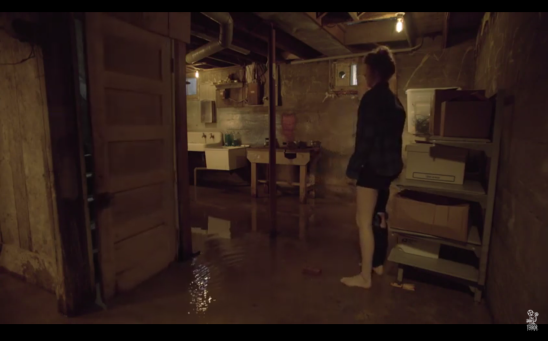
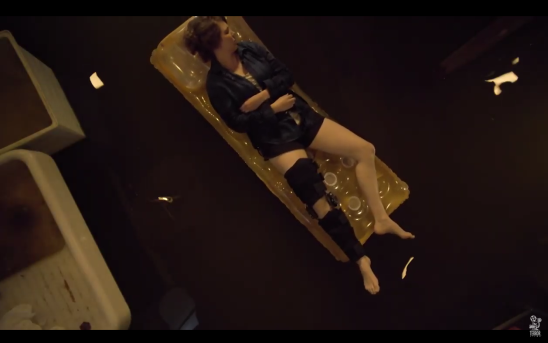
Jennifer Benson’s life is a storybook fairytale that’s embraced by her close sister, exalted by a sweet, kind husband, and excited with the news of an upcoming baby. Yet, all good things come to an end and in Jennifer’s case, in a devastating tragedy when everything and everyone she held close to her heart is unexpectedly wiped away within a single year. Physically injured and suffering from depression, Jennifer withdraws from family and friends inside an empty house, sinking lower into despondency, and letting bills and the house upkeep slip through the seemingly insignificant cracks. Jennifer eventually decides climb up a little out of her rut by cleaning up and letting go of some sentimental materials that leave painful memories by storing them in the unfinished basement, but when the basement door jams and won’t open, Jennifer finds herself trapped in a subterranean state with a large thunderstorm dumping rain that’s seeping from the basement walls, plumbing, and the ground. As the torrential rain continues to fall, the water level continues to rise with no way out.

Get ready to hold your breath in Barry Andersson’s agog of metaphorical poignant survival, “Relentless.” The filling of the fish tank mender is the director’s first and only release of 2020, following his 2019 releases of the historical drama, “The Lumber Baron,” and a 1940’s set sleep deficient thriller, “The Soviet Sleep Experiment.” Andersson continues to tell stories of intricately varied human responses as the filmmaker pens “Relentless” surrounded by themes of reactionary and recovery paths toward death with the film echoing more so with Andersson’s introductory “The Lumbar Baron” on a much smaller scale in terms of cast and setting. The story is set in or near Minnesota, a Midwest state prone to some of the United States worst flash flooding hit areas, and Andersson crafts his creative juices with that in mind to mold a symbolic cognitive descension stemmed by escapism inside creature comforts. Deodand Entertainment and Andersson’s filmic workshop company, Mogo Media, designate as the production companies.

“Relentless” indurates around being a one woman show with Rachel Weber spearheading the subject of crippled and downcast Jennifer Benson. Weber, whose worked briefly with Barry Andersson in “The Soviet Sleep Experiment,” has to operate Jennifer animatedly in a near voiceless, tacit role to simulate one alone with their thoughts and emotions. Only flashbacks limn with dialogue present the state of Jennifer’s woebegone mind as she goes from despair to reluctant acceptance by reopening the wound of concealed painful memories. Weber fulfills every inch of empty space with a tinge sorrow in some way, shape, or form but doesn’t quite convey the impact well enough to fortitude a presence. Weber’s post-flashback expressions deflect the corpus theme with no real tell of how Jennifer actually feels as she stands over a box full of memorabilia of what should be inducing whether a pensive sadness or vitalizing inspiration as she goes through an unbalanced reel of memories that include bedroom book snuggles with her sister at young age or survival life lessons with her father to up at the moment of what was supposed to be a joyous baby shower occasion that turns unexpectedly into tragic point in her life. Though the story acutely restricts the camera on Weber, the unfolding flashbacks ultimately tell the story from the past that includes stint performances from Charles Hubbell (“The Bitch That Cried Wolf”), Anna Hickey, Bea Hannahan, and Presley Grams.

“Relentless” has thought-provoking messages splayed up, down, and all around it’s encased four-walled theme of, literally, drowning in your own self pity and digging yourself out of a hole of depression. The water that gushes into the air tight unfinished basement represents the rising fathoms of depression that initially trickle in harmlessly enough, but the longer the despair drips go unchecked, as noted when Jennifer reaches out to nobody up on the top floors of her house and would rather recap wedding photos in the first act, the more intense the cascades can become when your submerged in from head to toe. Along Jennifer’s rather stagnant perilous journey, sitting on top of work benches as a hapless invalid and rummaging through miscellaneous items, she opens and goes through various storage boxes of her past that she carefully tries to keep dry by continuously moving the boxes out from the low-lying waters. Each box evokes a single memory from her past fashioned in an unchronological order and stews in a melting pot of stirred emotions that work backwards from melancholy to hope to, eventually, in my opinion, an inescapable suicide. My subjective take on Barry Andersson’s open-ended culmination is purely speculative as Jennifer’s struggles for survival may all be for naught, even in the evidence of the character leaving behind a note for storm survivors, or whomever, to collect staggering into what could be Jennifer’s tomb strongly suggests that particular path. That’s what admirable about intense thrillers, such as “Relentless,” that teases an unwritten coda for those to survive and tell the rest of the story, woven with their own personal singularities, but Andersson’s film, heavy in metaphors, lacks spirited vitality in a somber stroll through what’s innately a human fear: death.

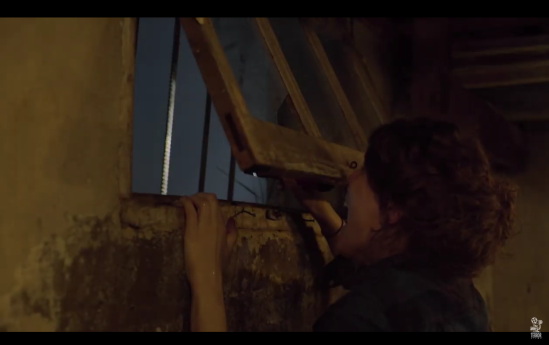
Basements continue to retain their bad rap in the traditional horror sense as well as in Terror Films’ release of Barry Andersson’s survive-or-die succumbing to mopery in “Relentless,” distributed digitally across multiple platforms. Rigorous self preservation might be watered down, but the stagecraft and production design is top shelf quality with a simple set of a well dressed dank and bare basement where streams of water rush into from the barred awning windows and waterlogged plumbing. The basement in itself is a character of misfortune, a cell of rehabilitation, and is just simply effective in a cinematic sense without seeming overly menacingly but rather like every other basement in the world. With the digital screener, there were no bonus material included nor any bonus scenes during or after the credits. Don’t expect a nonstop nail-biter that aims to fill your lungs with asphyxia inhaled water; instead, sympathy or empathy will play significantly in “Relentless'” success with an aggregating flurry of thoughts generator in a post-traumatic vicissitude.

“Relentless” included with Prime Video and available for purchase!

This EVIL Santa is Ho, Ho, Horrible. “Slayed” reviewed! (Terror Films / Digital Screener)

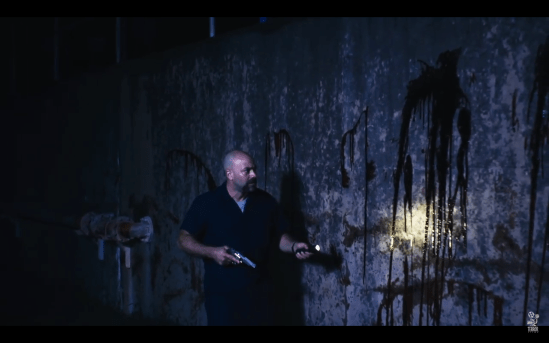
Five years after a murderous, Santa Claus-cladded maniac massacred a couple of young women in the dank basement of a water treatment plant in Harris County, AZ, the stigma of the plant being open has caused enough controversy, heartache, and notoriety for the local residents and will soon close the chained-link gate forever to soon transform into a car dealership. On the last day of operation, Christmas Eve night, the lone survivor of that night five years ago walks vigilantly around the perimeter with a tingled sense that something just isn’t right as he stashes weapons around the facility…just in case. With the last administrative staff gone for the night and a novice guard at the helm of watch, not a creature was stirring, not even a mouse, until there arose such a clatter and who did the guard and the survivor find? It was the return of Jolly Old Saint Nick with an axe to grind.

Merry Christmas, readers! You can’t spread Christmas fear without watching at least one, count them one, homicidal Holidays flick starring our favorite Yuletide strangler, Santa Claus. This year, the Fatman reins down upon a few unfortunate recipients on his coal gifting list in Jim Klock and Mike Capozzi’s “Slayed” that was released digitally this last month of 2020. The script is penned by Jim Klock following another Klock and Capozzi collaboration, the 2019 released Devil trickery detective-thriller, “Red Letters,” that has the unconventional atmospherics of a Christmas themed slasher set in the fictional location of Harris County, Arizona even though the climate of Arizona is semiarid and “Slayed” appears to be taking place in a lush, semi-tropic climate that’s perhaps more in tune with a Floridian winter. However, production company, Jim Klock and Darrell Martinelli”s Code 3 Films, is based out of New Jersey with offices in Los Angeles, suggesting a summer shoot with the cut off shorts, short sleeves t-shirts, and the wicking sporty running attire being worn amongst the limited primary characters.

Klock not only directs, writes, and produces the serial killer Santa but also co-stars as a new-to-the-area, aspiring actor standing in for a regular security guard. Klock enacts a classic clueless constitution for a baffled and bumbling outsider caught in the middle of historical notoriety having returned from the grave. Standing side-by-side and opposite is co-director, Mike Capozzi, who institutes a doomsday prepper’s fantasy come to fruition as the lone survivor of the 5-year bygone Harris County water plant massacre. The role of a water plant operator turned lone wolf of misanthropy never truly fleshes out of a state of rigid inflexible measures that stagnant the character’s mysterious backstory of surviving Santa’s bloody red-handed carnage and extend his development into an explanation of his long-awaited revenge obsession. Klock and Capozzi only bookend the film being in the same scene together, leaving much of the midsection, essentially the second act, for distressing females as hunting game for Santa’s slay. Coel Mahal and Kyra Kennedy, who have previously worked with Klock and Capozzi on previous projects, adequately fill in those rolls to an extent. Mahal’s masculine bity, water plant administrator acutely shifts into trope slasher-fodder of hapless articles of loosely bound prey. Things worsen with Kyra Kennedy’s rando abductee with an uncontrollably irritating sniveling in unprompted immediate danger as she sits in the passenger seat of a truck and just inconsolably cries, cries, and cries. Luckily, “Slayed” is a indie-reined in production that doesn’t swarm with halfhearted and ill-deserving characters as the film rounds out with minor roles casted to Delton Goodrum, Chuck Roberts, and Jennifer Meakin and Crystal Cameron as half-naked, strung up torture toys for a deranged Kris Kringle.

In a peeve already mentioned, “Slayed” rarely invokes as a Christmas chronicled horror film, striking lukewarm resemblances to that of “Silent Night, Deadly Night” or “Christmas Evil,” to which those films set a very low bar to emulated, unless you’re a trash-loving, so-bad-it’s-good, cult film enthusiastic, like yours truly, than its nothing but top shelf quality. However, the unexplained warm weather upholstery cripples “Slayed’s” genre-blend construct that’s been in august status of next level output over the last few years to dispel the happiest time of year into a certifiable time of fear in an apparent hostile seasonal takeover in a return of spite that Halloween shortens every year with Christmas nipping at the heels as soon as the first brown leaf hits the ground. If the shooting location is truly set in Arizona, winter months typically hover around a light jacket and shorts 60 degrees during the day and nippy 40 degrees at night, but the sweaty, wintery deficient clothing worn suggests a sweltering otherwise. Klock and Capozzi’s good faith effort into “Slayed’s” festive fare is in the garish Holiday decorations and ornamental lighting production design denotes the showy display of Christmas spirit, held in which season is not exactly clear. To speak more on the lighting, Emily Adam, another patron believer of Klock’s work, uses a restrained soft fuchsia lens tint, among other vivid primary colors, to elevate the seasonal veneer and Adam’s lighting is especially a favorable hallmark of the season with the use of the soft, but brilliant glow of Christmas string bulbs utilized to lash and tie up up naughty listers. Yet, up to scratch cinematography can’t fix what’s inherently broken with a story penned as a sequel structure that assumes the audiences’ knowledge of past events when, in fact, leaves viewers in blackout darkness with many questions: Why the Harris County water plant? Where did maniacal Santa go for five years? How did the water plant survivor make it out alive and is now determined to end not only maniacal Santa’s life but also his own? Why did maniacal Santa kidnap this random young lady from her house? What’s the significance of Christmas for maniacal Santa and why this period in time to return? I enjoy Christmas horror as much as the next genre votary but wrapping your head around “Slayed” topples any chance of actually enjoying the disgruntled, menacingly muttering “Ho Ho Ho” catch-phrasing, maniacal Santa terrorizing an unjolly skeleton crew on Christmas Eve night.

Ho Ho Horror! Santa delivers the gift of sufferable tidings and killjoys in the Terror Films distributed “Slayed” digitally only onto Prime Video. If you didn’t catch “Slayed” before Christmas when released on December 18th, then no worries! Quickly nosedive into your laptop or television set and catch Santa axing away on Prime Video today! An interesting tidbit about the crew of “Slayed” comes from the music department with composer Jojo Draven, former guitarists for a number of Las Vegas shows such as performance artists, the Blue Man Group, and Gothic street illusionist, Chris Angel. The Indonesian-American female rocker’s agreeable experimental-industrial sound comes across professionally astute toward the context with unbuckling tension baked right into the scene. There were no bonus material included with the screener nor where there bonus scenes during or after the credits. Instead of racing down the stairs, excited by the prospect of unwrapping that one main horror-inspired Christmas movie on Christmas Day, “Slayed” turns out to be a disappointing hefty lump of coal with a few diamond patches sparkling through the sedimentary rock and catching our eye in a rather humbug holiday horror falling short of that so-bad-its-good set bar.

Watch “Slayed” on Prime Video by clicking the poster!

Money is the Root of All EVIL! “Beasts Clawing at Straws” reviewed! (Blu-ray / Artsploitation Films)

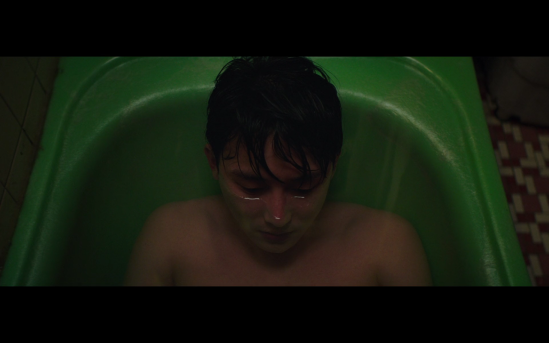
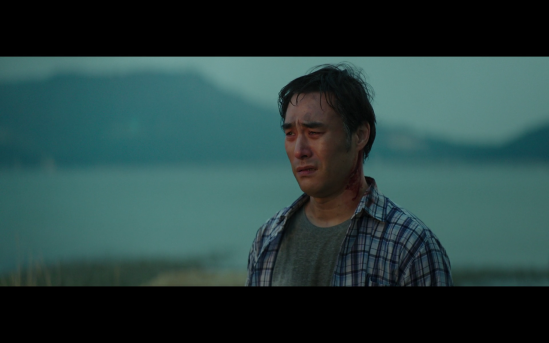
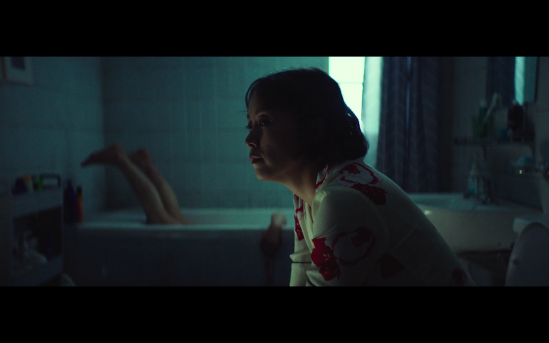
A middle-aged man working a meager job at a gentleman’s bathhouse finds a Louis Vuitton bag full of money when routinely checking the storage lockers at closing.  Unsure about what to do with the money, he stows the bag away in the backroom and continues a moral, yet pauper’s, life while dealing with financial and family troubles at home.  Meanwhile, a border customs agent finds himself in severe debt with an unstable loan shark after his girlfriend skates and disappears with a large borrowed sum.  With a week to come up with the money, plus interest, he calls upon his distant cousin to assist in scamming a scammer who illegally came into some money, but things go awry when an overly friendly and clingy cop begins to snoop around.  Lastly, a prostitute grinds tirelessly to work off a large debt her abusive husband continues to blame her for with night after night beatings.  She jumps into bed with a young, handsome foreigner and her eager to support female boss to off her husband and collect the insurance money.  Yet, these troubled souls find that sticking to their convictions doesn’t always bode well as the unexpected happens in a blink of an eye.

The Asian film machine has mastered the art of the crime thriller from a proven track record that began with Akira Kurosawa films, if not even before that, and has chronically grown stronger, and sometimes more peculiar, with choice stylistic elements, suggestive themes, and extreme violence that has garnered, to much disdain, Westerner attention over the last 20 years with films like Park Chan-wook’s “Oldboy” and Andrew Lau and Alan Mak’s “Internal Affairs” being Americanized with a Hollywood remake.  With that being said in an upward trend of remakes spilling over the edge, there would be no eye-brow raising surprise if the introductory film, the tri-narrative crime drama idiomatically titled “Beasts Clawing at Straws,” from South Korean filmmaker, Kim Yong-hoon, will one day grace the English silver screens in a diluted variation of a Brad Pitt featured carbon copy.  Based of the Keisuke Sone neo-noir novel of the same name, Kim Yong-hoon’s pulpy impression of against-the-wall misdeeds is dog-eat-dog dark comedy gold.  “Beasts Clawing at Straws” is produced by Jang Won-seok (“The Gangster, The Cop, and The Devil”) and is a production of Megabox Plus M films (“Zombie for Sale”) and B.A. Entertainment.

The three prong, greed-catapulting narrative converge characters separately at first and then string them linearly together when the picture becomes clearly what exactly each one of them is chasing, but every story is magnetized to a single focal point, a person under immense pressure, stress, and the malice forces that thirst for their humility, kinetically embarking on the bad choice choo-choo steaming toward the station of vary bad things.  Bae Seong-woo stars as a downtrodden Joong-man, a middle-aged man stuck in the rut of poverty with a geriatric, browbeating mother, a fatigued wife, and busting his rump in a dead end job.  Seong-woo combats himself as a man tight rope walking the thin line of ethic principles when opportunity knocks at his door, but his ill-timed strike to grab life by the balls blows up in his face in a farce of instant karma leaves him less than what he had before.  Then there’s a Tae-young, a comfortably Governmental positioned customs agent facing a different kind of hardship when his ex-girlfriend, Yeon-hee, disappears with a borrowed lump sum of a gangster’s money and he’s left on the fence.  “Illang:  The Wolf Brigade’s” Jung Woo-sung plays into the desperate stench of the superstitious and ambitious customs agent.  Slightly cradling the severity of the situation, Jung amply positions Tae-young’s dilemma that resembles spearfishing in a barrel and he’s the fish.  The last story follows the abused wife Mi-ran, played reservedly by Shin Hyun-bin as a desperate woman looking to bank her soon-to-be dead’s insurance money.  When Mi-ran is abetted by motive-dueling pair of instigators, she finds that paying her debt can be more severe than ever imagined.  While sitting back and basking in the stir-craziness of the leads’ turmoiled chaos, the best characters of the film are the supporting roles of Kim Jun-han as an intestine devouring, fanny-pack wearing henchman, Park Ji-hwan as Tae-young’s bumbling, but begrudgingly loyal distant cousin, and Jung Man-sik as a breezy mobster with a cherry, yet malevolent disposition.  Youn Yuh-jung, Jin Kyung, Jung Ga-ram, Bae Jin-wong, and Heo Dong-won round out the cast.

Non-linear yet interconnected in story, “Beasts Clawing at Straws” hawks a Tarantino layered thriller with colorful deplorables from all walks of life and luxuries.  Kim Yong-hoon nourishes the unbridled, free-for-all nature of diving into the murky, shark-infested waters uncaged and tethered with cuts of raw steaks dangling from the pelvis area in this two wrongs don’t equal a right account of mistrusting desperation and misguided optimism.  Kim’s style echoes the likes of the popular “Pulp Fiction” filmmaker along the lines of shooting techniques and a frank view of violence to tell the frantic clutching of hanging onto what is left of tattered lives and borrowed time while disavowing pure, unadulterated nihilism by at least giving characters a grain of hope.  With any non-linear, multiple moving part films, individual aspects tend to become lost in order for pacing and “Beasts Clawing at Straws” doesn’t fall into the excluded category as factors that play into the main quandary are left hanging, such as in Yeon-hee’s circumstantial results of jetting off with a mobster’s money as the assumption is there, but nothing is fully concrete in her storyline.  The same indiscernible spousal battery stemmed from Mi-ran and her husband’s severe debt that leads to transgressions beyond marital misuse isn’t privy to the audience of how circumstances come about surrounding their predicament and we’re forced to speculate and shoulder an explanation that doesn’t quite feel justified.  However, neither of the slapdash developments hinder “Beast Clawing for Straws’” steamrolling posture to get that desirable bag full of problem-solving, filthy lucre. 

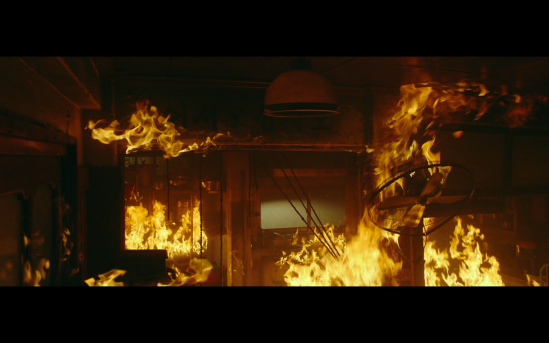
Artsploitation Films delivers a stylish and avaricious South Korea crime drama with “Beasts Clawing for Straws” into the U.S. Blu-ray home video market. The not rated BD25, high-definition 1080p release is presented in a widescreen, 2.39:1 aspect ratio, and nears the epitome of flawless. Aside from the picture slightly flickering, more noticeably on solid colored backdrops, the hue palette is absolutely gorgeous with the neon lights of South Korean cities, the breathtaking silhouettes of the natural mountains adjacent to a lifelessly still lake, and the variety of settings from an airy fish house to a modern, symmetrically designed bordello denote a keen eye by Kim Tao-sung. The South Korean language 5.1 DTS-HD Master Audio surround sound couldn’t be any better with a crystal clear aptitude for strong dialogue balanced in front of a robust soundtrack accompanied by deep range of ambience from fire crackling to the faint hint of rain drops audible from inside a restaurant, solidifying the depth package as well. English subtitles are available along with an English dub track in a dual channel Dolby stereo. What’s lacking with this release is bonus material as there is virtually nothing besides four Artsploitation trailers and the film’s own theatrical trailer. Parlous and deadpan funny, “Beasts Clawing at Straws” amazes as Kim Yong-hoon’s first time effort with the technical grace and the story construction that has been a paradigm for only a handful of notable directors able to execute an impeccable result.

Own “Beasts Clawing at Straws” on Blu-ray! Click the poster to go to Amazon.com