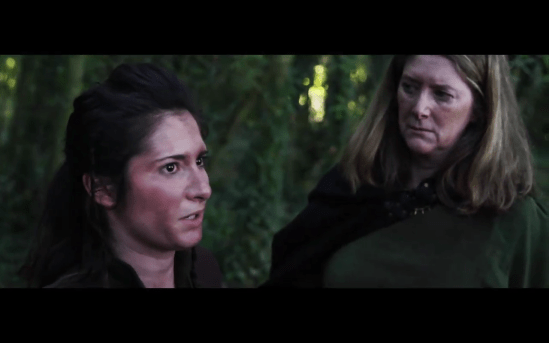
In Youngstown, Ohio, a small documentary team follows popular fashion blogger JoAnne and while continuing to roll film during a friend’s wake, a fallen member of the military during combat, a horde of zombie horror storm the reception hall packed with celebratory mourners. JoAnne, the documentary crew, and a handful of JoAnne’s friends run for their lives through all of Youngstown only to be rescued by a former Afghanistan war solider, Atam, debriefing the situation of a powerful drug manufacturing corporation behind the localized crisis. The survivors soon realize that a band of greedy mercenaries, Atam’s ex-brothers in arms, are supervising the drug’s effects that will, in turn, create a money making, desperation cure in the weeks to come.

If you haven’t guessed, 2012’s “The Zombinator” is a zombie title melded with “The Terminator” franchise and helmed by documentarian and comedy writer-director Sergio Myers. “The Zombinator” is the first horror feature in the filmmaker’s videography repertoire that chips in comedic soundbites to fully absolve the zombie apocalypse film from being a strictly horror. The very reason the film’s called “The Zombinator” should have been a great comedy-horror indicator as well. Sergio Myers’ 7 Ponies Productions finances the micro-budget, semi-found footage feature that egregiously pollutes the very “Terminator” brand in a way that promotes “Lady Terminator” from being not only a grandly exploitation of Indonesian deference, but now an innate fragment of the renowned franchise. “The Zombinator” endoskeleton is not as indestructible with little-to-no homage connection other than a muscly actor donning his best Arnold Schwarzenegger lookalike getup, dressed a bastardized version of the T-800 infiltrator. No machines. No time travel. No anything that approximates the franchise that would have been a cool concept of a time traveling machine hellbent on blowing zombie scum away.

The cast is virtually made up of unknowns, faces who certainly received their career start with a foot inside the door of “The Zombinator.” The talent is young and unseasoned, but hungry to make a name for themselves with melodramatic performances despite a poorly written script that’s more stationary than progressive on the coattails of the last “Terminator” film “Salvation.” While the documentary team films fashion blogger JoAnne played by Joanne Tombo, Tombo isn’t the headliner. In fact, a lead is lost in the scuffling mist of the zombie outbreak, but the top bill is certainly given to an experienced acting vet in the hard-nosed form of Patrick Kilpatrick (“The Toxic Avenger,” “Eraser”) as a military colonel squaring up against the poster boy of “The Zombinator” and the film’s co-producer, Joseph Aviel in his debut feature film. Aviel, who has doubled as Arnold Schwarzenegger in the YouTube sci-fi comedy episodes of “Terminator: Genisys: The YouTube Chronicles,” is just as monstrous as Schwarzenegger was in his prime, garbed in a pitch black trench coat, wielding a shotgun, and sporting shades inside dark warehouse and nighttime scenes – keep in mind, Aviel is not playing a machine, but a ex-soldier so there’s really no need for the sunglasses. The rest of the cast, including Aviel, are quite rigid and lost, stuck in a loop of spewing much of the same peculiarities without every changing. “The Zombinator” rounds out with Lucia Brizzi, Justin Brown (“Early Grave”), Diana Sillaots, Jennifer Sulkowski, Scott Alin (“What’s Eating Todd?”), Travis Bratten, Melvin Breedlove, Maria Desimone, and Michael Angelletta.

Recently, I caught “Star Trek: Deep Space Nine” episode from “Star Trek: Deep Space Nine” with Patrick Kilpatrick as a hardnosed, war-torn Starfleet officer whose been part of a team holding a pivotal Jem’Hadar communications array in the Chin’toka system. The lean and towering Kilpatrick from 20 plus years ago is nearly unrecognizable as Father Time has been rather unforgiving to the actor’s midsection, but Kilpatrick still has that apathetic stare on top of a sternly contoured face graced now by an impressively horizontal and lengthy bushy mustache. Kilpatrick’s a brilliant highlight in a rather abysmal film of bleary lines on whether it’s supposed to be found footage or not horror-comedy; somehow the found footage crew are not a part of the surrounding action to the extend that zombies and the mercenaries are not aware of their presence despite standing merely a few feet away in plain view, but the survivors are clearly aware of them combatively noting to the crew to turn off their cameras …? Also, the comedic lines, such as, “getting popped by the grand fucking wizard of zombies,” seem sorely out of place, poorly timed between frantic moments of confusion, fear, and strife, and don’t really know if they’re actually intended to be funny…? Confusion doesn’t end there as Youngstown, Ohio is a hop, skip, and jump from rural, to urban, to a dam-side cabin in segued acts, scaling down to miniature and unrealistic grounds of time and space. Lastly, there’s an uneven ratio of zombie action and dialogue exposition that will bore audiences with locale-to-locate histrionics without the commingling remedy of undead mayhem equalization to lure back in the attention of wandering eyeballs and dissatisfied brains.

“The Zombinator” targets and destroys zombies with a brand new DVD home video, released this past March from New Jersey based distributed, Bayview Entertainment, with a slick looking front cover of a T-800 skull half dripping with zombie flesh surrounding a milky white eye. Unfortunately, I was provided with an online screener for review and can’t officially comment on the exact video and audio technical quality, but I will say that the found footage approach render very dark when only a couple of moving LED ring light accessories become the primary source of lighting. The underused original score provided by Todd Maki bests out much of everything else about the project with harrowing tracks baselined by zombie groans and the undetermined reverberations of distant ambience. There were no special features on the screener as well. Like a chunk of spoiled meat prime for tasteful critical fodder, there’s absolutely no wriggle room for positivity for the high concept, low output film, “The Zombinator.” Hasta la vista, baby.
Pray EVIL Isn’t This Cruel. “Suffering Bible” reviewed! (Sub Rosa Studios/DVD)

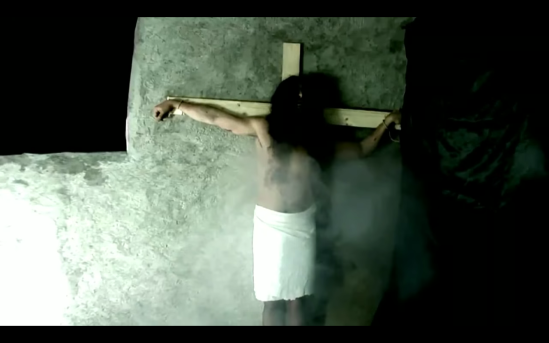
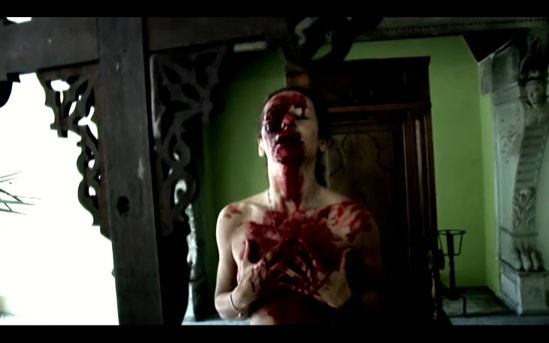
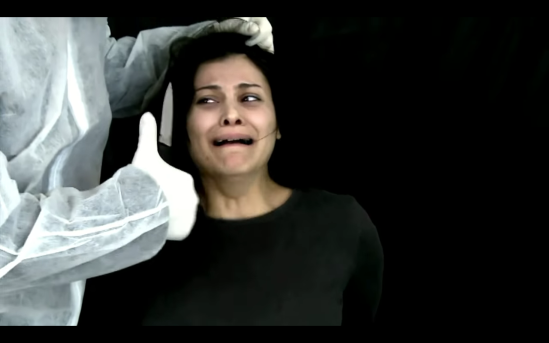
Welcome to the Suffering Bible, a collection of violating and gory interpreted religious allegories digging into stark contrasts of sin and piety and illuminating the darker side of these allegories with a lacerating gruesome perspective. These short stories include the internal strife of a psychopaths strong urge for forbidden lesbian companionship with the contentious, bigoted teachings of finding forever friends inside God’s eyes, a visceral performing depiction of the Incredulity of St. Thomas, an extreme mortification of the flesh, the prideful consequences with a Devil’s pact, and the murderous portrayals of lost souls needing redemption into God’s good graces.

Right in time for the Easter holiday, where Jesus Christ has risen back from the dead for our salvation, comes Davide Pesca’s written and directed “Suffering Bible” of sinfully derived tales of reverent and irreverent perfervid images. The Italian made and produced anthology that’s a contexture of stories is forged together with a wraparound story of the Adam and Eve in the Garden of Eden apologue. “Suffering Bible” begins with a title card excerpt, Tear thy neighbor as thyself, from an unknown storyteller named saamang Ruinees with a skewed version of the second commandment, Love thy neighbor as thyself, subtly denouncing the evils in popular religious culture and then slithering them, not so subtly, into the shorts of those suffering at behest of the bible. Pesca’s shock efforts have come across ItsBlogginEvil.com’s radar once before with another short framed macabre tale, “Hemophobia,” from Artsploitation’s home distributed release of “A Taste of Phobia” anthology and “Hemophobia” is and feels more commercialized with less than salutary toward mutilation and variety body meat, but the filmmaker does fly on a parallel body horror plane and has had his shorts featured alongside with fellow Italian auteur and shock director, Domiziano Cristophario (“House of Flesh Manniquins,” “Red Krokodil”) with a more rudimentary, analogue-video-feel approach. “Suffering Bible” is self-produced by his independent production and distribution company – Demented Gore Productions.

Being an Italian made cast functioning on the performances grounds of a heel budget writing up about “Suffering Bible’s” actors and actresses past credits, influences, methods and so on is proving to be a challenging task. Most of the cast is comprised of alternative, half-naked women, such as Nicola Fugazza and Mary Rubes who are the sole credited on IMDB.com. Rubes, an erotic model, becomes “Suffering Bible’s” inadvertent poster girl that graces the Sub Rosa Studio’s DVD cover and static menu as her seductively deceptive solo performance of body and genital self-mutilation is the most unsettling story revolving around mortification of the flesh. Rubes has previously worked with Pesca on a 2017 short film entitled “Fame de Vampira,” which also co-stars Beata Walewska. Both Rubes and Walewska sizzle in the Italian action scene with “Rage Killers” by director Roger A. Fratter, who co-directed “Fame de Vampira.” As you can see, a casting inner circle is starting to form, but that’s the extent of the network with Simon Rocca, Simon Macleod, Catlin Strange, Pate Douce, Paolo Salvadeo, Emilio Stangalini, Paolo Borsa, Emanuela La Neve, Chiara Digonzelli, and Marilena Marmo.

On the surface, “Suffering Bible” has a unwieldly, pigeonhole affect that places the impervious shutters around one’s peepers and thinking cap for the pleasures of gore and nudity that run continuously rampant, but Davide Pesca has a connect-the-dot vision that aims to unveil the worst of religious culture, using graphic imagery in a reverse psychological and divinity experience that’s wildly novel inside a less commercialized parameters and the more I stew on this film, the more I like it. Without this review not seeming to be a theoretical paper on Davide Pesca and the “Suffering Bible,” examples of the filmmaker using gore as the pain and suffering vessel for those struggling to be closer to God can be modeled from the first short, “My Only God” aka “Friends Forever,” in which a woman stitches herself to her now dead friend to be closer to her, as if their friendship, which was severed insinuated by the dead woman, will continue in the afterlife. Same can be said about the last, if not more potently gristly, short, “The Redemption of Last Souls,” where a druggie, a terminal ill person, and a homeless man who has lost family connectivity have nothing left to lose, have lost faith, and seek redemption through being chair strapped subjects of a snuff film. While “My Only God” and “The Redemption of Lost Souls” caters to the barbaric rite of celestial passage, Davide Pesca’s specialty falls more within the lines of body horror as the filmmaker has saturated himself in the infatuation of the Body Modification culture, reflected in his “St. Thomas” and “In The Name of The Father” that include Doubting Thomas reaching protractedly into a crucified Jesus’s side slit and include the extreme mortification of the sinful flesh – eyes, breasts, and clitoris – by a devout devotee.

“Suffering Bible” is a throwback moxie livid on sin and body destruction and it’s a title coming to you on DVD home vide like a disastrous, break faith, miracle from SRS Home Video and MVDVisual. Though listed as a retro release by SRS, “Suffering Bible” released in 2018, shooting over the course of a few years prior more than likely, with a combination sepia-color approach and the result outputted a strained and digitally cursed image of a widescreen, 1.78:1 presentation that suffers from severe compression artifacts in conjunction with digital interference. The errs are absolved by the very label of a throwback “erotic art house horror” gracing the retro, faux-VHS DVD back cover. The single channel stereo has limited flexibility with some ostentatious, if not laughable, Foley work. Aside from a little dialogue in two of the shorts, “Suffering Bible” takes a vow of silence and speaks volumes in actions alone; this creative choice, along with some probable glitch art, saves much of the technical woes already plaguing Pesca’s stain on profane. The robust grunge-brood style of OKY’s prolong guitar distortions, delicate strum and percussion echoing, and reverse melodies bedazzles in a cathartic relief that no dense, run of the mill metal band is attached to the soundtrack. Special features include a short interview with Davide Pesca, which turned out to be more of a behind-the-scenes look at handful of shorts for the film, a lengthy ultra violent and gory showreel for Pesca’s “Tales from the Deep Hell,” and SRS trailers. More grimly poetic than sleazy gore-porn, the book of the “Suffering Bible” can open eyes to the unsettling infernal of holy virtue with transfixing horrid death rooms.
The Cycle of Life Can Be EVIL. “Vivarium” reviewed! (Screener/Vertigo Releasing)

Gemma and Tom are a happily in love young couple who are looking to purchase a starter home. They visit a real-estate agency for a brand new housing development called Yonder. Met by a strange and persuasive real-estate agent, they’re convinced to follow the unusual agent to tour the neighborhood that has been marketed as the family forever home with everything they could ever need and want. A row upon row of identical houses and yards go as far as the eye can see and before the tour of the rather ordinary house number 9 ends, Gemma and Tom find themselves alone inside with the bizarre agent gone. Their efforts to leave the mysterious residential suburbia proves impossible as each turn leads them back to house number 9. When a box containing a baby boy is left at the doorstep with a note to raise the child to be released, the young couple reluctantly reside into domestic confinement.

Vivarium defined is an enclosure, container, or structure adapted prepared for keeping animals under seminatural conditions for observation or study or as pets, like an aquarium or a terrarium. “Vivarium,” the 2019 movie, embraces the definition, twisted into an idiosyncratic neighborhood block of duplicity from the “Without Name” director, Lorcan Finnegan. Story concept is flushed out by Finnegan and “Vivarium’” credited screenwriter, Garret Stanley, in their second collaboration for the director’s sophomore feature endeavor that’s a panicking puzzle in every square foot of Yonder’s backwards backyard. The film resonates with echoes of Finnegan and Stanley’s seminal short film, “Foxes,” from 2012, revolving around a couple living in a remote and forgotten housing development and become drowning in obsession, madness, and malaise as shrieking foxes surround their isolated home. There’s an equating animalistic instinct to each film that brandishes many of the same motifs as well as joining themes that are corralled in Finnegan’s copious foreboding and disconnecting dehumanization narrative. “Vivarium” is produced by XYZ Films (“Tusk”), Fantastic Films (“Stitches”), PingPong Film, and Frakas Productions (“Raw”).

The happy, young love birds are played by Imogen Poots (“Green Room” and “Black Christmas” 2019 released remake), who has an underlining affinity for not typecasting herself in the same role, and Jesse Eisenberg (“Cursed” and “Zombieland”), who manages to step a foot outside his conventional performance of a rattle mouth, know-it-all. However, Eisenberg deserves the praise of a man with severed ties from reality as the actor embraces a reserved manic by channeling Tom’s obsessive need to dig, an aspect of his handyman profession he’s good at in perhaps providing an escape from cage-less confinement, and being the bearer of skepticism of caring for an abnormal child. Gemma has complications of her own confronting her educator responsibilities for young children. She struggles with internal conflict, does she still use her innate care and instruct a young mind or in self-preservation, take Tom’s passive aggressive approach? Poots and Eisenberg share a mutual, caring bond that defines Gemma and Tom kind of steady, kind of loose relationship that gradually devolves civilly, like the amicable breakdown of a marriage revealing lost, but not forgotten love between two people. Along with the surreal atmosphere, “Vivarium” grades well in the creepy kid department with the child in Tom and Gemma care, but don’t even bother giving a name. Dubbed with a playful man’s voice, a shrill scream ignited by displeasure, a knack for imitating, and always dressed in Sunday’s best, Senan Jennings’ middle aged boy presence is a supernova of chilling proportions with a performance that gives his co-stars a run for their money while Eanna Hardwicke is equally spasmodic and creepy as the grown up, young man version of the boy with a little more alienating know-how and clandestine about his origins.

Finnegan and Stanley pursue thought-provoking substance of human corporeal limitations and how we, as humans, cycle through them with such cavalier ease. The opening scenes examples this with the practice of the common cuckoo laying their mimicry egg inside the nests of other birds. As a brood parasite amongst birds, the cuckoo egg hatches and the cuckoo chick pushes out the mother birds’ inborn chicks and becomes the sole chick in the nest with the surrogate mother tending to the cuckoo’s dietary needs. When the cuckoo is matured, it is grossly larger than the mother bird and, also, mimics the bird species to an extent, much in the same way of the boy or young man Gemma and Tom surrogate as being the unintended mimicry that infiltrates and ousts the limitations of his foster parents. Finnegan and Stanley also explore the parental lifecycle with the theme that our children will replace us, extend our legacy, but we will ultimately be forgotten. “Vivarium’s” craft dictates a larger scale, disproportionate, otherworld teemed with secret subterranean corridors leading to other disturbing observatory immures, making for a stimulating meta-induced terrarium as we watch miniature versions of Jesse Eisenberg and Imogen Poots suffer inside a screen from the comfort of our couch.

If you’re stuck at home, living the quarantine life you’ve always wanted, “Vivarium” may just break of your introverted stance on home with it’s “Black Mirror” and “Twilight Zone” encouragement. Because of the COVID-19 pandemic, the Vertigo Releasing and Wildcard Distribution released film has circulated digital only on the following platforms in the UK: iTunes/Apple TV, Amazon, Sky Store, Virgin, Google Play, Rakuten, BT, Playstation, Microsoft, Curzon Home Cinema, and BFI Player. Unfortunately, I will not be able to comment or critique of the audio, video, or bonus features of this release due to the varying elements of a digital screener. Novel, suspenseful, and a great film to brood over, yet difficult envisaging, “Vivarium” truly resembles slithers of somber dimensions of an upside world with lashings of surveillance paranoia.
Amazon Prime Video is one way to watch! Rent or Buy “Vivarium” with Prime Video
Run And Hid When Yuletide EVIL Comes A Calling! “Pagan Warrior” reviewed! (ITN Distribution / DVD)

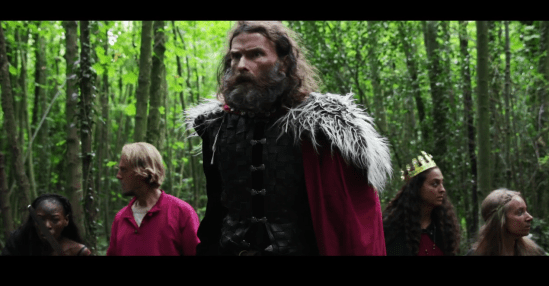
In Medieval times of Sussex, England, a powerful English king, who has kept the seething Viking savages at bay for decades, has died, vacating the throne to his son, Rollo. The Vikings seize the opportunity during this time of transition and storm the Saxon Castle, nearly killing the monarchy and all of throne’s subjects left to oppose them. With their daughter Avery kidnapped and themselves on the brink of death, King Rollo and Queen Silvia are revived by two women of the woods, a pair of witch sisters known as Constance and Millicent, who use their mystical healing powers and offer the king retribution by summoning the Yuletide monster, Krampus. In return for slaughtering the Viking usurpers, the Krampus will collect his debt in exactly 10 years, taking whatever is precious and dear as payment from the vengeful King Rollo.

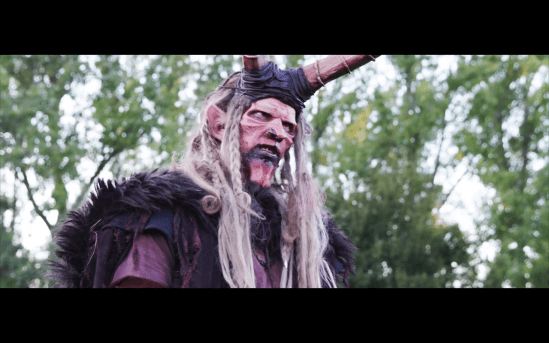
Krampus has become a major media trend over the last decade, popping up in all forms of popular culture that compounded lore inside the leafy pages of books and magazines to the beast’s frighteningly half-goat, half-man exterior making for great big screen monster entertainment. The inverse icon of jolly Saint Nicholas offers punitive measures for bad little girls and boys and is sometimes referred as a companion to Saint Nicholas who probably turned a decisive blind eye to little brat Johnny’s enjoyably thievery and torture of chickens from a neighboring farm. “Pagan Warrior” is yet another narrative of the Christmas creature spun with different fabric and woven into a bitter feud of two contending enemies told modestly by director Louisa Warren (“Tooth Fairy”), produced by Warren’s London, UK based production company, ChampDog Films, a creative outlet for independent film ventures that are mostly in the horror genre and are sometimes inferior versions of bigger budget films, in the same vein as Asylum Entertainment. The script comes from Shannon Holiday (“Bride of Scarecrow”) that conveys an ageless theme of beware of what you wish for and the price of blind vengeance.

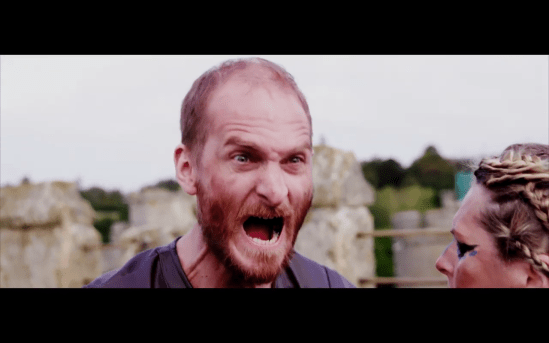
“Pagan Warrior” hones in on numerous character stories, never clearly defining a single perspective. King Rollo, played by “Escape from Cannibal Farm’s Peter Cosgrove, becomes the royal fate sealer as what he deems necessary and right is, in fact, the worst possible scenario a mad king could bestow upon himself by calling upon the supernatural death dealers for revenge. Cosgrove cleans up nicely as an English blue blood whose bequest incorporates a lineage of fighting kings with Cosgrove taking his role with due importance despite a humbling filmmaking production. King Rollo’s counterpart, the merciless Viking Ubbe fitted for Carey Thring (“Scarecrow’s Revenge”), combats a war on two fronts – the contentious bout with King Rollo and an internal family squabble that beleaguer the bond between him and his wife (Kate Milner Evans, “Pet Graveyard”) and child (Adam Sugawara, “Virtual Death Match”) as he tries to court princess Avery with a crude sexual advances. Thring’s vision of Ubbe is a classically depicted villain whose stronger with allies and a whimpering coward when alone in a fight, especially when the Krampus comes calling for his head. Darrell Griggs dons the makeup, prosthetics, and wardrobe of the horned beast, becoming the folklore of a cursed death who not only pursues the 12 month progression of horrible children, but also the appointed damned when conjured for a hit. Krampus’ outward appearance is pleasing and Griggs provides the lumbering and slight preternatural motions that give Krampus that dreaded paranormal mysticism. “Pagan Warrior” rounds out with Sarah T. Cohen (“ClownDoll”), Jessica O’Toole (“Pet Graveyard”), Mike Kelson (“Scarecrow’s Revenge”), Hattie Willow (“The Mermaid’s Curse”), Will Todd (“Mummy Reborn”), and Tara MacGowran (“Mother Krampus”) and director Louisa Warren as the women of the woods.

ChampDog Films uses a tightknit group of actors and filmmakers to sell archaic swordplay action fastened against demonic folklore and despite the underwhelming band of Vikings versus an equally small English contingent squaring off in front of a historic English castle with virtually no ample practical or CGI era enhanced presentations, the production just barely eeks by with Feudal times. Wisely, Warren shoots a number of character closeup shots, avoiding much of the surrounding modern elements and forcing audiences to focus just on the characters who are dolled up for Medieval times roleplay. Where the battle scenes and smart camera work flourish, the Shannon Holiday script becomes the ultimate weak link in the chain with a predictable plot storied with terribly cliched and uninteresting characters that couldn’t grip a sword let alone one’s attention. The story begins with its most shocking ending scene, thwarting any possibility of surprise for even the most dense and cinematically uneducated individual for the ruse play out. There is also this millennium goof in the opening backstory credits indicating events take place in 812 AD and in the same breath, mentioned also is the three days of December 1812 that this episode occurs. Since 1812 England was all about redcoats, guns, and war with America colonies, I would assume 812 AD would be the correct time period against a Viking invasion.

In what is not exactly a Christmas holiday horror movie, the malediction of the “Pagan Warrior” spread little holiday cheer and more yesterday fear onto an ITN Distribution and Mill Creek Entertainment DVD. Presented in a widescreen, 2.35:1 aspect ration, on a single layer DVD, sheathed inside a DVD cover that looks cooler than the actual movie itself, the lower end production avoids stylizing a historical based feature with tinted mattes, computer imagery, or any other miscellaneous camera effects seeking more toward a naturalistic cinematography that utilizes the hues at hand. Pastel blacks jump with noise and posterization from the electronic interference whereas the existing hues exhibit a less than rich approach of a more vapid green, brown, and stonewall beige. The English language Dolby Digital 2.0 stereo audio mix maintains a level of consistency. Sometimes, Krampus’ dialogue is murky because of the extra gnarling effect parroting an LFE emitting voice; however, dialogue is mainly clear and prominent. English SDH is an available option. For a time period action-horror, the lack of rudimentary range and depth troubles with little sense into the effort of adding skirmishing swords and Krampus’ reverberating growls always seem to be right next to the camera. The only bonus feature available is the trailer. With conventional means of dispatching people, “Pagan Warrior” shadows more of the slasher concept conjured by the breath of the desperate who misfires judgment rather than being an omnipotent being summoned like a djinn for total annihilation in exchange for a debt in this good faith effort by Louisa Warren of Krampus diabolism.
EVIL Waited 30 Years. Now It’s Unleashed! “Zombie Rampage II” reviewed! (Wild Eye Releasing / DVD)

A zombie ravaged world divides survivors into gangs. In this case, two warring rivals, a group of decent folk versus cannibalistic savages, spar over little territory left untouched by the undead. Seeking tactical advantage, the contentious factions either scheme a plan for appropriating the land while the other recruits and trains an inexpert survivalist to better their odds against one another. Leave it to humanity to still be the most dangerous animal on Earth during a zombie apocalypse when an armed showdown opens the doors for death and the undead to wreak havoc on the best and worst parts of being human.

Full disclosure. I have never seen or even sought out Todd Sheets’ renown direct-to-video, zombie epic, “Zombie Rampage,” from 1989. So, when the opportunity came around to check out the sequel, “Zombie Rampage II,” presented on a Wild Eye Releasing DVD, I jumped at the chance to witness the anticipated follow-up despite the sequel not being steered by Sheets himself. The “Bonehill Road” director’s involvement extends to the credit of producer and co-writer of the aborted 1990 sequel, which had unearthed VHS footage repurposed for the 2019 release, while Alexander Brotherton makes his directorial and script debut the new material and Mike Hellman and Charles Gooseman, who were a heavily involved duo of the original discovered footage, are credited as co-directors. In the last few years, Brotherton’s been a staple of Sheets’ films in some skeleton cast and crew capacity from the satirically bonkers “Clownado” to the narcotically world toppling chaos of “Dreaming Purple Neon” and with full confidence in Brotherton, therein lies sanctions for the filmmaker to pay homage to the 1989 original with its own shot-on-video rendition that maintains that gritty VHS integrity, continuing to be a financial churned out by Todd Sheets’ production company, Extreme Entertainment, which has been goring out content since 1988 and that makes “Zombie Rampage” and “Zombie Rampage II” larger than life, honorary bookends to Sheets’ continued indie success.

Cast is comprised of Sheets’ entourage of actors and actresses, starting off with Antwoine Steele whose reprising the afro-sporting, smooth talking, lady loving, ass-kicking Durville Sweet from “Zombie Bloodbath 3: Zombie Armageddon.” Steele steals the show with his indifferently foul mouth Sam Jackson approach that somehow manages to spin into a favorable personality trait. Another show stealer is Dilynn Fawn Harvey serving a plate of scantily-cladded roughness with the sexually suggestive Hot Stuff. Harvey jumps at the opportunity to show off her chest again while being the sultry lass who never has to be the dame in distress. Both Steele and Harvey are bigger than life on screen and that trend continues with other key players in Jack Mccord as the cross-dressed Mr. Hyde, leader of the cannibal gang, Eve Smith as an androgynous warrior for the good side, Jay Perkaple as the inept survivor recruit, and Skyler Roberts as a psychotic cannibal with a severed finger partner in crime. The supporting cast is made up of Daniell Bell, Carol Word, and Jenny McCarty.

“Zombie Rampage II” is a rough, SOV mix of black-to-satirical humor and a healthy amount of zombie carnage that isn’t a direct sequel. Don’t expect the carnage to be overwhelming complete and gory as the low budget bullet flatlines the realism of any kind of flesh-eating horde violence, but that lack of zombie realism is to be expected from the kitschy quality that seals in air tight the stank of the 30-year-old VHS predecessor. Yes, mistakes and miscues will be a natural condition of a penny-pinched film, such as a conspicuous train passing by in the background during a supposed zombie desolated world, fight sequences that will be hilariously and horrendously overstated, and the gore would be nothing more than quick explosive flashes of red matted paint and be about as Wharferin thin to the point of being limpid clear. Yet, what bothers me the most out of everything is the drifting flimsy and anorexic plot that initially emphases on finding Stewart and his assimilation into the gang of well-versed survivalist, but then grossly upends more for a battle of territory between gang one and gang two with a final showdown involving Durville swinging a colossally fluorescent, two-sided dildo as a num-chuk and the bashing of heads in with foam covered kids’ toy bat that you can purchase offline for $10. There’s a crude and abnormal sense of poetry in that scene involving an adult’s orifice stuffing sex toy with a children’s athletic plaything being combative instruments in the same scene, but for the sake of not going off on a tangent, “Zombie Rampage II” bares little plot growth that flaunts more tasteless humor than rampaging a zombie chorus and the destruction that leaves in it’s wake.

For fans sworn to be loyal acolytes of Todd Sheets, take a long, hard gander at “Zombie Rampage II” on DVD home video from Wild Eye Releasing on their Raw and Extreme banner. Those who’ve waited for a sequel will be pleasantly surprised in how the video presentation and quality are comprised of two similar but distinct formats with a letterbox 16:9 in the recently shot video that bookends the letterbox 4:3 footage from 1990. Both formats are heavily lossy in providing a detailed presentation and express vapid color that comes to not surprise inside a production value cost little-to-nothing at all. “Zombie Rampage II” definitely harks back to the demeanor of a shot on video film where quality is but an intangible illusion compared to the unfathomable gore that fills the quality caliber void, but to my shock, there is just not enough fake blood in the sequel to justify a purchase of a subpar quality pardon. The English language single channel stereo output caters to the same lossy conditions of a low bitrate amplitude with a stiffened dialogue track and poorly edited stock foley inserts. Again, all telltale attributes of an indie video recorded classic that’ll certainly get SOV and Todd Sheets’ fans rocks off. The only special feature amongst a model static menu available is the film’s trailer, but the visceral DVD cover, distributed by MVDVisual, has a milky eyed zombie grotesquely chowing down viscera that’s very poignant of a Raw and Extreme title and very welcoming, eye-catching package feature. There are bonus features before and after the feature with a fake trailer for “Durville Sweet and the Lost Temple of Ass Pirates” and bloopers during the rolling credits. “Zombie Rampage II” covers 30-years of ground, breaking the laws of time, and giving retrograde VHS and Todd Sheets aficionados what they want – blood, boobs, and butchery.