
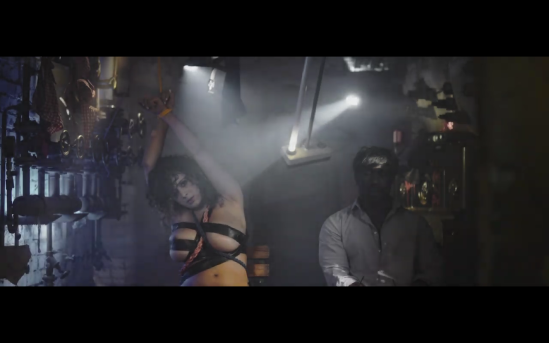
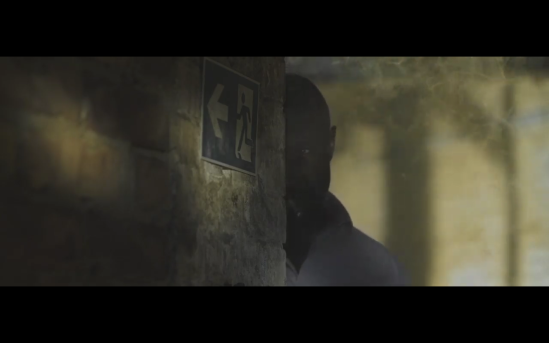
In the moments before attending a pool party, apparent strangers-to-acquaintances, a distinguished, if not quirky man and a promiscuous, self-involved German woman, withdraw to a secluded building in order for the brazen woman to shave the bikini line exposed excess hairs before strapping on a suit. Their intricately deep discussions about desires, sex, and kinky foreplay fair nothing more but course, blunt banter between two familiarities, but when the woman pretends she must be tied up and punished for playfully biting the man’s ear until bleeding, the next few moments after fall into a state of obscurity of a he said, she said rape accusation. As confounding declarations are made and fingers are being pointed to decimate lives, a sack of deceptions and an abundance of threats accrue through a blackmail scheme and an abduction based vendetta. Nothing can be certain and no one can be trusted between the two, but one thing is definite, a third man watching from afar has nefarious plans of his own.
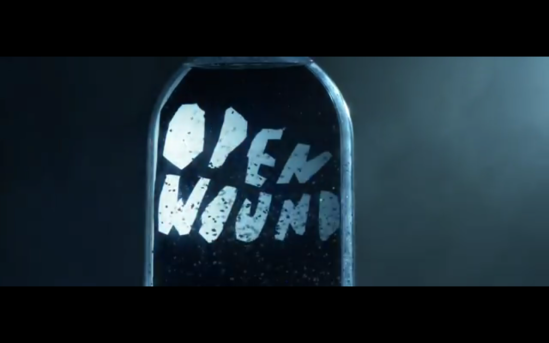
Like sitting front row at a bastardized version of an off-broadway show, “Open Wound” is an immaculate stage performance of battered psychologies and visceral deceptions from writer-director Jürgen Weber. The thriller, also known as “Time Is Up” or “Open Wound: The Über-Movie,” measures extreme lengths of human bitterness while constantly shapeshifting into plot twist after plot twist aggregated with clusters of popup violence. The Chinese born Weng Menghan, under her moniker Tau Tau, is the financial backer of “Open Wound. The globetrotting author makes her breakthrough imprint into the feature film business that modestly begins with an opening scene about anal sex among other verbal sexual references before man versus woman fisticuffs and a pivoting third act that rapidly alters character compositions into, essentially, a free for all. So metaphorically speaking, a Chinese producer walks into a bar, sits onto a stool next to a German director, and orders one of the more absorbingly chic cocktail thrillers in English. “Open Wound” is a melting pot of cultural influences and a display damaged egos that’s simply brilliant.
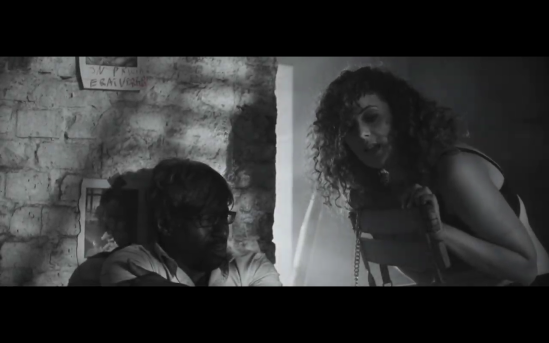
“Open Wound” has a short character list comprised of three characters. The first is woman who is introduced first, or rather her lips do when she declares her love anal sex and the parallel criteria for types of cars in one man’s garage, as she’s using a straight razor to trim the dark haired pubes from her bikini line. She oozes eroticism like a bodily fluid that gravitationally seeps from between the legs, spilling innermost desires, whims, and historical sex-capades with in a philosophical prose. #Nippelstatthetze advocate, German podcast expert, and stunning model, Leila Lowfire engrosses herself into the role of fierce, proud, confident, and strong woman. With an established vigorous sexual prowess, Lowfire culminates the femme fatales and breakneck show-stoppers female roles, notably similar in Quentin Tarantino movies, with high-brow tastes and a debasing reprove. Lowfire’s accent is low and thick and can be considered her weakness here as getting your brain to interpret the fluidity of the words, structures, and compositions is undeniable challenging at times, but acts upon fervor while in her lingerie or even topless throughout the film. The contrast against man is stark. His introduction paints him as unequipped, socially inept, and hopeless desperate. Man longs for Woman, but knows he doesn’t have a chance with her until she offers up a random game of role-play that inevitably leads to disarray. Jerry Kwarteng’s man performance is systematically peerless and a complete joy. Even if the character lacks depth, Kwarteng’s range is devilishly good with the only comparison coming to mind would be James McAvoy and his multiple personality disorder in “Glass.” Once Man and Woman comes to terms after a back and forth bout with dominance, the Suicide King’s grand appearance bestows upon the plot an even bigger, clunkier monkey wrench. The Suicide King’s an ex-con, looking for revenge in a small vat of acid, and his mark and him have a long, complicated history which parts personally shock the other. Erik Hanson’s raspy voice, feeble appearing physique, and lofty age has a second row seat to his character’s unwillingness to die, in a slick performance that’s part nihilist and part psychotic to which Hansen pulls off.

Weber’s choice toward “Open Wound’s” narrative layout conflicts with how the DVD release is specifically marketed. “Open Wound” rides the dark comedy pine that is peppered with black tongue-and-cheek dialogue and violence and as will be noted later in the review, the advertising depicts something far more extreme and graphic. On the shock value scale of one to ten, “Open Wound” hovers around a solid five and maybe a seven or eight for the casual popcorn viewer and, personally, I don’t believe “Open Wound” was intended to be a source of utter distress and visual barbarity. There’s brisk lighthearted comedy that softens the blunt force. For example, in the room with the Man and Woman, a record player will every so often, to comically assist in explaining the actions, play the cheesy tune of lounge background music with a singer narrating the character’s every move and also be the voice of between chapter contention or bewilderment. The singing is privy to only the audience just as the twelve chapter titles that offer a mixed bag of sequences that interchange between English, German, and Chinese title introductions, a toilet paper title card in reverse action, and an artistic rendering of chapters titles and just like his title card introductions, Weber also utilizes an assortment of styles to tell his story, whether be a 5 minute sepia, nitrate film burn effect, or day dream sequence, that peers the sudden twists and eruptive chaos between the characters. While the effects work to sensationalize the context, they tend to be equally be nauseating and annoying as a disruptive structure that seemingly doesn’t make sense to the naked eye.
MVDVisual and Wild Eye Releasing distributes Jürgen Weber’s “Open Wound” onto DVD home video as the the 11th spine feature under the Wild Eye Raw & Extreme sub-label. The DVD is presented in a widescreen format and the image quality holds up well, withstanding Weber’s bombardment of stylistic techniques of distortion, over exposure, sepia, and contrast. There’s a little softness around the skin, more noticeably during facial close ups, with a slightly lower bit rate in the compression but still very agreeable detail. The stereo two channel audio channel does the job, but has flaws with Weber’s score have an equal playing field with the dialogue tracks. The audience already has to manage Leila Lowfire’s thick German accent and their ears will also need to try and filter out the soundtrack that’s invasive upon the colloquy. Not much range to warrant mentioning, but the depth was well tweaked amongst Weber’s visual compliments. There are unfortunately no bonus material with the feature, but the DVD reversible insert is graced with a semi-naked and bound Leila Lowfire. “Open Wound” is dangerous, sexy, thrilling, and complicated to say the least, but stamped as a Raw & Extreme film it should not; however, see this film! Director Jürgen Weber’s visionary molotov cocktail of a story is an underground must for arthouse lovers and noir enthusiasts.


Being a Gracious Host Goes Well with an Accompaniment of Corkscrew Evil! “The House” review!

Set inside the conflict of World War II, a strayed former SS lieutenant and a German paratrooper must band together and escort a Norwegian captive through the snow covered forest of the frigid Norwegian mountains. Venturing through the cold and soulless landscape, the lieutenant is baffled by his bearings as his map doesn’t correlate with his surroundings, the sun is positioned at the opposite direction, and their compass points in the wrong direction. Faced with the possibility of gangrene and hypothermia, the lost combatants are forced to take up camp in a seemingly abandoned house that fly’s a hoisted Norwegian flag and has a pot of stew left simmering on a stove burner. Their already puzzling arrival into the residence is also met with unexplainable occurrences that place the extremely cold and weary soldiers even more so on an overwrought edge as they continuously search the house of presence telling life signs. Shadows and sounds trick their senses, soon realizing that the cozy confines are an inhospitable prison and with the deadly cold nipping at the doorstep, the soldiers are left with no choice but to face a sinister absence of time inside a hostile house that toys with their psyche and questions their own mortal existence.

Quickly becoming Norway’s prominent horror filmmaker, Reinert Kiil found success with his controversial and provocative “Whore” films and had a well-received review at Its Bloggin’ Evil for his cheerfully grisly, holiday slasher classic, “Christmas Blood.” Artsploitation Films continues to wholeheartedly support the Norway born director with his next venture, the supernaturally-charged possession of a home-sweet-home feature entitled simply “The House’ or “Huset” as titled in the original tongue. Kiil typically trends with shock horror, but with “The House,” there is an expansion upon his range as a filmmaker while remaining in a field he’s finds most endearing, pulling inspiration from his childhood memory vault of B-movie horror schlock and nostalgia grandeur, and dapples with replacing his guts and gory showmanship with slowly developing and instilling fear, especially with fear of the unknown and fear of change. Audiences are going to be attached to the hip and entrenched with the German soldiers, clueless to their predicament and anxious for them with the house’s uncanny and perplexing animosity, and Kiil doesn’t show much right away, slowly simmering the taut chills lined meticulously in the story.

Paratrooper Andres Fleiss is introduced in the preface attempting to save his mortally wounded friend and brother in arms, Max. Fleiss’s passion greatly motivates him as he jump out of a plane first rather than assess whether he has a parachute on first, willing to assign blame and kill Rune, Norwegian captive, right away without any provocation as instant relief and gratification. You see, Rune didn’t kill Max and, in fact, no exposition is provided about how the three men arrived at preface’s point in time, standing on a snowy side of a mountain just on the outskirts of a forest edge. Frederik von Luttichau (“A Room to Die For”) incites the paratrooper’s sense of duty and sense of irrationality. Luttichau’s able to quickly switch gears from confident combatant to a frightened bumbling idiot whose trapped inside a complete mind scramble of a situation. Fleiss is juxtaposed against the cooler head of a commissioned officer, Lieutenant Jurgen Kreiner. The former architect from Munich uses his SS training to tranquil the anxiety; so much so that Kreiner has a strange habit of protecting Rune from expiring much to the displeasure of Fleiss. Mats Reinhardt, in his sophomore film, is a juggernaut of emotional suppression. The rigid actor perfectly suits Kreiner’s stoic rationality toward not only the malevolent shelter, but also to Fleiss’s thin patience. Both characters’ melancholy is confounding as you start to feel for these Nazi soldiers stuck in a state of limbo and Kiil writes their roles down a personal level that expresses guilt, sadness, and shame that lets you know that they’re human too, humans who have done terrible things that have become their undoing. The Norway solider, Rune, is an important piece to the puzzlement. With his background unexplained and role in the house’s occurrences, Rune becomes an integrated symbol of subtle vengeance; even Rune, in the origin sense of the word, is defined as a secret mystery. Rune, or Runes, can also imply a set of symbols in archaic German languages much like the ones used on the closet door in the house or at the title screen. The mysterious Norwegian is subjected to being always hurt, whether a bout with gangrene or being shot, Rune ceases to cease. “Christman Blood’s” Sondre Krogtoft Larsen perforates the two opposes forces as a well-executed deceitful key to the mystery and though Rune doesn’t fully explain the entirety of the house’s backstory, Larsen simply quantifies the a potential reason with his the character’s simplicity role in it all. Other character flow in and out of the story as either a flashback or a vision and they include performances from Evy Kasseth Rosten (“Dead Snow”), Sigmund Saeverud (“Christmas Blood”), Ingvild Flikkerud, and Espen Edvartsen (“Dead Snow 2”).

There are other “House” reviews that compare Kiil’s film to the likes of “The Exorcist” or an exorcist type film and while the German soldier’s narrative is spliced with a flashback sub-story of a priest performance the rites of exorcism on a young girl inside the “House,” labeling the film as such warrants a rebranding. These flashback scenes, that are not consecutive, sluggishly rolls out a bit piece in the house’s backstory that almost predates the 20th century (the trailer suggests 1901), but doesn’t, in my opinion, obviously explain all that’s happening to the soldiers forty years later. Fleiss said it best during a frantic moment when the paratrooper comes to a full realization that the reason their stuck in an unescapable phenomena is because he and Lt. Kreiner are dead. Sometimes the more blatant reason is perhaps the more conclusive as Kiil offers a breadcrumb trail to point out these two Nazi soldiers are in oblivion of atonement. From the very beginning, the three men couldn’t explain how they came together, every facet of direction is obscured, time ceases to exist, their most inner desires and offenses bubble to the surface, and even Fleiss mentions the soup, the one simmer on the burner upon their arrive, is bland to the taste for the dead have no need for senses. In short, the momentary exorcist scenes are fathomable, perhaps in-depth more with the dated slideshow series of events in the Scandes, but, in context, cheapens the film slightly and could go easily as “The House” is inherently soul crushing and effectively atmospheric.

Artsploitation Films and Reel Suspects presents Rinert Kiil’s “House,” a product of Sanctum Films, onto DVD home video. The release is presented in an anamorphic widescreen, 2.35:1 aspect ratio, shot digitally that idyllically compositions Norway’s Norefjell snowy mountain range of the Scandes. The opening title sequence has some image instability with faint pixel fluttery in the compression, but doesn’t seem to go beyond the barely visible stage. “House” isn’t a flashy conceived concept that renders a lot of texture or detail warranted scenes, but darker scenes are overly rich with black that interpreting the visuals more difficult and as a note on one of Kiil’s visional techniques on being outside in or at night, like when Fleiss is hoisting the Nazi flag, the obvious tinted lens isn’t a reasonable substitute for dusk, dawn, and night. Skin tones are a pleasantly raw in appearance and, hey, the lighting in the snow is great for obvious reasons. The Dolby Digital 5.1 surround sound is hands down the past technical feature with an engrossing atmosphere track that has depth and range to send the audible senses hiding in fear underneath the comfy blanket. The intertwining German, Norwegian, and English language tracks holds strong and upfront with clear and precise synchronization of paralleling subtitles, offered solely in English, and Kim Berg and and Levi Gawrock Troite’s powerful score portrays a film bigger than it’s budget. Bonus features include a behind-the-scenes segment, an interview with Reinert Kiil who discusses his trek through Norway film and delves a little in each of his projects, a commentary track with Kiil, a short film by the director entitled “The Voice of One’s Conscience” (aka “Samvittighetens Rost”), and Artsploitation trailers. Reinert Kiil’s “The House” is non-exuberant horror diverging toward exploring the filmmaker’s unlimited possibilities and with “The House’s” diabolical descent into invigorating terror, Norway cinema has an abundance of sheer promise for the future of horror.


A Kingdom Engulfed by Evil! “Rampant” review!

The kingdom of Joseon is in a state of great turmoil as the absolute monarchy is being influentially divided. The King has treacherous whispers being fed to him by head of the nobles, Minister Kim, and the eldest royal son, the Crown Prince, witnesses his father’s dominion being redirected against the common people despite his best efforts to persuade his father. When the Crown Prince’s insurrection plan for kingdom stabilizing is foiled, the Crown Prince commits public suicide as act of sacrifice to spare his cohorts and their family from capital punishment, but before his death, the Crown Prince sends word to his younger brother, Lee Chung, to return home from the Qing Dynasty and escort his sister and unborn child out of a country soon to be in the throes of chaos. In the midst of the struggle, a foreign ship cargoes new age weapons and the Captain has secret dealings with Minister Kim, but is raided by the Crown Prince’s rebellion The ship also holds another human eradicating payload, a plagued foreigner in the brig is transforming into a blood hungry monster with grayed out eyes and razor sharp teeth With one of the raiding members being bitten, the carnivorous outbreak spreads throughout the kingdom days before the pleasure seeking and arrogant Lee Chung returns home. Chung not only finds his people suffering from bloodthirsty monsters, but also from a turbulent hierarchy sought for destruction by a devilish and traitorous orchestrator who will do anything, like leave a plague go unchecked, to see the lineage die out.

From the same studio that delivered the critically successful, zombie apocalyptic nail biter, “Train to Buscan” comes Kim Sung-hoon’s martial arts horror-fantasy, “Rampant,” that’s a perfect accompaniment double feature film involving a familiar fast-spreading zombie-like outbreak with gripping, non-stop action based on the webcomic Kingdom of the Gods. “Rampant” is the filmmaker’s junior film from 2018, a film blended with truly epic magnitude and an ancient Korean civilization that’s penned by “Scary Hair” writer-director Shin-yeon Won and Hwang Jo Yoon to weave battling aortic stories that inherently funnel toward the dismantling of an established empire. While not serving as a straight genre film with savage moments of on the edge of your seat horror, the theme hones in on the separation of classes, peasants and blue-blooded or high ranking officials, and the reuniting them by compassion and strength. Inklings of fear, greed, and ignorance are stitched in the very hanbok and gat-laden fabrics of the story and serving as a precursor to the Netflix produced television series, Kingdom, scripted by Kim Eun-hee and directed by Seong-hun Kim, involving virtually an identical premise of a troubled monarchy being plagued by a horde of diabolical creatures.

Prince Lee Chung is a stimulating character to say the least; the prince’s introduction isn’t favorable to royal morals as a pleasure seeking, womanizer who gets his kicks by doing what he wants, when he wants. Yet, Chung arches so prominently that the transformation goes seamless, and covertly, to persuades audiences to rally behind Chung in the least-to-most extreme circumstances. Hyun Bin’s confidence in the prince ceases to amaze. From his impeccable arrogance to selfless protection, Bin sustains high level performance no matter the situation while bearing a giant blade, holstered on his lower back. Chung has the skill of a warrior, but the tact of a barfly at first and comes to be a complete better version of himself at the dire end that also completes Bin’s full range of the role. Chung is pitted against Minister Kim, the head of all the court’s ministers, and Kim plots to dethrone the Joseon kingdom in chaos by any means. Jang Dong-Gun is Korean’s version of Mads Mikkelsen. Jang envelops a deepening mystery that’s hard to deescalate and emits a presence on screen just by the way he positions himself in an ominous, if not anime swordsman, manner. Minister Kim is a staggering and formidable nemesis, more overall suited to be the main villain amongst an ever-growing sea of plague-spewing creatures. The remaining lot of characters feel auxiliary around the protagonist Chung and antagonist Kim and these roles are supported by Kim Eui-sung (“Train to Buscan”), Jo Woo-jin, Jo Dal-hwan, Jung Yoo-An, Lee Sun-Bin, and Seo Ji-hye.

You might have noticed that the term creatures were used to describe the menace that plagues Joseon. Characters often reference the plague transformed attackers as demons and, to be honest, these grayed eyed, pointy teeth demons could pass as extras in Lamberto Bava’s “Demons” or Kevin Tenney’s “Night of the Demons,” but the U.S. marketing of the Well Go USA Entertainment release promises zombies and zombie action, even going as far as splaying on the front and back cover that the same studio produced “Train to Buscan.” To be fair, a plague did start the mayhem, transmission of the disease was by bite, and the course ran the kingdom very, well, rampant like a traditional, George A. Romero style, outbreak. Either way, to kill a demon and/or zombie, an assortment of kill method was acceptable such as: beheadings, severing the heart, and, to thoroughly ensure death, kill with fire. Demons. Zombies. Audiences won’t be too hard up on how to label the hungry hordes as “Rampant” slices, dices, and crucifies the the living hell out of the living dead.

Well Go USA Entertainment presents the VAST Entertainment and Leeyang Film, “Rampant,” onto a dual format, DVD and Blu-ray combo, release. The 129 minute runtime Blu-ray is exhibited in a widescreen, 16:9 aspect ratio. There’s money behind this release as visual effects are one of the superior cases over the lot of 2018 releases with pinpoint detail from the mass of infected, the textures and coloring of fire, and the Joseon Kingdom structures and detail attire. The attention is really in the details with not only historical authenticity, but also realism. Human coloring looks rather natural and the no issues with compression either. The Korean DTS-HD Master Audio track suits the action heavy film with LFE combustions and explosions, unlimited range and depth amongst a vast Kingdom battleground, and dialogue that right up front. The DVD has a Dolby Digital audio track. Well constructed and syned English subtitles are available on both formats. Inyoung Park’s ho-hum score is the Achilles’ heal of brittleness that downplays the feverish action and reducing the entire sequence as mediocre that doesn’t aspire greatness to come or to be beheld. The same can be said about the bonus material too with a making of featurette that’s more of “Rampant’s” Stateside promo reel, Behind the Scenes featurette that also feels like a marketing campaign ad focusing on character introductions, and Well GO USA Entertainment trailers. In short, no substance in the bonus features. With sound swordplay choreography, a swarm of multiplying reanimated corpses, and an engrossing narrative with a lore foundation, “Rampant” is the next Korean mega hit in the fantasy-horror catalogue.


Evil Shall Not Steal! “Purgatory Road” review!

The Kirby brothers, Vincent and Michael, witness the attempted suicide of his father who placed a snub-nosed barrel shotgun underneath his chin and pulls the trigger. As adult, the brothers process the trauma in their own ways with Michael unable to jumpstart his life that has been exploited by his brother who has joined the priesthood. Now as exonerated Catholic priest, Father Vincent continues his crusade in absolving confessional patrons of their sins, but with a twist. Hell bent on exacting death through absolving upon those who steal in any capacity, Father Vincent travels the rural areas of Mississippi in a beat up congregational and confessional mobile camper to soapbox his wrath sermons and to rid the world of those who surface his childhood trauma. When another psychotic killer ascertains Father Vincent’s radical cause and wants to join devious purposes, the aversely complicate Michael can no longer abide by his brother’s carnage of guilt path and isn’t keen on spending his life with another heartless killer, urging himself to exit the threesome and starting a life of his own with Ruby, a diner waitress who has taken a shine to him, but Father Vincent and his newfound accomplice won’t let him go that easily.
Just what the Catholic Church needs… one more film depicting a priest using God to benefit his own greed! Mark Savage co-writes and directs the damnation of thieves film, “Purgatory Road,” with a post-viewing requiring a penance of one Our Father and ten Hail Mary’s! Co-written with “Stressed to Kill’” Tom Parnell, “Purgatory Road” is a horrific hallmark of adverse Americanisms such as religious fanaticisms, self-indulgence, mental instability, corruption, and narcissism. All these qualities can potentially lead to one common bond that Savage makes centerpiece and that would be murder. Savage’s extreme vision isn’t all that far from today’s reality where cases of the mentally and the spiritually unstable and religious acolytes plan, stage, and carry out killing sprees almost weekly, corrupt politicians and the uppermost devout pocket secrets and bribes, and egotistical maniacs pick and choose basic civilities to divide groups against each other. I don’t see “Purgatory Road” as shocking and taboo, but rather as 98 minute revelation, not in a Almighty sense, but as a break in the opaque lens that is today.
Father Vincent firmly believe in his actions, without doubt and without shame, and uses any tool, or person, to fatally smite thieves, but has no absolute joy in the way he responds to pilferage acts. The guilt over his father’s attempted suicide drives him, sucking the vibrancy, the energy, and the happiness from him, and the fact that his father still lives, as a basement dwelling, cannibalistic creature, makes the matter even more dire to Vincent. The fraught priest ended up being an ideal performance for Gary Cairns (“Malignant”) who noted in the behind-the-scenes interview that his personal issues at the time brought out the all-around worst in Father Vincent and despite the character written as a fire-breathing, wrath of God man of the cloth, Cairns is able to weather his role as a seemingly idyllic Catholic priest with something to hide from credits-to-credits. Michael Kirby might be complicit, but isn’t wholeheartedly on-board with his brother’s blood shedding that drives another relevant nail into a Cain and Abel type tale. Michael’s longing to part from his brother is difficult for him, whether he also feels guilt for his father’s misfortune or an attempt to try and steer Vincent from complete and utter chaos, and even with a chance to escape the madness, Michael unintentionally flounders the attempt that ultimately becomes his climax to kill. Luke Albright (“Devil’s Pass”) engrosses himself as the black sheep amongst wolves in sheep clothing. Though his character is scribed as conflicted, Michael has downplayed emotional trauma that extremely binds him to his brother and makes him just as equally disturbed when disposing of his brother’s victims. Savage and Parnell’s narrative angle might not focus on the emotional level of Michael, but Albright flourishes the angst that internally rips him apart within the confines of every contentious scene that involves Cairns’ character. The brothers are driven further apart when Mary Francis, a sadistic and cannibalistic serial killer, discovers their undertaking, forces herself to join them in the cause, and catches the eye of Father Vincent, who displays some physical touch withdrawals and loneliness with the vulnerability of his corpses. Mary Francis is easy on the eyes, casual in her affairs, and empowering with a high sex drive that would make any man weak at the knees in a normal world, but Mary Francis is far from normal and Trista Robinson (“Jurassic City”) offers her short build, cutesy voice, and piercing eyes that favorably compliment Mary Francis’s dark features and equally dark soul. The character is an unsuspecting brut heart whose well-written as she describes to a radio talk show host her boy or girl fascinations as a drab hunting sport where spilling their blood and robbing them is the last great and excitable moment of the relationship, signified and sealed with a single kiss. The rest of the cast rounds out with Sylvia Grace Crim (“Happy Death Day 2U”), Geoff Falk (“The Livingston Gardener”), Chace Beck (“Meltdown”), and Douglas Cunningham.
Shot on location in Mississippi, “Purgatory Road” offers a really cool story that’s not produced on a studio lot and is kept out of the rural areas of California and any other locations that bear no resemblance to the deeply Southern pious roots of the 20th state of the U.S. Savage was able to obtain raw locations that best fit the delusional and fanatic tendencies of Father Vincent and with the gruesomely beautiful special effects and makeup by “American Guinea Pig: Bloodshock’s” Marcus Koch and Cat Bernier, the murderous role of not only Father Vincent but also Mary Francis are furnished to frightful fruition of two fiends you just don’t mess with in the devout South. Koch and Bernier texturize severed body parts and provide a wide diameter for blood splatter as an intensifying tool, but don’t overly exaggerate the gory garnishes that might re-direct attention from the story.
Unearthed Films and MVDVisual’s Blu-ray of Delirium’s “Purgatory Road” has Unchristian values worth indulging that includes a widescreen 1.85:! aspect ratio. The digital shot film uses a Canon EOS C300 Mark ll in a full HD setting and the image quality has phenomenal sharpness with natural skin coloring and excellent details that come to focus on the outside faded, dirty paneling of the rustic RV and in the fleshy, blood wet limbs of the Koch and Bernier gory special. Cinematographer Andrew Giannetta has a working eye for the horror element of “Purgatory Road’s” red-light district familiar frame work with appropriate fog and tint to augment the gothic murkiness and dread. The Dolby Digital 2.0 audio track is favorably well-balanced with no kickback or unintelligible miscues. “Purgatory Road” might have an RV kill room, but the RV isn’t involved in high speed chases or fiery explosions, so the dual channel works well for this type of low-key thriller. There are bonus features aplenty with a commentary with writer-director Mark Savage, a gallery slideshow entitled “The Grisly Art of Marcus Koch and Cat Bernier,” writer Tom Parnell speaking about his experience as a screenwriter behind his main profession as a lawyer, a lengthy featurette of the three lead actors speaking about their involvement, how they came to the project, and what the film and/or story means to them personally, and a Purgatory Road Q&A featuring Mark Savage. Impenitent swindlers beware! “Purgatory Road” is all fire and brimstone braced with a strong cast of compelling talent and a horrifically transfixing tale of blood is stronger than holy water.


Evil’s Brewing in “Crucible of the Vampire” review!

When half of an archaic crucible is discovered while excavating in the basement of an old Victorian mansion, Isabelle, an assistant museum curator, is hastily dispatched to authenticate the finding and to confirm the analyst that the cauldron is, in fact, the missing second half to the one in the museum’s possession. Isabelle is greeted by the estate owner, Karl, his wife Evelyn, and their eccentric daughter Scarlet who welcome Isabelle to stay with them while she evaluates the crucible. The unnerving manor home keeps Isabelle awake at night as she frightfully witnesses silhouettes of a young woman wandering through the haunting corridors and the untended rooms. As Karl brushes Isabelle’s nightly concerns to the side, impatiently urging her to summon for the other half of the piece and finalize a match that would then focus on the crucible’s value, the young curator can’t shake the continuously dreadful sensation that danger lurks in every dark corner of the estate and that the residents are inherently grooming her for a sinister awakening of immortality and power.

Writer-director Iain Ross-McNamee has diffidently checked all the British-gothic horror boxes in his latest film, a brooding vampire macabre entitled “Crucible of the Vampire.” “The Singing Bird Will Come” director co-writes the script with Darren Lake and “I Bought a Vampire Motorcycle” screenwriter John Wolskel to reel in the once was, the gilded age of British horror that made a nick in time with the vehemently violent and boldly colorful enriched Hammer Horror. Like other genetic make-ups of horror bodies, Hammer Horror has a genome of a check list of self-defining attributes and “Crucible of a Vampire” aims to notch a few key elements including the Gothicism finesse, the sexually unchaste vampire, and, also, to deliver big horror on a small budget. Ross-McNamee places stakes not into the cold, bloodthirsty hearts, but more so into construing a film that isn’t a carbon copy of the old days, adding a contemporary digital presentation that’s laced generously with contemporary photography techniques even when the opening prelude is set in the 17-century and shot in a sepia style.

The story centers around the assistant curator, Isabelle, who has wearisome tendencies of 24/7 suspicion, being a pawn in every sense of the word. From the head curator to Karl’s family, Isabelle finds herself alone in tight spots and not many people she can count on. There are a couple of characters that are potential allies, but their feeble attempts in buffering Isabelle from the house’s evil secret are no thinker than a single sheet of college rule paper. Isabelle herself is her strongest defense and when push comes to shove, the curator turns ass kicker against a family of vampire acolytes. Katie Goldfinch handles Isabelle with reasonable composure, if not slightly timid at times, especially during fight sequences. Goldfinch sustains her lead performance of her sophomore feature film that is exposition heavy to formulate an isolating and intimidating dynamic between her and Karl’s family. Karl’s portentous cruelty is town-renowned, shaped by rumors and peppered with truisms and Larry Rew channels Karl precisely. The “Underworld: Rise of the Lycans” actor has traditional methods of able to creep one out by standing still and speaking with a vigorously commanding tone, but Rew feels significantly older compared to his wife and daughter. Karl’s wife, Evelyn, stammers as a wild card in a role that seems to go nowhere and Babette Barat can only strut her hippie performance of Evelyn so far until we’re wondering what’s significance as a mother, as a wife, and as part of the crucible grand scheme. Scarlet had the opposite effect as the daughter was overly forward with defining her intentions that toward Isabelle that involved stealing, desiring, and chastising. Scarlet’s predestined for villainy and actress Florence Cady provides a fringe heavy and tantalizing seductive performance. So much so, Cady nearly becomes the female lead, but certainly overshadows the crucible’s calling, a vampire named Lydia, a non-verbal role with barely much screen time given to wild-eye, teased haired, and paled Lisa Martin. Angela Carter, Brian Coucher (1995’s “Underworld”), Phil Hemming, Aaron Jeffcoate (AMC’s “The Terror”), Charles O’Neill (“Cripsy’s Curse”), and the UK Bob of “Bob the Builder” Neil Morrissey co-star.

If “Crucible of the Vampire” is supposed to be a reawakening of British gothic horror, Ross-McNamee went without the vibrancy of color and went without much of the fervent violence that Hammer Productions was keen on. “Crucible of the Vampire” sustains a dissimilar path focally toward more exposition to forefront a narrative until an action climax that’s initiated by awkwardly edited gratuitous nudity and weak character flaws. Like being brewed inside the ironclad enclosure of a crucible, the filmmaker simmered a story that quietly bubbled to the surface until it boiled over uncontrollably and extinguished itself, splattering onto the floor below in a heap of smoke. Act three is misshapen by the prior two acts with one issue being Isabella transforming in an instant into a complete bad ass when faced with death because of her pure, virgin blood. In a blink of an eye, she literally kills five acolytes with a melee weapons that include a rustic knife, the crucible, a metal pipe, and a fired filled chalice. The kill by fire chalice and other igniting instances during the film saw shoddy outcomes of superimposed, computer generated fire which really do speak the inane quality of the visual effects. Even with the practical effects, blood doesn’t spray or gush onto a wall when a vamp victim has his throat become the main course; instead, the effect squirts on the adjacent wall like from a condiment squeezer, losing a sense of convincing value.

ScreenBound Pictures presents “Crucible of the Vampire,” a Ghost Dog Films’ production, onto an all region PAL dual format, DVD/Blu-ray home video release. The Blu-ray is presented in 1080p with a widescreen, 2.35:1 aspect ratio. Picture looks absolutely gorgeous with the natural color palate, but slightly stodgy with the blood red vampire vision in only a couple of brief scenes. Details are fine and textures slice through, especially in the opening segments of Isabelle walking along the river line, and in conjunction with aesthetic wide shots that monolithic structures, like an old giant tree or the Victorian home. The English Dolby Digital 5.1 LCPM uncompressed audio track is not a film that necessarily needs five channels, but does utilize them when the night churns out bumps in the darkness. The dialogue has prominence, depth, and range without breaking or interrupting the audio lineage. The staid score by Michelle Bee and Amanda Murray floundered in the lossless audio as an unfortunate miscue to reel in and hammer away the gothic vision. This release came with no bonus features in a day and age where most Blu-rays do have some sort of extra content. “Crucible of the Vampire” has earned merit in the traditional British gothic horror sub-genre that’s been flailing over the years, reinvigorating the concept of dark arts and lesbian vampires, but loses footing at crucial moments that ultimately unglues the narrative.


 It's Bloggin Evil!