To Do EVIL or To Do Good? “Men of War” reviewed! (MVD Visual / Blu-ray)

“Men of War” are Men now in High Def! See It Here!

Living like a pauper on the frozen street of a snow Chicago, ex-special forces soldier Nick Gunar has no desire to return to his former life, but when he’s referred a mercenary job to visit an island off the South China sea, he’s assured by the man that referred him, his fatherlike former colonial, that there will be no bloodshed in his all for show and intimidation situation that needs more finesse than firepower.  His mission is to assemble a team and negotiate with armed persuasion to get the unwilling, combative locals to sign over the rights to a mineral rich underground cave system.   Gunar’s expected confrontation turns out to be a small village of unarmed men, women, and children, peacefully refusing to sign over their land for excavational exploitation of their ancestral home.  While Gunar weighs his morality, a second team lead by Gunar’s more ruthless brother-in-arms, Keefer, sets to make sure the job is completed one way or another. 
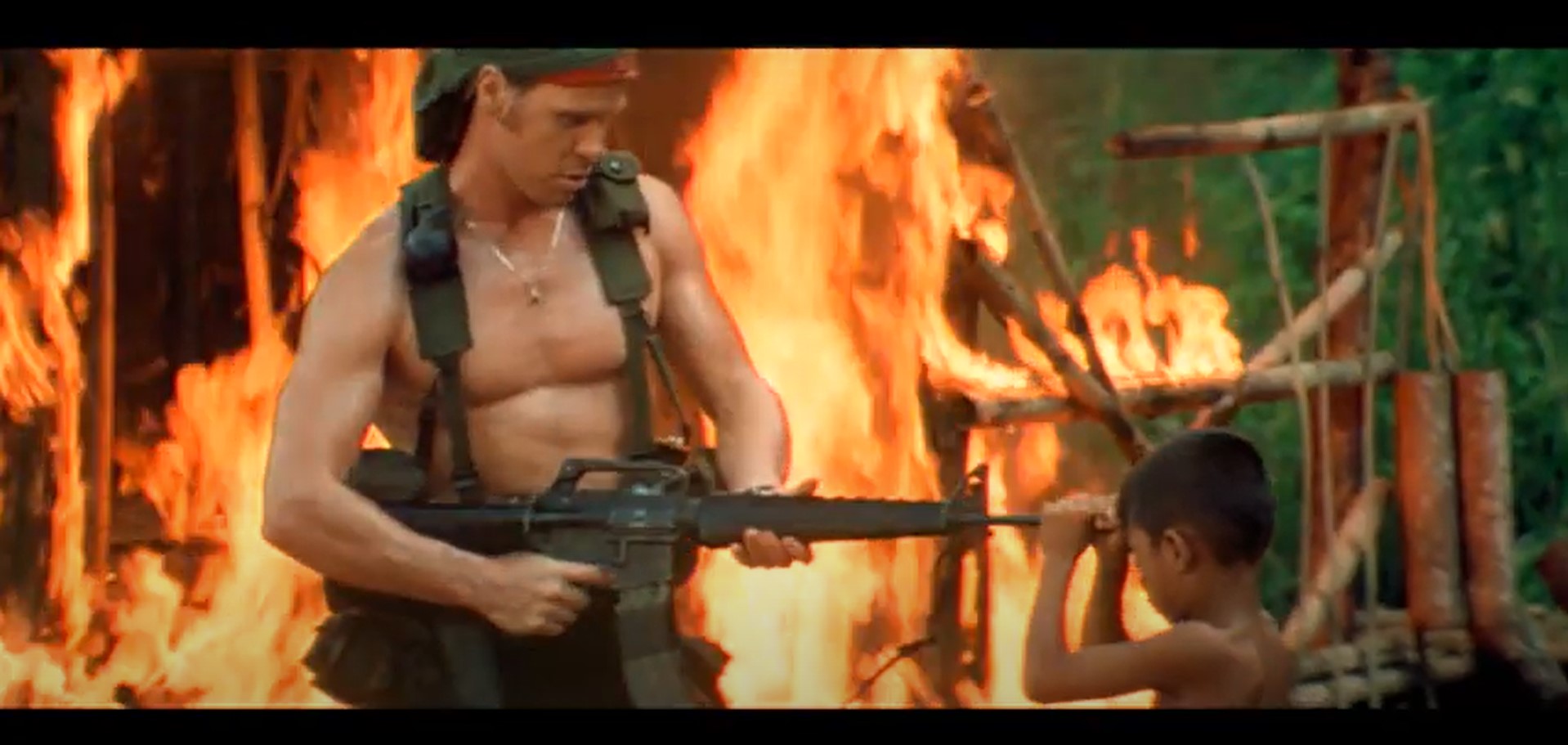
Set off the coast of Thailand, “Men of War” is the 1994 U.S. mercenary action film that induces the ethics and morality question of armed-to-the-teeth hired guns against a small village of mostly helpless residents going to sit with an honorable conscious.  Perry Lang, actor in such films as “Teen Lust,” “The Hearse,” and “Alligator” who then turned director in the early 90s, helmed his sophomore picture after directing Catherine O’Hara in “Little Vegas” four years prior.  “Men of War,” which had a working title of “A Safe Place,” is penned by a trifecta of writers in “The Howling’s” John Sayles, “Demon Knight’s” Ethan Reiff, and Reiff’s longtime screenwriting partner Cyrus Voris.  Seasoned writers and an upcoming director garnered studio funds by Moshe Diamant and Stan Rogow to take a chance on the abroad militant-action subgenre that was dwindling at the time of the mid-90s.  Mark Darmon Productions Worldwide, in association with Grandview Avenue Pictures, served as coproduction studios with Arthur Goldblatt, Andrew Pfeffer, and David C. Anderson producing.

The big name that attracted financial support and give the title a boost was Dolph Lundgren who, at that time, was one of the biggest action stars of the late 80s into the 90s with “Rocky IV,” “Masters of the Universe,” “The Punisher,” and “Universal Soldier” all under his 6’ 3” Swedish, muscular frame topped with blonde haired and gentle blue-eyes.  Lundgren tackles his next role as conflicted mercenary looking to get out of the game all together as former special forces soldier Nick Gunar.  Perhaps one of the more complex roles Lundgren has portrayed in his career, Gunar fights the uphill battle of a pressurized existence that always leads him back to what he does best, being a soldier of fortune.  Yet, the well-trained combatant’s heart has softened and changed to not be an elite killer anymore and his new mission, assigned to him by venture capitalist Lyle (Perry Lang) and Warren (Thomas Gibson, “Eyes Wide Shut”) and referred by Colonial Merrick (a true typecasted bad guy in Kevin Tighe of “K-9”), will put his trained tactics and newfound compassion to the test.  However, for obvious cinematic reasons, things will not go as smooth as Gunar obliviously hopes with nudges from a diversely skilled team of assembled gung-ho comrades, deceived by those he’s trusted, and antagonized vehemently by an unstable, former fellow special forces brother-in-arms Keefer, played by one of my favorite Aussie actors, the late Trevor Goddard (“Mortal Kombat,” “Deep Rising”).  Lundgren usually brings with his large and imposing self to the table with every role he slips into, but Gunar feels different partly because of two very different reasons:  Gunar lacks defining confidence and maintains the fierce façade to keep the assignment afloat under the aforesaid pressures, but Lundgren doesn’t look physically all there as he appears hunched over for a better part of downtime scenes.  “Jurassic Park’s” B.D. Wong plays the village wisecracking’ spokesperson Po who welcome Gunar and his team’s arrival with respect and with a little humor.  Wong’s cavalier style for Po works to cut tension and to showcase the natives as peaceful and unassuming but steadfast in their beliefs.  “Embrace of the Vampire’s” Charlotte Lewis, as Loki the the native island single mother and love interest to Lundgren, is the second credit name of the film yet has perhaps the shortest screen time of all the characters that fill out “Men of War” with Tony Denison (“Wild Things 2”), Tommy “Tiny” Lister Jr. (“The Fifth Element”), Thomas Wright (“Tales from the Hood”), Tim Guinee (“Vampires”), Don Harvey (“The Relic”), and Catherine Bell.
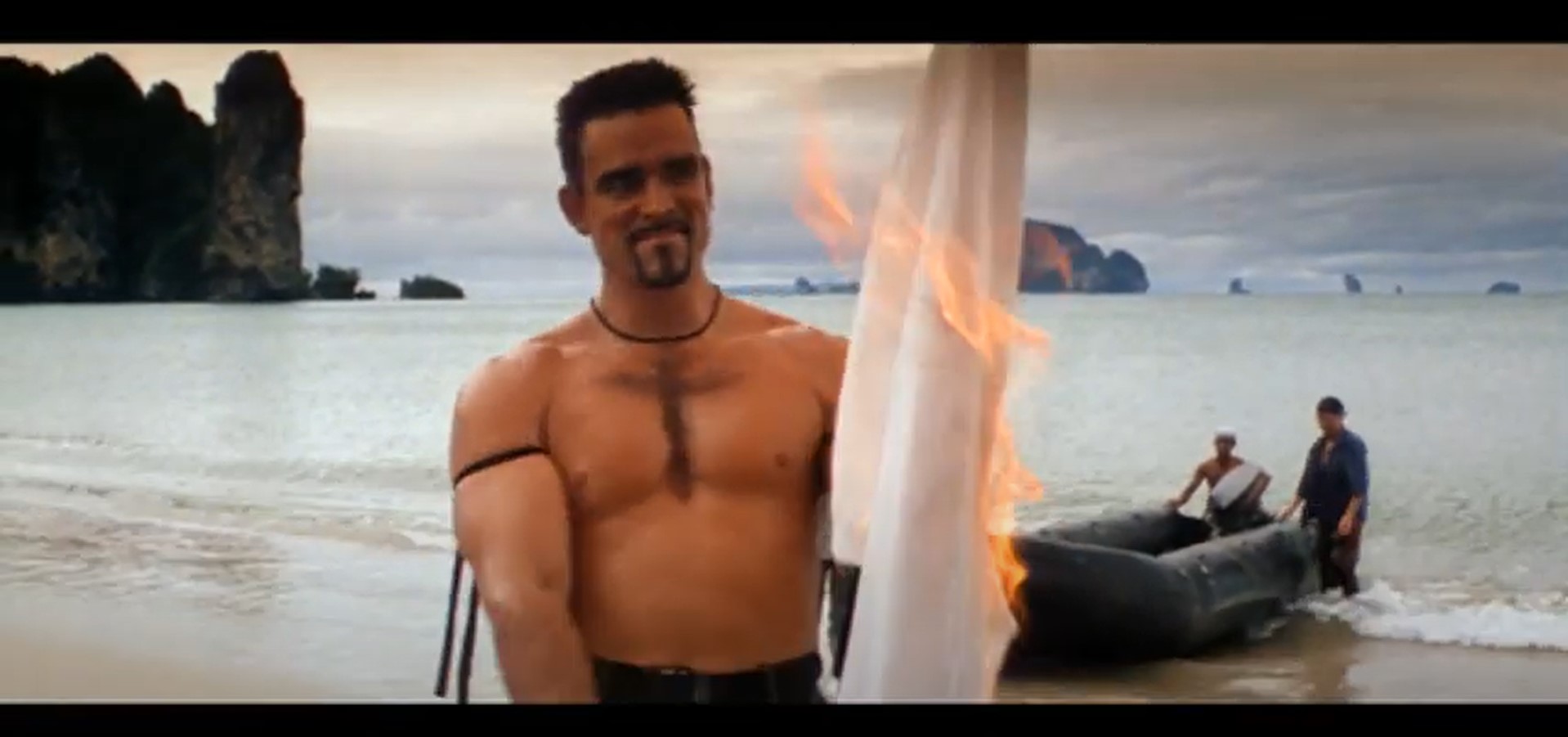
Cast ensemble of familiar faces makes “Men of War” easier to digest when considering the threadbare sensical plot.  If taking the trouble to hire mercenaries to negotiate the signature surrender of property, the company investors might as well have used extreme force instead of finesse as the good Colonial Merrick suggests to Gunar.  “Men of War’s” setup is not very sexy to establish a radical rational to plot against the native denizens, fast-forwarding and skirting through the first act’s purposed goal and recruitment of characters is sullied by that dilution of plot device.  The recruiting montage is what hurts the most that shows Gunar travelling across the globe to handpick past acquaintances for his team, but the history markers are not in place to establish characters behaviors, past or present undercurrents, or anything that really ties them together or tears them apart which eventually happens when a line in the sand is drawn.  Even Keefer’s neglected volatile bad juvenile behavior is crucified by zero backstory substance.  “Men of War” bravely relies on the future to flourish and does so quite well by creating a dichotomy between a paid duty and a moral deed, especially when falling in love with a native girl is involved.  Explosions, bullets, and various kinds of melee skirmishes rock the story’s intended searching for inner peace theme and there’s no shortage or pulled punches with the pyrotechnics or squib-popping gunplay.  Perry Lang and producers make no qualms about the product their peddling by offering a detonating spectacle on a wafer-thin plot to razzle-dazzle on the silver screen and that’s okay. 

Coming in as title number 62 on the MVD Rewind Collection, a boutique banner for MVD Visual, is “Men on War” on a new Blu-ray release that’s an AVC encoded BD50, presented in a widescreen 2.35:1 aspect ratio and high-definition 1080p. This one looks pretty darn good for a 2K scan of a well-kept 35mm film. Picture retention shows just how clean as a whistle it is with no sign of a damaged original print. There also appears to be no issues with compression, such as banding or macroblocking, to gunk of visuals in what is a clean sweep of texturized objects from skin to fabric, even the island jungle setting has a rich green and a variety of sedimentary rock and soil to a real organic coloring that creates the tropical paradise around as seen on vacation brochures. When cinematographer Rohn Schmidt (“The Mist”) does go for more aesthetic, “Men of War” turns into panoramic escapism brilliant with warm colors and a composition too impressive for the likes of a picture teetering between being a B- and A-lister. The English language dialogue comes with two lossless audio options: A DTS-HD 5.1 surround sound and a LPCM 2.0. An explosive film requires free range fidelity and “Men of War” and its sound design package prowls the ambit of discharging and cannonading that hit fast and hard. Dialogue runs through-and-through clean and clear without interrupt or folly against it, as well as being layered properly to have heavy volley suppress the dialogue to a muffled scream. The score of Gerald Gouriet (“Grand Tour: Disaster in Time”) has a pretense of a militaristic stanza that wonders into an idealistic romance choon which downgrades to a pedestrian level at times but there’s also a hint, or even possibly sampling, of Alan Silvestri lurking in the mix from the score of “Predator” when Lundgren stealthily storm the beach with his team. A Spanish 2.0 stereo is available and English and Spanish subtitles are available for toggle. For the MVD release, Perry Lang provides a new, from his living room introduction. The remainder of the special features are archival pieces, such as An Unsafe Place: Making Men of War, a brief doc with Dolph Lungren enthusiast Jérémie Damoiseau going over the genesis of the film, raw footage and dailies from the feature, a photo gallery, and the theatrical trailer. If looking for tangible collectibles, you’re in luck because, like most of the MVD Rewind Collection catalogue, “Men of War” comes with a cardboard O-slipcover with printed faux VHS rental stickers and a mini folded poster of the slipcover image tucked inside. The clear Amaray Blu-ray mirrors of slipcover and has a reversible composition. Region free with a 103-minute runtime, the MVD release is not rated.

Last Rites: An ensemble of colorful characters spearheaded by the towering Dolph Lundgren and shot in the serenity beaches of Thailand lends “Men of War” to be a luxury good of the cinematic armament rhubarb and the presentational transfer by MVD, on their Rewind Collection, breathes fresh and favorable for a solid screening of campy chaos.

“Men of War” are Men now in High Def! See It Here!

An Experiment Backfiring with EVIL Payback. “Moonchild” reviewed! (Visual Vengeance / Blu-ray)

“Moonchild” now on Blu-ray from Visual Vengeance!

An Inhuman government body of a dystopian future experiments with genetic splicing to create the ultimate weapon, known as Project Moonchild, against the human rebellion. That weapon, Jacob Stryker, is unaware of his newly encoded abilities when he escapes one of their holding labs to rescue his captive son from the very same apathetic regime. Stryker teams up with a group of human rebels and uncover by mistake Stryker’s hidden super solider talent of turning into an unstoppable beast – a werewolf. Hellbent on taking down his son’s brainwashing captives by any means necessary and to do it before an intestinal bomb explodes within 72 hours, Stryker convinces the rebels to assist him and now they have an ace in the pocket as they traverse in search for Stryker’s boy, encountering android and mutant bounty hunters, cannibalistic human survivors, and a surfeit of governmental soldiers hot on his tail, but when the werewolf comes out, Project Moonchild is out to seek and destroy those son-stealing son-a-of-bitches by ripping them to shreds.

Director Todd Sheets has long been considered one of the kings of SOV. The “Zombie Rampage” and “Clownado” Kansas City filmmaker writes and directs “Moonchild,” the 1994 direct-to-video, post-societal, lycanthropy actioner is Sheets’ attempt in splintering himself away from the gore. The American Prince of Gore and the Master of Splatter accomplishes the lessened bloodletting and liquid innards coming outwards werewolf feature with a dystopian rescuer that pits what remains of a separatist human society on a verge of collapse to go on a quest to cure a dividing mutation affliction and to go up against the malign immortals of killers and assassins constructed with nuts and bolts and sawblades on a super independent budget. The ambitious project comes with car chases, a large cast, and a hairy beast that fights for family! Executive producer Greg Petrak returns to Todd Sheets’ side after “Bloodthirsty Cannibal Demons” and is a production of Sheets’ very own Extreme Entertainment, a now 34-year standing product company based out of Kansas City, Missouri. Feel old yet?

Playing the lab rat, the werewolf, and the integral hero, Jacob Stryker, to the story is Auggi Alvarez (“Zombie Bloodbath”) as a widowed father who will stop at nothing to save his son Caleb (Stefan Hilt) in the hands of iron-hearted inhuman leader, Lothos (Harry Rose). Alvarez, like much of the rest of the cast, fall into a monotonal expositional black hole that can make “Moonchild” a slog between the excitement. While fleeing captivity, Stryker runs into Rocky (Julie King, “Zombie Bloodbath 2”), Talon (Dave Miller, “Violent New Breed”), and Athena (Kathleen McSweeney, “Violent New Breed), a band of underground resistant fighters who are desperate enough to overthrow the authoritarian ruling class that’s comprised of henchmen with duct tape masks and are skippered by a mustache wearing an unadorned samurai kabuto helmet – catching a tad resemblance to Mel Brooks’ Lord Helmet of “Space Balls.” If you have noticed already, the cast is an entourage of Todd Sheets regulars, a small niche of actors and actress with close ties to the Master of Splatter and have reoccurring roles in most the director’s early 90s indie gems. That trend continues with Carol Barta (“Prehistoric Bimbos in Armeggedon City”) as the bounty hunter, Medusa. Looking more like your next-door neighbor grandmother, Medusa is viper-tongued assassin with an unforgettable cackle and a throaty super ability that’ll inject nightmares for nights to come. Barta’s performance is one of those cliched it’s so bad, its good acts that you have to see to believe. Cathy Metz, Kyrie King, Rebecca Rose, Jody Rovick, and Mike Hellman round out the cast.

Character names drenched with Greek mythology inspiration and a contemporary take on the werewolf canon, “Moonchild” is an interesting and unorthodox story to say at least. Todd Sheets had obviously perfected the limited capabilities of S-VHS shooting or was confident enough to build in a lengthy car chase into a project that didn’t rely on disgusting audiences with blood and guts, but rather actionable thrills and singular characters of the post-apocalypse with only a smidgen of horror. You see, the werewolf doesn’t make too many appearances on screen, only surfacing from beneath Jacob Stryker’s human skin twice in total. The wolfish transformation is shoddy but for the budget, there is an appreciation for the amazing looking effect as well as the other practical effects throughout the feature. “Moonchild’s” pacing can be concernedly plodding to make sure the exposition covers aspect of Stryker’s intentions, slowing down the film to the point sluggishness. It doesn’t help that the scripted word-for-word, automaton performances are not tonally textured with droning dialogue that can’t captivate and contributes to the fatigue at times. Though “Moonchild” is an evolving project for Sheets with conviction in his ability to produce, there are still some editing continuity blunders that downgrade the overall result. Upward closeup shots of Julie King as she looks down when supposedly holding a rifle on Auggi Alvarez show her hand mock holding a rifle as it comes into the frame and then the next cut is the actress actually holding a rifle. Another scene involving King has her smash in the head of a traitor on a concrete floor and the next shot is of her running down the hallway away from where the body should be but wasn’t. The corpse had vanished. Howlers, pun intended, like these conspicuous examples are what depreciate an already discounted movie, curbing any kind of recognition for Todd Sheets going outside his blood and guts comfort zone.

As one of Visual Vengeance’s SOV cult-horror titles, we come to expect temperamental image and sound quality from the Wild Eye Releasing banner due to the consumer grade S-VHS equipment and the novicey of the filmmakers as, and mostly related to the former, Visual Vengeance warns of prior to the start of every feature so thus far, but the 50GB, MPEG-4 encoded, 2-disc Blu-ray set, that presents the feature in 1080p of the 1.33:1 aspect ratio, is the best technical-looking SOV to date for the company. Hardly any tracking issues, artefact issues, and any tape distortion of any kind and while still lacking premium quality as we all expect today, nothing is taken away from “Moonchild’s” original SD master transfer that is a director supervised. The single soundtrack audio option is an English analogue 1.0 mono mix and the dialogue as well as the score come over nicely despite a less punchy channel output. There’s a steady, feature length electrical interference from start-to-finish that is no surprise and is not terribly audio intrusive. Depth suffers mostly with the type of equipment that doesn’t filter and level out ambient noise, but the range of sound is pleasant with the added clip tracks. English subtitles are option. The bonus features include two new audio commentaries – director Todd Sheets and star Auggi Alverz and Todd Shoots and Visual Vengeance. Other bonus features include the alternate VHS cut, Wolf Moon Rising documentary, archival behind-the-scenes cast and crew interviews featurette, the original VHS trailer, deleted ending, the Todd Sheets’ directed music video Burn the Church by the now defunct Kansas City-based, goth metal band Descension, short film “Sanguinary Desires,” trailer for Todd Sheets “Bonehill Road,” and other Visual Vengeance trailers.” The phyical release comes with a 2nd disc, a bonus audio CD of the movie soundtrack, reversible cover art featuring original VHS cover on the inside, new art on the clear cased Blu-ray snapper, and original art on the cardboard slipcover by The Dude Designs aka Thomas Hodge. Inside the snapper lining are four-page liner notes by Matt Desiderio, folded mini poster of the snapper front cover, and the standard VHS throwback sticker sheet. “Moonchild” on a Visual Vengeance Blu-ray comes unrated, region free, and with a runtime of 87-minutes. Todd Sheets is a maniacal moviemaking machine with “Moonchild” being released a decade after the gorehound began and there’s plenty of admirable spirit and effects in the Kansas City werewolf in dystopia tale, but one can’t shrug off the oversights and the exasperating exposition that goes way off trail the turbulent path of indie filmmaking.

“Moonchild” now on Blu-ray from Visual Vengeance!

Nothing Left To Lose Wants to Plunge It’s EVIL Blood Into Everyone! “L.A. AIDS Jabber” reviewed! (Visual Vengeance / Blu-ray)

A Dirty Needle Party in the “L.A. AIDS Jabber” Now Available on a Blu-ray Collector’s Edition

Jeff has just received terrible news about his health. He has contracted the deadly disease AIDS. Already mentally imbalanced with uncontrollable rage and a preconceived kill list, his damning diagnosis enrages him to act on his list of quarries. Isolating himself as a loner by kicking his endearing girlfriend to the curb, a furious-fueled Jeff uses a syringe to extract his blood and turns the needle in a weapon of mass infection by condemning others to the same diseased fate, starting with a high-turnover prostitute he suspects infected him six months ago. L.A. cops are hot on his trail as the unhinged hypodermic needle jabber continues his stabbing-spree, puncturing contaminated blood into anyone who has crossed him. A news reporter becomes Jeff’s next target after chiding his attacks on televised news and as the police keep close tabs on the potential next victim, Jeff aims to outsmart them with a single pinprick tactic.

AIDS. The very mention of the acronym rocked the U.S. nation to its knees in the late 80s-early 90’s as the country went through an epidemic inflation and the numerous scared communities and unprepared medical professionals were still learning from and evolving to the disease that took lives in rapid succession. Initially, no one knew how it spreads and so the scientific body had to dredge through tons of research and trails to determine cause and effect and get a sense of the true death sentence percentage from those infected. This was the turbulent scare baseline of Drew Godderis’s “L.A. AIDS Jabber, also formerly known as simply “Jabber,” the 1994 shot-on-video feature that became Godderis’s first and only written-and-directed work to deliver, in turn, a lasting impression revolving around the AIDS epidemic with a spin on fear mongering. Self-produced on a microbudget and shooting on the weekends paled in comparison to the extended year of principal photography that became the tedious portion in the making of the “L.A. AIDS Jabber” come to fruition.

Godderis printed a casting call in the Los Angeles periodical Drama-Logue to find his principal players in this would-be crime thriller and lessened slasher of sorts. The film scored its leading man in the fresh-faced Jason Majik. Majik’s introductory leading role as Jeff the jabber hardened the then teenage actor to discover depth and motivation of a character but ended up playing on screen an angsty young man bent out of shape and taking his revenge against the world he saw unfair, downtrodden, and hopeless. There’s a love interest that would seemingly be a good de-escalation of drama or tap into the vein of choice between revenge and love; instead, Godderis completely benches Jeff’s love interest by literally having Jeff run away from his adoring girlfriend like a 5-year-old who didn’t get a lollipop. At the opposite side of the law spectrum is a heroine, a detective Rogers played by Marcy Lynn. Lynn’s by-the-book L.A. detective performance is practically wrought iron with her character not only determined to catch the AIDS jabber but also to be an antagonist against her fellow cops’ corruptive wrongdoings. Lynn does a solid job being the tough cop while also being a sensitive soul going through a workaholic-stemmed separation from her husband and child, another excursion, like Jeff’s tumultuous relationship with his girlfriend, that goes unexplored. Since the principal photography extended way beyond the usual indie feature timeline of 7 to 14 days with slight differences as well as major changes to the actors. Lynn’s weight fluctuates throughout the story and Lynn’s costar, Tony Donangelo as Detective Smithers, was quickly written off having died in an accident since the actor was no longer available. Justin Mack replaces Donangelo as Rogers’ new partner, Detective Smithers, and continues the pursuit the protection of the in danger female report (Joy Yurada) from being punctured by an AIDS infected crazed maniac.

Despite a fluid cast of changes and a shooting schedule’s full of weekend work and on a tight budget, Drew Godderis was able to pull off a provocative themed project without having to go into the details of how AIDS, back during the initial flareups and scares, transmitted mostly between homosexual men. Godderis purposefully skirted around the issue with the intention of not declaring a rooted spreader event. Godderis only ever so delicately alludes to Jeff’s pansexual flings. We know for a fact that Jeff has two sides to him: a gentlemen side who refrains from sleeping with his good-natured girlfriend and a libidinous side to get his jollies off by paying a hooker by the hour, the latter he suspects his point-of-contact with the disease. There’s a moment of monologuing early on, shortly after his diagnosis, suggesting to the audience other sexual endeavors that made purposefully ambiguous and this is where Godderis sidesteps the homosexuality angle without having to completely forgo it. As for a SOV feature, an earnest approach would be that even though “L.A. AIDS Jabber” is a killer title that rolls right off the tongue, the film itself doesn’t appeal itself in a Super Video cassette. The feature would have likely done better and would have certainly looked better if kept on the original recording format of 35mm, but due to constant technical difficulties with the camera, the decision to change video formats was decided since video was seeing better outputs. The story isn’t strong enough for the then already rickety format at the time and there’s not spectacle gore to subsidize the playing field. “L.A. AIDS Jabber” is more of a stab to the face approach toward a 1980’s hot topic whereas more cryptic stories, such as John Carpenter’s “The Thing,” use allegories with the ferocity facade of carnage hungry monsters to mask any kind of conspicuously conceived thought regarding AIDS.

Now, I’m not saying “L.A. AIDS Jabber” shouldn’t be on the Wild Eye Releasing SOV sub-label, Visual Vengeance, but as spined number three on the newly curated SOV-horror and cult line, Drew Godderis’ film probably should have been a later constituted release and not in the top five. That’s just my two cents. Yet, the newly illustrated and design crafted slipcover and Blu-ray cover art is top notch from a marketing standpoint and an overall aesthetic. Much like “The Necro Files,” this Visual Vengeance release also comes with a technical disclaimer regarding the acquiring the best-known source materials, standard definition master tapes, and that the quality of the image presentation is by far the best known to exist. Presented in a fullscreen 1.33:1 aspect ratio, the feature lives up to the disclaimer with highly visible aliasing, macroblocking, and soft details that render any delineation fuzzy at best. Blacks see the worst of the compression issues and daytime scenes are often one-sided washed in contrast. The lossy English Dolby 2.0 is unable to withstand some of Jeff’s temper tantrum moments yet still holds up well enough to provide clear enough dialogue throughout. There’s a slight hum from start-to-finish that can takes away from the experience but isn’t a fatal blow to the audio presentation. Special feature is where it’s at with these Visual Vengeance releases with bonus content including a new director’s introduction to the film, a making-of featurette Lethal Injections: The Making of L.A. AIDS Jabber, a lengthy and in-depth interview with star Jason Majik Bleeding the Pack, an interview with “Blood Diner” director Jackie King, interviews with Drew Godderis’ son Justin, who had a small role in the film, costar Joy Yurada, cinematographer Rick Bradach, actor Gene Webber, a 2021 location tour around L.A., photo gallery, and the L.A. AIDS Jabber 2021 trailer as well as Visual Vengeance trailers. The physical release holds just as much bonus material with a cardboard slipcover, collectible mini-poster, Retro Wild Eye Releasing stickers, and reversible cover art of the original Drew Godderis mocked up VHS cover. Interesting concept that misses the vein and tries to cash in on shockvertising by not necessarily making a statement in “L.A. AIDS Jabber” purely exploitation bio-hazard waste.

A Dirty Needle Party in the “L.A. AIDS Jabber” Now Available on a Blu-ray Collector’s Edition

Taxi Driver by Day, EVIL Serial Killer by Night! “Dr. Lamb” reviewed! (Unearthed Films / Blu-ray)

“Dr. Lamb” is ready to operate.  See him in action on Blu-ray from Unearthed Films and MVD Visual!

Quiet as a boy verbally and physically abused by his stepmother yet laid to experience the adult perversities at the permission of his unconcerned father, Lam Gor-Yu, now as a man, is still quiet and still has unusual interests as an afterhours taxi driver.  Triggered by rainy nights when a torrent of verbal abuse by his female passengers send the usually reserved taxi driver into a homicidal fury, extending his lonely nights into straggling women, returning their bodies to his family homes, and video tapes his exploits within his fascination for amateur medical procedures.  When the police raid his family home after developed disturbing pictures were discovered at the local print shop, Lam’s entire family is hauled into questioning and it’s to Inspector Lee and his team to unearth exactly what transpired to the lifeless bodies seized by a notoriously sociopathic serial killer.

When you think of serial killers globally, Hong Kong isn’t the first place that comes to mind.  In fact, Hong Kong isn’t even a blip on the radar as the Pearl River Delta residence only has two known serial killers attributed to the city.  One of those killers is Lam Kor-wan – aka The Jars Murderer – aka the Rainy Night Butcher – who terrorized the then British territorialized Hong Kong in the early 80s, killing and post-mortem mutilating four young women.  La Kor-wan became the notorious inspirational material for the Danny Lee and Billy Tang (“Run and Kill”) co-directed Dr. Lamb that was released in 1992 and penned by Kam-Fai Law (“The Close Encounters of Vampire).  “The Killer’s” star Lee, who was more Chinese action star than filmmaker, developed the film, reluctantly at first, during the time when Hong Kong’s Category III classification rating was extending from solely high-end erotica and sleaze into extreme horror and thrillers.  Lee served as executive producer with Parkman Wong, who also worked alongside Danny Lee on “The Killer,” under Grand River Films Ltd.

To be portraying one of two Hong Kong’s serial killers feels like an unsurmountable responsibility burdening the actor’s shoulders in order to parallel the motivational intricacies and the mental mindset as accurate as possible knowing that the character can’t just blend into a vast serial killer fold where you can find multiple variations of John Wayne Gacy or Jeffrey Dahmer being grossly rendered for U.S. pop culture exploitation.  Yet, in steps in front of the camera Simon Yam, one of Hong Kong’s prolific action stars in the late 80s to early 90’s now stepping into the shoes of a real-life maniacal persona and relatively close to where all of Lam Kor-wan’s dirty-little-deeds took place.  Simon Yam could very well be the killer himself, that’s how brilliantly Yam’s performance is in what’s certainly a confident display of range in contrast within his acting opus.  Replacing a gun with a scalpel, Lee and Yam dig deep into the character’s psyche with an interpretation of why Lam Kor-wan did what he did and, frankly, Yam just went stoically wild to reach Lam’s staggering levels of crazy as he descends deeper into the retelling of his encounters with each victim. While “Dr Lamb” is a grim tale, there’s a comical side to it with the police force, supervised by Inspector Lee, played by Danny Lee himself in a duality position of cast and crew. More of the comic relief stems from Inspector Lee’s second-in-command, an experienced, yet overweight, cop who lets others handle his workload. Literally named Fat Bing, comedian and “Human Lanterns” actor Kent Cheng continues his whimsical routine in unvarnished subject matter revolving around separate bits and pieces of people’s tissue and organs for twisted pleasures. Collateral damage of Lam’s horrifying late-night exploratory surgery antics on women involve his family as they also become suspects. Lam’s father (Siu-Ming Lau, “A Chinese Ghost Story”) keeps his blinders on while the evidence piles only to be turned when his son’s transgressions include a minor family member does his own flesh and blood then cross a line of no return.

There are always two sides to every story. No, I’m not saying there are two repelling sides to The Rainy Night Butcher’s homicidal havoc. “Dr. Lamb,” as a film, has a dichotomy about it that’s half biographically true and grim while the other half is crime drama peppered with clownery. The combination is odd and equally as frustrating as the black tone of the historical background and the graphic nature of some authentical depicted acts of inhuman urges find their way weaved into the fabric of cavalier cop buffoonery who, on one hand, seem really good and really intense at their job while, on the other hand, lack the gumption for sobering behavior. Even when investigating Lam’s videotape (to which there is no way in Hell Lam videotaped that himself as the camera moves as he’s engrossed with necrophilia and removing body parts), the cops overact the disgust with what looks like chunky tuna being forced out of their mouth along the lines of appearing like vomit. The underplayed theme is anything but funny in its psychological context of misanthropy and misogyny. All of Lam’s scenes of cruelty are told in flashback through his perspective, molded by his undertone hate for women. “Dr. Lamb” is a misogynistic tale bred out of childhood abuse by a woman close to his family and unabashed and unattended by his lenient father’s lack of concern. Three out of the four women Lam taxis-to-taxidermy often verbally and physically assault him and plague his personal space with their awful behavior, setting a dial backwards in his battered brain that reminds him of the time his stepmother slapped him or forced him into a closet for hours. Is “Dr. Lamb” a Freudian lemma that Lam sees his ruthless stepmother in these women and turns on them to humiliate their corporeal existence? That’s a deep dive, but not as deep as “Dr. Lamb” cuts as a visceral experience based off of one of Hong Kong’s notorious serial killers.

Distributing in at number 8 on the spine of the Unearthed Films’ Unearthed Classics banner is “Dr. Lamb” on a new Blu-ray home video. The region A locked, AVC encoded, BD50 is slicked up with a 1080p high-definition upgrade presented in a widescreen 1.78:1 aspect ratio. As one of cinematographer Kin-Fai Mau’s first few pictures, the cool blue and misty has an interesting allure like a hazy bad dream subdued by an infusion of looking through blue glass with a prism of white light filtering through. Perhaps not as detailed as desired, the release does stand above the rest with low-level continuous speck blemishes that are only noticeable if you’re searching for them. Two audio options are available: a Cantonese LPCM 2.0 Mono and a Mandarin LPCM 2.0 Mono. Both tracks do come with well-sync and accurate English subtitles with the only downside is in their quick sojourning. There are a few instances where the subtitles pop up for literally a second as a result of quick nature of the dialect to get to the next set of text. While toggling between the two languages, my audio receptors really took to the Cantonese for a more natural flow and visually for unison between speech and speaking. The Mandarin is certainly more powerful but also too over-the-top as in watching I relate to watching old Japanese with English dub. The special features include an audio commentary by Ultra Violent’s Art Ettinger and Cinema Arcana’s Bruce Holecheck, a background interview about “Dr Lamb’s” genesis with the story producer Gilbert Po Lamb to the Slaughter, an interview with film critic James Mudge on the Golden Era of Cat III Three Times the Fear, a talking point conversation about “Dr Lamb” from film academic Sean Tierney, an Atomic TV interview with star Simon Yam, and trailers. The physical release itself comes with a 6-page, color booklet essay from cinema academic and author Calem Waddell (producer of “The Collingswood Story” and many horror-film related documentaries). A cardboard slipcover with one of the more provocative poster arts. Unearthed Films’ Blu-ray comes unrated with a runtime of 90 minutes. When perusing what to watch one night, be sure to hail down this cab of fact-based macabre driven by “Dr Lamb’s” psychological psychopathy and his pathologic urge for unnecessary medical procedures.

“Dr. Lamb” is ready to operate.  See him in action on Blu-ray from Unearthed Films and MVD Visual!

Bestest EVIL in the Whole Wide World! “Clifford” reviewed! (Ronin Flix / Blu-ray)


“Clifford” is the Best Comedy of 1994 and Now on Blu-ray!

10-year-old Clifford wants to go to Dinosaur World in Los Angeles.  I mean, really, really, wants to go to Dinosaur World and will stop at nothing to get his heart’s desire, even if that means intentionally grounding his parent’s plane destined for Hawaii.  Clifford’s parents, on the verge of strangling their own relentless mischievous son, concocts a care plan that includes reaching out to Uncle Martin, an out-of-touch, workaholic, kid-adverse L.A. resident looking to impress upon longtime, child-longing girlfriend that he adores children.  It’s a win-win for everyone, even Clifford who’s chances to ride Larry the Scary Rex rollercoaster at Dinosaur World have significantly increased.  The perfect plan is swimmingly going well until Martin’s boss throws him a deadline curveball that sidelines Clifford’s theme park trip, breaking his promise to a more than impish little boy who has declared life-ruining war against the Bestest uncle in the whole wide world.

Yes, finally!  “Clifford” has arrived onto Blu-ray home video and just like that that mischievous little brat comes back into our nostalgic hearts.  The 1991-filmed, 1994-released PG-rated comedy is written by “Back to School” duo Steven Krampmann and William Porter and directed by Peter Flaherty, director of “Who’s Harry Crumb?” and Martin Short’s pseudo-late night talk show series “Primetime Glick.”  If you don’t see Krampmann or Porters’ names in the pre- and post-credits but notice Jay Dee Rock and Bobby van Hayes scrolling by than that’s because the writers used pseudonyms to quietly disown the finish final film that was embroiled in questionable approaches such as hiring Martin Short, a then 40-year-old comedian-actor, to portray a 10-year-old boy.  Yet, the bizarre comedy that has a talented cast as well as a demented and twisted side to it has gained a rather quiet cult following.  Larry Brezner (“The ‘Burbs”) and Pieter Jan Brugge (“My Demon Lover”) produces “Clifford” and is one of the last releases to trickle out from Orion Pictures before their unfortunate bankruptcy. 

Through extremely creative measures to ensure Martin Short can sell the physicality of a prepubescent boy on screen, “Clifford” is one of the former SNL performer’s best and memorable roles amongst his arsenal of personalities.  The naughtily tormenting persona with a Devil’s grin and absent eyes for sympathy brings Clifford to a level that’s analogous to a fixated horror villain setting a target goal of destruction, mayhem, and chaos. No one is safe from Clifford’s duplicitous trajectory, not even Uncle Martin played by the late, great Charles Grodin (“Midnight Run”) who provides his standard uptight and exasperated character at first but slides into a sinister nihilism when push beyond the point of return. Short and Grodin are centric to the story, phenomenal dynamically, and funny at very second despite how antiquated the content and comedy is at 30 years old. Seeing Short play a little boy doesn’t even register he’s a grown man in an adolescent role and that’s how good Martin Short can massage the material in his favor. You see Short, you see he’s a kid amongst the rest of the cast, you see his childish exploits, and, yet, none of that is troublesome, bothersome, or even a tiny bit weird as you’re drawn into an overexaggerating, yet highly relatable, parenting hardships in negotiating with out of control, scheming children and the pure, unabashed wackiness of Martin Short who, in my mind’s eye, is essentially in a step-down version of his iconic Ed Grimley personality. Bringing down Short’s antics and Grodin’s disgruntled demeanor is the measured Mary Steenburger (“Back to the Future III, “Powder”) subduing, in a good way, audiences as Uncle Martin’s lowkey love interest to bring us down from the eccentric shenanigans. The casting is overall tight on those three leads but Dabney Coleman (“Dragnet”) becomes the sleazy bigwig wedging between his employee, Uncle Martin, and Martin’s girlfriend, Richard Kind (“Stargate”) searching for patient with his insufferable Clifford, Jennifer Salvidge (“Evolution”) as Clifford’s yielding, but equally as exhausted, Clifford’s mother, and “Little Monster’s” Ben Savage as a troubled youth set to follow Clifford’s footprints.

How does “Clifford” hold up to today’s comedies? Rated PG, the 1994 film lacks the big hitting criteria that ultimately slaps stricter rating labels right onto the trailer and home video covers, that ultimately bring in audiences with sex, violence, and harsh language, but “Clifford” isn’t a kids’ film per se and subtly lands more adult oriented and sexually suggestive one-liners and scenes that wouldn’t fly by today’s standards. In fact, I personally believe the entire production would have been scrubbed if the first casting choice for a young boy was a 40-year-old man. Movies like “Clifford” are relics that should be treasured because we’ll never see comedy like this again and that’s what makes “Clifford” a part of cult cinema. “Clifford” doesn’t need itemized fixings to be a great story and to possess substance to be a phenomenal film. Instead, the idiosyncrasies of the plot and the singularity of talent glue the first draft of the inane script together in its finished product, rewinding that chunky gray and white brain matter and the bits of skin, tissue, and tufts of hair back into and onto the head after having its top blown thinking, how the hell do we pull off this script? The first two acts are character building and about the dynamics of two conflicting temperaments that ensue a series of tit-for-tat jail landing pranks and a slew of grating and passive insults, suggesting a character-driven, quirky slapstick story of growth and understanding between the two sides. However, the third act shows another, unexpected side of “Clifford” that revels in Uncle Martin’s vindictiveness after having his mind and spirit broken by a child’s chastising for breaking a promise and Flaherty goes big and berserk with the Larry the Scary Rex rollercoaster (which looks amazing to ride to this date) to which the calamity of events culminates an epiphany for one of them, abetted by the fact a run amok mechanical dinosaur nearly chomped down on a human-sized snack.

“Clifford’s” mischief and mayhem in hi-def never before has looked so good on this new U.S. release Blu-ray from Ronin Flix in association with Scorpion Releasing and MGM. The region A, 90-minute release is presented in 1080p and in an anamorphic widescreen, 1.85:1 aspect ratio, and much like the Blu-ray’s front cover of blown-up headshot closeups of Martin Short and Charles Grodin and a crumbling two-story home that’s not a component in the film, the picture quality also appears to be a bit stretched, leaving details slightly scattered and marginally pixelated. The transfer print is without a doubt clean and discernable but retains the original, untouched up MGM anterior. The English language DTS-HD Master Audio 2.0 is the only audio option that provides a good mix and balance of dialogue, chaos, and everything else in between to come together for a gratifying dual channel audio alloy. In extreme instances of bickering, high level pranking, and even the clamorous and deep dino-discharging climax, much of the details remain intact and clear without losing distinctiveness. The Ronin Flix Blu-ray is a feature only release with no software or hardware bonus content. With or without bonus features, the film itself is worth the cinematic calories as “Clifford” shines as arresting tale full of laughs, heart, and anarchy and is a hellraising life-amenity that shouldn’t be lived without.

“Clifford” is the Best Comedy of 1994 and Now on Blu-ray!