To Bring Life into Existence, One Must Go Through the unscrupulous EVIL Trials and Tribulations. “The Last Frankenstein” reviewed! (DiabolikDVD / Blu-ray)

“The Last Frankenstein” on Blu-ray from DiabolikDVD

Jason Frankenstein is the great grandson from a long ancestorial line of corpse reanimators.  Feeling unfulfilled in life and his destined legacy, Jason goes through the motions of being a hospital’s physician assistant and putting up with his less ambitious girlfriend, Penny.  When a disfigured serial killer is brought into his hospital, Jason immediately recognizes the shell of a man as his grandfather’s reanimated corpse brought back to life with the family’s secret elixir, Adrenarol.   Hiring two crooked, drug-dealing EMTs to do his kidnapping bidding in exchange for medical grade drugs and with the assistance of a confidential nurse with a disreputable past, Jason sets to complete what his grandfather started by creating his own living, breathing, thinking monster with the family reanimating formula.  Selective hacked up body parts, double-crossing henchmen, and a troublesome manmade man goes against his birthright grain with the only path forward soaked in the blood created by his own hands. 
Resurrected from the depths of just a concept and electrified by crowdfunded, “The Last Frankenstein” is alive, ALIVE!, from writer-director David Weaver in his debut feature length film.  The U.S. film from 2021 was set and shot in Weaver’s hometown of Amsterdam, New York, just northwest of the state capital of Albany.  Labeled as an existential slasher, extracted from Mary Shelley’s classic gothic novel, Weaver sought to recreate exploitation films of the 1970s-1980s with a raw façade, gruesome practical effects and gore, and an assortment of cynical characters in a story that tells of generational expectations, the pressures of living up to greatness, being the last of one’s family surname.  The Kickstarter production raised $13,500 for mostly the shooting costs with much of the post work being completed by Weaver to maintain low costs and is a production of Gila Films with Jay Leonard producing.
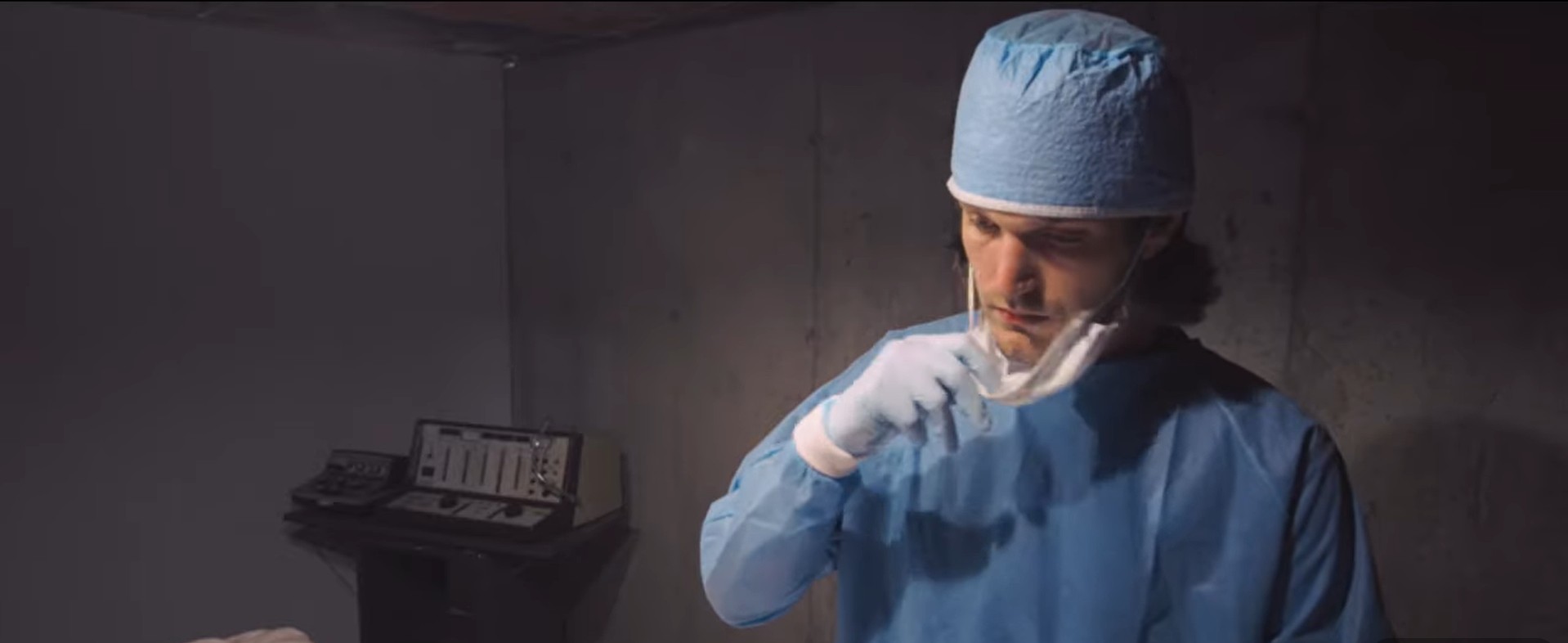
“The Last Frankenstein’s” acting tone is a curious one.  Complex with the desire to conquer death with footnotes of drug peddling and murderous EMTs, longing relationships and carnal stress releases, and death, much death, there’s a severe lack of emotion amongst the character pool, delivering a consistent and constant cadence of flat intonations.  The same expression is pretty much splayed onto each face with attitudes and personalities to match in a widespread of white bread acting.  In a way it works toward the story’s apathetic and cynical nature but while Frankenstein’s monster lives with a new life, “The Last Frankenstein” cast utterly is lifeless, beginning with the lead actor William Barnet in the titular role and though a doctors are conventionally attributes plainspoken, carry an unbiased inflection, and eve have some sense of being on the spectrum, perhaps, Barnet’s lukewarm woodenness extends beyond his reach and to the rest of the lot.  There’s no concern or fear in Nurse Paula’s (Keelie Sheridan) eyes when her acquaintance is killed by Jason Frankenstein or that the doctor is trying to resurrect the dead, no anger, resentment, or guilt from the two stoic ambulance drivers (Jeff Raiano and Ulisses Gonsalves) covertly dealing drugs and doing Frankenstein’s dirty work, and there’s definitely no life behind Frankenstein’s monster’s eyes, neither his grandfather’s nor his, that’s very opposite to the legacy portrayals by Boris Karloff’s sadness, Robert De Niro’s revenge, or Peter Boyle’s joy and fear.  This different take on the canopied story has the creature boiled down to a Jason Voorhees type, especially with eldest creature (Roderick Klimek) that looks very much like hockey mask slasher from the backside and even kills like him too.  Jason Frankenstein’s version, played by Michael Wetherbee, at least shows some reserve, some kind of calculation happening behind the flesh-stitched face, and does abide by his apathetic opportunity to kill but also resists the juggernaut chase to slaughter even if detrimental to his existence.  What that resistance is that holds him back goes without exposition or a vague sense of implicit explanation but it’s a performance that renders the most feeling in a rather frozen stiff guild of actors.  Jana Szabela plays Jason’s girlfriend Penny, Brett Owen plays Jason’s father in flashbacks, and cult actors Jim Boelsen (“Strange Behavior,” “The Curious Case of the Campus Corpse”) and the late Robert Dix (“Forbidden Planet,” “Horror of the Blood Monster”) also costar.
The creature’s Gothically enriched surroundings, darkly and bleakly trimmed with elaborate castles inside sinister castles and grotesque in unordinary shapes, styles, and hauntings, are more than replaced by David Weaver’s backwoods entry into the electrified monster.  Trading castles for cabins and grandiose laboratories for makeshift surgical rooms, “The Last Frankenstein” utilizes what’s immediately around, and in this case it’s Weaver’s hometown of Amsterdam, New York, a quaint, post-industrial smalltown surrounded by brick homes, rundown factories, and woodland that gives the story an unconventional look and approach while keeping true to the basic principles of Frankenstein and his monster.   With the idea that small towns hold secrets, “The Last Frankenstein” leans into the problematic drug problem less populated areas encounter with most turning a blind eye or ignorantly keeping their blinders down to the transgressions that are happening right underneath their noses.  In this instance, the drug dealing EMTs are utilized via blackmail but deal to come out better than before with more peddling product than before without risking exposure through a doctor approved sign out sheet for narcotics, which is how Frankenstein caught onto their scheme.  To dig deeper into that latter statement, Frankenstein is the smartest amongst his living peers but can’t seem to understand and figure out his and his ancestor’s creations that go against his family tree in a visceral and violent protest of what it means to live, promoting once again that anti-God actions spoil the fruits of man.  There’s a show of arrogance and false omnipotence to cheat the natural course of death found in all the Frankenstein subject films and those who create variations of the filmography, such as with “Re-Animator” and “The Lazarus Effect.”  
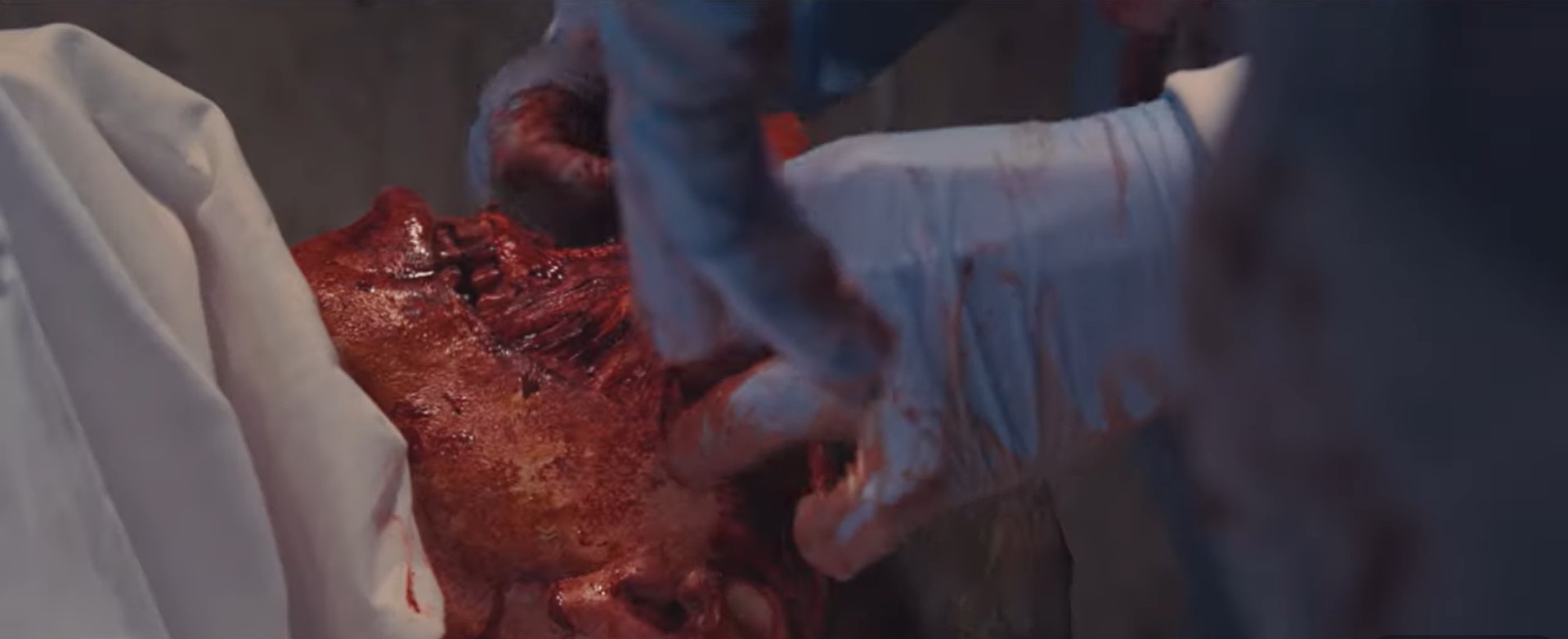
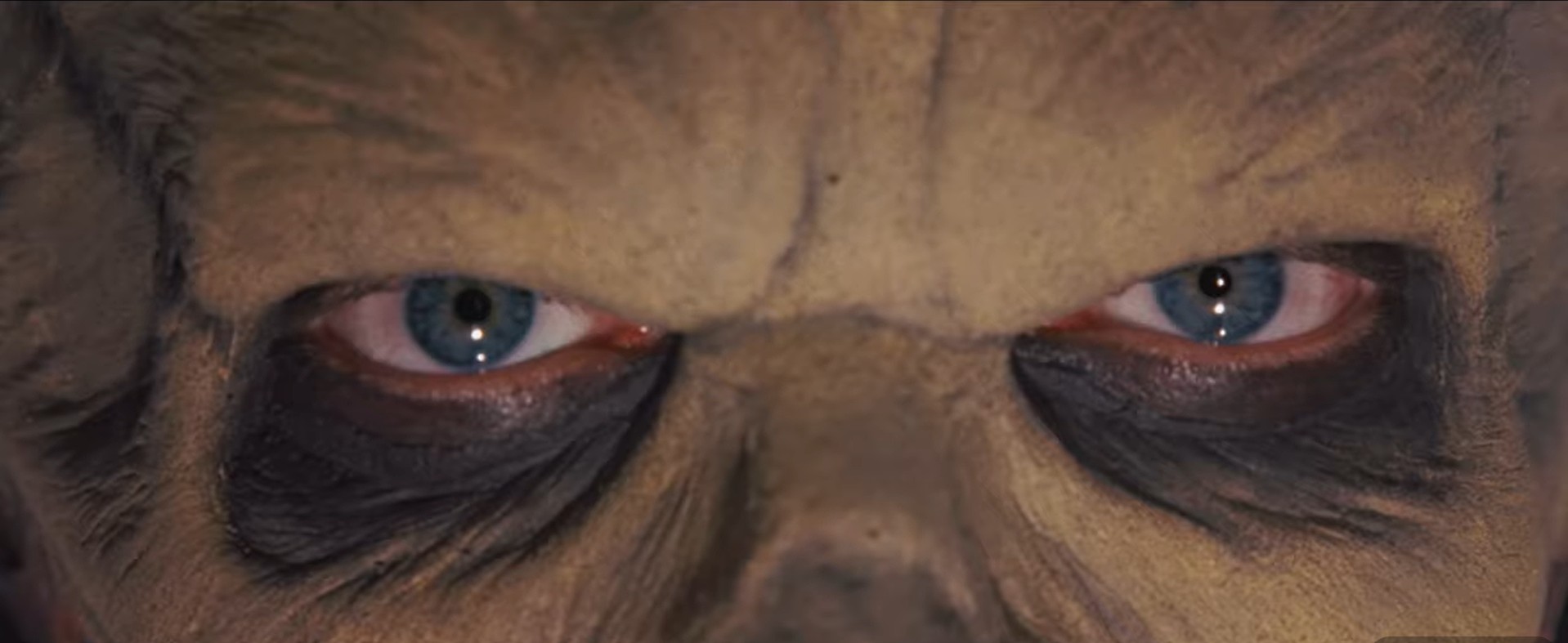
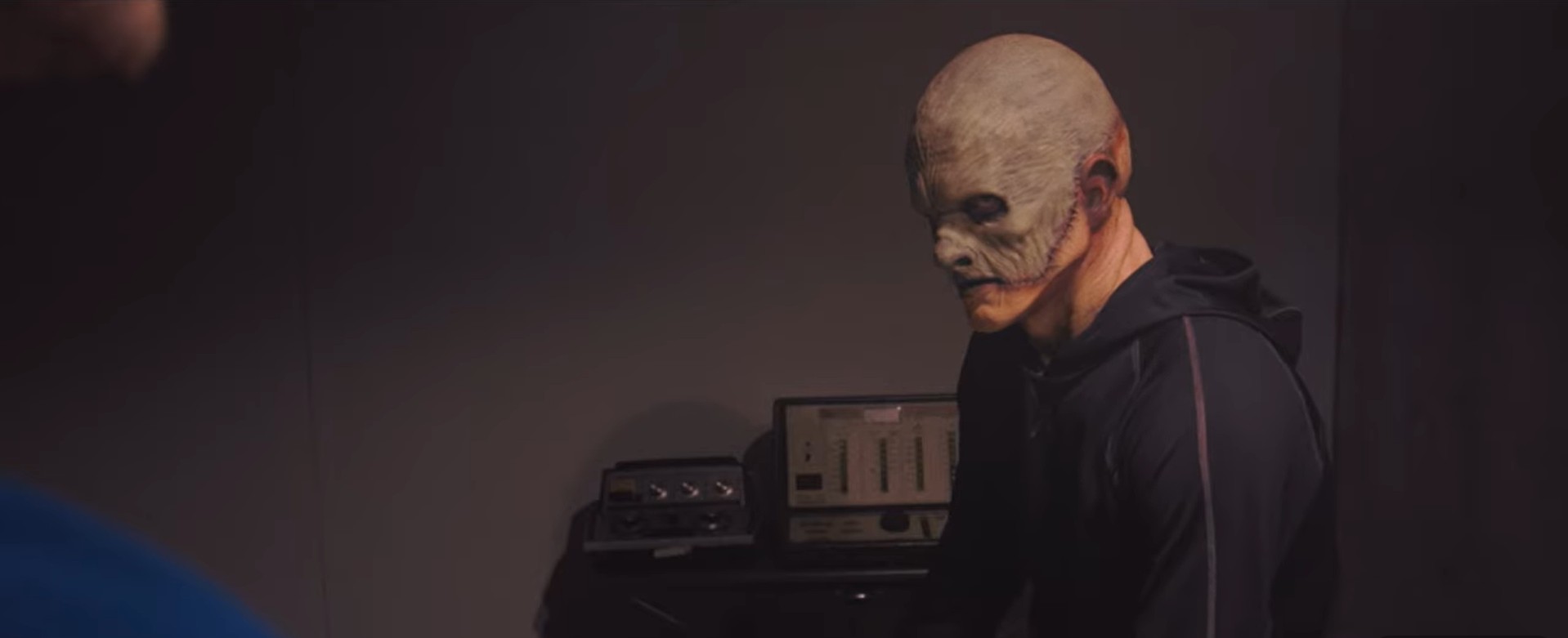
The film may be called “The Last Frankenstein” but it’s the first title with the DiabolikDVD label as a company release.  The AVC encoded, 1080p high-definition, BD50 Blu-ray is presented in the original widescreen aspect ratio of 2.35:1.  “The Last Frankenstein” favors a neutrally saturated raw image, capturing a lot of the natural greenery and aesthetic of nearby woods, creeks, and other characteristics of rural America, including trailer parks, post-industrial buildings, and wood paneling interiors.  The surrounding intricacies of a clearly puttied and latex mask used for the Frankenstein grafted facial skin looks like a true mask instead of skin but that’s the very intention of a created being, pieced together in slapdash stitchwork to add a layer of differentiation much like the original monster’s scars or bolt.  General particulars around exteriors and interiors are clearly defined with the consistent laid out image quality that produces ordinary smalltown charm contained to limited landscapes and mostly the direct environs that are not exactly cinematically picturesque but does depict the visual boredom of the vicinity.  The sole audition option is an English LPCM 2.0 stereo that reproduces faithful fidelity of the dialogue and diegetic action within the front channels.  The foley and Steve Noir’s poignant trance of a synth score are a little more girthier bodied to fill the entire medium that get to being comical in action (in foley) yet powerfully bleak and hypnotic (in score).  Dialogue is clean, clear, and in the forefront mostly, often vying for position with Noir’s repetitive and pulsing soundtrack portions. English SDH are optionally available.  Special features include feature-length commentary with writer-director David Weaver and producer Jay Leonard, a second commentary track with Weaver, a making-of featurette Reanimating the Last Frankenstein that goes through cast and crew interviews, the Kickstarter campaign, and a creation thought process for the concept and its materialized conception, deleted scenes, outtakes, still gallery, and a mentioned bonus easter egg listed on the back cover but unable to locate it on the disc. The reviewed copy isn’t the DiabolikDVD exclusive with limited slipcover, but the standard Blu-ray comes one-side cover art that actually requires the slipcover in its muted and dark composition of characters with no title, only the subtitle Nothing Lasts Forever, which makes me believe the slipcover is the one and only primary cover art. The 102-minute featured release comes not rated and region free.

Last Rites: Not to be a wash, rinse, and repeat of the canonical Frankenstein films, “The Last Frankenstein” is creature feature-lite in toneless, small-town adversities of creating an existence that requires life and limb…many, many limbs.
“The Last Frankenstein” on Blu-ray from DiabolikDVD

A Memory Fuels EVIL’s Sexualized Resurrection. “Scream of the Blind Dead” reviewed! (Full Moon Features / DVD)

“Scream of the Blind Dead” Now on DVD!

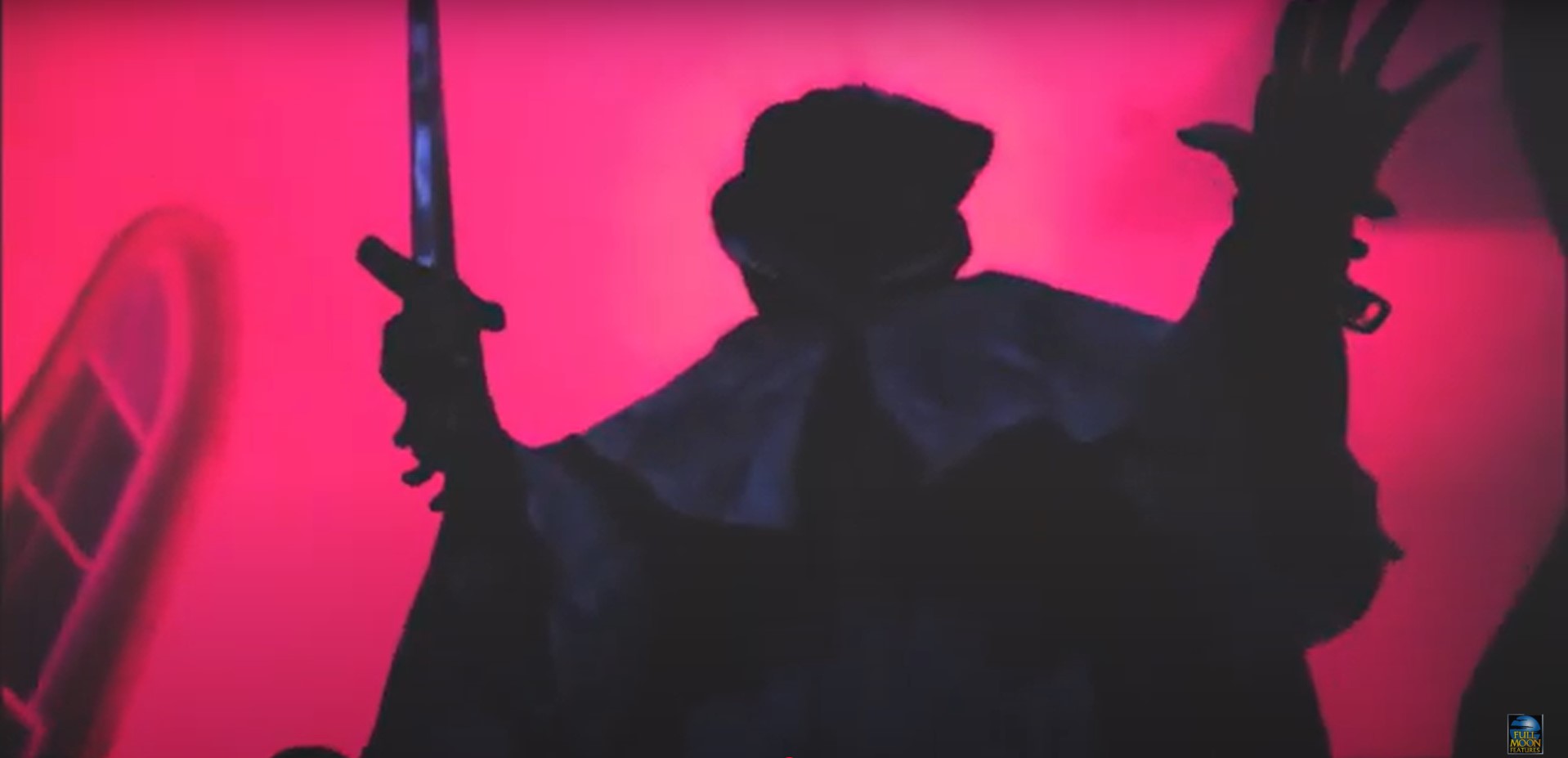
Arriving by train to the deserted, medieval ruins of a once great 14th century town, a woman wanders aimlessly through the dilapidated structures left standing and eventually finding a peaceful resting spot on a church pew before the Holy Trinity.  Alone with her amorous thoughts for another woman, her very presence stirs the awakening a blind undead corpse out from the slumbering, Earthly tomb, the resting place of a once righteous Templar knight of a prestigious order once assigned to protect Christian values with sword and shield but disbanded and accused of occult heresy.  Being chased from dark corner to dark corner inside the ruins’ isolated, labyrinth wall, the woman narrowly escapes the relentless knight’s bloodlust blade.  She is not only frightened by the razor-sharp sword of the ghostly, ghastly figure, a dirtily shrouded, mummified corpse, but what evokes within her, her own dark, secretive past of love, murder, and vengeance, will haunt her to death.  

Director Chris Alexander has settled himself in the realm of the homage.  The Canadian filmmaker is well-known for his tribute films toward specific directors and trope styles within the creepshow genre that allow him to express his own artistic take on a classic.  “Scream of the Blind Dead” is Alexander’s latest to follow suit based off the original concept and characters by Amando de Ossorio and the Spanish director’s Blind Dead series, beginning with “Tombs of the Blind Dead” in 1972 which is the featured inspiration of Alexander’s short remake film.  The 2021 homage is penned by the “Girl with a Straight Razor” director but is also progresses forward without dialogue in what is like a music video for Ossorio’s original film, slimmed down to the principal character and one blind undead knight for much of the story.   Alexander created Delirium Films, a Full Moon sublabel to release his own productions under, conjoining the once Fangoria editor to the hip of Charles Band, as coproducer, to stretch the imagination of terror even further.  Kevin Cormier and Cheryl Singleton also coproduce the short.

You won’t see a herd of horses or a horde of blind, rotting knights on horseback in the “Scream of the Blind Dead” nor will you there be a collective degree of humans fighting for against the dead for their very lives.  Instead, two women and one knight consist of the entire cast, pared down to the two chief female characters Betty and Virginia, though they’re not explicitly named in the story, but the gist of designation is there.  Betty is played by Ali Chappell, a mainstay regular in many of Chris Alexander directorial repertoire, having roles in “Necropolis:  Legion,” “Girl with a Straight Razor,” and “It Knows Your Alone” while also being quite the scream queen in other horror projects from the 2019 anthological “The Final Ride” to last year’s “Malediction” which she debuted as a director as well.  As Betty, the short-lived role sets the dark synth soundtrack-driven tone lengthened by use of slow-motion and additional edits to build suspense and does harp back to the premise and spirt of Ossorio’s brand of Spanish horror.  Not as seasoned as Chappell in credits, the casting of Virginia goes to Stephanie Delorme, a brunette in contrast to Chappell’s blonder shade, who finds herself being chased, melodramatically I might add, by an undead knight.  Delorme’s frightful face and lumbering getaway cadence have the hallmarks of a good final victim being pursued on common horror of past, present, and future but her direction to stop and stare, almost waiting in frozen terror, is reminiscent of yore when the act of escape is negated by the sheer shock.  These are the moments audiences yell at the screen, pleading for movement, to do something other than just stand there and gape at the monster before them.  Chasing Virginia is no ordinary templar knight but a female templar knight, played by all-things-horror enthusiast, musician, and another of Alexander’s on-screen regulars Thea Faulds, under her showbiz name of Thea Munster.  Munster dons two parts connected by death as Virginia’s lover in flashback and the ghoulish knight chasing Virginia. 

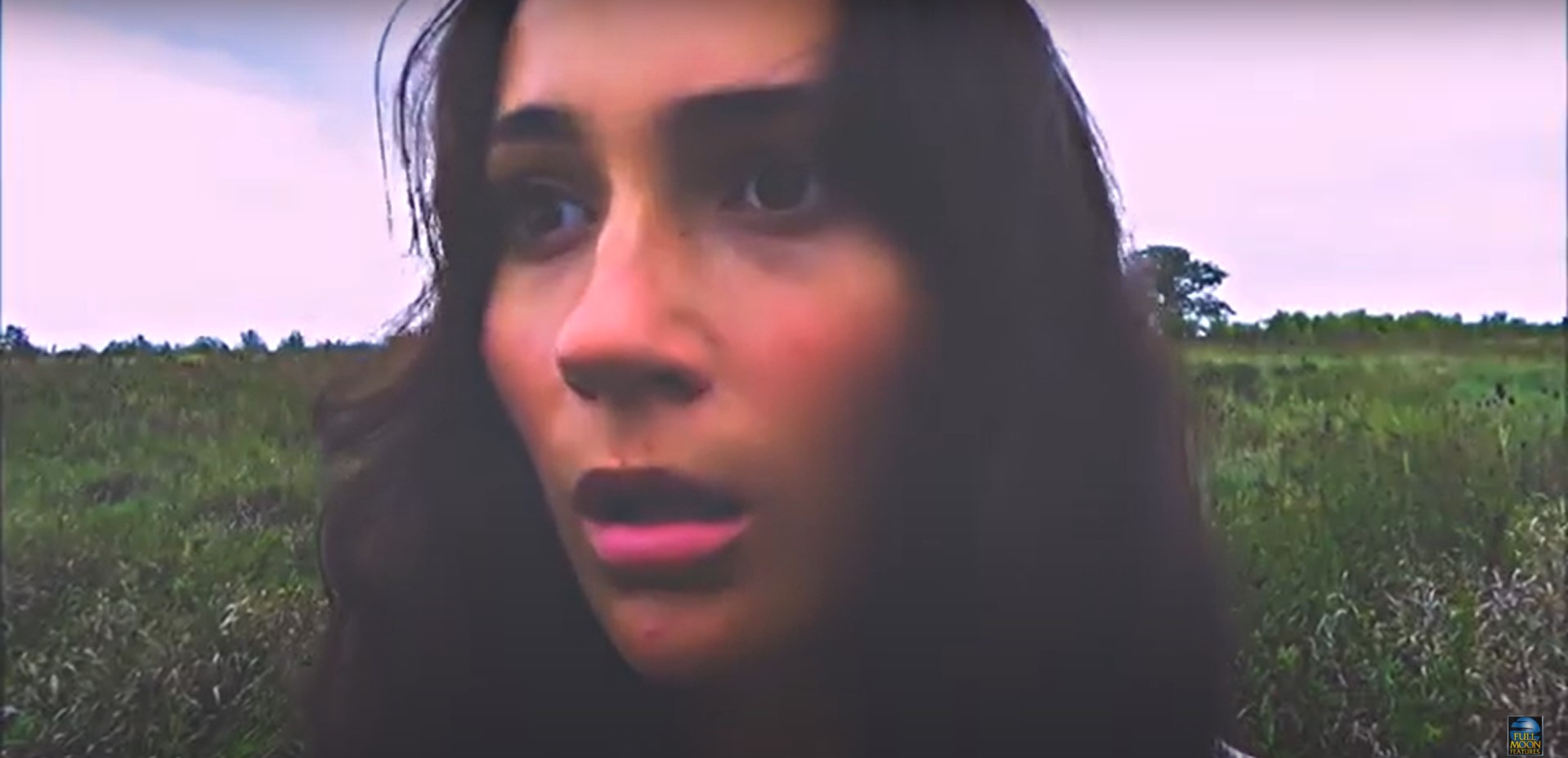
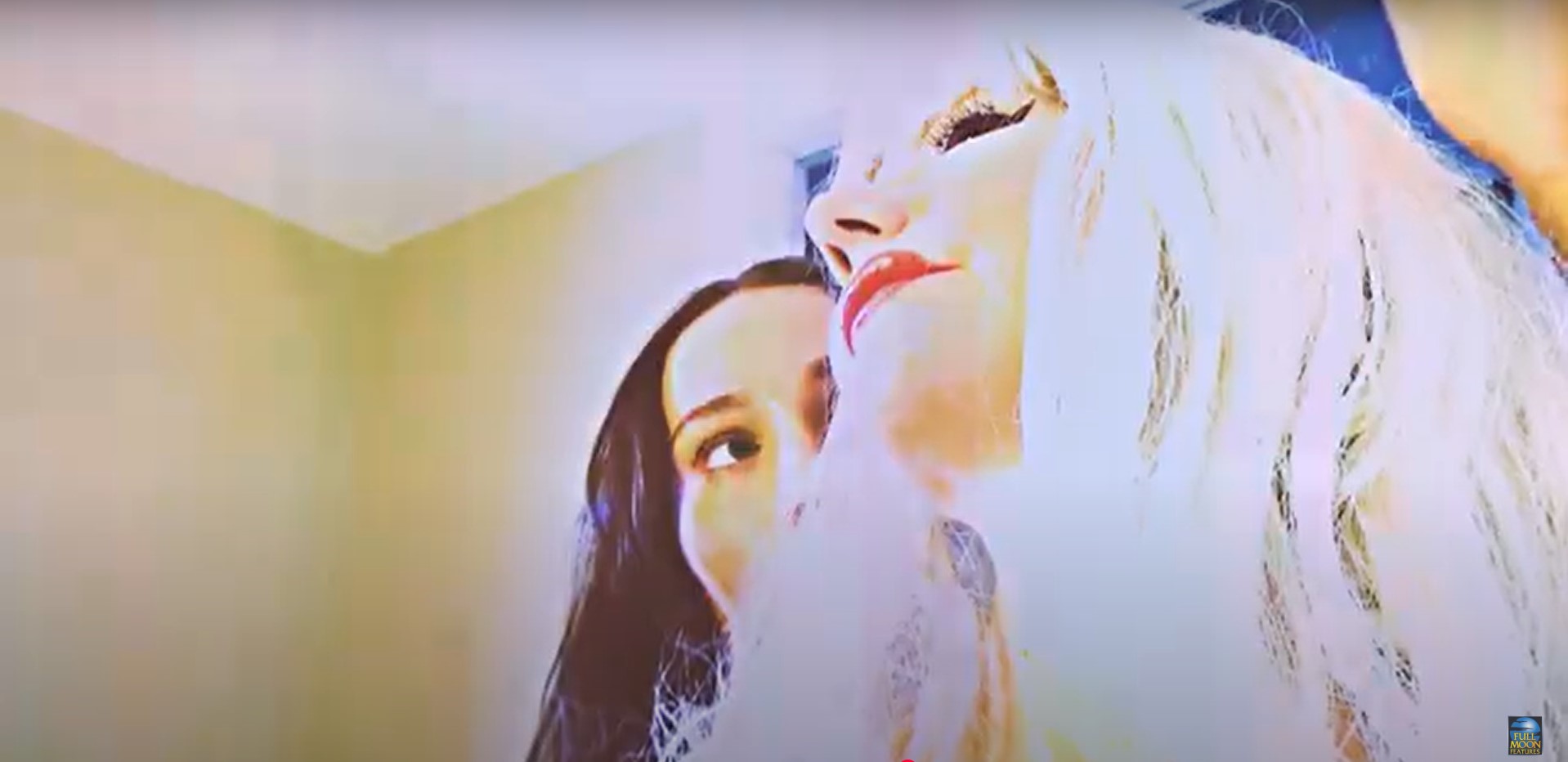
“Scream of the Blind Dead” has haunting connotations of past guilt or along the lines of the soul-touching past catching up to one’s beleaguered conscious, hence why Virginia wanders the countryside in search for answers, stopping or resting along the way into a state of pain or melancholy of a memory, and comes upon a church, perhaps unintentionally to confess her darkest sins or find solace in forgiveness.  However, it wouldn’t be a horror show without some fort of graveside penance from an unearthing corpse, slowly sauntering to seek eviscerating Virginia’s regret from her exposed, beach chic-cladded abdomen.  Right before being engrossed in the standard chase fair, scenes of Virginia self-groping from fantasizing the physical touch her female lover add a layer of sensuality yet to have context other than a strong passion within Virginia, whether it’s in her heart or loins is indeterminable, but shortly after singlehandedly pleasuring herself, a female knight, with pursed mummified lips, resurrects from inside the church where Virginia rests and the slow-motion macabre begins, moving about different backdrops within the ruins and field exteriors that are basked in neon gelled key lighting that creates a smokey psychedelic, or hallucinogenic, fever dream atmosphere, a nightmare experience only fabricated in deep-seeded guilt-trips.

“Scream of the Blind Dead” short salute to Amando de Ossorio and the “Blind Dead” series is honorable enough to keep the always nitpicking fanbase from picketing. Full Moon Features distributes the MPEG2 encoded DVD5 presented in 720p resolution and a widescreen 1.78:1 aspect ratio. Picture quality through a lower resolution and a patchwork of sizzling vibrant neon lights scores across a refined image with fuzzy details and indiscernible outlines. On the color scale, there’s plenty of range through the assortment of abrasive key lighting that illuminates the rustic, rundown church and surrounding area of mostly greens and browns. Sound selection offers a lossy English Dolby Digital 5.1 and Stereo 2.0 that absolutely has a soundtrack that trades the tings of a fortepiano for a theremin but still digs into the familiar tones of Antón García Abril’s ominous industrial-synth score that lingers eerily with resonating vocals. Very few moments do in-frame sounds from the actresses come over, entirely all screams in what was mostly done in post with a clear separation from action. Because of the music video approach with no dialogue, the lossy format is nulled by what’s really a psychosexual visual experience. English closed captioning is available. Special features a feature-length director’s commentary with Chris Alexander, two music videos including Thea Munster with her thermin solo entitled Werewolfry and the other track Burial Ground from her band Night Chill, the official trailer, and the Delirium Films’ trailers. Full Moon’s No. 355 title comes in a standard DVD Amary with a mixed illustration and live photo cover art that befits the body of work. There are no slipcovers, inserts, or other tangible materials set next to the disc pressed with the same knight silhouette but with a buzzing blue outline. At feature length, “Scream of the Blind Dead” would have been too long with Alexander’s stylistic outlet but at a crisp 40 minutes has a greater success rate for a not rated, region free releases that mostly lambent lights and ethereally evil sans actor dialogue.

Last Rites: “Scream of the Blind Dead” is not blind to the Ossorio source material and captures the core center of the Spanish director’s picture of history crusades on the ignoble never dies while Chris Alexander twists into it a fever dream of sexual fervor, slenderized for a post-impressionist style.

“Scream of the Blind Dead” Now on DVD!

Not All Zombies are EVIL. Some Zombies Save Lives. “The Loneliest Boy in the World” reviewed (Well Go USA Entertainment/ Blu-ray)

“The Loneliest Boy in the World” on Sale Now at Amazon.com!

The unexpected tragic death of Oliver’s mother, involving a pool, a television, and a garden gnome, places the now aged-out and deinstitutionalized Oliver into a difficult position. The sheltered, socially awkward young man, living by himself in his mother’s home and still makes like his mother is still with him, is given a last chance ultimatum from his supportive social worker and a pessimistic psychologist to make friends, to lead a normal life, and to sustain impendence or else he’ll have to return to being institutionalized as an adult. Local contemporaries single out Oliver for being weird, unusual, and a loner to the point that his childlike and naive mind turns him desperate enough for a friend to dig up corpses, those who used to be well-liked in the community, but when one morning the exhumed bodies come to life as a nuclear family that eats, breathes, and is sort of living. Though rotting from the outside, the undead family encourage and advise Oliver through his toughest life challenge yet – to be normal.

Described as a modern fairytale with zombies, “The Loneliest Boy in the World” is a satirical comedy horror about the rite of passage into adulthood from the screenwriting team of John Landis’ “Burke & Hare” writer Piers Ashworth, producer of “Director’s Cut” Brad Wyman, and “Maximum Overdrive” star and “Rated X” director Emilio Estevez. Director Martin Owen (“L.A. Slasher”, “Let’s Be Evil”) helms the late 80’s deco piece with a Halloween backdrop, fitting for any undead family to suddenly animate into an eclectic and eccentric fashion that encircles what it means to understand family values in a very trendy niche specific of the late 80’s style. The feature is produced by Piers Ashworth, Ryan Hamilton (“Possessor”), Matt Williams (“Let’s Be Evil”), Pat Wintersgill (“Amulet”) and a conglomeration of executive producers including Emilio Estevez and is a production of the London, UK-based Lip Sync in association with Future Artists Entertainment and presented by Great Point Media and Well Go Entertainment.

Max Harwood gives a peculiar performance as a soft-spoken, sheltered-to-a-fault mother’s boy, Oliver, with a delusional depiction of reality. Though Harwood’s performance pairs well enough with Martin Owen’s rocky shore small town of equally asymmetrical corporeality, the titular Oliver comes off derivative of done before loners and Harwood provides little range to fully arc with the character’s transition from a naive young adult on the fringe of losing everything to the compendious hero of his own story by unearthing not only dead bodies that come to life but learning from their advice, truth, and experience to flesh out his own path of courage and confidence. A part of the LGBTQ community, Harwood is joined by fellow community comrade Tallulah Haddon in a strange turn of casting as Oliver’s love interest, Chloe. Queers play straight in the innate course of acting that, as of late, has often been called out for its hypocrisy of an actor portraying something their actually not. The “Black Mirror: Bandersnatch” Haddon is an outsider to Oliver’s surroundings as isn’t influenced by those who have labeled Oliver weird or strange. Instead, Oliver and Chloe spark interest out of hate for being different, a relatable scenario for someone in the gay community. Oliver’s undead family is undoubtedly the best lot with a wide range of happy homemaker personalities and a decaying best friend that supports Oliver’s wings to fly from the next. Susan Wokoma is the stay-at-home mother with a knack for reading the room while her skin peels off and falls to the floor. Ben Miller is the red-blooded Frank that displays glimpses of being a renaissance man at times and Miller plays the beer drinking, jack-of-all-trades father figure aptly. “Harry Potter and the Half Blood Prince’s” Hero Fiennes Tiffin comes on the scene cool and suave in a skin that’s literally drooping off his bones and his eyes have disintegrated from his sockets; Tiffin’s charming, lively, and a source of verbal wit that would be missing from the film. Lastly, Zenobia Williams rounds out the family as Mel, the little sister who is frankly underused and is quiet and subservient to being nice to her living older brother. “The Loneliest Boy in the World’s” cast rounds out with Jacob Sartorious, Hammed Animashaun, Alex Murphy, Sam Coleman, Mitchell Zhangazha, and “The Curse of Buckout Road’s” Evan Ross and “Alone at Night’s” Ashley Benson as the two sole American actors in a contending professionals betting on Oliver’s outcome in friend making.

The casting is interesting as a melting pot of nationalities and cultures intertwined into an alternate reality where the dead can be willed alive. Again, “The Loneliest Boy in the World” is marketed as a modern fairytale and it’s comparable to the likes of if Andrew Currie’s 2006 “Fido,” where in a managed post-apocalyptic world the zombies are kept on as servants for the living in a 1950’s backdrop, was under the Peter Jackson landscape lens of hilltops, seasides, and graveyards. The obvious farce in the late 1980’s pattern aims to set the bar for a number of themes, including growing up into adulthood, to bring back traditional family values in order to push out and correct absent parent trauma, and to embrace the family as nurturing guidance. Oliver’s struggles are frugally displayed but that doesn’t mean the first act misses the mark on plotting the dots of his lonesomeness with being the target of bully teasing, the subject of an insensitive bet of established adults, and being in a position of having no living family or friends to slake his dependence. The one thing to note about Oliver’s sudden lifeline cut is that he doesn’t appear to bothered or frantic about the death of his mother or the prospect of being alone and possibly end up institutionalized. Instead, the unsocialized introvert falls into a semi-chimera state where he’s still tethered to his mother as he watches her favorite television shows and recalls their play-by-play during his graveside visits with mom. The whole concept of death is seemingly foreign to Oliver as he never calls the demise of his mother her death but rather an accident and he finds exhuming recently dead corpses to be his friends normal though he obviously knows it’s illegal and unacceptable normal behavior as he quickly hides or disguises the pre-animated bodies when visitors show up at his doorstep. There’s never an explanation why the dead come to life, but one thing is for sure is that the expired exhumed did a Frosty the Snowman just for the sake of Oliver’s desperation for companionship and, perhaps, that’s the entire reason why. The need for family was granted to the nice, dissociated boy in a lightning bolt of unexplainable supernatural serendipity to right all the bad things that are happening and will happen to him. Zombies are typically resurrected to take life and eat away at the living while Oliver’s zombies are atypical, restoring life and providing hope in an optimistic paradoxical universe.

Dark and quirky, “The Loneliness Boy in the World” is heartwarming with cold bodies. Well Go USA Entertainment releases the AVC Encoded, 1080p high-definition Blu-ray with a widescreen 1.78:1 aspect ratio. The presentation is quite colorful with a vast palette of foundational primary colors sprinkled with retro-vision, such as tape camcorder view, that splits the difference in extracting the vivid pink-laden house interior as well as the spot colors on the characters with stark contrast against the lush greenery background or the rocky, wave crashing shoreline. Night sequences are often blue tinted but not overly saturating. I didn’t note any issues with compression as blacks are generally deep without splotchiness or banding. Details are mostly fine with intricacies more expressive on the decomposing bodies that give off great muscle, skin, and organ decay. The Blu-ray comes with a single audio option, an English DTS-HD 5.1 Master Audio track. Dialogue never has to outbattle the ambient tracks or The Invisible Men pop score. The ambient range really comes through the auxiliary channels well with the central element focusing on the dialogue. English subtitles are optional. Bonus features include a short behind-the-scenes with more fluff from the cast who seemingly can’t get enough of this project and the theatrical trailer is also included. The physical release comes in a standard Blu-ray snapper with an illustrated mesh artwork of essentially every character in the film, even the dead Dachshund. “The Loneliest Boy in the World” has a runtime of 90 minutes, is regionally hard coded A, and is rated R for language and violent content. Enjoyable yet explainable, “The Loneliest Boy in the World” is more defined by its cadaverous twist of fate than the theme it attempts to convey; nonetheless, the Martin Owen film has heart, soul, and the living dead.

“The Loneliest Boy in the World” on Sale Now at Amazon.com!

EVIL vs EVIL vs EVIL vs EVIL vs EVIL etc., “Bigfoot vs Krampus” reviewed! (Ruthless Pictures / DVD)

Merry Kirstmas to all!  “Bigfoot vs Krampus” on DVD!

With Christmas time approaching and the Illuminati forces on the retreat, the Allies are in high spirits. Space rough neck Van Helsing considers taking his relationship with Allied Forces leader Princess Kali to the next level. Unfortunately Satan is set to ruin the moment. From the depths of Hell, the wicked Lord Of Darkness summons the demon spirit of Christmas, Krampus to wreak havoc on the living. Upon hearing the news, the clone of magician Aleister Crawley joins forces with the reptilian form of General Stalin and the Illuminati to mount a Christmas Eve attack on the Allies forcing Van Helsing and Kali to take drastic action. With help from the rowdy space rouge Bigfoot, the Allied Forces bait a syndicate of monsters to help take down the fiendish Krampus and restore peace to the galaxy.

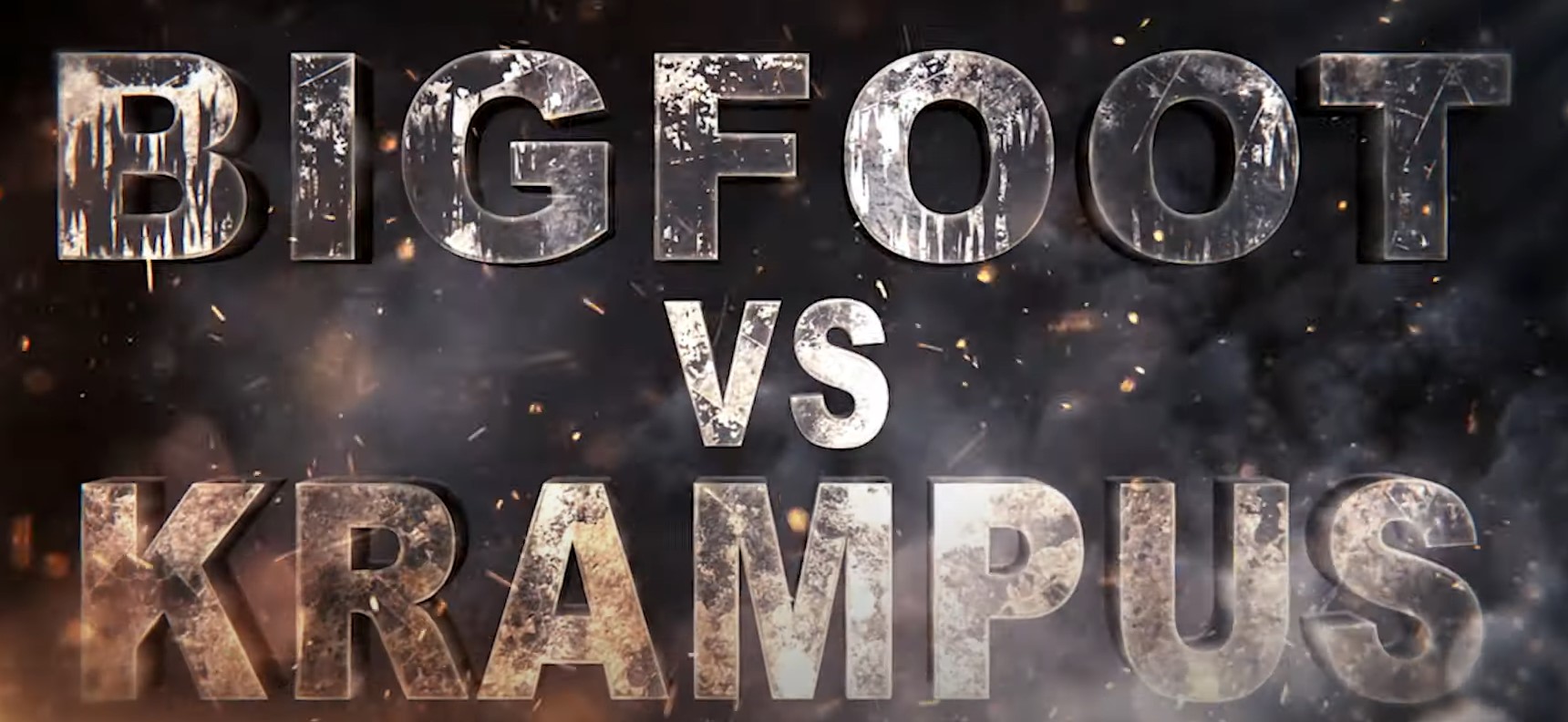
Usually, I write my own storyline synopsis for the physical releases I provide review coverage for as there’s something about firsthand accounts that interpret more clearly and is more detailed in story events than the tagline plot that can be misleading at times, whether be a false marketing ploy to sham potential viewers into watching or goes to the other extreme with a less-than-desirable summary of drab when really the movie is much more magical, but with the 2021 released “Bigfoot vs Krampus,” the bizarre synopsis is worth every word count calorie.  Coming off the heels of a decent bigfoot picture from 1976 (“Creature from Blake Lake”) and playing into the festive Christmas holiday theme with the anti-Santa folklore, I was fingers crossed and impossibly hopeful to be two-for-two in the Sasquatch saga that kills two birds with one stone in doing my duty watching holiday-horror.  Boy was I terribly mistaken.  “Bigfoot vs Krampus” is just a full-length computer-generated cog in the machine of writer-and-director BC Fourteen and is a part of his so-bad-they’re bad versus film lot of an unofficial science fiction, comedic and satirical saga of generally evil in nature icons facing off against one another….in space.  “Bigfoot vs the Illuminati,” “Bigfoot vs Megalodon,” and even “Trumpocalypse Now!” and “Trump vs the Illuminati” really speak the filmmaker’s political stance as well really speak volumes on the filmmaker’s wayward clashes of alternative universes that amalgamates characters from horror, sci-fi, folklore, and video games into battle beyond the stars cratered epic. From executive producer Tony Cliftonson and producer Randall Finings, both involved with “Tickles the Clown, another spinoff in BC Fourteen’s gonzo-galaxy epic, “Bigfoot vs Krampus” is a production and a presentation of indie distributor Ruthless Studios.

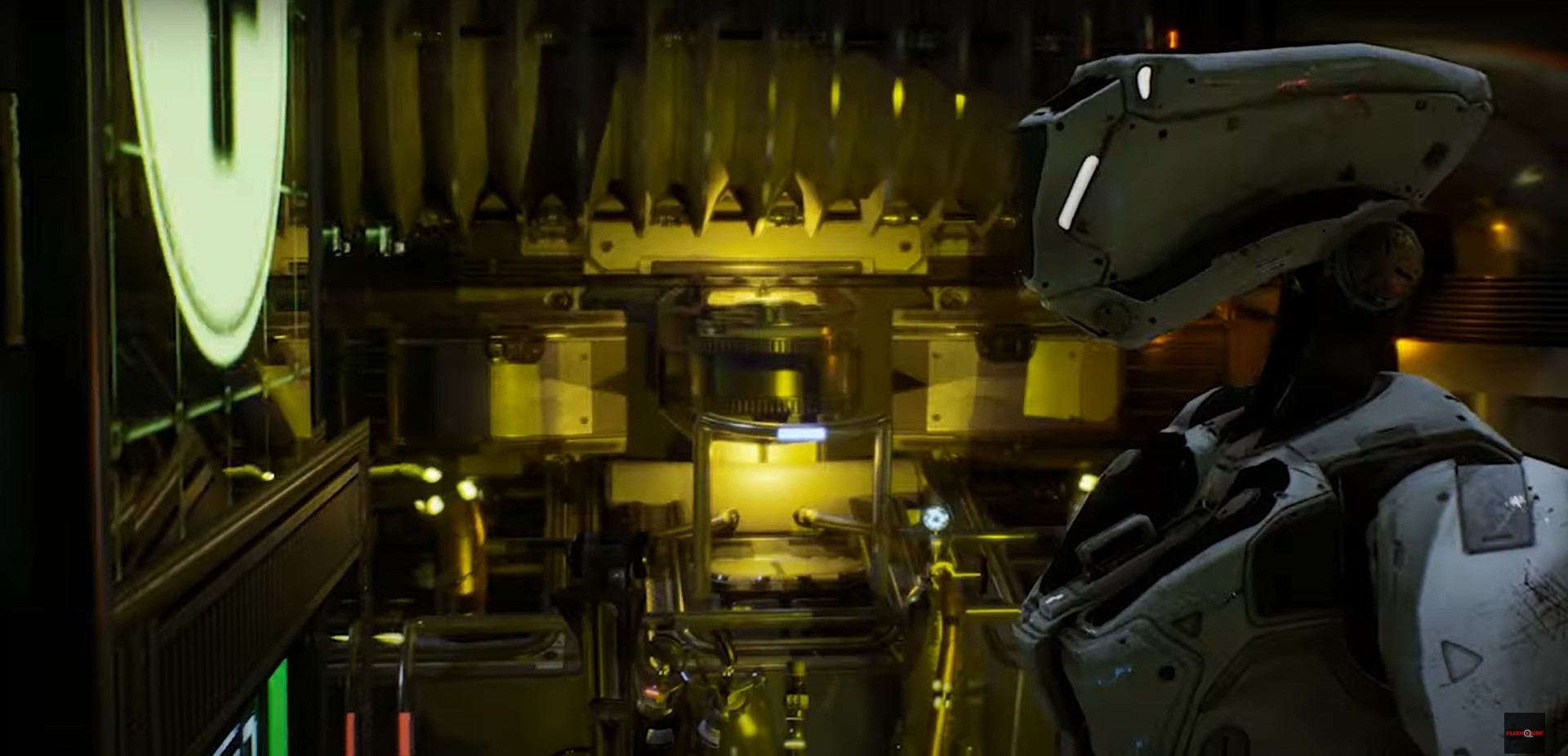
“Bigfoot vs Krampus” is total, 100% computer-generated graphics with only voiceovers to bring the highly kinetic, standing-in-place characters to resemble something that looks like life. BC Fourteen doesn’t stray too far from his regular voice talent as many of the same characters reoccur or popup randomly in this galactic gasbag of all talk and little action. When not voicing family friendly films, Marco Guzmán finds himself fouling the language barrier of space as he lends his vocals to the majority of principal leads and supporting char acters, such as the titular hairy primate Bigfoot who in the film sounds like a bastardized, sonorous, and raspy version of Fat Albert. Guzmán also voices another principal lead in Van Helsing, the 16th clone of the original vampire slayer. Known by his friends as V.H., Van Helsing looks less like a doctor with a stake and more like the Master Chief from Halo, never removing his helmet as he spews surefooted cockiness across the galaxy. Guzmán also voices the reptilian form of a reincarnated Joseph Stalin as well as the Egyptian sun God, Ra, who has ambiguous loyalties but can be useful to the allies as an all-seeing eye of the universe. Carli Radar voices humanities last hope and hero, Kali. The allied forces leader is pregnant with V.H.’s baby, a contentious sore point for Van Helsing who felt tricked into providing Kali a progeny, but has to become mankind and the illuminati, stereotypical green Martians with big black eyes and small mouths, last leader when the Illuminati’s Princess is destroyed by Krampus (who is oddly not listed as being voiced in the film’s credits), Satan’s partner in clinching power over the allies. The voice talent rounds out with Nate Trevors, Edson Camacho, Wes Bruff, Leslie Parsons, Simon Daigle, Carl Folds, Robert Forth, and BC Fourteen.

What do Bigfoot, Krampus, Megalodon, Clowns, The Terminator, Dummy Dolls, The Boogie Man, Werewolves, Satan, Anubis, Ra, and Jack Skeleton all have in common? BC Fourteen CGI’d their likeness into his…I don’t even know how to classify the film. I’ve had a run-in with a BC Fourteen film 8 years ago with 2014’s “Werewolf Rising” when the Pittsburgh, Pennsylvania-born filmmaker went under the name BC Furtney and aside from a stellar performance by the always captivating Bill Oberst Jr. and Irena Murphy baring a full moon going snout-to-nips with a werewolf, “Werewolf Rising received a mixed review but was still comprehensible with a start, middle, and an end. Though I stress the comedic and satire, a precaution must be instilled as the unfunny “Bigfoot vs Krampus” drags through the mud a trove of select horror and sci-fi pop icons in carbon copy tiny spaceships, flying around in a muddlesome mess, and rendered completely unnatural in an advanced resemblant version of the Goldsrc engine – you should see Bigfoot run down the ship’s corridors. If “Bigfoot vs Krampus’ were a series of cinematic story intercuts sewn together with gameplay axed entirely, I would believe it, and I’m sure, having spot check a few of the sequels, prequels, and spinoffs of the same caliber, that some animated scenes are recycled. There’s definitely recycling happening in this feature. If the war between the Illumanti-Humans-Bigfoot allied forces and every evildoer under the sun wasn’t thematic enough, the pseudonymous BC Fourteen throws in Van Helsing’s struggle with conscious as the cloned hired mercenary with legendary blood lineage skips town and on his baby’s mama because he does not feel appreciated in a fight that’s technically not his. The director also adds a subplot of Bigfoot checking in with old friend, and apparently cafe barista, Anubis to make sure the Sun Deity Ra isn’t fibbing about Van Helsing’s unexpected demise at the hands of Krampus. Everything does circle back around to an open-ended showdown for that next exposition heavy installment of intergalactic garbage made with no heart, no respect and very little effort.

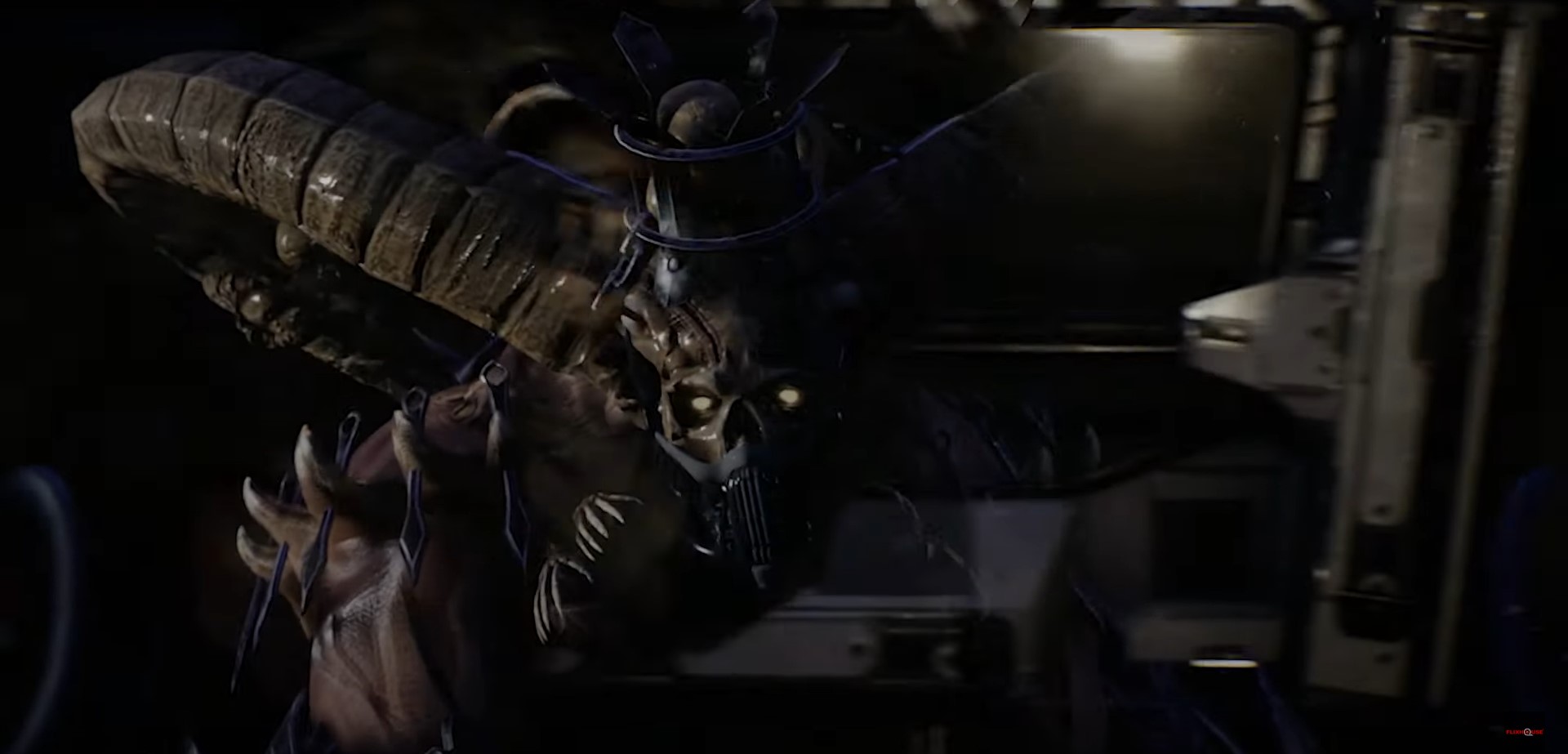
If the synopsis didn’t frighten you off from watching the film, text pulled word-for-word from the Ruthless Pictures’ DVD back cover, I surely hope this review left you with a bit of common sense prior to watching a cool and kitschy what if versus scenario. The Ruthless Pictures DVD presents the glossy computer graphics in a widescreen 1.78:1 aspect ratio. I will admit the animation provides here-and-there tactile moments, such as battle scuffs on robots or the ridges, grooves, and lighting on Krampus’s curled horns. All the animation looks about the same throughout, leaving a one-note taste that’s hard to wash out, but the at times, the CGI provides that nice ragdoll feel for humanoids Van Helsing and Kali and the lighting/shading does make appear more luxurious. Compression issues include background banding and splotches in darker spaces, but for the majority of the feature, those issues are limited. Though no listed on the DVD’s attributes, my players states “Bigfoot vs Krampus” has a single audio option – a Dolby Digital 2.0. For a science-fiction baster war, the lossy format is a lackluster that doesn’t surprisingly match all the other qualities, pushing out a mediocre 5-6Mbps average. Option English subtitles are available under the static menu. The DVD is a bare bones release with zero bonus content. The DVD is encoded region free and has a runtime of a merciful 70 minutes. Bigfoot films are back in the dumps again for this reviewer as “Bigfoot vs Krampus” is a flurry of insipidity and, the worst part of it all, it doesn’t add anything to the Christmas holiday horror subgenre with the Krampus module built-in for the sake of impersonating a something about as old as it’s folklore, a space invader.

Merry Kirstmas to all!  “Bigfoot vs Krampus” on DVD!

Starve EVIL With Unseen Faith. “A Banquet” reviewed! (Second Sight / Blu-ray)

After the long-term care of her terminally ill suffering husband, he suddenly commits suicide right in front of her and right in front of their oldest daughter who just came home.  Holly must now pull it together for her two teenage daughters, Betsey and Isabelle.  Drowning in debt to maintain a wealth front of normalcy, Holly puts on the facade to juggle life’s adversities to order to keep the family above water, but when Betsey is overcome by an apocalyptic vision that intermittently possesses her behavior, Holly’s unsure of how to cope as any threats of committing Betsey for treatment is rebutted by talks of suicide.   Betsey goes into deep trances, deep sleeps, and won’t eat despite not losing any weight and as imaginations run wild of what’s driving her unusual behavior, Holly must contend to survive and triumph not only in her daughter’s wellbeing but in all of the seemingly insurmountable problems threatening to tumble down and crush her spirit.

If you’re a fan of elevated horror then Ruth Paxton’s debut dysfunctional family drama horror, “A Banquet,” will tickle your thinking pickle.  While some would argue there is no need for elevated horror in the genre, sometimes exercising the old thinker can be immensely stimulating as well as scary in the same breath.  The 2021 psychological thriller-horror hailing from the United Kingdom was one of the first productions shot in the thick of government issued pandemic lockdowns that tossed the moviemaking job market into a frenzy, scary void of uncertainly and, what seemed like, an eternal limbo, similar to what “A Banquet” offers in its multifarious themes and interpretations that involve faith and religion, family hierarchy, and postural image.  With many departmental crews and cast out of a job and unable to find work during forced lockdowns, “A Banquet” became a beacon of hope and a chance to indulge a passion no matter how little it paid.  “A Banquet” is penned by Justin Bull (“Merge”) and was secured by first time producer Leonora Darby with Nik Bower (“Replicas”), James Harris (47 Meters Down”), Mark Lane “Cockneys vs Zombies”), and Laure Vaysse (“A Dark Place”) co-producing the conglomerated production from HanWay Films, Riverstone Pictures, Tea Shop Productions, and Reliance Entertainment Productions 8 LTD.

“A Banquet” surrounds around a nuclear family minus the patriarch who immediately removed from the picture within the first five-minute opener in a powerful scene of weary difficulty, distressing pain, and a harsh untethering of a burden that begins the inklings of the uncanny to come. Enter mother Holly (Sienne Guillory, Paul W.S. Anderson’s “Resident Evil” franchise) and her two daughters, Betsey (Jessica Alexander) and Isabelle (Ruby Stokes), into the frame weeks, maybe months later, and resided to the loss. Playing the center of concern is the raven-haired Jessica Alexander in what is one of her first feature film performances and it’s a doozy.  As Betsey, a mild-manner older teenage girl at the forefront of adulthood, Alexander earns the chance to showcase herself in a variety of ways with a role that transcends from a docile daughter to a variable vessel of unknown origin that’s haunting and unpredictable as you can never tell what’s taken control over Betsey is naturally good or evil.  Alexander even gets to dip her toes into, or rather dig her fingers into, gross and horrifying practical effects with brilliant results.  Opposite Alexander in the role of the mother, Holly, is Sienna Guillory, a beguiling veteran actress now in the throes of maintaining the routine and keeping appearances aggregated up to snuff.  Guillory exudes a bottled-up pressure that’s so immense it can be translate right off the screen and into the viewer.  There’s plenty of tension in the story but most of it is concentrated right on Guillory’s embodiment of a mother treading desperately in deep waters.  A maelstrom of frustration, fear, loathing, and neglect eviscerate Holly open to shoulder her family’s bleeding and she claws frantically, with poise, to cauterize the fissure.  Isabelle is a fascinating and almost unintentionally forgotten character that is meant to evoke that effect as the neglected younger sister.  While we’re constantly orbiting Holly and Betsey’s, we lose track of Ruby Stokes’s Isabelle yet the upcoming star for Netflix’s “Lockwood and Co.” Stokes paints a potent psychological picture of Isabelle being on the backburner.  Raw and tragic, Stokes subtly pushes Isabelle, who initially is the more cavalier and disobedient of the two sisters, to strive for attention in her own way whether be that longing glance into the stands when her mother isn’t paying her mind during figuring skating instruction or wanting to reluctantly engage in alcohol and sex just to outlet that notice me energy elsewhere.  Concluding this bloodline of women is the more draconian matriarch, Grandmother June, with an uncompromising and plain-spoken fascia erected by Lindsay Duncan (“Body Parts”).  Duncan’s fine snide performance compounds the pressure on Holly and is a cold bucket of ice water to her granddaughters when speaking her mind, telling them simply stop pretending, and remind them of their mother’s own historical mental problems in a matter-of-fact tone.  Between the four, there’s individualistic dominance over each of their domain without an ounce of withdraw or relief until the bitter end and that dreadful dynamic sets the tone for the “A Banquet” austere veneer and tone.

“A Banquet” is a lot to unbox and chew on in this women-driven created film.  Open for a many number of interpretations, based on one own’s spiritual outlook or personal opinions, Ruth Paxton tees up a broader theme of centrical growth of stepping outside another’s shadow.  The message can be applied to Holly and her two daughters as each one of them attempts to move forward or past a routine of some form of contempt.  Isabelle is trying to get out of her sister’s shadow, Holly bristles against her overbearing mother, and Betsey is being supernaturally guided through a symbolically painful transition of growing up into an adult as if the process came naturally. Blunt defiant moments shine Betsey’s overall separation from mother’s control, such as threatening to kill herself if her mother institutionalizes her or in during the number of elaborately prepped dinners that Holly slave over are just pushed aside and untouched by Betsey. Those dinners, in themselves, are a sign of privileged with fine dining right at their fingertips with no sign of hot dogs or sloppy joes in sight. Holly strives to maintain that sense of luxury, which is another form of control but, in this case, is Holly’s mother June whose elitist fundamentals enslave Holly to live up to the hype. Systematically, each member of the family, working up the ladder from youngest to oldest, breaks the inherent status quo. What Betsey undergoes is mystically charged after she emerges from the woods a changed woman and what might seem like a possession of sorts, we don’t exactly know if the extent of what inhabits her is wicked or actually good as the pendulum sways constantly between being enlightened and being cursed. There’s plenty of allusions toward a religious experience with encouragement of faith and rapture talk that not only spooks Holly but also makes her the primary subject of Betsey’s claim to save. When the time does come, and Betsey passes through a substitutionary atonement, the end scene shows Holly being embraced by a candescent light that illuminates from within her. Is it being saved or is it something else? Ruth Paxton smashes her first feature with an elevated deconstruction of a family obliviously rotting at the core and attacks the film with dispirited ambiance sewn to dread.

Feast your eyes on the new limited-edition Blu-ray set of Ruth Paxton’s “A Banquet” from Second Sight films. The region B, PAL encoded UK boxset presents the film in 1080p widescreen 2.39:1 aspect ratio with a frame rate of 23-24 fps. David Liddel’s deep and encroaching cinematography of somber is highly effective in dulling out any kind of hope that might try to sneak in and with Liddel’s close-to-mid shots of macro-sized foods of all fresh and decaying varieties and in the middle of the more volatile struggles between mother and daughter opens up “A Banquet” to a plethora scene being uncomfortable moments. Details are sharp and colors are about as rich as Liddel can make them inside a grey-covered world. The English language set comes with two audio options: a DTS-HD 5.1 and a LPCM 2.0 stereo. DTS is clearly more robust through the various channels with a well-balanced mix. Other than a few outlier moments in the forest that disperse the dialogue in a naggingly boxy echo that doesn’t fit the environment, dialogue is discerningly clean and clear of obstructions and damage, as if there would be any on a digital record. Optional English subtitles are also available. Bonus material includes an interview with director Ruth Paxton Deformity of the Flesh on creating her first film during the height of the pandemic, an interview with star Jessica Alexander Improvised Exorcism in which she discusses her experience soup-to-nuts from hiring to completion, an interview with producer Leonora Darby Producing a Feast who notes about the difficulties of being a first-time producer in pandemic time, an interview with cinematographer David Liddel Dark Edges on how he creates “A Banquet’s” gloomy aura and creative shooting angles, the Q&A from Glasgow Film Festival with Paxton, Alexander, and Sienna Guillory, and a making of featurette. The limited-edition physical boxset is a sturdy vessel of beauty with a rigid slipcase with new artwork by Jen Davies, a 56-page soft cover picture and essay book with thoughtful examinations by novelist Alexandra Heller-Nicholas (“1000 Women in Horror”), film critic and writer Jennie Kermode, and Heather Wixsn, the managing editor of the Daily Dead. The contents round out with 6 collectable art cards. The film has a runtime of 97 minutes and is certified 15 for strong threat, language, suicide, self-harm, and drug misuse. “A Banquet” is lavishly cataclysmic as a divinely damning dish of a broken, dysfunctional family made to order by first time director Ruth Paxton with more to say.