A Bond of Friendship Formed Over an EVIL Annual Contest. “The Long Walk” reviewed! (Lionsgate / Blu-ray)

“The Long Walk” on Blu-ray for the Holidays!

Over a decade ago, a divisive civil war nearly tore the United States of America apart, leaving in it’s wake a country on the brink of financial ruin and its place in the world behind other nations.  To help heal the nation back into an industrial superpower, an annual long walk was enacted to be a show of encouragement, an act of bravery, and to instill a sense of duty and production amongst the citizens of America.  Voluntary participants of young men, one from each state, must walk continuously at 3 ore more miles per hour with a military escort.  Last man standing will be bestowed a large cash prize and granted one wish of their choosing.  Those unable to continue their trek at the required pace will be issued three warnings before being gunned down, punching out their ticket.  Home state’s Ray and Georgia’s Peter form a bond on their walk that’ll test not only their friendship but their will to live in hopes to change the contest’s cruelty.  

“The Long Walk” has itself been on a long walk to being adapted on film from the first official novel by the prolific and renowned suspense writer Stephen King under his pseudonym of Richard Bachman.  I’ve italicized official because the late 60’s novel wasn’t published and released until 1979, five years later after “Carrie” was published in 1974.  Through the hands of George Romero and Ridley Scott, neither could materialize a filmic rendition of what is considered his most grim work.  That is until “Constantine,” “I Am Legend,” and “Hunger Games” director Francis Lawrence came along, acquired the rights, hired “Strange Darling’s” JT Mollner to script the project, and produced perhaps the most disturbed dystopian film of 2025.  “The Long Walk” feature is a collaborative production from Spooky Pictures, Electric Lady, and Miramax, is produced by Steven Schneider, Francis Lawrence, Roy Lee, Cameron MacConomy, Rhonda Baker, Ellen Rutter, and Carrie Wilkins, and has been given executive producer Stephen King’s blessing for minor, yet impactful, creative control.

“The Long Walk” courses with a young but up-and-coming cast with a veteran icon bringing up the rear as coxswain spurring the unpleasant action.  “Licorice Pizza’s” Cooper Hoffman, son of the late Philip Seymour Hoffman, and English actor David Jonsson whose just came off his part in a big science-fiction horror franchise with “Alien:  Romulus” from last year.  Together, Hoffman and Jonsson play the central characters of Ray Garrity and Peter McVries, two young men who formulate a bond while voluntarily participating in the annual deadly contest that traverses for hundreds of miles through heartland portions of an undisclosed state.  Right from the get-go, Ray and Peter hit it off as the check in for the contest simultaneously upon arrival with the story quickly introducing and discerning a select sundry of other walkers that are either in it to make friends, be an in-it-to-win-it antagonists, or be a formidable indifferent with a spectacular end to their ticket or otherwise arc toward either direction.  In these walk-along parts are Ben Wang, Charlie Pummer (“Moonfall”), Joshua Odjick, Tut Nyuot, Roman Griffin Davis, Garrett Wareing (“Independence Day:  Resurgence”), and Jordan Gonzalez supporting the Ray and Peter narrative with their own in-state regionalism and dialect backstories and motives for sacrificial strutting, which their exit that much more poignant.  Then you have Mark Hamill, who needs no introduction, in a performance on a totally different plane of existence than the young man walking for their very lives.  Blind to compassion and stern on his belief sacrifice is necessary for the greater good of the nation, Hamill as no nonsense brass, known only as The Major,” is a mythical figurehead initially held in high esteem and awe or overall indifferent amongst the young men.  All except one with Ray being the firm outlier of contrarian using passive aggressive measures that build to an endgame goal.  Sporting large aviators, green fatigues, and occasionally holding and firing a sidearm, Hamill’s method ways really come alive within The Major’s gung-ho disposition inside an authoritarian America.  Judy Greer (“Jurassic World”) and Josh Hamilton (“Dark Skies”) round out the cast as Ray’s parents. 

No matter how grim “The Long Walk” spans the 108-minute runtime, the story isn’t necessarily all bleak.  While the time period is unknown and the war that has seemingly divided the nation goes unsaid, one can assume the decade is late 1960s to early 1970s based off the military fatigues and weaponry, the dialect and slang vernacular, and the outer shell of the world with clothing, cars, and storefronts that speak to a simpler time where no cell phone exists, transmitter radios are the news and music, and the presence of any modern-day convenience lost amongst the vast fields and deprived brick-and-mortars of small town America.  Yet, the story walks along the lines of some alternate, dystopian reality, pre-dating a “Hunger Games” like contest involving the permanent elimination of young people in effort to better society.  Fortunately for “The Long Walk,” director Francis Lawrence directed “Hunger Games” and that gives him a leg up on the tone this adaptation needed for the big screen but although the two share a similar theme, the differences between them are vast with “The Long Walk” set in a past instead of a future dysphoria, objects and places are established and grounded by reality rather than creative fiction, and the violence is by far the grislier.  Often, violence can be gratuitously supplemental and unaffecting but Lawrence’s intention to show closeup executions contrasts with weight against the boys’ bond building during their fear and their ambition test.  With every explosion of brain matter and bits of flesh the stakes are real and the tension is thick even if the panic is subdued amongst the walking competitors.  Yet, with every ticket punched, that tightness starts to show signs of shuttering in conjunction with fatigue and that carries on for miles.  Much like the film adaptation of Frank Darabont’s “The Mist,” the ending for “The Long Walk” has been altered from the novel with prior Stephen King approval and while “The Mist” absolutely shatters all the hope with tons of despair and irony in a blaze of glory ending where one’s heart drops like a cannonball in the ocean, “The Long Walk’s” finale barely fizzle to make the same impact and can even be said to be a predictable modern moving ending. 

“The Long Walk” puts one foot in front of the other toward a new Blu-ray release from Lionsgate.  The AVC encoded, high-definition presentation in 1080p, is stored on a BD50 with a widescreen 1.39:1 aspect ratio.  Sharp detail in the small percentage desaturated picture offers a mid-20th century America air along with the costuming and production sets and locations.  Fabric textures result better in sweat-induced cotton Ts overtop a variety of muted shaded pants and solid army fatigues while the rest of the landscape has a green, brown, and tan landscape of a scarce Midwest, harnessing widescreen and medium shots for the open terrain that equally freeing and beautiful yet also confining and harsh in the grim, dystopian contest; however, the textures take a back seat to the chunky bits of exploded flesh, blood, and brain matter splattering either in gray and painted asphalt or spreading amongst the wind.  While the detail doesn’t provide all the gory bits and pieces there’s enough there to really cause alarm from within.  The English Dolby Amos is the primary English track for best to enclose the immediate space surrounding the 50 State participates feet hitting the pavement and the escorting military convoy tank and wheel tracks.  Gun shots are jolting that tear into the audio senses in step with the graphic nature of the scene of apathetic militaristic executions.  There are curious post-execution sounds from the blood pooling on the street in what sounds like a continuous gush of blood that hits the side channels; its an odd action for sound to take audible shape, especially in scenes that are not an extreme close up but rather materialize out of medium shots.  Dialogue is perfectly suitable in the conversational piece between the young men and the gruff Major.  Other audio format choices include a Spanish Dolby Digital 5.1 and a French Dolby Digital 5.1.  There are also an English 2.0 descriptive audio and subtitles in English, Spanish, and French.  Special features include feature length documentary Ever Onward:  Making the Long Wal” with crew – such as director, writer, and DP – and cast – including Cooper Hoffman, David Jonsson, Garrett Wareing and more – interviews discussing the depths of “The Long Walk” from A-to-Z, from it’s previous adaptation concept rights held in limbo down to the individual character mindsets.  Two theatrical trailers are the only other special features encoded.  Lionsgate Blu-ray Amaray case is encased a O-slipcover with straightforward (pun intended) artwork that’s also on the case artwork.  The digital copy leaflet is inside for digital moving watching pleasure.  The 108 minute film is encoded region A and is rated R for strong bloody violence, grisly images, alcohol, pervasive language and sexual references. 

Last Rites: An intense and somber America born out of division and fear is a reverse reality, an alternate take on what could have been or could be soon, as “The Long Walk” glorifies sacrifice as a scapegoat for national pride, strength, and the greater good in a warped sense of authoritarian rule and industrial encouragement.

“The Long Walk” on Blu-ray for the Holidays!

EVIL’s Path to being a Psychopath. “The Beast to Die” reviewed! (Radiance Films / Limited Edition Blu-ray)

“The Beast to Die” on Limited Edition Blu-ray from Radiance Films!

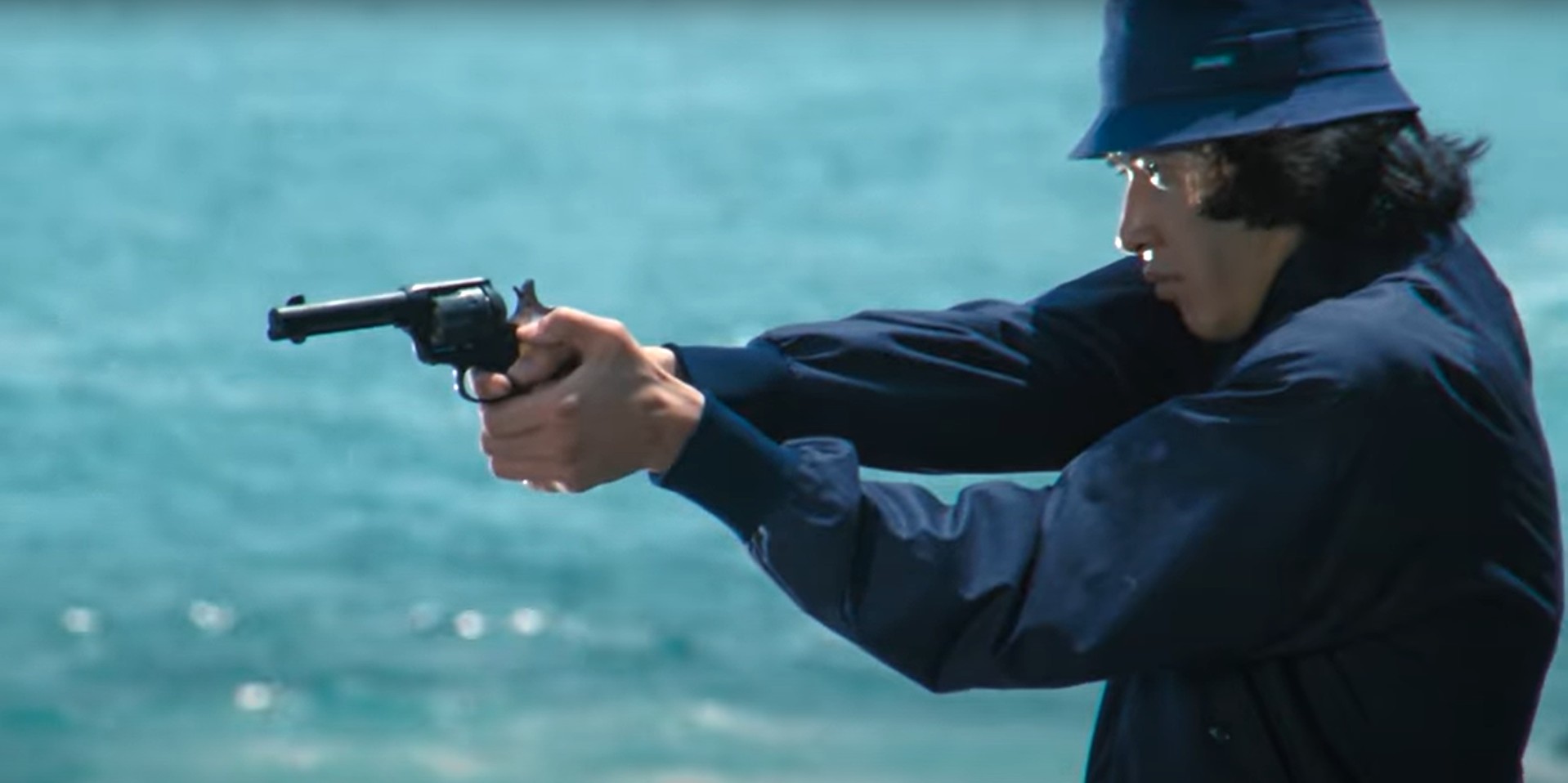
Former war journalist, Kunihiko Date, stabs a veteran police investigator to death.  He then uses the detective’s revolver and guns down three, after hours casino employees in cold blood and steals the day’s earnings.  Date’s seemingly random acts of violence and theft from a respected war journalist and photographer are not just random acts but part of a methodical plan for an upcoming heist of a bank in Tokyo’s Nihonbashi district.  Casing the bank’s security, personnel, and layout, Date’s perfect plan has one hitch; Because of the bank’s size and bustling busines, he’ll need a little help.  By chance, he comes across Tetsuo Sanada at an annual school alumni dinner with his closest friends who have a violent run-in with Sanada as their antagonistic waiter.  Seeing the same potential disregard for life and disdain for existence conventions, Date approaches Sanada and mentors him under a nihilistic wing.  Now with a plan and an accomplice, Date’s violent holdup can move forward but to what end is the length of his sociopathic carnage. 

“The Beast to Die,” aka “野獣死すべし, Yajū shisubeshi,” is the intense and violent noir-thriller from Japan, directed by “Dead Angle’s” Tôru Murakawa and a script by Shoichi Maruyama (“The Triple Cross”).  The 1980 released feature would be Murakawa and Maruyama’s second feature length production together behind 1979’s “The Execution Game,” the second film of a trilogy known as “the Japanese Game Trilogy is a visceral yakuza tale of a kidnapped hitman unable to escape the criminal underworld. “The Beast to Die” is a step away from the Japanese gangster film; instead, focuses on the interpretation of war trauma, the cynical views of precious life, and has subtle presences of U.S. big brothering, asexual themes, and coarse, unforgiving violence at the highest level of sophisticated society.  Adapted from the Haruhiko Ôyabu novel of the same name, the written origin mirrors the vehemency of visual art with the film produced by Haruki Kadokawa (“Virus”) and “The Resurrection of the Golden Wolf’s” Mitsuru Kurosawa and Tatsurô Shigaki under the Toei Company and Kadokawa Haruki Jimusho.

Undoubtedly one of the best sociopathic performances of our lifetime, “Horror of the Wolf” and the Japanese Game trilogy’s Yûsaku Matsuda is a cool, awkward, and, if not, plotting cucumber amongst the masses of jovial and hustling Tokyo denizens.  There’s a serenity about Matsuda’s Kunihiko Date that’s unparalleled, represented by blank stares, a patient demeanor, and precise movements that come in stark contrast in the film opener where Date takes down four people in one night in a show of murderous inexperienced bravado.  Even in the thick of combative survivalism, there’s only objective goal in his sweat infused brow and focused eyes while others gesture and make an invitational show of his attack or of their pleas for mercy.  Date becoming lost in classical music is a formidable way of grounding himself, not only from the high of excitement and thrills of killing, but also a way to retain sanity in the notes, an aspect he quickly unravels from when not exposed to classic music for an extended period.   Oppositely, Tetsu Sanada is full of pent-up anger as if he’s constantly hitting his head on the wall aiming to break free of the surroundings that confine his wild tiger attitude, yet Takashi Kaga (“Isle of the Evil Spirits”) maintains a personal struggle lock on the full emergence of Sanada as Kunihiko’s equal.  This dichotomy between the anger and tranquility of two sociopaths is immensely palpable that leads to a purposeful instability in a number of areas – hesitation and certainly, the sweat-inducing fear and the cooled fearless, and, eventually, the relationship’s ultimate internal destruction.  Thrown into the Kunihiko and Sanada tango is a potential love interest in the puppy-eyed Asami Kobayashi (“Sixteen Years Old:  Nymphets’ Room”) and her shared classical music and tenderness connection with Kunihiko and a happenstance Detective, played with casual approach by Toshie Negishi (“The Rapacious Jailbreaker”), being in Kunihiko’s consciously aloof presence as a pressuring force that suspects something between something off with Kunihiko and the murder of his detective colleague. 

“The Beast to Die” explores various themes around the indirect damage of post-war trauma and living and feeling like an outsider of the what’s consider the normal societal collective, but there’s another avenue to look down when consider Murakawa’s villainous protagonists.  Kunikhiko Date may have been scarred by war, but his mind always had an inkling for bloodthirst, sated through the images of a photographic lens that captured the horrors of global conflict from military losses to the collateral damage.  Upon his return to Japan, Date had lost the exciting sensation of death that has exceled his rationality beyond being Godlike, able to take life without conscious due reproach.   Sanada, in a way, is similar in his radical viewpoints but Date finds him more talk than action, held behind the line he has yet to cross unlike Date’s journalistic meatgrinder and his self-drive to kill the detective and casino workers.  As far as vices go, neither men have an appetite for sex:  Kunikhiko  watches a sex worker masturbate with little interest and his connect with Reiko doesn’t go beyond the gazes into each other’s eyes and Sanada’s fortunate relationship with his girlfriend provides him with well-off opportunity in money, business, and romance but because she dapples in rendezvous with a U.S. sailor, Sanada finds himself engrossed with spite.  Both men become essentially sexually impotent with seeing red, in anger and in blood, replacing that primal need or ravenous appetite.  The last scene between the two men becomes a crucial turning point in their cruel comradery as the forceful sex act with an unconscious woman sends the other unravelling their partnership for good.  “The Beast to Die” is a cynically cold narrative without regard for human life in the traumatizing belief one can surpass the omnipotent Gods by ending the existence of others.

A compelling dark thriller relatable to contemporary trauma feeding mentally warped violence, “The Beast to Die” arrives onto a limited-edition Blu-ray from Radiance Films.  The UK label produces a Kadakawa Coprporation-created digital 4K restoration transfer from the original and pristine 35mm print.  AVC encoded onto a BD50 and presented with 1080p high-definition resolution in a 1.85:1 widescreen aspect ratio, this Stateside edition is the picture of health with a rich palate that’s stark with contrast.  Skin tones and textures, as well as fabrics, emerge into perspicuousness without missing or dropping a beat.  Negative spaces and shadows enshroud appropriate with the keyed lit dim levels.  The grain is pleasant, stable, and natural and there are no real issues with the print itself, withstanding the test of time.  The uncompressed Japanese PCM 2.0 Stere track offers a reasonably ample sound design and fidelity with post-production dialogue, foley, and ambience recordings that creates some mismatch and distancing space between the action and atmosphere audio and the character diegetic dialogue.  There are no rough patches to mention within the audio recordings, producing more than fine discernible quality to the technical threshold.  Japanese to English translator Hayley Scanlon provides newly translated English subtitles that are spotless in the Blu-ray’s world premiere with English subtitles.  Limited to 3000 units, Radiance offers exclusive special features, including new interviews with director Toru Murakawa, screenwriter Shoichi Maruyama, and a film critique and analysis from novelist and screenwriter Jordan Harper.  The newly commissioned artwork by TimeTomorrow revamps with a new look and layout on the classic, original poster art as the primary Amaray front cover with a reversible side housing an alternate rendition.  There are new and archival essays and archival in the limited edition booklet with 27-pages of color stills, a Tom Mes Yusaku Matsude:  Lost Rebel essay from 2004 showcasing the art and films of the lead actor, a new Tatsuo Masuto essay Shadow of the Beast, cast and crew acknowledgements, and transfer notes and Blu-ray release acknowledgements.  Encoded with a region A/B lock, Radiance Films release has a runtime of 119 minutes and is not rated.

Last Rites: Radiance Films’s limited edition run of “The Beast to Die” is immaculate in every aspect – filmically, technically, packaging – and is an important piece of Japanese culture and cinematic criterion.

“The Beast to Die” on Limited Edition Blu-ray from Radiance Films!

EVIL Manga to EVIL Movie! “Liverleaf” reviewed! (SRS Cinema / DVD)

“LIverleaf” Pushes Through the Bleak to Shine. On DVD Now!

The move from Tokyo to a dwindling rural town hasn’t been easy for middle schooler Haruka.  Most of her classmates have grown up with each other and formed vicious cliques that bully her relentless during and after school.  Mitsuru Abu, a photography enthusiast and Haruka’s classmate is also an outsider but has family ties to the area, is about her only friend and whom she finds attractive.  Upon returning home after spending the day together, Haruka finds her family home engulfed in flames, her mother and father dead, and her little sister severely burned over her entire body.  The loss of her family, her only emotional support, mentally compromises Haruka’s self-control and sends her spiraling into a revenge fueled murdering spree, targeting her bullying classmates who had a hand in the inferno of her family home.  The root of malevolence is not as it appears on the surface, and it will be up to Haruka to kill her way in finding the truth and reveal the secrets.

Adapted from the popular manga series, “Misu Misō,” written by Oshikiri Rensuke, the film version incorporates the indelicate dramas of being a school age teen in while reproducing faithfully the graphic gore, violence, and disturbing nature of character of the series in great detail.  Titled “Liverleaf,” as in the resilient, mountainous found three-lobe leafed flower that resembles the human liver and can withstand harsh winter conditions, is helmed by “Let’s Make the Teacher Have a Miscarriage Club” director Eisuke Naitô and penned by Miako Tadano of “The World of Kanako,” another manga-based film adaptation.  The 2018 film, which can be described as a revenge-drama with particle elements of horror, is shot in one of the snow-covered foothills of Japan’s mountain regions and is produced by Shigeto Arai (“We Are Little Zombies”) under the production banners of the Nikkatsu Corp. and the L’espace Film Co.

Anna Yamada is in the lead role that’s very familiar and culturally significant to Japanese cinema.  A scorn-born femme fatale that’s merciless and personnel, the kind of role that Quentin Tarantino exacted in his tribute to Asian revenge narrative with “Kill Bill,” starring Uma Thurman, hunting down the offending party and dispatching the scum from the Earth in a one-by-one fashion.  The “Suicide Forest Village” actress Yamada headlined “Liverleaf” as mid-to-late teen portraying the manga series’ preteen or early teenage girl Haruka Nozaki.  She isn’t the only nearly adult woman to play a teen in the throes of hormones, peer pressures, and angsty conditions sideswiped by wickedness and a taste for dominance as the whole student body pretends to be a youthful waste in a snowy, mountainside village on the verge of collapse.  Howling Village’s Rinka Ôtani, as Taeko Oguro, stands out with her bright orange hair and a sense of indifferent authority being the supposed head of the gaggle of bullying girls.  “Liverleaf” is Ôtani debut picture and Ôtani would eventually reteam with Yamada on “Suicide Forest Village,” but their first dichotomized performance as protagonist and antagonists brings a palpable tension to the screen.  Throw a boy both girls stoically can’t admit with a lot of expression and that pressure pot grows into an ugly shape of jealousy spurred love triangle.  Mitsuru Aibe is tall, handsome, kind, and a photography buff always looking for the raw and beautiful moment to capture on film.  Played by Hiroya Shimizu, “The World of Kanako” and “Sadako” actor instills that hope for the future and a glance of stability amongst the opposing craziness that has ensued between the rebirthed revenger Nozaki and the horrible highschoolers now fearing for their lives because of their responsible part for the monster they’ve created but does he really provide a safer, greener pasture Nozaki needs to return to once her retribution is complete?  Kenshin Endô, Masato Endô, Reiko Kataoka, Seina Nakata, Arisa Sakura, Aki Moita, Minoir Terada, Kazuki Ôtomo, and ReRena Ôtsuka are cast in one messed up and depressive high school student body that ends in a blizzard of bloodshed.

One thing about “Liverleaf,” if looking at and considering all the components of the feature as a whole, to take away from the adaptation is how Eisuke Naitô facsimiles the plot points of a manga series or, in more general terms, Naitô” has plucked the rudimentary concepts straight from any regular extreme manga series, not just from Oshikiri Rensuke’s Misu Misō.  Yet, “Misu Misō” is very faithfully extracted from the illustrated pages for live action execution down to many of the details with very few changes to the story’s original design. Gore has an extreme graphic nature juxtaposed against the snow, contrasting in homage to those historical revenge genre films set in the same harsh, white blanket, and like all the heroines, or anti-heroines, Haruka Nozaki speaks her soul in her outfit, dressed in a continuously deepening red after each gruesome dispatch of her classmates.  This saturation into crimson extends into this belief that Nozaki is bordering being supernatural, like most condemned women done wrong, who somehow find the superhuman strength, endurance, know-how, and resilience in their own disdain for blood and violence to slay beyond their normal means without batting an eyelash.  “Liverleaf” is not the chippiest of narratives with a coursing core of grim doom and gloom through a quickly dilapidating little town with an austere school, junk pits, and modest structures that inhabit indifferent teachers, brooding teens, and a mental illness that ranges from inherent sociopathy to social sociopathy of peer pressures and bullying. 

SRS Cinema brings manga pen and paper to the big screen with their unrated DVD release of the film adaptation titled “Liverleaf.”  The MPEG2 encoded, upscaled 1080p, DVD9 release is presented in a 1.78:1 aspect ratio.  “Liverleaf” stands out unusual from the other SRS releases, a company that prides itself on standard definition 480 and 720 resolutions and compressing features and their special features onto a packed DVD5 that creates eye artefacts on already low budget, commercial grade, inexperienced film.  Instead, “Liverleaf” has punchier colors and distinction on that segregates the austere from the vibrancy and the extra space helps allow for this decoding to be as smooth as possible on what some may now consider an antiquated format.  Decoding at a higher range of 7-9Mbps, compression imprudence doesn’t show itself here with a clean picture that retians inky voids, charted snow mounds and footprints in a white sheet of snow, and the colors and details on objects that natural enlarge themselves when in contrast, such as Nozaki’s red jacket or the red, orange, and yellow glow of house flames against the night sky.  The Japanese LPCM 2.0 stereo renders a clean mix of dialogue, ambience, and soundtrack.  Dialogue’s clean, crisp, and clearly upfront of a subdued diegetic sound mixed from the boom mic or from post and a Hisashi Arita soundtrack that scores Japanese revenge in non-traditional Japanese notes.  Post mix and action does create some separation that uncouples the visual onomatopoeia of the activity but remains negligible throughout.  The burned-in English subtitles synch well and are error-free.  Extras include a featurette from Manga to Movie that goes into the history of manga and the adaptation concept which most thought the film couldn’t be adapted, Elijah Thomas supplements with his own thoughts and opinions on “Liverleaf” as well as another featurette titled Liverleaf’s Obsession that looks at the character’s dangerous obsessive qualities, the trailer, a Oshikiri Rensuke, biography The Comically Twisted Mind of Oshikiri Rensuke with narrator voiceover going into the writer’s family history and “Misu Misō” genesis, the trailer, and talent files on Anna Yamada, Eisuke Naito, Hiroya Shimizu, Miako Tadano, and Rinka Otani.  These features house behind a static menu, that only has a play option alongside the extras, with a neat art illustration of a murderously ominous Naruka Nozaki.  The cover art hints at the film’s stark contrast aesthetics with a Naruka Nozaki wrapped her red coat and jetblack hair sprawled out on the white snow.  The Amaray does not come with a reversible cover nor any tangible extras inside.  DVD has region A only playback and has a runtime of 114 minutes. 

Last Rites: “Liverleaf” is a surprising, better-than-no budget teen revenge thriller that deals with obsession, depression, and a consternation that Haruka’s tragic journey through the pits of a lowly high school hierarchy will only get worse before it gets better.

“LIverleaf” Pushes Through the Bleak to Shine. On DVD Now!

A CIA Plan is Being Sidelined by EVIL’s Rooftop Terrace Sniping! “Goodbye & Amen” reviewed! (Radiance Films / Blu-ray)

Own a Copy of “Goodbye & Amen” from Radiance Films. Click here to Purchase.

Ambitiously confident CIA agent John Dannahay eagerly wants to begin his plan for an African nation coup.  Based in Italy, Dannahay runs through his team the stage of events when suddenly a current administrative African agent, known for sniffing and snuffing out power-overthrowing schemes, suddenly arrives in town, Dannahay’s friend Harry Lambert up-and-leaves his wife and child and takes a rifle with him, and a gunman, supposedly Lambert, is at the top of a hotel terrace sniping down pedestrians.  Whatever surgical strike Dannahay had plan is now in jeopardy as a hostage situation occurs in one of the hotel rooms and agent Dannahay and Italian inspector Moreno must piece together why a longtime compliant and clean nosed American embassy worker has suddenly gone murderously berserk.  A public stir amidst a shrewd madman with a high-powered rifle creates a confounding panic of national security and for fear of what will happen next in the moment of mayhem.

Italian filmmaker Damiano Damiani, known for his crime thrillers, such as “Mafia” and “Confessions of a Police Captain,” and his small footprint in horror with the sequel “Amityville II:  The Possession,” had cowrite and directed an intense espionage thriller outside the confines of actual cloak-and-dagger activities with a multi-national cast.  The 1977 film titled “Goodbye & Amen”  is first and foremost an Italian production, cowritten by Damiani alongside “Wanted:  Babysitter” screenwriter Nicola Badalucco and is based off the novel “The Grosvenor Square Goodbye” by British writer Francis Clifford.   The gripping story draws upon multi-layered themes and twists to keep the narratively recycling on fresh and to never become stale with its intriguing mystery and taut tension, shot right in the heart of Rome, Italy at the Cavalieri Waldorf Astoria hotel.  “Goodbye & Amen” is a product of Capital Film and Rizzoli Film and produced by the profound producer Mario Cecchi Gori of Michele Soavi’s “The Sect” and Dino Risi’s “The Tiger and the Pussycat.”

Italians.  Americans.  British.  “Goodbye & Amen” has an all-star international cast that lines up and knocks down the perfectly scripted and beguilingly complex roles that warrant nothing less than the utmost praise for their personal performances. What starts off as a CIA caper to overthrow an African nation regime pivots acutely into a hostage standoff with many unanswered questions pelting down almost simultaneously in mass confusion and uproar in what translates to a very relatable, real moment.  Introductions begin with the CIA’s operational leader John Dannahay (Tony Musante, “The Bird with the Crystal Plumage”) spearheading the preparation meeting when suddenly his operational plans become under jeopardy.  Musante’s strongheaded approach to not lose control of the situation is fierce against the challenge his character faces – a lone gunman, a man Dannahay calls a friend played by “Tenebrae’s” John Steiner, holding hostage an actor (Gianrico Tondinelli, “Enter the Devil”) and his illicit mistress (Claudia Cardinale, “8 ½”).  Steiner delivers a sophisticated, twangy-accented killer hellbent on making a statement with a M1 Carbine rifle and a thought-out plan being a step ahead of Dannahay and Italian Inspector Moreno (Fabrizio Jovine, “The Psycho”).  The dynamic between Dannahay and Moreno, in my opinion, is rather lite for a fast and loose Dannahay and a by-the-book Moreno being two stags vying over how to handle an American mess on Italian land.  Other supporting characters add their creative two cents to “Goodbye & Amen’s” already swelling storyline with great additional principals from Renzo Palmer (“The Eroticist”), Wolfango Soldati (“The House at the Edge of the Lake”), John Forsythe (“Scrooged”), and Anna Zinnemann (“My Sister of Ursula”) that fillet down the mystery to reveal its coldblooded nature.

Not lately have I’ve impressed with a crime thriller and said to myself, wow, that was really engaging and unexpectedly good.  With confidence, “Goodbye and Amen” hit that satisfying note, a note thought to have strayed into an obscure black void never to be seen again, but the story coupled by Damiani perceptive big-world direction and some great camera work and angles by cinematographer Luigi Kuveiller, that shimmers hints of Kuveiller’s work on previous films like “Deep Red” and “A Lizard in a Woman’s Skin,” and “Goodbye and Amen” is one of the better Italian crime thrillers to come out of the country that isn’t in the giallo subgenre.  Incorporating wide shots with depth and a seriously oversaturation of characters and extras, plus not to forget to mention helicopters and shoot outs, create the illusion of a bigger film without manufacturing too many atmospherics to hoist suspense.  Plenty of red herrings and blunt force action, peppered with bare flesh sensuality, and heedful acting provides the film with an incredibly firm bite that sinks its teeth in and never releases.  Compelling and always one step ahead, “Goodbye & Amen’s” layers of excitement keep viewers simultaneously abreast and in the dark and with the seesaw suspense, which never falters with an overly opaque complex ingenuity, there’s a pleasant rollercoaster effective of up and downs between penetrating thrills and just enough down to Earth exposition in order to catch one’s breath.   

In a new limited edition Blu-ray release from UK distributor Radiance Films on their North American lineup, “Goodbye & Amen” receives a 2023 2K restoration scan from the original camera 35mm negative and presented on an AVC encoded, high-definition 1080p, BD50 in an anamorphic 1.85:1 aspect ratio. Certainly, a smooth image with no enhancement fluff or over-corrective, off-tilted coloring, the restoration brings out the best parts of Damniano Damiani’s natural approach with key lighting supporting exteriors and some intensely lit interiors without a smidgen of banding or posterization to complicate it. Details are razor sharp and the hue saturation is full-bodied and deep even along the line of a sunny Italian coastline where contours are a nice edge drop-off and shape. The English version has three exclusive shots pulled and scanned from the 16 reversal elements that create a slight grain difference that manages to nearly go unnoticed. Audio options come with the original Italian DTS-HD Master Audio 2.0 mono and, for the first time on home video, the English export in a DTS-HD Master Audio 2.0 mono. The English export’s audio track does come with a proclaimed statement right on the main menu about its unresolved damage. Like being pushed through a filter of interference, the English track is intelligible if not entirely clear and free from static and squelch. The Italian track offers a cleaner ordonnance albeit a few in-and-out moments of faint distortion of unrestorable audio ribbon snippets. New and approved English subtitles on both lossless, uncompressed tracks help alleviate some of the technical pain audio aficionados may suffer but, in my honest opinion, the Italian meets the bar whereas the English is under the bar by just a few clicks. Radiance’s special features include a new audio commentary track by Eurocrime experts Nathaniel Thompson and Howard S. Berger, a new interview with editor Antonio Siciliano, and an archival interview with actor Wolfango Soldati. Both interviews are in Italian with burned in English subtitles. Radiance’s physical approach to their releases is highly unique in format by using obscure poster elements, and sometimes often new illustrated art and compositions, to exact a striking front cover image. With “Goodbye & Amen,” the rendition of Italian’s finest in their version of S.W.A.T. body armor within the sites of a crosshair is clever and engaging to know more. The reverse cover offers more of the common language poster art. A 19-page color booklet, that contents the cast and crew information, transfer notes and credits, and a new essay from Lucio Rinaldi entitled “The American Connection: Damiano Damiani’s Goodbye & Amen,” accompanies a reserved blue background and yellow font disc art that befits Radiance’s retro-classy style. Being a UK distributor releasing in the North American market lends the title to have a region A and B playback for two varied runtimes, for the Italian and English version tracks, of 110 (Italian) and 102 (English) minutes. Radiance’s 38th release is also not rated.

Last Rites: “Goodbye & Amen” is a collaborative triumph, an arresting story anchored by monolithic performances, and imparted by director Daminano Damiani with attention, detail, and substance that makes the film a pillar amongst the Eurocrime narrative.

Own a Copy of “Goodbye & Amen” from Radiance Films. Click here to Purchase.

Hear That? That’s EVIL Bamboolzing You! “Ultrasound” reviewed! (Magnet Releasing / Digital Screener)


Driving home from a wedding reception, Glenn’s car suffers a flat tire in the pouring rain.  He finds refuge in the home of married couple, Art and Cyndi, with an extended offer to him to wait out the rain and spend the night, spending the night in bed with Cyndi at the pleading request of Art.    The next morning, Glenn wakes up and Art and Cyndi are gone.  Months later, Art shows up at Glenn’s apartment and shows him a videotape of a pregnant Cyndi.  Unable to make sense how of his role within Art and Cyndi’s lives, Glenn agrees to meet with Cyndi to discuss future plans and wind up a romantic relationship, but when they suddenly wake up in a hospital and kept separated, they believe they lost the baby as well as the use of Glenn’s legs due to an assumed accident.  What unfolds for the couple from then on is bizarre reality that doesn’t make much sense with only a few familiar chords being struck in their mind and every step of their life is being controlled by manipulators with various agendas. 

A gyrating wool over the eyes suspense thriller is set to release this Friday, March 11th. That film is “Ultrasound,” the first feature film helmed by Rob Schroeder, the producer of “Sun Choke” and “Beyond the Gates,” both films starring Barbara Crampton.  Unfortunately, “Ultrasound” doesn’t star the iconic scream queen but the Conor Stechschulte script, based off the Stechschute’s erotic psychological graphic novel series, “Generous Bosom,” produces the high intense frequencies from off the illustrated pages and into the subjected characters and audiences with disorienting loops of truths and falsities.  The U.S. production is a product of the Los Angeles based Lodger Films, cofounded by Schroeder and Georg Kallert, and with co-producers Brock Bodell and Spencer Jazewski.

“Ultrasound’s” narrative is a latticework of character arcs divided into two stories that only merge when Glenn and Cyndi are involved in an unusual (some could say almost magical) scheme connived by hypnotist The Amazing Art, played with sure hand nervousness by Bob Stephenson (“Lady Bird”) whose very good at the soft touch of persuasion with his innocent demeanor.  Stephenson works tirelessly his Jedi mind tricks on Glenn, “My Friend Dahmer’s” Vincent Kartheiser, and Cyndi, “Phoenix Forgotten’s” Chelsea Lopez. Kartheiser and Lopez relish in their own deceptions as two strangers being joined by unintended, radical means to fulfill not one but two devious plans. Between political scandal coverups and government sanctioned alternative military tactics, Chris Gartin (“Tremors II: Aftershocks”) and Tunde Adebimpe (“She Dies Tomorrow”) couldn’t be any more different in character engrained into their repelling tangential tales sourced from the same spoiled spring but both actors root deep into the same antithesis garden as a pair of well-informed and completely in control power hungry and idealistic men in idol roles, driving Schroeder’s message right into the heart of public figure facade versus public figure character and both Gartin and Adebimpe nurture that perspective all too well. Then, you throw in a monkey wrench named Breeda Wool (“Mr. Mercedes“) into the well-oiled machine of exploitation to be the controlled outlier only to have the veil lifted for truth. Wool, probably not intendedly punned toward “Ultrasound’s” theme of pulling the wool over one’s eyes or a wolf in sheep’s clothing, casts rightful doubt as Shannon, an innocent associate being kept in the dark, much like Cyndi and Glenn. While the cast is great in roles, none of them stand out in a singular performance and are all a cog in Schroeder’s contrivance. “Ultrasound’s” cast fills in with Megan Fox lookalike Rainey Qualley (“Shut In”), Porter Duong, and Mark Burnham who dons the fleshy mask of Leatherface in this year’s Netflix original and legacy sequel “Texas Chainsaw Massacre.”

Tapping from the same virtual reality vein of Christopher Nolan and David Cronenberg, the idiosyncrasies of perception are no longer our own as audio, visual, and thoughts become the duped fool in “Ultrasound’s” underhanded exploitation.  The concept, high in twist and turns working backwards to unfold what befuddles the hapless into a life believed depressingly real, parallelly touches upon the real-life issue of sleight of hand corruption and scandal.  Because this person is an upstanding politician with a beautiful family or this other person has an advanced medical degree and is respected in the science community, we are supposed to take them at their word when in actuality, they’re pulling the metaphorical rug from under our sensorial feet to the extreme point where everything they have said and done that has crumbled down to a lie has a flummoxing and deafening aftershock effect that almost can’t be believed.  The two-tale narrative connects with Art and his mismanaging of one plan that tosses his subjects into the hands of another group for what’s to become of Glenn and Cyndi and that transfer, much like the disintegrating hypnosis effect at times, is not tight enough and becomes lost in translation inside Schroeder’s illusive imagery and harsh editing to keep in story in line until a point.  “Ultrasound” plagues with hot, intense colors under a low-key lighting, like a deep blue or an intense red, to often relay reality outside the confines of normality.  Even though the word “Ultrasound” revolves around the manipulative use of ultrasonic frequencies, I do find the irony in Stechschulte’s story that at the center of much of the tumultuous misperception, there’s a baby often represented as there or not there depending on how we should perceive the characters and it’s like the filmmakers wanted to plug in, perhaps, the nuisances with scanning technology or dip their toes into body horror with body image.

“Ultrasound” is a great low-level, high-tech Sci-fi brainteaser ready to mess with your mind being released this Friday, March 11th, in theaters and on demand from Magnet Releasing, a subsidiary label of Magnolia Pictures that offers innovative tales of horror and science fiction from new, creative filmmaking talent.  Since a digital screener was provided, we will not delve into any audio or video evaluations, but Mathew Rudenberg, whose worked in the past with Schroeder as DP on “Sun Choke,” has come a long way since his image work on the 2008 alien-driven-zombie film “Evilution” with keeping the frame tight during medium and closeup shots to never expose to much at one time, leaving a little to imagination when the time comes to open up the room, so to speak.  Zak Engel’s analogue and digital synth-score with tangible instrumental highlights from Piano and violin and Bob Borito’s dial and knob sound design swishing static and low-frequency humming sends this soundtrack into a futuristic guise on contemporary grounds that insidiously works into the grand scheme low-tech yet terrifying Sci-Fi. The 103-minute film does not include any bonus scenes during or after the credits. I keep throwing around key descriptors like low-tech for “Ultrasound” and by no means do mean that as a criticism as I speak about the simplest of tech, the original mechanism, of our body and our sensory nodes that receives data input, processes it, and transmits signals to our outputting areas and “Ultrasound” looks at disrupting the supply of data and, just like in today’s pandemic and war climate, a break in the chain can cause unforeseen turmoil that upends lives when cranked up.