EVIL’s Casting Couch Could Be the Last Audition! “Young Blondes, Stalked and Murdered!” reviewed! (Anchor Bay / Blu-ray)

Not Red Heads, Not Brunettes, Blondes! “Young Blondes, Stalked and Murdered!” on Blu-ray!

Stacy and Josie are two aspiring young actresses living in Los Angeles.  Both women are blonde and both ambitious to make it big in acting while being friends vying for the same work in the difficult industry that involves casting couches and who-knowing-who to get even just a foot into the door.  As Stacey’s journey to fulfil her acting career stumbles role-after-role, especially after a unique pre-casting session with a film director named Sasha, she finds that Josie receives role interest from the same director.  The pressure gets under Stacey’s skin to where nightmares evoke jealousy and a thin layer of fear, raised by the widespread terror of blonde women, also aspiring actresses, being discovered horrible murdered by a killer who records every kill.  Stacy pushes forward but her friendship with Josey wanes with her casting success and the news of more blonde actresses found gruesomely murdered unlock her nightmares to their full potential. 

“Young Blondes, Stalked and Murdered” catches the eye with a lustrous, vice-drenched title, but the narrative layout is anything but candidly conventional.  The film can be described as a reverse slasher that keeps the serial killer of young, blonde actresses in the peripherals integrated ever so delicately inside a character study of the principal lead, in this case with Stacey, a Minnesotan with stars in her eyes.  Those stars eventually lose their sheen, but the desire doesn’t dull amongst a deficiently of roles for an overabundance of the same type of actress going for them.  For writer-director, “Young Blondes, Stalked and Murdered” is Nick Funess’s first feature-length production based loosely on the trials and tribulations of young women cat scratching their way into the business with a hairline hook of a maniac with a murdered type.  Silence Films serves as the production company with Corentin Leroux and Matt Morello co-executive producing alongside Funess for the L.A. shot film.

Inhabiting as the primary character learning the curve of your desired trade is Samantha Carroll in her second full-length feature role but first at the helm as the star.  However, as Stacy, Carroll plays a character who doesn’t feel like her longed dream of being a star.  Instead, Stacy plays by the rules as if there’s a guide or a playbook to becoming a successful on-screen thespian.  Carroll’s range of emotions can peak from mile excitement to absolutely feeling crushed by the weight of failure.  Disdain and jealousy also rear their ugly heads in between inside a structure that isn’t exclusive in following Stacy as Josie runs a parallel course with less touch-upons in the grind that is to follow one’s dreams.  Elle Chapman’s more dolled up for the role by accentuating her natural beautiful for perkier and more cosmetically inclined haughtiness to contrast her conceit against Stacy’s honest efforts.  Though Funess essentially wraps the story around two actresses, the extent of supporting actors is limited to the exact same number with Gemma Remington as another blonde, actress acquittance and/or rival to Stacy and Zachary Grant as a casting filmmaking who has unspoken quirks about his character Sascha that are told through his rather distinct distilled friendliness and the way Funess and Corentin Leroux frame him by cropping out portions of his body by the frame itself or by objects, as if hiding bits and pieces of his truth in obscurity.  Both Remington and Grant’s scenes are brief and spliced in to add to the stress of an actress’s day-in-a-life, to terraform the the gossipy, cutthroat world, and, in earnest, to be more a grounding third-dimensional force that doesn’t allow Josey to be the only other character for Stacy to bounce off of, yet the characters do add impact with the peripheral killer with Remington’s gruesome news update of another blonde-headed body found as well as hinting at the killer’s possible modus operandi of how he selects, hunts, and dispatches his victims and Grant going further with that idea with a seemingly irrelevant and odd casting couch method depicted with Stacey on screen and with Josey off-screen told anecdotally through her perception, and from both experiences may leave breadcrumb clues toward a suspect without ever divulging concrete evidence toward an unnamed and masked killer rarity making an appearance in the film.

Like most moviegoers might experience, my eyes bored with interest into the unique title.  So much so, my mind started an imagination factory of possibilities there could be inside the encoded disc.  A true-blue slasher initially became settled on with a conventional killer stalking, hunting, and the eventual demise of the titular, ill-fated blondes and while that sort of terminus concept is hackneyed beyond repair, excitement still bubbles to the surface because the method itself sells from it’s tried and true history with genre fans and general audiences alike.  “Young Blondes, Stalked and Murdered” is not that kind of film.  You can label it a deconstructive or backwards slasher, but the subgenre thriller has deeper drama roots in the grounded character conflict garden, blossoming more toward a psychological thriller with a rear mirror, background view of a niche specific serial killer.  Funess’s film is akin to some apocalyptic thrillers of an impending, world-ending devastator on the horizon that you know is coming but it’s the interpersonal dynamics, or maybe even political and authoritarian moments, leading up to that catastrophe that are the heart-and-soul of the story.  Funess’s film is very much a slice of life rather than a slice of flesh with an eye for framed shot, the draw of contention through personal hindrance and envy, the melting mindset stemmed by failure, and it’s an overall celebration of performance by the cast in a story with minimal violence because the violence itself is at the very back of the mind, forgotten almost as these young blonde women continue to strive for just an ounce of limelight no matter the cost that stares directly at their faces. 

Anchor Bay continues to release rebellious films on their revamped label with “Young Blondes, Stalked and Murdered” now available on Blu-ray.  Stored on a single-layered BD25, the AVC encoded high-definition film, 1080p resolution, is presented in widescreen 1.78:1 aspect ratio.  Image wise, the picture captures natural appearances with a soft grading that lightly brightens the image.  There is some excellent use of blacks that are solid and deep with crush but works to the advantage of the scene to create a void tension of what’s inside’s it’s inkiness.  Skin textures are fair with some smoothing over of texture, but the tones appear organic and consistent throughout; the same can be said about fabric and surface textures in a range of settings and outfits that add unconscious concentrated coatings to the mise-en-scene.  The English 5.1 DTS-HD MA audio is overkill for a dialogue and score-driven soundtrack narrative but does provide clean conversation with plenty of clarity and no interference.  The back and side channels are less utilized with most of the action held within camera lens view, reducing any kind of non-diegetic milieu activity to the flutter of soft intrusions.  Sergei Kofman’s delicate perceptible score hangs in the rafters for the most part but does come down form time-to-time when needed to either build tension and show discourse in Stacey’s life/wellbeing as she struggles to get ahead with acting gigs. The special features include a scene-by-scene breakdown audio commentary from writer-director Nick Funess and executive producer-cinematographer Coretin Leroux. Anchor Bay’s Blu-ray is encased in a standard Blu-ray Amaray with a white, yellow, and poker hot red artwork of a splattered star with Stacey’s face inside staring back out at you. A leafy insert depicts the same primary artwork plus additional, similar artwork. Clocking in just above an hour at 65 minutes, “Young Blondes, Stalked and Murdered” has region free playback and is unrated.

Last Rites: “Young Blondes, Stalked and Murdered” is a hard sell as a backwards slasher but the unsettling disseminating of ruthless Hollywood is a methodology projecting hopelessness, defeating, and hostility, metaphorically represented by a killer on the hunt for blonde actresses and could pop into frame at any moment.

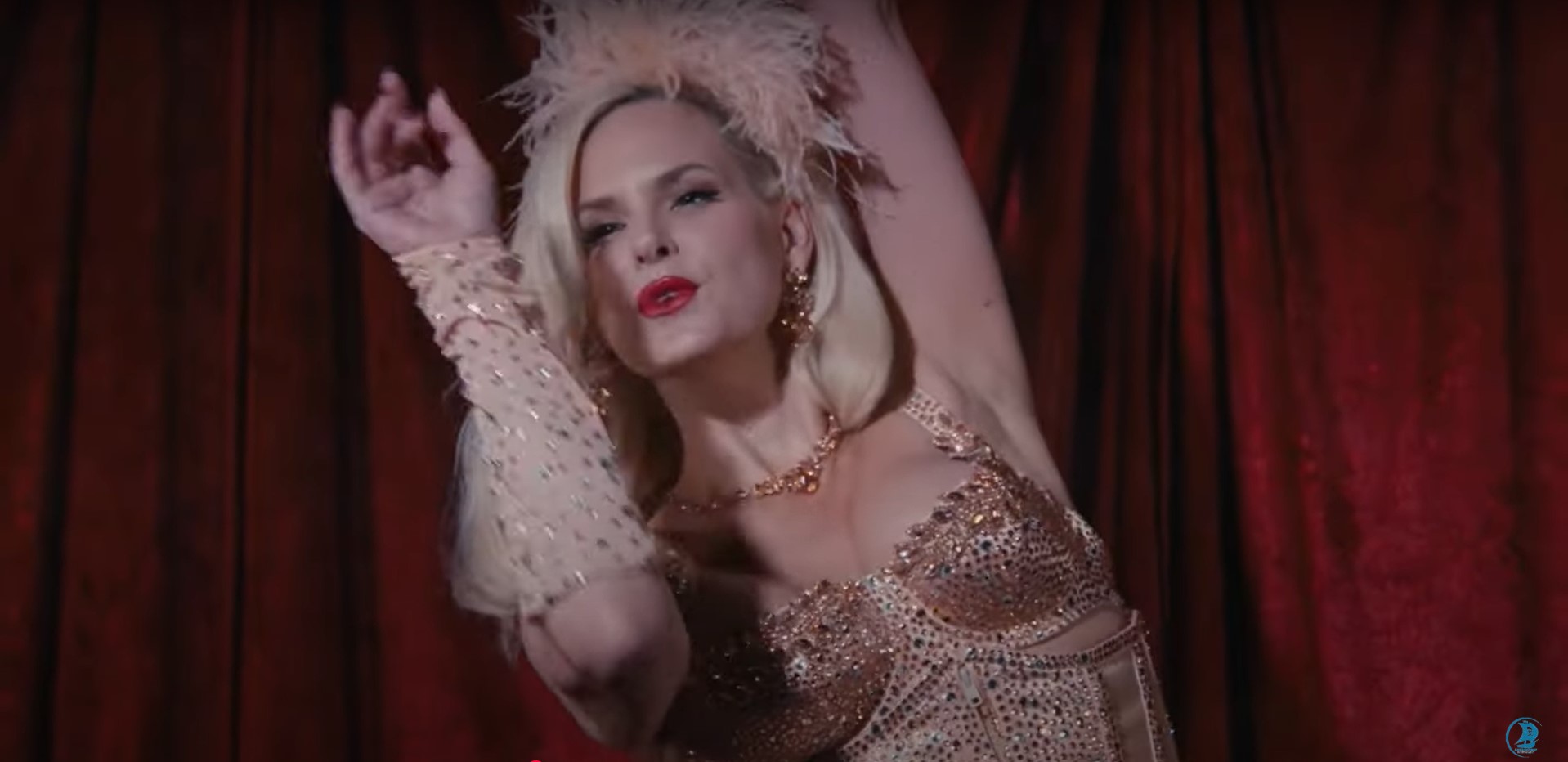
Not Red Heads, Not Brunettes, Blondes! “Young Blondes, Stalked and Murdered!” on Blu-ray!

A Man Looking for Answers Finds EVIL in Tijuana Instead! “Cursed in Baja” reviewed! (Anchor Bay Entertainment / Blu-ray)

Jeff Daniel Phillips’s “Cursed in Baja” on Blu-ray!

Ex-narcotics cop Pierlli is now a formerly incarcerated, rehabilitated man after suffering a mental breakdown from discovering the love of his life dead during a drug-fueled, kidnapping ordeal that sent him spiraling rogue.  Listless under medication and dragging his feet through the motions of a low paying maintenance man and janitorial job, Pierlli is contacted by his lover’s wealthy, depressed and dying parents to investigate and track down the disappearance of their grandson.  Reluctant to fall back into psychological swirl of pandemonium, he agrees to the case that leads him to Mexico despite the grandfather’s warnings of unsavory unlawful dealings with criminals .  After a few interviews with the grandson’s known associates, gathered by previous detectives who have since disappeared, he’s able to locate the now young man, living in cohabitation with a peculiar pair of outlying summoners who sacrifice the unwelcomed to a native beast of the land, a vicious chupacabra.

Out from under the cinematic and musical thumb the Rob Zombie rockabilly show, Jeff Daniel Phillips emerges with a project his shocking rocking collaborator and friend is not attached to in any way, shape, or form.  “Curse in Baja” is Phillips’s sophomore feature-length film in over a decade since the 2009 jailhouse thriller “Convict,” starring Kevin Durand, and too like his debut film, Phillips also provides the screenplay for the 2024 film that’s described as crime noir meets surrealist horror from Los Angeles to Tijuana.  “Curse in Baja” is a Camp Lee and Indigo Vision production with Kent Isaacs coproducing with Phillips as well as having a role and the revitalized Anchor Bay Entertainment execs Brian Katz and Thomas Zambeck supplying financials in support to release the movie on home video, co-presented with Traverse Terror, a company we’ve seen light of recently and covered films with “Bag of Lies” being the most recent.

Phillips not only produces, writes, and directs, he also stars as the troubled Pierlli, opening up his introduction in a non-linear fashion under a character self-describing, self-loathing voiceover narration revolving around the woman he fell for, hinting at her forlorn fate, his own transgressions stemmed for lost, and how belittled his once formidable self has become after being released from prison.  Inner monologuing picks up here-and-there where narrative leaves off in a quasi-glint of personal elucidation about the characters and situations he finds himself amid, troubleshooting his own inners demons that could destroy him if he goes down the rabbit hole of grief again.  Yet, besides Pierlli’s vague thoughts and descriptions, characters brought not the fold have a prefabrication establishment that’s already patched them into narrative blanket and, for audiences, understanding these characters and see where they piece into the noir pie becomes very dense and chewy, tough to work out their role because much of the backstory is loaded into the chamber before viewers can digest everything mentioned in Pierlli’s opening narration of elongated events.  Jim Storm (“Trilogy of Terror”) and Constance Forslund (John Carpenter’s “Village of the Damned”) are tragic-saturated grandparents who will do anything to find their grandson, but their subtle persona richness filled with terminal illness, alcoholism, grief stricken, and a sordid past is greatly deprecated by little involvement in the rest of the story and their unexplained bad history in the network of how things came to be how they are now.  Instead, their retained lawyer (Mark Fite) has more skin and dialogue in the game of tracking down the grandson, played by the front man Finnegan Seeker Bell of alternative rock band Love Ghost in another character that’s spotty being sensical.  Kent Isaacs as a chupacabra keeper, Jacqueline Wright as a dancing evoker of the beast, Jacely Fuentes as a double dipping girlfriend, and Jose Conejo Martin as a Mexican music mogul and hardcore gangster, too, had shapelessness around defining themselves in character to serve what is a fever dream of past guilt and present lore clashing into a surreal tailspin from Pierlli’s visceral viewpoint.  The only character I could truly make sense and understand is “Re-Animator’s” Barbara Crampton’s short-stint warden role. 

I get “Cursed in Baja” is an indie production with nearly a zero-dollar budget and limited, on-hand advantages.  I get Jeff Daniel Phillips has a knack for the obscure, the off-putting, and the odd.  I get horror is subjective and you make what you get out of it.  With all that being said, “Cursed in Baja” doesn’t speak to me on a level I can fully appreciate, understand, or decipher through the opaque narrative stuck in its own adrift design.  Aspects of the nonlinear course and often repeating multiple same scenes doesn’t beat one down into following along but there’s also a rhythm that does denote Pierlli’s neurosis.  Though chaotic at times, Marc Cohen’s editing captures Pierlli’s agitational anarchy that plagues his nightmares and splits his reality seemingly down the middle of an already drug-and-crime fuel Mexicali affair the ex-con and lawman tries desperate not to repeat, but like any good sage person will tell you, we’re all given the opportunity to repeat dooming ourselves and relive past mistakes.  That’s Pierlli’s Pandora’x box and his Achillies heel, no matter how much he attempts to deflect himself out of the physically crippling investigation, he must sally forth again to find answers for the love he let down.  If he doesn’t, that do-nothing stagnation will ultimately destroy him faster.  I’m sure there are merits to Phillips’ first feature in over a decade, but “Curse in Baja” is all over the place, missing key interlocking points of the nomadic concepts to cement better coherency when switching gears between genres.

Anchor Bay’s third film of the first three releases released by the revitalized company by Brian Katz and Thomas Zambeck, “Cursed in Baja” receives exclusive at-home video rights with an AVC encoded, high-definition 1080p, BD25. The single layer is all this story requires with low-impact, mostly psychological thriller that relies heavily on Marc Cahon’s overlapping fade in-fade out and rough-cut, around-again editing to shoulder the burden of entertaining with Pierlli’s meandering mental melancholy. The compressed image quality provides no qualms for a standard, under-bedazzled indie production in widescreen 1.78:1 aspect ratio. Color saturation varies depending on toggling contrast levels, likely a result of the when-we-can shoot scenes methodology of low budget films. Blacks are not as deep as desired but there’s no signs of artefacts in the void and that suppresses any of kind of resentment toward a lighter shade of the grayscales darker side. The audio comes with an English Dolby Digital 5.1 surround mix. Though lossy, the format retains consistency in a rather heavily vague gumshoe of exposition with not too much crime centric and chupacabra chomping bytes to make or break the fidelity. Dialogue is clean in voiceover as well as in-scene with a favorable soundscape under Vaaal’s eclectic clouded haunt of industrial and discordant string. English subtitles are optional. Special features are limited to feature length commentary by Jeff Daniel Phillips and a making-of featurette with Phillips walking through a shooting location and discussing his ventured process. The Amaray case sports a grindhouse cover art character compilation with no other physical attributes included. The 80-minute, unrated feature is encoded with region free playback.

Last Rites: Jeff Daniel Phillips’s personal stick-and-glue “Cursed in Baja” works to a point off of the auteur’s ambition and who’s in his back pocket network of talented friends eager to lend their niche or locations to create noir delirium a la mode.

Jeff Daniel Phillips’s “Cursed in Baja” on Blu-ray!

All You Need to Protect You From Everything is a Pile of EVIL Socks! “Crust” reviewed! (Anchor Bay / Blu-ray)

Sean Whalen’s Debut “Crust” Now on Blu-ray!

Vegas Winters is a famous washed-up child actor now working at a laundry mat. Depressed from having been exploited during his career years, Vegas’s problems continue as an unkempt, middle-aged man still enamored with an ex-girlfriend who can’t stand the sight of his growth impotency and the news of his show’s revival that stirs up the past’s unwelcomed hubbub. Day-in and day-out, Vegas does the laundry mat rounds, collecting lost socks for his own personal use, whether be for blowing his nose, cleaning a blood lip, or masturbating into for his daydreaming fantasies, until one day the poor schlub is beyond humiliated and sheds a tear into his pile of used and unwanted collection of socks that turns the heap into his own personal protector he calls Crust. Murdering all who emotionally hurt or threaten Vegas, Crust becomes his best pal who has to vie with Vegas’s drunkard business partner and friend as well as his newfound girlfriend who’s infatuated with him.

Sean Whalen is one of the more underappreciated side characters in the last 30 years.  You know the face, but you may not know his extensive filmography.  Most of us horror fanatics adore Whalen in what was likely one of East coast born actor’s most notable roles from early in his career as the wall-crawling, good-hearted, inbred child named Roach from Wes Craven’s “The People Under the Stairs.”  From that film in 1991 to today, Whalen has run the genre gamut as a supporting actor in “Tammy and the T-Rex,” “Waterworld,” Rob Zombie’s “Halloween II,” as well as Zombie’s “3 From Hell” and a slew of other films, made-for-TV movies, and popping up in television series, including the U.S. version of CBS’s Ghosts pilot which I’m still sorely peeved he no longer continued the basement-dwelling, leprosy ghost role.  Now, we’re seeing a whole new side to our favorite side actor who steps into the lead principal role and, also, writes-and-directs his first feature length film with the 2024 comedy-horror “Crust.”  The indie film is cowritten with Jim Wald and is a production between Mezek Films, Moonless Media & Entertainment, Wicked Monkey Pictures, Stag Mountain Films, and the LLC, Crustsock Productions, supported by a crowdfunding campaign that generated nearly 100K dollars from over 600 backers.

A personal project for Whalen, “Crust” came to fruition as an allegorical metaphor for his own depression after a divorce and he plays Vegas Winters, a former child actor who left the industry after the success of his show due to those around him mistreating him or forgetting about him once the show success wore off.  Gloomy-faced, disheveled, and suppressively lethargic and explosively frantic when called for, Vegas is the epitome of depression while co-running a bland laundry with an alcoholic Russ, played by another horror-friendly, long-time supporting actor in Daniel Roebuck (“Final Destination,” “Terrifier 3”).  Audiences will feel for Vegas and his ultimate wish to be left alone as he sends his blood, sweat, tears, and amongst other bodily fluids, into the leftover socks of strangers, but audiences will also be delighted in his return to fervor materialized by a spur-of-the-moment, quirky laundry mat dance routine with his newfound cute-and-cuddly, stiff-sock creature, Crust. Like Daniel, Nila is too entangled in Vegas’s sticky-sock situation as his from-afar admirer turned quickly cemented girlfriend, played by Rebekah Kennedy (“Two Witches,” “Traumatika”), and there ensues the conflict when friend and girlfriend don’t know where they place or stand alongside a sock-monster. Roebuck and Kennedy manage to fiddle the strings of being the irresolute and concerned while not being a total antagonist to Vegas, who himself might not be 100% the hero of the story. “Crust” rounds the big hitting cast with “Sleepaway Camp’s” Felissa Rose and “Ferris Bueller’s Day Off’s” Alan Ruck along with William Gabriel Grier, Charles Chudabala, Ricky Dean Logan, Shawntay Dalon, and Zoe Unkovich.

Divided into laundry themed chapters, “Crust” is all about the depression and the stagnation that it entails. The creature Crust is that imaginary hope or need fabricated to pull one out of its depths and talons as a protector and a friendly companion to retreat into when the world around is threatening with a difficulty level of hard. Vegas is bombarded with down-in-the-dumps missiles being reminded of an unpleasant past, an ex that continues to belittle him, and an escape from reality that soon becomes an invasion of privacy. Whalen’s decision to shoot in black and white is a conscious one that eliminates colorful distractions to keep story focus around the characters, driving down the narrative nail into Vegas’s episodic progress that deepens to deprecating d, depths, and to keep blemishes with Crust’s marionette-ways to a bare minimum. That’s not to express that Crust is a mealy patchwork of loose socks and back felt for eyes. Crust construction might be simple in design but effective in applied personification with emotional swings, eyebrow moods, and hand gestures despite the obvious movement limitations that require multiple shots and cuts at different angles to sell its tearful autonomy and aggressive nature to protect. Remember, “Crust” is a comedy-horror with emphasis on comedy and while Whalen’s directorial debut comedy is fettered by a lighter shade of black, there’s a waving playfulness about it, such as Whalen and Crust’s spontaneous choreography, that provides a wake from the satirical black humor and completely submerge the story in surrealism with laughs and heart-wrenching moments.

One of the first, and hopefully many to come, titles a part of the initial Anchor Bay Entertainment revival by Umbrelic Entertainment cofounders Thomas Zambeck and Brian Katz, “Crust” hits the Blu-ray market with distribution assistance from MVD Visual.  The AVC encoded, 1080p high-definition, BD25 has the work cut out for it with the black-and-white presentation that allows for a better decoding bitrate, hovering around easily a high-20 Mbps.  Monochromic anamorphic widescreen 1.78:1 aspect ratio exhibits cleanly, clearly, and classically in a consistent contrast that balances situational light and shadow where appropriately.  Textures are dullened without color but the picture is crisp without showing fuzziness or compressed without blocky or bandy issue.  Not listed on the back cover, my player detects an English Dolby Digital Stereo 2.0 track.  More talkative than taking action, “Crust” delivers a fine digitally recorded dialogue track through a lossy Dolby compression that while isn’t as an exact replica, it is clear. Yet, dialogue’s separated from the pack, isolated from the caricature ambience of a laundry mat that has settles on a single wash or dryer sound, the exaggerated sounds of exterior paparazzi, and minor action sounds reach the upper audio layer hemisphere, diffusing into virtually the same foreground plane as dialogue rather medium-to-near range background in what is more of a production stemmed, Foley incorporated audio design.  Blu-ray’s bonus features include a Sean Whalen feature length audio commentary track, a Los Angeles premiere Q&A with Sean Whalen, Rebekah Kennedy, Daniel Roebuck, Felissa Rose, and William Gabriel Grier along with Crust puppeteer, Lisa Hinds, and two short comedies about Dorothy post-Wizard of Oz by many, many tragic years of alcoholism, sex, and delusional state of poor Dorothy, written and played by Whalen in “Dorothy:  50 Years Later” and “Dorothy 2:  The Bump and Run.”  Anchor Bay’s releases standard fair within a traditional Amaray case with the image of Whalen, or rather Vegas, the sock-monster Crust, and a trail of speckled blood in a back-and-white laundry mat with no tangible inserts and the same image pressed on the disc but digitally rearranged.  The region free release has a runtime of 102 minutes and is not rated.

Last Rites: Depression sucks, but “Crust” doesn’t in its sticky sardonic theme told simply in genericisms and broad grayscale strokes. Whelan’s first feature is first rate farce with fantastic puppet work and a Whelan, himself, best at self-deprecating his image for what’s good of the story, which is a morsel of his own.

Sean Whalen’s Debut “Crust” Now on Blu-ray!

EVIL’s One Brush Stroke Away From Losing It! “Spiral” reviewed! (Ronin Flix / Blu-ray)

The New “Spiral” Now on Blu-ray!

Mason, a socially awkward painter and car insurance telemarketer, struggles to cope with a seemingly bad breakup that might have turned into a misdeed, but a quick call to his only, childhood friend Berkeley helps keep his anxious emotions from spiraling out of control into nightmarish allusions.  As Mason gradually works to purge his previously relationship, a woman who was also his inspiration for his artistic work, he suddenly meets Amber, a new amiable hire in his company, sitting with him on his lunchbreak outside bench.  Amber’s able to slowly break down Mason’s guarded wall of insecurity and two begin an innocent, romantic relationship as Mason continues to push his haunting past aside for Amber to fully step into being his modeling muse, but the further imbed she becomes into his life the more enigmatic secrets are revealed surrounding Mason’s life, even the darkness that slowly spreads and loops into it.

Actor Joel David Moore had established himself as an actor in early 2000s, usually portraying the lanky, awkward, if not ungainly trope in comedies most notably in “Dodgeball” and “Grandma’s Boy,” playing a supporting protagonist as well as lead antagonist.  Director Adam Green quickly became an overnight success amongst genre fans with his release of the Cajun miscreant slasher in “Hatchet” that would spawn a pair of sequels.  Having worked as actor and director respectively on “Hatchet,” Moore and Adam became good friends and decided to take a step further to not only expand upon an acting career and expand upon the objectivity of storytelling but also to co-direct their next project entitled “Spiral.”  The script, that orbits around the romantic-psychological thriller purview, is cowritten between Moore with debut feature writer Jeremy Boreing.  The 2007 film revolves around and enters the disconnected mind of an emotionally compromised individual and how he copes and handles everyday life while in constant fear.  “Spiral” is executively produced by Moore and costar Zachary Levi along with Boreing, David Muller, Kurt Schemper and Cory Neal producing under the Balcony 9 and ArieScope Pictures production flag.

If you haven’t gathered already, “Spiral” is Joel David Moore’s baby.  Moore’s idea natural earmarked him as the executive producer and the project is the first to land him a directorial and a writer credit, so unsurprisingly, the role of the socially recluse and mentally scarred Mason went to the Portland, Oregon born actor, likely a role he wrote with himself in mind.  As Mason, Moore breaks the mold that has trapped him in previous films that were relegated to what producers might have considered not leading man material, leaving much to be desired when stuck in a second of third string supporting role.  Then Adam Green puts Moore in “Hatchet” and in the principal protagonist role.  The opportunity proves Moore had more than just comic, sidekick relief and he really cements Mason’s depth with ticks, tantrums, and a taste for tenterhook romance.  Meeting Mason in the ambiguous opening stirs internal conflict for how we’re supposed to receive this hyperventilating wailer confessing to something vile we’re not privy too just yet.  From there, we meet the philandering, go-with-the-flow, and Mason’s best bud, only friend at that, Berkeley (Zachary Levi, “Shazam!) and the quirky cute and Mason-eyer Amber (“Amber Tamblyn, “The Ring”) that develop upon Mason’s home-work relationship that highlight his interests – painting and jazz – as well as his disinterests – basketball and speaking about his past.  The very opening scene compared to the heart of much of the story has stark contrast and, so much so, that audiences will tend to forget Mason’s late-night phone call ramblings and fear to his friend Berkeley, his wake-up screaming nightmares to wear he looks at his hands for blood, and his overall highly anxious persona when he’s talking shop and girls with Berkeley and breaking out of his shell of solitude with Amber in a lengthy string of normalacy.  Ryan Chase, David Muller, Annie Neal and Lori Yohe fill out the cast.

“Spiral” is all about the trauma, a fiercely common theme inside the heads of the mental thriller subgenre.  With deeply troubled lead character, an at interval switchboard that lights and darkens between the protagonist and ambiguous antihero storyline, watching Mason grow, fall, grow, fall, grow, and then finally collapse in a heap of his own trauma is terrifyingly satisfying, mostly to the thanks of Moore’s added plummeting nuances that spit his character back into abnormality.  Mason’s arc circulates in a circular pattern and the evidently timebomb is ticking away but in the middle of that circulation forms a bond, a friendship, an affair, hope, compassion, and every affirmative adjective you can think of to bring happiness to what shouldn’t be a happy trajectory because in the back of our minds, darkness lies.  That’s the sublayer of this trauma-laden yarn with a repressive factor and the key to unleash years of pent up unlocks a whole new side of Mason, one that isn’t completely illuminated upon until the shocking, device-destroying end.  

Ronin Flix rekindles Joel David Moore and Adam Green’s “Spiral” back to Blu-ray with an AVC encoded, 1080p resolution, BD50. Comparatively to the Anchor Bay 2010 Blu-ray release, which also presents the film in a widescreen 1.78:1 aspect ratio, Ronin Flix edges out the now decade previous release but not by much. The back cover only notes the label went through a film restoration with no other details or specifics to elaborate but from a spectator’s view, the 2024 restoration handles a sharper delineation that provides excellent depth that plays key to the various scenes of Amber and Mason’s painting sessions, Mason’s guilt-ridden obsession with the bathroom door, and Mason’s overhead cubicle viewpoint to name a few examples. Details are much more specific in brighter, ambient-lit scenes than the darker shades of key lighting or night sequences not only because of the innate lack of illumining exposure. Blacks tend to crush slightly, bleeding in the details and washing them out in blank of black. Skin and textures particularize better on Ronin Flix’s upgrade that uses a newer codec for compression, elevating the elaboration for this under-the-radar indie. The English DTS-HD Master Audio 5.1 manages the lossless mix much in the same was as Anchor Bay’s with greatly clear articulation on the forefront, a spacious and spatial ambient track, a patterned sound design dynamic to the progression, and a supporting soundtrack that while isn’t overly worthwhile does aid the varying moods, especially when Mason turns on a dime intertwined with jazz brass. Decent sound diffusion through the back and side channels to harness surrounding elements while the fronts tackle the predominant dialogue until an occasion acousmatic turns our heads and our attention. English subtitles are available for selection. The static menu offers special features that includes exclusive content, such as a newly put together making-of “Spiral” entitled Paint it Red, an audio commentary with Adam Green and Joel David Moore, director of photography Will Barrett, and editor Cory Livingston an a behind-the-scenes documentary featurette with interviews from Green, Moore, Livingston, Barrett and co-star and producer Zachary Levi. Archival content includes an audio commentary with the co-directors, director of photography, Levi, writer Jeremy Boreing, and actress Amber Tamblyn, and rounds out with the theatrical trailer. A cardboard O-slipcover sheathes the Blu-ray Amaray case and both contain the same more-gruesome-than-it-really-is cover art and David Levine package design. Inside the case is just the disc pressed with a third copy of the hand dripping blood, or paint. Ronin Flix release is rated PG-13 for disturbing behavior, violence, some partial nudity and language, has a runtime of 91 minutes, and also unlike the Anchor Bay release, this release has region free playback.

Last Rites: “Spiral” paints Joel David Moore in a whole new light, colored in vague tones that just nip at nerves, and slaps you square in the face just when things start to feel warm, cozy, and safe.

The New “Spiral” Now on Blu-ray!

Beer Can Stuff Boots Give EVIL a New Height! “The Lost” reviewed! (Ronin Flix / Blu-ray)

Click Here to Purchase “The Lost” on Blu-ray!

Sociopathic teen-adult Ray Pye guns down two young women he suspects are romantically involved with each other and wants to feel the thrill of the kill for the first time with his two friends, Jennifer and Tim, as frightened, reluctant witnesses and abettors to his heinous crime.  Four years later, police investigation can’t pinpoint Pye as the culprit when the only surviving victim succumbs to her wounds after being in a coma all this time.  Pye, the slicked haired, pathological liar and assistant manager of his mother’s motel, continues his nice boy act as he peddles drugs and tries to woo any girl into bed while having a firm, feared grip on best friend Tim and girlfriend Jennifer to keep them in line.  As Pye chases after new women that enter in his world, the police continue their unofficial investigation, waiting for Pye to slip up and make a mistake but as his manipulation backfires and things don’t go his way, Pye’s already unstable nature morphs into an all-in, serial killer rampage and kidnapping of the three prominent women that have recently challenged his masculinity.

A real down spiral of machoism and growing up out of the adolescent fantasy world, “The Lost” is the 2006, loosely based biopic thriller inspired by real-life serial killer, the Pied Piper of Tucson, Charles Schmid interpreted from the book of the same title by late horror novelist Jack Ketchum.  This part II of our serial killer film review coverage, following the Robert “Willy” Pickton Canadian murders inspiring “Pig Killer,” “The Lost” bring us back to American murderers and is the first solo feature run for writer-and-director Chris Sivertson.   The father-son duo Mike and Lucky McKee, the filmmakers behind “May” and “Roman” co-produce “The Lost” alongside Sivertson and Shelli Merrill under the production company banners of Silver Web Productions.

To play Ray Pye, the actor must incarnate being on the edge of principles and be crazed to the point of no return.   For Marc Senter, Ray Pye was a means to break from minor television roles and star as a leading man defying principal conventions in being the best bad guy he could cook up.  Senter, who went on to be in credited roles of “Wicked Lake,” “Cabin Fever 2:  Spring Fever,” and “Old Man,” will forever be seen as the crushed soda can-filled boot wearing and greaser veneered Ray Pye as the boyish-looking Colorado native brings the ferocity, the energy, and the killer instinct of a high-strung teen teetering the line of losing it all.  Senter’s approach rides on insecure masculinity of being a short man showing teeth to appear larger than life and exacts a screen perforating fear that holds friends Jennifer (Shay Aster, “Ernest Scared Stupid”) and Tim (Alex Frost, “Elephant”) in a tail-between-the-leg stasis of his end all, be all despot presence.  Aside from the Ray Pye storyline, a trio of sub-stories add more development and substance to other principal characters, such as Tim and Jennifer hooking up dictated by them inching out from under Ray Pye’s reach, a washed out midlife Detective (Ed Lauter, “Cujo”), who was formerly on the Ray Pye investigation, and his romantic involvement with a Pye pursuant Sally (Megan Henning, “I Know Who Killed Me”), who is approx. 40-years the Detective’s junior that creates an intriguing, struggling dichotomy between love and appearance, and with the alluring Katherine Wallace (Full Moon regular actress Robin Sydney, “Evil Bong” franchise) in a love-hate, obstinate relationship with an absent psychotic mother and her fondness for Ray in who on some levels mirrors the same qualities as Katherine’s mother.  Michael Bowen (“Deadgirl”), Dee Wallace (“Cujo”), Tom Ayers (“Bloody Bridget”), Cynthia Cervini, Richard Riehle (“3 From Hell”), and to compound skin scenes, soft-core erotic starlets Erin Brown (aka Misty Mundae, “An Erotic Werewolf in London”), and Elise Larocca (“Blood for the Muse”) co-star.

What first struck me about Sivertson’s “The Lost” is it doesn’t define a period in time.  Charles Schmid’s reign of terror coursed the span of a year in the mid-to-late 60s, which follow’s Ketchum’s timeline in the novel.  Yet, the books’ characters follow the movie’s scheme without clearly stating the years, stringing the connection between the three like step-relationships.  Pye’s greaser finish, drive-in burger joints, boxy-rectangle cars and VW Beetles, and a motel as one of the principal shooting locations float in the very essence of the title itself, as a Lost in time story that stretches the decades.  What’s not lost is the aggressive sexual nature that drives the nihilistic Ray Pye’s bedding scorecard by feigned compassion and romance; yet there’s plenty depth behind his sleazy cockiness that warrants more discussion into his problematic psyche, such as how he’s able to charm the pants of these women and how he’s able to keep those who fear him, close to him.  Sivertson’s unafraid to make a statement in “The Lost’s” sexuality with plenty of skin from a number of the principal actresses to the simulated sexual acts in and out the vein of style and in and out of Pye’s sociopathic tantrums that’s more self-doubting bullying than actual power.  At a young age, Pye aims high for machohood by the misguided dealings of the cards he’s dealt, augmenting himself with shoe stuffers and makeup to make him taller and more attractive.  “The Lost” is very much a deconstruction of masculinity mania in the way we see Pye’s worlds comes crashing down and he loses everything when his guard is down by one swift moment of real, tangible love with Katherine and the only way to gain back control, like a hissy-fitting baby, is to go berserk in a if I can’t have it, nobody will tear. 

Evil never looked so dapper as “The Lost” receives a new 2K remaster produced from a 4K scan of the original camera negative by the boutique label Ronin Flix.  The AVC encoded, 1080p, high-definition BD50 contains the presented anamorphic widescreen 2.35:1 film with pixel-by-pixel coherence exacting extensive details and chromatic fidelity.  What stuck out the most from the 4K scan was the night scenes blanked in near sheer darkness with minimal direction illumination from natural and unnatural lighting in a positive, well, light.  In night forest scenes, especially around the lake, objects are lost in the void of shadows, tenebrously covered in obscurity, and that’s accomplished and accentuated in the opening moments of Ray Pye’s debut double murder, creating a better illusion of reality rather than creating an illusion out of often folly fabrication of dark blue gels or immense random key lighting.  Textures are strong through, greatly defined by the delineating of edges on striking clothing, cars, and the amount of skin displayed.  Two lossless English audio options are available to select from:  a 5.1 DTS-HD Master Audio and a 2.0 Stereo DTS-HD Master Audio.  “The Lost’s” audio/video design produces a high fidelity and contains a blend of unprocessed and stylistic expression that stretch the audio range depending on the current Ray Pye Richter scaled mood.  Pye’s occasional rapid-fire rants are unmistakable and clear as the decoding unfolds every syllable without sounding seamless or garbled.  English SDH are optionally available.  Ronin Flix delivers new and previously owned special features.  New content like an audio commentary with director Chris Sivertson and Lucky Mckee serve as a trip down memory lane with new, pondered upon insights and recalled tales and new individualized interviews with principal actors Marc Senter, Robin Sydney, and Shay Astar in regard to auditioning, prepping for the role, and recalling their experience on the shoot expand more into “The Lost’s” attention and what it took to illuminate focus on the Pied Piper of Tucson.  A second, archival commentary with writer Monica O’Rourke moderating conversation with late novelist Jack Ketchum, audition tapes, outtakes, storyboard sequence, and the original “Jack and Jill” short film directed by Chris Sivertson fill out the special features.  A new front cover design, replacing the bland bullet hole-riddled and blood-puddled eyes cover on the Anchor Bay DVD and Blu-ray, on the trio of cardboard O-slipcover, translucent Blu-ray Amaray case, and disc art spruces up the Ronin Flix’s lifted release with a sense of hep threads and fatal knuckle sandwiches.; however, that’s about the extent of its physical beauty and tangible adjuncts.  The region free Blu-ray comes not rated and has a runtime of 119 minutes.  Marc Senter’s tour de force burns rubber, a ferocity of friction and perpetual anger sculps one of the best true-to-life silver screen villains from the last two decades. 

Click Here to Purchase “The Lost” on Blu-ray!