No EVIL Gets Left Behind! “P.O.W. The Escape” reviewed! (Ronin Flix / Blu-ray)

“P.O.W. The Escape” on Blu-ray at Amazon.com!

Colonel James Cooper’s moto is no one gets left behind.  The seasoned P.O.W. extraction officer volunteers for a politically spearheaded suicide mission to save Vietcong American captives before a cease fire treaty ends the war, effectively turning the P.O.W.’s into M.I.A. and possibly never heard from again.  As the U.S. Airborne Colonel expected, the mission of rescue results in a complete fiasco of resources and being empty handed of prisoners as the enemy suspected an imminent attack.  Cooper becomes a P.O.W. alongside the men who set to rescue but that doesn’t deter the determined officer to plan his escape, but before detailing out a route out, the camp’s warden Captain Vinh has alternative plans for his prized captive in all of North Vietnam.  Vietcong headquarters wants to retrieve the Colonel in two days for public execution but Capt. Ving seeks a better life outside his country and accumulates the K.I.A. and P.O.W.s valuables plus in addition to stealing gold bars form his country in order to relocate him and his family to the U.S. but on his terms with a perilous journey across enemy lines with all the P.O.W.s in order for no one to get left behind.

The Carradine name is one of the most recognizable names in Hollywood with David Carradine the most famous, behind his father John Carradine, with his highly successful television series from the mid-70s, “Kung Fu.”  A part of “Kung Fu’s” success was due in part of the decade itself where kung fu films were a peak popular with rising star Bruce Lee.  A decade later and still in the shadow of that breakout series with a made-for-television movie, Carradine breaks into another rising type of films that trades in hip-throws and round house kicks for M1 assault rifles, Huey helicopters, and the jungles of the Vietnam war.  And coincidently enough, Vietnam actioners were made popular by another martial artist with “Missing in Action” starring Chuck Norris.  Carradine’s venture into the America’s shame frame being exploited for personal gain is P.O.W. The Escape, a rip-roaring and explosive do-or-die war caper from first time director Gideon Amir and penned, and re-penned, by Jeremy Lipp (“The Hitchhiker” TV series), James Bruner (“Invasion USA”), and “Deadly Sins” co-writers Malcolm Barbour and John Langley.  Also known as “Attack Force ‘Nam” and “Behind Enemy Lines,” the Philippines doubling Vietnam production is produced by Yoram Globus and Menahem Golan as a Globus-Golan Production.

The Late Carradine epitomizes stone-faced patriotism as the exfiltration expert Colonel Cooper.  Showing hardly any emotion except for a handful of scenes that call for it, or else Cooper would be a full-scale unempathetic sociopath, Carradine gives his best harden American warrior as well as an indestructible combat commando where a barrage of bullets whizz around him, explosions don’t impede his health, and an army of Vietcong are no match for the Colonel’s American flag draped, M60 machine strapped fighting spirt in an uphill battle of certain death.  Its farcically funny to behold but that was the traditional one-man-army paradigm back then and, to an extent, still is even today to give audiences as gung-ho and impossibly invincible hero.  Cooper leads a bunch of weary P.O.W. troopers on the brink of becoming lost in wartime politics and only three out of the bunch are highlighted throughout the misadventure toward safety with those roles’ boots on the ground by Steve James (“McBain”), as the order-following Sgt. Johnston, Phillip Brock (“American Ninja”) as wise-cracking know-it-all, good soldier Adams, and Charles Grant (“Witchcraft”) as the maverick Sparks who initially goes against Cooper’s plan.  Sparks is likely the most interesting and complex character with an internal conflict having set into his own path of escape dedicated on selfishness and greed only to feel the tremendous weight of guilt and burden of his fellow soldier while on the bed of a half-naked, North Vietnamese prostitute.  The last major principal is actually a Captain, that is Captain Vinh, played by one of the most recognizable faces in Japanese cinema history, Mako, of Arnold Schwarzenegger “Conan” fame as the Akiro the Wizard.  Understanding Vinh’s motivation hardly musters conclusively on why he wishes to defect his country and why he needed Colonel Cooper to accomplish it.  Perhaps Vinh’s undergoing hate for his own country was lost in the editing room as the film is noted to have gone through multiple re-writes, edits, and additional post-production shoots.  “P.O.W. the Escape” fills out the cast with Daniel Demorest, Tony Pierce, Steve Freedman, James Acheson, Ken Metcalfe, Ken Glover, Rudy Daniels, and Irma Alegre.

For Gideon Amir’s first picture, this Vietnam vehicle is an action-packed romp.  Never letting up on the accelerating peddle, especially with Cooper’s blank determination to get all the men out of the arm struggle before a treaty wraps up the conflict and leaves his charge in casted away in the arms of the enemy, what Amir accomplishes at the behest of his influential producers wonders how this high-value production ever made it past post without being a completely incomprehensible mess.  There lies choppy moments of editing that puts into question it’s original concept even if one isn’t aware of the film’s narrative conflictions.  What ensues is not a traditional rally and escape from a torturous, inhuman enemy camp that one can’t abscond from so easily; instead, the narrative becomes an escapade of itinerant provides various difficult scenarios that split up the group, sees internal turmoil, and propels desperation to get to the friendly Huey’s with their very lives, but doesn’t see Cooper come under threatening fire as he spurts off short rifles rounds and takes out a handful of Vietcong at once with one scene reminiscent on a particular World War II hero charging up hill and taking out a whole German squadron alone with a machine gun.  Audie Murphy, If remembering accurately, but instead of sustaining any projectile wounds, Cooper thrusts forward unscathed while those G.I.s he’s trying to recover and rescue perish in an inescapable firefight.  Carradine’s stoicism throughout the life profit and loss campaign doesn’t match Cooper’s liberation maxim that forces “P.O.W. the Escape” into an impassive, often times comical, attitude with the story’s central character.

Director Gideon Amir and David Carradine tempt their hand at the Vietnam vamoose now on a Hi-Def Blu-ray forged by Ronin Flix through way of Scorpion Releasing’s 2019 HD transfer of the previous MGM print.  The widescreen 1.78:1 aspect ratio presented feature fails to capture impeccable clarity of acme perfection with approx. half the frames wilted away with artefact de-escalation of details. Half the scenes look great with a semi-serious saturation of color, a few of facial and foliage details come out, and textures have tactile range at times, but the film’s glass is only half full within a darker dilution of speckled splotches. The English DTS-HD 2.0 master audio mix relays a fair enough dialogue consignment with comprehensible clarity and is utterly clean but lacks punchiness with a flat as a David Carradine’s poker-face facade. With a robust range of gunfire, explosions, and modes of transportation, especially going through the mucky and miry jungles of war-torn Vietnam, the film definitely needed a stronger suit of sound but was ultimately discharged without dullness. English subtitles are available. Special features include three on-camera interviews with Director Gideon Amir, screenwriter James Bruner, and stunt man Steve Lambert discussing their particular involvement in pre-and-principal shoots, some of the process woes, and how exotic the opportunity was to work internationally and with David Carrine. The film’s original trailer rounding out the special features block. Physically, the Ronin Flix release comes in a standard Blu-ray snapper with an action-packed and commandoed David Carradine blasting off his rifle like in a Ghana-esque illustrated movie poster. Inside, the lack of insert and reversible cover art leads our eyes straight to the disc art that’s the same as the cover, cropped down to fit in the circumference. Rated PG, that is rated 1986 PG with strong war violence, strong language, and nudity, the release is region A locked in playback and has a runtime of 86 minutes. A campy commando campaign capitalizing on the success of the Vietnam prison camp subgenre, “P.O.W. the Escape” could be much worse for wear as a solid action flick fierce in delivery yet fickle in substance.


“P.O.W. The Escape” on Blu-ray at Amazon.com!

The Dark One’s EVIL Sucks the Air Out of You! “Robot Holocaust” reviewed! (Ronin Flix / Blu-ray)

“Robot Holocaust” enslaves Humanity on Blu-ray!

Year 2033 – a robot rebellion turned the once convenient machines into man’s most deadly adversary.  The aftershock of war has left mankind almost extinct and most of the atmosphere uninhabitable with radiation.  The last standing metropolis on what is now known as New Terra has the only breathable environment monopolized by the tyrannical Dark One, a disembodied machine that uses human slave labor to fuel the air producing contraption for the entire city.  A motley band of heroes, led by an outsider from a wasteland tribe who can breathe the toxic air, embark on a perilous journey to the Dark One’s factory lair, evading deadly flesh-eating worms, wasteland mutants, and a ruthless robot subordinates under the command of the Dark One.   Their mission is to rescue a purloined scientist after developing a device that lets people breathe outside the Dark One’s grip of a controlled environment.

The 1980s is a goldmine for post-apocalyptic cinema that has virtually no ambit.  Whether a big Hollywood studio or a rinky-dink production, inhospitable badlands filled with cutthroat survivors and malformed beings unfortunate enough to be left alive to battle it out to the death over the Earth’s last remaining precious resources was (and to an extent, still is) a salivating story prospect with vast barren landscapes, dangers around every corner, an untamed primal violence, and a BDSM-like wardrobe that hits the suppressed kink nerve in all of us.  Tim Kincaid’s “Robot Holocaust” is right smack dab in the middle of the subgenre and plays tune to every crowd-pleasing characteristic.  The 1987 post-apocalypse actioner is written-and-directed by Kincaid who cut his teeth on gay adult films in the late 1970’s and has maintained a healthy dose of homosexual erotic and adult films throughout his career until 2017 under his pseudonym of Joe Gaga.  After complete stag only cheapies “Cellblock #9” and “…in the Name of Leather,” Kincaid received a hankering to dip his directorial toes into sci-fi and horror, beginning with the sexual assaulting alien flick “Breeders” in 1986.  “Robot Holocaust” became the filmmaker’s subsequent feature one year later, shot mostly in the abandoned Brooklyn Navy Yard buildings as well as the undeveloped then Roosevelt Island in New York City.  Presented by Wizard Video (“I Spit on Your Grave”), Tycan Entertaiment and Taryn Productions are the companies behind the film. Taryn Productions is a subsidiary created by Charles Band (“Puppet Master’) and named after his daughter Taryn. Cynthia De Paula produces the film, who she almost exclusively produces every Kincaid sci-fi horror fixation, and the film likely supported by Charles Band in an executive producer role.

“Robot Holocaust” follows the narrative of a ragtag bunch of good-guy survivors journeying to rescue a friend and take down a tyrannical overlord.  While not one role stands as a principal lead, the band of heroes is led by Neo, played by Norris Culf.  Starring in his first lead role following a couple of smalltime gigs in supporting roles in another Taryn Production, “Necropolis,” and in Tim Kincaid’s “Breeders,” Culf receives his big break as a wasteland conqueror able to breathe outside in the radioactive atmosphere.   As a leader, Culf isn’t as charismatic as Keanu Reeves’ Neo nor is he fierce enough to be intimidating; instead, Culf is quite reserved, unpowerful, and lacks coordination to pull off choreographed fight sequences with a believable plausibility.  Nyla, on the hand, is played Jennifer Delora of “Frankenhooker” and “Fright House.”  Delora, an martial arts blackbelt, brought the proper attitude to her fiercely feministic leader of the She Zone women tribe by adding the mean to Nyla’s demeanor.  The other woman of the group is Deeja, Jorn the Scientist’s daughter who terribly reliant on her father, sparking major contrast between her delicacy in daddy issues and Nyla’s hardnosed, man-hating feminism.  Nadine Hartstein and Michael Downend reconnect from their minor roles in “Necropolis” to be the daughter and father team at the core of suicide mission. More ceremonious than being an emotional wreck of being separated during the middle of a robot run world, Harstein and Downend bring little flair as they themselves often are more automaton than the automatons. Joel Von Ornsteiner (“Zombie Death House,” “Slash Dance”) had the most flair as Klyton, a pickpocketing free-thinking droid that looks like a cross between Star Wars’ C3PO and MAC from “Mac and Me.” Ornsteiner never let up or broke the eccentric droid’s light-hearted Robin to Neo’s Batman antics complete with rigid, robotic movements and a ray gun that never seems to work. One of the more painfully pressed roles is Valaria, the Dark One’s flamboyantly dressed second in command. Think “Forbidden Zone”-esque. Angelika Jager performance in cahoots with the Dark One is about as dry as toast and at odds with her own vestigial accent. Jager’s the congenial visual to her counterpart Torque’s effectual exoskeletal mechanical cover who could pass for a T-800 with the teeth replaced by dangling like Lobster antennae. Rick Gianasi, who went on to be Troma’s Sgt. Kabukiman, plays the underestimated and underrated villain, leading the way for other sidelines roles with a cast that rounds out with George Grey, Michael Azzolina, John Blaylock, and Nicholas Reiner.

As mentioned earlier, “Robot Holocaust’s” acting isn’t good.  It borders old-timey melodramatic in a proclamation sense.  There are no in-depth discussions, debates, conversing naturally, or any aspect of the dialogue having a normalcy about it as everything is vigorously proclaimed or is awkward narrated for exposition.  The other half of the problems is in direct result of Kincaid’s poorly written script that can’t capture ordinary conversation, much like those of his pornographic films, I would think. Nor could Kincaid write himself out of the erratic flippancy of some principal characters who woujld go from bad to good then from good to bad in a blink of an eye.  While the communication is about a dull as a butter knife, the costuming is where “Robot Holocaust” balances the scales with 80’s ridiculously appropriate garb of what the ruined future would sport.  A metrosexual mixture of v-neck pelt shirts of mystery animal origin and early WWF professional wrestler spandex turn the men into “Conan the Barbarian” types, to which a few other influencing aspects are pulled from the Schwarzenegger epic fantasy.  The women are equally suited but with more finesse in the way of warrior princess as well as a goddess. With a title like “Robot Holocaust,” the android designs better be spectacular and in all for its time period, Ed Fench’s designs and Valarie McNeill’s fabrications are a mixed bag of good and bad. Klyton derives too heavily from “Star Wars'” inspiration without wowing into something of the tiny production’s own while Torque radiates power and fear with a complete head-to-toe body suit of an acolyte with attitude. Both designs don’t compartmentalize by operating individual body parts, such as moving mouths or even hands for that matter, which would have nailed the robots down for a film called “Robot Holocaust.”

Ronin Flix, under the re-distribution of Scorpion Releasing and MGM, release “Robot Holocaust” on a 1080p high-definition AVC encoded Blu-ray. The hard coded region A North American release is presented in an anamorphic widescreen 1.85:1 aspect ratio from the original 35mm negative. Natural grain, a palatable and diverse color palette, and swelling textures, such as fine details in the skin, scuffed up droids, and a grimy industrial complex provides a zestier interest that parallels the languishing storyline. The English language 5.1 DTS-HD Master Audio is remarkably clean, much like the transfer, with a coextending presence of robust range, depth, and quality. The proclaiming dialogue is crystal clear, hanging on every syllable and syntax, with no issues with hissing, popping, or other flaws. Jager’s accented monologues and conversations are kitsch guilty pleasures to hear her laissez faire style and delivery. Special features include a new interview with Nyla actress Jennifer Delora touching upon little-by-little her experience with cast, crew, and overall project. There’s also the official trailer included. The physical release comes in a regular blue snapper case with one-sided grindhouse artwork of a looming Torque, an explicitly worn skull, and Angelika Jager’s Valaria with her eyes closed and slight smirk. The unrated film runs a brisk 79 minutes. The “Robot Holocaust” is only 11 years away according to the film’s timeline, but director Tim Kincaid’s future can’t help but feel like a vintage hunk of junk by the stale performances and skimpy Tarzan-like duds and getting through the brief runtime proved unfortunately challenging.

“Robot Holocaust” enslaves Humanity on Blu-ray!

Come With EVIL If You Want to Live. “The Zombinator” reviewed! (Bayview Entertainment/Screener)


In Youngstown, Ohio, a small documentary team follows popular fashion blogger JoAnne and while continuing to roll film during a friend’s wake, a fallen member of the military during combat, a horde of zombie horror storm the reception hall packed with celebratory mourners. JoAnne, the documentary crew, and a handful of JoAnne’s friends run for their lives through all of Youngstown only to be rescued by a former Afghanistan war solider, Atam, debriefing the situation of a powerful drug manufacturing corporation behind the localized crisis. The survivors soon realize that a band of greedy mercenaries, Atam’s ex-brothers in arms, are supervising the drug’s effects that will, in turn, create a money making, desperation cure in the weeks to come.

If you haven’t guessed, 2012’s “The Zombinator” is a zombie title melded with “The Terminator” franchise and helmed by documentarian and comedy writer-director Sergio Myers. “The Zombinator” is the first horror feature in the filmmaker’s videography repertoire that chips in comedic soundbites to fully absolve the zombie apocalypse film from being a strictly horror. The very reason the film’s called “The Zombinator” should have been a great comedy-horror indicator as well. Sergio Myers’ 7 Ponies Productions finances the micro-budget, semi-found footage feature that egregiously pollutes the very “Terminator” brand in a way that promotes “Lady Terminator” from being not only a grandly exploitation of Indonesian deference, but now an innate fragment of the renowned franchise. “The Zombinator” endoskeleton is not as indestructible with little-to-no homage connection other than a muscly actor donning his best Arnold Schwarzenegger lookalike getup, dressed a bastardized version of the T-800 infiltrator. No machines. No time travel. No anything that approximates the franchise that would have been a cool concept of a time traveling machine hellbent on blowing zombie scum away.

The cast is virtually made up of unknowns, faces who certainly received their career start with a foot inside the door of “The Zombinator.” The talent is young and unseasoned, but hungry to make a name for themselves with melodramatic performances despite a poorly written script that’s more stationary than progressive on the coattails of the last “Terminator” film “Salvation.” While the documentary team films fashion blogger JoAnne played by Joanne Tombo, Tombo isn’t the headliner. In fact, a lead is lost in the scuffling mist of the zombie outbreak, but the top bill is certainly given to an experienced acting vet in the hard-nosed form of Patrick Kilpatrick (“The Toxic Avenger,” “Eraser”) as a military colonel squaring up against the poster boy of “The Zombinator” and the film’s co-producer, Joseph Aviel in his debut feature film. Aviel, who has doubled as Arnold Schwarzenegger in the YouTube sci-fi comedy episodes of “Terminator: Genisys: The YouTube Chronicles,” is just as monstrous as Schwarzenegger was in his prime, garbed in a pitch black trench coat, wielding a shotgun, and sporting shades inside dark warehouse and nighttime scenes – keep in mind, Aviel is not playing a machine, but a ex-soldier so there’s really no need for the sunglasses. The rest of the cast, including Aviel, are quite rigid and lost, stuck in a loop of spewing much of the same peculiarities without every changing. “The Zombinator” rounds out with Lucia Brizzi, Justin Brown (“Early Grave”), Diana Sillaots, Jennifer Sulkowski, Scott Alin (“What’s Eating Todd?”), Travis Bratten, Melvin Breedlove, Maria Desimone, and Michael Angelletta.

Recently, I caught “Star Trek: Deep Space Nine” episode from “Star Trek: Deep Space Nine” with Patrick Kilpatrick as a hardnosed, war-torn Starfleet officer whose been part of a team holding a pivotal Jem’Hadar communications array in the Chin’toka system. The lean and towering Kilpatrick from 20 plus years ago is nearly unrecognizable as Father Time has been rather unforgiving to the actor’s midsection, but Kilpatrick still has that apathetic stare on top of a sternly contoured face graced now by an impressively horizontal and lengthy bushy mustache. Kilpatrick’s a brilliant highlight in a rather abysmal film of bleary lines on whether it’s supposed to be found footage or not horror-comedy; somehow the found footage crew are not a part of the surrounding action to the extend that zombies and the mercenaries are not aware of their presence despite standing merely a few feet away in plain view, but the survivors are clearly aware of them combatively noting to the crew to turn off their cameras …? Also, the comedic lines, such as, “getting popped by the grand fucking wizard of zombies,” seem sorely out of place, poorly timed between frantic moments of confusion, fear, and strife, and don’t really know if they’re actually intended to be funny…? Confusion doesn’t end there as Youngstown, Ohio is a hop, skip, and jump from rural, to urban, to a dam-side cabin in segued acts, scaling down to miniature and unrealistic grounds of time and space. Lastly, there’s an uneven ratio of zombie action and dialogue exposition that will bore audiences with locale-to-locate histrionics without the commingling remedy of undead mayhem equalization to lure back in the attention of wandering eyeballs and dissatisfied brains.

“The Zombinator” targets and destroys zombies with a brand new DVD home video, released this past March from New Jersey based distributed, Bayview Entertainment, with a slick looking front cover of a T-800 skull half dripping with zombie flesh surrounding a milky white eye. Unfortunately, I was provided with an online screener for review and can’t officially comment on the exact video and audio technical quality, but I will say that the found footage approach render very dark when only a couple of moving LED ring light accessories become the primary source of lighting. The underused original score provided by Todd Maki bests out much of everything else about the project with harrowing tracks baselined by zombie groans and the undetermined reverberations of distant ambience. There were no special features on the screener as well. Like a chunk of spoiled meat prime for tasteful critical fodder, there’s absolutely no wriggle room for positivity for the high concept, low output film, “The Zombinator.” Hasta la vista, baby.

Buy “The Zombinator” on DVD!

Watch “The Zombinator” on Prime Video

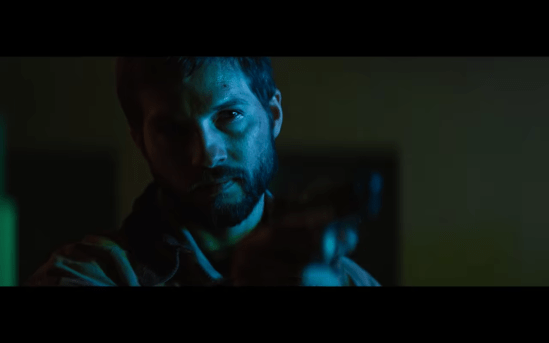
When EVIL Becomes Obsolete, Its Time for an…”Upgrade” reviewed!


In the near future where assistive technology serves as the cultural way of life, a very manual Grey Trace still clings to being self-independent while his loving wife, Asha, laps up and embraces new and innovative tech. When an fatal shooting strikes down Asha and cripples Grey to an automated wheelchair, Grey is forced into a depressive world he no longer recognizes. Desperate to find his wife’s killers, he accepts experimental computer chip implant known as STEM to send the signals from his brain to his extremities; however, that is not all STEM can do. The smart technology can also scan, record, and reactive to all of Grey’s experiences, be a voice of knowledge, and enact super human abilities that will aid in Grey’s vengeance, but without much control over his own body, how much will Grey continue to use the smart device that becomes smarter every minute.

In a cinematic age when remakes, re-imaginings, and sequels really do rule supreme, a breath of innovation and compelling storytelling in Leigh Whannell’s 2018 science fiction, action-noir “Upgrade” is a technological advance that’s feels lightyears ahead in comparison. The “Saw” and “Insidious” writer, who indulges in all of horror’s gracious qualities, tackles the future with a synergetic and brutal vengeance film on indie-budget proportions; however, “Upgrade” feels no where near being low budget in a futuristic world that includes monochromatic self-driving cars, bio-weaponized forearms and hands, and a robotic protein shake slingers for those meal replacement pick-me-ups. With the assistance from Blumhouse Tilt, a Blumhouse production sublabel that seeks to release projects onto multi-platforms, Whannell gained freedom to script, in every sense of the world, his own vision of cyborg horror and crime thriller.

Logan Marshall-Green stars as Grey Trace, an analog man living comfortably in a digital world. Trace is a dying bred as the technology ecosystem slowly creeps into all that earned by hard work, even in his small classic car restoration business. The “Prometheus” star tackles a unique physicality aspect of an action film that involves the robotic responses of hand-to-hand combat while also being the emotional punching bag of pelted heartache and turmoil. Portraying his character as a man’s man, Marshall-Green has to find humility in not only unable to self-serve himself as a cripple, but then also rely on the one thing he withdrew himself from for help….a machine. “Upgrade” primarily focuses on Trace to even having the camera affix to his character during fight sequences, but though most of the narrative is through Trace’s vindictive narrative, a cascading effect of his destruction brings one of his nemesis’s into reactive defense. Fisk, Benedict Hardie from the upcoming remake of “The Invisible Man” that’s also directed by Whannell, is a mysterious soldier of fortune whose backstory, that salivates at the tip of the tongue to be told, is only sampled at best with his cybernetic implants or why he was even chosen to be a deadly, robotic killing machine. Perhaps Fisk’s backstory, and those of his fellow veteran comrades, are another misrepresentation or the maltreatment of veterans by conglomerate, privately owned tech and weapon companies that lean more toward involuntary experimentation rather over anything else that’s an allegory of owning a person, a piece of property, as we also see with STEM attached to Grey Trace’s spinal cord. “Upgrade” rounds out with performances from Melanie Vallejo, Harrison Gilbertson (“Haunt”), Betty Gabriel (“Get Out”), Kai Bradley, and Simon Maiden as the voice of STEM.

Shot in urban Melbourne that’s quasi-reflective of the gritty streets of Chicago, Leigh Whannell aimed for a fatalistic mystery that breaks down relationship barriers and sustains a punitive jurisdiction of grime. Whannell surely achieves the desired affect that goes from a classy futuristic society to the bottom barrel of human existences that have been tainted by the dark side of tech including addiction and dangers of being fully aware as a sanctioned being. “Upgrade” capitalizes on every inch of its capital to enlarge the quality of a miniature budget and utilizes local talent, who, aside from Logan Marshall-Green, never wane from their unnatural American English accents, to offer heartfelt human performances despite their mechanical transitions. “Upgrade” isn’t “Robocop” or “Nemesis,” but rather more “Terminator” where organic and inorganic don’t exactly coincide to benefit as a single entity. Unlike the autonomous killing machine portrayed by Arnold Schwarzenegger, “STEM” acts like a computer virus working off commands, coding, and complex algorithms to infiltrate and deploy executions to subverse the man over the machine and Whannell’s concept brilliantly contextualizes that dynamic without having too much exposition to divulge and is easily computed without having to be deciphered from binary code.

Coming November 18th is Second Sight Film’s limited edition Blu-ray release of “Upgrade” presented in full HD, 1080p, and clocks in at 100 minutes under a region B UK coding. Unfortunately, a screener disc was provided for review and so I will not be critiquing the video or audio quality at this time so this review is solely about the film only. A static menu including chapters were available on the disc as well as bonus features including a commentary by writer-director Leigh Whannell, a new Second Sights’ interview with the director about his envisioning and how it came to fruition, more new interviews with producer Kylie Du Fresne, cinematographer Stefan Duscio, editor Andy Canny, and fight choreographer Chris Weir. All the interviews showcase depth with the material to their respective roles and opinions about “Upgrade.” Don’t think it necessary to refer filmmaker Leigh Whannell as the “Saw” guy now that “Upgrade” has completely overshadowed the franchise in a single sitting entertained with action, gore, and a heart-rendering story. Surely to be Whannell’s break out film from the horror genre.

Buy your Limited Edition UK Blu-ray today! Click the cover to purchase!

One Tough Cop Taking on Evil Cyborgs! “Nemesis” review!


In the year 2027, enhanced humanistic cyborgs virtually run the planet with the renowned L.A.P.D. being no exception. Alex Rain, one of L.A.’s finest brute cops, is partially cyborg himself, but the essence of his soul remains human intact while his synthetic flesh cloaks the icy machine beneath. After tracking down suspected cyborg terrorists and almost losing his life in the struggle to stop them, Alex questions his dwindling humanity, leading him down a path of unfulfilling revenge and botched smuggling before his former employer, the L.A.P.D. commissioner named Farnsworth, tracks him down and uses deadly coercion to force Alex as a pawn in dangerous covert mission. The burnt out cop is thrusted back into the fray of his former life when Farnsworth orders him to retrieve data from the treacherous female cyborg, Jared, who was once Alex’s partner and lover, before she hands over the sensitive information to a group of cyborg terrorists who call themselves The Red Army Hammerheads. With a micro bomb implanted near his heart as insurance, Alex has no choice but to accept the assignment before detonation in 3 days and with his time running out, finding Jared isn’t the problem as Alex comes to realize that deception has convoluted the stakes and nothing is who or what they seem.

Albert Pyun’s 1992 cyberpunk action-thriller “Nemesis” is an explosive-heavy, science fiction existentialism film never before seen, or even aware of, by this reviewer, but the ground-worked narrative has remained a constant piece of foundation in being the byproduct of inspiration extracted from other cyberpunk films of its kind, such as “Robocop,” “Blade Runner,” and “The Terminator.” “Nemesis” has a presence much to the tune of another film, “Cyborg,” starring John-Claude Van Damme and that inclination would inevitably make a world of sense when the awe-striking epiphany lands that Pyun also directed that film, also utilizing some of the same actors for his early 90’s cybernetic dystopian feature. In reviewing Pyun’s credits, the assumption can be made that the filmmaker has a sturdy hard-on for the intertwining of mankind and machine as not only did the director write and direct “Cyborg” and helmed “Nemesis,” but went on to be a part of, whether director, writer, or producer, of four more “Nemesis” sequels with a fifth being produced and shot, but scrapped in post-production due to Pyun’s flailing mental health. Rebecca Charles fed the scribal beast as “Nemesis’” screenwriter, along with penning “Nemesis 2: Nebula” and “Nemesis 3: Time Lapse.”

Alex Rain is a cold cut character, sliced thick like a cool cucumber on top of a hard to wedge salad. Rain’s iciness symbolizes his downtrodden humanity status and with each part of his body shattered from destruction, he becomes one step closer to being an automaton with eye brows. B-movie action star Olivier Guner essentially make a big career breakthrough with “Nemesis” as his sophomore feature. Guner’s military background suitably solidifies his physique as a workaholic cyborg cop while also presenting a rough cut speech impediment that’s very straight forward and without emotion. Some would say that Gruner’s approach fits his half-human, half-toaster oven character and I would say that would be correct. The 80’s and 90’s saw a crowded entry list of action stars, including Jean-Claude Van Damme, Chuck Norris, Steven Seagal, Sylvester Stallone, Arnold Schwarzenegger, and many others in various degrees of success – and Olivier Gruner became one of those faces that had since then been lost over the years; Gruner’s performance in “Nemesis” lacked pizazz which could have been the contributing factor to his success, but the monotonic, unflattering one-liners and blank face stare didn’t spark any fires on top of his average muscular frame. His performance, to keep with the fire motif, didn’t provide the oxygen, a combustible, or a flammable source to quickly set ablaze a trail for semi-popularity amongst his peers and that’s where “Nemesis” falters in entertainment value. Comparatively, “Trancers” franchise actor, Tim Thomerson, is full of range and vigor as an concealing Commissioner Farnsworth. Thomerson, in his early 40’s at the time of filming, displayed an impressive physicality to his role, keeping up nicely with his onscreen rival. Farnsworth, from the get-go, reeks of desperation when pressuring Alex to do his bidding and Thomerson really nails the part and can switch on the proverbial dime as an egocentric field operative when chasing Alex through the jungles on the Hawaii set. The night and day performance is a stark contrast between the two actors. What’s mostly disappointing about “Nemesis’” cast that favorable characters come and go; some the characters a pinned with terrific actors such as Shang Tsung himself, “Mortal Kombat’s” Cary-Hiroyuki Tagawa, as the leader of The Red Army Hammerheads and the late, great Brion James (“Red Heat”) chirping a lousy German accent of the Commissioner’s right hand man. The cast has many other recognizable names that, again, come and go, including a strung out looking Merle Kennedy (“Night of the Demons 2”) as Max Impact, Marjorie Monaghan as the algorithmic beauty Jared, Vincent Klyn (“Cyborg”) as a disposable bodyguard, an extremely fit and nude Deborah Shelton (“Body Double”), voice actor Nicholas Guest (“Dollman”), brief cameo by Jackie Earle Haley (“Watchmen”), a fresh faced version of “The Predator’s” Thomas Jane, and Thomas Jane’s bare ass.

The financial backing was obviously designated for a particular department in the “Nemesis” workshop and that department was special effects. Explosions, rotoscoping, stop-motion, sculpture, implosions, practical effects and makeup are just the tip of the iceberg. Frayed wires and eye ball cannons are the elegant touch that makes “Nemesis” a cult favorite and bring substance to a clunky storyline and divisively dynamic acting. However, not all the specials are pinpoint precision and grounded by reality. The one scene that stands above the rest when Farnsworth is hot in pursuit of Alex and Max and he’s shelling off rounds of a shotgun, standing relatively still, blasting away without moving the barrel around to compensate for his prey’s length of distance gained or even when they decided to make quick pivots in direction. Somehow, the rounds hit very close to Alex and Max and that’s not all, they even explode like a single stick of TNT. ACME must have had a hand in the special effects department because the scene sure was loony. Yet, the implosion of a monolithic silo was uber-impressive, well-executed, and really ritzy for the silver screen.

Imperial Entertainment’s “Nemesis” infiltrates onto another home video release, a region free, dual DVD and Hi-Def 1080p Blu-ray format release, from MVDVisual under their MVD Rewind Collection series. Sheathed by a slick, retro-grade slipcover with familiar art, reminiscent of the now decade old Sterling DVD release, the special collector’s edition provides two aspect ratios, an anamorphic widescreen 2.35:1 and a widescreen 1.78:1. This MVDVisual Release has stellar detail in the texture and in framing that are exhibited in various tint shades, such as yellow and blue, and eventually cough up toward a more natural look into the second act when Alex reaches the rough neighborhood of Shang Loo, Java. Even though the visual compositions and mold work doesn’t pop with color and are a bit fuzzy, “Nemesis” is a product of it’s time, the early 1990’s and you can’t fault Pyun’s film for that. The English 5.1 surround sound is beautiful. So beautiful and potent, in fact, that you can actually understand Olivier Gruner’s mumbling, putting dialogue for all characters right into the front row while offering a stimulating range and depth of ambience sound, an unlimited variety of explosions, and plenty of miscellany cyborg hubbub. Other language are available, including French, German, as well as English in 2.0 stereo and there are English and German SDH subtitles available The Blu-ray bonus features include new interviews with producer Eric Karson and director Albert Pyun, “Nemesis 2.0” the director’s cut with Albert Pyun audio commentary, and original theatrical trailer. The DVD is the director’s cut and also includes the Japanese cut with Japanese subtitles burnt-in. Bonus features for the DVD include introductions by the director Albert Pyun and star Olivier Gruner, an afterword by Albert Pyun, a behind-the-scenes featurette, an interview with star Olivier Gruner, the making of segment involving the hefty special effects, stunt work, and visual effects, a featurette entitled “Killcount,” a behind-the-scenes photo gallery, TV spots, Key Art Photo gallery, and, top it all off, a mini-poster inside the casing. Inside a killer definitive, two-format and disc set from MVDvisual, “Nemesis” hones in on the existentialism notion of what being human actually means to each and every one of us through the bombardment of gun fights and jumbo explosions on top of a conglomerate cyborg coup that peaks with hard bodies and even harder viewer contemplation.