

On a dark and stormy night after a school football game, a teacher and three students take shelter at a cottage adjacent to a cemetery. If the cottage wasn’t creepy enough, the sole occupant owner surpassed the bar. She calls herself Miss Leslie, a middle aged woman with an ill-fated story of her friend and mother’s fiery demise from long past and a quirky penchant for making life-size female dolls that set inside an illuminating shrine. Though they feel uneasy about the creepy surroundings, the visitors stay and get cozy, especially with each other, but Miss Leslie has ulterior, deranged motives. Her dolls are not just lifelike, they once were vibrant lives of women Miss Leslie sorely wanted to inhabit their feminine confines of youth and beauty from over the years, but now they are an undecomposable shells, encase in Miss Leslie’s special doll making brew to timelessly capture their lovely physiques. They are also beautiful, yet painful reminders of her failed attempts to transfer her essence into their adolescent bodies.

Every so often you come across a film with a gigantically absurd hard shell cover with the gooey insides of eye-rolling cheesiness and you just have to ask yourself, how in the world did something like this ever come to fruition!? Yet, somehow, someway, these productions of an oddball variety always have an intense allure about them and end up being just one of the coolest rarities to grace the glazed-over irises. Joseph Prieto’s “Miss Leslie’s Dolls” is the epitome of this very phenomena. “Miss Leslie’s Dolls” is an exploitation, nearly softcore porn, horror with a deranged killers with severe mental issues that range from communication with dead to, what can be now construed as antiquated, complications of gender identity. One of the last directed films from Prieto, who also helmed “Shanty Tramp” and “Savages from Hell,” also penned the screenplay alongside longtime collaborator and producer Ralph Remy Jr. The script reads like an insatiable bedside thriller novel, an object of complete obsession through the entirety and well long after being completed; “Miss Leslie’s Dolls’” has a rich gothic lining, a strong sexual appetite, and a timely LGTB subject that involves debate on mental illness or inherited gender orientation.

Not many actors performed in drag. Sure, there was Jack Lemmon and Tony Curtis in “Some Like It Hot” and there was even Anthony Perkins from “Psycho,” who some might go as far as saying that “Miss Leslie’s Dolls” might draw inspiration from with the whole mother fixation, but only a small faction of fans, especially in the genre, might know Salvador Ugarte. The Cuban born Ugarte has great poise as a woman imprisoned in a man’s body. Miss Leslie just isn’t a deranged killer in drag; the character has deep rooted issues stemming out of not only being a woman embodied incorrectly, but also seeded by an engulfing obsession with capturing beauty to obtain it for herself, an addition from a result of a permanent scarring left behind by Miss Leslie’s homicidal rampage in the character’s history. Ugarte has the mannerisms and the gait down so unerringly that’s the performance is downright creepy, but there was one aspect of womanhood that Ugarte’s masculinity couldn’t mask: his voice. The actor is horrendously dubbed, adding charm to the bizarre concept. Ugarte’s joined by “Little Laura and Big John’s” Terri Juston, Marchelle Bichette (“The Gruesome Twosome”), Kitty Lewis, and Charles Pitts of “Supervixens.”

Contrary to the above, “Miss Leslie’s Dolls” has some drawback. Though the characters might be entertaining and interesting, especially with the Bourbon obsessed and hot for teacher Roy and his terrible gangster accent or the fact that Ms. Alma Frost is a smoking hot, twenty-something year old prude teacher to her pupils who are practically the same age as her, they’re washed over with an aloof mentality, consequently looking past or just blatantly oblivious to Miss Leslie’s obvious male features, her inauspicious ramblings, and the fact she has a shrine of creepy and realistic dolls of women that fill the room with the smell like rot and death. Perhaps too busy running through the cemetery at night in skimpy bedroom garments. Yes, this does happen. On top of that, Miss Leslie harness of occult powers goes relatively unexplored, yet very much utilized as an important portion of the film near the last act. Despite being passively mentioned and rather undercut from more than most of the film, Miss Leslie’s occult mischief is plucked right from left field to further the enigmatic aurora of Prieto’s mystical exploitation.

Network proudly presents “Miss Leslie’s Dolls” on an UK 1080p Hi-Definition, region free Blu-ray home video, remastered from the original film elements once thought to be have been forever lost. The newly scanned transfer came from a surviving print and presented in the film’s original theatrical aspect ratio of 1.85:1. The restoration included detailed grain management, the automated and manual removal of dirt and damage, and the correction of major color instability, warp, and density fluctuations. (In full disclosure, Network sent me a DVD-R screener and that is what the following critique is based off of) Though in some frames there flares up some instability, from my perspective, the first act and half really came out well with the vivid, yet natural, coloring. However, once inside Miss Leslie’s basement, woozy blotchy moments of Leslie fiddling around makes the particular scene a bit off putting. The stereo mono track is fair for the 1973 film that has it’s share of distortions and editing pop faux pas, but the dialogue is fiercely prominent, despite the inherent awfully laid dub track, and equally well balanced with ambient tracks. There were no bonus material on the release. Transvestitism horror is quite a rare experience that always has a lasting impression, cerebrally popping visuals of grim visions commingling with the blood, the viscera, and the other supplementary violence. “Miss Leslie’s Dolls” deserved this Blu-ray release and Network did right by Prieto’s obscure grindhouse feature that will sear into your skull.
Tag Archives: blu-ray
Planning a Jailbreak off an Evil Corporation’s Island Prison! “Escape from Absolom” review!

In the year 2022, Special Forces solider, Captain Robbins, is court martialed for putting a bullet in the head of his commanding officer. After escaping two maximum security prisons and a record of rebellious activity, a corrupt and power hungry warden of the Lactivus prison ships Robbins off to an off shore island called Absolom, where prisoners can roam free with no chance of escape due to 24/7 surveillance by Satellite and rocket launcher armed helicopter gunships surrounding the island perimeter. Island prisoners separate into two factions: the Outsiders and the Insiders. Each with the respective camps, the lawless Outsiders overwhelm the Insider’s numbers by 6 to 1, leaving the small manned community in constant fear of attack and pillage by the Outsider’s merciless leader, Walter Marek. When the insiders learn than Robbins has faced Marek and lived, they take the former solider into their community, but Robbins sole desire is to escape off the condemning rock and with the help of a few good men from the Insiders’ camp, the chances of escape and survival are greater together as long as Marek and his band of starving cutthroats don’t seize the endangered community first.

“Escape from Absolom,” also known as simply “No Escape” in the U.S., is a Martin Campbell directed action film from 1994 that’s futuristic and violent, fun and thrilling, and kitschy without being too cheesy. Campbell, who went on to direct not one, but two, James Bond films, begins a base of epic action that’s toweringly ambitious and pulled off nicely with the stunts and the editing. Based off the Richard Herley novel “The Penal Coloney,” the script is penned by Michael Gaylin who puts pen to paper to scribe a playful, passively aggressive dialogue, but fun and energetic on a the same coy lines of other high visibility action films. Gaylin was able to conform to a story that has no dynamic with the opposite sex in one of the few films that exhibits a rare all male cast.

“Goodfella’s” star Ray Liotta finally got his time to shine as the butch and badass action hero that is Captain Robbins, a highly skilled special forces solider and killing machine whose pragmatic intentions, at first, are hard to read. The cockiness overtop a well-cloaked deadly skill set works to the advantage of the blue-eyed actor for New Jersey. Opposite Liotta is Stuart Wilson (“Hot Fuzz”) as Walter Marek, a 7-year island lifer with dreadlocks and nose bridge piercings to match his psychotic leadership. Wilson does psychotic just fine, but the look resembles John Travolta’s atrocious attire from Battlefield Earth. Lance Henriksen, One of the most recognizable legendary genre actors, has a more serene approach in being a mentor and the leadership figurehead of the Insiders camp when compared to conventionally eccentric, sometimes maniacal performances, but Henriksen has a mellow side to him that conveys are very affectionate kumbaya approach, but any personality compared to Stuart Wilson’s internal rampage would be a stark contrast. “Ghostbusters'” Ernie Hudson has his role as security office in the Insiders camp and the sole black man of the film, for obvious reasons, stands out, but Hudson just adapts to anything you put him in though the Michigan born tended to sway toward the thrilling fantasy/sci-fi genre in the height of his career. Rounding out the cast is Kevin Dillon (“The Blob” remake), Kevin J. O’Conner (“Lord of Illusions”), Don Henderson (“The Ghoul”), Ian McNeice (“Dune”), and Michael Lerner (“Maniac Cop 2”).

All things considered, “Escape from Absolom” is a torrent men-in-prison extravaganza that’s one part Sylvester Stallone “Judge Dredd,” one part Chuck Norris “Missing in Action,” and, as a whole, an endangered brand of droll entertainment. Speaking of Stallone, Ray Liotta did it first as a character who is an expert at escaping the inescapable maximum security penitentiaries and instead of Arnold Schwarzenegger and Dave Bautista as contentious, yet supportive allies, the friendly, yet solidly statured Ernie Hudson and Lance Henriksen share Liotta’s Captain Robbin’s unquenchable lust for freedom, even if it to provide unsheathe exposition of the unethical corporate penal system practices. Far from being a perfect film and extremely blantant on a no underlying message, Martin Campbell undoubtedly has a fine tuned niche of capturing the casual eye with large scale action sequences and an affable character allure.

Umbrella Entertainment releases “Escape from Absolom” on a region-all Blu-ray, presented in 1080p, widescreen 16:9 aspect ratio. The coloring is phenomenally remastered and stable compared to previous transfers. There are times when depth becomes two-dimensional or flat, skewing the picture noticeably, but the overall picture quality is spectacular in the vast amount of Australian landscapes and even in the night scenes that show hardly any enhancing, such as sharpening or contrast. The English DTS-HD Master Audio 2.0 track is laid out nicely with audible poise and precision balance. Dialogue is prominent while explosions have just the right amount of oomph under an exact LFE recipe. The release sports other language Dolby Digital audio tracks such as a German 2.0, Spanish 2.0, Italian 2.0, and a French 2.0. Optional English SDH subtitles are available. Bonus material includes a two part making of featurette from around the production of the film with interviews with cast and crew, four TV spots, trailer, and a reversible cover. Runtime is 118 minutes. Martin Campbell’s “Escape from Absolom” is dystopian dynamite, explosive and aggressive with a flare for enjoyable banter amongst defined and diversified characters inhabiting an utopian island of mostly societal scum.
Evil’s Eager to Loop You In! “The Endless” review!
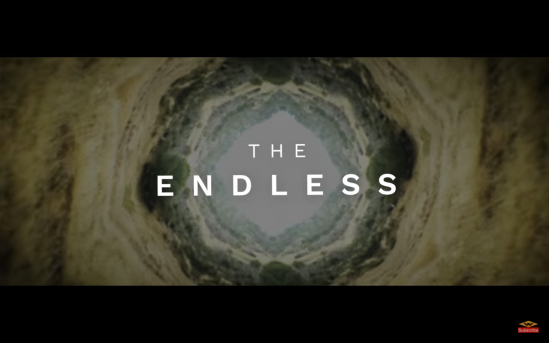
Brothers Justin and Aaron struggle to maintain a normal and fruitful life outside Camp Arcadia, the UFO death cult camp they fled as young men. When Aaron feels empty, poor, and hungry as a cleaning serviceman on the brink of poverty and social misfortune, he convinces his older brother to take him back to the camp for one day. Once they’ve arrived, the two felt as if nothing has changed, even the cultists haven’t aged in the decade they were gone. Aaron seeks to reintegrate during his time at the camp while Justin is eager to vacate the premises pronto, but an otherworldly phenomenon promises answers to Justin and Aaron’s perceptions of their former cult and leaves questions to the unexplainable events that surround the camp site. The brothers must solve the mystery before being ensnared by the phenomena that lurks all around them with an ever present eye.

“The Endless” is the 2017 science fiction horror film from a pair of directors, Justin Benson and Aaron Moorhead, who helmed a segment in the anthology, “V/H/S Viral.” The duo also star as the leads in the film as Justin and Aaron. Benson penned the film’ script that has grand originality and fosters an underlying Lovecraftian concept and despite the limited budget, “The Endless” has favorable special effects of mind-boggling proportions incorporated with a splash of mildly dark humor in this blithe fantasy horror. Reminiscent of such other off-the-wall commingling genre films such as Don Coscarelli’s “John Dies at the End” or Madellaine Paxson’s “Blood Punch,” where the supernatural and bizarre collide and the characters are equally demented for a pinch of extra pizazz.
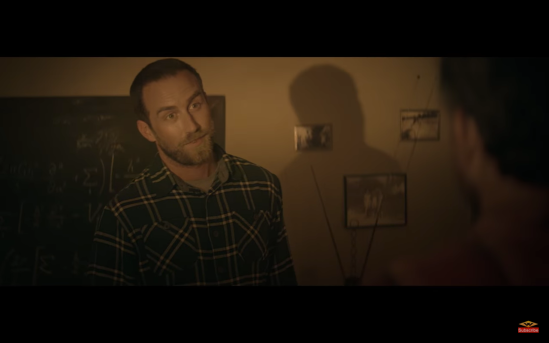
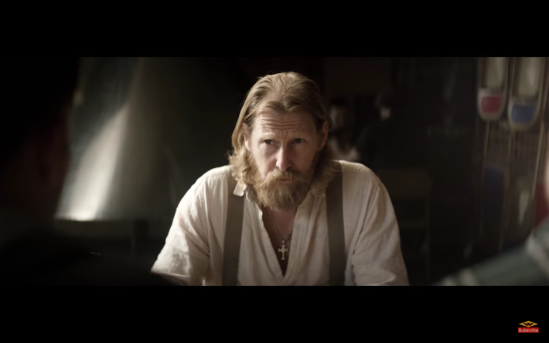
Benson and Moorhead may be the stars of “The Endless” and essentially are the epicenter of the entire premise, but their characters wouldn’t be aptly as important if it wasn’t for the cast that supported them. One of the actors is Tate Ellington (“Sinister 2”) as the unofficial camp leader Hal with the gift of gab and just as mysterious as the camp itself. Ellington’s one of many of the camp so called UFO Death Cult characters that make the story really stick out as odd as there’s Lew Temple (“The Walking Dead”) too. A very unshaven and unkempt Temple weighs the look of an Civil War soldier in Tim and Tim’s distant expressionless is very much Temple’s bread and butter. Rivaling the unnerving silence of Lew Temple is “Alien: Covenant’s” Callie Hernandez. As Anna, Hernandez plays the girl next door, flirting with Aaron with trivial matter that toys Aaron’s inherent innocence. The rest of the cast includes Emily Montague (“Fright Night” remake), James Jordan, Kira Powell, Peter Ciella, and David Lawson Jr. as Smiling Dave.
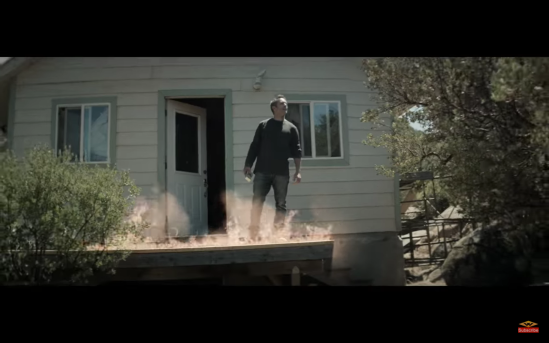
“The Endless” could be said to have a slew of metaphors and symbolism, even the older brother Justin frustratingly points out how camp leader Hal always speaks in metaphors. So, what is causing all the weird and terrifying atmospherics at Camp Arcadia? Arcadia ends up being an oxymoron as the camp is not harmonious or a utopia as believed, but rather a coiled purgatory with an ominous presence thats ever present. Don’t know what’s watching, where it came from, or what it wants, but it’s driven fear of the unknown as noted during the title card epilogue of a quote. What we do know is this presence, this thing, is massive, looming over the hills and in the depths of a nearby lake; the thing is very Lovecraftian in proportion to what that means. Hell, even the quote I mentioned earlier about fear of the unknown is pulled from H.P. Lovecraft himself – “The oldest and strongest emotion of mankind is fear, and the oldest and strongest kind of fear is fear of the unknown.” The brother symbolism fear for they have fear of the outside world and fear of their unforeseen and possibly poverish future, but once Justin and Aaron come to terms with ending being at odds with each other, the brothers know they can conquer whatever comes at them together.
Well Go USA Entertainment presents Snowfort, Love & Death, and Pffaf & Pfaff productions’ “The Endless” onto Blu-ray home video. The single disc BD-50 has a widescreen 16:9 aspect ratio. Image presentation has fair natural tones with a set of a rather light yellowish tint during desert sequences. Color palette is enriched especially when the inexplicable does come ahead; moments of heavy tinting, such as a heavy red flare, inexplicably stand out. Blotching, DNR, or banding are an issue here, leaving the details considerably intact in a plenty of the duration. The English DTS-HD Master Audio 5.1 surround sound has not gaffs about it. The plentiful dialogue is clearly present to get the full story told, ambient and phenomena effects proportionally ranged and appropriate, and the soundtrack supports to dialogue and story with the amount of depth. Overall, the tracks are consistent throughout. Bonus features include an audio commentary with directors and producers, a 30+ minute make of segment, a behind the scenes featurette, deleted scenes, Visual effects breakdown, a “Ridiculous Extras” featurette that includes casting, and trailers. Don’t let the peppered black comedy in “The Endless” fool you; Justin Benson and Aaron Moorhead have constructed an original sci-fi horror that shells out an unsettling ambiguity of a modern and universal fear too invasive to try and stop the perpetual replaying of attempting to know the unknown.

Purchase “The Endless” on Blu-ray!

Tell, Don’t Ask, Evil to Go Away! “The Addiction” review!

NYU Philosophy doctoral hopeful, Kathleen Conklin, has a run-in with a woman on the night streets of New York City, attacking her into a secluded dark enclave, and biting her on the neck after Kathleen is unable to comply with the woman’s bizarre instructions of ordering her to go away. The incident instills fear into Kathleen that quickly turns to a painful vampirism transformation that involves aversion to sunlight, self-antipathy, and a craving for blood. She continues to her studies that evolve into a deeper analytical parallelism of her newly acquired immortality, the results of it, and the human aspect that’s affected by it while along the way, feeding and turning friends, colleagues, and strangers into her brood of own image. Kathleen happens upon Peina, a vampire like herself, that has claimed to conquer his own addiction to blood and can even mirror himself as human, such as eating normal food and jogging. The agonizing withdrawal with Peina drops a slither of a notion into Kathleen that her gargantuan thirst for blood will overdose her soul to pure evil and she has to come to terms with her immortal being on the life she wants to live.

Abel Ferrara’s “The Addiction” has such anti-Hollywood tenacity that the black and white aurora of the 1995 noir vampire film goes against the more conventional grain that is Ferrara’s body of work, but still maintains a healthy amount of the director’s trademarks and his dispositional motifs to give the feature enough claim to clearly become his imprint of a screw you onto the big money motion pictures. The “Driller Killer” and “Bad Lieutenant” director orchestrates a film from without the complications of a union, with producers breathing down his neck to do this or that, and on such a minuscule budget; the vampires here are not transforming in bats, their eyes do not glow in the dark, and they even don’t have jugular piercing canines. Nicholas St. John’s script was written to portray monsters as just people with a severe addiction this particular drug of choice – the blood. The symbolism is so potent that’s hardly symbolism as the main character literally injects a syringe full of blood into the crook of her arm to get a fix.

Ravished without hesitation, Lili Taylor seizes Kathleen Conklin as if Taylor herself was addicted to the character, overtaking the character to an enlightened savagery of an academic disciple on the cusp of achieving stress-inducing doctoral status. Through the studious muck and death of mankind’s prior carnage, the “The Haunting” star goes for the full throttle transformation in the blink of a bite and never blatantly displays the hesitation of her former mortal self until the tide turns to whether stay blood thirsty or to live with the embattlement of struggling addiction. Kathleen crosses paths with Peina whose been undertaken by a classic Walken, Christopher Walken that is, and the New York City born “Communion” star had a big year in horror as “The Prophecy” was released the same year – 1995. Though Peina is crucial to Kathleen’s ultimate survival, the character has little screen time and Walken nails the performance with credence and gusto as some sort of subversive mentor to the young vampire protégé. The cast rounds out with Edie Falco, Paul Calderon (“Fear the Walking Dead”), Fredro Starr, and “The Hand That Rocks the Cradle’s” Annabella Sciorra as Casanova, the female nightstalker who takes a bite out of Kathleen and initiates the carnage.

Ferrara’s choice for black and white isn’t all surprising. At the time, numerous notable directors were doing the very exact concept in the 1990s, examples being Steven Speilberg’s award winning “Schindler’s List” in 1993 and Tim Burton’s dark comedy biopic “Ed Wood” with Johnny Depp in 1994, but Ferrara had a conceptually aesthetic noir appearance that created distance between the rest and established a solid black and white film that renders being akin to, perhaps, George Romero’s “Night of the Living Dead.” Not only did Ferrara’s film fit in the scheme of the 90’s fad, but extended “The Addiction’s” disturbing dramatic value and horror sensationalism in which color would have for sure diluted the story due in part to the pocket change budget. Taylor, Walken, and Sciorra very much believed in the project and that belief brought their characters to the formidable forefront to where a color picture didn’t really matter in the end.

Arrow Films presents “The Addiction” onto Blu-ray home video and is distributed by MVD Visual. The Blu-ray has been newly restored 4K scan of the original camera negative and approved by director Abel Ferrara and director of photography Ken Kelsch. The high definition 1080p widescreen, 1.85:1, picture has a clean palate and despite the lack of the color palette, the black and white has virtually little-to-no blotching or DNR, leaving a flawless image. The English 5.1 DTE-HD MA and 2.0 LPCM soundtracks, with optional English subtitles, is well-balanced, at least in the 5.1 DTE-HD Master Audio. Dialogue in the forefront with a brooding and jarring score by composer Joe Delia has great distinction and range, but there’s a curious lack of ambiance that focuses more on direct action of characters. NYC should be booming with surrounding noise; yet the direction Ferrara takes with reduced ambiance is risky, but exquisitely done to add a more personal touch to Kathleen Conklin’s struggle. Bonus material includes an audio commentary by Abel Ferrara, moderated by critic and biographer Brad Stevens. There also includes a new documentary, entitled Talking with the Vampires, directed by Abel Ferrara that features new interviews with composer Joe Delia, Ken Kelsch, Christopher Walken, Lili Taylor, and Ferrara himself. A new interview with Abel Ferrera going into the background of the film’s construction and the era of filmmaking, a new appreciation by Brad Stevens, an achival piece from the time of production, original trailer, and a reversible sleeve featuring original and newly commissioned artwork by Peter Strain. A supremely inclusive Blu-ray release by Arrow Films and MVD Visual of Abel Ferrara’s grittiest work of his gritty catalogue and the very spartan vampire film has an outlook of what future vampire films should aspire to with great beneficial expectations.

Buy “The Addiction” today!

Herbert West Receives a New, Evil Release! “Re-Animator” review!
Third year medical student Dan Cain is on the verge of graduating from the New England Miskatonic University Medical School. That is until Dr. Herbert West walks into his life. Learning all he can from neurologist Dr. Hans Gruber in Zurich, Switzerland, West eagerly enrolls as a student at Miskatonic to viciously dismantle, what he believes, is a garbage postmortem brain functionality theory of the school’s grant piggybank Dr. Carl Hill while West also works on his own off the books after death experiments with his formulated reagent serum. West takes up Cain’s apartment for rent offer and involves Cain in a series of experiments that lead to reviving the old and the fresh dead. The only side effects of revitalizing dead tissue is the unquenchable rage and chaos that urges the recently revived to rip everything to shreds. Things also get complicated and people begin to die and then revive when West and Cain’s work becomes the obsessive target of Dr. Hill, whom discovers the truth and plans to steal West’s work, claiming the reagent serum as his own handiwork while also attempting to win the affection of Dr. Cain’s fiancee and Miskatonic’s Dean Halsey daughter, Megan Halsey, in the most undead way.

A vast amount of time has passed since the last time I’ve injected myself with the “Re-Animator” films and I can tell you this, my rejuvenation was sorely and regrettably way overdue. Stuart Gordon’s impeccable horror-comedy, “The Re-Animator,” is the extolled bastardized version of Mary Shelley’s Frankenstein without direct references and begins the ghastliness right from the initial opening prologue and never wanes through a fast-paced narrative of character thematic insanity and self-destructing arrogance with hapless do-gooders caught in the middle of undead mayhem. Producer Brian Yuzna financially backs Charles Band’s Empire International Pictures distributed 1985 film that’s based loosely off the H.P. Lovecraft 1922 novelette “Herbert West-Reanimator.” From a bygone novelette to an instant cult favorite amongst critics and fans, “Re-Animator” glows vibrantly like it’s reagent serum embodied with reality-buckling entertainment and grisly havoc displayed through the silver screen adapted form. Umbrella Entertainment has released a two-disc collector’s set, the first volume on their Beyond Genres label of cult favorites, and this release, with various versions, will include the allusive 106 minute integral cut!
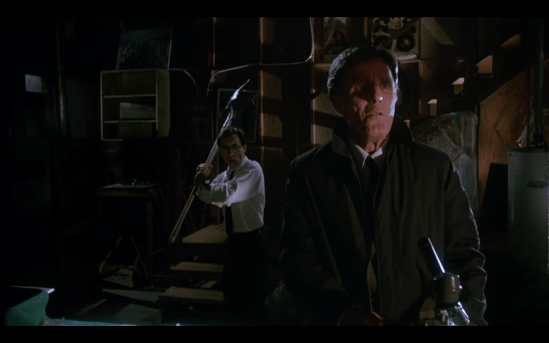
From his first moments on screen holding a syringe to over three decades of pop-culture films, comics, and social media presence, nobody other actor other than Jeffrey Combs could be envisioned to be the insatiable Dr. Herbert West. Combs is so compact with an explosive vitality that his character goes beyond being a likable derivative of a Machiavellian anti-hero. Narrowing, dagger-like eyes through thick glasses on-top of small stature and a cruel intent about him makes Combs an established horror icon unlike any other mad doctor we’ve ever seen before. Bruce Abbot costars as Dr. Dan Cain, a good natured physician with a penchant of not giving up on life, but that’s where he’s trouble ensnares him with Dr. West’s overcoming death obsession. Abbott’s physically towers over Combs, but his performance of Cain is softly acute to West’s hard nose antics. Abbott plays on the side of caution as his character has much to lose from career to fiancée, whose played by Barbara Crampton. “Re-Animator” essentially unveiled the Long Island born actresses and made her a household name who went on to have roles in other prominent horror films, including another Stuart Gordon feature “From Beyond,” “You’re Next,” and the upcoming “Death House.” David Gale rounds out the featured foursome as the detestable Dr. Carl Hill. Gale embraces the role, really delving into and capturing Dr. Hill’s maddening short temper and slimy persona; a perfect antagonist to the likes of Combs and Abbott. The remaining cast includes Robert Sampson (“City of the Living Dead”), Carolyn Purdy-Gordon, and Peter Kent.

The “Re-Animator” universe is right up there with the likes of Sam Raimi’s “The Evil Dead.” Hell, there is even a line of comics that pit the two franchises together in a versus underlining. Unfortunately, “Re-Animator” is frankly nothing without the franchise star Jeffrey Combs, much like “The Evil Dead” is nothing without Bruce Campbell even though we, as fans, very much enjoyed the Fede Alvarez 2013 remake despite the lack of chin. Gordon’s film needs zero remakes with any Zac Efron types to star in such as holy role as Dr. Herbert West. That’s the true and pure terrifying horror of today’s studio lucrative cash cow is to remake everything under the genre sun. Fortunately, “Re-Animator” and both the sequels have gone unscathed and unmolested by string of remakes, reboots, or re-imagings. Aside from a new release here and there, such as Umbrella’s upstanding release which is fantastic to see the levels of upgrades up until then, “Re-Animator” has safely and properly been restored and capsulated for generations to come.
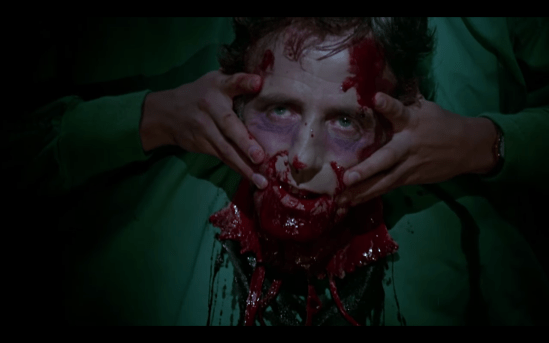
Umbrella Entertainment proudly presents the first volume of the Beyond Genres’ label with Stuart Gordon’s “Re-Animator” on a two-disc, full HD 1080 Blu-ray set, presented in a widescreen 1.77:1 aspect ratio. A very fine and sharp image quality that maintains equality across the board with minuscule problematics with compression issues, jumping imagery on solid colored walls for example, but the issues are too small amongst the rich levelness of quality and when compared to other releases, Umbrella Entertainment’s release is a clear-cut winner. The English DTS-HD master audio puts that extra oomph into Richard Bands’ score that’s heavily influenced by Alfred Hitchcock’s “Psycho,” adding a pinch of chaotic gothic charm to the macabre story. Dialogue is balanced and upfront, but there isn’t much prominent ambient noise to put the dialogue off-kilter. Special features on the first disc include the 86 minute unrated version of “Re-Animator,” audio commentaries from director Stuart Gordon, producer Brian Yuzna, and stars Jeffrey Combs, Barbara Crampton, Bruce Abbott, and Robert Sampson; there’s also a “Re-Animator Resurrectus” documentary, 16 extended scenes, and a deleted scene. The second disc includes the 106 itegral cut along with interviews with Stuart Gordon, Brian Yuzna, writer Denis Paoli, composer Richard Band, and former Fangoria editor Tony Timpone. Plus, a music analyst by Richard Band, TV spots, and the theatrical trailer. All this and a bag of corpses is sheathed inside a remarkably beautiful encasement with a seriously wicked custom slipcover desgin by illustrator Simon Sherry. There’s also reversible Blu-ray casing cover art with previous designs incorporated. H.P. Lovecraft would be extremely flattered and proud on how Umbrella Entertainment not only enhanced the film adaptation of his classic tale of macabre, but also with how diabolically attired the release is distributed. A true horror classic done right!
 It's Bloggin Evil!