

Inspector Gianni Di Salvo is called in to investigate the discovery of a wrapped in plastic nude body of a young girl, located and waterlogged at the base of a dam. Her death was ruled a homicide after the coroner discovers her insides ripped apart from the blunt trauma of an extremely large dildo. The case leads the detective to an all-girl private school that aims to keep it’s pristine reputation, but with many suspects at hand, Inspector Di Salvo has no choice but to play the wildcard in tracking down a killer and breaking all the rules handed down to him by his superior, Chief Inspector Louis Roccaglio. The deeper he digs into the case, his long list of suspects shortens when they turn up murdered themselves, but the inspector’s key to solving this case lies with the young girl’s inseparable friends, Franca, Paola, and Virginia, whom frantically try to keep their secret under a tight lip.

“Someone with a cock this big raped Angela Russo and threw her in the river!” Trust me, thats not a line from a porn, but spoken by popular lead actor Fabio Tetsi is the ultimate hook. The long, hard, veiny lure that sucks you deep into this 1978 giallo known as “Enigma Rosso,” the first feature film by television director Alberto Negrin. Also known as “Red Rings of Fear” or just simply “Rings of Fear,” a plethora of screenwriters penned the uber-sleazy murder mystery, including Marcello Coscia (“The Living Dead at Manchester Morgue”), Massimo Dallamano (“What Have They Done to Your Daughters?”), Franco Ferrini (“Demons 2”), Peter Berling, Stefano Ubezio, and, the director as well, Alberto Negrin. “Enigma Rosso” completes the “school girl in peril” trilogy, following director Massimo Dallamano’s two films, “What Have You Done to Solange?” and “What Have They Done to Your Daughters?”, that don’t connect via a storyline but the reigns were unfortunately handed to Negrin to finish the task after tragedy struck Dallamano that rendered him deceased before production.

Lucio Fulci’s “Contraband” star Fabio Tetsi sizes up as the determined Inspector Gianni Di Salvo with a penchant for his kleptomaniac girlfriend. Tetsi’s a handsome, rugged actor with a defined jawline, dark and thick features, and a dimpled chin when he’s not sporting a beard or a goatee, such as in “Enigma Rosso.” Di Salvo goes from suspect-to-suspect with his equally eager assistant Bruno Allessandra. The two cops report to the off hands Chief Inspector played by a very worldly Ivan Desny and Desny’s casual style is polar opposite of the act first, look later of Tetsi. The officers go through a slew of suspects, including one played by American actor Jack Taylor (“Pieces”) as a very wealthy and scandalous shop owner who likes young women and three lovelies, Silvia Aguilar, Taida Urruzola, and Carolin Ohrner as “The Inseparables” form a forbidden click of girls who know what has transpired but are too scared to say a word. Tony Isbert (“Tragic Ceremony”) also has a role of a German teacher whose too involved with one female student in particular. Rounding out the cast is Helga Liné, from the sexploitation “Madame Olga’s Pupils,” María Asquerino, and Christine Kaufman as the Inspector’s love interest with a insatiable habit for stealing, but that romance fizzles in a matter of two scenes that don’t quite build up the tension between them.

“Enigma Rosso” puts the school girl in obscene peril, for sure. And, also, puts the school girl full frontal in various scenes ranging from desire to showers and in such scenes that exhibit the exploits of a large dildo being used during a sex party to pave the way for a crime, giving the film a perverseness air about it that glorifies the giallo that it embodies and embraces. Complete with the killer’s first person point of view, ominous gloved murderous hands, and the mysterious allure of an elaborate reason behind the murder, “Enigma Rosso” has everything a thirsty giallo drinker would gulp down. However, with the long list of writers, Negrin’s film partakes in a nonconformist pattern from intriguing and intricate mystery to wild hair hunches and scattered brain antics that jive about as a well as grape jam on a hot dog. the finale also wraps up too easily that Inspect Di Salvo doesn’t even break a sweat figuring out the whodunit aspect and more goes in line with a talking head scene that’s an exposition of events rendering a lackluster finale. However, the ending does wrap up the story nicely, leaving no unanswered or unsolved enigmas about the crime.

Scorpion Releasing and Doppelgänger Releasing present “Enigma Rosso,” also known as “Trauma” or “Virgin Terror,” onto a not rated 1080p High-Definition Blu-ray in a widescreen 2.35:1 aspect ratio. From brand new scans of the original negatives with extensive color correction, noted as done in The States, this is, and will ever be, the best version of the Negrin’s giallo. For instance, the coloring vastly outscores any other version with natural skin tones and in the brilliancy of conventional giallo color palettes. Some issue still surface to rear the unfortunate blemishes from the original negatives, such as vertical (blue) scratches that poison a couple of scenes. Also, there’s also a color correctness issue far right of the screen through the entire 85 minute duration, showing an fault in the scan with the unintentional exhibition of the untouched negative. Two audio versions exist on the static menu: an Italian language with English Subtitles and an English dubbed. The mono track has no real serious issues other than a slight static during more high frequency effects. “Don’t Torture a Duckling’s” Riz Ortolani furnished score has a robust quality that highlights the upbeat swanky tones of a 1970’s Italian crime film. Only an audio commentary with historian and author of the Mondo Digital website Nathaniel Thompson. Sizzlingly laced with casual nudity, glued together by elaborate criminal coverup, “Enigma Rosso” is one of Alberto Negrin’s most memorable shiplapped pieces of work in the most polished impressions of the original negative.
Tag Archives: blu-ray
The Evil That Doesn’t Kill You Makes You Stronger! “Jungle” review!

Yossi Ghinsberg yearned for more than the comfy, cushy life he was born into and being young and adventurous, Yossi travels abroad to backpack in Bolivia to pursue self-discovery and beauty in places far less travelled despite his father’s wishes. He quickly befriends fellow backpackers Marcus and Kevin and together, they lay tracks through the eclectic terrain of the breathtaking Bolivian landscape, but wasn’t until an Austrian geologist named Karl approached Yossi about a promise of unearthing gold and experiencing hidden tribes deep inside the lush jungle. After some convincing, the three friends venture into the jungle with only Karl to guide them and, at first glance, the wilderness is an escape from the noise and pollution of human corrupted inhabitations, but a drastic realization quickly washes over them when they’re force to separate and that the jungle is a cauldron of constant survival. Along with captivating beauty, fire ants, poisonous snakes, symbiotic organisms, jaguars, and torrential rains tip the iceberg of everything that embodies the sequestered jungle and Yossi must endure the trials and tribulations alone in order to make it out alive.

Based off the book of true events from Yossi Ghinsberg comes the motion picture retelling of Ghinsberg harrowing tale of survival in “Jungle.” The 2017 biographical adventure-thriller is penned by Justin Monjo (teleplay writer for TV hits like the sci-fi odyssey “Farscape”) and directed by “Rogue” and “Wolf Creek” director Greg McLean. “Jungle” showcases the night and day environment of one of the world’s most beautiful, yet deadliest locations, cascaded with awesome uncharted landscapes with an augmentation of great mortality once man is introduced. However, the thing with the jungle is that no matter what man’s objectives may be with the rainforest, whether it’s to destroy it or to embrace it as were Yossi’s intentions, nature treats all with the same merciless brutal as it’s kill or be killed. Yossi is in the midst of a man versus nature thematic element where Darwin’s survival of the fittest lays all well true and from his book, Yossi Ghinsberg went through a nearly three weeks of severe isolation, stomach-devouring starvation, and vigilant hyperawareness against the local wildlife. Yet, somehow, he survived.

To play such as downtrodden character needed an actor committed wholeheartedly to the story and, luckily for McLean and the rest of the crew, Daniel Radcliffe encompassed Yossi Ghinsberg and his plight with passion and dedication. So much dedication that the Harry Potter famed actor lost about 14 to 15 pounds in order to mimic starvation and really put his body close to the hazards Yossi had faced. “Jungle” has certainly solidified his range as an actor inside the genre of not only fantasy films, but also thrillers as well. From “Horns” to “Imperium,” the English-born, 5’5”, 28-year-old actor has placed a major footprint in the industry that stretched from low-budget to Hollywood stardom and doesn’t seek to stop in the near future. Radcliffe is joined by a pair of Australian actors in Alex Russell (“Chronicle” and “Bait”) as American photographer Kevin Gale and Joel Jackson as Swiss teacher Marcus Stamm on sabbatical. A standout performance, one that really rivals Radcliffe in cliffhanging suspense with cryptic intentions, is that of Thomas Kretschmann (“Blade II”) playing the Austrian geologist Karl Ruprecther. Fantastic chemistry between all four men with spot-on performances, especially not portraying their native heritage.

While Greg McLeans has no fear in getting gritty where gritty needs to be get, “Jungle” has a tame nature about it for a director well-known for Outback cruelty. McLean doesn’t exact the right amount of perilous attitude that was unfortunately bestow upon Yossi. Much of Yossi Ghinsberg’s book was not translated to screen such as his rectum being impaled by a large stick when he falls down a slope. The hard stop editing and pivot bounces the viewer around being out of control on a trampoline. When we meet Yossi for the first time and he encounters Marcus Stamm, a cascading event of one jointly pursuit with another that string along and attach Kevin Gale to a web of awkwardly editing scenes of traveling through Bolivia in what felt like a slapdash montage with the sole purpose of setting up the trio’s friendship in an unsympathetic way. Another issue with the editing was that the film had to keep reminding the viewers about previous events, such as when Yossi was bitten by a fire ant, and those scenes ended up being a redundant time filler that points audiences to being naive and inattentive to cherry pick previous actions.

Umbrella Entertainment releases “Jungle” on a rated mature, region B Blu-ray with crystal clear full high definition, 1080p presented in a widescreen 2.35:1 aspect ratio. Image quality bares no marks of compression issues nor any flagrant fouls in the coloring, whether natural or generated. Aliasing is also a non-issue. The 5.1 DTS-HD English soundtrack has moments of low fidelity at the beginning of the film where making out the dialogue can be challenge, but the jungle ambiance and the Johnny Klimek (“Land of the Dead”) score bring alive the eclectic atmospherics of the wild, wildlife. Bonus features include a featurette that extends up Danial Radcliffe becoming Yossi Ghinsberg, the making of the Yossi Ghinsberg story, cast and crew interviews, and the theatrical trailer. “Jungle’s” adventurous first half sets up the catalytic downfall into desperation and despair of a man versus nature thriller in the latter half, splitting Daniel Radcliffe into two auspicious roles of enchanting self-discovery and a fight for survival. The movie most certainly encourages one to read the book of Yossi Ghisbergs edge of death misadventure.
Small Town Evil Under a Full Moon! “Silver Bullet” review!
A small town is under sieged by a callous killer, ripping victims to bloody pieces and shreds without an ounce of mercy. As the town goes into a lockdown curfew, a paraplegic young boy named Marty decides to enact his own version of rebellious fun with a stroll in his gas-engine powered wheelchair for some nighttime fireworks, despite a killer on the loose and lurking in the moonlight. Marty’s fun turns into a terrifying nightmare when the killer stalks the boy and when Marty comes face to face with the killer and lives to tell the tale, he discovers that the town maniac is no ordinary deranged person but, in fact, a nasty, snarling werewolf whose also living in plain sight amongst them in the small town community. The only two to believe Marty’s harrowing tale is his older sister, Jane, and his drunk Uncle Red, whose still on the fence about Marty’s werewolf encounter. When the moon is high and full, the three devise a plan to lure out the monster to definitively put it down with a single shot from their one and only silver bullet.

A true piece of Americana horror, “Silver Bullet” remains a staple werewolf flick for those who grew up watching genre films in the 1980s. Daniel Attias, his first and only ever feature film, had embraced a larger-than-life monster movie from a script written by the legendary macabre novelist Stephen King, based off his novella “Cycle of the Werewolf.” Attias and King were practically novices when in regards to directing and screenplays; yet, “Silver Bullet” offers much in the way of comedy, drama, and the frightening scares with a practical effects wolf and snippets of gruesome, violent death at the hands of the beast. “Silver Bullet” goes beyond just being a thrilling story of good versus evil by also blurring the lines of the conventional establishment that spark up the old idiom, a wolf in sheep’s clothing, and dives into a satirical outlook of certain religious faiths and their viewpoints.

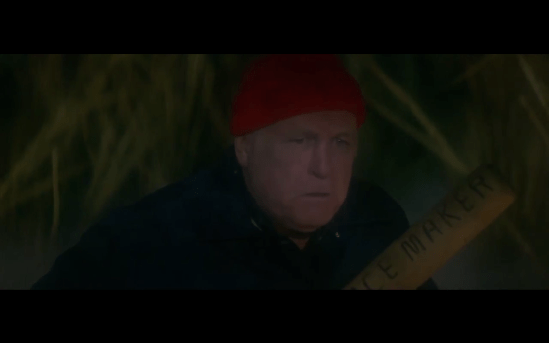
What makes “Silver Bullet” as one of the most recognizable and rememberable films, regardless of some microscopic sloppy screenwriting and first time directing woes, is the cast. Before his life altering motorcycle accident, Gary Busey (“Predator 2”) as Uncle Red brings flesh and bone, and booze, to akin King’s Uncle Al character from the novella. Busey fabricates a wonderful, heartwarming performance dynamic with Marty, whose played by the late Corey Haim (“Lost Boys”). Haim is fresh to the scene with his chubby cheeks and doughy soft eyes that would eventually make him a heartthrob idol later into his career and at the young age of thirteen, Haim’s paraplegic performance is respectable and empowering. Uncle Red and Marty are pitted against a sleeper antagonist in Revered Lester Lowe, a role who I could see no one else being in aside from Everett McGill (“People Under the Stairs”). McGill has a face for television, or the big screen in this case, as his chiseled, dark features make him a formidable foe that’s hidden behind a clerical collar. Longtime television and TV movie star Megan Follows plays big sister Jane whom factors in as Marty’s only ally despite their dysfunctional relationship which Follows portrays well with verbal jabs of adolescent wickedness toward her disabled little brother. Rounding out the cast is Terry O’Quinn (“The Stepfather”), Bill Smitrovich (“Manhunter”), and “Reservior Dogs” Lawrence Tierney.
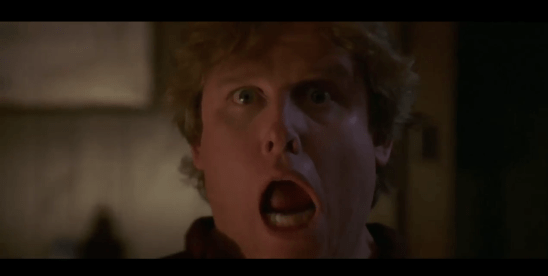
Television cooking show host, Giada De Laurentiis’ grandfather, Dino De Laurentiis, produced the film who was no stranger to the horror genre, such as “Orca” and “Amityville II,” nor to films adapted from Stephen King’s work like the “Dead Zone.” Under Luarentiis’ wing, “Silver Bullet” delivered brutal, traumatizing werewolf kills spun from the werewolf suit creating hands of another Italian, Carlo Rambaldi (“The Hand That Feeds the Dead”), and together, the two Italian filmmakers, along with an apt cast and crew, saw their installment flourish amongst an overcrowded werewolf subgenre in the early 1980’s with competition from films such as John Landis’ “An American Werewolf in London,” “The Howling,” and, yes, even “Teen Wolf.” “Silver Bullet” didn’t just arrive on the scene without some challenges to the storyline. For instance, a killing spree has already established with more than five townsfolk dead and a strict curefew has been set in place, but Marty, ignoring his Uncle Red’s solicited advice about staying near the house to set off fireworks, sneaks out in the middle of the night to shoot off fireworks away from the house. Marty’s fairly bright through the entire story and a nice kid, but the initial encounter between him and the werewolf is by far one of the most unintelligent and dim-witted action any character to make in the history of horror films. What makes the scenario even worse is that Marty is handicapped.
Umbrella Entertainment presents Daniel Attias’ “Silver Bullet” on region B Blu-ray home video in a widescreen 2.35.1 aspect ratio. Image quality of the full high-definition 1080p picture has an agreeable color palette, sharpness, and pinpoint details that especially come to light during the memorable church of wolves scene. A very few scenes have transfer instability where, in a blink of an eye, a revert to a faded frame comes into the fold. The English 2.0 DTE-HD master audio poises and harmonizes the elements and the dialogue into a vat of consistency that isn’t flawed by track damage. Jay Chattaway rallying, chilling score is a candor testament to the quality of the soundtrack that follows suit right behind the beyond par quality of the dialogue and ambient levels. Special features include audio commentary with director Daniel Attias, interviews with special effects artists Michael McCracken, Jr (“Deep Blue Sea”) & Matthew Mingle (“A Nightmare on Elm Street 3: Dream Warriors”), an interview with actor Everett McGill, an Umbrella exclusive interview with producer Martha De Laurentii’s remembering “Silver Bullet,” isolated score selections and audio interviews with composer James Chattaway, theatrical trailer, TV Spots, radio spot, and still gallery. A complete and definitive set from Umbrella Entertainment! “Silver Bullet” is a howling success story of classic American horror that has timeless practical effects, a riveting narrative, and cast enriched characters that invest into the lycanthropy film paralleling David versus Goliath.
The Evils After World War III! “The Aftermath” review!

On the space shuttle Nautilus, three astronauts are returning home after one year in deep space. Their outbound transmissions to Earth are not being returned nor are they being received and as their ship draws closer to Earth, the only option for reentry is to take a risky crash landing into the Pacific Ocean, just off the coast of California, hoping someone, anyone, would see their shuttle coursing downward from the sky. Only two survive the crash and swim to shore where no boats, no planes, nor onlookers were around to receive them. They soon find out why. World War III had engulfed much of the Earth during their time in space, reaping the land of the urban jungles and making food and living conditions scare. Germ warfare had mutated much of the population to cannibalistic creatures and when torrentially raining, acid rain pours from the war torn atmosphere from ferociously brilliant and deadly clouds. Only a small band of good people remain and the two astronauts seek to keep them safe from the harsh elements, even against a merciless gang of thugs.

In the early 1980s, an ambitious and visionary filmmaker sought to produce, write, direct, and star in his very own modest budget feature film that would rival Hollywood’s glamourous and expensive effects while still maintaining a down-to-Earth independent production. That filmmaker was none other than Steve Barkett, creating his debut film, the 1982 science fiction post-war catastrophe, “The Aftermath.” “The Aftermath” is like if the “Planet of the Apes” met “The Walking Dead,” a sheer blunt for trauma of returning to your home to discover the world in shambles with different factions of hard nose killers ready to plunder all that you own and all that you will ever have. Barkett, with assistance from the brothers Dennis and Robert Skotak, who’ve went on to work on major studio films such as “Aliens” and did the matte work for John Carpenter’s “Escape from New York,” create a destroyed Los Angeles landscape through the power of some serious movie magic considering the time period and the budget.

Steve Barkett is Newman, one of the three astronauts with no first name, and the tough hombre’s hard disposition comes from his background exposition where he lost his wife and child before going up into space. Newman’s cold, but not heartless, and Barkett taps into that fairly well despite some robotic and formulaic performances. However, Christopher Barkett, Steve’s son, was a complete first generation cyborg, a regular toaster oven with teeth and eyeballs that monotones through all the lines and actions. The most interesting casting here is Lynne Margulies, who at the time of this release, was or was not yet the late Andy Kaufman’s girlfriend. Margulies, who previous worked on an adult film entitled “Young, Hot ‘n Nasty Teenage Cruisers,” continued the racy trend with a shirt-pokey role in Sarah, Newman’s quick-to-sack love interest with a briefly, well-endowed nude scene. Yet, Sig Haig manages to steal the Barkett’s film from right under his nose. The young and ruggedly muscular “The Devil’s Rejects” star sports his trademark shaved head and thick, dark goatee, labeling him the perfect casting choice in gang leader Cutter. Alfie Martin, Forrest J. Ackerman (“Dead Alive”), Larry Latham, Linda Stiegler, and Steve’s young daughter, Laura Anne Barkett costar.

One aspect that’s really appreciated in Barkett’s enterprising venture through post-war commentary and morally righteous themes is the special effects matte work from the Skotak brothers. Detailed paintings, such as exampled in the war-ravaged metropolis that was formerly L.A. embodying the once towering buildings, are now destructively cut short in a mangled heap in a matte effect with live actors. Practical effects work wonders for Barkett’s large scale premise despite the small scale performances, except from Sid Haig. The detail in the violence dawns a newly restored faith in early 1980’s sci-fi films; violence that was more prevalent in the genre later in the decade, in such films as “Aliens” or “Robocop,” making Barkett’s film a trail blazer that paved the way to deliver more sensational savagery and lots of blood of a high body count to a already fantastic genre.

MVDVisual and VCI Entertainment release Steve Barkett’s “The Aftermath” onto a dual format, DVD and Blu-ray, combo pack. Presented in 1080p on a MPEG-4 AVC encoded BD-50, the post apocalypse never looked so good in a widescreen 1.78:1 aspect ratio from a 2K remastered transfer of the original 35mm negative. VCI has bested the rest with colorfully enriched scenes and untouched framing. Slight grain more so over the matte special effects that optically contrasts between the two different layers where a little touchup could have smoothed out the indifferences, but other than that, the details are quite stark. The clean and untarnished English LCPM 2.0 mono track is also vastly well constructed that contains minuscule hissing and the occasion pop, clearly making the dialogue a prevalent force. Composer John Morgan’s traumatically dramatic score is full-bodied and robust that coinciding renders well with the action sequences and tranquil moments. The extras offer the original laserdisc bonus material that provide snippets of interviews from cast and crew, Steve Barkett’s short film “Night Caller,” over an hours’ worth of John Morgan’s soundtrack complete with title information, VCI promo announcement for Barkett’s other director “Empire of the Dark, and the original theatrical trailer. A retrospective journey to the early 1980’s science fiction indie sector is also a visually stunning resurrection of “The Aftermath” courtesy of VCI Entertainment and with impressive effects and a bigger-than-life concept despite an underwhelming performance as an actor, director Steve Barkett’s legacy as a filmmaker remains stronger than ever with this prominent and well-deserved upgrade of the lazer-gun and mutant inhibiting world reckoning.

The Aftermath available at Amazon.com!

Evil Gets a 4K Digital Transfer! “Ichi the Killer” review!

Three hundred million yen and Yakuza boss Anjo have disappeared without a trace. Anjo’s most deadly and most sadomasochistic enforcer, Kakihara, and the rest of the Yakuza gang embark on a torture-riddle search and rescue to find their missing boss. After unrightfully torturing and mutilating a rival Yakuza leader, Kakihara learns through a trail of mayhem of a fierce killer known as Ichi and after being exposed to Ichi’s grisly handiwork first hand, a usually stagnant and emotionally detached Kakihara becomes stimulated and eager to go one-on-one with a formidable foe like Ichi, who could possibly bestow upon him gratifying pain to feel something other than emptiness. Ichi’s eviscerating destruction isn’t totally in his control as the sexually-repressed and candidly disturbed overall nice guy is being coerce through psycho-manipulation by Jijii, an old man seeking retribution against the Anjo gang. With blades projecting from his shoes and his skill at martial arts, the timid Ichi becomes the ultimate killing machine when brainwashing takes him over the edge into a hysterical fit of rage that leaves guts and blood to paint the floor and walls.

Perhaps director Takashi Miike’s finest work, the 2001 Japanese blood bath “Ichi the Killer” is a must own for any film aficionado teetering on the razor wire between crime dramas and gory action flicks that might be on the viewing docket for then night, but certainly a must-see for all film lovers at some point in time. Miike’s stone cold, chaotic style of filmmaking embraces the story’s unwavering havoc that blisters with ruthless brutality between two very different, black and white characters with one thing in common – being good a killing. Based off the manga penned by Hideo Yamamoto and from the adapted screenplay by Sakichi Sato, Miike crafts the most disturbing elements of mankind and brings them to the forefront in a simple story of revenge. On one side, there’s Kakihara, a scarred-face Yakuza enforcer with a very rich violent history to the extent that he’s become numb to his own existence in the world and then there’s Ichi, a reclusive cry-baby stemmed from being mentally fed graphic bulling stories of battery and rape in a memory built upon languishing lies. Vastly different, well-written characters opposite the spectrum and both are good at dealing death, but one aims to dish it out and the other yearns to stop his carnage, and that compelling core element is immensely fluffed by extreme violence in a way that only Miike can deliver it.

But for a film like “Ichi the Killer,” Takashi Miike had a little (hint of sarcasm) help from his gifted cast in making this project a cult success. Before this actor was Hogun in the Marvel Universe’s “Thor” franchise, Tadanobu Asano shaped up the psychotic enforcer Kakihara and the usually dark featured Asano reconfigures his appearance to put life into the character who sports blonde, wavy hair, a frothy complexion, and small hoop piercings at the corners of his lips to keep the slits from opening to expose the entire gaping jaw which is used as a defensive weapon. Opposite Asano is the Tokyo born Nao Ohmori who perfectly subjects himself to being a wimpy human shell with an explosive inner anger. The two men have only a small amount of screen time together and that requires them to build their character’s standout personalities. Complimenting their performances is an amazing support cast, including Shin’ya Tsukamoto (“Marebito”), Miss Singapore 1994 Paulyn Sun, Hiroyuki Tanaka, and Suzuki Matsuo.

“Ichi the Killer” is simply magnificent where it vulgarly touches upon various themes, mostly human flawed that also destines opposing counterparts together. Aside from the graphically realistic violence, Miike’s film hits upon other attributable tangents, among them some are just being plain gross, but these aspects are undeniably important to the story. Themes ranging from sexual suppression and female inferiority to sadomasochism and severe obsession top the charts in a heap of motifs throughout. Accessorial blood and other bodily fluids are extravagantly portrayed, spraying across the room with jettison entrails or dripping from potted plants to a cloudy puddle below during in a voyeuristic rape scene, to get the clear sense of an adult manga inspired chockablock exploitation and crime drama.

Well Go USA presents “Ichi the Killer” on Blu-ray in a newly restored 4K digital transfer of the director’s cut; a task undertaken by Emperor Motion Pictures in 2017. Presented in a widescreen 16:9 (1.85:1) aspect ratio, the film starts off with a blurb about the history of this particular digital restoration and transfer that asserts director Takashi Miike’s approval for release. Well Go USA’s rendering resembles much of the previous Tokyo Shock Blu-ray with subtle differences such as a slightly more aqua tint to the picture coloring and also much like it’s other Region A Blu-ray counterpart, a bit of noise is present in the restoration, but still the better detail of the two. The Japanese stereo 5.1 DTE-HD Master Audio surround sound has an bombastic soundtrack, but dialogue remains on the softer side where relying on the English subtitles is crucial. No issues with timing or accuracy in the subtitles. Surprisingly, the only extras included on the Well Go USA release is an audio commentary with director Takashi Miike and manga artist Hideo Yamamoto, still gallery, and the trailer that undercuts this releases’ purchasing value and might as well hunt down for the out of print Media Blasters Blu-ray, if extras are a must. Even still, “Ichi the Killer” has been resurrected in North America again and the release technically sustains growth amongst the mass of releases around the world. The lack of special features is disconcerting, especially being a restored director’s cut, but “Ichi the Killer” can stand on it’s own as a gracefully sanguinary masterpiece. Look for the Blu-ray to hit retail and online shelves March 20th!

Get Ichi the Killer today on Blu-ray!


