EVIL Tossing Back an EVIL Hail Mary! “The Last Match” reviewed! (Cauldron Films / Blu-ray)

“The Last Match” is Now on Blu-ray From Cauldron Films!

A sovereign, Latin American banana republic is a beautiful paradise for those seeking tropical getaways, such as with 18-year-old Susan Gaylor and her boyfriend George indulging in paradisial romance, but paradise turns into hell when Susan is accused of smuggling drugs out while going through the departure gate at airport security.  George flees the scene to evade capture and phones Susan’s father, famous football quarterback Cliff Gaylor, to help administer talks to release Susan.  When negotiations fall on deaf ears, the American consul is handcuffed by little-to-no relations with the incarcerating nation, and the local counsel are nothing more than greedy exploiters, Cliff and George have no one and nowhere else to turn to except for Cliff’s team of broad shoulder teammates and a gameplan-calling coach dedicating their lives to suit up and extract Cliff’s daughter from the cruel grip of Warden Yashin and his miscarriage of the law and order with an all-out offensive assault.

Italian filmmakers directed a football movie.  No, I don’t mean fútbol, aka soccer.  I’m talking about American football with face-masked helmets, shoulder pads, and a prolate spheroid shaped ball with laces you kick through the uprights.  The contradictory idea isn’t so much of a theorotical concept as it is a reality with Fabrizio De Angelis’s directorial attempt at pigskin gridiron in the early 1990s.  The “Killer Crocodile” director helms the jailhouse break picture entitled “The Last Match, or “L’ultima meta,” released in 1991, from a script by fellow Italians Gianfranco Clercic (“Cannibal Holocaust,” “The New York Ripper”) and Vincenzo Mannion (“Murder-Rock,” “The Last Shark”) that blitzes hardnosed foreign opponents with not only high caliber assault rifles and ammo but also done in full team gear, right down to the numbered jerseys and cleats.  Angelis produces the shot in the Dominican Republic film with Mark Young serving as executive producer with Fulvi Films as the production company.

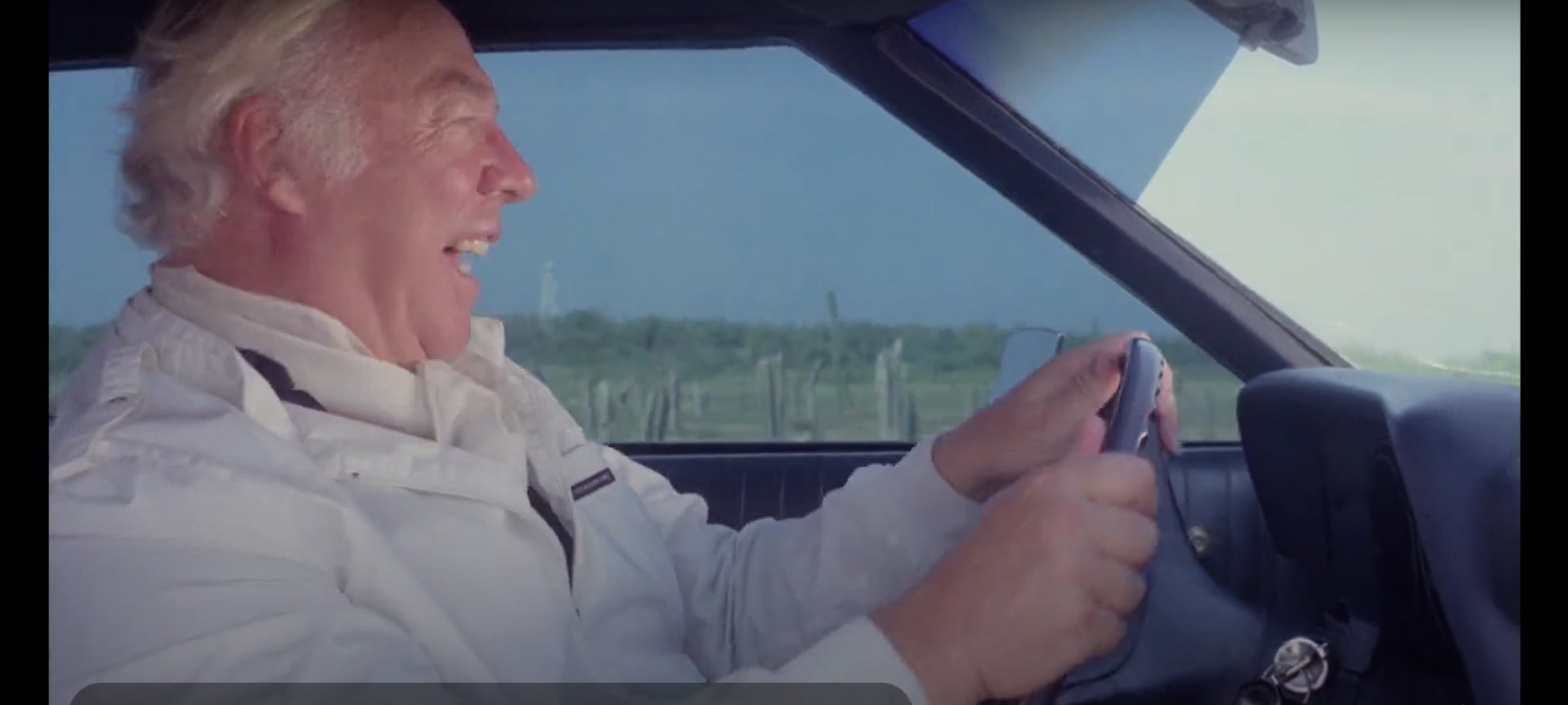
Not only does “The Last Match” have a theme around an American sport, but it also employs a nearly all-American cast, a popular course of casting once the Italian industry started to gain traction and making films in The Boot proved to be more costly at the time, plus American actors were also far more marketable than Italian actors.   Ernest Borgnine (“Escape from New York,” “The Poseidon Adventure”) plays the fair-weather looking coach who knows common football terms, about as generic as coaching on screen comes without dipping into play strategies and being inundated by the game.  Borgnine’s cruise control motivation is equaled by Charles Napier (“Supervixens,” “Rambo:  First Blood Part II”) in the performance of a hands-tied American Consul stationed in the unnamed tropical country.  While Borgnine and Naiper act in natural nationality aspects, there are also another pair of Americans who transition their talents to be native islanders who are subsequently more deviously portrayed in what becomes a pro-American, anti-foreigner perception.  The actors, whom are also both New York City born, are Martin Balsam (“Death Wish 3,” “The Delta Force”), as a greedy local defense attorney who tries to exploit Cliff Gaylor’s desperation, and Henry Silva (“Almost Human,” “Allan Quartermain and the Lost City of Gold”) with his wide face stretching a maniacal grin as the sadist warden Yashin and though Balsam and Silva tout the root of evil archetype, molded to their individualized immorality, they barely fit in the framework of Latin American men with a less than convincing swarthy spray tan.  In the middle of it all is German-born “’Tis Pity She’s A Whore” actor Oliver Tobias as football star father, Cliff Gaylor, determined to try every line of legal offense to acquit his daughter for the firm hand of the country’s tight authoritarian, punitive system.  Gaylor’s arc possess a line of natural progression through anger, confidence, and desperation, and perhaps even a little bit of all hope is lost but does become stymied, or neutralized, but Coach’s unconventional jailbreak playbook that sends Gaylor into the backseat though he still quarterbacks the mission, at least on paperwork.  Melissa Palmisano as the Gaylor’s wrongfully incarcerated daughter Susan and Rob Floyd playing her determined to help but pretty much young and useless boyfriend George fill out the remaining principal cast alongside bit part support from Jim Klick, Jim Jensen, Jim Kelly, Mike Kozlowsky, Mark Rush, Bart Schuchts and Elmer Bailey as Gaylor’s football brethren in arms. 

As for escape from foreign prison/work camp films go, “The Last Match” ranks at mid-range with a plausible conflict involving being a foreign tourist patsy to mule drugs through airport customs only to be caught, charged, and sentenced to be condemned without fair due process and entitled to incorruptible legal representation.  The scenario enacts frightening destabilizations of a pre-CCTV and security vigilance airport situation, evokes hopelessness of relief or assistance within a near lawless republic, and you can feel Gaylor being drained of all avenues where even his fame and fortune can’t even muster any type of traction in releasing his daughter.  Being a father myself, there’s a compelling aspect to see an expat father helpless in strange surroundings, suppled by indifferent and aggressive native blockades in a corrupt system, with his only choice then being to extract his only child with violent force.  This is the point where the compelling subjugation stops and the gaminess of the story begins to unravel when Coach brings the boys to the yard, yard being the tropical island, to acquire an arsenal, helicopter, and suit up in their conspicuous gridiron gear for an all-out prison assault.  Garbed in bumblebee yellow football pants, black helmets, and white jerseys, the elite wildcat formation commando unit isn’t dressed to blend into the background, foliage, or even the night with their reflective color gametime getup.  Coaching from the sky, Borgnine is perched high in the helicopter calling off plays while his offensive team makes quick and dirty work of the island prison defense without nearly a fumblerooskie.  Conceptual neat for the movies, but practically asinine for reality, “The Last Match” favors the fortunate heroes with a near obliteration of the entire prison camp without a single loss to their own, especially when they’re not in any kind of bullet resistance helmets or vests.  Fabrizio De Angelis runs the ball with confidence in his mildly amusing sports themed actioner as he’s able to blend footage of a national police bowl game into his narrative by fashioning matching football uniforms.  About as surprising as a fleaflicking trick play to win the game, “The Last Match” is worth going for the endzone on 4th and long.

A pulled-pin pigskin grenade explosion thrill ride in the tropics is “The Last Match’s” hard-hitting American football done the Italian way. Cauldron Films’ new Blu-ray release is the U.S. home video and worldwide debut from a new 4K restoration from the camera negative.  The AVC encoded, 1080p high-definition, BD50 presents the film in the original aspect ratio, the European widescreen 1.66:1.  There’s hardly anything to fault in this clean, sharp, diffused color saturated picture from a well-stored camera negative that has seemingly suffered no time or external wear and tear.  Grain appears naturally disseminating into a favorable detailed reproduction print with skin tones that are organic and don a nice sheen and rivulets of sweat when things get heated in football and in armed assault.  Tropical landscape remains focused in back and foregrounds, especially in instances of Giuseppe Ruzzolin’s (“Hitch-Hike,” “Firestarter”) mirror reflection shots, but not a ton of wide or long shots to take in the scope of the Caribbean battleground, limiting scenes to medium-to-closeups that crop the milieu quite a bit when you’re trying to sell a large-scale football bowl game or an ambiguous kakistocracy tropic nation.  The English language DTS-HD Master Audio 2.0 provides lossless fidelity with full range diffusing evenly through the dual-channel output, separating decisively the dialogue and the action.  With a majority of the cast native English speakers and having been filmed party in the U.S. and in the western hemisphere, ADR is not the main source of recorded dialogue with boom work providing and capturing the distinct voices and personalities of some of the more recognizable voice talent, such as Ernest Borgnine and, especially, Charles Napier’s Kentuckian twang.  However, there’s quite a bit of hissing feedback sporadically throughout.  Action depth is a bit front loaded, naturally with any dual channel, with the explosions and gunfire that never quite hit the same distance markers but do excel in being robust where needed.  English SDH subtitles are available.  Cauldron conjures new and exclusive special features with an interview with special effects artist Roberto Ricci Blown Away, a minidoc about American actors in Italian cinema narrated and directed by Mike Malloy, Italian film aficionado Eugenio Ercolani provides a video essay Understanding the Cobra, a commentary by Italian exploitation critic Michael A. Martinez, an image gallery, and the film’s trailer.  Cauldron Films has continued to provide eye-catching artwork with reversible cover sheets and “The Last Match” is no exception with dual compositional illustrations of football players wielding AR15 rifles and bazookas, though I’m not so confident the illegal purchase of Island armory would be police issued AR15s and bazookas.  Just sayin’.  There are no other tangible supplements with this release.  The region free Blu-ray is not rated and has a 94-minute runtime.

Last Rites: An Italian film using big named American actors pitting an armed, American football-cladded, rescue team against a hostile and sinister island prison, creating “The Last Match’s” action extraction of hairbreadth escape and pulling it off!

“The Last Match” is Now on Blu-ray From Cauldron Films!

Cartagena’s Secrets are Mountainous EVIL Aliens! “Top Line” reviewed! (Cauldron Films / Blu-ray)

When Everyone’s Out To Get You, You Get “Top Line” on Blu-ray!

Washed up, alcoholic feature journalist Ted Angelo drinks himself into a stupor on the porticos of Columbia.  Having just been fired by his magazine editor for lack of content, Angelo scores big when led down the path of ancient tribal artifacts that proves the terminus of one of Europe’s famous new world explorers, rewriting history of the disappeared pioneer, but what he truly discovers is bigger, and more frightening, than history itself as he unearths a large alien spacecraft hidden within the Columbian mountains, big enough to enclose the explorer’s lost mast ship.  The discovery of a lifetime becomes the bane of Ted Angelo’s existence as he’s suddenly on a kill list and every organization, from the C.I.A., to the K.G.B., to former Nazis, is hunting him and wanting him dead.  Unable to trust anyone and nowhere to run and hide, the desperate writer is determined to expose the secret-to-kill-for to the world but not if the aliens have anything to say about it. 

Let’s talk about a film that is a bit of a smorgasbord with tapas plate tastings of just about every genre that exists.  That’s one way to serve the description of Nello Rossati’s “Top Line” with an inarguable action coating menu overtop the varietal lifeblood veins of science fiction, espionage, drama, parody, horror, and driven by a sensationalized historical context.  Directed under Rossati’s Americanized pen name, Ted Archer, and known alternatively as “Alien Terminator,” “Top Line” tries to appeal to western audiences with brazenly broad script cowritten by “The Woman in the Night” director and Roberto Gianviti (“Don’t Torture the Duckling,” “Murder Rock”) at the height of Italian ripping of popular American movies.  Filmed on site in Cartagena, Colombia, the Italian production was produced by Luciano Martino (“The Island of the Fishmen”) and productionally sanctioned under companies Dania Film, Reteitalia and the National Cinematografica. 

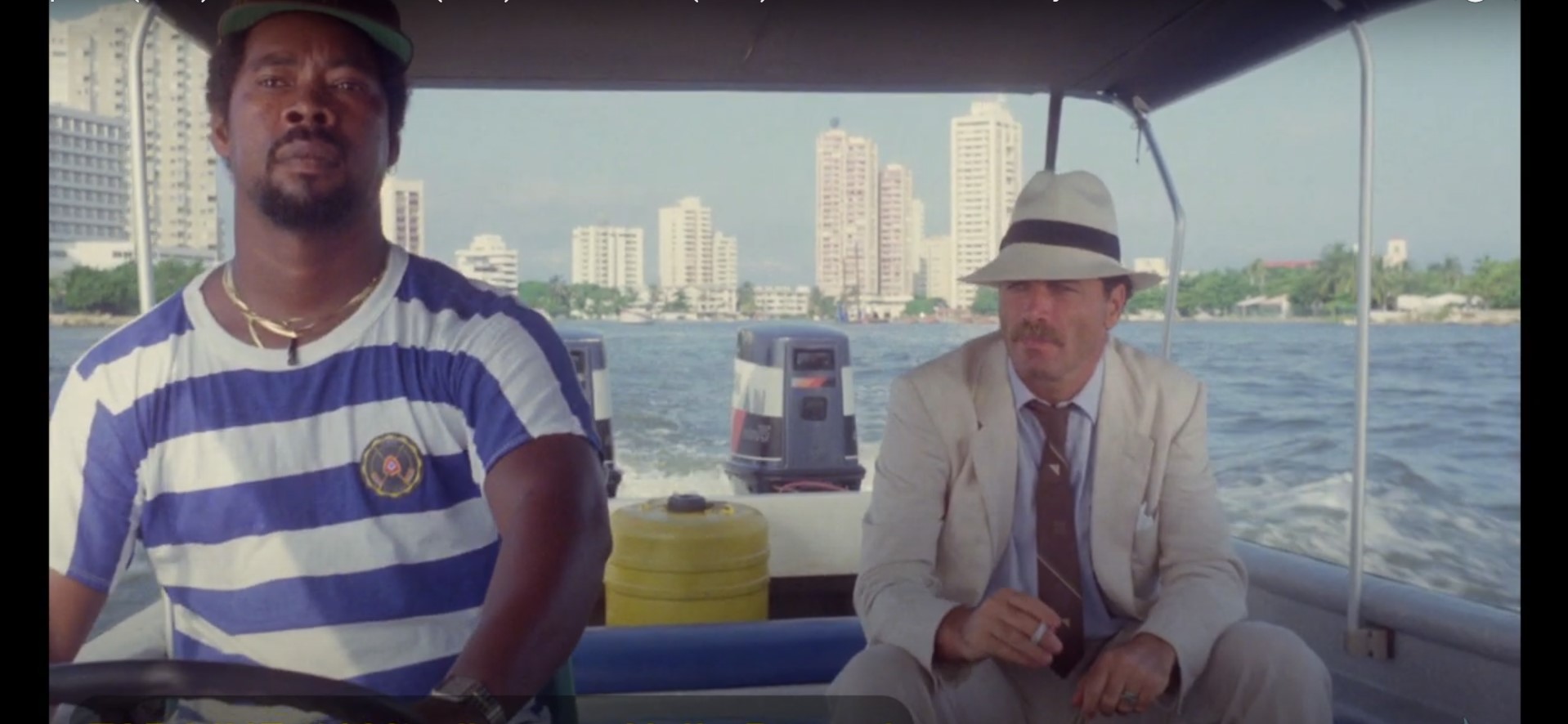
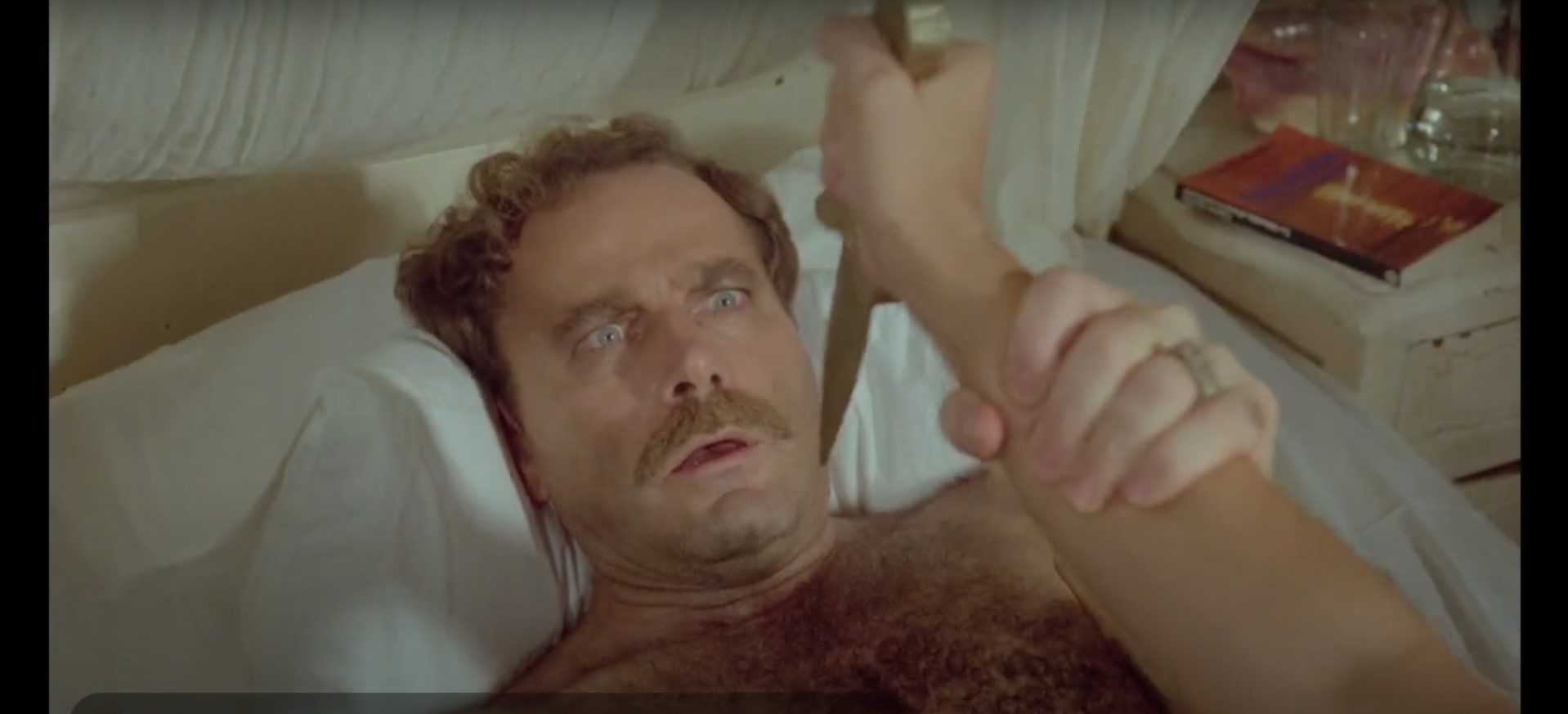
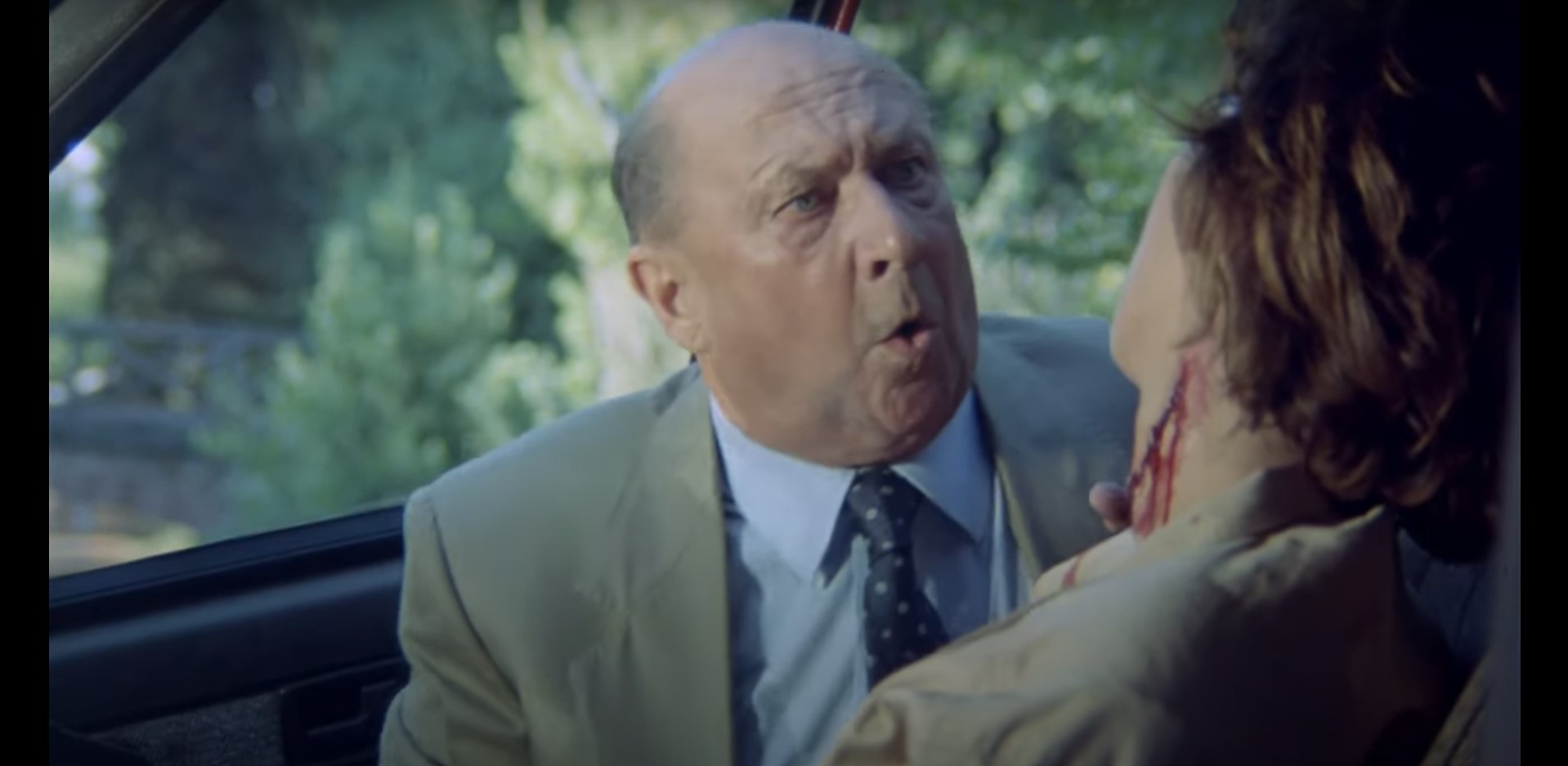
What’s likeable about Ted Angelo is he’s simply a writer.  He’s not a crack-shot, he’s not a world-class fighter, and he’s not one for conjuring up a complex master plan.  Instead, Ted Angelo is a flawed man under the influence of a bottle and is a low-level womanizer where the bedroom interests are more about local information than about the sexual activities.  Franco Nero (“Django,” “High Crime”) goes against his multifaceted ruggedness and muscular physique to be the more of an adaptable and instinctual hero that tries to make up for slouching about Columbia’s drink selection.  Nero’s the hero while Deborah Moore, of “Warriors of the Apocalypse” and daughter of former James Bond Roger Moore, tiptoes about the love interest trope after her character’s senior colleague, who is also Angelo’s good friend, is murdered in the plot and the two become intwined and more goal oriented in unearthing the reason in a minor ploy of revenge.  Yet, the trick is on them after discovering a U.F.O. right in their mountainous backyard and the hunt for their lives is on by a former Nazi and antiquities collector Heinrich Holzmann (George Kennedy, “Naked Gun”), a whole slew of clandestine organization spooks, and Rodrigo Obregón (“Savage Beach”) doing his best Arnold Schwarzenegger “Terminator” act as a large cybernetic man with a stoic and half-exposed face.  “Top Line” supporting cast includes William Berger (“Devil Fish”), Sherly Hernandez, Larry Dolgin (“Caligula:  The Untold Story”), Steven Luotto, Robert Redcross, and Mary Stavin (“House”) as Ted Angelo’s ex-blonde beauty editor girlfriend.

“Top Line” has one of those cinematic stories that’s all over the place pieced together by western inspiration like some sort of genre stitched together Frankenstein’s monster.  Unlike the flat top and bolt-necked creature born of electrical current and held together by suture and mad scientist sorcery, “Top Line” doesn’t have any hideous scars or an unfavorable attitude deterrent but what the Nello Rossati film does feature similarly are the monstrous best parts, such as unpredictability, a pendulum of excitements, and an everyone has grabbed their pitchforks and is out to get you sentiment.  “Top Line” is a wild, exciting, volatile ride set in the heart of a landscape and culturally showcased Cartagena and the ever game, Italian actor Franco Nero at the helm steering what at first appears to be an adventurous escapade of treasuring hunting and covert coverups in act one and two suddenly careens into an assault of astro-terrestrials forces to the tune of the fourth Indiana Jones film, “The Kingdom of the Crystal Skull, by crescendoing third act.  “Top Line” is just as theatrically thrilling without the whipcrackin’, fedora-wearing, family friendly archaeologist with multiple blood squib shootouts, a superb tongue-and-cheek car chase down winding mountainside road, and the hydraulics-driven special effects transfiguration your eyes need to see to below.

Cauldron Films proudly presents “Top Line” onto Blu-ray for the first time, the resulting 2K transfer sourced from the camera negative. The AVC encoded, 1080p high-definition, BD25 decodes a clean, color stable picture that feels organic around the diffused color scheme, and that palette pops without being artificially enhanced. Grain appears in check, natural, and consistent throughout. Presented in the original aspect ratio, a widescreen European ratio 1.66:1, does capture the grandiose of a 17th century exploration ship inside the cavernous mountain without a squeeze of the frame, providing more depth with the help of the art direction to visualize and construct an actual set. Textures, fibers, and other tactile s are limited around the jungle setting that does offer a nice leafy and lush setting that depicts a thicket of a developing country without just being a smear of the same color arrangement but outside of that, what does source de facto is sumptuous textural material. Two audio options are available to choose from with an English DTS-HD Master Audio 2.0 mono and an Italian DTS-HD Master Audio 2.0 mono. The Italian is done in post with ADR and has that nagging space between action and voice while the English track goes through less dubbing, or more exact dubbing, with Franco Nero, and other cast, having their voice heard in scene and in synch. The only issue concerning comes with George Kennedy’s dialogue which is dubbed to be more archetypical German of the Nazi-era; however, this route was not heavily travelled with very few lines being delivered by Kennedy, or rather Kennedy’s voiceover actor. Ambience travels amply and disseminates well for a single signal to travel through a stereo output and this jumps the eclectic range of action from the speakers to your ears. Granted, the action is very selective as you don’t every nuisance of jungle skirmishes and the other village landscapes, but there is enough and what’s not covered is often overlayed with Maurizio Dami’s tribal, tropical paradisio percussion and parallel synth with echoing vocal snips, such as whistling, and peppered with scene bytes – the chase sequence where the first batch of armed men running down Ted Angelo is audio composition gold. Special features on Cauldron’s standard Blu-ray contain an exclusive, new interview with lead man Franco Nero Black Top!, an interview with Eugenio Ercolani The Strange Case of Ted Archer, parapolitic researcher Robert Skvarla takes at examples of known alien sightings and speculations in Alien Terminated: The Alien Theories, an audio commentary by film historian Eric Zaldivar that includes interviews from Deborah Moore and Robert Redcross, and with additional insight on Italian cult films from actors Brett Halsey and Richard Harrison. The clear Amaray Blu-ray houses reversible cover art, both representing original artwork from the film’s release. The primary art is more adventurously exciting with Angelo’s arm wrapped around Moore and a rope, reminiscent of “Romancing the Stone,” while the interior cover plays to the science fiction side of the story, more “Terminator-y” to be exact. There are no inserts or other tangible items included. The 92-minute feature is presented unrated with a hard encoded region A playback.

Last Rites: “Top Line” is a top tier title with a little bit of everything for everybody that’s accentuated by a on-the-run Franco Nero performance with a new, gorgeous 2K transfer Blu-ray packed with special features from our friends at Cauldron Films.

When Everyone’s Out To Get You, You Get “Top Line” on Blu-ray!

Cheese Isn’t the Only Snack on this EVIL Rodent’s Diet! “Rat Man” reviewed! (Cauldron Films / Blu-ray)

See Nelson de la Rosa as the “Rat Man” on Blu-ray!

On the Caribbean Island of Santo Domingo, a genetic fiend scampers on the streets.  By injecting the sperm of a rat into a Monkey embryo, one fervent geneticist’s desires to be globally renowned creates a small yet deadly human rat.  Intelligent, agile, and with a lethal poison under its fingernails that could kill a normal size human in a matter of seconds, the creature escapes confines and roams the streets looking for fresh meat to eat.  One of the victims is a photoshoot supermodel from New York City that prompts an unofficial investigation of the mistaken sister to the supermodel and a mystery writer who are now on the hunt for the whereabouts of the others from the photoshoot group.  As the bodies pile up, the rat man wreaks havoc on the small island villages where the survivors and investigators must fight for their life to avoid being gnawed upon.

“Rat Man,” aka “Quella villa in fondo al parco,” translated to “That Villa at the End of the Park,” is the 1988 the Italian-made, creature feature of predominant spaghetti western and poliziotteschi director Giuliano Carnimeo in what would become one of his last feature films  Credited as Anthony Ascot, the western “Sartana” franchise and “The Exterminators of the Year 3000” director tackles the horrors of genetic manipulation with survivalist rodent given primate intelligence, a far cry from Carnimeo’s usual genres.  The screenplay comes from “Demons” and “The Ogre” writer Dandano Sacchetti under the penname David Parker Jr.  Carnimeo and Sacchetti Americanize their credits to appeal more to western audiences who, in the late 80’s, were lapping up Italian horror and creature features starring known international actors in tropical republics and “Rat Man” falls perfectly into that category.  “Zombie” and “The Beyond” producer Fabrizio De Angelis produces the film from production companies Surf Film and Fulvia Film.

While usually Italian productions go after American names, like John Saxon, Christopher George, or Robert Vaughn, “Rat Man” looked elsewhere amongst the surrounding Anglo-Saxon countries and plucked a few names that lead the charge in what would become a cluster of principals to become ensnared by tropical bred, genetically tainted vermin standing just over 2-feet tall, with elongated sharp teeth, and poisonous fingernails.  Without a defined lead, the script swirls through possible hero and heroine tropes, such as the investigating team-up between New Zealand actor David Warbeck (“The Beyond”) and Swedish actress Janet Agren (“Eaten Alive”) who are no strangers starring Italian productions.  Agren plays Terry who flies into Santo Domingo under the impression her supermodel sister was brutally murdered, and she happenstance meets at the same hailed cab Warbeck’s character, work vacationing mystery writer Fred Williams, who for some reason, some how becomes involved in helping Terry without significant cause or benefit other than possibly the mysterious case being a good plot for his next book.  There’s also the case of the false hero and final girl with the pursuit of photoshop photographer Mark, played by Austrian actor Werner Pochath (“Devil in the Flesh”) and his hot model Marilyn, by Italian actress Eva Grimaldi (“Covent of Sinners”).  These intended, or perhaps not intended, red herrings do make “Rat Man” favorably unpredictable as well as grim in regard to centric characters.  Grimaldi becomes the object of obsession with gratuitous nudity and a showcase of her other assets.  In more forgiving times when the diverging physical differences subjected actors into selective roles, the film employed one of the shortest men in our lifetime with Nelson de la Rosa.  Standing all of 2’ 4 ¼” because of Seckel Syndrome, the Dominican Republic born actor donned the makeup, false teeth, glued-on nails, and the ratty clothes to be transformed into the titular villain.  Limited movements and with no dialogue, de la Rosa’s underrated, give-it-his-best performance reveals to be a bright spot in story about a rat spliced with a monkey with the assistance of some movie magic; that one scene where he climbs up the window drapes and looks over his shoulder at Eva Grimaldi as she sleeps in a dark room and he’s slipping into the shadows gives proper chills.  Cast rounds out with Anna Silvia Grullon, Luisa Menon, Pepito Guerra, and Franklin Dominguez. 

Out in the cinema land, there have been worse genetical abomination movies through the decades.  “Rat Man,” surprisingly enough, champions for the middle ground as a solid, campy, man-made creature-on-the-loose feature with, dare I say it, okay performances, competent camerawork, and a villain unlike any other scampering around.  Sure, there are cheesy moments, but rats do like cheese, or so the stereotype goes, and that adds a layer of relaxation and ease knowing Giuliano Carnimeo had a sense of acceptability rather than trying to make a absolute, serious horror movie.  The one aspect I will mention where there was difficulty in swallowing was the scattered story flow.  “Rat Man” seemed to be everywhere all at once from beaches to the jungle to the vacant streets of Santo Domingo without rhyme or reason.  For a while I ran with the theory the Rat Man followed the photoshoot group, targeting the eye candy for its own perverse desires, but that promising concept was blown to smithereens when the little village of St. Martin had been terrorized and abandoned in a moment of exposition awareness.  Carnimeo’s jump from out of the western pot and into the horror fire translates his eye for the lingering and peripheral dread, much like a showdown of glares that has revolutionized to the lie and wait of the rat man cometh but if only the director could yoke the loose story for a straighter edge, “Rat Man” would have been acute as pestilence in the Italian horror mercati.

The “Rat Man” chews its way onto a brand-new Blu-ray release from Cauldron Films.  The restored in 4K transfer is pulled from the 35mm original negative and presented on an AVC encoded, high-definition 1080p, dual-layered BD50, exhibited in the original European widescreen aspect ratio of 1.66:1.  Primarily in low key, shadows run the range of a creature lurking in every nook and cranny, turning “The Naked Doorwoman’s” Roberto Girometti’s, credited as Robert Gardner, cinematography from darkened eyesore to a penetrating thriller of what’s scuttering beneath the shadows.  Emerging from the color is the perfect diffusion of color and texture underneath the natural looking stock grain.  There also isn’t a compression blemish insight or any kind of unnecessary enhancements from this good-looking print.  The only audio optional available is an English dub 2.0 mono track.  Despite an assortment of nationalities, the English dub does make the distinct accents go away with language uniformity.  Foley strength lies principally in the forefront but does champion the beast with a low growl always at your feet, or face depending on the camera angle.   English subtitles are optionally available and synch well with no errors in spelling or in grammar. Cauldron Films exclusive bonus features include an audio commentary, also available on the audio setup portion of the fluid menu, with film historians Eugenio Ercolani, Troy Howarth, and Nathaniel Thompson, and three Italian language with English subtitles interviews with cinematographer Robert Girometti, camera operator Federico Del Zoppo, and post-production consultant Alberto De Martino. “Rat Man’s” trailer rounds out the special features encoded content. The standard release comes in a clear Amaray Blu-ray case with new illustrated artwork that gives a real sense of what to expect by Justin Coffee. The reverse has the original, and if I might add beautiful, poster art that’s less surmising but more intriguing. Authored for region free playback, Cauldron Films’ “Rat Man” scurries with an 82-minute runtime and is not rated.

Last Rites: Forget setting out the poison, “Rat Man” can’t be exterminated with a phenomenally invincible release from Cauldron Films. In the slim pickings of the killer rat subgenre, “Rat Man” leads the pack rats as one of the more bizarre, degrading, and omnipotent villains ever to be on prowl.

See Nelson de la Rosa as the “Rat Man” on Blu-ray!

A Gang’s EVIL Ransom Elicits the Wrath of “Zero Woman: Red Handcuffs” reviewed! (Neon Eagle Video / Blu-ray)

“Zero Woman: Red Handcuffs” is Number One on Our Must Have Lists!

When undercover officer Rei lets her overwhelming emotions kill a suspect on an assignment, her displeased colleagues lock her into a cell, unable to decide her fate with fear of public outcry of police brutality that would blemish the department and force leadership regsinations.  When a prime minister candidate’s daughter is kidnapped by a ruthless gang of rapists and murderers and brought to a cathouse for sale, the brothel madam believes the young woman is better exploited by issuing a large ransom for her safe return.  Unwilling to face public scandal, the politician and a rigid yet loyal investigator of the clandestine Zero Division rig up a covert plan to eliminate every person involved with the kidnapping by offering a murderous deal to Rei in exchange for her freedom.  Rei’s able to infiltrate the gang’s inner circle only to see the plan devolve into chaos and blood between the gang and corrupt authorities.   

Japan doesn’t make films like “Zero Woman:  Red Handcuffs” anymore!  The violent Toei company pinkusploitation production, released in 1974, played a major role in unifying the sexual appetites of Japan’s pink pornos with the rough-and-tumble violence of exploitation action films.  The rising of Nikkatsu Roman Pornos forced the hand of the Toei Company to expand their portfolio, creating such as combinational conquest over salivating grindhouse cinema patrons that the radical subgenre deserved a new sublet coinage labeled pinky violence.  Toei company man Yukio Noda, a staple yakuza filmmaker for the company, helms the visuals translated from a script penned by “Female Prisoner #701:  Scorpion” writers Fumio Kônami and Hirô Matsuda.  Loosely based off the manga written by Tooru Shinohara (who also penned the manga of “Female Prison Scorpion series”), “Zero Woman: Red Handcuffs” stitches its own blood soaked and sexually provocative clothing that would later continue “Zero Woman’s” adventures throughout the years with more films.

Cladded in a chic long red coat, black boats strapped up just below the knee, and wielding an extra-long connector chain pair of red handcuffs, Rei is the anti-heroine of our manga fantasies.  Miki Sugimoto works deep into that fantasy vision as Rei, Division Zero’s lady cop who will do anything and everything, clothed or undressed, to get the job done, even with extreme prejudice.  A frequent delinquent girl portrayer for Toei Company’s gritty bad girl gang pink pictures (try saying that five times fast), Sugimoto’s filmography include the “Girl Boss” series, “Terrifying Girls’ High School:  Women’s Violent Classroom, and “Criminal Woman:  Killing Melody,” and so Sugimoto already had established this foundational layer for Rei as a fortitude of badassery and now tacking on another layer of a moral high ground, justified only by seeing her word through to the end.  Rei is up against a gang of five – four street thugs led by the recent prison released Nagumo (Eiji Go,” The Executioner”) and one lesbian brothel madam (Yôko Mihara, “Sex & Fury”) – as she agrees to a back-against-the-wall deal and slyly subverts the gang by helping Nagumo during a faux ransom sting operation.  Along with Sugimoto’s stoicism, the Toei porn actress retains her promiscuous allure, one where she doesn’t have to do anything to be seductive but just be herself, working not only toward the favor of her character, who continuously is taken advantage of sexually without shame, but also keeping the integrity of the Toei élan for Japanese sleaze.  “Harakiri’s” Tetsurô “Tiger” Tanba resides to the general’s overlooking hill as the prime minister candidate who sends his battlefield colonel in Hideo Murota (“Rape and Death of a Housewife”) to be the Zero Woman’s handler.  Their scheme quickly devolves as their plan evolve when the operation goes slower than expected and the gang’s leader Nagumo begins feel the pressure of paranoia and starts to unhinge, especially around his ruffian acolytes played by Seiji Endô, Rokkô Toura, Iwao Dan, Kôji Fujiyama, and Ichirô Araki as Saburo the mysteriously quiet, aviator-waring knifeman who in himself is an interesting character.  Cast fills in with the Japanese speaking Westerner Ralph Jesser in a wild opening sequence that results in a gunshot to the groin!  

Like most pinky films, “Zero Woman:  Red Handcuff’s” incorporates an X-rated sexual violence but unlike most pinky films, the pinky violence subgenre omits the softer side of sensuality, creating more of a nihilistic viewpoint toward sex of taking what you want, when you want it, and aggressively at that.  Yukio Noda picture contains hostile lesbianism, gang rape, and pressurized perversions that take control thematically in pinky violence.  The corrosive context that has a guilty pleasure pull in most patriarchal dominated cultures and fleapit cinemagoers goes hand-in-hand with the over-the-top violence conjoined at the hip of cause-and-effect.  Usually, the narrative goes an ugly rape equals hard-fought revenge; in Noda’s film, the cause is the kidnapping, and subsequent deflowering of a power politician’s little girl leas to the Zero Woman effect of silencing with corporal punishment that circumvents the law.  Stylish like a spaghetti western and brutally violent, “Zero Woman:  Red Handcuffs” is a meanspirited, out-for-blood, femme fatale engendered on the verge of the pinkusploitation genesis.

Neon Eagle Video, a collaborative boutique label effort between Cauldron Films and Mondo Macabro’s Jared Auner, releases “Zero Woman: Red Handcuffs” onto a new Blu-ray, restored in 4K from the 35mm print. The transfer is AVC encoded, 1080p high-definition, onto a BD50 and shown in the widescreen aspect ratio of 2.35:1. A relatively clean 50-year-old print hardly displays any age wear, if any at all. Scarcely marred by blue vertical emulsion scratches in only a single scene, the print retains and is stored with care to diffuse the range of color and to effectuate as much detail as possible in textures and skin while without taking away from Noda’s underbelly surrealism. The lower contrast infuses a pulpy layer to create softer shadows, but contouring manages to stick an outline thanks to key Rembrandt lighting precision, akin to Hammer Horror with a splash of Kensington gore. The uncompressed Japanese DTS-HD MA 2.0 mono peaks with the best possible optical audio. While not much in the way of depth creation, there’s plenty of range in the Foley, even if it’s artificially abstract and illogical compared to shotgun microphone captured audio. The ADR synch is one of the best inlaid post-recordings with visuals that renders hardly any feedback or unnatural noises on the audio layer. English subtitles are burned into the only available Japanese language picture on the release. Special features include a feature length audio commentary by author and producer for Vinegar Syndrome Samm Deighan, Sex + Violence = Pink Violence TokyoScope author Patrick Macias analyzes “Zero Woman: Red Handcuffs,” and an image gallery. Graphic designer Justin Coffee produces a new, rich-in-red, and taletelling composite illustration of what kind of film to expect on the front cover art of the clear Amaray Blu-ray. The reverse cover houses another illustration, one pulled from the feature’s original poster line. The BD is pressed with more Coffee fiery and red-laced artwork. This particular copy reviewed is not the limited edition set with accompanying slipcover and neither copy contains insert material. The region A playback release comes unrated and has a runtime of 88 minutes.

Last Rites: “Zero Woman: Red Handcuffs” is a fine introductory film into the world of Pinky Violence, a starting line for those perverse-thirsty for the unification of sex and violence in Japanese cinema. Neon Eagle Video delivers excellences with their restored print, second to none in its picture and audio quality that will provide a sterling experience.

“Zero Woman: Red Handcuffs” is Number One on Our Must Have Lists!