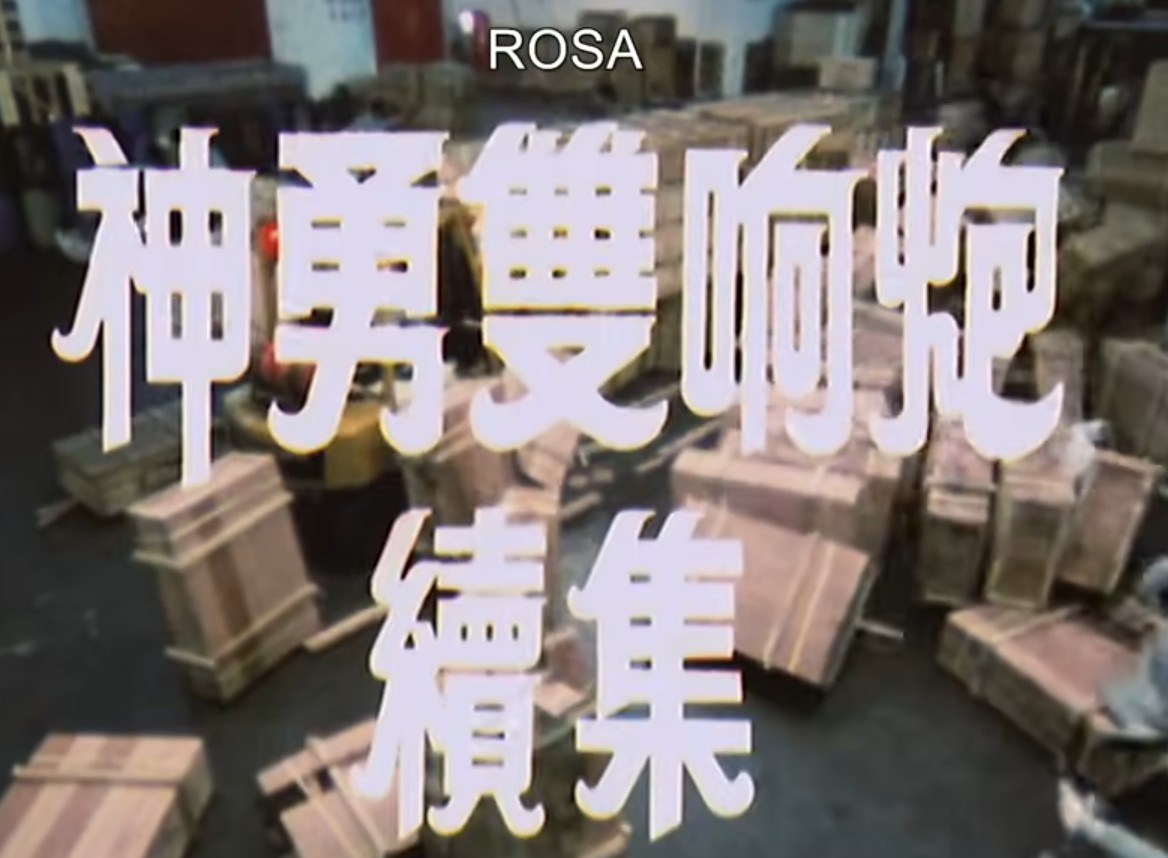
Two Cops. Two Girls. One EVIL Crime Boss! “Rosa” reviewed! (88 Films / Limited Edition Blu-ray)

Grab the Limited Edition Blu-ray of “Rosa” from 88 Films!

Little Monster and Lui Gung didn’t get along to begin with when Little Monster’s accident put Kung’s sister in the hospital for minor injuries but when the two rookie cops get on the bad side of their direct supervisor, Inspector Tin, they have no choice but to work together under his pleasure to see them suffer.  The two cops are assigned to the case of Li Wei-Feng, a smalltime crook who tries to black male mob boss Wong with incriminating photographs of a deal gone deadly.  They stay on top of and befriend Wei-Feng’s ex-girlfriend Rosa in hopes he’ll show up but the cops find themselves going on more double dates between Kung wooing the model Rosa and Little Monster courting Kung’s sister than actually doing any detective leg work.  Before they know it, they’re assisting Rosa out of her gambling debts with medium level bosses and on hot coals with Boss Wong’s formidable henchmen who will stop at nothing and will kill anyone in their way from obtaining the smoking gun film roll. 
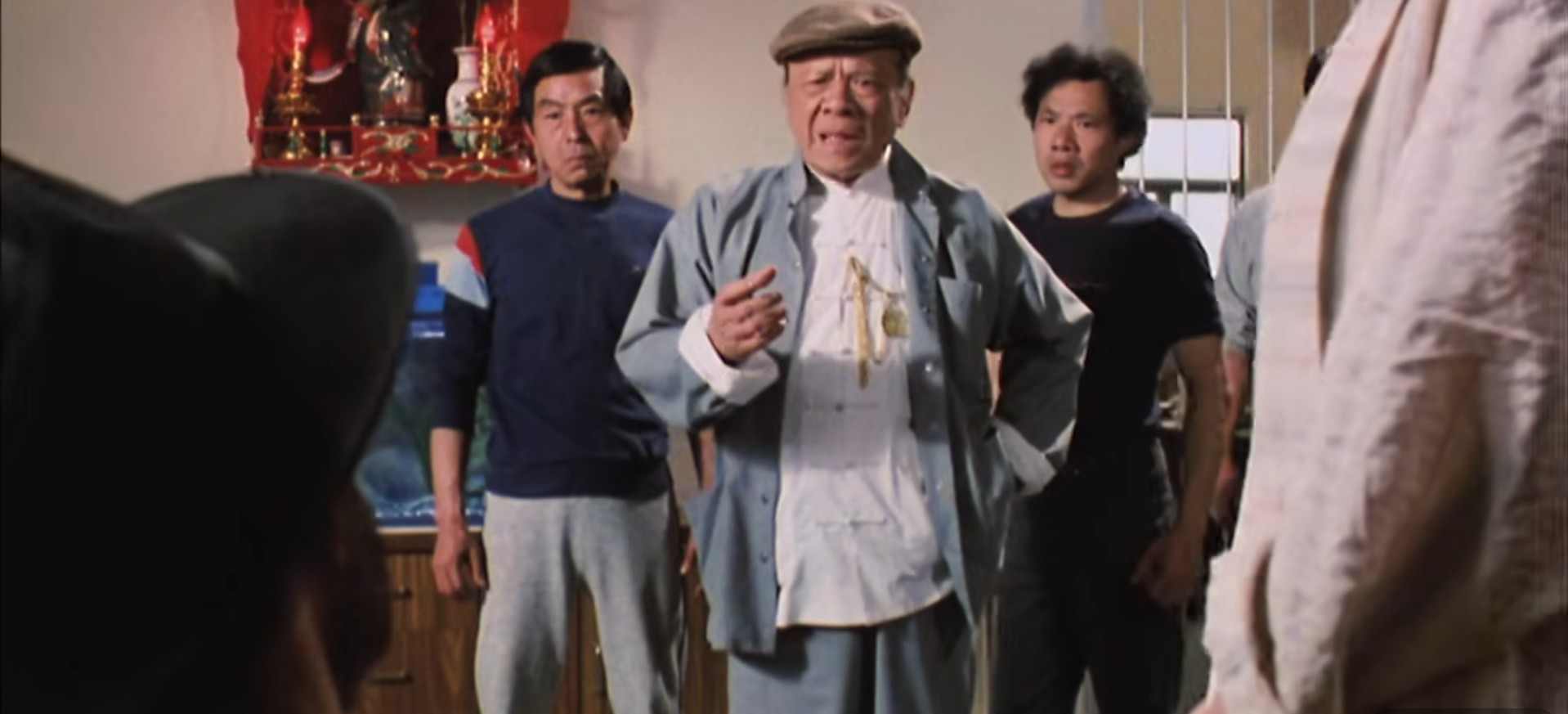
“Rosa” is the 1986, Tung Cho “Joe” Cheung directed buddy cop comedy-action film from Hong Kong,  Cheung has delivered a string of action comedies prior, such as with the a torn Kung Fu novice must jealous mend the rift between his two masters before a war ensues in “The Incredible Kung-Fu Master” in 1978 and the story of a veteran police officer who must work both sides of the law to manage his wife’s gambling addiction is paired with a rookie cop to take down transgresses in “Shadow Ninja,” release in 1980.  “Rosa” is another notch of comedic effort in Cheung’s belt but on a bigger scale with well-known actors, a large cast, incredible stunts, and fast martial arts choreography in a script penned by the “Chungking Express” director Wong Kar-Wai and “Hard Boiled” and “Mr. Vampire” writer Barry Wong.  Wong and Anthony Chow (“The Cat”) produce the film under the Golden Harvest Company and Bo Ho Film Company flags.
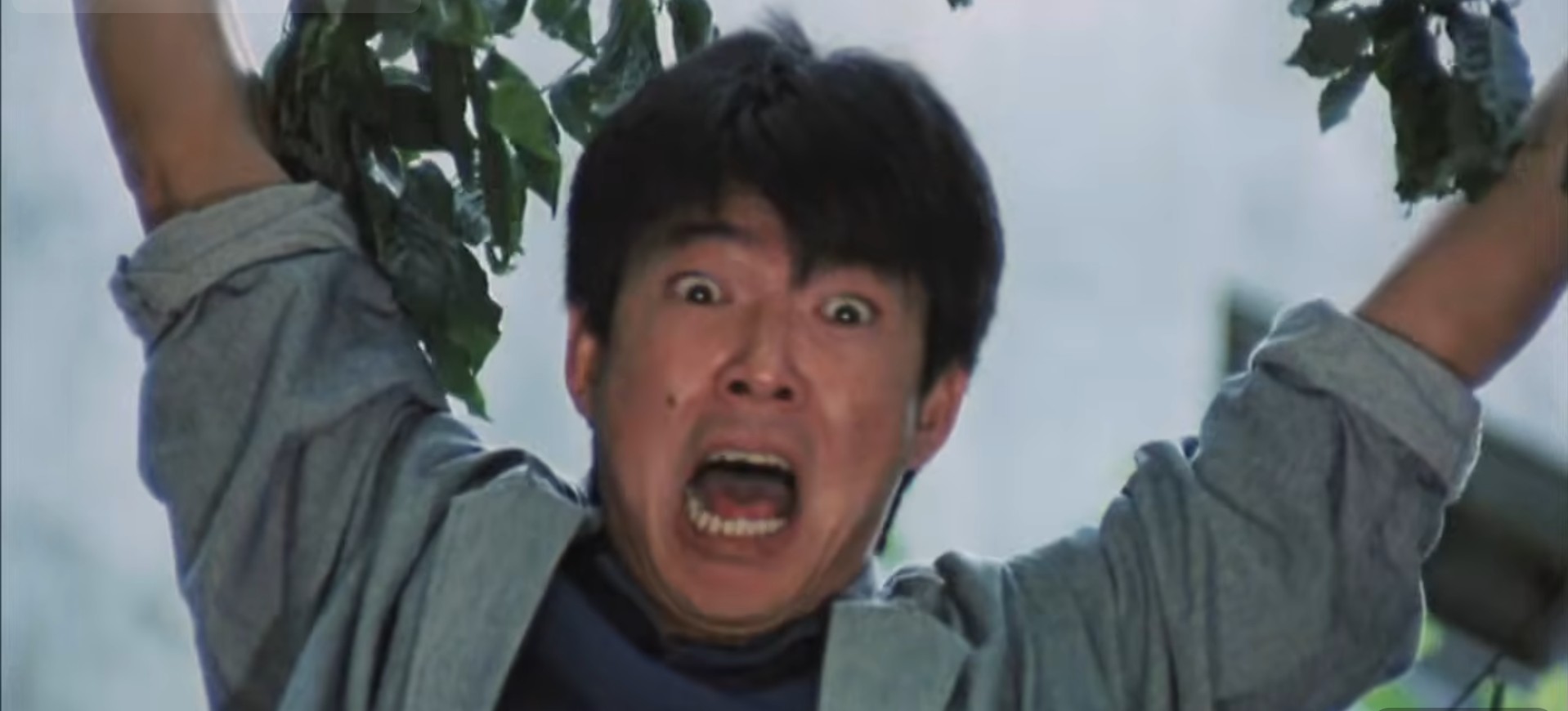
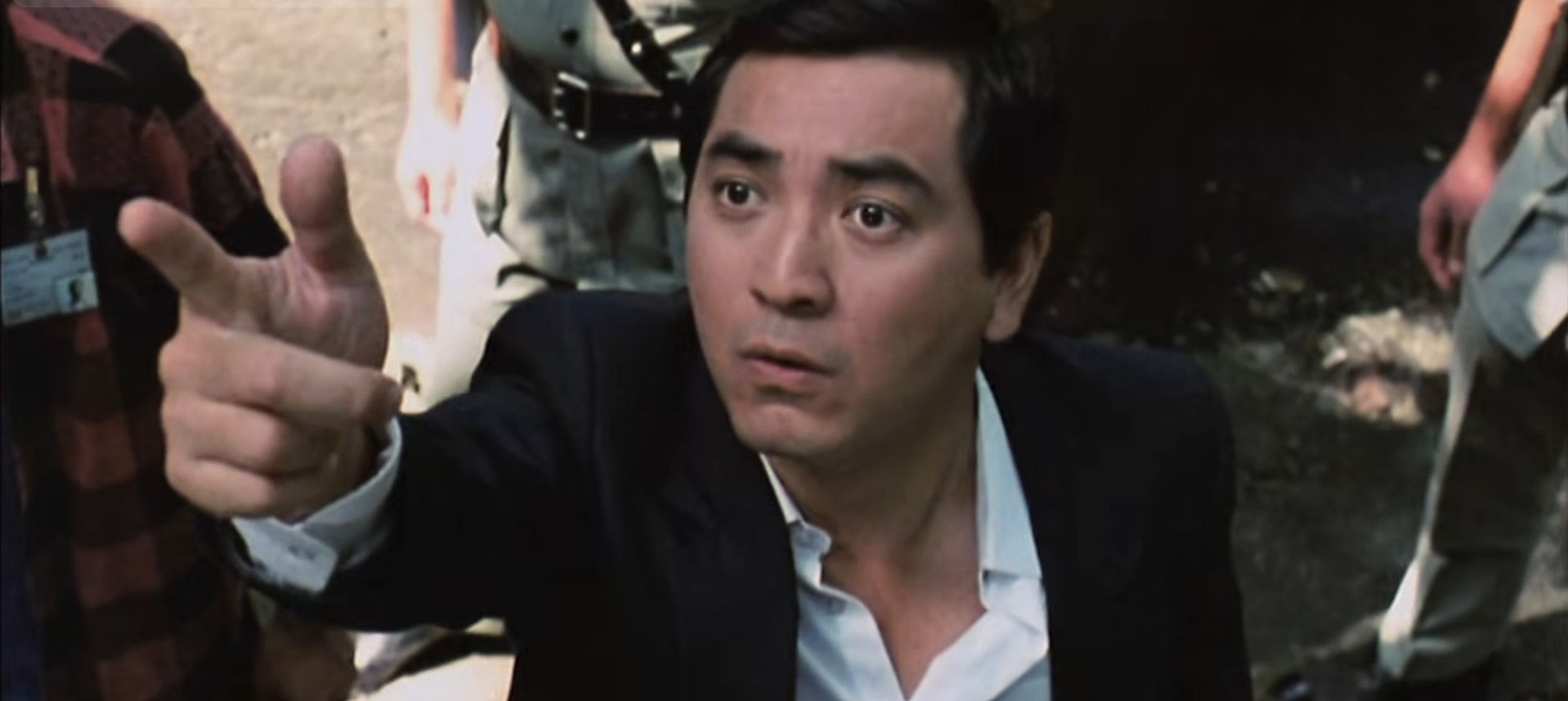
“Rosa” uses an ensemble cast more for comedic purposes rather than to instill dramatic action, beginning chief principal Biao Yuen, who we’ve recently reviewed in another new phenomenal physical 88 Films Blu-ray release in “Saga of the Phoenix” and has had roles in “Game of Death,” “Encounter of a Spooky Kind,” and “Picture of a Nymph,” as the endearingly named Little Monster, a go-lucky rookie cop with skilled martial arts moves.  Charming and confidence, Yuen plays the most sensible of protagonists without absorbing a lot of humiliation unlike his costar Lowell Lo who finds himself in a more subordinate role of Lui Gung underneath Little Monster’s suavity by having more overreactions, slapstick, and chasing with his tongue out a lost cause – that being Rosa.  “Inferno Thunderbolt’s” Hsiao-Fen Lu plays that titular role, a gambler addict and model with loan shark debt with ties to a small-time crook that incidentally involve her in a deadlier high-stakes blackmail with a power crime boss, but her importance is depreciated by Yuen and Lo’s buddying comedy and not the driving focus of the plot.  In all, the progression is a group effort rather than encamping around a centralized person.  With that being said, Kara Ying Hung Wai (“The Ghost Story”) often feels like an afterthought, a proverbial fourth wheel, as Gung’s sister Lui Lui whos’ gifted lines and a presence here and there but is mainly only Little Monster’s love interest in corporeal presence only.  Rounding out the good guys is the hapless Inspector Tin (Paul Chun, “To Hell With the Devil”), an arrogant supervisor who doesn’t want to get his hands dirty with police work and recruits Little Monster and Kung as punching bags for wrong him in their individualized opening, mishap run-ins with the inspector, another comedy outlet absorbing Rosa’s unintended entrenched Mob connection.  The Mob and other baddies fill out the cast with Billy Sau Yat Ching, James Tien, Charlie Cho, Fat Chung, Chen Chuan, and Dick Wei. 
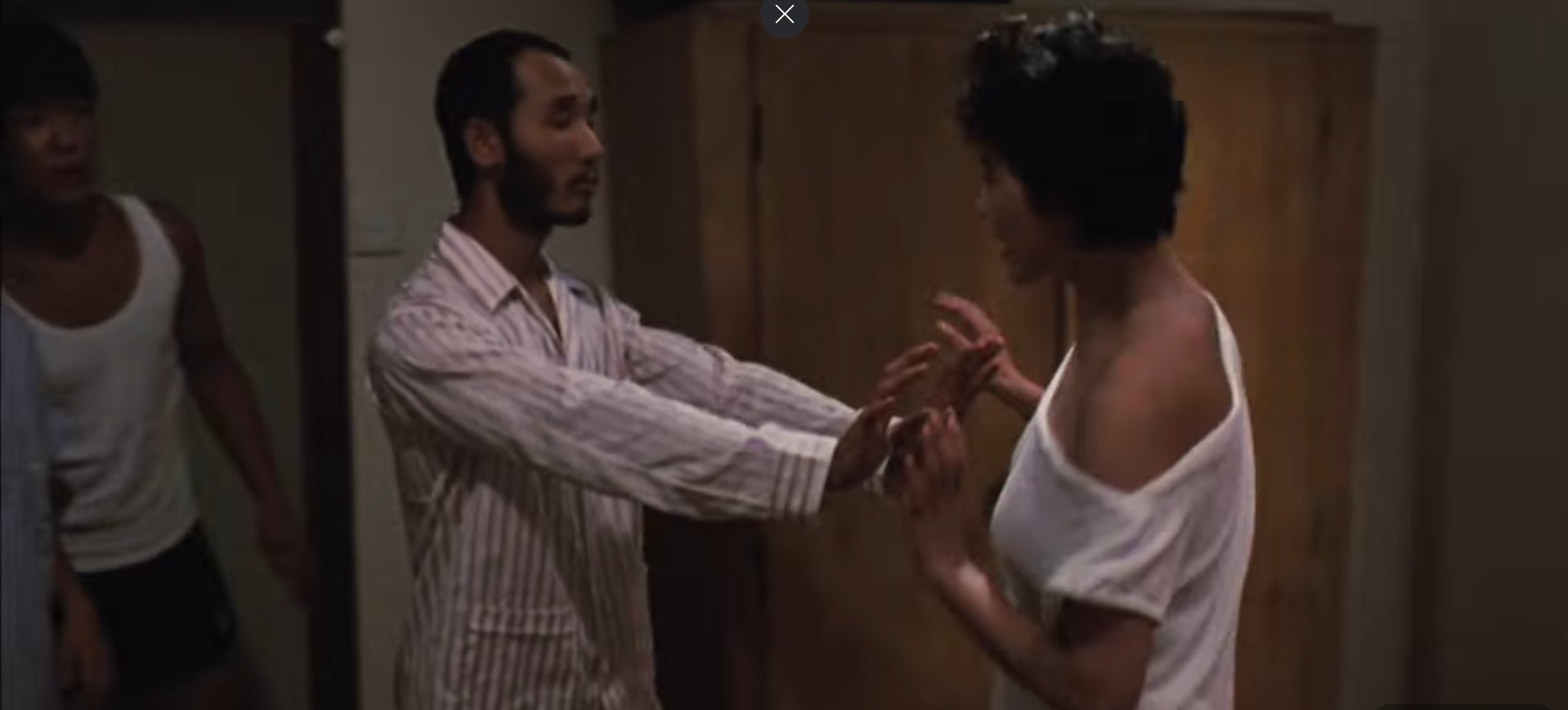
As far as “Rosa’s” action is concerned, it is topnotch quality between the wide-variety of stunts, the pinpoint choreography, and the excellently executed martial art fights that disproportionately leaves the narrative as a quintessential chop-socky police story.  I say disproportionately because the action is overly consumed by the comedy that, in itself, has struggles.  The humor physicality lands with precision with big hits taken in accidental error or are made within the context of choreographed fight scenes mostly stemmed by Lowell Lo and Paul Chun as they bumble their way through situations, but the dialogued jokes and other vocal gags are terribly corny that unfortunately dilute the overall mirth-murky pool that it becomes too often cringeworthy to swim in.  The light-hearted and sexualized humor is blended with an endless wooing and an outdo rivalry between the forced partnership that evolves into a fond friendship between Little Monster and Lui Gung, who is often referred to as Big Brother.  Lowell Lo embodies a larger slapstick piece of the pie with his distinguishable friendly face and doughy-eyed demeanor, contrasted against the athletic slender of Biao Yuen who outshines him on the conventional society determined good looks scale with an unassuming martial arts skillset to match.  All the serious and grim nature comes out of the Hong Kong’s criminal element with deadly assassins that use piano wire and large caliber handgun to lacerate jugulars and explode cars full of betrayed crooks.  The third act finale finally puts the pieces together and creates a harmonious brawl that blends action and comedy evenly, even integrating Lui Lui into the fold with an out of the blue ability to hold her own and fight just as fast and furious as Little Monster.  
Another Golden Harvest distributed production garners attention once again on 88 Films, in association with Fortune Star Films, with a definitive Blu-ray set from the UK boutique label making their presence known here in the North American market.  The AVC encoded, 1080p high-definition transfer, onto a BD50 has remarkable presentational quality with a pristine print transferred onto a 2K scan from its original 35mm negative.  The immersive quality shows no sign of destabilizing the matrix, leaving audiences with the immense scope of a cleaner, natural image full of depth and range of saturated and diffused color.  Skin tones appear organic and nitty-gritty with the stubble, sweat, beauty marks, and the subtle contrasts of tones.   88 Films’ flexes their restoration efforts that extends the color palate to suitable measure and each scene, through its superb editing by chop-socky veteran Peter Cheung, segues into the next without missing a color resolution beat.  The film is also presented in original 1.85:1 widescreen aspect ratio.  There are two ADR mono tracks, Cantonese and English.  Cantonese is preferred with the better mouth-to-sound synchronization, but both deliver a really good decoded mono mix despite the singular direction of all the audio but with post-production sound, that can be manipulated to exact timing with the exact sound to create a better disbursed audio design.  There some crackling and hissing in the dialogue but very low-level interference that doesn’t hinder the prominence and really affect the clarity.  The newly translated UK English subtitles are available from Ken Zhang and synch fine with a steady pace and come without typos.  Encoded special features have a new audio commentary by Hong Kong Cinema experts Frank Djeng and F.J. DeSanto, a second new commentary from another Hong Kong Cinema expert David west, an interview with director Tung Cho “Joe” Cheung and assistant director Benz Kong, alternate English opening and closing credit titles, an image gallery, and the original trailer.  The limited-edition set comes with a rigid slipbox sheathed by an O-Ring slipcover with new artwork by Sean Longmore that plays into Rosa’s bosomy running ga. Inside the slipbox is a 40-page color booklet with stills and a pair of essays from Fraser Elliott and Paul Bramhell, a collectible postcard, and the clear Amaray case with the same primary Langmore art on the sleeve that can be reversed for the original Hong Kong poster art.  The booklet and slipbox have more original art as well that speaks the action and slapstick.  The not rated, region A and B encoded release has a runtime of 97 minutes.

Last Rites: Fun, exciting, and moderately droll, “Rosa” might hit-and-miss on the comedy, but what definitely hits is the martial arts action defined in a harmony of perfect scrappy chorography.
Grab the Limited Edition Blu-ray of “Rosa” from 88 Films!

Etiquette over EVIL Shot in Super 8! “Kung Fu Rascals” reviewed! (Visual Vengeance / Blu-ray)

Kung Fu Rascals Kicking Butt on Blu-ray!

Chen Chow Mein expertly steals an ancient tablet from the evil overlord Bamboo Man from Ka Pow whose plan is to seek complete and total dominion with the tablet stone.  Chen regroups with this acolyte pupils, Reepo and Lao Ze, to visit an old wise man for translation of the tablet’s mysteries and follow it’s mapped out quest that’ll lead them to glory over the land’s malevolent beings, but the Bamboo Man from Ka Pow will not let their journey be so easy by dispatching head minion Raspmutant the Mad Monk to hire the corrupt Sherriff of Ching Wa County and his two apprentices, Dar Ling and Ba Foon, as well as summoning the monolithic Neo Titan to stop them at all costs.  Always training their Kung-Fu etiquette, the trio embark on a journey through a land filled with evil ninja henchmen and must fight together to finish the journey.

Sculptor and creature effects guru Seve Wang might be best known for his work on some of the genre’s most memorable and favorite characters, such as designing the final extraterrestrial jungle hunter of John McTiernan’s “Predator,” created the Mohawk Spider Gremlin in Joe Dante’s “Gremlins 2:  The New Batch,” and sculpted the failed Ripley clones in “Alien Resurrection” amongst other notable cult and blockbuster films.  What you might not know is that Steve Wang had also directed, incorporating too his special effects and sculpting talents behind the camera in a debut feature, a homage to the Kung-Fu and Kaiju genres, titled “Kung Fun Rascals.”  Wang also cowrote the 1992 film with another special effects artist and actor Johnnie S. Espiritu (aka Johnnie Saiko) of “Hell Comes to Frogtown” and “Aliens vs. Predator:  Requiem.”  Wang self-produced the film after a series of short films to gain financial backing for a feature-length production.

On any self-produced, independent film, the cast usually wears multiple hats.  “Kung Fu Rascals” was no different as writer-director-producer-caterer-sculptor-and etc., Steve Wang also starred as Chen Chow Mien, an expert Kung-Fu fighter who steals a pivotal stone tablet from the Bamboo Man of Ka Pow, one of the many roles played by Ted Smith.  Wang and Smith are friends, and that age-old motif of a friend casted film holds very true for “Kung Fu Rascals,” comprised of mostly the director’s friends, who are also special effects and makeup artists, to accomplish his dream of branching out into a different field in filmmaking.  Johnnie Saiko is also one of those friends and is one of the two actors in this Kung-Fu romp playing Reepo, the trio’s good-natured goofball stylized like a character out of a “Mad Max” movie garbed in black and with a standing mohawk.  The third that rounds out the team is Lao Ze from one of the few actors initially not a part of Wang’s friend pool in Troy Fromin (“Shrunken Heads”).  Quaintly and quietly inspired by the antics and approaches of “The Three Stooges,” the “Kung Fu Rascals” march to a different dynamic drum as quasi-foolish, good-hearted good guys acted with slapstick, sure-fisted parody against a hapless army of animal-flavored mutants and their master with a flair for villainy.  Along with that master villain role, Smith continues his trend of being the guy in the suit throughout the film by being a giant Kaiju Meta Spartan and hilariously plays out of the suit with Dar Ling, a queer flamboyant henchman alongside fellow henchmen and Chicken-style Kung-Fu fighter Ba Foon (Aaron Simms) as they add a sense of diversity and daffy under the leadership Les Claypool’s Sherriff of Ching Wa County.  Yes, the same Les Claypool from the band Primus.  The cast rounds out with Cleve Hall (“The Halfway House”) as an old wise, creepy, and slightly uncouth clairvoyant, Matt Rose as the wild-eyed torturer, Michelle McCrary as The Spider Witch, Ed Yang as the other Kaiju Neo Titan, Tom Martinek as the hoppy Frog guard, and Wyatt Weed (“Predator 2”) doing the devil in the details with every step as the fully anthropomorphic Pig fitted Raspmutant the Mad Monk.

“Kung Fu Rascals” is the tastier, punchier, made with more heart version of “Kung Pow,” and I don’t mean the Chinese spicy stir-fry chicken dish with hints of peanut and accompanied with vegetables and peppers.  For an independent, first-time feature on a budget, Steve Wang and friends sculps and fashions meticulous creatures from head-to-toe.  Not one latex ear, not one molded snout, and not one full-body outfit appears shoddy or cheap overtop encased actors who know what to do underneath all that masking makeup and rubber.  On top of that, the fight choreography, editing, and dimensional effects are high level pointing in all the right directions with interesting camera visuals and angles to turn a little production like “Kung Fu Rascals” into a fully-fledged feature that audiences of 1992 weren’t ready yet until Power Rangers explosively came onto the scene a year later.  Of course, there was “The Guyver” a year earlier, also from Steve Wang, but “The Guyver” was geared for a limited audience that blended science-fiction with gory elements.  “Kung Fu Rascals” settles at the other end of the spectrum with a more family-friendly façade with an homage to Asian cinema and medieval monsters.  “Kung Fu Rascals” might not have been made today being quite politically incorrect with its play-on-names, stereotypes, and white-washing Asians but in the end, it’s Kung-Fu etiquette is entertaining chop-socky. 

Visual Vengeance once again delivers.  A high-end presentation and package of Steve Wang’s “Kung Fu Rascals” finds Blu-ray gold with a high-definition release despite the film being shot in Super 8 film.  The AVC encoded, 1080p resolution, BD50 is presented in a 1:33:1 aspect ratio.  Super 8 is not peak definition or color saturation as the image is captured straight onto the celluloid, color and contrast in all, in a direct positive process that left hardly any room for cleaner reprocessing.  Scenes often look darker at a higher contrast on a lower, blockier resolution, decoding at a broad range of 8 to 25Mbps, and the editing, though keeping continuous fighting scenes seamless, fluctuates with surface finish inconsistency in shots that make some scenes appear dark in the daylight; this could also be result in the filming time-of-day.  Yet, the cinematography is excellent in capturing interesting visual angles and the lighting setup is stunning despite the unpolished Super 8.  Visual Vengeance continues to supply the technical disclaimer with the caveat of using the best possible source materials for their releases, including this director-supervised version of the standard definition master tape and original film elements, which had a few, very minor, linear scratches and dust/dirt speckles.  The English language Dolby Digital Stereo mix is quite sharp and clean that emulates the boxiness of Asian dubbing/ADR.  Thrown punches and kicks hit their audio marks with timed whack and thud Foley and the dialogue, through the cheesy and cheeky antics, suffers from no fidelity loss or reel damage.  I’m surprised how clean the track is with little-to-no static, crackling, or hissing. English subtitles are available though no listed on the back.  If looking for special features, Visual Vengeance has the definitive special features for the Steve Wang’s obscurity with a brand new feature length documentary The Making of Kung Fu Rascals containing interviews with cast and crew, two new feature-parallel commentary tracks with the first being the “Kung Fu Rascals” themselves, Steve Wang, Troy Fromin, and Johnnie Saiko, as well with composter-actor Les Claypool and actor Ted Smith and the second with film superfans Justin Decloux and Dylan Cheung, an exclusive reunion of the Rascals with a sit down conversation between Wang, Fromin, and Saiko, a Steve Wang and Les Claypool reunion, Film Threat editor Chris Gore interview on distributing the VHS, a behind-the-scenes video diary, the 30-minute “Kung Fun Rascals” Super 8 short film, the 9-minute “Code 9” Steve Wang short film, Film Threat video #6 behind-the-scenes article, film and behind-the-scene stills, and Visual Vengeance cut version of the “Kung Fu Rascals” trailer.  Visual Vengeance also has your physical needs covered, and no I don’t mean sexually, with a cardboard O-Slipcover illustrated with a new art design by Thomas “The Dude Designs” Hodge overtop the clear Blu-ray Amaray case.  The reversible sleeve contains two compositional, Asian cinema-homage illustrations that an eye-appealing.  Inside contains a 13-page, Marc Gras illustrated, official comic book adaptation, a 2-sided single sheet insert with a fourth artwork design and Blu-ray acknowledgements, a folded mini-poster of the primary Blu-ray art, and a Visual Vengeance rental stick sheet containing 12-rental theme descriptor stickers.  The unrated release comes region free and has a runtime of 102 minutes.

Last Rites: Phenomenal creature suits and makeup, a lost sense of irreverent, spot-on comedy, and butt-kicking Kung Fu, Steve Wang’s little-known picture is the poster child for satirical, independent comedy-action and a good time overall.

Kung Fu Rascals Kicking Butt on Blu-ray!

EVIL’s a Face-Off to the Death! “Guns Akimbo” reviewed! (Saban Films / Screener)


Miles, a thirtysomething video game developer, remains stuck in an unfulfilling and lonely existence where being an internet troll gives him his only taste of dominance over those who normally succeed above him in all other life aspects. When he pokes and prods a popular and sadistic underground death match known as Schism, the virally trending sensation sweeping the internet nation comes knocking at his apartment door to officially install him into the next melee bout. With guns crudely surgically bolted to both hands, Miles, whose used to running from just about everything, now has to nut up against Schism’s most prolific killer, Nix, and save his kidnapped ex-girlfriend from the deviants behind the game.

Social commentary runs amok in this grisly balls to the wall, gunplay stimulating action-comedy, “Guns Akimbo,” from the New Zealander, “Deathgasm” writer-director Jason Lei Howden. Trading in doom metal horror for a crass bullet ruckus, Howden barrels down with an on fleek supercharged story like a runaway freight train or a 6,000 round per minute minigun, shredding through a high body count like in a high occupancy round of a first person shooter. Under the production wing of Occupant Entertainment and distributed by Saban Films, who released films such as “The Girl with All the Gifts” and Rob Zombie’s “31” and “3 From Hell”, “Guns Akimbo’s” edgy dystopian air gangling along nerdy humor scraps “Robocop” utilitarian veneer for a fresh coat of millennial trivialities, fleshing out, in a ream of firepower, relevant societal topics and facing their adversarial shades head on in a barrage of blood soaked bullets.

Spearheading “Guns Akimbo” is Daniel Radcliffe, who seemingly continues to distance himself from the world of wizardry of “Harry Potter” and focusing his current career on off-Hollywood and chic films that has gained Radcliffe a cult following alongside his cache of wizards and witches fandom. Feeling content stagnant, Miles lounges comfortably in the power of being a keyboard warrior and Radcliffe leads the non-exuberant charge until pushes comes to guns bolted to my and someone is trying to kill me-shove. Opposite Radcliffe is Samara Weaving as a brashly confident and hard-hitting character of familiar skin that’s similar to her Melanie Cross role in Joe Lynch’s “Mayhem.” Instead of being a mild-mannered woman infected to be a savage, floor-clearing combat artist, Weaving bares no dissuasion embodying another uncaged killer becoming the nitty-gritty, tattooed, and uncouth Nix, hard-nosed with violent tendencies stemmed by the fiery murder of her family. Together, Weaving and Radcliffe make engaging adversaries and friendlies who both end up on working on themselves while working with each other in a do-or-die game. Ned Dennehy plays the creator of Schism and overall bad guy Riktor. The Irish actor, who recently had a role in Nicholas Cage’s “Mandy,” finds himself just as tatted up as Nix, waving a nihilistic-revolutionist banner like its something to be proud of, but despite Dennehy’s best efforts in alleviating his cynical nature with a few sarcastic quips, Riktor comes off as bland and unfulfilled as a story’s aortic villain; instead, I found myself more curious about his fascinating short-lived henchmen played by Mark Rowley as a Zangief Street Fighter doppelganger, Racheal Ofori shelling out with double barrels, and Set Sjöstrand as a gimp mask wearing Fuckface. The international cast rounds out with Natasha Liu Bordizzo (“Hotel Mumbai”), a once in a lifetime hilarious homeless man act by funny man Rhys Darby, Grant Bowler, and Edwin Wright (“Turbo Kid”).

“Guns Akimbo” could have been pulled straight from the crimson flashy illustrated pages of a popular graphic novel and, most definitely, would have worked as one too, soon to come for sure, but as a feature film is concerned, as fun as Howden drapers it with explosions, expletives, and executions, “Guns Akimbo” ultimately shakes at the knees with acute breakneck, 24-hour speed that clocks in at a 95 minute runtime. While that’s the standard runtime of choice for movies, average around 90 to 100 minutes, consequences from flying through backstories (Miles, Schism, Riktor, Nix) in a blink of an eye at the story’s expense to hastily push for gun blazing glory puts all the pressure on the viewer to keep up. The story’s non-linear moments also factor into being an onerous barrier for audiences which are shiplapped together egregiously just for the sake of going against the atypical plot structure design and interspersed with flash backs and wishful thinking near death pipe dreams all jam and crammed packed into the sardine can that is the very eye-candy combat of “Guns Akimbo.” Yet, enough time was mustered for symbolism where Miles finds himself ensnared in the sticky negativity that is the social media sludge, fueled by the sadistic voyeurs enjoying the show in a violence-porn tapestry. From troll to titan, Miles rises as the unlikely gladiator presence in Schism, pushing him toward being a viral sensation from which he can’t escape despite the lack of enthusiasm to anything related to Schism and his skyrocketing social media status. The whole showdown thrusts him into controlling his own life whether he likes it or not, a kick in the ass for a lack of a better phrase, to get him motivated.

Come February 28th, Saban Films’ “Gun Akimbo,” produced by Occupant Films’ Joe Neurauter, Felipe Marino, and New Zealand film producer Tom Hern, will go full blown trigger happy into select theaters, on demand, and on digital. Since this movie is yet to be officially released, is a screener, and doesn’t have a home video release just quite yet, there will be no audio and video critique portion of this review nor were there bonus material. There have been many great dual wielding action heros in our lifetime, including John Weston from “Equilibrium,” Selene from “Underworld,” and even that Counter-Strike terrorist avatar with the option to wield Dual Berettas. Now, we have Miles from “Guns Akimbo,” an immense ball of New Zealand vitality, un-tapered exploitation, and twofold in gun fun.

Pre-Order “Guns Akimbo” on Amazon Prime!