
EVIL’s Beauty is in Her Catwalk Madness! “Nothing Underneath” reviewed! (Rustblade / Blu-ray)

“Nothing Underneath” 40th Anniversary Blu-ray Available Here!

Bob Crane, a Wyoming park ranger, suddenly sees visions of gloved hands wielding long, sharp shears entering his supermodel, twin sister’s hotel room in Milan, Italy.  His  psychic experience with his sister sends him packing frantically to Italy, specifically to the Hotel Scala, where his sister, amongst many other gorgeous supermodels, reside when working in Milan.  Unable to locate her and without a sign of disturbance in her hotel room, her disappearance is seemingly nothing more than that – a disappearance – but an aging police detective, Commissario Danesi, is willing to investigate the disappearance which will be his very last case before retirement.  Without any leads, Crane and Danesi don’t have much evidence to go off of until another supermodel is brutally murdered in the same hotel and a pair of scissors is the forensically determined cause of death.  The once case of disappearance now turns into a murder investigation and goes deeper into the ugliness of the fashion world with a deranged killer targeting supermodels. 

Considered to be a prominent gem of the giallo genre but not entirely considered to be a full-fledged horror by the filmmakers is Carlo Vanzina’s “Nothing Underneath.”  Known natively as  “Sotto il vestito niente,” inspired by the title only written by Marco Parma, a pseudonym for journalist Paolo Pietroni, Vanzina cowrote the novel extraneous story alongside brother Enrico Vanzina (“Call Girl”), who are siblings more suited in the measures of comedic premises initially, and the prolific horror writer Franco Ferrini’s, whose screenplays of Dario Argento’s “Phenomena,” “Opera,” “The Card Player,” and amongst others, as well as Lamberta Bava’s “Demons”, gave the writer formidable cult status and creditability amongst the international horror fan base, not to forget to mention regular work and collaboration with a master of horror, Dario Argento.  “Nothing Underneath” is shot on location in Milan under the Faso Film productions with executive producer Raffaello Saragò (“The Witches’ Sabbath”) and producer Achille Manzotti (“Beyond Darkness”).
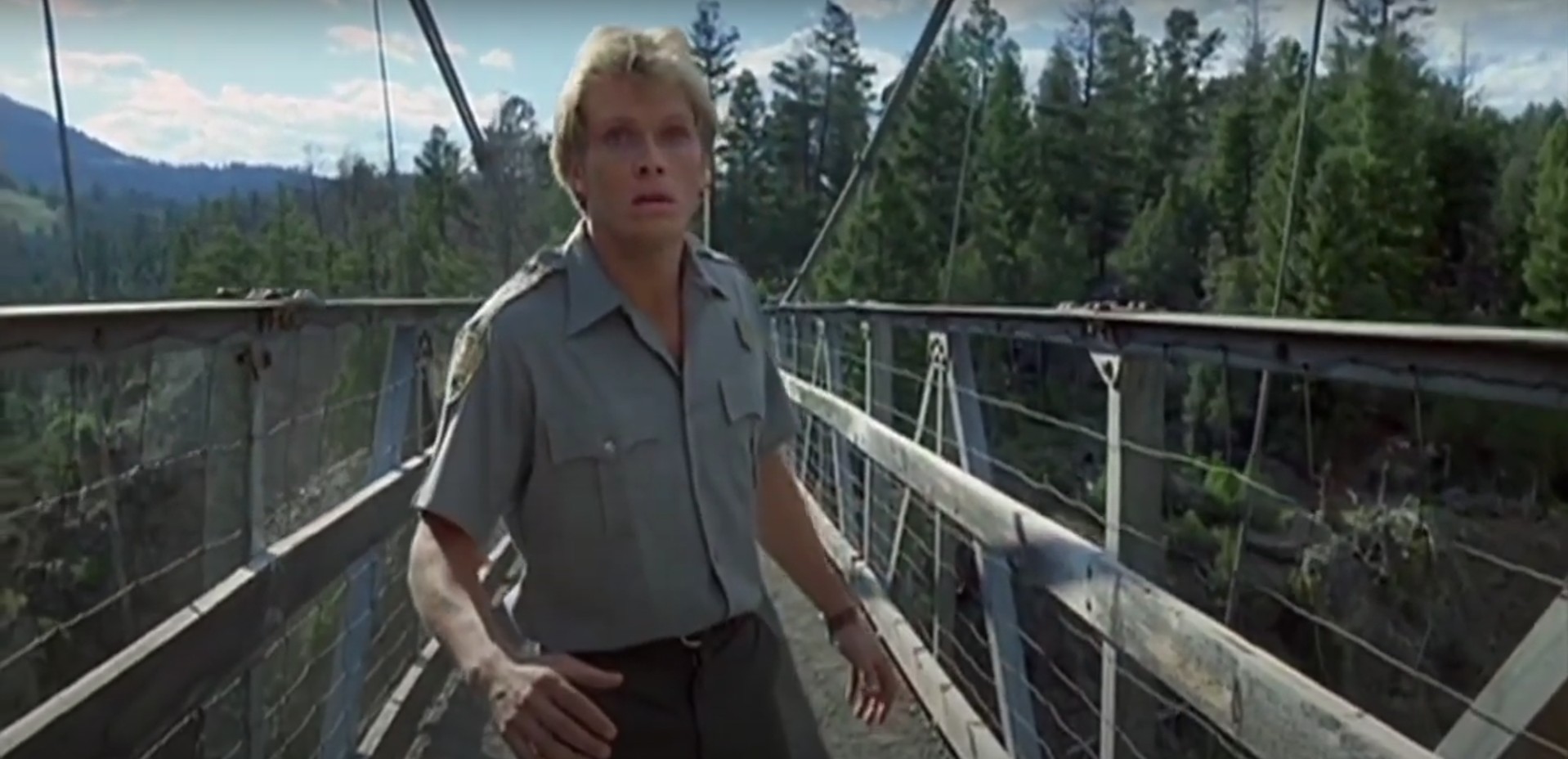
What’s interesting and more infrequent for this Italian production is that it’s entirely shot in English and not dubbed in post-production ADR.  Reason for this was for “Nothing Underneath” to be a synch-sound production with the image and to market it better internationally because of the main cast comprised of American and English actors.  The American actor, starring in his debut feature film, is Tom Schanley (“Savage”) as Wyomning park ranger Bob Crane and the way the story is structure really homes in Crane as the principal lead with a complete credit setup and character follow-through of the Yellowstone National Park.  Schanley’s blonde hair and muscular toned good looks embodies a likeness to his on-screen supermodel sister, played by Nicola Perring, who, as the story displays her, is not in the business of acting with very little dialogue and is only used for her short platinum blonde hair and thin figure for narrative form fitting.   The other native English speaker in a cooperative lead role is “Halloween’s” Donald Pleasence as an investigator on the verge of retirement.  Pleasence is no stranger to Italian cinema, seeing his fair share in the 1980’s psychotronic pictures, including Dario Argento’s “Phenomena” released prior.  The prolific British actor still manages to produce mountains of charm even in his most rubbish Italian accent as the long in the tooth comminssario eager to solve one more exciting, mysterious case and buddying up with young, handsome, and outdoorsy Bob Crane with twintuition.   The love interest falls upon real life model and Denmark native, then 19-year-old Renée Simonsen who is absolutely stunning with her looks and with her debut into acting in what is a significant role that involves a lot of screentime, a lot of dynamic and interactive dialogue, and does show some brief nudity with intimate sexual situations with Schanley.  “Nothing Underneath” has a roster that fills out with Catherine Noyes and Maria McDonald as Milan models, Paolo Tomei as a coke-head jeweler and model philanderer, Cyrus Elias as Comminssario’s Danesi’s assistant, and Phillip Wong as the peculiar fashion photographer Keno Masayuki.

“Nothing Underneath” isn’t a skimpy, loose garment with nothing going for it.  Instead, Carlo Vanzina offers more with his giallo by making it less giallo in terms of its cinematic style and with Pino Donaggio’s score which is in the style of, much like the rest of the filmed and narrative structure, a Brian De Palma erotic thriller.  With plenty of sexy sashaying from beautiful models, a balance between sex and sadism teeters as the alluring aspects of a promiscuously titled are dissected and interspersed with a long sheer psycho engrossed by a theme rarely explored and depicted, but certainly skimmed, during those times of 1980’s Europe and completely disconnected from Paolo Pietroni’s story with keeping only the fashion world and the murder mystery as core elements and adding a supernatural flavoring with the brother and sister telepathy.  Donaggio’s suspenseful brass orchestration and conduit synth-infusion score separate itself others in the subcategory that deploy synth-rock, haunting discord, and, perhaps, even a late 70’s swanky cop thriller piece typically layered alongside.  The composition, coinciding with the temporary expat cast as most giallo’s permit, often feels more westernized while still striking notes of unnerving tension and having collaborated with De Palma on “Dressed to Kill” and “Body Double” years prior, Donaggio imports those arrangement qualities for the Italian market and reaping success amongst the rest of the frayed giallo conventions. 

Italian boutique label Rustblade extends their release of “Sotto il Vestito Niente,” aka “Nothing Underneath” to the North American market with a new region free, 40th anniversary special edition Blu-ray release as well as releasing deluxe releases that come with accompanying limited edition lobby cards postcards, a polaroid, a poster, a colored vinyl, a book, CD soundtrack, a tote bag, and even, yes you’re going to read this correctly, underwear.  The standard release isn’t that supplementally sexy but does have great standalone supplementals in its AVC encoded, 1080p full hi-def, BD50.  The newly restored version stems from the original 35mm negative and presented in 1.85:1 widescreen aspect ratio.  The negative print looks to have been in pristine condition that rendered an impeccable transfer that fully provides depth and detail accentuated by well-adjusted and put together color grading that elevates the pop of the natural hues.  No signs of compression issues or smoothing over with sharp detail textures on skin and fabrics alike as well as the metallic shears having reflective qualities as it sheens and shines in mirrored property.  Two audio options are available, an Italian DTS Master Audio 2.0 Mono and an English DTS Master Audio 2.0 Stereo, the latter comes from the English living synch recording mixed in Dolby Stereo.  The English track is preferred here as its natural with innate reflections and tones of the actors on screen.  I noticed brief moments of Italian actors being English dubbed as a mismatch in the A/V synchronization as well as a disturbance in the aural consistency.  The dialogue track has prominence but has intermittent hissing and crackling, likely from the video-synch recording.  English, Italian, Spanish, and German subtitle are available.  Special features include interviews with co-writer Enrico Vanzina and composer Pino Donaggio, plus a film analysis by Francesco Lomuscio, the theatrical trailer, and a still image gallery.  For the standard packaging, the clear Amaray encasement has the supermodel in sheer and blood artwork used in previous DVD and Blu-ray versions and the reverse side as a still image with the opposite a black and red silhouette of shears and blood drop splatters.  The disc is pressed with the same cover art image.  Rustblade’s release is not rated and has a total runtime of 94 minutes.

Last Rites: Rustblade’s 40th Anniversary Edition Blu-ray of Carlo Vanzina’s “Nothing Underneath” is a great leap toward a go-to less giallo that’s tragically overlooked and underappreciated but ranks high above the bar and near the top sure to please in seduction and in murder.

“Nothing Underneath” 40th Anniversary Blu-ray Available Here!

Beware of Friendly Strangers, They Just Might Be EVIL! “Speak No Evil” reviewed! (Acorn Media International / DVD)

“Speak No Evil” has Speechless Horror! Now Available at Amazon!

A Danish family on holiday in Tuscany meets a family from Holland.  The two families hit it off enjoying each other’s company on the final days at the getaway villa.  Weeks after returning home, a postcard arrives from the Dutch family, inviting the Danish family to stay with them for a weekend at their home.  What starts off as the pleasant beginnings of friendship slowly degrades to an unsettling suspicion something is not right with the Holland family.  Abel, the Dutch couple’s mute son, is held to a higher standard with uncompromising, punitive measure, the husband and wife’s acute uncouth behavior sets an uncomfortable stage, and their attention toward the Danes’ daughter, Agnes, is unconscionably overstepping parental boundaries.  An attempt to call out or even leave the home altogether has been met with disbelief, guilt, and pleads for stay and enjoy under their guise of sincerest apologies soon to be dropped for something far more sinister. 

Before James McAvoy grew a beard, got jacked, and attired himself in buffalo plaid for his manly maniac performance in the 2024, usurpative family thriller, “Speak No Evil,” directed by “Eden Lake’s” James Watkins, the Netherlands and Denmark were the original blunt forces behind the sociopathic caprices of those assumed normal and amiable adults.  Only released two years ago, the 2022 film that spurred the American remake and the feature’s namesake is directed by the Copenhagen-born Christian Tafdrup (“Parents’) and co-written between Christian and brother, Mads Tafdrup, as one of their numerous collaborations since 2017, beginning with a manipulative tale of a viperous female in “A Horrible Woman.”  Profile Pictures (“Holy Spider”), in a co-production association with OAK Motion Pictures, serves as the production companies on the Jacob Jerek, of Profile Pictures, and Trent, of OAK Motion Pictures, produced motion picture shot primarily in the southern portion of Netherlands in the Friesland region.

The Danish father and mother, Bjørn and Louise, are played by Morten Burian and Sidsel Siem Koch and before becoming ingrained into the crux of the story, the couple reflect a complicated complexion all on their own, especially and specifically with the focus toward Bjørn who seems unsatisfied or unhappy with his life as he’s shown staring off in the distance or mentally checking out at the dinner table.  The Danish are represented as a couple who are too nice to a fault, unable to say no most of the time, and try to keep to themselves mostly when a problem arises, skirting away without notice in a dust of avoidance.  That’s not so much the case with the Holland father and mother, Patrick and Karin, bordering as an equally amiable couple performance by Fedja van Huêt and Karina Smulders.  That is until the outer appearance of friendly strangers turns into an uncomfortable nightmare of being caught between a rock and a hard place of how other people live and do things, especially from another culture or country.  Patrick and Karin show more passionate displays of anger, sexuality, and bohemianism that wasn’t on display on their shared holiday with the Danes.  Then, there are the children.  Agnes (Liva Forsberg) is a lovely young daughter perhaps too coddled by her parents, especially by Bjørn who can’t resist saying no in going to find Agnes’s beloved stuff animal when she constantly loses it.  Abel (Marius Damslev), on the other hand, is shy and can’ talk due to a tongue malformation, but the overly critical parenting by Patrick and Karin keeps Abel on a silent edge.  The Holland family’s outer haul slowly regresses, facades drop, but still the Danes are reeled back in by their own niceties despite all the red flags.

I can’t help but think those comportment particulars are somehow a reflection of the Denmark peoples’ true nature as a statement to their culture and social relations between themselves and, in this case, their neighboring countries.  The Tafdrup brothers prelude the script with verbal contrast between the two countries, such as their similarities, but the Tafdrup’s firmly stamp that just because you’re similar doesn’t mean you’re the same.  The notion can be applied to anybody of people from groups to individuals living amongst each other in a neighboring fashion and that their differences are being conducted right under your noses.  Of course, the script then embellishes more a distributing sensationalism of a spider leading the innocent moth to it’s sticky web by an attractive, orienting glow of light.  The analogy is right up Bjørn’s alley as a man who is looking to loosen the chains of parental and marital, perhaps even inherent to his nationality, suppression in a misguided notion that his promises have put a limitation on freedom; he finds himself attracted to Patrick’s freewheeling way of life and wants to emulate that in some sort of way.  The psychology behind “Speak No Evil” runs rampant with a paralyzing inability to let wicked do what it wants without confronting it head-on or without fighting it.  “Speak No Evil” is a chilling story of the all too familiar Edward Burke phrase, the only thing necessary for the triumph of evil is for good men to do nothing

“Speak No Evil” arrives onto UK DVD from Acorn Media International co-presented as a Shudder Exclusive and IFC Midnight production.  The MPEG 2 encoded, upscaled 1080p, DVD9 is presented with an anamorphic aspect ratio of 2.35:1 that encompasses an array of landscapes from vast fields, rocky dunes, and Tuscany vistas.  Contrastingly, director of photography Erik Molberg Hansen goes for an austere, harsh grading with little less light to give everything surface a rough edge from skin to fabric to natural to synthetics.  Colors a held at neutral browns, tans, grays, and blacks to accentuate the severity that continues to increase as the story progresses when moving away from holiday in Italy to the morose, rock-strewn dunes in Holland and while details are generally lost in dense nighttime exteriors, the more brightly lit corners excel in isolated spots.  The Danish-Holland-English audio comes in only one format, a lossy Dolby Digital 5.1 surround sound mix.  Adequate for this type of interpersonal awkwardness, the score and sound design offers a plentiful mix free from compression issues or physical obstacles on the recording in post.  “Speak No Evil” is person-on-person violence in the most primal form that leaves the possibility of added effects from violence next to nothing in what is more of a less is more design under a suppressive audio format that’s akin to trying silence a low-talker.  Dialogue is clean, clear, and at the bow of all the other layers in the audio boat.  What’s interesting about the encoded English subtitles is that they’re only available for the Danish dialogue and not the Netherlanders’, which adds an additional layer of intrigue and suspension as the non-native Dutch speakers with not understand what Patrick or Karin are communicating between each other.  The static menu offers no special features option and there is no stinger at the end of the credits.  The clear DVD case showcases that austere black and gray look with one of the story’s most engagingly odd scenes involving Abel.  The insides are standard edition bare as well with this disc pressed with the same primary image.  THE PAL disc is hard coded with region 2 playback, has a runtime of 93 minutes, and is certified 18 for strong violence and injury detail.

Last Rites: The original “Speak No Evil” speaks volumes of the dangers of societal pleasantries that turn a blind eye to caution for the sake of not hurting the feelings of others, but those subconscious hints are a part of the innate, primal early warning system in us all. Once we ignore those insinuations, we might as well dig our own grave.

“Speak No Evil” has Speechless Horror! Now Available at Amazon!

The Old EVIL Scorpion and the Frog Tale in “Drive” reviewed! (Second Sight / Screener)


“Anything Happens in that Five Minues and I’m Yours.”  Drive Limited Edition Boxset at Amazon.com!

A solitary mechanic and movie stunt driver offers his services as a getaway driver for illicit odd jobs.  He falls for his single parenting neighbor and as the two begin their romantic affair, her ex-con lover returns from prison to reintegrate back into her and their son’s life.   When ex-con trouble brews an inescapable situation involving ruthless gangsters calling in their favor for prison protection, the stunt driver involves himself with his moonlighting work but when things go terribly wrong and he becomes a target, everyone he knows and cares for are threatened by the mobsters.  War is waged in the fast lane between the mysterious stunt driver and Los Angeles most feared gangsters for the sake of an innocent mother and her child caught in the middle.

Around 2010-2011, when I first heard of Nicolas Winding Refn’s “Drive” starring “The Notebook” and “Lars and the Real Girl’s” Ryan Gosling, I thought to myself, why would I watch this quirky comedy-romance actor drive around in a run-of-the-mill stunt car action film?  Immediately, I wrote off the film penned by “The Four Feathers’” screenwriter Hossein Amini, whose now penning the stories and teleplays of a little Disney+ streaming series you may have heard of called “Obi-Wan Kenobi.”  I now admit it, as painful to my pride as it is, that I was so ignorantly wrong about Refn’s “Drive” that has turned out to be a cult hit present day and a really good and exceptional crime-drama that’s subtle on the dialogue, high on the graphic violence, and all-around superb performances.  The script is the filmic adaptation based off American author James Sallis’s novel of the same title, keeping the neo-noir intact under of guise of muscle car predilection, and is a produced by Gigi Pritzker and Chris Ranta of Oddlot Entertainment (“Buried Alive”), Jonathan Oakes and Gary Michael Walters of Bold Films (“The Neon Demon”), Marc Platt of Marc Platt Productions (“Wanted”), and Motel Movies (“Blue Valentine”). 

To be upfront, Ryan Gosling has never been a go-to movie star for me, personally, so there might have been some psychogenic bias blocker keeping me away from the film over the last decade.  However, over the years, my pallet has grown in diversity and in tastes, chiefly because of influences in my life, and so curiosity got the better of me in wanting to explore the story of and the craft of Ryan Gosling’s character in “Drive.”  The way Gosling portrays the lead, known only as either the Driver or Kid, heavily relies on expression with minimal dialogue and lets all his emotions be poured through his eyes and body language as well as his actions in an anti-charismatic sense that, in a good way, leaves the character unassuming but still confident.  Watching Gosling’s methodical flow through the role and while having a little knowledge of the neurodivergence, it’s not difficult to see that the principal character comes off as a person somewhere on the autism spectrum and doing some post-credits research, I’m not the only one who had the same thought.  Unsociable, quiet, lack of facial expression, and obsessed with routine, especially when moonlighting as a criminal getaway driver with a set of very specific conditions, are just some examples of his behavior that point in the autism direction.  When the driver meets beautiful single parent neighbor Irene (Carey Mulligan, “Shame”), that is when we start seeing him deviate from his isolation, from his routine, and become more complex with what was previously a non-existent life, but of course as life blossoms into something new and safe, gangster obstacles rear their ugly head and the criminal in him is forced out for a head on collision.  “Ex Machina’s” Oscar Issacs is the first hurdle as the recently release ex-con dragged back into unscrupulous dealings with unsavory organized crime that climb the latter to “Hellboy’s” Ron Perlman and “Taxi Driver’s” Albert Brooks, business partners who oversee the West Coast turf. Perlman is a natural tough guy, as we’ve seen in countless works stretching over numerous decades and I would have never pictured “The In-Laws” and “Finding Nemo” Albert Brooks to be the minatory type but he does in fact have a dark-twinkle in his eye and can extract the false sense of security out of people before he jabs a fork in their eye and slits their throat…wrist….guts….yeah, his character loves to knife others. The all-star cast rounds out with Bryan Cranston (“Godzilla”) as the Driver’s mob-connected boss-friend-agent and Christina Hendricks (“The Neon Demon”) in a lowkey accomplice role that makes a gruesome, unforgettable impact.

Speaking of “The Neon Demon,” a more recent Nicholas Winding Refn film, you’ll begin to absorb the Denmark-born filmmaker’s stylistic motifs between the two films involving lingering shots, graphic violence, and the integration of electro-pop tracks into an eclectic soundtrack. Many of the scenes convey an emotion through dialogue-less scenes and the soundtrack to contrast actions speak louder than words. However, there is one radical theory of mine that I believe has a firm foundation is that everything from point A to point Z in the story is all in the Driver’s fantasy world. I know “Drive” is a movie and the need to suspend belief is important but only to an extent and depending on the quality derived from the filmmaker. Refn’s a good filmmaker, we know this, but everything the Driver experiences pitches upon pure imagination when the truth is stretched to be in his favor for the length of the feature. First example – the Driver slams into the side of another car head on, but the headlights, front bumper, and ventilation grille are all clearly intact. Second example – a tense-elevator scene involving the Driver, Irene, and a mobster assigned to take the Driver out takes an improbable turn when the Driver turns to Irene, both bathed in the sudden appearance of a spotlight, and they kiss passionately for quite a while. The moment become the perfect opportunity for the goon to blow away his target. Instead, he lets them kiss and then a close-quarter fight ensues shortly after. Third example but not last – the Driver is nearly an unstoppable force with no background to who he really is or why he is in Los Angeles, but he fights like a hardened criminal and knows how to play the organized crime game, never really have bad hand in his deck of cards, and even is given an ambiguous “Shane” ending. So, I ask again, is the beautiful girl, the ripe for the picking off gangsters, and the prodigious skillset all in his head?

I’ve clearly misjudged Nicolas Winding Refn’s “Drive” to be pretty-boy, stock-story, waste of time. Though I’m still not convinced about Ryan Gosling’s acting, like a Supreme Court Judge nowadays, I’m overturning my naive judgement and calling “Drive” a true modern day cult film hiding in plain sight, receiving new life from Second Sight films with an UK limited edition 4K UHF/Blu-ray release as well as a standard 4K and Blu-ray release. Unfortunately, this review covers only a BD-R screener so commenting on the true quality of the image and audio will not be recorded, but release specs include a new 4K master produced by the original post-production company with Refn’s approval, the UHD is presented in Dolby Vision HDR graded by the film’s original colorist, audio options include a Dolby Atmos and a DTS-HD Master Audio 5.1 with optional English subtitles, and the 4K UHD are region free while the Blu-rays are region locked encoded on region B. Standard bonus features include a new exclusive commentary by director Nicolas Winding Ren and The Guardian critic Peter Bradshaw, a feature length conversation with Refn, editor Mat Newman, and composer Cliff Martinez reminiscing about their sudden post-theatrical career success with “Drive” when the film saw more success on video, Gutting a Getaway – a new interview with Mat Newman, and 3 Point Turns – a new video essay by Leigh Singer. The limited-edition contents include a premium box set with new Driver Scorpion artwork by AllCity, a 240-page hardback book with new essays by various authors, an exclusive interview with “Drive” author James Sallis hosted by Matthew Thrift, original storyboards, stills, behind-the-scenes photos, the original Sallis novel with new AllCity artwork as well, and 7 collectible art cards. What a massive, massive haul for the film that didn’t do great in theaters due to poor financial support by investors who saw the film as a failure. The film has a runtime of 100 minutes and is UK certified 18. Don’t be like me and neglect a chance to see “Drive,” a great piston-pumping and violently beautiful crime-drama paralleled love story that deserves our time, our attention, and everything including the kitchen sink Second Sight Films pumped into the tremendous limited-edition boxset that dropped this week for release!

“Anything Happens in that Five Minues and I’m Yours.”  Drive Limited Edition Boxset at Amazon.com!

The EVILS of Trauma Band Together to Take Down the Bad Guys. “Riders of Justice” reviewed (Magnet Releasing / Digital Screener)


Estranged form his family due to war torn military deployment, Markus must now come home to take care of his teenage daughter after his wife dies in a violent train accident.  A statistic mathematician, Otto, aboard the same train believes the train accident was no accident at all but a hit on a high profile informant testifying in the coming days against the head of a ruthless gang known as the Riders of Justice.  Joined by his eccentric friends, a therapy-inundated hacker named Lennart and an OCD computer whiz named Emmenthaler, they present Markus a convincing theory that his wife was a casualty of a gang’s complex assassination.  Unable to resist, Markus and his newfound friends set a course to unearth and destroy those who they think are responsible for his wife’s demise. 

With my unhealthy man-crush on “Valhalla Rising” and “Hannibal” star Mads Mikkelsen aside, “Riders of Justice” initial plot teased very little interest in what seemed to be another wife or child dies kill-them-all revenge action-thriller.  “Riders of Justice” also marks the 5th time Mikkelsen and director-screenwriter Anders Thomas Jensen collaborate on a project over the course of the Jensen’s entire 20 year directing filmography.  Jensen, who co-write the film adaptation of Stephen King’s “The Dark Tower,” ping ponged the story idea of the Denmark production with fellow “The Dark Tower” writer and “The Girl with the Dragon Tattoo” adapted writer, Nikolaj Arcel, in a story that brings tormented trauma victims together, latching on to idea they find themselves useful for, and inadvertently find the counsel they need through a dangerous operation in hunting down coldblooded killers.  Sisse Graum Jorgensen serves as producer under the Zentropa Productions entertainment banner and Sidsel Hybchmann debuts in her first producer role after a seasoned run as an associate producer alongside Graum Jorgensen on previous projects and between Graum Jorgensen and Hybchmann, “Riders of Justice” has a strong female producer contingent supporting a nearly all-male cast in bed with their lovable misfit characters that aims to be more about acceptance than revenge. 

Did I mention I have an unquenchable need to see every movie Mad Mikkelsen has starred in?  With “Riders of Justice,” Mikkelsen sports a long, skunk-colored beard with a shaved head in a not-so-typical look for one of, if not the, biggest movie stars to come out of Denmark.  Mikkelsen takes on this look for Markus, a military deployed father who rather be running covert drills and operations with his brothers in arms rather than being a father and husband in what becomes evident an underlining issue with his character.  As Markus tries to comfort his daughter Mathilde (“Andrea Heick Gadesberg) the only way he knows how as a regimentally stoic head of the house, but for being away so long, he knows very little of his now teenage daughter.  Mikkelsen’s natural gift for austere should be award-winning as becomes a lethal enforcer, a role he does extremely well, for a group of traumatically damaged outcasts looking for a righteous cause, beginning with Denmark’s Seth Rogan doppelganger, Nikolaj Lie Kaas, as a fellow train passenger Otto, a brainy mathematician who momentarily befriends Markus’ wife by offering up his seat that ultimately leads to her death.  Otto’s guilt, surging through him a pair of different ways, leads the brilliant mathematician to reach out to Markus with the help of his equally smart, yet equally maladjusted friends Lennart (Lars Brygmann “Flies on the Wall”) and Emmenthaler (Nicholas Bro “Nymphomaniac Vol. 1”). What ensues next are inadvertent events that spin Markus into a plot to assassinate an entire gang based off the statistics of one mathematician’s conspiracy theory evidence and along for the ride are the mathematician and his misfit buddies who might just be too smart for their own good. Every single performance is dead on spectacular with every character lush with tragic communal backstories and are clubbable in their own unconventional rite within the circle of Markus’s fearless vengeance at the center as they are drawn together by their own neurosis behaviors. Gustav Lindh, Albert Rudbeck Lindhardt, and Roland Møller round out the “Riders of Justice” cast.

The one sheet doesn’t do Jensen’s film any justice with a bearded Mikkelsen standing face front taking up much of the negative space, strapped with an automatic rifle around his back and a handgun in hand with the faded images of helmeted dirt bikers riding in the background. Let me tell you this: There were no dirt bikes in the movie. Not one. Mikkelsen looks great, as always, but the poster makes “Riders of Justice” reminiscent Mark Wahlberg’s “Shooter.” “Riders of Justice” stands outside that circle of militia or gorilla tactic action by being about 50% comedy and good comedy at that from Brygmann, Bro, and Kaas who elevate “Riders of Justice” from another run of the mill actioner about revenge, a subgenre plastic bag Liam Neeson can’t seem to escape from, to a heartfelt piece about belonging and mentally recuperating through helpful outreach with a standard whoop ass fare plotline.  Though some of the investigating work pinpointing the gang comes about far-fetched, I still believe “Riders of Justice” is one of the best films released this year, touching upon several multiplex themes of mental health, the urge to reach out for help to battle your issues, father and daughter relationships, and a sense of fitting in and having a purpose as an ostracized member of society. 

“Riders of Justice” has a lot of heart as well as a lot of brutal violence balled up in one remarkably empathetic film.  Magnet Releasing will be releasing the film everywhere May 21st with a limited run May 14th in New York and Los Angeles theaters.  Serendipity plays a huge role in Jensen’s vision of life against the odds and how people can ultimately rally together, sometime unexpectedly, to overcome obstacles often daunting for individuality with a sense of humor that can trump the dark behaviors of a depressive story core.  Kasper Tuxen’s cinematography in the hard lit scenes often confines the actors in a small car or around a table that not only screams cloak and dagger positioning but also exacts a sense of fellowship as they do everything together from planning, to surveillance, to assassinations, to even impromptu counseling sessions. The bookending story fable of happenstance leading from sadness to happiness christens “Riders of Justice” that debatable label, often argued with films like “Die Hard” or “Lethal Weapon,” of whether it’s a Christmas film or an action film. Fans will not have to stay for the credits expecting to see a bonus scene as there isn’t one; instead, enjoy the 115 minutes of fractured individuals coming together to be unlikely heroes in this hilarious shoot’em up ballbuster from Denmark.

And We All Thought Puppy Mills Were EVIL! “Breeder” reviewed! (Eureka Entertainment / Blu-ray Screener)

Avid and accomplished equestrian, Mia, yearns for a child of her own with husband Thomas as the clock on her ovaries continues ticking into her 30s, but something keeps her husband from digging himself out of a sexually frustrated trench, causing strain on their marriage.  Mia thinks his imperative financial venture, a collaboration alongside ruthless businesswoman and unorthodox scientist named Ruben, has made him sexually reclusive being wrapped up in a delicate investment of reversing the aging process that could crumble at any time, but when a beautiful and youthful neighbor goes missing after frantically showing up bloodied at her front door, Mia follows her trail to an abandoned candy factory where Ruben holds hostage young women for her violating biohacking experiments.  Becoming caged herself at the mercy of Ruben, Mia, and the rest of the women, are left to the sadistic and misogynistic whims of Ruben’s henchmen, the Pig and The Dog, in between the good doctor’s examinations. 

What happens when the powerful elite, using wealth and influence, circumvent ethical red tape in order to receive medical advancements as soon as possible?  Director Jens Dahl and screenwriter Sissel Dalsgaard Thomsen explore that radical and illegal biohacking ideology with an intense and extreme feminist view in their 2020 released, invasively graphic, horror thriller, “Breeder.”   Hailing from Denmark, not too many extreme films come out of the Nordic country, but taking a cue from their German neighbors from the South with a sexual and age dysphoria viscosity, “Breeder” takes an urban legend-esque approach to age defying that’s more Countess Bathory than anything Aveeno facial creams could ever manufacture in a story based on biohacking blended loosely with the French folklore of Bluebeard where an affluent man has an obsessive habit in murdering his wives, one after another, per director Jens Dahl.  “Breeder” might not be that black and, well, blue with a tough love message and an illicit theme of subversive genetical achievements produced by Peter Hyldahl, Amalie Lyngbo Quist, Penelope Bjerregaard and Maria Moller Christoffersen of Beo Starling (Beofilm) production company.

Leading the pack of caged, exploitered women in this human puppy mill comes with a hefty price of compromising positions and uncomfortable scenarios. The 32-yeard old actress, Sara Hjort Ditlevsen, plays an age appropriate Mia whose coming down to her last straw when coming to her husband’s inability to commit to their teetering marriage, but Mia comes with a twist in that she never gives up, achieving her end goal even if that means strapping on her riding boots and stirrups, dropping her panties, and digging those spurs into her hind parts while masturbating just to release the sexual tension. Ditlevsen gives a gradual fuming performance gaslit by the abusing sustained by the sadistic misogynist, monikered The Dog (Morten Hoist) who, in appearances, has the visual looks of a greasy Bill Oberst Jr. Jackson Pollock’d from a Mads Mikkelsen portrait and has the temper to match. The Dog and his partner, The Pig, played by Jens Anderson in an unbalanced contrast to the The Dog’s screen time, are harnessed and weaponized by a mad scientist role that was originally intended for a man before screenwriter, Sissel Dalsgaard Thomsen, had an epiphany that her feminist script was playing right into that systemic, male dominant, structure. Instead, the role was flipped, in gender only, and performed by “Wild Witch’s” Signe Eghom Olsen. Olsen gives a chillingly cold performance in Ruben’s contradictory indifference for life by snatching youth and beauty from young women, those who spite Ruben just by the mere fact of their innate good genes and healthy reproductive system, and selling the epitome of their stolen essence to the highest, or oldest, bidder in an age-reserval scheme. Ruben does have another motive with self-preservation as her rare genetic makeup makes finding a genome match nearly impossible, but she slays away a lot of women and a lot of infants in order to unearth her type. Anders Heinrichsen, Eeva Putro, Elvira Friis, Eja Rhea Mathea Due, Oksana Kniazeva, and Sara Wilgaard Sinkjær round out of the cast.

One of the “Breeder’s” core themes is the power one holds over another, but absolute control is not a singular reoccurring motif as power ebbs and flows from one character to another in a rolodex of examples that include Thomas’s financial control of Ruben’s rebellious operational decisions, The Dog’s inhumane dominance over captive women he loathes, and, on the receiving end, an enslaved woman’s embracing of a submissive, masochistic posture to The Dog’s punishing sadism, but control can be fleeting as seen in many movies yet proved to be in an abundance in Dahl’s “Breeder” with plot points that overturn sovereign power through a pendulum sway of brute, bloody force and hostage exploitation ugliness.  One bizarre recurrent through the cat and mouse power struggles is urination.  Yup, bodily fluids make an appearance, but go beyond the one-time shock value affect with three, count them three, acts of peeing in which two scenes reflect dominance as the powerful relieve themselves all over the, at that time, docile weak as a dog would when marking his claimed spot in the yard.  “Breeder” continues the varied questionable character tactics when primary plot turning points fail to impress plausible reactionary needs; an example would include when Ruben uses Thomas’ affection for Mia to control his unpredictable behavior, but the obsessed mad scientist, not to be bested by losing her financial support, lets Thomas run freely around her private abandoned factory of horrors which allows Thomas to become a monkey wrench in her biohacking laboratorial machine.  The same easy street escapes run rampant throughout and is even unintentionally spoofed when one women is able to escape not once but twice The Dog and The Pig’s rigorous grasps, taking “Breeder’s” serious new wave extreme a level down to a sickly stage of story blunders with rough draft written characters and scuffle.


If golden showers are not the extreme go-to for brutal survival horror, “Breeder” offers a variety of acrid amenities from stapling lips together to a trash can full of dead, dismembered babies and is homeward bound in the UK on Blu-ray from Eureka Entertainment under the company’s Montage Pictures banner.  Available February 15th, 2021, the first 2,000 prints of the Blu-ray will come with a limited edition O-card slipcase.  If you’re not a physical media aficionado (…loser.  J/K), “Breeder” will also be available digitally and will be presented in the film’s original aspect ratio of 2.35:1.  The Danish language DTS-HD MA 5.1 audio mix will be accompanied with optional English subtitles.  Since this review is based off a Blu-ray screener, I will not go into depth with the audio and visual conditions, but the cinematography work is from the sophomore feature of Nicolai Lok.  Behind the camera, Lok’s settles on a drab color schemes of mostly black and grey of a sterile environment, with the Lindberg house or inside Ruben’s medical popup tent, along with hard yellows, like mustard, to accentuate the rust and grime in closeups to medium shots within the tight confines of the abandoned candy factory turned into an unsweet meat market, but uses a fisheye lens on the regular to the effect I couldn’t pinpoint other than to fishbowl dysphoria an already narrow area. The end result made scenes unnecessarily warped for the viewers already stomaching a large amount of women battering. The special features included an October 2020 answer only interview with director Jens Dahl and screenwriter Sissel Dalsgaard Thomsen discussing in depth the reason they wanted to make this film. “Breeder” opens with Mia prancing her horse Karat and she inner dialogues how they move in tandem, but she questions the pecking order of master and prisoner between them knowing for certain she’s Karat’s jailor and that translates perfectly into her own subhuman treatment as a branded and caged animal for the pleasure of others; however, this type of depth thinking begins to rotate the hamster wheel but, as soon as momentum picks up on those tiny legs of collusion and betrayal, a gradual limp slows that hamster’s endurance with not enough plot developmental pallets to digest in order to keep up the effort.