A Gang’s EVIL Ransom Elicits the Wrath of “Zero Woman: Red Handcuffs” reviewed! (Neon Eagle Video / Blu-ray)

“Zero Woman: Red Handcuffs” is Number One on Our Must Have Lists!

When undercover officer Rei lets her overwhelming emotions kill a suspect on an assignment, her displeased colleagues lock her into a cell, unable to decide her fate with fear of public outcry of police brutality that would blemish the department and force leadership regsinations.  When a prime minister candidate’s daughter is kidnapped by a ruthless gang of rapists and murderers and brought to a cathouse for sale, the brothel madam believes the young woman is better exploited by issuing a large ransom for her safe return.  Unwilling to face public scandal, the politician and a rigid yet loyal investigator of the clandestine Zero Division rig up a covert plan to eliminate every person involved with the kidnapping by offering a murderous deal to Rei in exchange for her freedom.  Rei’s able to infiltrate the gang’s inner circle only to see the plan devolve into chaos and blood between the gang and corrupt authorities.   

Japan doesn’t make films like “Zero Woman:  Red Handcuffs” anymore!  The violent Toei company pinkusploitation production, released in 1974, played a major role in unifying the sexual appetites of Japan’s pink pornos with the rough-and-tumble violence of exploitation action films.  The rising of Nikkatsu Roman Pornos forced the hand of the Toei Company to expand their portfolio, creating such as combinational conquest over salivating grindhouse cinema patrons that the radical subgenre deserved a new sublet coinage labeled pinky violence.  Toei company man Yukio Noda, a staple yakuza filmmaker for the company, helms the visuals translated from a script penned by “Female Prisoner #701:  Scorpion” writers Fumio Kônami and Hirô Matsuda.  Loosely based off the manga written by Tooru Shinohara (who also penned the manga of “Female Prison Scorpion series”), “Zero Woman: Red Handcuffs” stitches its own blood soaked and sexually provocative clothing that would later continue “Zero Woman’s” adventures throughout the years with more films.

Cladded in a chic long red coat, black boats strapped up just below the knee, and wielding an extra-long connector chain pair of red handcuffs, Rei is the anti-heroine of our manga fantasies.  Miki Sugimoto works deep into that fantasy vision as Rei, Division Zero’s lady cop who will do anything and everything, clothed or undressed, to get the job done, even with extreme prejudice.  A frequent delinquent girl portrayer for Toei Company’s gritty bad girl gang pink pictures (try saying that five times fast), Sugimoto’s filmography include the “Girl Boss” series, “Terrifying Girls’ High School:  Women’s Violent Classroom, and “Criminal Woman:  Killing Melody,” and so Sugimoto already had established this foundational layer for Rei as a fortitude of badassery and now tacking on another layer of a moral high ground, justified only by seeing her word through to the end.  Rei is up against a gang of five – four street thugs led by the recent prison released Nagumo (Eiji Go,” The Executioner”) and one lesbian brothel madam (Yôko Mihara, “Sex & Fury”) – as she agrees to a back-against-the-wall deal and slyly subverts the gang by helping Nagumo during a faux ransom sting operation.  Along with Sugimoto’s stoicism, the Toei porn actress retains her promiscuous allure, one where she doesn’t have to do anything to be seductive but just be herself, working not only toward the favor of her character, who continuously is taken advantage of sexually without shame, but also keeping the integrity of the Toei élan for Japanese sleaze.  “Harakiri’s” Tetsurô “Tiger” Tanba resides to the general’s overlooking hill as the prime minister candidate who sends his battlefield colonel in Hideo Murota (“Rape and Death of a Housewife”) to be the Zero Woman’s handler.  Their scheme quickly devolves as their plan evolve when the operation goes slower than expected and the gang’s leader Nagumo begins feel the pressure of paranoia and starts to unhinge, especially around his ruffian acolytes played by Seiji Endô, Rokkô Toura, Iwao Dan, Kôji Fujiyama, and Ichirô Araki as Saburo the mysteriously quiet, aviator-waring knifeman who in himself is an interesting character.  Cast fills in with the Japanese speaking Westerner Ralph Jesser in a wild opening sequence that results in a gunshot to the groin!  

Like most pinky films, “Zero Woman:  Red Handcuff’s” incorporates an X-rated sexual violence but unlike most pinky films, the pinky violence subgenre omits the softer side of sensuality, creating more of a nihilistic viewpoint toward sex of taking what you want, when you want it, and aggressively at that.  Yukio Noda picture contains hostile lesbianism, gang rape, and pressurized perversions that take control thematically in pinky violence.  The corrosive context that has a guilty pleasure pull in most patriarchal dominated cultures and fleapit cinemagoers goes hand-in-hand with the over-the-top violence conjoined at the hip of cause-and-effect.  Usually, the narrative goes an ugly rape equals hard-fought revenge; in Noda’s film, the cause is the kidnapping, and subsequent deflowering of a power politician’s little girl leas to the Zero Woman effect of silencing with corporal punishment that circumvents the law.  Stylish like a spaghetti western and brutally violent, “Zero Woman:  Red Handcuffs” is a meanspirited, out-for-blood, femme fatale engendered on the verge of the pinkusploitation genesis.

Neon Eagle Video, a collaborative boutique label effort between Cauldron Films and Mondo Macabro’s Jared Auner, releases “Zero Woman: Red Handcuffs” onto a new Blu-ray, restored in 4K from the 35mm print. The transfer is AVC encoded, 1080p high-definition, onto a BD50 and shown in the widescreen aspect ratio of 2.35:1. A relatively clean 50-year-old print hardly displays any age wear, if any at all. Scarcely marred by blue vertical emulsion scratches in only a single scene, the print retains and is stored with care to diffuse the range of color and to effectuate as much detail as possible in textures and skin while without taking away from Noda’s underbelly surrealism. The lower contrast infuses a pulpy layer to create softer shadows, but contouring manages to stick an outline thanks to key Rembrandt lighting precision, akin to Hammer Horror with a splash of Kensington gore. The uncompressed Japanese DTS-HD MA 2.0 mono peaks with the best possible optical audio. While not much in the way of depth creation, there’s plenty of range in the Foley, even if it’s artificially abstract and illogical compared to shotgun microphone captured audio. The ADR synch is one of the best inlaid post-recordings with visuals that renders hardly any feedback or unnatural noises on the audio layer. English subtitles are burned into the only available Japanese language picture on the release. Special features include a feature length audio commentary by author and producer for Vinegar Syndrome Samm Deighan, Sex + Violence = Pink Violence TokyoScope author Patrick Macias analyzes “Zero Woman: Red Handcuffs,” and an image gallery. Graphic designer Justin Coffee produces a new, rich-in-red, and taletelling composite illustration of what kind of film to expect on the front cover art of the clear Amaray Blu-ray. The reverse cover houses another illustration, one pulled from the feature’s original poster line. The BD is pressed with more Coffee fiery and red-laced artwork. This particular copy reviewed is not the limited edition set with accompanying slipcover and neither copy contains insert material. The region A playback release comes unrated and has a runtime of 88 minutes.

Last Rites: “Zero Woman: Red Handcuffs” is a fine introductory film into the world of Pinky Violence, a starting line for those perverse-thirsty for the unification of sex and violence in Japanese cinema. Neon Eagle Video delivers excellences with their restored print, second to none in its picture and audio quality that will provide a sterling experience.

“Zero Woman: Red Handcuffs” is Number One on Our Must Have Lists!

If the Tenants Keep on Dying, Better Get Out of that EVIL High-Rise! “The Case of the Bloody Iris” reviewed! (Celluloid Dreams / 2-Disc Blu-ray and 4K UHD Set)

Own Your 4K and Blu-ray copy of “The Case of the Bloody Iris” today!

A pair of beautiful women are heinously murdered in a respectable high-rise apartment building.  As the case remains unsolved, a real estate architect, Andrea Antinon, is looking for models to market his new property, happening upon models Jennifer Langsburgy and Marilyn Ricci during his photographer friend’s photoshoot, and entices them by offering a sublet of the now vacant apartment in the building where one of the girls was murdered.  Jennifer, who finds herself slowly falling for the Andrea, is stalked by her polyamorous sect past and the group’s leader, her ex-husband, Adam who refuses to let her go and while he proves himself dangerous, attempting to kill Andrea after one of his dates with Jennifer, Adam is found dead in her new apartment.  The suspect pool grows as police are continuing to be baffled by an elusive killer remaining at large and set their sights on Andrea with his brief connections in two of the three victims.  Evidence against Andrea swells as those around Jennifer wind up dead and she’s next on the kill list. 

“The Case of the Bloody Iris,” the Iris represented as the delicately beautiful flower that symbolized the bound between Jennifer and her deranged, sex cult ex-husband Adam, is the 1972 giallo thriller from the prolific spaghetti western, Italian director Giuliano Carnimeo (from the previous “Sartana” series and would later helm “The Exterminators of the Year 3000″) and prolific giallo screenwriter Ernesto Gastaldi (“Your Vice is a Locked Room and Only I Have the Key,” “Torso,”) shot in the city of Genoa doubling as Milan.  Full of eccentric suspects, taboo desires, and handsome principals, “The Cast of the Bloody Iris” is a very attractive, violent, and superbly shot whodunit.  Under the original native title of “Perché quelle strane gocce di sangue sul corpo di Jennifer?” aka “What Are Those Strange Drops of Blood on the Body of Jennifer?” Galassia Films serves as the production company with Luciano Martino (“The Strange Vice of Mrs. Wardh”) having produced the giallo. 

The story floats back-and-forth between a pair of co-headlining stars, one of them being the retrospective cult and sex icon actress Edwige Fenech in one of her earlier performances, and who has starred in “Strip Nude for Your Killer” and “The Strange Vice of Mrs. Wardh.  Co-star George Hamilton also stars in that latter giallo, reteaming the handsome-faced “The Case of the Scorpion’s Tail” actor born in Uruguay, and whose birth name is Jorge Hill Acosta y Lara, with Fenech in their respective roles of model Jennifer and architect Andrea intertwined into what is a romantic tale of love at first sight that becomes mangled by a crazed killer on a murder spree and they’re at the heart of the matter.  If revisiting Giuliano Carnimeo, comedies and watching some of his interviews, you can see why he folds in subtle comedic elements that doesn’t allow “The Case of the Bloody Iris,” or a good chunk of his credits, to be a totally engaged, heart-racing murder mystery; those comedic elements come in the form of bumbling police, a too dead-set on commissioner (Giampiero Albertini, “Commandos”) and his more ungainly assistant (Franco Agostini, “The Sex Machine”), who are always one step behind and in the wrong direction.  The juxtaposition may be too evident yet it’s also welcoming, breaking up the forbidding business with a little levity, and creates a backend sense of assurance knowing police, just like today, can be human and clueless on serious natured instances.  The suspect pool and other salient supporting principals include Paola Quattrini as Jennifer’s roommate Marilyn (no doubt based loosely on Marilyn Monroe), Ben Carra as Jennifer’s sex cultist ex-husband, Jorge Rigaud as the professional violinist neighbor, Annabella Incontrera as the professor’s lesbian daughter, Oreste Lionello as a sleazy photographer, Carla Brait as a nightclub’s dominating femme, and Maria Tedeschi as the unfriendly neighbor.

Even though giallos did not appeal to him nor did they really become a staple of his oeuvre, director Giuliano Carmineo had a different perspective than most and that closely aligns with masterclass filmmakers like Dario Argento.  Carmineo and cinematographer, who’ve collaborated previously on a pair of Sartana westerns, had purpose in their odd and first person camera shots and movements, such as laying the camera down and sideways as characters perform routine events before being attacked or looking up and doing a 360-degree turn as if scanning a stairway, that coincided with the usual first person perspective of the conventionally masked and gloved killer wielding a deadly blade.  The technique engages the viewer, as in a sort of tell that something is about to happen or is amiss in a scene to create breath holding, heightened anxiety, but the multi-faceted narrative itself doesn’t need assistant in keeping viewers glued to the edge of their seats with the eclectic mix of sultry and taboo eroticism, lampooning the authority figures, designed seamless red herrings, unique characters, a variety in murder, and an elaborate, mysterious complexity that’s downright deviant. 

If you’re a distributor looking to shoot your shot on your first release, new boutique physical media label, Celluloid Dreams, hit the bullseye with a 2-disc 4K UHD and Standard Blu-ray release of “The Cast of the Bloody Iris” on a HVEC encoded, 2160p resolution, 100 gigabyte 4K UHD and on an AVC encoded, 1080p, 50 gigabyte Blu-ray, scanned and restored brand new in 4K on a pin-registered Arriscan from the film’s original 2-perf Techniscope camera negative, and presented in the original widescreen aspect ratio of 2.35:1.  Coloring grading and restoration is noted on the interior insert being entirely completed by Celluloid Dreams Studios to remove all the celluloid and age imperfections and stimulate a vivid, vibrant picture quality and, by the giallo-Gods, this has to be one of the more flawless image presentations I’ve seen on 4K and Blu-ray in a very long time, or ever!  Meticulous precision techniques reveal a straight from-farm-to-table quality, organic for its era with a balanced, natural grain and color saturation.   Details have delineated trim and higher contrast leveling where appropriate for darker scenes, such as an unilluminated bedroom or a basement boiler room, that retains the rich inkiness of the negative space.  No signs of compression issues in the negative spaces as well and no signs of unnecessary enhancing.  Two, lossless audio options are available for selection:  an Italian 1.0 DTS-HD and an English 1.0 DTS-HD.  Both remastered tracks from the optical sound negative provided full fidelity through the single channel.  Concise and crisp dialogue renders through in full, robust effect with ample detail in the ambience and depth to create a dynamic space.  No hissing, crackling, or popping in the ADR dialogue or ambient tracks and swanky tuned by Bruno Nicolai’s multi-instrumental base, drum, sintir-like guitar, and more score.  English subtitles are available on the Italian track.  With the larger capacity on the UHD, both formats are able to handle the included three featurettes with star George Hilton, principal actress Paola Quattrini, and director and writer, Guliano Carnimeo and Ernesto Gastaldi in Italian language.  Also included is a new commentary track from film critic and Celluloid Dreams co-founder Guido Henkel, an outtake reel that extend out certain scenes, photo gallery, the original Italian Opening Credits that beginning of the feature, and Italian and English theatrical trailers. Inside a dual-sided cardboard slipcover with both the feature’s baptized titles and illustrated cover art representation of Edwige Fenech, the black 4K UHD Amaray case possesses a second and more fleshy-erotic illustration of Fenech. The same art and arrangement are on the reverse side but with the Italian title. Each disc is housed on either side of the interior snapped firmly on a press-lock on with a release acknowledgements and an advert for their next physical feature, “La Tarantola Dal Ventre Nero” aka “Black Belly of the Tarantula.” The region A playback release has a runtime of 94 and is not rated.

Last Rites: Showing such diligence in the restoration efforts, Celluloid Dreams is the new kid on the block, the promising young boutique label with the Midas touch, with a killer first presentation in “The Case of the Bloody Iris.” We can’t wait to see more!

Own Your 4K and Blu-ray copy of “The Case of the Bloody Iris” today!

This Dinner Party Dishes the EVIL! “Happy Times” reviewed! (Artsploitation Films / Digital Screener)

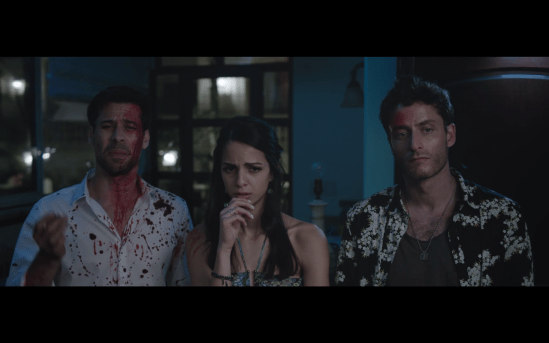
A small, but affluent, Los Angeles Jewish community dine together at a Hollywood mansion in celebration of the Shabbat.  Mixed feelings about each other compounded with mixed drinks stir the emotions of heated topics, including business ventures, religious attitudes, social statuses, marital qualms, and hidden desires.  Lines are being drawn and sides are being taken when one thing leads to another and undisclosed secrets become evident in a clash of suburban violence that pits friend versus friend, colleague versus colleague, and husband versus wife to the death. 

Director Michael Mayer reminds us that you should never mix business with pleasure with a keep your friends close, but your enemies closer black comedy entitled “Happy Times.”  The brawl of survival centered around Israel immigrants living in the U.S. is the second written and directed film from Mayer, following polar oppositely against another Israel themed, 2012 picture, “Out in the Dark,” a gay drama in the backdrop of the two rival and patriarchal sides of the Israeli-Palestinian conflict.  The only conflict in this 2019 thriller-com is of the gravely plentiful and concentrated kind inside a L.A. mansion turned battle arena that sees about as much confrontation as the war-torn Gaza strip.  Co-written with Guy Ayal, “Happy Times” is a collaboration produced by Erri De Luca and Paola Porrini Bisson of OH!PEN and, the Israeli born, Gabrielle and Tomer Almagor’s Urban Tales Productions in association with Michael Mayer’s own company, M7200 Productions.

The Israel-nationality cast can be an immersive experience and a sign of good faith casting from the filmmakers as well as a show of open diversity from the production studios that casting Hebrew speaking, Israel background actors implies a serious interest and respect embroidered into the project. Mayer, born in Haifa, Israel himself, is a breath of a fresh air of non-appropriation in a time where whitewashing can still be prevalent in the movie industry. Israel born actresses Shani Atias, Liraz Chamami, and Iris Bahr command the screen not only as Israeli women in lead roles, but as different personas that interact and keep lively the one night, single dinner party narrative. Chamani especially dazzles in the details as the dinner hosting socialite wife and mother, Sigal, who exacts an assertive Jewish woman with a cooped up attitude and a knack for handling her own while also worried about her social status, an extravagant exhibition of a screen trope that you might experience on shows like “The Marvelous Ms. Maisel” or movies like “The Slums of Beverly Hills,” enacted on point when she’s handing a frightened dinner guest, outside their Jewish circle and fleeing from the scene, tin foil wrapped leftovers with a wide menacingly unsure smile, while holding a medieval crossbow to go frag another party guest, in the plain view driveway. The wives’ counterparts are equally as Jewish and equally as prominent in the fold of the affair with Ido Mor as a unscrupulous businessman co-hosting the dinner, Guy Adler as a construction manager with money problems, and Alon Pdut as an unhappily married Ph.D engineer bothered by his fellow dinner guests’ lack of education and tact. In all, most of the characters are undilutedly snobbish with the exception of Sigal’s struggling actor cousin, Michael, played by Michael Aloni, whose magnified Hollywood liberalism deconstructs the Hebrew bible as racist and inaccurate among other colorful adjectives and becomes the catalyst that begins all hell breaking loose. Stéfi Celma, Mike Burstyn, Daniel Lavid, and Sophie Santi become the filament around the principle leads that strengthen the kill or be killed melee in “Happy Times.”

As if dinner parties weren’t already stressful enough, having to make trivial small talk, possibly acquaint or re-acquaint with unaccustomed faces, or pretend to enjoy the slop being served as food, “Happy Times” turns the internally exasperating dinner party debacle on its head with guests and hosts who are just too terribly comfortable with each other as volatile personalities explode like little active volcanos plumed to reach every corner of the house in a deadly playground for unstable, on-edge adults spewing their strident emotions and Mayer is able to maintain a layered pace with a narrative that’s snowballing quickly.  Where “Happy Times” struggles is the redline occurrences that trigger things to go very badly.  Though hardly trivial episodes between the guests, involving innocent infidelity affections or a slight practical joke stretched beyond devastating consequences, the harried moments afterwards diverge into a blown out result while more nefarious consequential revelations are held back, in after the fact chaos, and these differently graded spurs seem unbalanced, if not flip-flopped, in the story.  The characters themselves adequately course into being delightfully insane and as about as relatable as the internal frustration against our friendly-façade enemies, but there’s a part of me that personally wanted more development.  Military vet Avner, for example, exhibits symptoms of post-traumatic stress disorder (PTSD) as the horror sounds of war play in his head when under stress.  As he stares into oblivion when the rage fills into his face, especially by a nagging, browbeating wife who doesn’t seem to be aware of his condition, the subconscious killing-machine overcomes the mild-manner tech engineer.  There’s also Yossi’s opaque tax evasion scheme, Michael’s thespian struggles, and Mati, the late arriving Rabbi, who pockets money on the side from Yossi and Sigal that factor into an erratic equation that’s a mind field surprise every step of the way.

“Happy Times” relishes in unpredictable violence as a round table of feast or famine hatred in this dog-eat-dog thriller coming to you from the Philadelphia based distributor, Artsploitation Films. Slated for a February 9th, 2021 release, the unrated film will be presented in a widescreen, 2.39:1 aspect ratio, in a gorgeously rich color of a modest, natural color scheme. Kazakhstani cinematographer, Ziv Berkovich, distills a solid, yet uninspiring, photography of mostly still cam mixed with subtle steady cam, rooting firmly to particular rooms without capturing the flow of a big mansion, reducing much of the in clover luxuries of the hosts. The Hebrew, English and some Spanish 5.1 Dolby Digital mix offers well balanced layers of audio tracks with dialogue clarity and establishing good range with depth not really set up because of the close up or medium shot frames. Guy Aya;’s score offers a good blend of a violin-screeching from a murder mystery dinner theater with the inklings of traditional Israel folk sprinkled in to create an anxiety riddled brew of trouble. There were no bonus material included with the digital screener nor were there any bonus scenes during or after the credits. The best of times and the worst of times doesn’t compare to the bloodletting of “Happy Times” in a wildly amusing dark comedy with every impulsive-driven and tension-wrought scene chockfull with bated breath.

Pre-order “Happy Times” on DVD or Blu-ray at Amazom.com (Click the poster)