

Dave, a failed, down on his luck musician with a penchant for doing the wrong thing, volunteers to chaperone a kindergarten field trip to a popular outdoor petting zoo park attraction intent on gaining the affection of his 5-year-old nephew’s perky teacher, Miss Caroline. Also at the attraction is an American children’s’ television personality, Teddy McGiggle, travelling the world with his latest stop in Australia. All seems well and dandy until the U.S. stationed Army base adjacent to the petting zoo loses control of the highly aggressive rejuvenation test subjects and are overrun by the lemming of slow, flesh-eating zombies that stagger bit by bit toward the park’s touristy patrons. With every last living, breathing thing either turned undead or eaten to the spinal cord, Dave, Miss Caroline, and Teddy McGiggle must fight against the outbreak for not only their survival, but for the troop of young and impressionable kindergarteners thinking what’s happening is nothing more than a prolonged game of tag before the gung-ho U.S. military sanction of eradicating airstrike right on their location.

The lumbering zombie canon enjoys a delightfully endearing and rousingly tucked zom-rom comedy, “Little Monsters,” with children being the heartfelt conquerors to slay the funk the genre has been stagnantly lingering inside. Written and directed by up and coming filmmaker Abe Forsythe, the internationally collaborated production from the U.S., United Kingdom, and Australia delivers a brashly funny film under the guise of long-pigged zombie horror shot primarily in Sydney, Australia at Centennial Park. Not to be confused with the Fred Savage children’s film of the same title from 1989 that also starred funny man Howie Mandel, Forsythe’s “Little Monsters’” head lopping, guts coiling, and every four letter word in the profanity bible goes to infinity and beyond the parental guidance rating.

Perfect performances all around from a dynamically intercontinental collaborative cast starting off with Lupita Nyong’o. The “Us” actress, who should have won an Oscar for her performance in the Jordan Peele film, astounds again with a delicately frank and beautifully sage performance as the alluring kindergarten teacher Miss Caroline whose number one priority is to protect her class of 5-year-olds, physically and mentally, at all costs. Counter to Miss Caroline seemingly having her stuff together, the raucously detached Dave immediate sets his whirlwind claws right into Miss Caroline, attempting to attract her with disinformation about his stable state of mind and being; however, Dave to the core is a good guy harnessed by Australian actor Alexander England (“Alien: Covenant”) who adds the rough edges around Dave’s stagnant and serrated lifestyle. Though different on the surface level, Caroline and Dave do have rooted similarities that spark romance after some convincing through zombie tribulations and scenario finesse; Nyong’o and England singe around the edge of attraction that’s goes from a seething disaster to being playfully coy and tender that works confidently on screen. When you through Josh Gad into the mix, you never know what to expect in terms of a wild card character. The “Frozen” star pulls off Olaf on hard drugs as Teddy McGiggle as Gad’s voice is unmistakably the overly friendly snowman who likes warm hugs but with a lot more F bombs and a dee seeded disgust for kids show personality that results him bedding many of his toddler fans’ moms. I wasn’t sure how Gad was going to pull off a zombie epic, but his gas-riot performance is a spiked drink compared to other who dances around the children’s innocence and the fact Teddy McGiggle is a kids show personality elevates his crude conduct to that more pungent. “Little Monsters” round out with Kat Stewart, Marshall Napier (“The Beast”), Diesel La Torraca as Felix.

The word from my inner circle of moviegoers, those who have little interest in horror and more interests in fast cars and vast explosions, say something along the lines that “Little Monsters” was “okay,” “Didn’t really do it for them,” or “I didn’t watch the last 20 minutes.” Disclaimer: These people are really not close friends, but barely colleagues, and since “Little Monsters” is being cut down by popcornist naysayers, their opinions have itty-bitty merit awarded to their poor judgement in taste of good, funny, and superbly acted eye-candy horror cinema with pocket messages of insufferable loneliness, hidden internal commonality, and the caliber in what makes us human that piece together as collectively relatable. If these aspects do not register with you, then you’re not human, but rather a 7-headed martian with tentacles and a pea-size purple brain. “Little Monsters” has some good gritty zombies at work here that juxtapose against the tender nature of children and the only thing between these children being lunch are three damaged adults searching for something meaningful. The apocalypse becomes a fork in the road, an ultimatum, that tests their worth and Aby Forsythe bombards that fateful decision with little notes of comedy, witty banter, and a clear case carnage.

“Little Monsters” takes a field trip to Blu-ray DVD home video, and digital download February 10th from UK distributor, Altitude Film Entertainment. “Little Monsters” is a production of Made Up Stories, Protagonist Pictures (“31” and “Lords of Chaos“), and Snoot Entertainment (“Dude Bro Massacre III” and “You’re Next”). Unfortunately, a DVD-R was provided for review so no audio or video quality critiques will be touched up, but the upcoming region B Blu-ray is listed as a BD-50, 1080p Full HD, and presented in the original 2.39:1 widescreen aspect ratio with an English language DTS-HD Master Audio 5.1 track. There were no special features listed in the press release and there were none available on the DVD-R. Finding a way to harness everything sacred from the zombie genre and then creating something new, interesting, and captive from start to finish to blend is a victory melange of wall-to-wall wit and feral monsters leaves “Little Monsters” as the horror romantic comedy that has it all.
Tag Archives: dvd
A Double Dose of Revenge Against EVIL in “Psycho Kickboxer” and “Canvas of Blood” reviewed!

Alex Hunter had all he could ever want. A blooming career as an up-and-coming kick boxer, a successful police chief father on the verge of finally nailing a crime lord, and becoming recently engaged to marry to his long time girlfriend. Yes, Alex’s life fortune was very valuable indeed until it suddenly came crashing down to a fateful end when the ruthless crime lord his father was pursuing, known as Hawthorne, kidnaps and brutally murders his father and finance right in front of him and leaves him to die. Found and rescued by a well-bound special forces veteran, a recovering Alex lives to fight another day, a day for retribution against the a city of evil and crime. The one time kick boxer turns to a life of vigilantism under the guise of the public designated The Dark Angel who cleans up thugs, thieves, and low-lifes with martial art combinations that put Hawthorne in a supply chain bind when drug deals fall through at the result of The Dark Angel’s meddling. Nobody knows the identity of the masked hero, but one Cassie Wells, a journalist, aims to unmask the citizenry protector with the help of a bumbling private detective, but when they become too close to Alex, Hawthorne sets his target on them as bait.

The American 5-time world kickboxing champion, Curtis “The Explosive Thin Man” Bush, stars in his debut leading role performance in the martial arts, action-melee, “Psycho Kickboxer.” Also known as “Psycho Kickboxer: The Dark Angel,” the film had exclusive rights to being born and bred in Southeast Virginia, more specifically in the Hampton Roads area, with a local cast and crew and the opportunity to utilize region locales and business, such as his own, the Curtis Bush Karate Club, and those he was acquainted with at free of charge. Bush, born in Virginia Beach, puts up the cash, along with a slew of family and friends as investors as well, to finally produce his own work without having to be another masked Foot Solider in a “Teenage Mutant Ninja Turtle” sequel or just be another bad guy who can kick real good for the camera. Bush hires TV series and documentary director David Haycox and freshman filmmaker Mardy South to work from a Kathy Varner script. Bush’s career didn’t quite take off to be the next Chuck Norris or Jean-Claude Van Damme of Virginia Beach despite having athletic talent and good lucks, but he lives comfortably now in Hawaii with his family. Instead, the legendary fighter, who retired at the age of 37 in 1999, can look back at 1997’s “Psycho Kickboxer,” a five year project that began filming in 1992, as a crowning cinema achievement outside the square ring and without the confinement of 20.1 x 20.1 ft ropes alongside a heap of localized co-stars Kim Reynolds, Rick Clark, Tom Story (“Metamorphosis”), Rodney Suitor (“Traxx”), Jeffrey Kotvas, and George James.
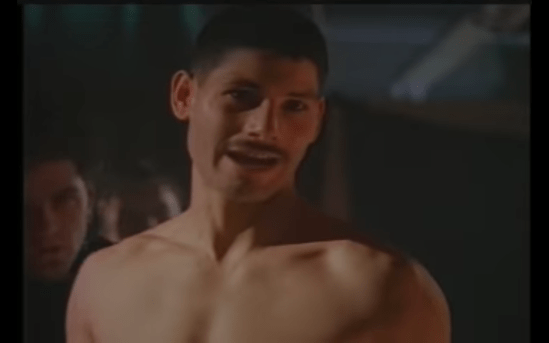
Personally, “Psycho Kickboxing” round kicks close to my heart, targeting the marshmallow center, and landing a Curtis Bush southpaw punch right (or should I say left) into one of my favorite home town films of all time. You see, this reviewer is a native of the Hampton Roads area and raised in the area for 28 years until becoming a Northerner. Honestly, I’ve never heard of “Psycho Kickboxer” or even Curtis Bush for that matter, not even the mayor honored Curtis Bush Day that’s April 27th, and once I looked past the slew of mullets and mustaches and saw the name of a local bar, Hot Tuna Bar and Grill, briefly observable in a scene, the regional newspaper, The Virginian-Pilot, and a resident country station, 97.3 The Eagle, with a pair of DJs as themselves. Championing “Psycho Kickboxer” as a good film is an enormously uphill one and even being a cult classic wobbles on the bunny hill as filler scenes, specifically the film’s ninja-cladded Curtis Bush tearing through bad guys is more than half the movie as montage segments, run rampant over what should be character exploration of redefining and rediscovering character arc qualities. However, the Haycox and South directorial has some blood red and amorous highlights with a pair of exceptional head rupturing scenes I’ve ever bared witnessed from the special effects of the Creations Unlimited team, Steve Stephens and Clay Sayre, and some tasteful T and A from Kim Reynolds in her bathtub that’s shouldn’t dare be missed.

The accompanying feature on this pyscho-revenger set tells the story of Julia, a young violin prodigy, who feels the extreme pressure weighing her down with an abrasive and abusive boyfriend and the intense passion she has for music that’s literally destroying her gifted hands from within. Her father, an art professor who has a disabled hand himself, quickly rushes her to a doctor for examination and concludes surgery is the only course of action to right the damage, but the coked up, alcoholic of a surgeon botches the job, leaving poor Julia unable to use her hand and diminishing any hope of playing her violin again. A long line of deep engrained corruption integrated inside the justice system is uncovered by her father after a sabotaged lawsuit exonerates the doctor from any wrongdoing. Pissed off with rage, the art professor decides to take justice in his own hands or, rather, his own hand as he fabricates instruments of death to paint his own retribution for physically and mentally injuring his daughter who is now in a semi-catatonic state. Police are baffled by each death that leaves little clues to the man who perpetrated them as one detective continues the investigation of grisly murders.

“Canvas of Blood” is the rightful backseat second feature being inferior of the two films on the double bill release. Set on location in and around the Baltimore, Maryland region, the anomalously rare 1997 revenge flick, that was only released on VHS, was at one time the debut disaster-piece from writer-director Joel Denning, produced by the Post Productions Film Company in association with Bad Credit OK and presented by Michael Mann – no, not the same Michael Mann who helmed Al Pacino and Robert De Niro in “Heat.” Instead of intense gun-blazing battles and gritty dialogue exchanges, Denning’s carnivalized approach to vindictive measures is met with an unscrupulous amount of aberrant sound effects such with a fart track, overweight male strippers with mullets in thongs doing abhorrent dance moves, and exaggerated character travesties in a mishmash plot involving a decorated war vet now art professor painting a trail of blood with his interchangeable cyborg mitt arsenal that includes a flame thrower, bone saw, and a T-800 “Terminator” style hand for massive nutsack squeezing. The most difficult to comprehend about a tale that warrants no deep thought is whether Denning’s intentions are sincere or to make a mockery of the revenge genre with a blatant boorish attempt. As far as actors go, the now radio personality, Jennifer Hutt, does what she can with cheap cinematic artwork and the same thing can be said about Jack Mclernan, who portrays no Paul Kersey, a role tailored by Charles Bronson in “Death Wish”, and while McLernan might strike a resemblance to the “Once Upon A Time in the West” actor, McClernan can only muster about half the set of stoic acting chops to save any kind of face. Lance Irwin, Andy Colvin, Marian Koubek, Mark Frear, Jamie Bell, Michael Mann Reennie McManus, Irena Beytler, and Svetlana Milikouris co-star.

POP Cinema’s Shock-O-Rama banner presents a Psycho Horror Double Feature with “Psycho Kickboxer” and “Canvas of Blood” on a single disc DVD and both films are presented from in a VHS-rip, 4:3 aspect ratio, format that gives no indication of an enhanced or upscale treatment to the transfers. “Psycho Kickboxer,” which was actually shot in 16mm and transferred to Betacam VHS, fairs better with a unscathed negative obtained cleanly without the annoyance of compression artifacts, due to the lower bitrate from the more than likely clean 16mm source. However, don’t expect colors to pop and details to be fine from a VHS transfer that’s has a slightly fuzzy and gray washed tone. Canvas sports much of the same with a more warmer tone and some over-saturation of blue tint, but tracking distortions and analog graded noise are more evident flaws in this presentation. The English Language mono tracks on both features are a composited nightmare of little range and depth. Fight ambience could have been pulled right from the Double Dragon Nintendo game and the subjective overlay of obscurely crude ambient tracks, even an overly synthesized enhanced screaming I would consider as well, dilutes “Canvas of Blood’s” objective plotline. The DVD extras include Shock-O-Rama vault trailers and a 3-page booklet insert containing a 1998 Alternative Cinema Magazine article written by Curtis Bush who provides a humbling anecdote about film’s origin story and the process of making his independent movie dream come reality. There’s no contest. “Psycho Kickboxer” TKO’s “Canvas of Blood” in every round of the Psycho Horror Double Feature, despite the horde of mustaches and mullets and despite both films not really being a horror. Shame that world class kickboxer Curtis Bush’s career didn’t skyrocket afterwards, but thats what makes “Psycho Kickboxer” inherently special and exceptional to behold, just like the fighter himself.

“Psycho Kickboxer” available on DVD! Click the Cover to buy!

No More EVIL Circling the Cage in “47 Meters Down: Uncaged” reviewed!

Mia and her family have moved from Chicago to Mexico’s Yucatan. As she struggles to acclimate into her surroundings and survives being the school’s most unpopular student, her father flourishes with his archeological findings of an ancient Mayan burial temple hidden under rising waters just off the coast. Mia and stepsister Sasha skip an unflattering weekend boat trip to join friends Alexa and Nicole who are privy to the underwater entrance of the remote ruin. The four use Mia’s father’s scuba gear to go exploring through the numerous narrow passageways and shrined openings of the burial temple, but their innocent adventure turns deadly when the sudden collapse of the entrance traps them inside. As they save every last breathe running dangerously low on oxygen, they come face-to-face with blind, monstrous Great White sharks with heightened senses of smell and hearing to track them down.

Terror has defined new depths with Johannes Roberts’ sequel to his critically praised and genre fan pleasing 2017 shark-horror “47 Meters Down.” Along with the return of screenwriter Ernest Riera and The Fyzz Facility team providing production and financials, Roberts once again dives into the murky waters of deep sea productions with “47 Meters Down: Uncaged,” working mainly underwater once more to capture weightless fear in the eyes of the actors to perform in a tough environment and perform against, what will be, computer generated adversaries. The success of “47 Meters Down” helped stem a sudden revival that swam from being a dwindling and cheap demonizing of sharks that have plagued the direct-to-video market for over a decade to bestowing the respect the man-eating fish rightfully deserve, showcasing that man does not rule the water. “47 Meters Down: Uncaged” continues the trend by chomping serrated jaws through the chummed waters of the great white shark schlock and crest with a heart pounding suspense and scares.

A couple of big names star in the sequel and by big, I don’t mean actresses who are mega superstars in their own rite. What I mean are the well-established and globally recognizable last names of Corinne Foxx and Sistine Stallone, the respective daughters of Academy Award winning actor and singer Jamie Foxx (“Ray”) and of one of the world’s biggest action stars of our lives, Sylvester Stallone (“Rambo”), debuting into the big time as one-half of the group of girls exploring the underwater temple. Across the aisle, the other two actresses that take a joy swim are Brianne Tju (“The Crooked Man”) and Sophie Nélisse, the latter being the high school oppressed and timid Mia who battles through her adolescent problems by being a leader in the shark infested tunnels. As four girls looking for a good time on the Yucatan, they’re tediously whimsical without the virtue of substance behind them aside from Mia’s brief bullying encounter and heart-to-heart moment with step mom. Joh Corbett is the most recognizable face sans just having a famous name. The “Sex in the City” actor – don’t ask me how I know that – has fatherly intentions in the role of Mia’s dad, the archeologist who discovers the flooded temple. Rounding out the cast is Khylin Rhambo (“Teen Wolf” television series) and Davi Santos (“Polaroid”).

All that is right with “47 Meters Down: Uncaged” is the isolating suspense and lurking terror that carries over seamlessly from the first film, despite both films’ pre-judging killjoy that is a PG-13 rating, and with the return of Mark Silk’s beautifully murky cinematography and Roberts’ choice of focal direction that engulfs the actors, the story sharpens to completely detach the real world from this shark threatening one. “47 Meters Down” had an equally beautiful, haunting, and industrially trance score, pitched perfect for the lethal space-like expanse, from Tomandandy and the musical duo return for another round with a broody audio vision that can be taken with you long after the credits roll. However, Roberts’ second installment has some issues. For instance, why keep the initial title? The 47 meters doesn’t exist as the protagonists go up and down through burial shafts without the utilization of a depth meter and could have benefited better with a standalone title. Not even a wet suit is worn so the hunt is not too deep where the frigid waters rules. The trend of those scenes that make you go huh? continue in a form of a plot hole of exactly where did those ghostly Great White sharks come from? There isn’t enough food down in the tight confines to sustain such eating machines, but they don’t seem to be crippled by the fact as they appear from out of nowhere after one of the characters makes their presence noisily known.

Like a persevering slasher, the jaws of death just keep on coming for you in “47 Meters Down” Uncaged” onto a 2-disc Blu-ray and DVD home video, with a digital download available, distributed by Lionsgate. Presented in a widescreen, 2.40:1 aspect ratio, with the Blu-ray BD-50 in 1080p High Definition, the digitally recorded, shot on an Arri Alexa according to IMDB, image captures, through the some fields of darker tints, the warranted definition and enough softness to maximize the aqua effect of a hazy and shadowy sunken ruin with silhouette inducing dark spots, corners, and passageways. Moments of vibrancy pop, especially with emergency beacons, to dazzle like a neon marquee in the pitch-black night sky. The ruin’s sharks themselves, though ghostly depicted and riddled with scaring, appeared too soft, an inescapable side effect from the visual FX team, and the same can be said with the sharks out in the open ocean that have unnatural movements along with their too clean look as if the light above surface wasn’t bouncing off them correctly. The English language 5.1 DTE-HD Master Audio mix has power and girth in an environment where sound is virtually stiffened. The Tomandandy score is absolute and denotes what it means to have an eloquently disruptive soundtrack to peak fear in conjunction with looming, flesh-ripping presences inside a dooming labyrinth. And what impeccable timing to have one of the recently passed Marie Fredriksson’s Roxette tracks showcased as the main song. #RIP Marie. Dialogue is clean and clear in the depthless communications of opened face scuba masks. Audio accessories include an English descriptive audio option, English SDH subtitles, and Spanish subtitles. Par for the course in the Lionsgate special features department with an audio commentary from writer-director Johannes Roberts, co-writer Ernest Riera, and producer James Harris. Plus, interviews with the cast in the making-of featurette entitled “Diving Deeper: Uncaging 47 Meters Down.” “47 Meters Down: Uncaged” is far from perfect and nearly drowns with an uncouth story that doesn’t represent Johannes Roberts first film’s good name, but the frenzy-laden successor has high energy, an olfactory for good PG-13 scares, and monstrous sharks that makes for an entertaining and terrifying swim.

Add “47 Meters Down: Uncaged” to your horror collection!

Nihilism Brings Out the Evil in All of Us! “The Vicious Sweet” reviewed!

Popular B-movie scream queen, Tyler Phoenix, just walked out belligerently from the latest screening for her new schlocky horror film. Fed up with worrisome managers, pressuring producers, and hot-headed directors, the leading lady glazes over her career as the past creeps back into her life, sourly affecting the platonic, one-sided relationship with her boyfriend. Tyler’s downward spiral toward the depths of depression and frustration attractively consider suicide by pills, but when Tyler awakes, she finds herself handcuffed to a bed with a mysterious masked man looming over her. What the man wants is unclear to Tyler, but one thing is absolute, he’s an adoring fan of hers who seemingly knows more about Tyler than she knows about herself. Hours seem like days, days seem like weeks, and weeks seem like months as Tyler is continuously drugged and asked personal questions about her past and about the disparage campaign to capsize her life. Tyler begins to hallucinate and can’t tell what’s real or not as she confronts internal demons while being completely forthcoming to her dangerously devoted captor.
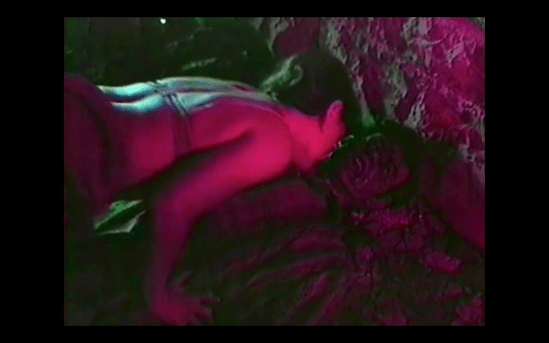
“The Vicious Sweet” captures visceral surreal existentialism from Sub Rosa Studio’s own Ron Bonk in the shoes of writer and director. The 1997 thriller is a cinematic blend of psychological horror, self-deprivation, and coming to terms with one’s own identity. All shot on analog video and on a micro budget, Bonk’s able to depict dreamlike scenes hauntingly and pragmatically without the assistance of costly visual effects that often cheap in appearance on video transfers. Shot in Syracuse, New York, “The Vicious Sweet” could be set anywhere, USA and with locations that set the main characters in close knit quarters for nearly most of the 90 minute runtime, the “House Shark” is able to fashion an under the radar overwrought mystery. Though the SRS Cinema retro DVD cover is lustfully tasteful with an illustrative Tyler Phoenix handcuffed to the bed and in her underwear, “The Vicious Sweet” isn’t about abduction for sexual exploitation. Yes, one scene does represent the DVD cover; however, Bonk’s story tickles the frayed and blurry realm of the mortal coil that can push the limits of not only the story, but also Bonk’s ability to explore that plane of existence that inhibits zombies, large rat-faced looking creatures, and the intangibility of time.
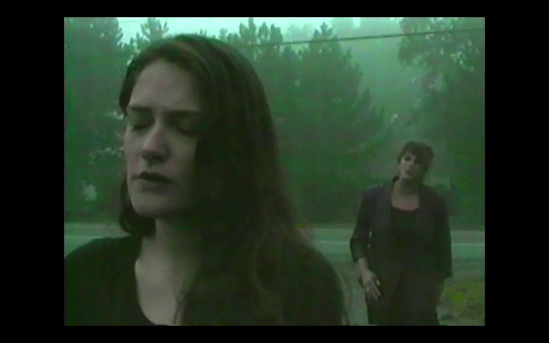
Tyler Phoenix whirls as an angsty actress with a chip on her shoulder and a metaphorical duffle bag full of internalized secrets. Sasha Graham straps herself right into the role, exhorting all the right kinds of anger and cynicism into her seemingly successful character’s career. Graham has seen her fair share of mid to late 1990’s lowballed b-movie films, such as having a substantial role in “Polymorph” directed by “The Dead Next Door” director J.R. Bookwalter and in “Bloodletting” helmed by the “Witchhouse” screenwriter Matthew Jason Walsh, but “The Vicious Sweet” marks the debut of leading lady, a true scream queen role, and Graham wears it well. She’s complimented by the debut performance of the late Bob Licata as the mysterious tormentor who goes by the name of Grimaldi, one of the performers from Phoenix’s early, short-stinted porn career. Grimaldi, who repeatedly notes, is a part of Phoenix and, for a lack of a better term, symbolizes the actresses betwixt past and present on a conscious level of trying to make sense of all that’s entangled in that screwed up and complex mind of hers. Licata, in regards to his character, is cold and consistent, playing the act of a passionately solemn and unpredictable serrated fan hellbent on trying to expose Tyler Phoenix’s true self. “The Vicious Sweet” also stars Jason Wicks, Theresa Constantine (“Bloodletting”), Jeffrey Forsyth (“Gut-Pile”), Al Marshall, Steve Wood, and Jeff Jones.
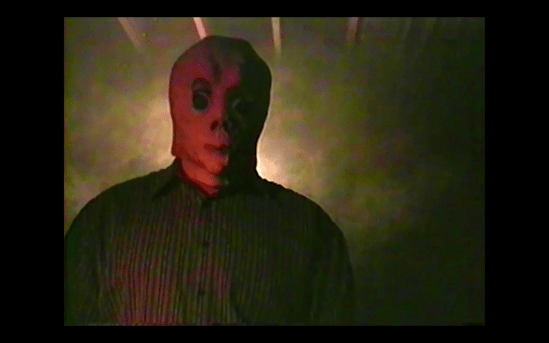
The story progression through Tyler’s figuratively personal hell hardly goes stagnant despite, for most of the her status, being manacled to a bed for relentless interrogation. Tyler’s put through a variant ringer of drug induced hallucinations and cerebral caprices and much of the credit, alongside Sasha Graham, should go to writer-director Ron Bonk who is able to translate from script to screen his vision. Contrary to the restraints of a SOV production, the creativity of Bonk’s camera work in masking, in more ways than one, Grimaldi’s stoic façade and centralizing Tyler’s and her experiences is evocative , the antiquated practical effects are still appositely poignant, and the diverse content holds “The Vicious Sweet” to a larger scale than the finances suggests. I’m not trying to elevate Ron Bonk’s film up to being the Holy Grail of low budget horror held in the vibrancy of limelight, but in my opinion, to dismiss the appreciation for producing something out of nothing would be a tremendous disservice to all auteurs. “The Vicious Sweet” leaves us with an open for interpretation perspective that somehow manages a jaw-dropping mound of shock and perplexity, nothing short of the likes of Christopher Nolan’s “Inception” ending.

The SRS Cinema DVD home video release of Ron Bonk’s “The Vicious Sweet” is presented region free, 1.33:1 aspect ratio from a S-VHS Betacam SP, that mostly result with black bars on each side of your 16:9 HD television. The limited edition Blu-ray is marketed as remastered, but the DVD image quality is awfully poor from the analog master transfer and doesn’t seem to have a smidgen of touch up where marco-blocking artifacts and aliasing run rampant. What also doesn’t help matters is the faded coloring and the blacks nearly void of any shape of definition as if you’re in a bright room and the light is shutoff and nothing but a blurry black void is present between the light and the time you’re eyes can adjust. The English language lossy 1.0 uncompressed mono track is frail and shaky, but still manage to push through without an obfuscate obstacles. Dialogue cozily lies low on the audio totem pole and the range and depth lack during more fantastical moments of zombies and monster swarming about. Bonus features include a director commentary, a director and Sasha Graham commentary, and SRS Cinema trailers. The best DVD feature, along with the film itself, is the illustrated, VHS letterbox DVD cover of the aforesaid Tyler Phoenix beautifully bound to the bed with candles lit by her table side and dressed scantily with a nice Please Be Kind, Rewind cherry on top. Despite the technical woes, “The Vicious Sweet” remedies the longstanding misinformed notion that independent b-horror movies are a hack and burden to the cinema fuselage with vast imagination and sturdy ambition.

The Vicious Sweet DVD is a must buy!

There is no EVIL like the Firefly Family! “3 From Hell” reviewed!

A bullet-riddled shootout with police left Baby Firefly, Otis Driftwood, and Captain Spaulding full lead, but not dead! The trio barely survives despite getting shelled by 20 gunshot wounds a piece and are tried and incarcerated for over a decade in maximum security prisons. After Captain Spaulding’s wears out his welcome on death row and becomes the first one executed, a merciless escape carried out by Otis’ half-brother, Winslow Foxworth Coltrane aka The Midnight Wolf, leaves a trail of blood and violence in their wake up to freeing Baby Firefly who can’t wait to play and unleash her uncontrollable crazy cyanide upon the world. However, there’s only one itsy-bitsy problem – they’re faces are about as dangerous to themselves as they are dangerous to others. The three from hell vamoose to a dumpy Mexico town to start afresh, but little do they know, no place is safe for long.

Over the span of 16 years and 14 years since “The Devil’s Rejects,” shock rock and rockabilly, metal rocker Rob Zombie returns to write and direct the third and highly anticipated sequel film in the Firefly trilogy with “3 From Hell.” The 2019 continuation of the Baby, Otis, and Captain Spaulding rejuvenates interesting in returning hellions that’ll undoubtedly wreak havoc across the midwest plains, splatter some brains, remove some flesh, and, well, you get the gist of their unholy hobbies. “3 From Hell” had to literally dig out these characters from the grave since being shot to shreds at the end of,***spoiler alert***, “The Devil’s Rejects” and Zombie was able to sell Lionsgate and Saban Films on the story divergent from the last film, much like “House of a 1000 Corpses” horror show went straight into exploitation extravaganza with “The Devil’s Rejects.” “3 From Hell” is a whole new animal, an anti-hero’s indulgent fantasy of crime, action, and still barely kickin’ to kick ass through the rampaging blood.

The three in “3 from Hell,” Baby Firefly, Otis Driftwood, and Captain Spaulding, return for one more three amigo misadventure through hell and brimstone and the original cast, respectively include Sheri Moon Zombie, Bill Moseley, and Sid Haig, suit up to be a depraved family once again. Sadly, Sid Haig’s health rapidly deteriorates in the midst of filming, leaving Zombie no other choice other than to write him quickly from the script and introduce a new character, a transgression tyrant to pass the torch to, with Winslow Coltrane played fittingly by “31’s” Richard Brake. As though like never missing a backwoods bumpkin beat, Richard Brake embraces the Midnight Wolf and breaks in the character with such ease and fortitude that the question never arises if the Midnight Wolf should be a part of the sacred Firefly pack. Sheri Moon Zombie steps out of a time machine and right into Baby Firefly, despite being a little aged around the eyes. The quirky and unpredictable Baby doesn’t reinvent the wheel, which should please the fandom, and is a wonderful sadistic mecha with Sheri Moon at the helm. The same can be said about Bill Moseley who, goes without saying, has a unique voice that’s been rebranded as Otis Driftwood. Every other movie, old or new, with Bill Moseley starring, or not starring, will forever be tainted by Otis Driftwood for when Moseley monologues or even just speaking one or two words of dialogue, the spine starts to twinge and tingle, the hairs shoots straight up, and that stepping on your grave feeling of cold desolation swallows you in an instant. The “3 From Hell,” plus Coltrane, face the world with a big knife and lots of guns and those who stand in their way are played by co-stars Danny Trejo (“Machete”), Jeff Daniel Phillips (“31”), Emilio Rivera (“Sons of Anarchy”), Richard Edson (“Super Mario Bros.”), Pancho Molar (“Candy Corn”), Dee Wallace (“Cujo”), Sean Whale (“The People Under the Stairs”), Clint Howard (“Evilspeak”) and Bill Oberst Jr. (“Dis”).

Rob Zombie has mentioned in a behind the scenes featurette that he didn’t want to recapture the magic of the previous Firefly cruelty and the rocker-filmmaker has done that just, straying away from the horror of “House of the 1000 Corpses” and the exploitation vehemence of “The Devil’s Rejects,” which the fans groveled for, and going bravely, or blindly, into crime action with the “3 From Hell” that still’s beholden to Rob Zombie’s hillbilly swank. Rob Zombie risks a new path and also gambling on more of Lionsgate’s capital with showing off more visual effects than in the former films. Bullets tearing through flesh and flying straight toward the camera lend to example of the computer imagery effects that, from a fan’s perspective, dilute Rob Zombie’s adoration for horror who takes less and less chances with this film that not only feels rather ordinary and just another piece of maize in the field, but “3 For Hell” also doesn’t feel to have substance to all the madness. Baby, Otis, and Coltrane go from point-to-point, aimlessly pondering what’s next, and just happen to fall into a barrage of bullets and blood, rather than being the epitome of evil bring vile upon mankind. Just being a Rob Zombie film that resurrects his beloved and beguiling modern iconic characters, “3 From Hell” coopers the longing with a fierce show of violence that opens the door for one more installment.

Lionsgate and Saban Films, along with Spookshow International, proudly presents Rob Zombie’s “3 From Hell” onto a R rated DVD and an unrated, 1080p Blu-ray sheathed inside a slipcover. The two disc, dual format release are both presented in a widescreen, 1.85:1 aspect ratio, and the image is about as sleek as they come with an ARRIRAW formatted 2.8k ARRI camera that shoots 48fps. Zombie reins back on the color palette and hones onto more natural coloring. The details are delineating, as aforesaid with Sheri Moon Zombie’s crows feet. The English language 7.1 Dolby TrueHD audio track is lossless with a crisp dialogue and ambient mix. The range and depth are robust with explosions and gunfire. The release comes with Spanish subtitles and English SDH subtitles. In accompaniment with the 115 runtime, bonus features include To Hell and Back: the Making of 3 From Hell which is a 4-part documentary on the Blu-ray only and both formats include an audio commentary from writer-director Rob Zombie. Also included is a digital copy to instantly stream and download onto personal devices. The horror element might be gone, but the inexplicable chaos surges through death row to desperado Mexico in Rob Zombie’s “# From Hell!”

Own “3 From Hell” on Blu-ray/DVD!

 It's Bloggin Evil!