Killed by Your Monstrous, EVIL Twin Set on Repeat. “Island Escape” reviewed! (Dread / Blu-ray)

“Island Escape” Available Here at Amazon.com

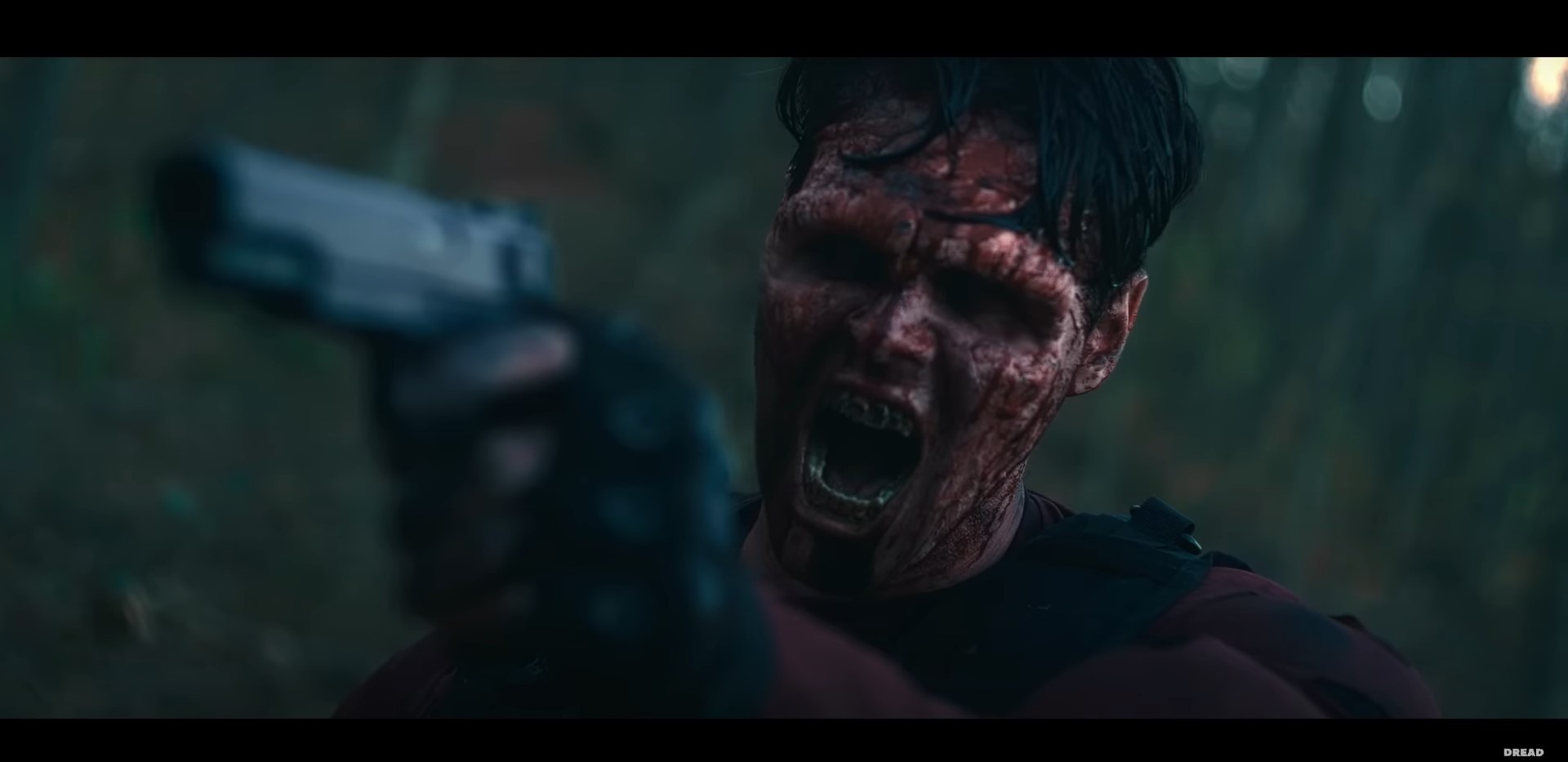
Chase, a washed up mercenary with touch of amnesia regarding his past, is hired to round out a six-person team for a rescue mission on the Isle of Grand Manan where a top secret TSL research facility has gone dark and a high-level CEO’s daughter has gone missing.  Ordered to retrieve the daughter inside a 48-hour window, the team arrives on the seemingly deserted island to find multiple dead scientists having been torn to shreds.  The team soon learns they’re not alone when attacked by bigger, aggressive, monstrous versions of themselves.  Unable to believe their eyes, the one scientist left on the island has determined they’ve been trapped inside an encircling wormhole that resets the island and it’s inhabitants every 3 days, turning those left alive after the third day into these humongous, blood-hungry creatures.  With the mission quickly dissolution, it’s quickly being pieced together that the rescuing mercenaries are the ones who actually need rescuing and their only way to escape would nearly destroy them all.
I’ve said this once before and I’ll say it again.  Weaving wormholes, time loops, time travel, and the like into a narrative is a tricky, tricky business.  Bending time and space can calamitously collapse a story so bad that every internet warrior and science fiction nerd, including myself, will pick apart and ridicule the film until the end of time, but if the portent collapse can be averted and little-to-no complaints with the time travel aspect of the story can go unscathed for a better part of the runtime, then the power of the multi-dimensional space time continuum can be magical and enthralling.  Writer-director Bruce Wemple (“Altered Hours,” “My Best Friend’s Dead”) wraps his hand around a wormhole-driven action-horror “Island Escape” to grasp ahold of the unruly concept of time.   The Traverse Terror production, a division of producers Cole Payne and Mason Dwinell’s Traverse Media in association with Wemple’s 377 Films, and presented and produced by Patrick Ewald’s Dread Central, “Island Escape” rounds out the producer set with Vincent Conroy.
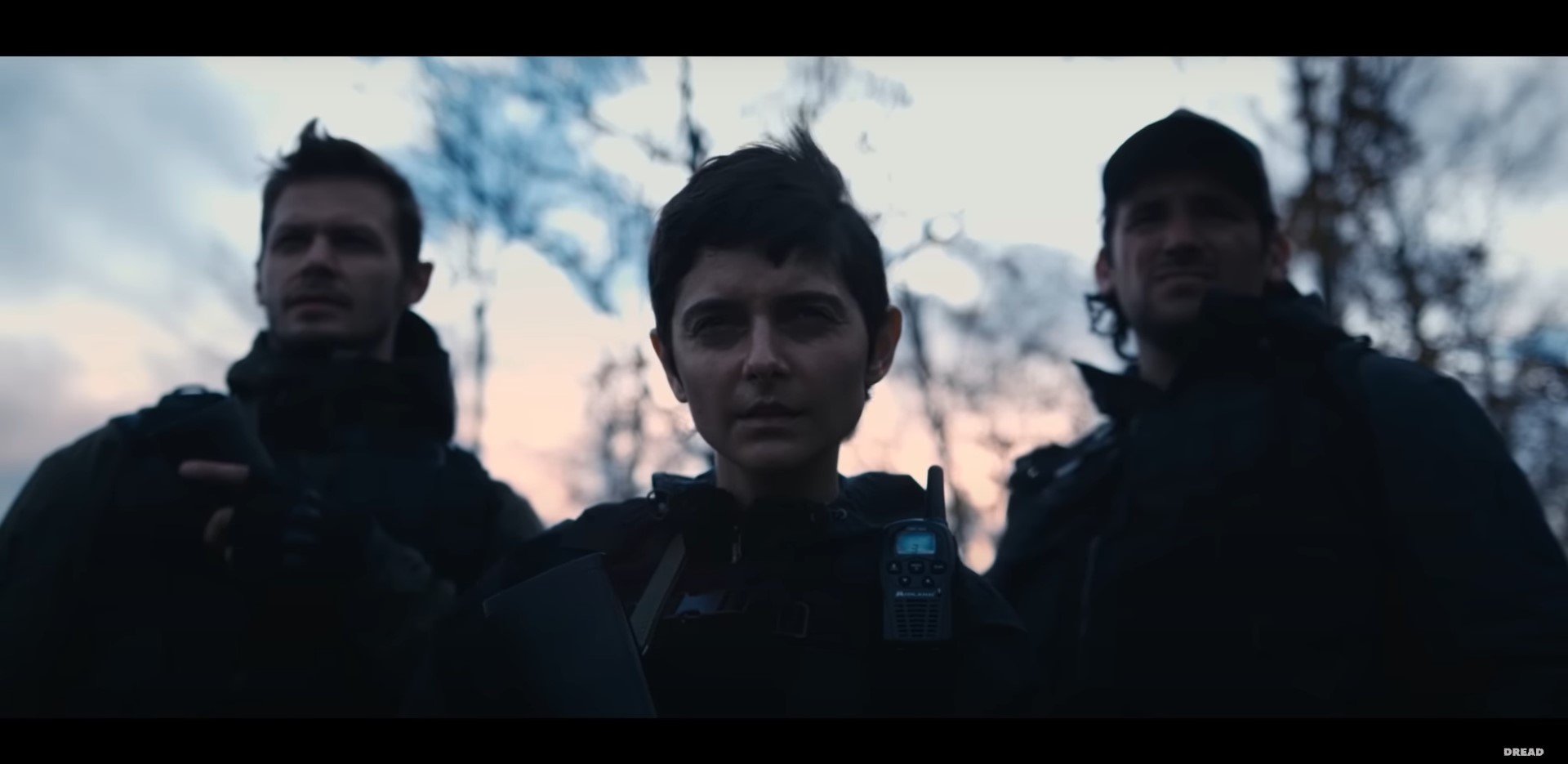
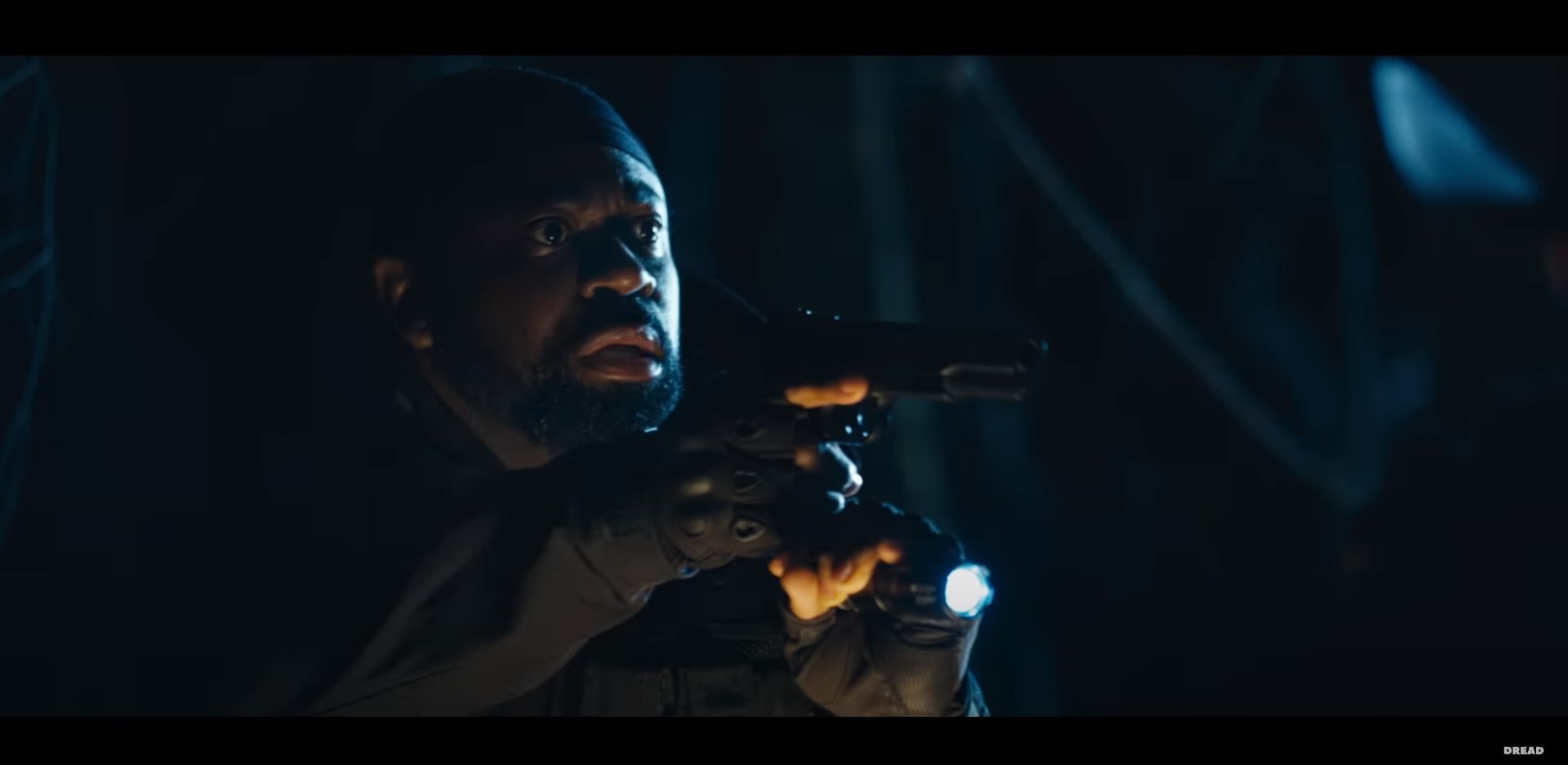
Bruce Wemple carries with him a cast entourage, a staple of actors who have worked years with the filmmaker through a number of project.  “Island Escape” is no different as Wemple signs aboard his trusted troupe to tackle the terror on TLS island with a rescue gone wormhole wrong.  The story has a trifold focus Chase (James Liddell, “Hell House LLC Origins:  The Carmichael Manor”) as the washed up gun for hire with memory loss, Addison (Ariella Mastroianni, “My Best Friend’s Dead”) as team lead and recruit of the Isle of Gran Manan mission, and Russ (Grant Schumacher, “My Best Friend’s Dead”) as the dithery team member not in Chase’s good graces based of fragmented memories of a failed mission.  Between the three characters there lies a fleeting tautness that’s not tremendous carried out as expected from initial introductions.  Instances such as Chase expressing his distrust for Russ never has the tension reach open air in any time they’re together or in the case of Addison as a melancholic memory for Chase that eventually evolves into mid-misison romance that’s more spontaneous than building momentum to in the first and second act.  The undercooked characters fail to establish boundaries, positions, and progressing or regressing dynamics and arcs.  There’s more headway with supporting staff in Tag, a self-penancing father doing dirty, dangerous work to support his young daughter and this consistently shows throughout his screen span, hitting upon the nerve of a father trying his best for the sake of his child.  The cast rounds out with a handful more of mercenaries and scientists to become minced meat by their devilish doppelgangers with Chris Cimperman (“First Contact”), Michael L. Parker (“First Contact”), Andrew Gombas (“The Tomorrow Job”), William Champion (“The Tomorrow Job”), and the feature length debut of Renee Gagner filling those roles. 
Wormholes.  The suspended openings in space let the Dominion race invade Star Fleet in the Alpha Quadrant of “Deep Space Nine,” dropped a fiery plane engine on top of the titular character “Donnie Darko,” and brought back something alien and terribly evil in the titular ship “Event Horizon.”  For Bruce Wemple and his “Island Escape,” wormholes have become more earthbound thanks to a shady research corporation delving into dangerous methods and unscrupulous science practices for the go-to cover up slogan of a better world tomorrow.  While Wemple spins an intriguing yarn needled quick to be full of cankerous clones coming from all corners of the island to attack their uncorrupted selves while trying to survive and flee, the filmmaker skip stitches during his knitting of a tight narrative, fashioning an uneven story that can’t quite get the pattern right for in some of the more restlessly difficult areas of trouble island.  Fleshing out Chase’s blank slate produces no reason to light, Russ’s lack of motivation in divulging life-and-death information, the deep dive into Island experiments fall to the wayside, the CEO’s daughter seemingly dead to all of a sudden be alive, and I could go on with all the loose ends that kneecap the better parts of story, such as the creature action and the wormhole aspect, but the fact won’t escape that there’s a mishandling of the island’s treacherous overgrowth that’s severely underplayed and the epic scale Wemple tries to impress is torpedoed by omitted small cogs that turn the bigger, weight-bearing gears. 
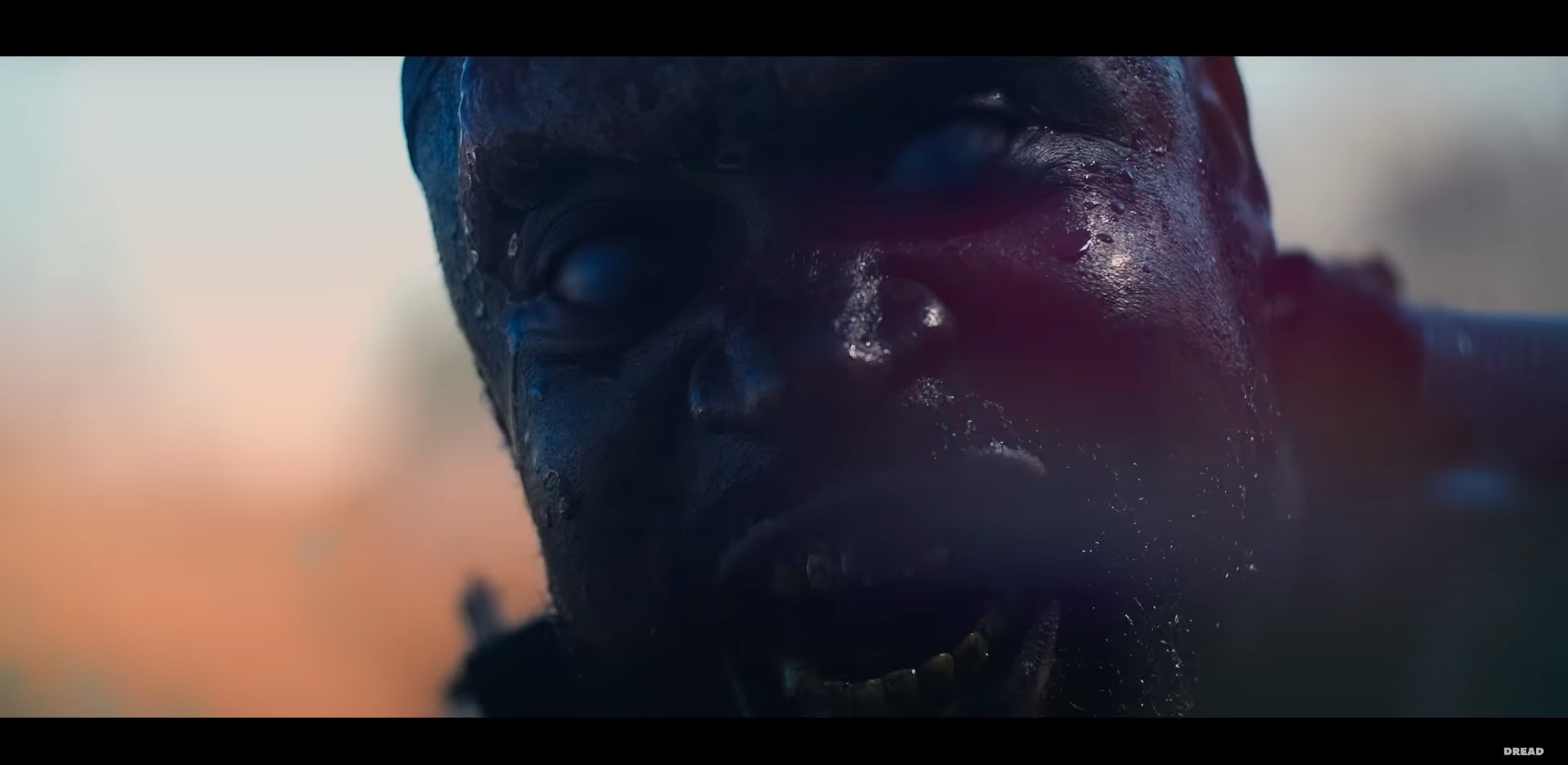
Dread presents Island Escape onto a high-definition Blu-ray distributed by Epic Pictures.  The AVC encoded, 1080pm, BD25, presenting the film in an anamorphic 2.35:1 aspect ratio, is a slurry of personal style and cinematography issues.  Capacity-wise, not a ton of wall-bearing issues that would make the visuals crumble; a few fleeting areas of dark side banding and quick movement aliasing pop up occasionally.  Where most of the issues stem are stylistically with poor VFX compositions that stymie any high-action utile climaxes.  The light pink/fuchsia grading replaces much of the island’s, or island-like setting’s, innate green foliage for a broad one-tone that has an adverse effect of unnaturally darkening the characters.  Two English audio options are available to select:  a Dolby Digital 5.1 and a Dolby Stereo 2.0.  Both lossy formats offer what this particular films needs, a fast and loose sufficient mix that gets the job done without causing too many waves.  Most of the dialogue has a ADR pretense that I would take a wild guess and say is more a sound design issue of not creating space in the depth field.  Each character sound to be on the same audio plane that forces a full-on push of dialogue right to the front of the audio layering that makes ever channel in the 5.1 the same.  Ambience Foley is harshly isolated from other tracks so if a character is walking through the forest, you hear nothing else but the lonely crunching the tree litter that doesn’t mesh with onscreen movements.  With most digital recording, no interference and damage flaws are present.  Optional English SDH and Spanish subtitles are available.  Special features include a roundtable commentary with writer-director Bruce Wemple at the helm with most of the cast speaking through Zoom or some kind of video chat program.  In addition, the commentary is greatly colorful with more jokes and jabs at one another and at themselves that reflect how much of a good time they have working with each other on this film and previous Wemple credits.  Also included in the special features are a few deleted scenes, the making of “Island Escape,” feature trailer, and other Dread presented film trailers.  Like most Epic Releasing products, a standard Blu-ray Amaray case displays an intriguing cover art for Dread’s 47th at-home title with a wormhole opening to an skull-faced Island and a helicopter and four soldiers walking toward it.  Disc art renders the same image and there’s no insert included opposite side of the case.  With a region free playback, “Island Escape” has a runtime of 86-minutes and is not rated. 

Last Rites:  The haphazardly executed science-fictional survival film “Island Escape” has good plot bones underneath the shambled edifice of an ambitious façade with only decent monster mayhem and creature effects dwelling inside. 

“Island Escape” Available Here at Amazon.com

When Marriage Sours, EVIL From Within Manifests. “Possession” reviewed (Umbrella Entertainment / Blu-ray)

After his return from a lengthy time abroad, Mark finds himself in a contentious and spiteful relationship with his skittish wife Anna unveils her infidelity.  Unable to pry any kind of information from her before her sudden disappearance, Mark results to all the stages of grief and heartache:  denial, isolation, anger, bargaining, depression and, finally, acceptance.   Anna comes-and-goes from Mark and their son’s life, but their spats continue, increasing in anger and violence which each encounter.  Mark hires private investigators to track down Anna’s whereabouts.  He evens confronts her flamboyant and Zen-mastering lover.  But when Mark comes face-to-face with Anna’s sinister secret, a sub rosa affair unlike anything Mark has ever seen, he will go to unimaginable lengths to protect the wife he obsessively loves. 

Polish filmmaker Andrzej Zulawski’s “Possession” spans over a number of parallels that, in abstract theory, reflect social political matters of a post-war, Berlin wall divided Germany and the personal matters of Zulawski as a mirror of his ugly and bitter divorce from actress Malgorzata Braunek.  The 1981, Berlin shot, inimitable horror is a speeding melodramatic bullet train racing down a tracklayer of surreal rails and planks, ripping toward destruction with two turbulent people who about to slam, engine first, into an unforeseen mountain façade of towering despondency. That unforeseen mountain takes form from the tug-a-war of within, materializing duplicity, in every sense of the word, unnaturally. Frederic Tuten cowrote the emotionally florid and easily post-grad thesis dissecting film with Zulawski that was French mounted by Gaumont Film Company under producer Marie-Laure Reyre. Two other French companies, Oliane Productions and Soma Films, co-produced.

Watching Mark (“Jurassic Park” and “Event Horizon’s” Sam Neill), and Anna (“The Tenant” and “Diabolique’s” Isabelle Adjani) go at each other’s throat in a vicious cycle of matrimony madness can be in itself, maddening. Neill and Adjani radiate such loathing and desperation that’s seeing the two interact could possibly ignite World War III right there in the heart of Germany. What makes the contentious and hyperventilating scenes more interesting and alluring are the actors’ stage-like, full of hyperbolic melodrama, performances that somehow don’t quite register as the feisty interactions playout in what can only be concluded being pinpoint precision. Even Heinrich (“A Young Emmanuelle’s” Heinz Bennent”) is blatantly over-the-top with erratically wild movements of his body during scenes of emotional and physical struggle. Zulawski and “Possession” embraces the international cast with individual methodology on acting from Britain, France, Germany, and with even Zulawski who’s Polish and though you know the film is set in a divided Berlin between East and West Germany, there’s never this sense that “Possession” is strictly locked down to be anything but German. Aside from the Berlin Wall and some signage, maybe even the architecture, the multinational cast thins out the inklings of thinking, “oh yeah, this is filed in Germany!” “Possession” cast concludes with Margit Carstensen, Shaun Lawton, Johanna Hofner, Michael Hogben and Carl Duering.

Being that this was my second sit down with Andrzej Zulaski’s “Possession,” the first being Second Sight Films’ DVD release over 10 years ago, you begin to fathom the pattern of surrealism Zulaski aims to bombard viewers with through incessant bickering and an unspoken love-and-hate undertone. The doppelganger theory that’s attached itself to “Possession” from over the years warrants merit because those in a relationship on the precipice of implosion always wish the other person to be a better version of themselves, of who they want them to be, or of who they fell in love with in the first place. One can’t go deep into the doppelganger theory without totally exposing all of “Possession’s” secrets, surreal or not, and that infestation of preference takes shape for Zulaski as, ironically enough, a shapeless creature. The desire is tremendously powerful for Anna she can’t avoid being away from it for long stretches of a time, popping in to her and Mark’s old apartment for just enough time to have Mark stir the pot with his own manifested infernal creature, himself. Anna, an extremely passive woman, rarely confronts Mark about her infidelity and is always Mark who has to extract that information with every tooth and nail. “Possession” will forever be hailed a film that can analyzed over and over again without ever finding a concrete interpretation and, you know what, we can live with that.

As I said, last time “Possession” was visited by these aging eyes was over a decade ago on a UK DVD. Now, I had the fortunate opportunity to sit down with a new Blu-ray release from Australia. Umbrella Entertainment, in conjunction with The Film Institute (TFI) Films Production, releases a single disc, full 1080p Blu-ray, registered as their volume #11 on the spine, as part of the banner’s Beyond Genres collection. Presented in European widescreen 1.66:1 aspect ratio, this “Possession” release has a giant leap of negative exposure in comparison to Second Sight’s DVD, retreating away from a more natural and textural palpable transfer, full of detail and good amount of grain, to a blue-tinged headscratcher with a higher contrast that renders details and shadows nearly wiped out. The transfer is also conveyed with slight damage seen in approx. minute 14 with a vertical scratch and some image destabilization that makes discernability dematerialize right before your eyes near minute 44 and 57. The English language DTS-HD 2.0 master audio renders better with cleaner tracks seeing little-to-none hissing or static. The dialogue’s apparent and unobstructed thought slightly isolating without much depth. Despite some limited capacity with the dual channels, “Possession’s” more adrenalized scenes/ranges – i.e., speeding car flip, shoot outs, apartment explosion – sound effective and robust. Special features include an archival audio commentary with director Andrzej Zulawski and co-writer Frederic Tuten, an archival interview with the late Zulawski The Other Side of the Wall: The Making of Possession from 2011, a U.S. Cut of the film with a following featurette Repossessed, a location featurette A Divided City, the musical compositions in an interview with composer Andrej Korzynski The Sounds of Possession, an interview with producer Christian Ferry Our Friend in the West, a poster analysis, and the international and U.S. theatrical trailer. What’s presented by Umbrella is the fully uncut 123-minute version in a region B-code format though, weirdly enough, rated 18. Another weird note about the release is the back cover credits are displayed in French on the cardboard slipcover housing the reversible DVD artwork featuring a new illustrated snapcase cover art by Simon Sherry. I’m a clear fan of “Possession’s” clear ambiguity despite being not sure positive about the new Blu-ray release. Zulawski’s tale of corrosive dissolving of wedlock definitely fits the Beyond Genres banner and is a fine edition to Umbrella’s celebratory bank of classic horror.


Possess Your Own Copy of Umbrella Entertainment’s Blu-ray Release of “Possession” Today!

Triangular Space EVIL is the Sign of the Beast! “The Dark Side of the Moon” reviewed!


In the year 2022, orbital satellites carry nuclear missiles and maintain flight patterns around the moon. When a satellite repair ship, known as a “refab” ship called Spaecore 1, attempts to intercept a satellite for maintenance, the system wide computer goes into an unexplained power failure that jeopardizes communications, life support, and navigation. Drifting helpless toward sector Centrus B-40, the dark side of the moon, all hope will be lost within 24 hours unless operations can be restored, but a mysterious spacecraft, NASA’s Discovery shuttle, heads toward them and docks onto their outer hull without so much of a hail from the shuttle. Captain Flynn and Lt. Giles investigate a seemingly abandoned ship until coming across a dead body of a presumed missing NASA astronaut, eviscerated with an opening left in a perfect triangle as the cause of death, and that opens the door to more questions than answer as a sinister presence boards their ship, pursuing damnation for their souls.

Just think, in two more years, weapons of mass destruction satellites will loom just above fluffy white clouds, ready to mushroom clouds out of targets with a 10-ton yield; at least that’s what director D.J. Webster and the screenwriters, identical twins Carey W. Hayes and Chad Hayes, modeled the future when conjuring up this delectable Sci-Fi horror film approx. 20 years ago. With special effects models and techniques that withstand against powerhouse space films, such as from the immaculate effects of Alien franchise, “The Dark Side of the Moon” becomes more than just a 1973 Pink Floyd album title Fabricated out of warped creativity of old and new concepts with a Biblical horror base that only the 1990’s could loosely spin into an hour and 27 minute feature, for many of the filmmakers involved, “The Dark Side of the Moon” credits as their first taste of a feature length, large scale production, especially with the mainly music video director D.J. Webster, who loves his closeups, and director of photography Russ T. Alsobrook, as they auto clicks into a team that seemingly have experience of seasoned veterans or, perhaps, spent some secretive, unlogged time in space. Who knows, but the outcome ruminates about the dark side of religion and how each of us deal with it internally.

When mullets and giant framed glasses are afoot, the late 80’s, early 90’s filming era is beyond evident with interestingly gritty characters lined up for an evil figure eager to knock them down and, of course, the story’s lead character is the mullet sporting pilot named Lt. Giles Stewart who is unwittingly thrust into the fast track of a hero’s lane. Giles’s atheism framework has a pleasant sardonicism about it when face-to-face with the immortal conqueror of his ship and crew. Will Bledsoe paints Giles as such as faithless space pilot, bound to duty, and willing to do anything to just not save himself, but others. One of the only recognizable faces, at least for myself, in the cast is John Diehl. The “Stargate” and “The Shield” television actor is best at being a wild card in turmoil situations and as shipmate Phillip Jennings, the same can be expected without being utterly conventional or warrant any kind of typecast label. Another actor to note is Alan Blumenfeld as the ship’s panicky Dr. Dreyfuss Steiner. Blumenfeld, who had a role in the best Jason Voorhees film, in my humble opinion, “Friday the 13th Part VI: Jason Lives, is once again stalked by a larger-than-life villain while maintaining a profusely sweaty persona that’s symbolically intended to be true, unadulterated fear. As a whole, the cast is amazing regardless of some first time filmmakers at the helm, rounding out with “Re-Animator’s” Robert Sampson as the ship’s Capt. Flynn, Joe Turkel from the first “Blade Runner,” “Blood Frenzy’s,” and overall erotic thriller goddess, Wendy MacDonald, stunt man (“Kill Bill Vol. 1 & 2, “Army of Darkness”) Ken Lesco, and another “Friday the 13th” actor, Camilla More, or Tina from “The Final Chapter,” as the stationary sexy, ship’s onboard computer-robot named Lesli – think on the same lines as Mother from “Alien,” but in the flesh.

What makes “The Dark Side of the Moon” very interesting is the film being an unofficial precursor to other science fiction horror films like “Event Horizon” that was released roughly seven years later. Space as this gateway to Hell concept is sorely under-appreciated and underutilized. Space is already vastly frightening to begin with and by adding a devilish abyss aspect to it makes the idea an absorbingly scary thought. What’s also fascinating is the Hayes brother. “The Dark Side of the Moon” is the brothers’ roots film; the proverbial patient zero that spread successful movie writing careers for the twins, spawning turn of the century horror with the remake of “House of Wax” that saw the on-screen death of Paris Hilton, had “Underworld” star Kate Beckinsale track down a killer in Antarctica in “Whiteout,” and they penned “The Conjuring” that constructed its very own universe.

“The Dark Side of the Moon” comes in at #2 on the Unearthed Films’ Classics label distributed MVDVisual. The newly restored 4K transfer of the Wild Street Pictures production is presented in a widescreen, 1.85:1 aspect ratio, region A Blu-ray release. Surprisingly sharp despite consistent low-lit scenes and not as washed like previous VHS versions, this restoration fine tunes the nitty-gritty specifics needed for proper presentation that doesn’t falter from heavy digital noise or blotch artifacts and shows no signs of enhancing The English language LPCM 2.0 audio track is strapping for a dual channel format. Dialogue pronounced clearly, ambient spaceship clinks and clunks create atmospheric range and depth, and the relentless brooding score by “Society’s” Mark Ryder and Phil Davies delivers shuddering spinal-tingles without being monotonously dull. Bonus features include a commentary with executive producer Paul and Unearthed Films’ Stephen Biro, interviews with Alan Blumenfeld, FX artist R. Christopher Biggs, and stuntman Chuck Borden, plus vintage audio track, trailers, photo gallery, and a insert booklet that dives into about the production and the cast. All packed into a nice little slipcover package. “The Dark Side of the Moon” pioneers into the future of space horror as a good ole dread-inducing fear-monger of the great expanse, deserving this Unearthed Films’ release, hands down.

Hauling Evil Earns a Living! “Space Truckers” review!


Times are tough. Loads are scarce. For John Canyon, being an independent owner operator space trucker in the year 2196, without the influential assistance of conglomerate sponsors and big corporations, is the last freedom in the last great frontier, but even Canyon needs to earn a living and when a questionable load becomes his only way out of a jam with the authorities, Canyon and his new and young partner, Mike Pucci, snatch the haul bound for Earth. Manifested as carrying sex dolls, Canyon and Pucci become suspicious of their cargo that’s loaded with a fatal self-defense mechanism, but when encountered by space pirates, lead by former company man named Macanudo, the space truckers learn their hauling thousands of virtually unstoppable killer cyborgs programmed to conquer Earth.

In today’s age, a nationwide driver shortage threatens to slow down crucial logistics worldwide. Director Stuart Gordon (“Re-Animator,” “Dagon”) with co-writer Ted Mann had the inverse premonition that trucker cargo would be at a premium in the space; the point A to point B in a timely fashion has not and neither have the negotiations of rate costs and demurrage time in this world-saving adventure entitled “Space Truckers.” In the same science fiction-comedy vein as the similarly colorful Luc Besson’s “The Fifth Element,” “Space Truckers” has that unrefined inviting quality about it, categorized as blue collared heroes, that complete the dynamic character arcs, but what’s more interesting about “Space Truckers,” which was released a year earlier than Bruce Willis film, was that it was constructed on a third of the budget, making the film one of Stuart Gordon’s most expensive and ambitious projects chocked with square pigs in cages, a self-built cyborg with a ripcord sexual organ, and an army of ass-kicking fembots with disintegrated lasers…”Space Truckers” is out of this world fun!

In the realm of Sci-fi comedy or fantasy, one legendary actor has nailed his performance in every flop that’s too big for commercial audiences. From “Waterworld” to the movie adaptation of popular and beloved video game, “Super Mario Bros.,” Dennis Hopper ruled the 1990’s with memorable, fascinating, and engaging overweening characters, especially villains, but Hopper snags John Canyon, a long in the tooth trucker who prefers to work alone. Hopper’s in his element, in control, and in the lead role despite not being top bill; instead, a young Stephen Dorff would be eyed as the one to provide fresh protagonist momentum into the mid-nineties. Dorff’s rather low-key to Hopper’s giant persona and that’s inherit to the character’s written traits, by always complimenting and complying with and whatever John Canyon says, but the soon-to-be “Blade’s” Decon Frost actor has a sturdy performance that’s portly as any trucker can be portrayed and has great repertoire with Debi Mazar as a trucking hub waitress who needs a hitch a ride to Earth. Mazar’s all-natural New York City accent compliments her guido-type character attire and she downplays her beauty with instilling innocents and ramping up the wit when the scene calls for it. “Game of Thrones'” Charles Dance makes an appearance as the space pirate captain Macanudo and Dance has always has a steel complexion, but in “Space Truckers,” he lets his hair down as far as becoming subjected to hours worth of cyberpunk makeup and prosthetics that’s comically outlandish and utterly fleshy. Certainly not a role one would consider the actor who comes complete with a rich British accent and an urbane quality about him to then sport a sparkling fishbowl cranium and a battleship gray half a buttocks. The remaining cast includes George Wendt (“King of the Ants”) and Shane Rimmer (“The Hunger”).

CGI was relatively in the early stages of infancy; yet “Space Truckers” had an astonishingly working blend of computer generated imagery and palpable miniature models that were supported with an integrated futuristic edifice style of production design by Simon Murton, whose speciality is high concept science fiction with illustrative art department experience that includes “Demolition Man,” “Tank Girl,” “Judge Dredd,” and “Stargate.” Murton’s style incorporated with the bright colored visuals of neon flicker marquees, illuminating body parts, and red hot poker red infrareds hues are the very antagonistic views of a cold and dark space, yet Gordon and his crew envisioned characters who sought out color, who wanted nothing to do with the darkness, and that’s what made them colorful and maybe a bit off-kilter.

Stuart Gordon’s stellar “Space Truckers” rockets to a region B, 1080p Blu-ray courtesy of UK distributor Second Sight that delivers with a widescreen presentation, 2.35:1 aspect ratio, that has out of this world image quality vividly displaying the massive color palette through a 2K restoration from the 35mm negative. Running at nearly 24 fps, Second Sight’s edition is superior in detail, cleanliness, and balance amongst the coloring and despite being able to see the special effect wires, “Space Truckers” has one of the best restorations I’ve seen lately under the black Blu-ray box laced with new artwork by graphic designer Rich Davies. The English 2.0 LPCM uncompressed stereo track, with optional subtitles, has immense range across the board. From cheesy John Canyon dialogue to the vary of space-kindred ambience, not one track felt short to being muddled or murky. Colin Towns bigrig score is big country cadence that’s emits a well-rounded six pack from the dual channel sound. The robot’s disintegrations amplify a high pitch note that can be a thorn in one’s ear, but adds to the chaotic charm when all hell breaks loose in space. Bonus features include a new interview with Stuart Gordon delving into the film’s beginnings and his recollections with the stars, and a new interview with composer Colin Towns (“Rawhead Rex”), a new interview with Art Director Simon Lamont (“Event Horizon”). “Space Truckers” is 96 minutes of mudflappin’ mayhem strapped with slender models in killer robot suits and Charles Dance’s exhibiting his tin-can half-nakedness in a bizarro world of high concept meets tongue-and-cheek performances of a film that ultimately pits the epitome of the blue collar workforce as the unsung heros of space.