EVIL Will Have You Die Laughing! “Too Late” reviewed (Gravitas Ventures / Digital Screener)


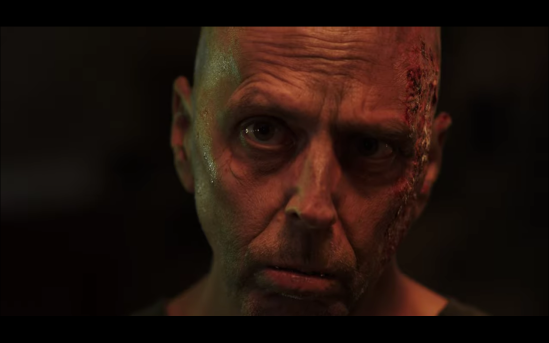
Non-stop and around the clock, Violet is the worked obsessed assistant to legendary showman and standup comic Bob Devore at the Too Late comedy club.  Violet books new talent and schedules the lineup day in, day out, but that isn’t all she does for her overly demanding boss.  Bob Devore has been around for a long time and during a very specific moon cycle, Bob needs to eat and we’re not talking pizza or Subway sandwiches.   Bob is a literal monster who feeds on devouring entire people, especially no comedy talent hacks provided by his assistant, Violet.  The longevity of Bob’s Life spans decades, if not centuries, as he sees people come and go right off existence.  When Violet meets a nice guy comic who Bob takes a shining to, the long time lonely assistant decides enough is enough and the time to stand up to the eternal stand up comedian and monster boss is now before what little she has is taken from her. 

I hear the Los Angeles stand-up comedy scene is tough.  Sometimes, even cutthroat.  In D.W. Thomas’ comedy-horror “Too Late,” a blend of mic night funnies with a hunger for full body snacks, dying on stage turns into a whole new meaning!  Thomas’ debut feature film kills it as a low-budget horror that incorporates figurative levels of monstrosities behind the curtain of a stand-up’s spotlight.  The 2021 film is the first screenplay credit for Tom Becker that tackles underappreciated long hours and work ethic of female workers in a typical male dominated profession., touching upon the toxicity of the business.  “Too Late’s” underground comedy-horror sees the light of day under the indie production studio, Firemark Media, and is produced by Thomas and Becker as well as executive producer and long time industry vet, Lonnie Ramati, a production business affairs manager dabbling in producer with the selected credits including “The Expendable” sequels, “Leatherface,” and 2019’s “Hellboy” under his belt. 

“Too Late” marquees mostly tongue-and-cheek talent in a cast list chocked full of comedians, starting with actress, writer, and jack of all trades stand-up comedian Alyssa Limperis in the headline role of Violet.  What’s ironic with Limperis’s “Too Late” role is that Violet is perhaps by design the least funniest amongst the characters as a lonely, borderline depressed, and overworked slave of an assistant to Bob Devore, a renowned variety show presenter and entertainer played by one of my favorite spoof performances by Ron Lynch from last year in Travis Irvine’s “Killer Raccoons! 2! Dark Christmas in the Dark!” as General Negligence.  As Violet begins to blossom after meeting humble comic, Jimmy Rhodes (Will Weldon), after bumping into him renting out one of her friend’s closet since, you know, L.A. is a tough, expensive town, this give Limperis ammunition to turn Violet sour on her abrasive, glass ceiling mentor.  Limpers excellently conceals intentions in each relationship step taken with her new unassuming and amiable beau and this really brings out Devore’ darkness crafted so well by the New York born actor and comedian with a gloomier roaring-twenties vaudeville vibe.  One thing I will say about the chemistry between Limperis and Weldon is I didn’t think there was much spark as their flirting banter catered to good friendzone material.  Perhaps used for their more syndicated appeal, Mary Lynn Rajskub and Fred Armisen add very little to the mix.  “24’s” Rajskub is a no-nonsense hotshot comic who has Devore wrapped around her finger whereas Armisen plays a nearly simpleminded stage hand who adds a bit of levity to the darker tone with his pudding cups and indecisiveness on blue filter gels for the spotlight.  The rest of cast pans out with Jack De Sena (“The Veil), Brooks Wheelan, Jenny Zigrino, Billy Breed, and Paul Danke. 

“Too Late’s” opening drive buildups a focuses around Violet’s passively aggressive position in being an undervalued assistant to her bark-and-you-jump Boss.  Constantly scribble but unenabled to perform her own material be her own self-starting, stand-up comedian, Violent falls into a lonely state that she is unaware of and it takes her best friend/roommate’s lighthearted berating to get Violent to come to a Jesus moment with her total profession and lack of relationship unhappiness. What’s not in the prevalent in the first act is Bob Devore’s permanence, his beastly transmogrification, and his appetite for anthropoids. If you didn’t read the synopsis beforehand, the acute dark turn “Too Late” takes comes at a shock because of how little-to-no prep there is setting up the true Bob Devore. A backfill of creeps a long, like opening the little chocolate stuffed doors on an advent calendar, in a wait and you’ll get more character treats up to a grand finale. About two-thirds of the way through, “Too Late” starts to flounder with what to do about Devore as a character, never expressing a full delineation of character to how Devore ended up at a nightclub, or who, or actually what, the actual hell is he and how Violet, who isn’t as innocent as one might believe, became so fatefully involved. The underlining theme here, noted explicitly in the title, is don’t hold yourself back no matter the circumstances, whether be an actual monster or a monstrous personality, because life is short, time is of the essence, and carpe diem! Violet, a hard working female in a male dominated industry and is undercut by not only her dominating boss but also her advantage taking male peers, need a monkey wrench in the gears of a monotonous, browbeaten life and that happened to be Jimmy Rhodes, a nice, non-threatening, and unimposing comedian who seemed to be just be handed the keys to Violet’s rightful castle just because he’s a man, and though she falls for Jimmy, that’s the career careening straw that breaks Violet’s abuse absorbing spirit.

With a dry wit, “Too Late” black humor is more figurative than funny but first time director D.W. Thomas makes good on her debut horror-comedy that has released this month in select theaters and on digital platforms, such as iTunes, Google Play, Fandango Now and all major cable/satellite platforms from Gravitas Ventures. A digital screener doesn’t allow me to fully dive into the A/V quality but the Scott Toler Collins cinematography grasps the underground comedy scene experience, selling the location of an boutique variety show club, hard mood lit in various colored staged lighting with a smoky irradiance, of tight medium and closeup shots that kind of hover amongst the characters. “Too Late” is not effects heavy though maybe should have been to make Bob Devore a real menacing presence as much of his late night snacking is done off screen, through shadows, or blurred during a shallow focus. We always get the aftermath Bob Devore, bloated and bulging at the seams from a big meal, like a secondhand Eddie Murphy fat suit from “The Nutty Professor.” Still, kudos to Mo Meinhart (“The Walking Dead”) in making Ron Lynch appear farcically 40lbs heavier in what you might typically seen in a Looney Toons episode. Bucking the more modern trend, this indie picture has no bonus scenes during or after the credits. The in-film stand-up is spotty at best but “Too Late” has a lot else to focus on with a deeply disturbing look at machismo arrogance and sexism inequality that are the relevant horrors of today.

“Too Late” on Amazon Prime!

Transcend This Life With an EVIL Elixir! “At Night Come Wolves” reviewed! (Gravitas Ventures / Digital Screener)


Leah has tirelessly tried everything to please her misogynic and negative husband Daniel, even going as far as dressing up in a skimpy and sexy Wonder Woman outfit and serving him his cake in more ways than one.  Yet, nothing seems to be chipper his spirit as he barrages her with meanspirited down talk that disparages her in every possible way.  Fed up with it all and hightailing their home before she does something rash, Leah drives aimlessly to get away from him and winds up, out of gas, at a diner where she meets Mary May, an acolyte to cultist Davey Stone who believes an elixir made from a forgotten, thought extinct, plant will transcend their existence beyond the cruel world of the now.  What the elixir actually does is something far more horrifying.

Verbal abusers, cult leaders, murders.  The crazy doesn’t stop there in Thomas J. Marine’s debut feature film, “At Night Comes Wolves,” landing it’s anti-sexism and anti-misogynistic messages upon the world on digital platforms this month.  Marine comprises his three short 2015 through 2017 films – “Paris, My Love,” “The Call to Future,” and “Object in Reality” – together with central narrative to bring new life into each one of his projects and also create something new from half the work being already filmed years earlier. Marine, or TJ as credited, writes a genre abstract story out of the pieces he tries to puzzle together, wildly cutting and pasting his shorts together as he continuously self-funds that extends into the filler narrative of his 2021 film under his own copyright, leaving “At Night Come Wolves” as a piece of true work from an auteur.

Beyond the first scene of a bound woman to a chair, bleeding from her hungry eyes and mouth, “At Night Comes Wolves” opens with Leah, “On-Site’s” Gabi Alves in her sophomore feature film, coming under hellfire from her loathing husband Daniel (Jacob Allen Weldy). Alves comes off with the submissive, will-do-anything to be a pleasing wife starkly contrasted against Weldy’s take-it-all and give nothing sexist persona; however, their relationship strays into Daniel’s bizarre sexual fetishes and watching his sexually objectified wife become the plaything for another man, a black man to be specific. The scene is brief, but powerful, perhaps the most powerful 10 seconds in the entire film that could have been, or rather should have been, the very principal theme of “At Night Comes Wolves'” subjugating prejudice roots. Instead, Leah throws in the towel and deadheads to nowheresville, serendipitously running into cult acolyte Mary May (Sarah Serio) and cult leader Davey Stone (Vladimir Noel). Stone’s fancies himself as an alchemy enthusiast, mixing his vintage bottled potions of unmarked substances that produce a variety of outcomes, usually ones Stone doesn’t expect and that thinly becomes the plot point genesis of Marine’s shorts. The entire dynamic becomes a glass ceiling as the story kind of just ceases to make logical sense when Leah deliveres Stone and Mary May to Daniel in a reconnect from the past of bad blood crossing paths again and along for the ride is Daniel acolyte Susanne (Colleen Elizabeth Miller “Leaf Blower Massacre 2”) whose down to drink Daniel’s demented womanizing Kool-Aid. Joe Bongiovanni, Myles Forster, Madeleine Heil and Byron Reo are sprinkled into servitude of “At Night Comes Wolves'” contorted three prong story.

Marine might repurposed his shorts into a Frankenstein feature to resuscitate new life into his lifeless projects, but the concept of regurgitating material itself isn’t totally unheard of while also being not widely popular amongst the mainstream crowd and even well-backed, risk-taking B movies due to the innate choppiness consequence.  Whether the restructure comes in the form of a web episodes strung together as in Nicholas Tana’s “Hell’s Kitty” or from lengthy shorts of one continuous story as with Joe Lujan’s “Rust” being a prime example of his short films, “Rust” and “Rust 2,” having been meld together years later, the narrative planes always seem and feel fragmented and staggered to the point where convincing audiences of a seamless story becomes a blurred line of why even try as filming styles, crews, actors, and even equipment change over time and “At Night Comes Wolves” suffers from that very incoherency with an intended non-linear storyline inelegantly sewn together by backtracking segues. Marine has two, if not three, very different ideas floating around his feature with one being very poignant, another identifying ideological radicalism with sexism undertones, and the other being just for the hell of a horrific good time with the undead. Of course, you don’t ever see the finale coming because, let’s face it, there’s never an established clean and clear objective in the narrative that floats in time and space. Hell, I don’t even know if it’s supposed to be partly a comedy or not with the incorporated park ranger scenes with Joe Bongiovanni and Vladimir Noel that are offbeat funny. This is the hand Marine dealt himself and it wasn’t a pretty one, yet somehow his ambition made a semi-intelligible presentation of a cult group toppling another more depreciating cult group before transcending into the seedlings of the apocalypse. And all I can do by the end of the movie is ask myself, what the hell did I just watch?

Don’t let this review scare the preeminent pants off of you from checking out and judging for yourself TJ Marine’s 2015, 2017, or, maybe, 2021 released films within a film as “At Night Comes Wolves” hit digital platforms this month of April, including iTunes, Google Play, Fandago as well as available on cable and satellite VOD services. Clocking in at 77 minutes, the unrated “At Night Comes Wolves” is out now released by worldwide film distributor Gravitas Ventures.  Aside from that singular moment of marital dysphoria that leads into an uncomfortably potent fetish of sexual desires and some witty repartee between a pair of colorful characters, TJ Marine’s reworked story might actually weaken the mystifying intrigue of his shorts as he plucks holes and fills gaps with new footage in a forced teetering of trying to make a comprehensible notch in the movie market.

Rent or Own “At Night Comes Wolves” at Amazon.com!

A Major Book Deal Isn’t Worth This EVIL. “Writer’s Block” reviewed! (Gravitas Ventures / Digital Screener)

Skip Larson has become a one hit wonder in the literary field.  The aftermath of his initial work, a best seller success, has never again been duplicated as Larson’s wretched and dispassionate heart and mind hit an unscalable writer’s block that can’t afford to pay the ever mounting bills.  When a stranger approaches him at one of his dismal book signings, an opportunity presents itself to meet serial best-selling novelist, Chester Everett McGraw, at his private ranch where Larson has to decide whether to sign McGraw’s rigorously partisan and severe contract for wealth, prestige, and a chance to co-author McGraw’s next big novel after being cut off from the outside world for six months or walk away from everything without penalty and return to his mundane life struggle.  Larson agrees to McGraw’s extreme terms and begins working chapter after chapter on McGraw’s next literary masterpiece, but as the days turn to weeks and each draft is ridiculed and critically trashed, an irritated Larson itches to leave but the snake-tongued McGraw, his brutish bodyguard, and even the beautiful maid, who has suddenly taken a liken to him, keep tortuously motivating him back to novel drawing board whether he likes it or not. 

Putting pen to paperwork with a looming deadline on the horizon is already stressfully hair pulling, but when the cold steel of a gun muzzle is pressed against your sweaty temple, the pressure grows tenfold to get the creative juices flowing before the contract is up in Jeff Kerr and Ray Spivey’s co-written and directed 2019 exploitation thriller, “Writer’s Block.”  The independent feature is the second collaborated project between Kerr and Spivey following their 2016 documentary, “The Last of the Moonlight Towers,” about the obsolete street illumination system, the last of its kind, of electric light towers in Austin, Texas.  Continuing the trend of holding their filmmaking shop in their home state but not exploring non-fictional antiquated monolithic engineering marvels, the directing duo concentrate their Texas-based shot film toward being a cinematic turn-pager saturated with perfidious suspicion and crackpot characters that keep the road toward a clandestine endgame alluring and mysterious, unfolding in a similar regard to that of its general context of an exceedingly multifarious murder mystery novel.  Kerr and Spivey’s Sharp Town Productions serve as the attached production company.

Kerr and Spivey shop locally when choosing their downtrodden literary hero, Skip Larson, plagued with a wretched past and the desirable callings of the bottle.  The filmmakers settle on “Fear the Walking Dead’s” Craig Nigh who can sell smartass with the best of them and be as tough as nails when push comes to shove.  On paper, Larson’s a forlorn gambler risking his chance at life by accepting a seemingly glamorous, one-in-a-life, game-changing deal by a fellow writer he admires, but with a number of fishy, tall-tail signs of deception and corruption by McGraw and his goon, Digger, Larson can come off naïve, especially when he sticks around still after his free will fractures under physical violence and threatened to be shot.  The oppressive McGraw obviously has an ace up his sleeve in his proposed partnership with Larson and, never once, feels sincere in building Larson’s library with his dreams.  I found Mike Gassaway’s performance as McGraw to be one-note.  “The Next Kill” Gassaway tussles with sly intentions of a manipulative best-seller author, devolving into an unintentional weaker ranch obstacle that dwindles down McGraw to be more of a façade behind the true game being played against an unwary Larson.  Though McGraw as the brains, the cowboy hat wearing former oil rig worker, Digger, provided much of the muscle whose anxious temperament kept him from seeing the final stages of McGraw’s malevolent game.  Chris Warner finally lands a principle role that isn’t a short lived bit part that’s labeled Flatbed Driver or Prison Guard.  Instead, Digger Haskell seems like a teddy bear good old boy that Warner can inherently step into without having to get lost in a new persona and Warner fleshes out Digger’s hasty disdain in how the slow progression keeps him for enjoying what he loves to do best – being a hired goon – but the character rarely established a definitive connection of servitude toward McGraw other than the notable writer taking the oil rig injured man under his wing, causing some unresolved character development.  Cataline is perhaps the most underwhelming character as the immigrant house cleaner who falls in love with Skip Larson.  Played by Jeannie Carter-Cruz (“Sasquatch!  Curse of the Tree Guardian”), Catalina bashfully wills herself around the house, not really cleaning much in the audiences scope of her profession, and becomes discreetly entangled with the struggle writer for unknown reasons she herself couldn’t explain, leaving her, and Carter-Cruz, exposed in an under-seasoned character course. Katusha Robert, Avery Lewis, and Natasha Buffington rounds out of the cast.

“Writer’s Block” shoves an easily relatable theme of success never comes easy right into audiences’ laps as Skip Larson’s humiliation exhibits as much through literary famed Chester McGraw’s browbeating tactics ranging from verbal assaults to unwanted sexual persuasions. Not by McGraw. That would be gross. Yet, in essence, the actual frustration condition of writer’s block for an author in any facet is akin to the sensation of conquering in what seems the impossible. Once Skip Larson tips the odds into his favor, the woebegone writer’s line graph to success skyrockets off the chart after a bit of tough love motivation stemmed by McGraw and his boot camp, side-hustling ranch. However, “Writer’s Block” suffers from the titular misgiving in the form of pacing irregularities, a loitering third act, and a paper thin Skip Larson backstory that only dabbles into his post-family tragedy alcoholic stupors and his peradventure subversive dealings with his gangster cousin. The gangster cousin tangent is by far the most offshoot subplot underlined only in flashbacks and at the finale that introduces a character that has seemingly never been a functional part of the story but is pivotal in Skip Larson’s corner. The crux of the story’s issues is that it tries to incorporate too much whereas the basic building blocks, the pure premise, would have sufficed and have been modestly more successful if stuck to instead of throwing a curve ball of horror into the macabre construction of McGraw’s collective work of best sellers as trophies that becomes synonymous with his obsession for hunting, if not more so conquering, the wild game he annihilates.

When a wordsmith’s mental typewriter stalls and the hands hang still with fingers dangling above the alphanumeric keys, waiting for inspiration to flow through the very fingertips that provide financial stability and creative vigor, use the Gravitas Ventures released “Writer’s Block” as a tool to unstick the tacky words, pry open the oppressive blockade of the expression dam, and let the flood of literature be unbridled. Released earlier this month on November 3rd, “Writer’s Block” is now available on VOD and streaming platforms, such as Amazon Prime Video, Apple TV, Fandango Now, and Google Play as well as all major cable and satellite platforms. The 98 minute film is shot in the capable hands of Alex Walker who stays put mostly in natural lighting, swerving almost unnoticeably at times into various colored lighting (mostly blue or purple) and utilizes the story’s drone to capture effective aerial shots. There were no bonus features included with the screener nor were any bonus scenes during or after the credits. “Writer’s Block” is a tousle survival-thriller careening toward a grisly surprise that requires a little more spick and span shaping for a grittier exploitation.

Own “Writer’s Block” on Prime Video!


EVIL is Out For Blood! “Attack of the Unknown” reviewed! (Gravitas Ventures / Digital Screener)

A Los Angeles SWAT team raids a syndicate congregating big narcotics deal that leads to the arrest of the local high profile drug lord named Hades.  In transporting Hades into federal custody, massive alien ships suddenly loom over the city, beginning a merciless extraterrestrial invasion that forces the close knit SWAT team, Hades, and a handful of low on the totem poll federal agents to take shelter at an inmate detention center housing dangerous criminals as everyone outside, fighting for their very lives on the streets of an ablaze metropolis, are swarmed and killed by tentacle spearing, blood sucking aliens.  Running low on ammo, cut off from any kind of rescue, and aware that an attack on them is imminent, the survivors must band together to plan their continuous survival and understand what the aliens want from them before being raided for their blood.

“Independence Day” meets “Assault on Precinct 13” in the blood marauding mayhem of the alien invasion action film “Attack of the Unknown” from writer-director Brandon Slagle (“House on Manson,” “The Dawn”) based off a story by producers Michael and Sonny Mahal of the Mahal Empire production company. The American made, Los Angeles and Las Vegas shot Sci-Fi embattled entanglement labors an intensive visual effects heavy bombardment that bares an unbiblical similarity of the David versus Goliath parable.  Instead of using stones and a slingshot to bring the formidable giant down, gunfire and hand-to-hand combat serve as the nearly useless weaponry of choice against these spacemen, with a slight inspiration of H.R. Giger’s biochemical flare, searching for the junkie’s high of medicinal hemoglobin.  Alongside the Mahal Empire, the company behind the artistry of supernatural-sins, “Art of the Dead,” Spicy Ramen Productions (“Murder Van”), FilmCore (“Clownado”), and Blain-Y-Bootleg Films also stick their producing tentacles into the narrative that entails expropriation of human blood by otherworldly beings.

“Attack of the Unknown” reunites “Art of the Dead’s” Richard Grieco and Tara Reid once again in a non-scene sharing feature, but, this time around, Grieco lands the lead role of Vernon, a long-in-the-tooth cop going through a brutal divorce, going through cancer, and must be the person to save during the invasion…wait, what? Yes, forget the women, children, and possible any other last hope for mankind, Vernon, through the eyes of his SWAT brethren, becomes early on the favorite for survival, but only later into the story does the fact of Vernon’s fatalistic, cancerous blood is the cure for dominion dominance, something that should have been noted when Vernon is labeled as must live. Grieco’s austere soul for Vernon disposes a man without a care or is unpredictable and while the role is overall solid, Grieco is a bit theatrical with the performance. On the short end of the stick is Tara Reid whose barely in a folklore tale told by Hades as a severely brief conclusion on why these malevolent space invaders have landed on planet Earth. Former “Hellraiser: Revelations'” cenobite, Jolene Andersen, and typecast bad guy, “Strangeland’s” Robert LaSardo, without an alternative, had the most intrigue without having a lick of depth with their characters. Andersen is the only female SWAT member, Hannah, with an unexplained connection between her and Vernon other than being colleagues, but Hannah is a bit of a Jane of all trades able to hold her own in a humbling kind of way, making her more likable. On the other hand, the mysterious temperament challenges us to figure out what LaSardo kind of person is Hades; obviously named after the lord of Hell, the drug kingpin isn’t devilish in the least and has the tendency to be more of a stubborn and angst tween. The cast list is huge but the main players involved rounding out the cast list is Douglas Tait, Robert Donovan, Paul Gunn, Mouine Omari, Clay Trimble, Gerardo de Pablos, King Jeff, and, not forgetting to mention as Featured Dancer #1, adult actress Tasha Reign.

Slagle has to reign over and rein in the slew of competing talents and the story’s first act of an indeterminate direction. When the narrative finally settles upon the alien encircled detention center with the survivors’ back against the wall, a harried subplot with two, nearly off the clock San Fernando cops encountering a crashed ship in the desert on the outskirts of town is pushed aside; instead of a smaller, parallel story alongside the SWAT’s predicament, the two cop encounter becomes a bookend story that feels sorely out of place and sheepishly wrapped up. Another out of place aspect, an unfillable character arc within the core story, is with an out of element survivor, a vlogger from Texas, who is the only unqualified defender against an attack and supposed to be on this tangent of earning his “got your back” badge (anyone from Texas, the Alamo state, should know a thing or two about a last stand), but by the time the vlogger musters the courage to shoot back at the bloodsucking tentacles during an elevator escape, the moment is way too late and way too underwhelming to make an impact, leaving his presence wasted amongst a motley crew of rough and tough officers and criminals. Luckily, the Mahal production has plenty of capital to go around to render a bolstering blend of practical and visual effects that tags “Attack of the Unknown” as Slagle’s Michael Bay attempt of a Sci-Fi action film. The visual effect composites are verisimilar in comparison to big budget Hollywood and the practical work, whether be with the fleeting gruesome deaths (ripping off the crown of the head scene was pretty nasty), the alien spacesuits, and the alien’s classic bug eyes and small mouth, harped back on a throwback science fiction alien attack sans the ray gun trope.

For an indie production, “Attack of the Unknown” has a palpable core story with promising visuals that has invaded all major VOD platforms this past August courtesy of Gravitas Ventures. The A/V qualities will not be reviewed due to the digital screener provided, but just to comment on the rigors of budget films, the depth perception issues in the composited effects and the sounds effects not always necessarily syncing properly with the action (i.e. explosions), cold cocks us back down a peg that “Attack of the Unknown” is an indie film. The music score is provided by Scott Glasgow (“Hatchet III”) and the shots are provided by Michael Su, who I thought garnished really neat scenes with smoke and brilliant light. Bottom line, “Attack of the Unknown” just ekes out being entertaining enough but the space vampire’s ground assault traverses a rocky road of dry performances and unfocused bearings that cultivates earnest dramatics progressing into one ginormous space ship-sized cliché.

Available to Rent on Amazon!

EVIL Begins With A Simple Pizza Delivery in “Chop Chop” reviewed! (Kamikaze Dogfight / Digital Screener)

Married couple Liv and Chuck Matthews are enjoying a quiet and romantic night in at their apartment complex.  That is until a pizza delivering psychopath, who relishes chopping off the heads of his victims, knocks at their front door, interrupting the Matthews’ serenity with his own homicidal desires.  The skirmish puts forth the Matthews onto a series of misguided and bizarre encounters with an underground criminal syndicate that upends and jeopardizes their very lives, but the Matthews are not as innocent as they appear and harbor a dark secret of their own that just might get them out alive, barely. 

Flying under the October release radar this year, amongst a swarm of horror films that we thankfully have this unprecedented Halloween season, ekes in the debut feature film, a USA-made, independent horror-thriller entitled “Chop Chop,” from writer-director Rony Patel.  Co-written with Andrew Ericksen, the sleeper film echoes notes of Lynchian themes embroidered with idiosyncratic personas toiling uncomfortable tensions that are dryly humorous.  The Temple University educated in film studies Patel is no stranger to the metaphysics of the genre, pulling influences from and expanding upon his short film catalogue over the last decade with narratives that revolve around the dread of situational surrealism and detour from tropes of traditional tangible horror.  “Chop Chop” is a production of the Patel founded LA based company, Fairwolf Productions, LLC.

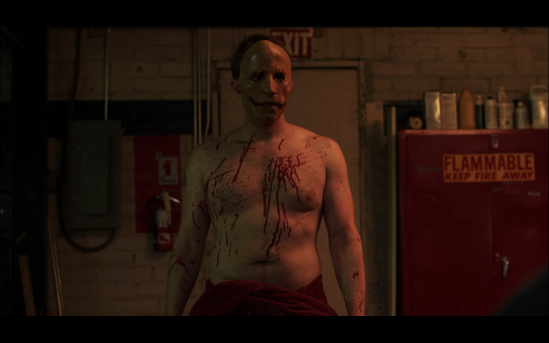
Jake Taylor and, the uncanny Zoe Saldana lookalike, Atala Arce, star in their first principle roles as a seemingly normal husband and wife, Chuck and Liv, who are introduced into the initial beginnings of date night that turns into a stay-at-home night of relationship bliss, but as the story progresses, even before the psychotic pizza boy’s entrance into their lives, setting off a string of deadly incidents, a latent secret itches within them as if toiling an escape plan from a previous unsavory life connected by the unexplained red spade symbol tattooed on both of their bodies.  Ambiguity fills the air between the mysterious tattoo and Taylor and Arce’s sanctum mind and side-eyed performances that convey very little of their unspoken plight and reveal very little about their existing purpose in an organization comprised of odd, but dangerous, jobs and dubiously offbeat and clandestine characters.  However, the face of “Chop Chop” draws an intense paroxysm of eye popping curiosity from the character actor David Harper (“Sick Boy”) in a dual performance as Teddy, the head chopping pizza delivery man, and Teddy’s mute twin brother who wields a samurai sword with a glaring look conveying malevolence.  Harper’s distinct face becomes transfixing when the scarred skin and bedecked with silvery braced teeth jut out from the bowed lips of a sinister smile.  To continue the trend of eccentric, quite rememberable, dark characters, Mikael Mattsson (“Scariest Night of Your Life”) and Nicholas Correnti contribute warped opposition encased inside an intermittent individual of horrid killer instincts reinforcing the already loaded with tension thriller.   “Chop Chop” rounds out with Jeremy Jordan, James McCabe (“Drifter”), Natasha Missick, and Lizzie Chaplin to wring Liv and Chuck’s out, whatever that might be from, even more life-and-death.

“Chop Chop’s” immensely cryptic diagram tones more evocatively by the uniquely rich characters planted from moment to moment inside Liv and Chuck’s inescapable conundrum of cascading misadventures.  Whereas Patel and Ericksen scribe persona diversity that’s interlinked to the fermenting innards of the scene, these characters would not be as fruitful if not exuberated by the actors who portray them, instilling a symbiotic coexistence of selling viperous rouges. Mysterious elements don’t solely lie with the veiled married couple, but also with Terry and his brother who are said, and is shown to an extent, to have powers with the abilities to walk through walls and be clairvoyant; yet, cliff notes of the beyond elemental are nixed and the omission of faculty talents are obliquely positive.  Where the characters flourish in a cesspool of strange and usual criminal activity, the story steps back as a murkier shadow game that’s about as translucent as pea soup and while understanding Liv and Chuck’s more exact role in the whole scheme of events isn’t a complete necessity, Patel and Ericksen’s narrative shell loses the cohesive glue to hold and sustain everything in into a diatonic cadence to the end.  Viewers will be kind of left stuck on the precipice by the finale led up by a perpetual tease of haphazard affairs thinly connected by one inexplicable common source that was surrounded by spies, murderers, and a malicious carcass disposer.  Evading a near total fumbling of the story, “Chop Chop” whips up fresh, new characters for the fray scattered throughout the playing field, keeping the loosely lassoed narrative structure from disastrously crumbling down into hollowed heap.

Ding, Dong! Pizza’s here! “Chop Chop” is a deliciously devilish dish from newcomer Rony Patel, landing onto Digital HD and Cable VOD on October 20th to rent or own on Amazon, iTunes, Comcast, Spectrum, Vudu and more, distributed by Kamikaze Dogfight in partnership with Gravitas Ventures. Since a digital screener was reviewed, critiquing the A/V aspects will not be covered. There was also no bonus material available and no bonus scenes during or after the credits. The cinematography scenes from Ryan Emanuel and Carter Fawcett produce striking setups that immediately dictate an artistry of vest-pocket anarchy that stick out gorgeously from the more darker laden respite between meetups. The English audio mix entangles the dialogue into murky territories underneath the swathed action, creating minor clarity issues to chase when trying to understand Liv and Chuck’s subdued spats that are telling of who they really are in “Chop Chop’s” lethal, but still trippy, Alice in Wonderland variation. Keep an eye on Rony Patel’s future cinematic endeavors as the young filmmaker’s tenebrous thriller, “Chop Chop,” has a meticulous sound design and a marvelously simple flare for character prototypes that energizes the rough enigmatic mystery.