A Pact Plans EVIL Revenge on Crime Fighting Heroes! “Royal Warriors” reviewed! (88 Films / Blu-ray)

“Royal Warriors,” a Revenge Tale, Now on Blu-ray from 88 Films!

Hong Kong police inspector boards a Hong Kong bound plane on return from her vacationing in Japan.  She meets Michael Wong, the plane’s air marshal, as well as her across the aisle seat mate, Japanese native, Yamamoto, a retired cop returning to Hong Kong to retrieve his wife and daughter and retreat back to Japan to start their new life.  Also on the plane, an escorted criminal being extradited to Japan for prosecution.  When a criminal accomplice takes the plane at gunpoint, Michele, Michael, and Yamamoto spring into action and thwart an aero catastrophe with the two terrorists dead.  After celebrating their success of saving many lives, the heroic trio begin to depart their separate ways when suddenly Yamamoto’s car explodes with his wife and daughter inside.  The assassination attempt puts a target on the backs of all three of them as two war veterans swear vengeance for their slain combat brothers from the airplane hijacking.

“Royal Warriors,” also known in other parts of the world as “In the Line of Duty,” “Ultra Force,” and “Police Assassin,” is the 1986 Hong Kong police action-thriller from “Web of Deception” director and “Once Upon a Time in China” director of photography, David Chung.  Stephen Chow’s regular screenwriter Kan-Cheung Tsang, who penned Chow’s “Kung Fu Hustle” and “Shaolin Soccer,” as well as “Magic Cop” and “Intruder,” reteams with Chung on their sophomore collaboration following the comedic-crime film “It’s a Drink!  It’s a Bomb!” starring the Hong Kong humorist John Sham, and a denotes a shared three-way perspective of protagonist principals while simultaneously providing sympathetic seedlings for the principal antagonists who though are coming wrongdoings and murdering up a storm of people, a wartime conflict bond between them holds them a higher level of honor between close brothers in arms.  Dickson Poon and D&B Films produce the explosive and hard hitting with prejudice venture with John Sham (Remember him from earlier?) and Yiu-Ying Chan, serving as associate producer.

Michelle Yeoh plays Michelle Yip, the level-headed chopsocky cop returning from some rest and relaxation only to wind up on a dish best served cold “Royral Warriors” for Yeoh, who then under the less recognizable moniker Michelle Khan, is the risk-it-all action film for the actress still in the earlier days of her what would be a prolific international career.  Her breakout hit “Yes, Madam,” saw both Yeoh and also then newcomer Cynthia Rothrock punch and kick into silverscreen success as unlikely onscreen partners to take down a crime syndicate.  In the Yeoh’s next film, she rides solo but only in the actress category, being a third of the good guys, yet holding her own as a strong female, lead between another prolific Asian cinema actor Michael Wong (“Tiger Cage III,” “Dream Killer”) playing essentially himself as Michael Wong (not a typo), the plane air marshal turned love sick puppy for Hong Kong’s tough cop Michelle Yip, and yet another prolific Asian actor whose career in Japanese films started well before Yeoh and Wong and has been rising internationally amongst the ranks of American cinema in Hiroyuki Sanada (“Sunshine,” “Mortal Kombat”) playing retired officer Yamamoto, a revenge-seeking justifier on those responsible for killing his family.  The level of how these three come together in a post-incident instantaneous bond borders an idealistic way of an extreme shared experience.  Yeoh and Sanada offer a cool, collective approach with degrees of vindictive separation with a layer of compassion thinly in between with Wong providing calculated lighthearted measures of chasing Yip with infatuated eyes to break any kind of monotonous, stagnant composure between the other two, yet they’re seemingly different lives, connected ever so vaguely by being around law enforcement one way or another, doesn’t seem to thwart an instant relationship immediately after the plan incident.  What’s also odd, especially with Yamaoto, is there is more background to the villains of the story than there is with him, providing rewarding elements for reason why the two men are hunting down Yeoh, Wong, and Yamamoto and seeking deadly revenge.  Ying Bai, Wait Lam, Hing-Yin Kam, and Michael Chan Wait-Man are the pact-making, behind-enemy-lines soldiers of some unknown war from long ago who neither one of them will turn their back on a combat brother in need.  Through a series of none linear flashbacks, a union of honor between them is made and while respectable and moral during war, that pact turns rotten overtime outside the context of global conflict, suggesting ever-so-lightly toward a combat shock issue between the four men that builds a bit of sympathy for them even though blowing up a mother and child and shooting to shreds a whole lot of nightclub patrons in their misguided revenge runs ice through their veins.  Peter Yamamoto wears his sleeve on his shoulder and there is this uncertainty with his character, and his wife too, that something is amiss, creating a tension that goes unfounded and sticks out.  “Royal Warriors” rounds out the cast with Kenneth Tsang, Siu-Ming Lau, Jing Chen, Reiko Niwa and Eddie Maher.

As part of the In the Line of Duy series, a strict criterion needs to be met:  Police Action, check.  Martial Arts, check.  A Level of High Intensity, check.  And a Female Heroine, check.  “Royal Warriors” meets and exceeds the bar with another bar, a no holds bar, of spectacular stunt work done by the Hong Kong standard way of action now, think later which looks phenomenal on camera and the resulting footage.  Hoi Mang’s martial arts choreography showcases a fast-striking combinations that cut traditional sparring with melee improvisation dependent on the surroundings, moving the action left-to-right, top-to-bottom by never staying in the same place and expanding the field of play with collateral damage of bystanders and family.  A couple of components are missed between that focused innocence and whiplash of violence.  For example, the playfully amorous affections between two of the characters are not poignantly shattered like precious stained glass when one is suddenly offed.  There are other examples of once a downspin cataclysm occurs, the aftershock of loss and change does not rear its ugly head.  “Royal Warriors” just pushes forth, continuing pursuit, in a rage of retribution and righteousness. 
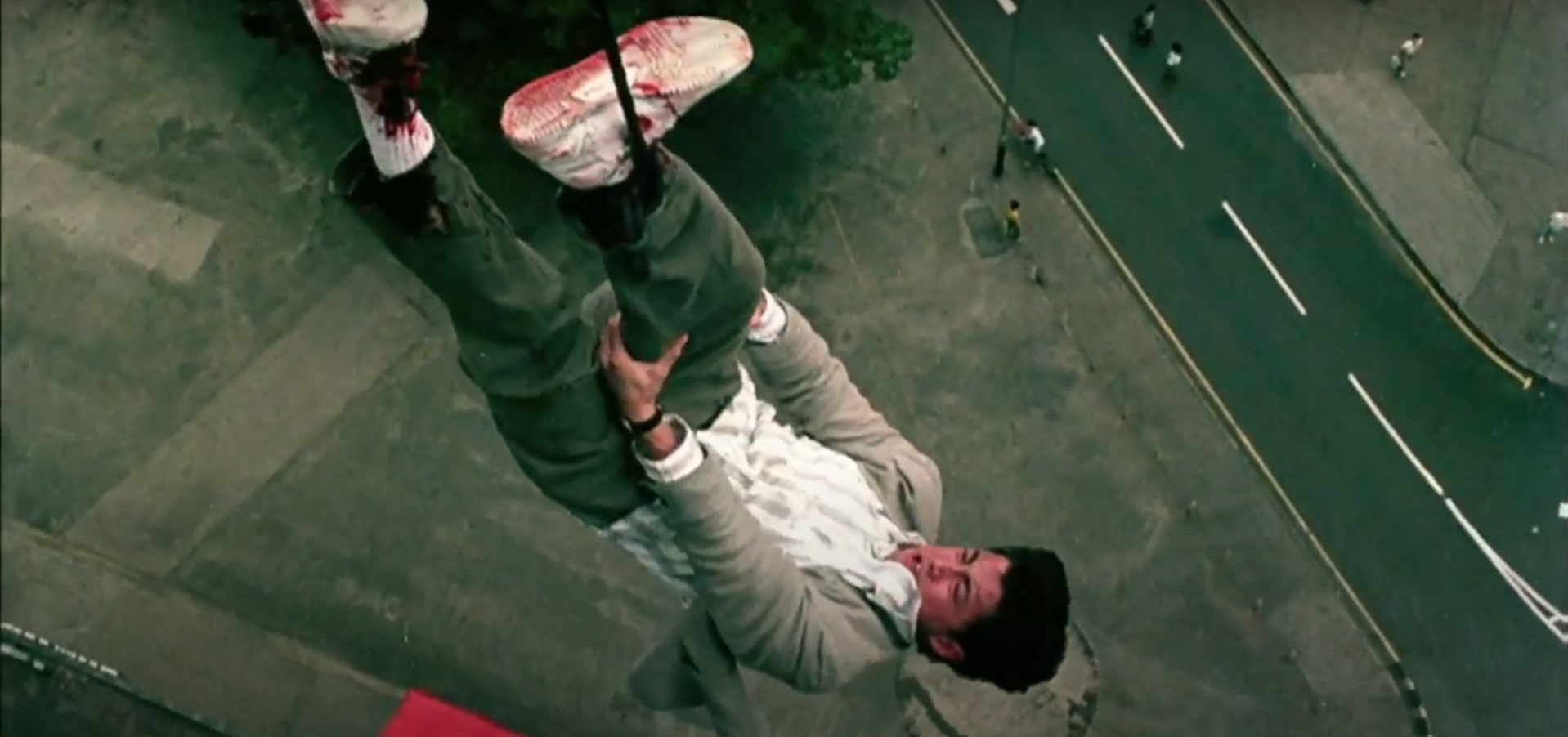
88 Films releases “Royal Warriors” onto an AVC encoded, 1080p high definition, BD50, presented in the film’s original widescreen aspect ratio of 1.85:1.  If you own the “In the Line of Duty” four film boxset, the version in the boxset contains the same transfer as this standalone, standard version that stuns with a new 2K restoration from the original 35mm print.  When I say this restoration stuns, I mean it.  A clean-cut natural gain, color balanced saturation, and with all the detail trimmings laud 88 Films’ work, as such as with the rest of their higher definition catalogue in the older Asian film market.  Range of atmospherics challenge with a different lighting scheme and mise-en-scene cinematography, such as the pink and purple warmth of a nightclub glow or the brilliantly lit restaurant ferry boat.  Skin and texture tones cater to a slight darker pastel but is consistent through-and-through without appearing to unnatural.  The restoration does have a positive to a fault, revealing stunt equipment during the fast-paced fighting, such as the exterior stone ground turning bouncy with creases when Yeoh vault kicks one of the Japanese yakuza members to the ground.  The release comes with four, count’em four, audio tracks:  a Cantonese DTS-HD 2.0 mono theatrical mix, a Cantonese DTS-HD 2.0 alternate mix, an English dub DTS-HD 2.0, and an English dub DTS-HD 5.1.  Of course, I go with the theatrical mix to comply with the original fidelity as much as possible with any films using ADR for an immersive experience within the original, intended language.  the 2.0 mix keeps a midlevel management of the voluminous aspects to bombastic range but never muddles or mutes the tracks.  Dialogue comes out clear with a microscopic static lingering way deep in the sublayer but, again, has negligible effect on the mix.  Special features content includes an audio commentary by Hong Kong film expert Frank Djeng, missing airplane inserts which are spliced out shots of an inflight plane exterior, and the Cantonese and English trailers.  The standard edition comes pretty standard but does feature the new character compilation artwork of Sean Longmore on the front cover with the reversible sleeve featuring the original Hong Kong poster.  The disc is individually pressed with Michelle Yeoh doing what she does best in most of her films, kick butt.  There are no inserts or other tangible bonus content.  88 Films’ North American release comes with a region A encoded playback, not rated, and has a runtime of 96 minutes.

Last Rites: 88 Films’ “Royal Warriors” Blu-ray release captures Hong Kong cinema impeccably with monumental stunts, hard-boiled police work, and permeates with color, detail, and a cleanly, discernible audio mix. In the Line of Duty, “Royal Warriors” is the first, and foremost, cop crusading caper that began it all.

“Royal Warriors,” a Revenge Tale, Now on Blu-ray from 88 Films!

Reap the EVILS You Sow. “Wired Shut” reviewed! (101 Films / DVD)

The failings of a once famed novelist, Reed Rodney, have come calling after a horrific car accident leaves Reed with reconstructive surgery and his mouth wired shut.  Stuck in remote mountain home, sipping pain meds through a straw and hitting terrible writer’s block after the critically trashed last novel, fortune and distinction never seemed so lonely until his estranged daughter, Emmy, shows up at his front door, looking to spend some time with him before going to school abroad.  Their hoary embattled relationship, built on alcoholism, lies, and abuse, urges Reed for a change of heart, willing to reconnect with Emmy by any way necessary, even if that means being a punching bag for her bottled up emotional outpourings.  When an unexpected intruder exposes a callous secret and lives are at stake, Reed and Emmy must rely on each other to survive a twisted prowler’s sadistic games. 

“Wired Shut” is the teeth-clenching, family quarrelling, sociopathic surviving inaugural full-length feature from Vancouver born director Alexander Sharp.  The home-invasion thriller too hails from Vancouver, Canada with an old-fashion tale of an inside job story co-written by Sharp and the director’s steady collaborator Peter Malone Elliott in which the project is also the first full-length script for the two writers.  “Wired Shut” houses a single location with a small cast but indulges varying levels of crazy and a good amount of bloodshed initially pie-eyed by the immense build up of downtrodden characters.  Singed family relations, the ebb and flow of trust, and the untangling of an ugly knot to retether a stronger bond becomes the parallel of reconnecting in this GoFundMe crowdfunded film under Lakehouse Productions and Alexander Sharp’s Sharpy Films presented by Motion Picture Exchange or MPX.

In a role where you have to keep your trap shut at all times because you’re playing a former self-centered rake who crashed his Lamborghini and had to have your mouth wired shut, Blake Stadel (“Rise of the Damned”) has one of the easiest parts in all of move making history.  Thank about it.  Zero lines of dialogue, you’re feigning an ego that is as shattered as your character’s jaw, and you write or type if you have to communicate.  Now, I’m not belittling Stadel’s once famous novelist, Reed Rodney, as the actor has to absorb the pity, the verbal abuse, and the overall confinement resulted by his injury as a sort of surrender to unfortunate happenstance.  Reed’s moment of life-altering clarity came pre-introduction when crashing the Lambo that left him vulnerable and alone, two bad, pre-depression dispositions of mind and being.  Across the table stews the stark opposite with Reed’s daughter Emmy, played by Alexander Sharp’s sister, Natalie Sharp (“Baby Monitor Murders”).  Pent up with anger and seething with intent, Emmy is executed with these qualities with perfection by Sharp.  However, Emmy extinguishes her fiery eyed hate too quickly in the fate upturning twist that creates a dubious bubble around her and not in a good way.  Emmy’s defining moment of clarity is weakly pawned off just for her and her dad to have a slither of reconnection in a breakneck transition without any struggle or sacrifice to change her mind.  Her blurry change of heart quickly becomes moot by Behtash Fazlaili’s (“The Evil In Us”) unhinged performance as Emmy’s delinquent boyfriend, Preston.  Preston eclipses the entire father and daughter dynamic with a clichéd villain by monologuing and squandering wasted opportunities to end it all and getaway scot-free.  Fazlaili’s performance also doesn’t inspire terror or much of anything at all except for frustration with the cavalier, walk-on act that’s supposedly a mentally broken man fallen to and reshaped by life’s hard knocks.  What’s on screen is Joker-esque mush relating little backstory that drives him to scheme and to be completely off his rocker whereas, in contrast, we know what motivates Emmy and we know what motivates Reed.

The slow burn of “Wired Shut’s” first two acts attempts to humanize Reed as a dejected and alone with Emmy sparking life into an object he can now be fixated on to mend his meaningless, post-accident existence, but Emmy, herself, lugs her own daddy-issue baggage giving way for the two to buttheads in exacting their feelings upon one another.  Sharp fishes for sympathy but keeps loose with expressing Reed and Emmy’s contentious relationship; a relationship that truly never existed with an alcoholic Reed’s persona no grata behavior around Emmy’s mother and her that extends his jet setting lifestyle with the next mistress.  Though loose, you can see both stand and the foreseeable twist coming because of it in an unsurprising turn of events.  What is surprising is Preston’s sudden Jekyll and Hyde as if Reed’s salivated score is Sharp’s theme that for the love of money is the root of all evil.  The theme is peddled and not exactly discerned in Fazlaili’s character who’s more concerned with the cat and mouse game of unbelievable hilarity.  Part of the absurdity has to do with Reed’s three story house with a built-in elevator and if you’ve ever ridden an in-home elevator, the cramped, smaller versions of a regular Otis are slow as Hell dripping with molasses.  Yet, somehow, Reed and Emmy happen to beat Preston down a meager two stories with the push of a button while Preston stops to take an injury breather at the third story landing.  Getting in the elevator should have been easy pickings when exiting, but in entertainment for some, keeping the audience attentive is pinnacle even if that means sacrificing the story for cheap thrills by stretching the realism just a little bit.

“Wired Shut” will leave you speechless with a pedestrian anticlimax after watching the DVD. Distributed by the United Kingdom’s 101 Films, the region 2, PAL encoded, 91 minute thriller is presented in an anamorphic widescreen, 2.39:1 aspect ratio on a DVD5 and thoroughly soaked in a sea of tenebrous blue tint as the first, many firsts for these filmmakers, feature length cinematography for Martin Taube. Crystalized sleek and fresh with a modern, straight-edge finish, Taube main objective centers around personal space and to detox comfort with the strain and psychopathy, using close ups and up or down angling to exact an uneasy position during strenuous moments. The continuous tinting from start to finish could have been done without as it chokes the story in nearly an unviewable consumption. The English language Dolby Digital Stereo AC3, 5.1 surround sound mix, is a LFE sound cannon with a bass-heavy rattling industrial soundtrack by Oswald Dehnert and Rayshaun Thompson. The soundtrack’s sonorous tone crackles at the format’s compression, leaving granulated pops when the volume levels peak, which is really surprising for today’s digital and format spec cautious handling. Dialogue levels render nice and clear and the sound design’s not bad either with a complex range of soundbites inside a single setting, especially when Reed pops the wires when forcing open his mouth. The DVD is bare bones with special feature and the DVD cover itself is poorly misleading with a hooded figuring, standing backlit in the woods, with a large blade in hand. There is no such slasher figure in the movie. “Wired Shut” is not a slasher. I repeat. Not a slasher. “Wired Shut” is rated 15 for strong threat (gun pointing, knife to the throat), injury detail (stabbing, slicing, and surgical fastening coming undone), and language (Yes, foul language is present). As far as home invasion films go, “Wired Shut” says nothing new about the subgenre, but offers an intriguing ingredient of incapability and the strength to push through to the other side with the if there’s a will, there’s a way mentality underneath intruder chaos.

Early Bill Paxton EVIL in “Mortuary” reviewed! (MVD Visual / Blu-ray)

The tragic swimming pool drowning of Dr. Parsons might not have been an accident as determined by the police.  At least that is what his daughter, Christie, believes and she is for certain her mother has some involvement in the so called accident.  Plagued with nightmares followed by a stint of sleepwalking a month after her father’s untimely demise, Christie tries to maintain a semi normal life as a high school student romantically involved with boyfriend Greg Stevens.  Meanwhile, Greg’s best friend disappears after the two trespass onto local mortician Hank Andrews’s storage warehouse.  Christie and Greg unwittingly become embroiled into sinister intent by a masked and caped ghoulish killer stabbing victims with a detached embalming drain tube and at the center of it all is Hank Andrews and his son Paul’s family morgue that processes and possesses all the dead’s secrets. 

Before Wes Craven’s “Scream” mega-franchise turned caped killers revolutionary cool with meta-crafting horror tropes of the genre slasher, there was the little known “Mortuary” that perhaps paved just a slab of keystone for the Ghostface Killer who has become the face of slasher films for more than 20 years, much like Jason Voorhees or Michael Myers back in the 1980s and early 90s.  Written and directed by the Baghdad born filmmaker, Hikmet Labib Avedis, credited under the more westernized stage name of Howard Avedis, the 1983 film nearly had all the hallmarks of a peculiar macabre dance that skated around the slasher sphere.  “Mortuary” had seances, pagan rituals, a shrouded murderer, and, of course, the embalming of dead, naked bodies that are the inevitable, natural, mortality reminding entities in movies regarding morgues.  The late director, who passed away in 2017, cowrote the film with wife, producer, and actress Marlene Schmidt who had a role in every single piece of his body of work.  “Mortuary” was self-produce by the husband and wife filmmakers under their Hickmar Productions company and by grindhouse producer Edward L. Montoro (“Beyond the Door”).

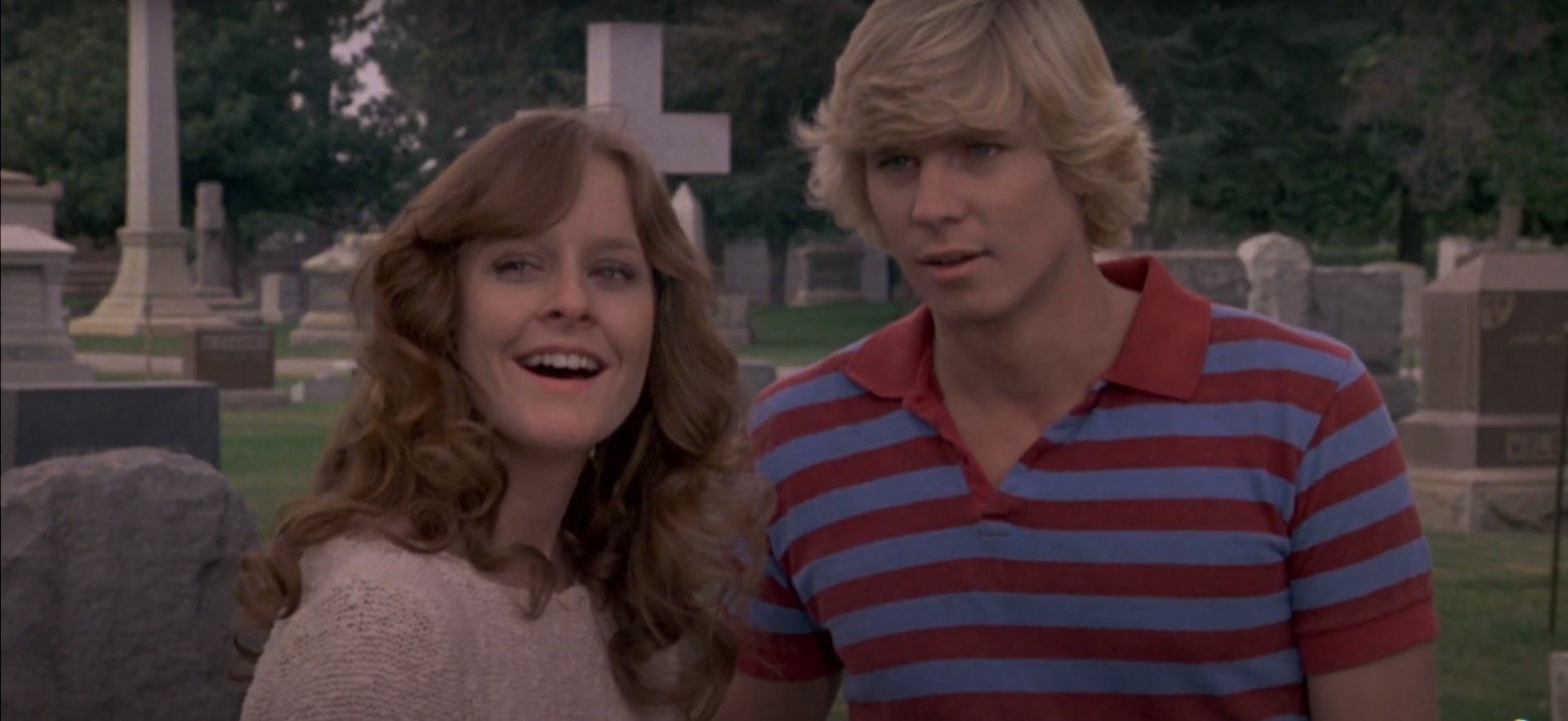
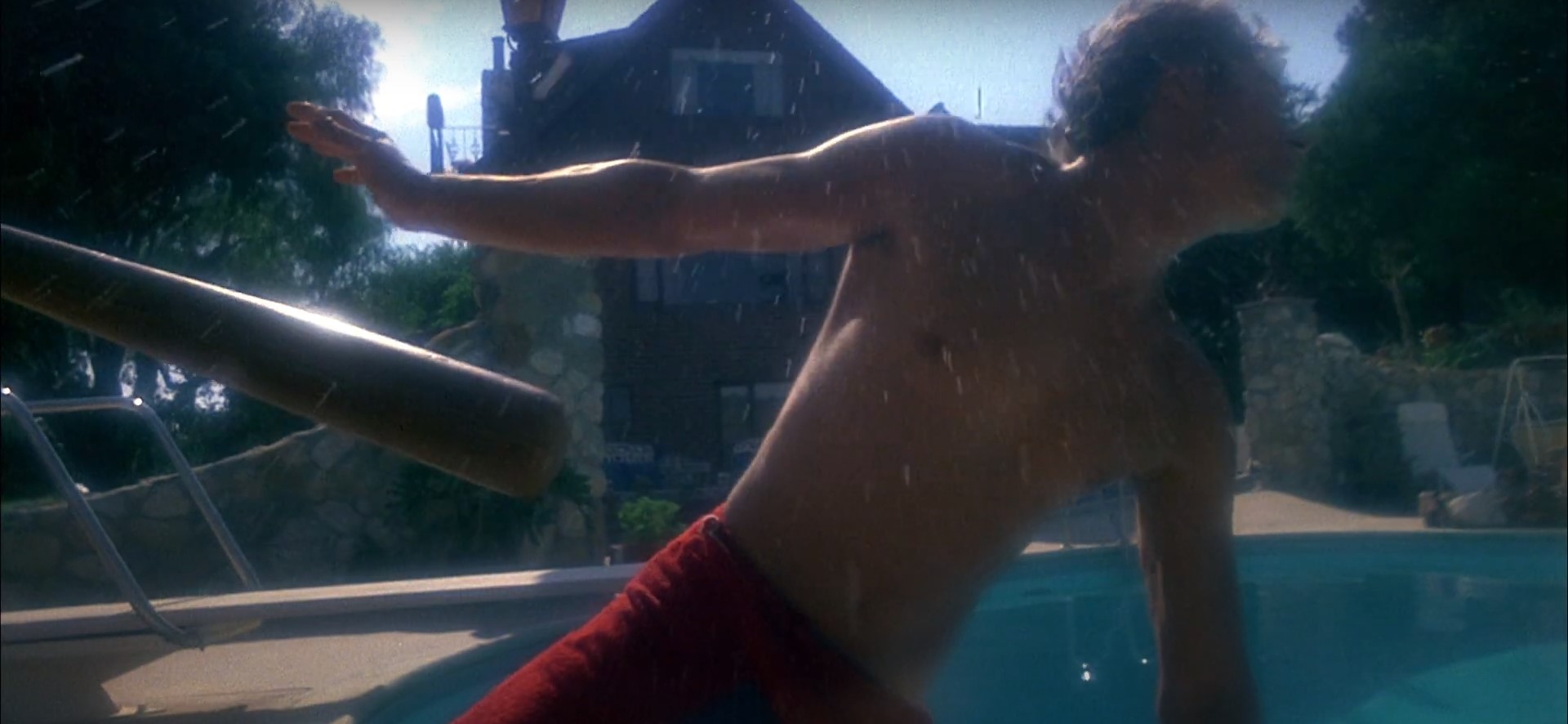
Though the post-credit opening scenes begins unscrupulous enough with Greg Stevens, played by television soap opera star David Wysocki whose credited as David Wallace, and his best friend Josh (Denis Mandel) stealing tires from Josh’s ex-employer, morgue owner Hank Andrews, the late “Day of the Animals” and “Pieces’s” Christopher George’s last cinematic role, because of being fired without being paid for his services, “Mortuary” inconspicuously moves from Stevens’ infringing on local law to surround itself more aligned with Stevens’ girlfriend Christie Parsons who feels more like a backseat character upon introduction.  Yet in a flurry of exposition with her mother, Christie, who is played by “Mom” actress Mary Beth McDonough, circles back and ties into the opening credit scenes of an unknown man being bashed over the head with a baseball bat and falling into his pool.  We learn that the man is Christie’s father whose death has been rule an accident (no evidence of baseball bat related injuries? Was evidence collecting really that low-tech in the 1980s?), but Christie begs to differ as she point blank accuses her mother, Christopher George’s life co-star Lynda Day George, being involved in his poolside death.   While performances statically hover inside the wheelhouse of teen horror with Greg and Christie seemingly unaffected by the mysterious incidents happening all around them until someone literally is grisly murdered in their adjacent bedroom, a fresh-faced Bill Paxton (“Frailty”) inevitably steals the show with this enormous presence on screen as Paul Andrews, the town’s mortician loony son working for his father as an embalmer.  Paxton’s zany act borders “Mortuary” as either a diverse trope horror with an awkward outlier character stuff into the eclectic mix or a seriously unserious bluff of being a serious horror film – see what I did there?  Paul listens to Mozart on vinyl, has an obsession for Christie, and likes to prance and skip through the graveyard as a son broken by his mother’s unhinged suicide.  “Mortuary” rounds out with Curt Ayers (“Zapped!”), stuntwoman Donna Garrett (“The Puppet Masters”), Greg Kaye (“They’re Playing With Fire”), Alvy Moore (“Intruder”), stuntman Danny Rogers, Marlene Schmidt, and Bill Conklin as a walking contradiction as a beach town sheriff wearing an unabashed cowboy hat like a sorely out of place rootin’-tootin’ lawman from the West complete with country draw lingo. Also – don’t miss the bad nude body double used for McDonough when Christie is lying on the morgue slab.

Now, I’m not saying “Mortuary” is the sole inspirational seed that sowed the way for the “Scream” franchise, as I’m sure many, many other iconic classics inspired Kevin Williamson, but, in my humble opinion as an aficionado about the genre components and how they’re all connected by a few or many degrees of separation, “Mortuary’s” villain could be the long, lost ancestral sperm donor responsible for the origins of Ghostface.  The purposeful movements and actions align very closely in a parallel of deranged defiance and floaty black and white costumes.  However, “Scream” is just packaged nicer as “Mortuary” continuously drips all over the place like a three scoop ice cream cone on a hot summer day.  Containing Avedis’s arc on Christie was nearly impossible as each act jumps and focuses on someone entirely different while also exposing the killer blatantly without even trying to misdirect or repel any kind of suspicion.  It was as if Avedis and Schmidt swung for the fences with a convoluted giallo mystery plot but couldn’t figure out how to build that into the narrative without drawing from and drowning in exposition and that’s how the cards came crashing down by unfolding with talking head pivotal plot points that steered to a rather quick, yet pleasant, climatic head of a total mental meltdown that’s much more cuckoo than Billy Loomis and Stu Macher will ever be. 

If you didn’t score a copy of Scorpion Releasing’s limited edition release of “Mortuary” on Blu-ray, then sing the praises of second chances with this Scorpion Releasing Blu-ray reissue through the MVD Visual Rewind Collection line. The all region release is presented in a high definition, 1080p, widescreen 1.78:1 aspect ratio of the Scorpion Releasing AVC encoded transfer on a BD25. Quality-wise, the release delivers the perhaps the full potential of a cleaned up 35 mm restore with no sign of cropping, edge enhancing, and a healthy amount of good grain, but there are noticeable gaffes with select scenes that seemed to have missed or left out of the restoration all together, reverting back to the rough, untouched image. Coloring, skin and objects in the mise-en-scene, come out lively, naturally, and without a flutter of instability with transfer damage at a minimum. Probably the most surprising is the original 2.0 mono LPCM track. The English language mix does the job without climbing the audiophile corporate latter, leaving in the wake a soft dialogue that’s a struggle to get through if you’re not wearing headphones. Depth seems a little slim, but the range keeps progressing nicely that often feeds into the late John Cacavas score. Cacavas operatic film score is bigger than the movie itself, often grandiose the Gary Graver one-note cinematography. The overexposed ethereal flashback has slapped redundant fatigue plastered all over it but, then again, the film is from the 80’s. Option English subtitles are available. Special features include only an interview with John Cacavas from 2012, from the original Scorpion Releasing print. Two upsides to the MVD Visual release are the cover art mini-poster tucked inside the casing and the added cardboard slip cover that resembles a tattered VHS rental tape slip box complete with a faded Movie Melt yellow caution sticker, a Be Kind, Remind sphere sticker, and a Rated R decal. If you’re a big Bill Paxton fan, “Mortuary” reveals another shade of talent from the late actor. Other than that, the Howard Avedis production often haphazardly stumbles bowleggedly to a giallo-errific-type ending made in America.

Crawldaddy and Her Two EVIL, Incestual Kids in “Skinned Alive” reviewed! (Tempe Digital and Makeflix / Blu-ray UE)


Crawldaddy and her two children, Violet and Phink, are psychopathic makers and sellers of fine leather apparel right off the backs of, well, literally ripped right off the fleshy backs of anyone they come across! When their van breaks down in a small, dumpy, low-bred Ohio town, Crawldaddy is forced to play nice with the town’s only mechanic, Tom, who offers a complete line of unreciprocated hospitality to the strange out-of-towners, but that doesn’t stop her and her children from committing slice and dicing of the local residents while bunkering in Tom and wife’s basement spare room. When Tom’s neighbor, Paul, an alcohol abusing ex-cop on the edge as a result of a brutal divorce, senses trouble and discovers Crawldaddy’s den of skin, the quiet small town explodes with bullets and blades in a macabre showdown.

Forget the Firefly family that has brought backwoods kin-in-arms killers to the masses in vogue fashion. Otis, Baby, and Captain Spaulding have nothing on Crawldaddy’s foul-mouth, foul-smelling skinner family who ranks as the top trash, living the nomad lifestyle with all the depraved trimmings of the criminally insane. Written and directed by Jon Killough, who after working on J.K. Bookwalter’s “The Dead Next Door” and “Robot Ninja” in multi-hat roles, “Skinned Alive” was bestowed a greenlight by Bookwalter to explore the creative side of Killough’s vile and offensive laden hillbilly horror that was released in 1990, before that very subgenre was coined and monetized years later. David DeCoutea, who envisioned the eviscerated virtuoso of the gruesome filmmaking talents from Todd Sheets to J.R. Bookwalter, served as executive producer and Bookwalter’s The Tempe Suburban Company tackled “Skinned Alive” with all the ingenious bloody pizzazz and outlandish death set financier and production company while filming the project in Ohio.

Since The Suburban Tempe Company is a tight-knit production company, familiar faces from Bookwalter’s previous films have been cast, beginning with Paul Hickox, the ex-cop with a drinking and ex-wife problem, played by Floyd Ewing Jr. The Hickox character crosses over from “Robot Ninja” into “Skinned Alive,” but exhibited in a dichotomous life position. While Ewing nails being a man dragged through the pig slop of divorce, Paul feels cut short with the amount of buildup written for the character that’s centered around ex-wife woes of losing his house and kids, depressed into drinking, and has to deal with a sleazy lawyer whose also litigating his former wife in a court of a sex. However, “Skinned Alive” is all about the bad guys.  In the majority of horror films, the bad guys are always the most interesting because of their rancid flavored persona and for our culturally-collective love of the eccentric, the offbeat, and the grim of villainy.  Crawldaddy embodies those despicable characteristics without so much of breaking a sweat with a abhorrent-welcoming performance by the late Mary Jackson.  Jackson, who went on later to work Bookwalter again in a minor role in “Ozone,” is transformed from a singing beauty to a basket case of a wretched, wheelchair bound hag, unearthing her uncouth Hyde at the flip of a switch.  Jackson is complimented by Susan Rothacker as the alluring-but-deadly Violent, a roll filled in the last minute by the film’s makeup artist when things didn’t work with Jackson’s daughter Lorie, and the one and only Scott Spiegel as Phink.  The energetic Spiegel has been a part of the longstanding Sam Raimi entourage, having minor roles in Raimi films, such as “The Evil Dead,” “Darkman,” and “Drag Me to Hell,” and when “Skinned Alive” became in need of a Phink, Spiegel may have just saved the film by his presence alone as the “Intruder” and “Dusk Till Dawn 2:  Texas Blood Money” director brings the manic ticks and callous charisma to Phink’s traits.  Rothacker ups the character dynamics with Phink as the pair’s love-hate relationship is a slap-stick of incest and homicidal cravings that fits right into the vile veneer of the story.  “Skinned Alive’s” cast rounds out with Lester Clark (“The Dead Next Door”), Barbara Katz-Norrod (“Kingdom of the Vampire”), Mike Shea (“Robot Ninja”), Mike Render (“Robot Ninia”), J.R. Bookwalter as a tortured Jehovah’s witness, and Jon Killough as an unlucky the hitchhiker.

As Killough’s indirect byproduct of Tobe Hooper’s “The Texas Chainsaw Massacre,” “Skinned Alive” is the skewed, bad dream version of the devious Sawyer family with heavy notes of black comedy chucked into the fold for an all-out odious assault on all fronts, but Killough’s first and only feature didn’t come out totally unscathed as a harmonious horror-comedy.  With little film stock left to shoot with and production controversial new scenes written by Killough and then altered by Bookwalter without consent, “Skinned Alive” became a rapid fire production of short shots compiled together that resulted in a choppy flow.  You could also discern which filmmaker wrote which dialogue in the filler scene between ex-cop Paul and his ex-wife with her sidepiece arrogant lawyer; Bookwalter adds witty, if not smart, dialogue to reinforce Paul’s degrading life while Killough’s dialogue for the rest of the feature is an expletive warzone without much of a strategy.  Both discourses work for the benefit “Skinned Alive,” but do cause a blatant, patchwork barrier between the conversing styles.  David Lange and Bill Morrison’s special effect makeup work is a complete continuation from “The Dead Next Door” and “Robot Ninja” of rendering gooey, gory visuals on a budget.  Sometimes, yes, you can see how unflattering the realism can be and easily securitize the flaws, but at the same time, the ingenuity trumps over cost and that elevates the effects beyond any dollar figure the film might cost.  That partial prosthetic of ripped flesh on Spiegel’s Phink when he’s hot in the face is one my favorite effects not only for the gruesome details, but for also its versatility.  It could easily be a bear claw swipe or a flesh eating bacteria, making the possibilities endless for Lange and Morrison.  Thirty-years later, “Skinned Alive” has preserved a rightful staunch cult following for it’s unparalleled grotesque veneer that will endure to linger for another 30 years plus thanks to technological advances and vehement filmmakers who are also filmic preservationist like J.R. Bookwalter.

Speaking of which, J.R. Bookwalter and his company, Tempe Digital, has painstakingly restored “Skinned Alive” and released it on a region free ultimate edition, dual-format Blu-ray/DVD, distributed by Makeflix.  The original 16mm A/B roll cut negative was scanned in 2K and is presented in the retained 1.33:1 aspect ratio.  The scan brought the transfer int a low-contrast in order to color correct and bring more life into the presentation from previous untouched versions and removed all of the white speckled dirt and scratches from nearly much of movie; a silver-lining made possible by COVID-19 quarantine that allotted the time to do so.   The color grading now has a much more vibrant appeal though slightly losing details from the high contrast with some of the more brilliant red glowing scenes in Tom and Whinnie’s basement.  Limited to 1000 pressings, “Skinned Alive,” the 30th Anniversary ultimate edition, by visuals alone, should be blipping frantically on any avid collector’s radar and sought by all genre aficionados.   The English 5.1 DTS-HD Master Audio surround sound stem from the DA-88 tape archives of the original 16-track audio masters and while much of the dialogue and musical score remained, a good chunk of the ambience and effects were rebuilt and remixed, defining a clearer, cleaner audio track presentation of balanced levels from all different file sets.  Aside from some small synchronization issues between the dialogue and the scenes, the range is pitch perfect and the depth is excellent.  There are optional English and Spanish subtitles included.  Bonus features, you say?  The ultimate edition has you covered with the BR disc one containing a 2020 commentary with writer/director Jon Killough and moderated by Tempe historian Ross Snyder of Saturn’s Core Audio and Video as well as a 2002 audio commentary with producer J.R. Bookwalter and makeup effects artist David Lange.  Other new material includes a 16 minute featurette entitled “Carving Up 30 Years of ‘Skinned Alive,'” featuring a number of interviews with the cast and crew recollecting good times on set, a remembering Mary Jackson featurette that includes Jackson’s son and daughter, among cast and crew, commemorating the Crawldaddy actress, an interview with Scott Spiegel, 2020 location tour, artwork and promotional gallery, behind the scenes gallery, production stills, and, my personal favorite, J.R. Bookwalter walking through the restoration process step-by-step giving insight on the time and effort into restoring the films such as “Skinned Alive.”  Disc 2, the DVD, includes a 2002 audio commentary with Doug Tilley and Moe Porne of The No-Budget Nightmares Podcast, the 1987 and 1988 “roommates” TV sitcom episode featuring the “Skinned Alive” cast and crew, the Joy Circuit “Love Turns to Darkness” music video, a making off featurette of “Skinned Alive,” behind the scenes, Camera and wardrobe tests, a short 2 minute segment about the 2002 remastering and the original DVD release trailer.  That’s not all!  Let’s not forget to mention the equally packed release package that includes a reversible wrap featuring original 1990 VHS artwork in the casing and new cover art by Alex Sarabia on the slip cover, plus an eight-page color booklet with liner notes by Ross Snyder.  The only thing missing is a soundtrack CD compact…wait, there is one!  Come September 18, the original motion picture soundtrack, featuring 29 tracks, will be released with scores composed and performed by J.R. Bookwalter, songs by Hang Dangle, Foxx, Virgil Pittman, Joy Circuit, Dave Jackson and Kenny Boyd, Seven Sez U, The Ninja Sequencers, and Willie and the Wagon Wheels.  This 2-disc set is the holy grail for die hard “Skinned Alive” fans who know and appreciate the unique, second to none hillbilly horror that’s flagrant on every level.

Pre-order the soundtrack!!! Click to go to Amazon.com