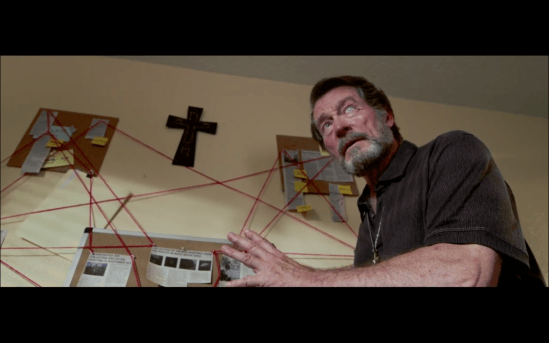
Evocation of EVIL in “The Girl In the Crawlspace” reviewed! (ITN Distribution / DVD)


Jill escapes from the grip of a kidnapping-serial killer who kept her confined in a crawlspace under the house. Her courage brings lethal justice to the captor when the local marshal shoots and kills him upon confrontation. Jill struggles to reintegrate back into her local community in the aftermath, sleeping unconfined in the outdoors and withdrawing herself for social interaction, including from her weekly role playing game with friends. When Kristen moves back into her hometown from college, she aims to set up her therapy practice to assist families impacted by the serial killer as well as Jill by special request from the marshal, but Kristen’s rocky relationship with her substance abusive, off-Hollywood screenwriting husband on the mend drags out Jill’s much needed treatment. With Jill and Kristen preoccupied, they’re oblivious to the concealed threat that plots the next terrorizing exploit of kidnapping and tormenting young, beautiful women.

From under the grubby wooden floorboards to the strategic folding table of a role playing game, “The Girl in the Crawlspace” is the Midwest direct-to-video suspense thriller that tackles post-traumatic stress and marital strife while submersed in a looming trail left by a notorious mass murderer, written and helmed by first time director John Oak Dalton. Dalton, who has penned several low-budget grindhouse titles over the last decade and half, including titles such as “Among Us,” “Sex Machine,” and “Jurassic Prey,” returns once again to the genre with the repercussions of Podunk psychopath upon small town America, filmed in Indiana and release in 2018 hitting the ground running with film festival circuits. Indie filmmaker Henrique Couto, schlock horror director of “Scarewaves” and “Marty Jenkins and the Vampire Bitches,” signs on as producer, stepping back from his usual productional duties, and letting an occasional collaborator Dalton to completely engulf himself as the omnipotent auteur. Midwest Film Ventures serves as the production company, shot in Farmland, Indiana.

Erin R. Ryan has continuously sustained a low level hover on the indie horror radar after taking her in Dustin Mill’s “Bath Salt Zombies,” based on the Miami incident based on a naked man eating someone’s face induced by being high on bath salts, and the gooey-gory body horror, “Skinless,” that’s also a Mills production. Ryan expands her portfolio outside physical horror with Jill, a traumatized recluse derived from her abduction and torture, as a subdued component that’s contrary to previous roles, but Ryan capitalizes the opportunity of a scared kitten, recoiling from public gatherings, and slowly and silently emerging back into society while recalling chilling moments as the story progresses. However, there’s difficult pinpointing the head lead as the protagonist roles are shared between Ryan and depicted married couple, a pair of more Henrique Couto casted actors, in Joni Durian and John Bradley Hambrick as Kristen and her husband, John. Between the three, chemistry clicks better than cooking meth in a chemist’s unsanctioned laboratory and offer ample contention without the attending killer’s presence hanging over the whole town’s head. Rounding out the remaining cast is Chelsi Kern (“Scarecrow Count”), Joe Kidd (“Ouija Room”), Jeff Kirkendall (“Sharkenstein”), Clifford Lowe (“Scarecrow County”), and re-introducing Tom Cherry as the good old boy town officer, Marshal Woody.

With a title like “The Girl in the Crawlspace,” I would be remiss if I didn’t say there were some expectations of bodily torture, psychological terror, and teeth-clinching tension when sitting down to watch. The hype was high considering the post-after-post amount of positivity for “The Girl in the Crawlspace” on my Twitter feed. The catchy name and optimistic comments provided real temptation, but Dalton steers in another direction, the what follows in the state of everlasting shock and the reliving of moments seared into your psyche. The direction wasn’t as expected, but that’s necessary a bad thing. “The Girl in the Crawlspace” is exposition heavy with considerable amount of movie referencing peppered with some current event topics, such as the brief mentioning of killing of migrant children, throughout and continuously wanders off point, strolling more into Kristen and John’s crumbling marriage. Jill, the supposed centerpiece of the story, feels more like an afterthought, despite being the “girl” in “The Girl in the Crawlspace.” The cantankerous marriage supposedly jeopardizes those personally involved in Jill’s well-being as John exploits Jill’s idiosyncratic experiences from being a captive by turning them into inspirational junk food for his fading screenwriting career, but the catalyst incident doesn’t stick, becoming more of a weak opening for a more pronounced return of Jill’s haunting past.

From ITN Distribution and Mill Creek Entertainment, “The Girl in the Crawlspace” lands onto a not rated DVD home video release. The single layer DVD is presented in a full frame widescreen of an 1.78:1 aspect ratio. In a framing sense, Henrique Couto’s cinematography distinctly places small town in a spectrum view that highlights the soybean fields and farms, the rustic brick infrastructures, and the simplicities of a relaxed, old-fashioned town, using some drone shots to expose the green belt greenery. For an indie feature, the agreeable bitrate has a frank, clear image despite some consistent overexposure that softens details, especially on faces in the outside scenes. The Dolby Digital stereo 2.0 mix has also agreeable dual channel output. Some of the dialogue scenes suffer through an echo, but for the majority, the lines have clarity and unobstructed by ambient layers or the soundtrack. The depth discloses some distant ambiguities, such as in a train shot that’s not rendered in the background as it should, but the amount of range is palatable. English SHD subtitles are available. The only bonus features available on the release are the theatrical trailer and an commentary with producer Henrique Couto and director John Oak Dalton regarding their history together and going through the shot techniques as well as touching upon the actors. The road to recovery is paved in nightmares, psychological terror, and Midwest psychopaths in “The Girl in the Crawlspace,” but pitches away from the principal concern that turns second fiddle to one struggling screenwriter’s difficult assimilation into rural life while simultaneously rethreading a floundering livelihood and a tattered marriage.

Own “The Girl in the Crawlspace” on DVD

Evil Aliens, Zombies, Vampires, Cannibals, and a Nun with Guns! “Savage Creatures” reviewed! (ITN Distribution / DVD)


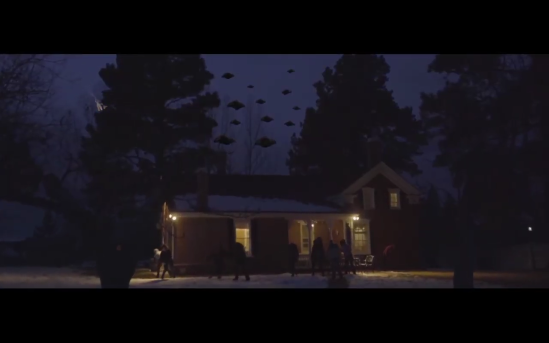
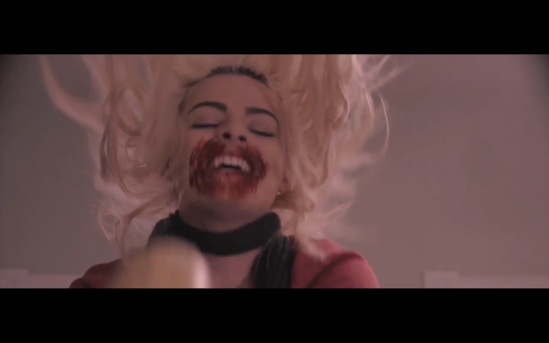
On God-fearing land, two young women drifters are shown compassion and hospitality by a religiously devout mother and son offering hot food, a shower, and a bed for the night. Their seemingly infallible generosity turns to violent deviancy as concealed motives of their cannibalism catches the women off guard that inevitably places the unsuspecting women literally on the chopping block, but the drifters are no ordinary, helpless prey but rather ancient vampires, wandering from one small town to the next, struggling to exist. Just when the bloodsuckers think the ordeal is over, a worldwide invasion of soul-sucking aliens aim to cleanse Earth of all inhabitants, turning those attacked by the beings into flesh-hungry crazies. Trapped inside the cannibals’ house, the vampires must save their human food source from completely being eradicated by an aggressive alien race with a conduit to possibly the Holy Father himself.

Talk about a full monty horror movie that has nearly everything but the kitchen sink! “Savage Creatures” is the 2020 released ambitious action-horror written and directed by Richard Lowry (“President Evil”) that serves up a platter of creativity ingenuity on a micro-budget while still outputting savagery, creatures, and an entertaining good time from start to finish. Lowry embodies inspired resourcefulness that reminisces the economically efficient horror credits of long time indie filmmaking entrepreneur Brett Piper (“Queen Crab”) and though serving as the filmmaker with many hats, composer, editor, director of photography, and visual effects, he also incorporates his own pleasurable schlocky devices as he shoots in the rocky rural regions of Pine Valley, Utah complete with isolated roads and mountainous views. The epically scaled “Savage Creatures” is a creature feature accomplished feat, try saying that ten times fast!

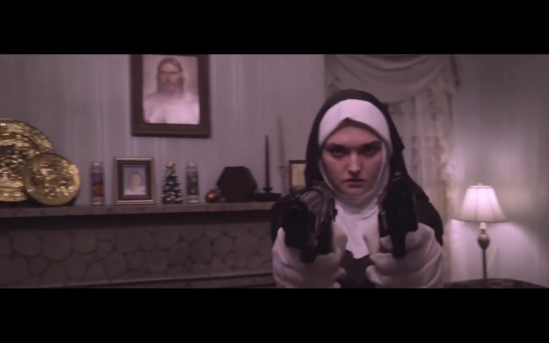
The two vampiric drifters, Rose and Ursula, serve as the story’s centralized characters played by Kelly Brook and Victoria Steadman respectively. Both actresses have worked with Lowry previously on his 2018 Armageddon-esque action-comedy, “Apocalypse Rising,” and familiar with his budgetary style, able to alleviate the pangs of severe funding limitations with some fundamentally respectable performances. Rose and Ursula are not only lovers, but lovers with a cavalier premise on life stemmed from the centuries of human evolving groundwork, shedding a light on questions that should be asked and pondered on in every day modern vampire story. The dynamic between Brook and Steadman strike the nerve sincerely with causal conversation, pressing upon their inevitable doom in between blowing off zombies heads and fragging flying aliens with crossbows as if they’re exacting some self-decompression through violence. Though Brook and Steadman are good and stable throughout, vet actor Greg Travis lands a the lauded performance of Father Cooper, a fanatical Irish priest on the run from the zombie horde. The “Humanoids from the Deep” and “Mortuary” actor goes full blown dogmatic with his theory of God being fed up with humanity and pulls off the extremely righteous and holy neurotic priest as an overboard affable character whose has to trust a couple of godless feminist vampires during apocalyptic mayhem. Rounding out the cast is Ryan Quinn Adams (“Before the Dark”), Cean Okada (“Bubba Ho-Tep”), and Kannon Smith as Sister Gigi, a mute nun with guns.

From the very beginning, “Savage Creatures” maintains a fiendish tempo of anti-heros and butchery. Even the soundtrack, though a relentless boor of stock action selection, plainly works to “Savage Creatures'” advantage one scene after another inside the scope of the sharp, periphery sublet moments to keep up with the breakneck pace. Lowdry’s sees little-to-no expositional sagging in the middle or on the bookends and diverts away from any hankering for a character story or background to fluff up worth-wild characters. With the exception of Rose and Ursula, who complain like boomers conversing upon reminiscing about the past on how easy times once were centuries ago to get away with murder before technology became an inconvenience, much of the cannibals, the priests and nun, and even the flying devil ay like aliens backstories don’t bubble to the surface. While typically these off the cuff details usually roll my eyes back into my skull to scour my brain for the minor moments in which I might have mistakenly missed something about a character backstory or just produce a hefty sigh of longing for more personal information on why this character does what they do, I found “Savage Creatures” uniquely isn’t symptomizing a distress of forgoing persona tell-all; instead, plays uncharacteristically to the obverse tune of an entertaining racket of head splitting, limb chopping, and with a hint of rampant gun akimbo.

Buyer beware! Don’t trust the cretinous DVD cover from ITN Distribution of appears to be Julian Sands from “Warlock” raging angrily with milky white eyes and standing over Cthulhu tentacles surrounding him in the foreground and silhouettes of bats are hovering over in front of a savior-esque crown moon in the background. Instead, trust your gut (or this review!) and see “Savage Creatures” on DVD home video presented in an anamorphic widescreen, 2.35:1 aspect ratio. Pine Valley, Utah never looked so picturesque in a clean transfer. The natural colors feel a bit faded and not as sharp that perhaps assists in blended Lowdry’s composited effects and practical creature design. The cabin night sequence has some noticeable banding, but isn’t a game changer. The English language Dolby Digital audio track is par for the course, running clean and clear dialogue, and satisfying a range of sounds. Depth’s tricky with Lowdry’s compositions that don’t hem neatly, especially when Rose and Ursula crossbow down aliens from a distance, the same cry of pain is utilized for each darted creatures, and the running stock soundtrack flutters in front and behind the gun play at times. DVD bonus material include a director commentary, behind-the-scenes with the actresses and crew, and a VFX breakdown, which I thought was neat to see how Lowdry layered his effects on a budget. Not listed as a bonus feature is the gag reel during the end credits. “Savage Creatures” enters 2020 as an all out brawl designed as a battle royal but with little bankroll; yet, director Richard Lowdry beats the odds, pinning out a win as the scathed champion of his latest apocalyptic caper!

“Savage Creatures” battle it out on DVD!

EVIL’s Brush Stroke of Genius in “Art of the Dead” reviewed!


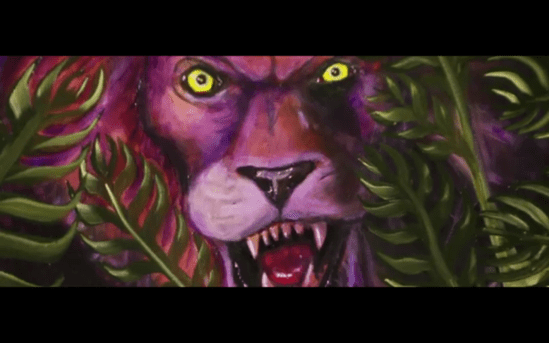
The Wilsons’ are the perfect portrait of a nice family; they’re wealthy but charitable and kind without exploiting the humility of others. However, when Dylan and Gina Wilson bid and win on the SinSational art collection at auction and hang the enchanted paintings strewn through their mansion estate, a strange succumbing to sin overwhelms their moral fiber. The paintings of Dorian Wilde, an eccentric and obsessive 1890’s painter who achieved eternal soul longevity by making a pact with the devil, created the art, depicting primal animals symbolic of the seven deadly sins, by using canvas and paint out of flesh and blood of his victims. The Wilsons’ become corrupted and carry out the sins of Pride, Lust, Gluttony, Sloth, Greed, Envy, and Wrath and the only way to save the family from damnation lies in the hands of a former priest, Father Mendale, and a girlfriend, Kim, of the oldest Wilson boy engulfed by Wrath.

“Art of the Dead” is what people call when art comes to life, or in this case, death. From the selective “Emmanuelle” film series and “There’s Nothing Out There” writer-director, Rolfe Kanefsky comes a story woven with the seven deadly sins theme as a foundation that approximates a 90’s grade thriller of epically gory proportions. With a catchy, yet dead horse beaten “of the Dead” title, “Art of the Dead” uses the seven deadly sin theme and blends it with an obvious homage to the gothic literary novel, “The Picture of Dorian Gray,” by Oscar Wilde. The main antagonist, Dorian Wilde, is the merging of the author and his fictional creation. Oscar Wilde wrote the novel in 1891, the same era the story enlightens in which Dorian Wilde makes a pact with the devil. Unlike another notable film, “Se7en,” where a practical killer exploits the capital vices to thwart a pair of detectives, “Art of the Dead” introduces dark, supernatural forces of Oscar Wilde’s work into the fold that are not only abject in what makes us human, but also biblically condemning, spearheaded by a satanic maniac who will do everything and anything to maintain his precious work and eternal soul, Produced by Michael and Sonny Mahal of Mahal Empire productions, the financial investors have also backed a previous Kanefsky film, another occult gone astray thriller entitled “Party Bus to Hell,” and in association with Nicholas George Productions and Slaughtercore Presentations.

Another pair of producers are also a couple of headlining actors who are household names – “Sharknado’s” Tara Reid and “21 Jump Street” actor and avid painter, Richard Grieco. Reid plays a snooty and shallow art gallery curator who sells willingly the Dorian Wilde set knowing well enough of their malignant history, but Grieco has a personal connection toward a film regarding art more so than the dolled up Reid because of his nearly 20 year passion as an painter of Abstract Emotionalism. His character, Douglas Winter, is obsessed with the SinSational collection to the point where it uses him as an instrument to kill his artistically unappreciative family; a sensation washed over as parallel and broad among all artists alike fore sure. Jessica Morris (“Evil Bong 666”) and Lukas Hassel (“The Black Room”) also headline. Morris provides the sultry and lustful-influenced mother, Gina, and her golden hair and blue eyes has a fitting innocence that’s is tainted and provocatively shields the cruel intentions of lust and power while Hassel, a giant of a man, immediately becomes capitulated to greeds’ warty influence. Each actor renders a version of their paintings and each dons the sinful presence gorgeously with individual personalties and traits; those other actors include Cynthia Aileen Strahan (“Dead End”), Sheila Krause, Jonah Gilkerson, and Zachary Chyz as well as “The Black Room’s” Alex Rinehart and Robert Donovan along with Danny Tesla playing the demonic proxy of Dorian Wilde.

“Art of the Dead” embodies an innovated spin on a classic tale of self-absorption and deferring one’s own detrimental sins upon others to carry the burden. Kanefsky grasps the concept well and visually sustains a contextualized 98 minute feature that carries a straightforward connection to the Gothicism of Oscar Wilde while cascading a family tree (pun intended) of problems that pinpoint each sin’s affecting destruction upon the soul through a wide burst of dispersive poison. While the idea is sound enough, the script and narrative channelling hardly carries the equivalent weight of the idea and comes off clunky, cheap, and sometimes uncharismatic. “The Black Room” was the last Kanefsky film critiqued at ItsBlogginEvil.com and the script was noted with the characters that hardly progress up toward and out of the despondent and deviant muck and it was the filmmaker’s softcore cinema background that attributed to the characters over-saturated girth of lust, which elevated and hindered “The Black Room’s” incubus storyline. With “Art of the Dead,” Kanefsky redresses the lust to quench just the respective sin with the right amount of perversion, represented by the mythical, sex driven Satyr that was created beyond being a nice touch of storytelling, disturbance, and meta kinkiness. Kanefsky continues to proportionally feed each sin the same manner with the exception of Pride that lures in a specific victim; however, the paintings’ insidious nature wonders to a circumstantial level at best with Kanefsky’s tongue-and-cheek dialogue and uncouth playfulness of Dorian Wilde while possessing the flesh of a black-laced, Fredrick’s of Hollywood-cladded Gina.

Umbrella Entertainment and ITN distribution release “Art of the Dead” onto a region 4 DVD home video and is presented in a widescreen, 2.35:1 aspect ratio. The sterile and polished look of the image renders doesn’t invite stimuli to visual senses, but is superbly clean and free of blotchiness that can routinely be a contrast issues with darker, indie productions; however, the digital source is nicely maintained and the darker scenes and colorfully deep portions of the paintings, the viscous blood, the modernized Wilson house, and the anywhere else have quality caliber. Visual and practical effects are necessarily key for “Art of the Dead” to be successful and the film scores a combination of talent to enhance the ho-hum photography with renaissance man Clint Carney, whose visual effects work on his own written and starred in film “Dry Blood” was flawless and who also painted Dorian Wilde’s works of art, and some solid practical and Satyr creature effects work by “Child Play’s 3” Victor Guastini and the VGP Effects team. The English language Dolby 5.1 surround sound audio is clear, precise, and no inkling of issues with the range and depth of ambient sound. Like most standard DVD releases from Umbrella Entertainment, this release comes with no bonus material or even a static menu. To observe his work as a whole, filmmaker Rolfe Kanefsky has nothing to prove with a body of work spanning over nearly three decades, but in reducing “Art of the Dead as a singular film, there in lies a double edged sword. A true sin is to headline a film with actors with brief roles just to draw in investors and an audience, yet “Art of the Dead” also finds innovated modernism out of classical creativity, giving new life by homage, and displaying some maximum carnage fun with plenty oil and water color.

“Art of the Dead” available to own and rent!

Radioactive Evil Will Bite and Burn Your Ass! “Saltwater: Atomic Shark” review!


On the gorgeous and lively beaches of San Diego, an atomic level predator lurks underneath the clear, blue water, splitting the ocean surface with a large glowing red dorsal fin. Lifeguards, Gina and Kaplan, track a series of scorched dead fish washed ashore and determine that a catastrophic environmental event is afflicting the shoreline in the form of an atomic shark, a sunken Russian nuclear submarine byproduct roaming unstable through the ocean, ravenously devouring ablaze any boat or any person that it comes in contact with, and unwittingly ready to deploy a one megaton nuclear explosion if provoked with enough ammunition. Bogged down by incompetent supervisors and purposeful governmental misdirection, Gina and Kaplan turn to radical social media journalists, a perverted drone enthusiast, and a salty boat captain to form a ragtag team of shark hunters to save the West Coast from becoming a fallout wasteland for thousands of years.

Just when you thought it was safe to return to the genre, another made-for-TV cheesy killer shark movie breaches to the small screen surface, but this particular man-eater has bite. “Sharktopus” doesn’t have enough tentacle fortitude. Tornado sharks are just a bunch of wind bags minnows in comparison. And “Dinoshark,” well, that beast is just ancient history. All these other silky, grey predatory kings of the ocean are no match for this man-made mistake of a Godlike creature in the 2016 horror-comedy “Saltwater: Atomic Shark.” You’ll need a bigger boat or a bigger ocean or a bigger sense of humor as this nuclear fish bestows havoc and mayhem upon a usually quiet California coastline with a fiery belly. “Lake Placid vs. Anaconda” director A.B. Stone helms a script by Scott Foy, Jack Snyder (“Fatal Exam”), Griff Furst (“Ghost Shark”) that’s essentially Baywatch chummed with “Sharknado!”

Leading a group of amateur shark hunter is the novice environmental scientist and lifeguard Gina, played by Rachele Brooke Smith who has worked with writer-director Griff Furst previously on the 2016’s horror-mystery “Cold Moon.” Almost immediately, Rachele won the heart of this viewer as the amazonian built actress is tough as she is beautiful and all the while, never out of her lifeguard swimsuit. Her performance against a CGI monster shark is the best amongst her cast mates. She’s opposite Bobby Campo, as an injury sidelined lifeguard with a cavalier life persona. “The Final Destination” actor has the charm and the looks of a spring breaker, ready to drink tequila shots from between the cavernous cleavage of intoxicated co-ed, but Campo’s rides the fine line into as an attentive and cooperative friend to his leading lady costar. Bud Bundy, I mean David Faustino, reprises a similar role from his “Married with Children” days with Fletcher, a drone enthusiast with a penchant for videotaping babes on the beach. Second shark flick being released in the same year along with “Sharknado 4,” Faustino keeps the old comedy schtick well lubed for a slick chuckle or two in his scenes. “Atomic Shark’s” headliner, “The Lawnmower Man” Jeff Fahey, gears up as a stern boat captain hellbent on leaving himself out of trouble. Fahey provides his trademark soft blue eyes under a furrowed brow and a solid performance to earn him his payday as the most recognizable name on the credits. The remaining cast include Isaiah LaBorde (“Cold Moon”), Adam Ambruso, Mariah Bonner, Jake Chiassen (“Trailer Park Shark”), and Jessica Kemejuk, producer of “The Neighbor.”

While “Saltwater: Atomic Shark” can be appreciated for not taking itself too literal or too serious as it organically shouldn’t, the comedy portion teeters on a fine line between stalely outdated or casually tongue-and-cheek. For plot progression during one of the movie’s pivotal discoveries that lead the would-be heroes to the shark, A.B. Stone mocks up a yelp.com review graphic image for one of the story’s locales at a beachside restaurant named Tales from the Grillside that loses one star when characters are caught in the middle of restaurant patrons, and the catch of the day, start simultaneously exploding via radioactive instability. The spontaneous combustion of a snobby Guy Fieri type to kick off the magnificent event after eating the infected fish spells classical campiness in all it’s oddball allure, but when that yelp.com review comes up on screen and downgrades the grill’s three star review scale to two, the moment feels out of place, cheap, and unnecessary post bombastic detonations of fish guts and human entrails, splattering into the crevices every nook and cranny, are more than satisfying. Scenes containing comedic tension highlight some of the film’s best moments not involving the shark itself, especially when Mariah Bonner’s Felice, after losing her conspiracy theorist companion Troy to radiant jaws of the shark, takes all her angst out on Gina. Felice pins down Gina’s head while trying to spark a lighter to ignite a yacht full of dynamite and as the anxiety riddled score inches closer with Felice moving toward to lighting the explosives, the score abruptly cuts with each time Gina blows out the small flame. It’s a simple, yet well thought out moment with poised performances from both actresses to bring that flash of comedy to ahead.

ITN distribution and MVDVisual distribute the Curmudgeon Films’ “Saltwater: Atomic Shark” onto DVD home entertainment. Presented in a widescreen, 1.78:1 aspect ratio, the imagery consists of numerous ariel shots, especially from the implemented drones. The overhead view of the water is immaculate, yet portions of the picture, mostly in wide and long shots, faintly go into pixeling state due to most likely the data transferring speed. It’s not as heinous as imagined as the pixeling is quite miniscule. The English Dolby Digital 5.1 audio track is a well-rounded machine that pickups up the generic, yet sometimes catchy score, conveys a clear dialogue, and produces ambient sounds like the beach, explosions, and drones inside the metrics of surround sound. If you want to see vengeful, eco-friendly lifeguard ride an outboard motor under the ocean surface to deliver bundled sticks of TNT to a giant, radioactive shark, then this shark frenzy flick, “Saltwater: Atomic Shark” is right for you!

Sink your TEETH in this “Saltwater: Atomic Shark” DVD!

Evil Surgical Nightmares…on Repeat! “Inoperable” review!


From being stuck in stand still Floridian hurricane traffic to waking up in a hospital without any recollection of how she got there, Amy Barrett finds herself in a seemingly evacuated sanitarium on the verge of being hit by a category 5 hurricane. When she finally makes contact with the limited hospital staff, Amy discovers that the staff are not in the position to help, but desire to perform unnecessary surgeries. Then, she finds herself in traffic again. Then, she wakes up in hospital…again. Amy, and other patients, find themselves trapped in a nightmare loop forged by the powers of the massive hurricane. Before the storm passes over, Amy must find a way to end the corkscrew of timelines that propel her limbo hell or else she will be trapped in the hospital forever.

To the O.R. stat! From writer-director Christopher Lawrence Chapman comes “Inoperable,” the horror equivalent to Bill Murray’s exceptional dark comedy “Groundhog Day.” As Chapman’s sophomore directorial, first in the realm of horror, the director takes “Inoperable” to rebrand the quantum paradoxical plight by introducing a medical butchers with hours upon hours, days upon days, years upon years of experience with exploratory surgery and ghastly invasion procedures. Behind the wormhole of terror script with Chapman is co-writer, the b-horror screenwriter, Jeff Miller whose extensive credits include “Axe Giant: The Wrath of Paul Bunyan” and “Jolly Roger: Massacre at Cutter’s Cove.” In this go-around, Miller explores the space-time-continuum, or does he, with Amy reliving the same moment, experienced slightly differently, in an endless loop of grisliness.

Starring in “Inoperable” is the “Halloween’s” franchise third favorite star, behind Jamie Lee Curtis and Donald Pleseance, being Danielle Harris (“Halloween 4,” “Halloween 5,” and Rob Zombie’s “Halloween” remakes). Harris keeps and maintains the tension, supplementing an increasing annoying and frustrating tone with each and every reset, and does superbly in extended takes running through the hospital’s dark corridors. Amy’s center storied character really puts Harris to work on her ability to flex in sequentially illogical scenes that go in various tangents and come to a dead halt in the end, flipping the script that forces the modern day scream queen to relive some of those killer “Halloween” moments. Harris is accompanied by Katie Keene and Jeff Denton, both whom worked with Chapman previously on the clownsploitation slasher “ClownTown.” Keene and Denton’s characters are also caught up in the same situation as a Denton plays a beefy good looking cop named Ryan who brings in a witness, Keene’s JenArdsen, a dolled up blonde who while in his custody, to the hospital following a multi-vehicle pile up; the very exact incident Amy in which Amy was involved. The two fall for each other more and more with each and every restart and that pain coldly passes over when to bare witness to each other’s demise over and over again is disturbingly twisted. Rounding out the cast is Chris Hahn “Axe Giant: The Wrath of Paul Bunyan”), Cher Hubsher (“The Amityville Terror”), Michelle Marin (“Bloody 27”), Philip Schene, and Crystal Cordero.

The trio of resetters formulate a wildly speculated theory that a nearby military compound, experimenting in spatial physics, was ravaged by the hurricane that oozed out their experiments that disrupted timelines, affecting this particular hospital, and the only way to escape the madness is by displacing the same energy that was put into it; so for example, since Ryan and JenArdsen arrived together, they would have to escape together. As long as Amy doesn’t die, every trapped soul is eligible for escape. Wait, what? Like aforementioned, Amy is the centerpiece to the puzzle and the whole entire situation actually revolves around Amy, intentional or not. Even though clues try to put a monkey wrench in that notion, the story always seems to revert back to Amy much like the loop she’s caught in. That in itself is the biggest hint of all that funnels to a underwhelming ending in null and voids the rest of the story.

ITN Distribution presents “Inoperable” onto DVD and VOD. The DVD is presented in a widescreen to “preserve the aspect ratio of its original exhibition” and, yes, this was done so. Nothing too particularly to note about the image quality being a modern release, but the color palette is balanced and vivid. The English language 5.1 Dolby Digital track has some good range and clear dialogue that effective communicate all theories and explanations on why this is happen to Amy, Ryan, and JenArdsen. Extras are slim that include a cast and crew commentary and the theatrical trailer. The Zorya Films and Millman Productions’ “Inoperable” is open heart surgery gory and is unique in a deadfall environment that’s sublimely refreshing for the over saturated genre, but culminates flaccidly with a conventional finale too predictable for comfort.