
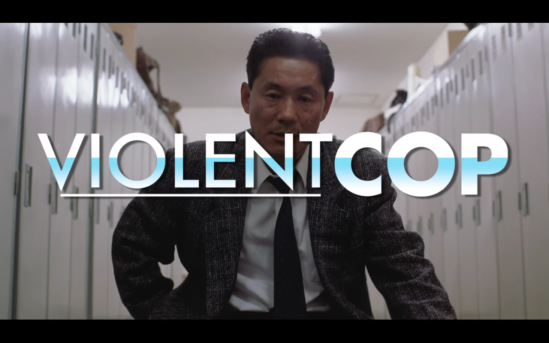
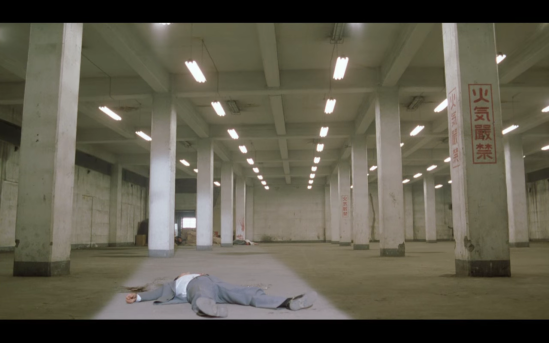
In a city fueled by constant drug trafficking and violence, a weak and corrupt police department has revolving leadership, but one good cop, detective Azuma, of the vice squad doesn’t have the taste for dope. Azuma’s wild card police tactics stir much controversy in his department, placing him on extremely thin ice, but he manages to get the job done no matter the destructive, if yet effective, trail left behind. When the detective learns that his long time colleague and best friend, detective Iwaki, has been involved with trafficking drugs, Iwaki ends up dead in apparent suicide and Azuma will stop at nothing to discover the truth behind his friend’s sudden death. Azuma’s Dirty Harry-style methods catch the attention of a powerful yakuza henchman who kidnaps her and lets his entourage gang rape his mentally unstable sister and with nothing else to lose, the rogue officer shoots first and never asks questions later.
“Violent Cop” is the breakout 1989 directorial film from Takeshi Kitano, one of the most recognizable names and faces in the revival of Japan’s film industry and a staple amongst other mediums including stage performance, television, and other various liberal arts. Kitano also headlines the yakuza genre film as the lead character, the ungovernable detective Azuma, in this unforgiving cop drama under his pseudonym ‘Beat’ Takeshi. Kitano’s harden plastered mug and short, stocky stature caters to the era of lone wolf. rogue cops, providing a hearty performance familiar to that of Clint Eastwood or Charles Bronson. “Violent Cop” quietly packs a punch, patiently waiting to seize the opportunity to display explicitly graphic violence while also being sleek in it’s construction, charmingly odd in it’s humor, and basking more in the parameters of performance than in it’s exposition of dialogue, which is kitano is known more for in his acting.
Much of the film revolves around Azuma’s cavalier and stoic personality. In the opening, three teenage boys unjustifiably harass and assault an elder homeless man. Azuma, who happened to witness the assault, follows one of the boys to his home, knocks on the door, identifies himself as a police offer to the boy’s mother, walks up the stairs alone, and slaps the boy around in his own room until the boy confesses and agrees to turn himself in at the station the following day. This introduction not only showcases Azuma’s descriptive title character as the violent cop, but also informs that the work alone Azuma has a vigilante moral principle that even isolates him from his unstable sister. Once a student of comedy, Kitano re-wrote the Hisashi Nozawa original comedic script into a brutal police drama, wanting to exhibit a serious side, but left alone some of the script’s initial comedy elements that blend the spirited yakuza film to being just inside the genre. Kitano’s progressive camera work includes deep long shots along with tight quarter setups, extensive and angled crane shots, slow motion sequences, and long track work that pinpoints Kitano’s diverse style.
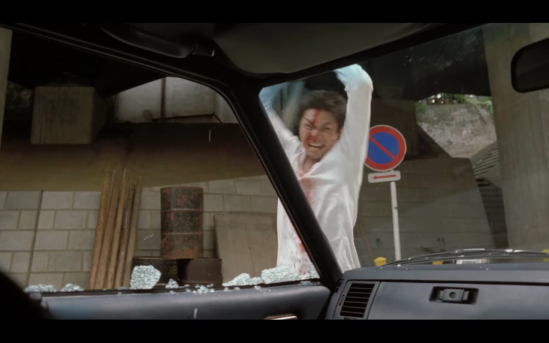
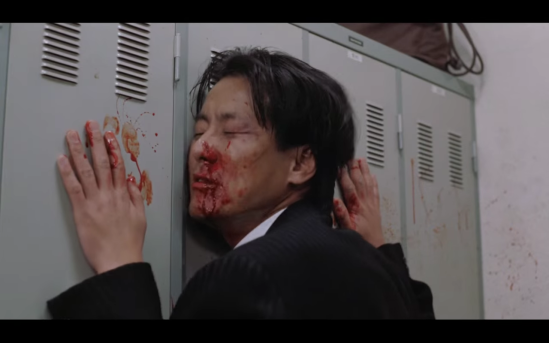
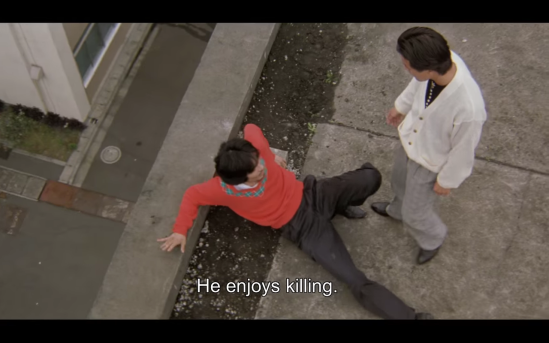
“Violent Cop” lives up to the title. Heads being bashed with an aluminum bat, multiple gory-soaked stabbings, and a sadistic, punishing maltreatments are just a few examples of “Violent Cops” barbaric qualities. The violent scenes feel almost peppered throughout, but they’re really strategically placed between character building segments that only support the necessity of brutality. Did detective Azuma really need to run over a suspect, who just murdered a colleague, down twice with the squad car? Yes, because the suspect desperately and dangerously wielded a baseball bat as a weapon and attacked them numerous time. The actions of the criminal warranted Azuma’s unethical position of bulldozing him over, twice. Only when Azuma is pushed beyond his limits does he lose what was left of any shred of restraints that were holding him back. Azuma meets an antagonistic match, a blood thirsty foe equally resistant and, at the same time, loyal with his boss, creating a villainous mirror image whose just as a loose canon as himself.
Film Movement, the New York based award-winning and foreign cinema distributor, presents a specialized hi-definition Blu-ray treatment of “Violent Cop” in a sharply detailed 1.85:1 aspect ratio stored on a single disc BD-50. The region A disc provides the best transfer quality of this 1989 film to date with stunning, natural coloring, balanced hues, and defined edges with no signs of compression artefacts. Darker scene noise is present, but to affect the experience, the noise would need to be more extensive. With Film Movement’s release, the noise is minimal and shouldn’t be considered a factor. The Japanese LCPM 2.0 audio track is quality with no hiss or pops. Dialogue is evident in the forefront, all other tracks seem level with an accompaniment range of ambiance, and, like aforementioned, all tracks are clean and clear of distortions. Extras include a featurette entitled “That Man is Dangerous: The Birth of Takeshi Kitano” and an booklet essay with the topic of Takehsi Kitano, written by Asian film expert and film curator Tom Vick. “Violent Cop” offers no sympathy, but provides an abundance of rich, dedicated filmmaking in a raw format that seems almost archaic in the present. Film Movement and “Violent Cop” go hand-in-hand, a foreign yakuza melodrama that saw the beginning stages of rebirth in the last days of a struggling Japanese cinema market and Kitano’s face is at the forefront of that movement.

“Violent Cop” on Blu-ray at Amazon.com!


