At Odds With Each Other Can’t Stop the EVIL That’s Coming for Them! “House of Dolls” reviewed! (VMI Releasing / Blu-ray)

“House of Dolls” Is Ready to Play! Blu-ray Available at Amazon.

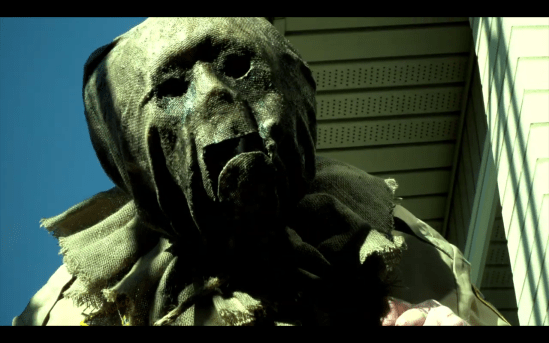
Estranged sisters Jenn, Diana, and Adalene are summoned to reunite by their dying father.  Greeted by their grandmother and a lawyer informing them of an inheritance within their father’s will, the verbally combative sisters are more than eager for their fair share of the will and be happy to never see each other again as they go on with their lives, but the will’s stipulation states the sisters must work together and revitalize the long severed kinship within the walls of his hand-built estate, a life-size representation of a doll house constructed for the love of his life where clues to their inheritance lie hidden inside.  Before even the first ounce of hope to mend their broken bond, one of the sisters is found brutally murdered in one of garish rooms and a masked maniac hunts for not only the two remaining sisters but also those close to them outside the house of dolls.

Juan Sala’s “House of Dolls” is the return to horror for the Texas taught director since his urban-thriller “Alp” in 2016 and the first independent story helmed that didn’t involve Sala’s going pen-to-paper with a script.  That task was handled by another Texas film school graduate, Iv Amenti, in her first feather length screenwriter credit aimed to label itself as a mystery-slasher under the guise of grueling family rejuvenation.  The 2023 released film’s story was shot on location in Los Angeles with Juan Salas solo producing the feature.  Salas is no stranger producing his own work as he’s done with most of his own repertoire (“The Triple D,” “The Wolf Catcher,” and “The Devil’s Ring”) while also branching out occasionally to support and/or fund other creative minds, such as with Brian King’s “Hell of a Night.”  Polar Bear Films produced the film along with Vantage Media International, or VMI Worldwide, who produced and distributed the film.
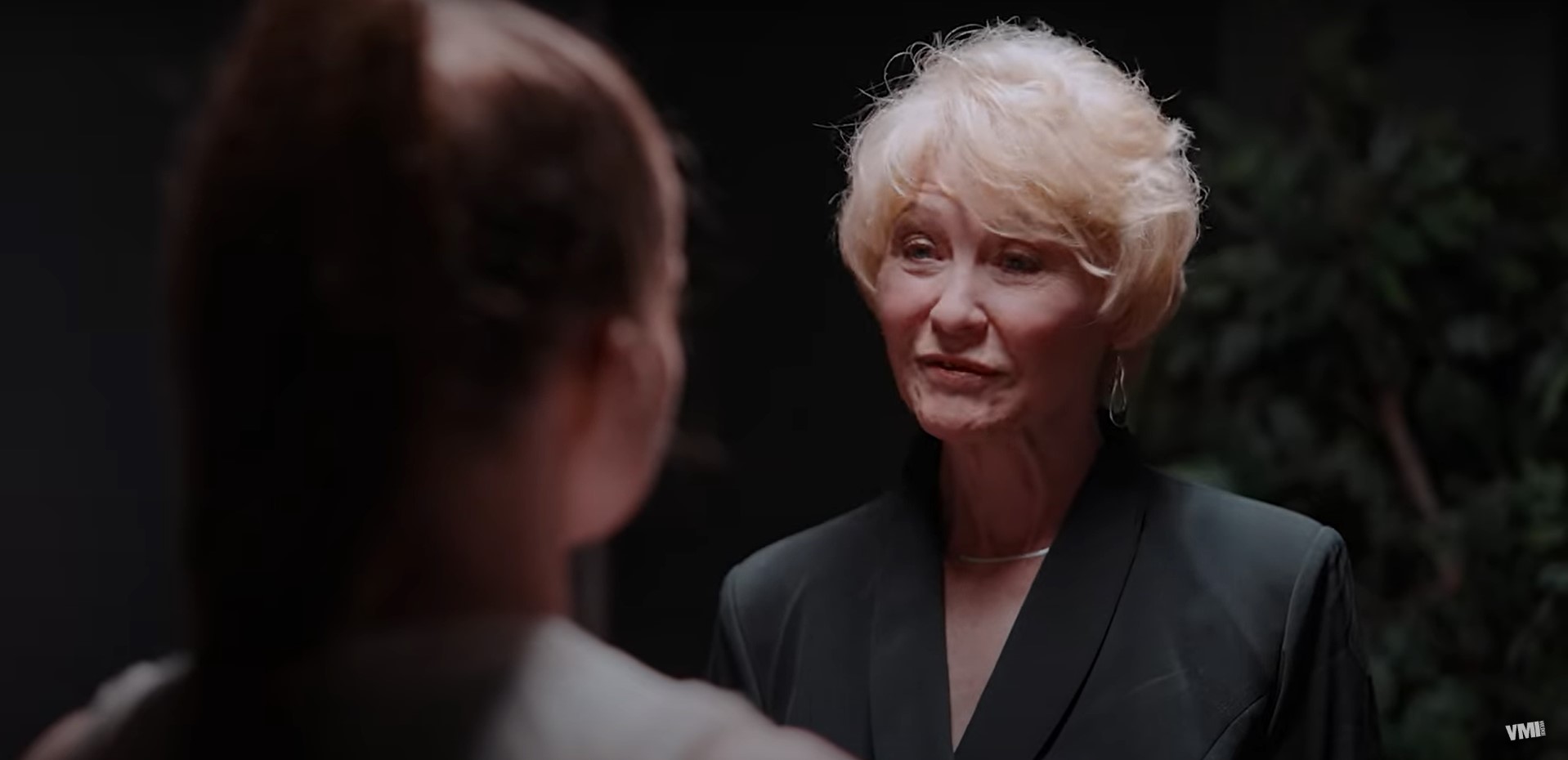
Powering “House of Dolls” vessel into explicit view is headliner Dee Wallace.  The “Cujo” and “Critters” scream queen has been on a junket of mom-and-pop productions for the better part of the last decade for aspiring horror filmmakers to leech off that eye-catching and weight-bearing Dee Wallace name.  Wallace reminds me of Linnea Quigley once said in an interview, if producers meet her price, she’ll star in pretty much anything.  Wallace seemingly has the same philosophy with a continuous stream of projects that screen her for no more than a total of 15-minutes, tops.  While this works to an extent, based off the prominence or the memorability of the role, most of that bankable name and face do little elevating the film, resulting in just a paycheck performance.  Sure, Wallace’s fans will check it out for the sake of Dee Wallace but for “House of Dolls,” as with the story or just as with the entity of the film, the gimmick doesn’t leave a mark.  The plot crux favors the three bickering sisters, Adalene (Violeta Ortega), Jenn (Stephanie Troyak), and Diana (Alicia Underwood).  Sibling diverging personalities uphold their seething hate for each other, that is much as obvious, but for what specific reason is never unfolded, or is unfolded but made unclear in the wake of its untidy heap.  What’s definingly unclear is the mother of these unlikeable brats.  Mentions of individually owning the unfortunate event of a mother’s death makes the ambiguous ruling that there is at least one half-sister.  They could all be half-sisters, but the unbridled dialogue and no conveyed backstory strays away from important pieces of the puzzle that make it as frustrating as trying to match a 2D puzzle piece within a 3D puzzle scheme.  The story also incorporates flimsy relationships with the sisters, Jenn’s drug buddy Justin (Jack Rain) who unexpectantly arrives with the sisters at their father’s estate, Adalene’s semi-sweet boyfriend Caleb (Phil Blevins), Diana’s vague friendzone coworker or perhaps boyfriend Lenny (Matt Blackwell”), and Diana’s out-of-nowhere go-to detective who just happens to be at her father’s hospital, dressed in beat cop fatigues, in Det. Ramierz (Meeko).  All these seedling characters are detached in their gravitational encircling around the sisters, pulling in zero weight on a story that’s quickly deflating.  Rounding out the fleeting supporting cast is Trey Peyton. 

Following “House of Dolls” plotline might as well be riddles with attention deficit disorder.  Too much is happening without the ease of transition or even sense to hold down a floating story that’s constituting forced uniformity and civility amongst rival siblings by way of a mysterious house with mysterious clues. Yet, those clues don’t flesh out and intrigue over what could have been a backstory backbone turns into gelatinous indiscretion of kill-after-kill by a leather coat-wearing masked-maniac with knives that offers up in the end being nothing more than surface level, superficial slasher.  Salas pulls off some decent, gory kills, such as a slimy disembowelment and a bisected torso that spills guts, to add some value to the production that’s ultimately equalized by areas of cut-rate props, such as the obviously flat and dull large knives that look more like cardboard than metal.  Like in true slasher tropes, the killer is seemingly everywhere at once, hopping from one location to the next, even if the other locations are across town, but this punk-cladded, homicidal maniac appears in-and-out of the alternating scenes too lackadaisically without systematic care to at least in try and make it plausible.   

VMI Releasing and MVD Visual handle the physical media distribution with a 1080p, high-definition Blu-ray.  The AVC encoded BD50 has the capacity for the eclectically ranged front lit key lighting and neon lighting, delivering a clean picture without compression issues.  Details waver between certain aspects of lighting, which is expected, but the details that do emerge pinpoint textural qualities and the key lighting reveals appropriate, vivid coloring and skin tones when contrasted against heavier background shadows.  Jorge Villa’s sizzling neon gives a warm glow in purple, blues, reds, and orange that enhances to a near music video quality outside the normal lighting and production parameters.  The film is presented in a 1.78:1 aspect ratio.  The uncompressed DTS-HD 5.1 English audio mix is an upbeat combination of verbal jabs, deregulated dialogue, and a medley of pop music and low-tone beat creator for the villain peppered with hip-hop rhythms, violin and piano down tone, and some suspense synthesized keyboard notes that do lean into what makes a decent horror soundtrack.  No complaints on the dialogue track that’s fairly level but doesn’t explore much in depth as characters are often up front and center on the camera.  There’s also not enough range to really utilize the multi-channel network and so the lack of miscellany fight for audible supremacy. Subtitles are available in English only.  Bonus features are aplenty on this larger capacity disc with Juan Salas commentary track that runs parallel to the feature, Juan Salas and Dee Wallace have a Halloween special video chat to converse about their time in production, a Natasha Martinez hosted cast Q&A for the U.S. premiere, a making-of featurette, and a MiB Legacy music video The Man Who Was Death.  On the outside, VMI’s standard Blu-ray comes with an appealing touchup of the killer in full dress from the chest-up, singled out by a black background and the title just overhead.  The disc is pressed with the same image with no other tangible features.  The film is not rated with region free capabilities and has a runtime of 84 minutes.    

Last Rites: “House of Dolls” crumbles as a clunky attempt at a slasher with a twist ending. The story shatters like someone pulling a pin on a grenade and pieces of act structure shrapnel propel in all different directions and never once hit target in the latest from director Juan Salas.

“House of Dolls” Is Ready to Play! Blu-ray Available at Amazon.

Sadomasochism and Decapitation Seen by a Child Turns Him into An EVIL Adult! “Nightmare” reviewed! (Severin / 4K UHD – Blu-ray)

Your “Nightmare” Should Be in 4K! Own it Here!

A schizophrenic patient continues to have reoccurring dreams of a young boy chopping the head of a woman in the midst of rough sexual fetishism.  The intense nightmares send him into violent stints, delusional states, and severe seizures.  As a test subject for an experimental behavior drug, the troubled man shows promise of recovery and enough so that he’s released from the mental hospital with continued outpatient therapy sessions.  Not long after his release does he skip his sessions to hightail it from New York City to Daytona Beach, Florida, killing people along the way after decapitating nightmare continues to plague and force him to murder.  In Daytona Beach, single mother of three becomes his obsession as he stalks the youngest boy, a mischievous troublemaker, and even breaks into their house when it’s not occupied , but as the bodies begin to pile up on the hands of his need to kill, the more brazen he becomes to entering while they’re home alone. 

Based loosely on the improprieties of government spy agencies using drugs to bend the minds of home and oversee terrorism to their wills, “Nightmare” sensationalizes the concept for the public sector involving a mental patient, experimental drugs, and exasperating an already instable person’s constitution into a hyperdrive of bloodletting carnage.  The U.S. production is written-and-directed by Italian filmmaker Romano Scavolini who came to America to shop around his scripts having failed to secure financial support in Europe, including, you guessed it, “Nightmare.”  Shot in New York and mostly around the Cocoa Beach Florida, the crime thriller filmmaker flexes his muscle with his first attempt at horror and the outcome is nothing short of unadulterated madness.  Once considered to be titled “Dark Games,” and goes loosely by “Blood Splash” and “Nightmare in the Damaged Brain,” the 1981 film is a feature of Goldmine Productions with John Watkins and Bill Milling (“Silent Madness”) producing.

The man behind the nightmare is George Tatum and the man behind George Tatum is Baird Stafford in one of his only two roles as an actor.  “Nightmare” wouldn’t be as skin-crawlingly shocking if it wasn’t for Stafford’s distressing performance of a man whose psychology is being peeled away and you can see Tatum physically fighting the urge, fighting to stay sane, but losing the battle as the grisly terror replays over and over inside his mind.  Stafford’s asunder of Tatum’s equilibrium has unequivocal transference to the audience.  Parallel Stafford is a child, a young child by the name of C.J. Cooke who essentially played his own version of himself in C.J. Temper, a mischievous prankster that ran babysitters up a wall mad and frightened and frustrated the living daylights out of his mother.  C.J. is part of the family Tatum is hellbent on driving down from New York to Florida to see for a reason that isn’t made clear yet until the shocking reveal.  C.J.’s single parent, a mother desperate for love and affection, is played by Sharon Smith who has become romantically involved with nice guy, and yacht owner, Bob Rosen, with Mik Cribben in the role.  Cribben was actually part of the cast but the original actor for Bob Rosen dropped out and Cribben quickly filled into the role that suited him well enough as a suitable suitor for C.J.’s mother.  “Nightmare” rounds out the cast with Danny Ronan, Scott Praetorius, Christina Keefe, William Kirksey, Tammy Patterson, Kim Patterson, Kathleen Ferguson, Candese Marchese, Tommy Bouvier, and producers John L. Watkins and Bill Milling as drug trial executive and psychologist tracking down Tatum to clean up their mistake. 

“Nightmare” combines excellent U.S. thespianism with an Italian way of suspense and violence glued together by the success of the late Leslie Larraine and team’s special effects albeit the controversial assertion on the film’s posters that Tom Savini (“Dawn of the Dead” ’78, “Friday the 13th, ’80) had been the effects supervisor on the film albeit Savini’s adamant claims of the opposite and denying the credit being false and liable for using his name to draw in audiences.  Savini continues to state his contribution “Nightmare” was limited to best to the action of a decapitating swing of the axe.  Ultimately, the whole ordeal mars Larraine’s due recognition for some of the more up-close and personal gory effects this side of the early 80s.  Scavolini also deserves well-received credit for his narrative vision of Tatum’s psychosexual struggles that drive him to kill.  Robert Megginson’s editing and the re-recording mixing team tackle a form of character plummeting that’s unlike any other from the intercut concatenation of events between Tatum’s horrific, blood-soaked nightmares and his antagonizing, sweat-inducing impulses that propel him without a choice.  The simultaneous parallels between Tatum and young C.J., as Scavolini aims to connect the two against-the-grain personalities as a singular link with back-and-forth subplots, leach the shock out of Sharon Smith’s acme line as mother Susan Temper that uncovers the truth when the chaotic smoke clears.  Why Tatum would drive so far from New York City to Daytona Beach, Florida with reason to stop and make roost on this one particular family fails to form mystery around what’s often crafted to be an arbitrary target with some minute hints that may provide clues to the audience is because even without those inklings, the shooting script defines the rationale right from the beginning thus bringing the viewers out from a shrouded suspenser and into being buckled in just along for the ride. 

Severin Films’ 4K scan of the 35mm internegative compositions the print with various foreign element sources for a comprehensive version of Romano Scavolini’s “Nightmare” on a 4K UHD and Blu-ray 2-dsic set.  The UHD is on a HEVC encoded, ultra high-definition 2160p with a 4K resolution, BD66 and the Blu-ray is housed on an AVC encoded, high-definition 1080p, BD50.  What’s released is a very enriched saturation of the technicolor process that defines and differentiates the innate hues.   Details are more than consistent throughout as we’re able to pinpoint the beads of sweat down Tatum’s face or feel the palpable slick sinew of a decapitated head amongst the examples.  Blood is a deep, glossy red and contrasts strikingly in the more sopping moments despite Savini’s claim that it needed more green dye to better pop for the camera.  A consistent layer of agreeable grain runs throughout from the 35mm film stock, as it should, without any inimical dust, dirt, scratches, flares, or of the like to obstruct viewing or cause lapse in the narrative, as it shouldn’t.  Between the resolution diverse formats, there’s a slightly more grindhouse look to the Blu-ray whereas the HDR10 crisps the image for better vibrancy.  Both formats retain inky blacks without shimmering or banding.  The English language audio tracks are available in two lossless options:  DTS-HD 5.1 and a DTS-HD Stereo 2.0.  The surround mix’s dialogue has resounding infusion, spread through the multi-channels to encompass a multi-directional approach to centralize.  The design is effective as it’s prominent to not understate the vocals but leaves little room for spatial distant to which no matter where characters stand, they are almost audible on the same audio plane.  Jack Eric Williams warping harmonica and twangy guitar, intrinsically integrated with piano notes, a variety of percussion, interjecting funk bass chords, and hints of string instruments, that ebb and swell with great intensity and favorable discordance is a real celebration of Williams’ score on Severin’s latest restorative edition of “Nightmare.”  English subtitles are optionally available.  The Ultra HD release comes the film’s trailers and a pair of audio commentaries as the only accompanying special features; commentary one has features star Baird Stafford and special effects assistant Cleve Hall with Lee Christian and David Decoteau and commentary two features producer William Paul.  The Blu-ray also has the commentaries and trailers plus an extended lot of interviews, such as a feature length (71-minute) Kill Thy Father and Thy Mother interview with director Romano Scavolini (Italian with English subtitles), Dreaming Up A Nightmare interview with cast and crew, a brief interview with Tom Savini discussing his role, or rather his not role, in The Nightmare of Nightmare to which Savini looks a little tired of answer the same question about his inaccurate involvement, an interview with makeup artist Robin Stevens The Stuff that Nightmares Are Made of.  Also included is an open matte peepshow as well as untouched deleted scenes, extending beyond the already newly achieved 99-minute runtime for the film.  “Nightmare” from Severin comes in a standard 4K Amaray case with original poster art used for the front cover.  The discs are separated and tab locked on either side of inner casing and this particular release, the 2-disc set, does not come with any insert or content.  The front cover is reversible with the European title “Nightmares in a Damaged Brain” and a different image composition of the European poster art. The disc has region free playback and is not rated.

Last Rites: “Nightmare” on a new, extended restoration in 4K and Blu-ray is a dream of a release. A nerve-wracking performance in Baird Stafford’s schizo vilifies the very classification of the mentally ill in what is sure to go down in history as one of the most disturbing, and disturbed, characters of the video nasty era.

Your “Nightmare” Should Be in 4K! Own it Here!

EVIL Inspires a New Concert. “Nightmare Symphony” reviewed! (Reel Gore Releasing / Blu-ray)

“Nightmare Symphony” is a Falsetto of Praise for Lucio Fulci.  Purchase the Blu-ray Below!

Unable to cope with another large box-office failure, the American indie horror director, Frank LaLoggia, is in the travails of a make-or-break psychological thriller overseas in Kosovo.  With an executive producer forcibly pulling LaLoggia’s creative marionette strings and the film’s screenwriter displeased and disapproving LaLoggia’s arm-twisted version of the story, the struggling director finds himself frantic and in the middle of a breakdown caught between a rock and a hard place with a postproduction from Hell.  Those around him, the conceited producer, the upset screenwriter, the pushy wannabe actor, and more, are being hunted down and brutally murdered by a masked killer and the imaginary line between Frank’s reality and paranoia grows in intensity coming down the wire of completing his career-saving, or rather lifesaving, film.

Long time since I’ve heard the name Frank LaLoggia enter the dark corners of my brain as it relates to the horror genre.  The director of 1981’s “Fear No Evil” and 1995’s “Mother” had seemingly vanished from the director’s chair spotlight and more-or-less, or rather more so than less so, vanished from the broader film industry altogether.  Then, Domiziano Cristopharo’s “Nightmare Symphony” suddenly drops on the doorstep and there’s Frank LaLoggia, starring in the lead role of an Italian horror production.  Domiziano, known from his entries of extreme horror, such as with “Red Krokodil,” “Doll Syndrome,” and “Xpiation,” engages LaLoggia to act in an unusual role, as himself, and turns away from the acuteness depths of uber-violence and acrid allegories to a toned down, more conventionally structured, narrative inspired by the Lucio Fulci psychological slasher “Nightmare Concert,” aka “A Cat in the Brain.” Co-directed with first time feature director Daniele Trani, who also edited and provided the cinematography, and penned by the original screenwriter of “A Cat in the Brain,” Antonio Tentori, “Nightmare Sympathy” plays into questioning reality, the external pressures that drive sanities, and weaves it with a meta thread and needle. The 2020 release is produced by Coulson Rutter (“Your Flesh, Your Curse”) and is an Italian film from Cristopharo’s The Enchanted Architect production company as well as companies Ulkûrzu (“Cold Ground”) and HH Kosova (“The Mad MacBeth”).

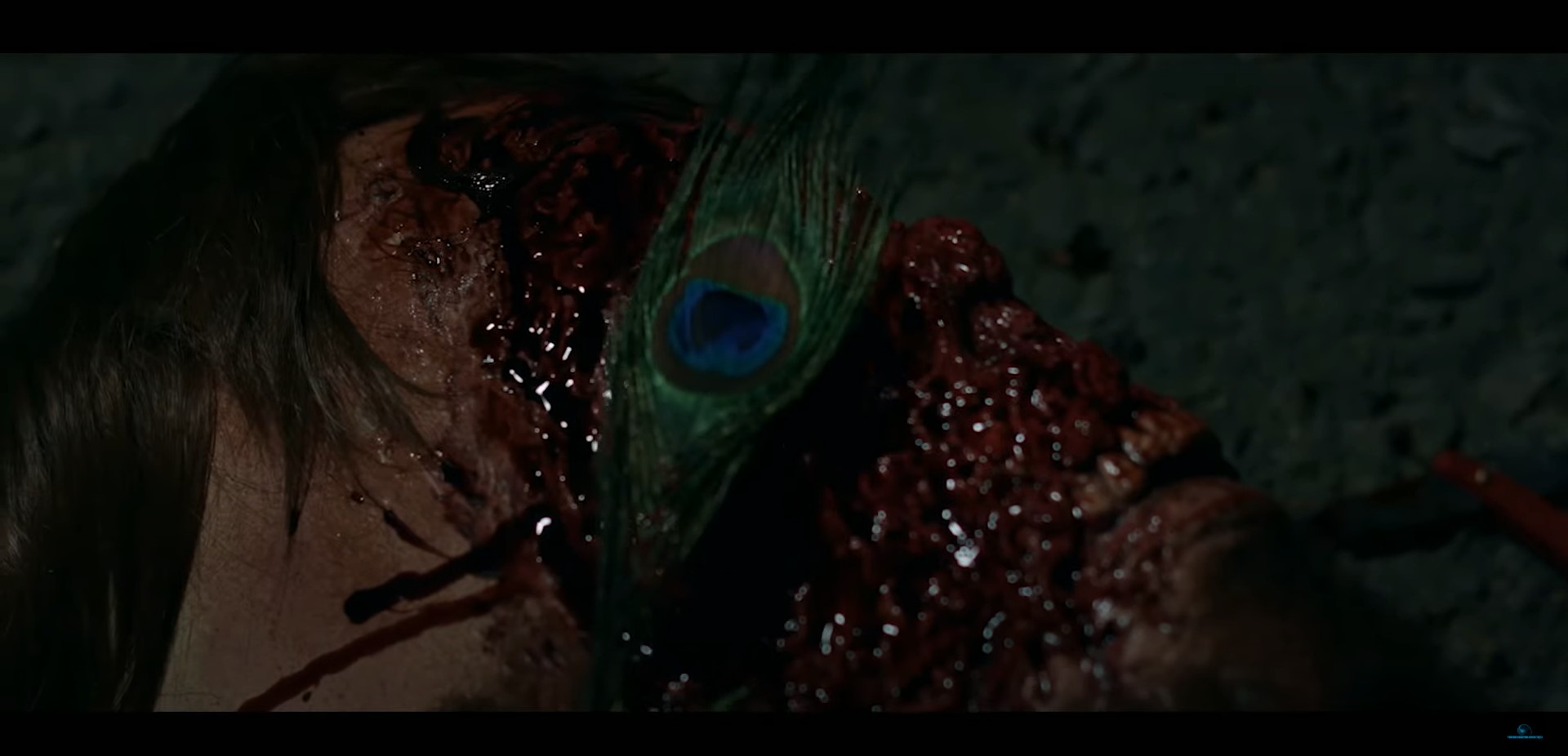
Much like “A Cat in the Brain,” Frank LaLoggia depicts his best Lucio Fulci representation as a horror filmmaker whose storyline production mirrors the individual slayings surrounding him. As a character, LaLoggia is not entirely aware of the murders as the peacock headed slasher’s string of sadism runs parallel to LaLoggia’s post-productional workload. Cristopharo pays a simultaneous tribute to not only Fulci but also LaLoggia with a built-in brief, off-plot moment of the editor, Isabella, a good friend and longtime partner of LaLoggia, running a reel of “Fear No Evil” to reminisce over his debut picture. Antonella Salvucci (“Dark Waves,” “The Torturer”) plays Isabella but also LaLoggia’s pseudo film lead actress Catherine in a dual role performance with the latter marking Salvucci’s topless kill scene that hits and sets up the giallo notes. Isabella denotes the director’s only real friend with everyone else, from the screenwriter to the executive producer, push their own self-gratifying wants onto the American filmmaker from all angles. A vulgar herd of personalities descend upon LaLoggia to exact their strong-willed ideas on how the film should appear and be marketed. From the screenwriter Antonio (Antonio Tentori, ‘Symphony in Blood Red”), the imposing desperate actor David (Halil Budakova, “Virus: Extreme Contamination”), to the uncultured and pushy executive producer Fernando Lola (Lumi Budakova) and his aspiring actress Debbie (Poison Rouge, “House of the Flesh Mannequins”), they all look to exploit LaLoggia’s modest career for their own benefit. Performances vary with a range of experience, and we receive more noticeably rigid recites and acts from the Kosovo cast in a clashing pattern with the Italy cast that has worked with Cristopharo previously. Ilmi Hajzeri (“Reaction Killers”), Pietro Cinieri, and Merita Budakova as a chain-smoking lady stalker that has glaring eyes for Frank LaLoggia.

While not necessarily thought of as a remake, “Nightmare Symphony” is certainly a re-envision of the Fulci’s “Cat in the Brain.” What Cristapharo and Trani don’t quite well connect on is connecting all the pieces of the psychotronic puzzle together into what is meant to be expressed. The giallo imagery is quite good, a praise of the golden era period in itself, with a mask and glove killer, the closeup of gratuitous violence, most of the score, and the stylistic visuals imparted with ominous shadow work, foggy and violent dream sequences, and with congruous cinematography and editing of earlier giallo. Plus, audiences are treated to not only the aforementioned Antonio Tentori, screenwriter of “Cat in the Brain,” but also have composer Fabio Frizzi score the opening title. Frizzi, who has orchestrated a score of Lucio Fulci films, such as “Zombie,” “The Beyond,” “Manhattan Baby,” and even “Cat in the Brain” just to select a few notable titles, adds that proverbial cherry on top to evoke Fulci directing “Nightmare Symphony” vicariously through Cristapharo and Trani. There are some questionable portions to reimagining’s take on the original work that are more the brand of the contemporary filmmakers. The presence of death metal prior to one of the kill moments puts the overall giallo at odds with itself in a fish out of water aspectual scene composition. Another out of place component are the external characters that are not directly involved with LaLoggia’s peacock-head themed slasher; the ironical venatic of an animal hunting down people is the reversal of a Darwinism theory that instead of sexual selection, the beautiful and elegant peacock forgoes using grace to attract and aims to survive by natural selection and thus the killer kills to remain alive. However, the story and the directors never reach that summit of summation and with the oddball characters adrift from the core story – such as the stalking woman and the eager actor – “Nightmare Symphony” flounders at the revealing end with its severe case of blinding mental delirium.

With a cover art of an upside skull overfilled with film reels and unfurling celluloid through the soft tissue cavities, “Cat in the Brain” continues to be reflected in “Nightmare Symphony” up to the release’s physical attributes on the Reel Gore Releasing’s Blu-ray. Presented in on a AVC encoded BD25, with a high definition 1080p resolution, and in a widescreen 2.35:1 aspect ratio, the Reel Gore Releasing espouses the Germany 8-Films’ Blu-ray transfer for a North American emanation, which might explain some of the complications with the bonus features that’ll I’ll cover in a bit. Situated in a low contrast and often set in a softer detail light, “Nightmare Symphony” doesn’t pop in any sense of term with a hazy air appearance and a muted color grading that goes against the giallo characteristics, especially when the clothing and set designs have the same desaturation or are colors inherent of low light intensity. Despite appearing like a slightly degraded transfer on a lower BD storage format, compression issues are slim-to-none with artefacts, banding, or blocking and this results in no tampering edge enhancements or digital noise reduction. The release comes with three audio options: A German DTS-HD 5.1, German DTS-HD 2.0 Master Audio and an English and Italian DTS-HD Stereo 2.0 all of which are Master Audio. The German audio tracks are a dub from the 8-Film Blu-ray and the 5.1 offers an amplified dynamics of the eclectic soundtrack and limited environment ambience. Dialogue remains outside the dynamics on a monotone course but is clean and clear with good mic placement and a neat, fidelity fine, digital recording. The German dub has a distinct detachment from the video because of its own layer environment, sounding a little sterile than the natural English or Italian, but works well enough as expected with the supplement multi-channel surround sound. English SDH and German subtitles are optional. Bonus contents feature a behind-the-scenes which is entirely just a blooper reel, an English language interview with co-director Domiziano Cristopharo whose secondary language is English, the original soundtrack playlist, and the teaser and theatrical trailer. I mentioned an 8-Films’ transfer complication with the bonus content because there’s is also an interview with Italian screenwriter Antonio Tentori that’s only in German dubbed and subtitled with no option for English subtitles or dub. When you insert “Nightmare Symphony” into your player, an introductory option displays to either pick German or English and I considered this to be the issue for the German only interview with Tentori; however, that is not the case as both country options are encoded in German for the interview, so at the beginning option display, I would recommend the German selection because the setup will have contain all audio options for the feature whereas the English selection will only contain the English 2.0. Reel Gore Releasing’s Blu-ray comes housed in a red snapper case, the same as the company’s release of “Maniac Driver,” and has a less tributing reversible cover art with more revealing and illustrated aspects of the narrative. The release is region free, unrated, and has a runtime of 78 minutes. Another little fun fact about the release is the incorrect spelling of the director’s name on the back cover that credits his surname as Christopharo instead of Cristopharo. Influenced by Lucio Fulci beyond a shadow of a doubt, “Nightmare Symphony” proffers the Horror Maestro’s less notable credit with a companion piece that punctuates both films love for the giallo genre, love for the violence, and love for the morbidly unhinged human condition.

“Nightmare Symphony” is a Falsetto of Praise for Lucio Fulci.  Purchase the Blu-ray Below!

EVIL Watches from the Shadows. “The Lurker” reviewed! (Indican Pictures / Screener)


A gruesome murder has brought a looming shadow over a high school. However, the shadow is not great enough to thwart the spirits of a group of thespian high school seniors in the throes of their last Shakespearian performances of the year of Romeo and Juliet. Determined to excel, the peer admired Taylor Wilson keeps her college acceptance hopes high on her well-received nightly performances as Juliet, but when a terrible secret involving Taylor begins to circulate through the school body, friendship and enemy ties begin become taut with tension. Simultaneously, those with knowledge of Taylor’s secret are being killed off one-by-one by a deranged killer in a black, long nose masquerade mask.

“The Lurker” is a 2019 American slasher film from the first attempt at horror-director Eric Liberacki, whose legs have been grounded in short film cinematography work over the past 2010 decade with “The Pale Man” being his sole feature length credit. Liberacki’s sophomore directorial is written by the “The Pale Man” screenwriter and short film director, John Lerchen, who’s scribes the slasher version of HBO’s “Big Little Lies” starring hormone-driven and backstabbing high school seniors on a thespian high. “The Lurker” re-imagines the high school dramatics to further dig into taboo subtexts worthy of a Jerry Springer talk show episode and interweaves a non-linear narrative, filled with flashback mystery, due suspicion, and the utmost desire to know what secret Taylor Wilson is being exploited against her preservability. “The Lurker” is a joint venture between John Lerchen’s production company, Forever Safe Productions, and Silva Shots.

One thing, right off the bat, that heedlessly seems erroneous for the story is casting Scout Taylor-Compton in the lead role of Taylor Wilson. And here’s why. From 2007 to 2019, the now 30-year-old actress has played a high school student in Rob Zombie’s remake of “Halloween” and in “The Lurker.” While Taylor-Compton is a natural beauty who seemingly defies all physics of aging and her performance is solid, the once Laurie Strode portraying actress from Long Beach, California emits a now mature glow in life and rehashing another character in a high school slasher is ultimately beneath and behind her. Aside from her counterpart co-star Michael Emery being roughly the same age, the rest of Taylor Wilson’s entourage are in their internship-status, post-college years of the early 20s, including Kali Skatchke, Casey Tutton, Isabel Thompson, Emmaline Skillicorn, and Marissa Banker. Juxtaposing against a young cast, as a sort of out with the old and in with new or to brighten with short strands of genre highlights, is the minor roles and cameos of recognizable faces and film royalty, such as Ari Lehman (“Friday the 13th), Naomi Grossman (“American Horror Story: Asylum”), and, most surprisingly, Domenica Cameron-Scorsese, the daughter of Martin Scorsese, playing Taylor’s mother. The cast rounds out with Charles Johnston, Rikki Lee Travolta, Eddie Huchro, Bruce Spielbauer, Roy Rainey, Josh Morris, and Walter S. Bernard.

“The Lurker” has textbook aspects going for it in the case of an above par production value of fancy editing and set locations, a cache of young and seasoned talented actors, and a story with a twist ending, but that nagging itch gnawing from the back of my skull, slowly inching one molecule at a time, toward the core of my brain informs me that the Liberacki’s slasher misses the intended mark if only by a fingertip attached to a severed pinky. The story tries to sell an alternate version of itself that becomes inane from predictability at the very starting gate and continues trucking an exemplum despite giving away too much, too early. Surrounding the conundrum of calamity building to the potential proverb of shit hitting the fan is a paradigmatic slasher flick with a masked killer murdering toward the technique of a final girl narrative. Yet, “The Lurker’s” kills weren’t terribly flashy and were really met with an uninspired creativity to assist in drawing and sustaining captivation of a ruthless assailant over an abundance the teenage melodramatics, which essentially ran amok. We really shouldn’t have been surprised at the narrative’s untroubled tone because the first kill in the opening scene was inside the school and the school was open the very next day; in today’s day and age, school would have been closed for the rest of the week, if not the rest of the academic year, for bereavement and investigation.

Come down with a serious case of stage fright with “The Lurker” coming to DVD home video and now out on various digital platforms, including renting and buying options on Amazon, distributed by Indican Pictures. The visual and audio review portion for this release will not be covered since a screener copy was provided; however, the DVD will be presented in the original widescreen presentation of an aspect ratio of 2.39:1. With a check disc, there were also no bonus material to review as well as no bonus material before the credits and before or after the credits. John Lerchen and Eric Liberacki’s first crack at full length horror is a win in my book with a complex web streamed of lies, deceits, and snuff, but, with a little fine tuning, “The Lurker” could have sheered to a bigger, better 80 minutes.

Rent or Buy “The Lurker” on Prime Video!!!

Evocation of EVIL in “The Girl In the Crawlspace” reviewed! (ITN Distribution / DVD)


Jill escapes from the grip of a kidnapping-serial killer who kept her confined in a crawlspace under the house. Her courage brings lethal justice to the captor when the local marshal shoots and kills him upon confrontation. Jill struggles to reintegrate back into her local community in the aftermath, sleeping unconfined in the outdoors and withdrawing herself for social interaction, including from her weekly role playing game with friends. When Kristen moves back into her hometown from college, she aims to set up her therapy practice to assist families impacted by the serial killer as well as Jill by special request from the marshal, but Kristen’s rocky relationship with her substance abusive, off-Hollywood screenwriting husband on the mend drags out Jill’s much needed treatment. With Jill and Kristen preoccupied, they’re oblivious to the concealed threat that plots the next terrorizing exploit of kidnapping and tormenting young, beautiful women.

From under the grubby wooden floorboards to the strategic folding table of a role playing game, “The Girl in the Crawlspace” is the Midwest direct-to-video suspense thriller that tackles post-traumatic stress and marital strife while submersed in a looming trail left by a notorious mass murderer, written and helmed by first time director John Oak Dalton. Dalton, who has penned several low-budget grindhouse titles over the last decade and half, including titles such as “Among Us,” “Sex Machine,” and “Jurassic Prey,” returns once again to the genre with the repercussions of Podunk psychopath upon small town America, filmed in Indiana and release in 2018 hitting the ground running with film festival circuits. Indie filmmaker Henrique Couto, schlock horror director of “Scarewaves” and “Marty Jenkins and the Vampire Bitches,” signs on as producer, stepping back from his usual productional duties, and letting an occasional collaborator Dalton to completely engulf himself as the omnipotent auteur. Midwest Film Ventures serves as the production company, shot in Farmland, Indiana.

Erin R. Ryan has continuously sustained a low level hover on the indie horror radar after taking her in Dustin Mill’s “Bath Salt Zombies,” based on the Miami incident based on a naked man eating someone’s face induced by being high on bath salts, and the gooey-gory body horror, “Skinless,” that’s also a Mills production. Ryan expands her portfolio outside physical horror with Jill, a traumatized recluse derived from her abduction and torture, as a subdued component that’s contrary to previous roles, but Ryan capitalizes the opportunity of a scared kitten, recoiling from public gatherings, and slowly and silently emerging back into society while recalling chilling moments as the story progresses. However, there’s difficult pinpointing the head lead as the protagonist roles are shared between Ryan and depicted married couple, a pair of more Henrique Couto casted actors, in Joni Durian and John Bradley Hambrick as Kristen and her husband, John. Between the three, chemistry clicks better than cooking meth in a chemist’s unsanctioned laboratory and offer ample contention without the attending killer’s presence hanging over the whole town’s head. Rounding out the remaining cast is Chelsi Kern (“Scarecrow Count”), Joe Kidd (“Ouija Room”), Jeff Kirkendall (“Sharkenstein”), Clifford Lowe (“Scarecrow County”), and re-introducing Tom Cherry as the good old boy town officer, Marshal Woody.

With a title like “The Girl in the Crawlspace,” I would be remiss if I didn’t say there were some expectations of bodily torture, psychological terror, and teeth-clinching tension when sitting down to watch. The hype was high considering the post-after-post amount of positivity for “The Girl in the Crawlspace” on my Twitter feed. The catchy name and optimistic comments provided real temptation, but Dalton steers in another direction, the what follows in the state of everlasting shock and the reliving of moments seared into your psyche. The direction wasn’t as expected, but that’s necessary a bad thing. “The Girl in the Crawlspace” is exposition heavy with considerable amount of movie referencing peppered with some current event topics, such as the brief mentioning of killing of migrant children, throughout and continuously wanders off point, strolling more into Kristen and John’s crumbling marriage. Jill, the supposed centerpiece of the story, feels more like an afterthought, despite being the “girl” in “The Girl in the Crawlspace.” The cantankerous marriage supposedly jeopardizes those personally involved in Jill’s well-being as John exploits Jill’s idiosyncratic experiences from being a captive by turning them into inspirational junk food for his fading screenwriting career, but the catalyst incident doesn’t stick, becoming more of a weak opening for a more pronounced return of Jill’s haunting past.

From ITN Distribution and Mill Creek Entertainment, “The Girl in the Crawlspace” lands onto a not rated DVD home video release. The single layer DVD is presented in a full frame widescreen of an 1.78:1 aspect ratio. In a framing sense, Henrique Couto’s cinematography distinctly places small town in a spectrum view that highlights the soybean fields and farms, the rustic brick infrastructures, and the simplicities of a relaxed, old-fashioned town, using some drone shots to expose the green belt greenery. For an indie feature, the agreeable bitrate has a frank, clear image despite some consistent overexposure that softens details, especially on faces in the outside scenes. The Dolby Digital stereo 2.0 mix has also agreeable dual channel output. Some of the dialogue scenes suffer through an echo, but for the majority, the lines have clarity and unobstructed by ambient layers or the soundtrack. The depth discloses some distant ambiguities, such as in a train shot that’s not rendered in the background as it should, but the amount of range is palatable. English SHD subtitles are available. The only bonus features available on the release are the theatrical trailer and an commentary with producer Henrique Couto and director John Oak Dalton regarding their history together and going through the shot techniques as well as touching upon the actors. The road to recovery is paved in nightmares, psychological terror, and Midwest psychopaths in “The Girl in the Crawlspace,” but pitches away from the principal concern that turns second fiddle to one struggling screenwriter’s difficult assimilation into rural life while simultaneously rethreading a floundering livelihood and a tattered marriage.

Own “The Girl in the Crawlspace” on DVD