
You, Me, and EVIL Makes Three on “The Island” reviewed! (Eureka Entertainment / Special Edition Blu-ray)

“The Island” from Eureka Entertainment and MVD Visual! Order Here!

Geography teacher Mr. Cheung faith in his student’s studies lacks encourage and their grades likely won’t improve.  He decides to take his class on a field trip to an isolated island he once visited more than a decade ago as a young man.  With the intended purpose of relaxation, Mr. Cheung refuses his students of mentioning any schoolwork and studies to try and enjoy the coasting waters and the native nature the island has to offer.  However, there’s more than just animals and plants inhabiting the island as a family of three eccentric brothers welcome them with strange behavior and creepy vibes.  When the younger brother selects one of the student girls as his bride to carrier on their lineage, the once ideal getaway traps Mr. Cheung and his students without a way of escaping the irrational whims and delusions of the three brothers.  With a retrieval boat still a day out, the cornered teacher must keep his party alive at all costs. 

Considered Hong Kong’s answer or version of the backwoods pursuers of cutoff society people, 1985’s “The Island” secludes normal kids and their acquiescent teacher on an island where inbreeding has corrupted the copies of three brothers who’ve recently interred their adamant mother to rest and who’ve been searching for mainland women suitable to be the unsterile youngest’s wife.  Leung Po-Chi, or Po-Chih Leong, director behind “He Lives By Night” and “Hong Kong 1941,” produces a Jekyll-and-Hyde contrasting tale that’s sad and bleak to the core with a script not pinpointed to one particular writer but rather to a creative team within the production company D & B Films, aimed to capitalize on the western grim nature of the deranged and callous upon the unsuspecting and innocent seen in such exploitation and other B-pictures as Hong Kong shifts from the longstanding yet now waning Kung-Fu pictures.  Dickson Poon, Sammo Hung Kam-Bo, and John Sham, the founders of D & B Films, produce the film. 

John Sham may not be the ideal looking or sounding hero with a receiving hairline close to Three Stooges’ Larry Fine, thick, round spectacles, and about as average build of a middle-aged man as they come, but for “The Island” the ‘Yes! Madam” actor and D & B Films’s cofounder is suitable and ideal to be the pliantly, run-of-the-mill geography instructor looking to leave the woes of education behind him for a chance to revisit a place from his youth.  Unfortunately, Sham’s inadvertently the head of the snake as everyone remembers the exposed poisonous fangs threateningly elongated from with out the jowls underneath the reptilian beady and glowing eyes.  No one really remembers the slithering body unless there’s a warning rattle connected at the end.  That’s how the rest of the student body reproduces in trying to portray characters to care about but not really achieving the level of sympathy needed to rise about that film of understanding.  One of the more prominent kids is Phyllis, labeled the chunkier one by youngest aggressive, the snotty-simpleton Sam Fat (Billy Sau Yat Ching, “Scared Stiff”) and she’s targeted for Sam Fat’s procreation affections.  Played by Hoi-Lun Au, Phyllis has a working but tiffed relationship with Ronald (Ronald Young, “Sex and Zen III”) and see the untimely death of Ronald sends Phyllis into seeing red, being a formidable survival combatant against the remaining Fat brothers Tai (Lung Chan, “Encounter of the Spooky Kind”) and Yee (Jing Chen, “Riki-Oh:  The Story of Ricky”).  Billy Sau Yat Ching, Lung Chan, and Jing Chen are distinctly diverse to the best possible way, and each deliver their own dish of crazy that gives “The Island” an inescapable locked inside a padded cell substructure all too familiar on its base componentry but alien enough to master a new diverging kind of terror.  Che Ching-Yuen, Chan Lap-Ban (“Hex After Hex”), Kitty Ngan Bo-Yan, Lisa Yeun Lai-Seung, and Timothy Zao (“Diary of the Serial Killer”) costar in the relatively fresh faced and unknown at the time casted film. 

Leung Po-Chi wets our whistle with an opening of an intense forced marriage ceremony involving shuddering sexual exploitation and personal space invasive mistreatment of a mainland young woman, a swimmer who swam her way into trouble with the island’s inhabitants – an elderly mother and her three disturbed sons with the goal of using her for breeding a new bloodline.  This ultimately sets up the tone for a bleaker story that tells of nihilist cruelty with a thematic division between the urban educated and the unsophisticated rural folk, in this case the rural Bumpkins are isolated island inhabitants, but then Leung switches gears with a lighthearted introduction of frolic scurrying teacher and his students as they spread amongst the island’s sandy beaches wearing brilliantly colored skin tight swimsuits and bask in the island’s natural beauty with a couple of them going tangent into their own personal secondary storylines.   Those subplots never vine out and upward to flower fully but there’s enough stem and leafing groundwork between the good old gay times and a few individual internal affairs to setup sympathy for at least a select few as the relationship between visitors and residents quickly sours with Sam-Fat’s eyes growing bigger and bigger and his drool becoming slobbery and slobbery for Phyllis.  There’s not a ton of autonomy for the brothers who do their mother’s bidding long after she expires, committing themselves to the original plan of marrying off Sam-Fat in a show of take and force that robs Mr. Chueng’s dual purpose plan of a good time of fun and nostalgia.  Leung acutely abrupt faces again, back to the cruel inklings from the beginning, that displays unsettling camera shots, dark and low-warmth lighting, and a ferocity that’s always been with the brothers now more evident and growing inside the remaining survives who must fight for each other as well as themselves.  Leung’s style feels very much like a blend between the quick editing and fast action of a martial arts production but has the lighting and chaos-laden horror of an Italian video nasty that does see and lingers onto blood spilled. 

“The Island’s” a terror-riddled getaway that has arrived onto a new Blu-ray from UK label Eureka Entertainment routed through North American distributor MVD Visual.  For the first time on the format outside of Asia and as part of the company’s Masters of Cinema series (#324), Eureka’s Special Edition release is AVC encoded, 1080p high-definition resolution, BD50 and presented in the original widescreen aspect ratio 1.85:1.  With a brand new 2K restoration scan, “The Island” has impeccable quality measure that emerges the most minute details in every frame.  Skin tones have inarguable organic quality and a true-to-form reactionary sweat-gleam look induced when the chase is on.  The textures pop through in garb, foliage, and in dilapidated structure that gives certain discernibility and depth of object.  The original print has virtually no wear or tear as well as any aging problems, appearing to be a fresh off the reel transfer with natural appeasing grain.  The original Cantonese mono track is the only track available and is really the only mix we could expect and receive without a remastering, but, in all fairness, the mono works well enough to satisfy dialogue, ambient, and soundtrack integrity in its limited fidelity box  Dialogue is clean and clear on the encoding with no damage or other verbal obstructions but the modulation favors the antiquate characteristics of the era and the paralleling ADR offers little synchronous value, both to not fault of Eureka.  The optional, newly translated English subtitles by Ken Zhang pace well and are in flawless transcription.  The special edition is encoded with a new commentary with East Asian film expert Frank Djeng, a second new commentary by genre connoisseurs Mike Leeder and Arne Venema, a 2023 interview with the director Po-Chih Leong Surviving the Shoot, East Asian film expert Tony Rayns provides an appreciation video essay Tony Rayns on “The Island,” and the film’s trailer.  The limited-edition set comes with a red and yellow pastel colored O-card slipcover with new beaitfully illustrated artwork by horror graphic artist Ilan Sheady, whose supplied extreme and gory “Terrifier” franchise artwork to European media books, and delivers “The Island” a warm glaze of trouble-in-paradise, capturing the essence of what to expect from the story.  Original poster art graces the clear Amaray façade with a sepia image of John Sham from the opening scenes on the reverse side.  The limited set also includes a 19-page color booklet containing photos of “The Island” as well as other Leong productions, cast and crew credits, To Genre and Back:  The Cinema of Po-Chih Leong program notes by Roger Garcia for a strand celebrating Po-Chih Leong at the 2023 Far East Film Festival, an interview with the director conducted by Roger Garcia All Within the Same Film:  An Interview with Po-Chih Leong, and bring up the booklet’s rear are viewing notes and release credits.  The not rated feature has a runtime of 93 minutes and is region A/B locked for playback.

Last Rites: Director Po-Chih Leong’s trip to “The Island” is beyond bleak in social commentary and in of dire situation of nothing but pure innocence being destroyed by those left forgotten on the outskirts of mainlanders and of sanity. Eureka Entertainment’s Blu-ray honors “The Island” with praise upon praise for its slick high-definition picture, solid extras, and beautifully designed O-slipcase and design.

“The Island” from Eureka Entertainment and MVD Visual! Order Here!

The Golden Ninja Warrior Turns Good Ninja Masters to EVIL! “Ninja Terminator” reviewed! (Neon Eagle Video / Blu-ray)

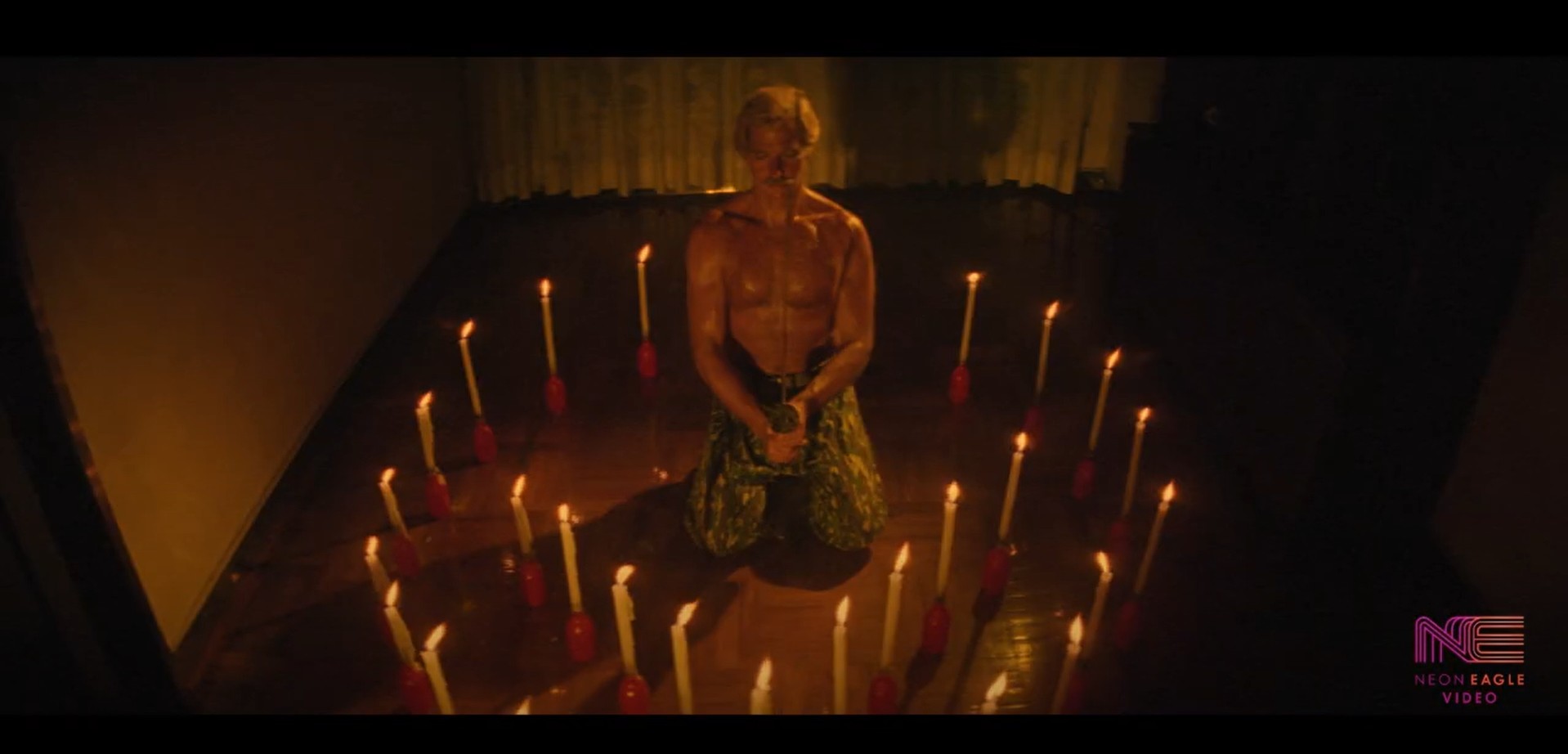
The Golden Ninja Warrior is the corrupt Ninja Empire’s most valued and powerful artifact with mystical powers to whomever posses it’s three pieces, granting them near invincibility against enemy attacks.  The Supreme Ninja leader displays the power of the golden bust, resembling a beastly torse and head wielding a katana, to three of the Empire’s Ninja Masters – Tamashi, Baron, and Harry.  The three Ninja Masters betray their supreme leader, each stealing a piece of the statue for their own intent and purposes.  With one piece back in the hands of the Supreme Ninja leader after Tamashi’s demise, the now crime boss Baron seeks Tamashi’s piece and will do anything, and kill anyone, to get it with the aid of his cruel right hand man Tiger Chan.  Meanwhile, Harry resigned from the Ninja Empire to reform the organization’s criminality but has been unearthed by the Empire’s Supreme leader with an ultimatum to return the pieces of the Golden Ninja Warrior.  With the help of his cocky and confident partner, Jaguar Wong, Harry and Jaguar investigate into Tamashi and his brother’s death, try and protect their surviving sister from those looking for Tamashi’s piece of the Golden Ninja warrior, and defeat any Baron or Empire warriors that stand in their way.

One of the numerous released Godfrey Ho productions in which the director shot new scenes with Caucasian, abroad actors and edited them into an pre-existing film his company owned the international rights.  “Ninja Terminator,” a bestowed title at the height of James Cameron’s highly popular cybernetic, time-travelling thriller “The Terminator,” is the 1986 Hong Kong feature that breathes new life into the South Korean,1984 released, martial arts gangster film “Uninvited Guest” as Ho splices new additional footage to create his own, half-cocked storyline for a cost-effective ninja themed film starring a recognizable white actor.  Ho writes and directs the IFD Films production that’s produced by Ho’s makeshift Ninja feature team of Betty Chan (“Ninja Strike Force”), Joseph Lai (“Full Metal Ninja”), and Steve Kam who regularly took popular U.S. tiltes and integrated them into their own for advantageous marketing.

Where to start with actors and actresses?  Two films shot in two completely different times with renamed characters and additional characters in a jumbled-up mesh of a ninja film.  Lets start with Richard Harrison, an American actor with muscles and good looks who couldn’t quite land the parts he wanted in his home country but found lead man success in other parts of the world, especially in the filmic industries of Italy (“Orgasmo Nero,” “One Hundred Thousand Dollars for Ringo”) earlier in his career and, in this case, Hong Kong (“Inferno Thunderbolt,” Diamond Ninja Force”) later in his career collaborating a handful of times with filmmaker Godfrey Ho.  For “Ninja Terminator,” Harrison isn’t a stealthy cybernetic ninja master but rather an idealistic, benevolent ninja master sporting a unique camo ninja-yoroi to, I guess, blend in around his home and urban environment…?  Still, the camouflaged attire has to be more clandestine than the hot red ninja-yorois of the Ninja Empire.  At least fellow western actor, Jonathan Wattis, as one of the three ninjas who stole a piece of the Golden Ninja Warrior statue and became a crime lord himself, donned a near traditional, black-dyed ninja garb.  Harrison and Wattis do the best they can being spliced into Jack Lam’s film “Uninvited Guest.”  Reconstructed or replayed to be named Jaguar Wong, for his character’s Jaguar fighting style, Jack Lam bests Wattis and levels with Harrison for screen time as a fellow principal lead despite the 2-3 year difference between principal photography but Jaguar fits in aptly enough into an inept chaos of a near nonsensical ninja narrative that jumps to inconclusive subplots with little connective tissue to the core plot.  Maria Francesca, Jeong-lee Hwang, James Chan, Simon Kim, Phillip Ko, Keith Mak, Tae-Joon Lee, Nancy Chan, Gerald Kim, Andrew Lee, and Eric Leung costar.

Cheaply made knockoffs and spirited, gung-ho capitalizing on popular film titles saw fists-of-fury in Hong Kong circa 1970s through the 1980s, much the same way the Italians also didn’t believe the copyright laws when they too took advantage with unofficial sequels, especially in the horror genre.  “Ninja Terminator” is obvious one of those projects and the sly Godfrey Ho manipulated the international market to garner new public interest in what is basically an old film with additional scene, a scheme done pretty much on the regular in various countries, even in the United States.  However, “Ninja Terminator” is not a good movie but rather a hilariously bad one weighed down by irrelevant offshoots to flesh out a scantily structured half-script.  With the additional scenes of Richard Harrison and the others spliced in, plus Jack Lam’s one-man army showdowns against henchmen and sub-bosses, the combat saves “Ninja Terminator” from full frontal embarrassment with competent choreographed fights, plenty of sword, ninja star, and ninja trickery play, and a fair amount of acrobatics, even if some of the scenes are just gratuitous cartwheels and flips in an ostentatious display of skill and of trying to raise the value of a low-budget production.  Granted, there are no cartwheels or flips in Jack Lam’s storyline, nor is there a single ninja, but Lam’s take-on-the-world scenes are confidently hip for the period and that is the jelly to the bold Ninja peanut butter that makes “Ninja Terminator” work on an amusingly bad level. 

Neon Eagle Video, a subsidiary label of Cauldron Films that focuses on the best of the worse of Asian cinema, scour the globe and deliver the best and authorized reproduction of “Ninja Terminator” on Blu-ray in North America, restored from a 4K scan of the original negative and presented in its proper anamorphic widescreen aspect ratio of CinemaScope 2.39:1. I must agree with Neon Video Eagle that this transfer renders the cleanest and clearest reproduction to date, likely ever, in this compilation of source materials to render a corrective, singular 4K scan. The AVC encoded, 1080p high-def resolution, BD50 offers ample storage to limit or squash any compression indelicacies on an already delicate Godfrey Ho production that’s been bootlegged to bastardization for decades. Corrected color timing sizes up the landscape, the mise-en-scene elements, and the characters too with a diffused scheme that holds firm vibrancy across an early 1980’s hip and preppy Japanese fashion. The audio is a forced English dub with an encoded LPCM 2.0 mono. The ADR definitely is seen and sounded as expected with total unsynchronized lips and dialogue, especially when the story is forged from splitting two films into one. What’s also evident amongst the three-prong, rough-and-ready sound design is the unrealistic fighting sounds, overzealous and overexerted to be more like the Hong Kong Kung-Fu movies of the decade before. The last element is the soundtrack that’s got some funk and groove in its ninja-yorois that likely borrowed and repurposed from another Godfrey Ho production to fit this particular need. Optional English subtitles are avaialble.. Special features include brand new material, including an audio commentary by Kenneth Brorsson and Phil Gillon of the Podcast on Fire Network, a second audio commentary by Asian film expert Arne Venema and Mike Leeder, an interview with director Godfrey Ho Ninja Master discussing the popularity of ninja films in the United States and the appropriation of the “Terminator” title as well as touching upon Richard Harrison and his onboarding onto the film, a second Godfrey Ho interview alongside separately dubber Simon Broad Golden Ninja Dubs discussing the quick and loose ADR of Hong Kong cinema, an interview with “These Fits Break Bricks” co-author Chris Poggiali Ninjamania, and the trailer. Neon Eagle Video’s standard release, showcased inside a clear Blu-ray Amaray, presents new artwork by graphic artist Justin Coffee. The reverse side of the cover holds the still capture composition of the original one-sheet. No insert material included, and the disc is pressed with the same Coffee illustration. The region free disc has a runtime of 90 minutes and though not listed as unrated, the film is surely such.

The First Authorized Blu-ray of “Ninja Terminator” Now Available!

EVIL Doesn’t Take Rejection Well. “Village of Doom” reviewed! (Unearthed Films / Collector’s Edition Blu-ray)

“Village of Doom” now on Unearthed Film’s Collector’s Edition Blu-ray!

Tsugio Inumaru is considered the smartest young man in his village.  Illness took the life of his parents, and he raised by his grandmother and lives off her land’s income, looking after him and dreading the day Tsugio becomes drafted as a soldier in war service, which bestows great honor from the villagers.  While husbands are away serving their country, bored and lonely housewives and bachelorettes desire the carnal company of the men remaining and with Tsugio’s youth and his own sexual yearnings bubbling to the surface, he’s prime Kobe beef for the hungry village women.  When Tsugio’s health examination reveals a tuberculosis diagnosis, he’s acutely shunned by the villagers, drying up his sexual escapades, as well as potential betrotheds.  Rejection by his village, and even his country, sends the young man into plotting a massive killing spree, targeting all of those who’ve forsaken or scorned him to a life not worth living. 

In the Tsuyama outskirt village of Kamo of 1938, 21-year-old Mutsuo Toi cut the village’s electricity, strapped flashlights to the side of his head, and took a mini arsenal that included a Browning shotgun, a katana, and an axe to 30 villagers, including his grandmother, in an act to revenge killing for being rejected socially and sexually because of his tuberculosis diagnosis.  What is known as the Tsuyama Massacre, Mutsuo Toi’s cold and merciless act of carnage was the basis for Noboru Tanaka’s “Village of Doom.”  The pinkupsloitation director of “Rape and Death of a Housewife” and “Angel Guts:  Nami” helms the Japanese, semi-biographical tale, penned by Takuya Nishioka (“Tattoo,” “Female Teacher:  Chain and Bondage”), that follows closely the bullet point events of Mustuo Toi but with different named characters and a strong pink eiga touch.  “Village of Doom” is one of Kazuyoshi Okuyama’s (“R100,” “Self-Bondage:  All Tied Up with My Own Rope”) first produced ventures and is a production of the Fuji Eiga and Shochiku Eizo Companies. 

While Mutsuo Toi is not directly portrayed, his downward spiraling steps are indirectly followed by Tsugio Inumaru, played by the late Nikkatsu actor Masato Furuoya.  Furuoya’s relationship with director Noboru Tanaka is well established within their director-actor collaborating context with Furuoya having roles in Tanaka’s previous credits of “Rape and Death of a Housewife” and “Angel Guts:  Nami.”  There’s a blanket of comfortability within Furuoya who must treat his character as one-part pink paramour and one-part biographical massacrer, seducing with a tantamount tease of fantasy and authenticity.  Furuoya’s beleaguered performance is a jagged mountainous range of emotions from confidence and compassion to hormonal desires, to the stressed misgivings from cold shoulders and bad fortune mishandled by Tsugio’s own sense of worth to his himself and the village that has turned its back on him.  In keeping with the simulated practice of Yobai, the night crawling sexual escapades amongst young men and women, typically unmarried men and women, Tanaka portions heavily toward Tsugio’s internal grievances with the suddenly thrusted into the primitive and stimulated needs of a young man’s novice sex drive awaken with a morsel nude photograph.  Furuoya’s costars are the collective antagonist from the perspective of Tsugio with their geniality turned hostility of the TB diagnosis.  Sexualized warmth and freedom run rampant, peppered in between with subdued duty to village and country, that cradles an shy Tsugio’s into his manhood but when his manhood is threatened and the village neglects and rejects his contributions, Tsugio’s acute ostracization from within the only community circle he’s ever known disfigures his rationality into revenge.  The cast is surprisingly pink vet lite with the actors coming from other Japanese oriented popular subgenres like samurai films, erotic but tasteful comedies and romance, and horror with Misako Tanaka, Isao Natsuyagi (“Female Prisoner #701: Scorpion,” Kumiko Ôba (“Hausu”), Shino Ikenami (“Evil Dead Trap 2”), Midori Satsuki, Yashiro Arai, Renji Ishibashi, and Izumi Hara (“Island of the Evil Spirits”).

“Village of the Doom” is a two-toned down spiral to build up only to crash down the hopes of an impressionable young person.  Similarly seen in later works like Gus Van Sant’s “Elephant” where the visually intense, raw, and viscerally slicing culmination of enough-is-enough points back to the series of occurrences that significantly mile mark every step lead to the slaughter.  Set inside a valley surrounded by green mountains, the idyllic and rural riverside village impresses more backdrop tranquility than doom with slower pace and dutiful lifestyles but like most cutoff societies, the slow, insidious corruption of morality courses with infectious infidelity under the guise of Yobai, upends rightful justice and trades in for lynch mobs, and wanes promises for easy streets and exploitation run out dates that run its course for one but not the other.  All these aspects have relevant translatability to today’s cliques and inner circles that oust the unusual to where a sense of belonging feels hopelessly frustrating.  The isolation is so engrained that it highlights, in a very matter-of-fact way but does speak to it quite a bit, is the incestuous relationships between related villagers with the instances of Tsugio and cousin Kazuko’s flirtatious meetups and talk of marriage as well as Tsugio accidental arousal around his cousin’s aunt.  This adds to the tension and the corruption of that old idiom of don’t shit where you eat and the evident sourness spoils relationship ties when family is important to lessen the blows of life’s subsidiary problems.  For Tsugio, who is already dealt a bad hand with both parents deceased and his illness, the whole village rots what’s left of his innocence and ambitions and, in turn, aims to exterminate those who’ve foiled his purity.

A wicked, notorious true crime story now for the rest of the world to visual in “Village of Doom” on Blu-ray, courtesy of Unearthed Films on their Unearthed Classics sublabel.  The new Collector’s Edition Blu-ray is format encoded onto an AVC encoded, 1080p high-definition, BD50.  The picture is tempered with the muted colors, or rather the scaled grays, of an archaic Japanese village coupled by the browns and straw hued housing set amongst in and surrounded by a sea of green foliaged valley, and while objects are delineated nicely without any saturation bleeding or compression issues, the colors don’t necessary pop.  What does pop are the textures of the same articles mentioned above.  The groves of thatched wooden abodes are remarkable deep, the greens, though seamless, are nicely touched upon in the foreground, and skin consistencies vary person-be-person within idiosyncratic personal brackets with dynamic sweatiness and emotion-delivery contouring to accentuate.  The Japanese LPCM 1.0 mono has no problem discerning elements.  Though all funneling through a single channel, the dialogue and ambience works together thanks to the clean, more immersive ADR.  Mashanori Sasaji’s tests the soundscapes of traditional Japanese drum rhythms of Oo-daiko with then modernized synthesized notes to create a forebodingly, entrancing composition.  With any post-production voiceover work, dialogue is very robust, and the synchronized English subtitles offer an error-free and organic translation.  The original audio file is compressed cleanly with no issues with crackling, hissing, or any other damage for noting. Unearthed Film’s 17th spined Classics title supplements with an audio commentary by Asian film experts Arne Venema and Mike Leeder, a look at the Tsuyama Massacre in Dark Asia with Megan: Case #57 Japan’s Darkest Night, a promotional gallery, and the theatrical trailer. The Amary Blu-ray case is housed in a cardboard O-slipcover featuring Mutsuo’s iconic night-crawlin’ getup on Masato Furuoya’s Tsugio in colorless black-and-white. The case has the same image used for the cover with no reversible sleeve and the inside does not contain any tangible inserts or materials. The disc is pressed with not the same image but the same head flashlight Tsugio, this time looking right at you in unison with his shotgun barrel. The not rated feature has a runtime of 106 minutes and is region A locked.

Last Rites: “Village of Doom” depicts the same sad story that strikes the hearts of today’s mass shootings, spurred by the dispel from those in proximity, intimate, and friendly. “Village of Doom” is a true classic of casted out carnage relit by Unearthed Films to retell the notorious narrative of Japan’s deadliest mass killing ever.

“Village of Doom” now on Unearthed Film’s Collector’s Edition Blu-ray!