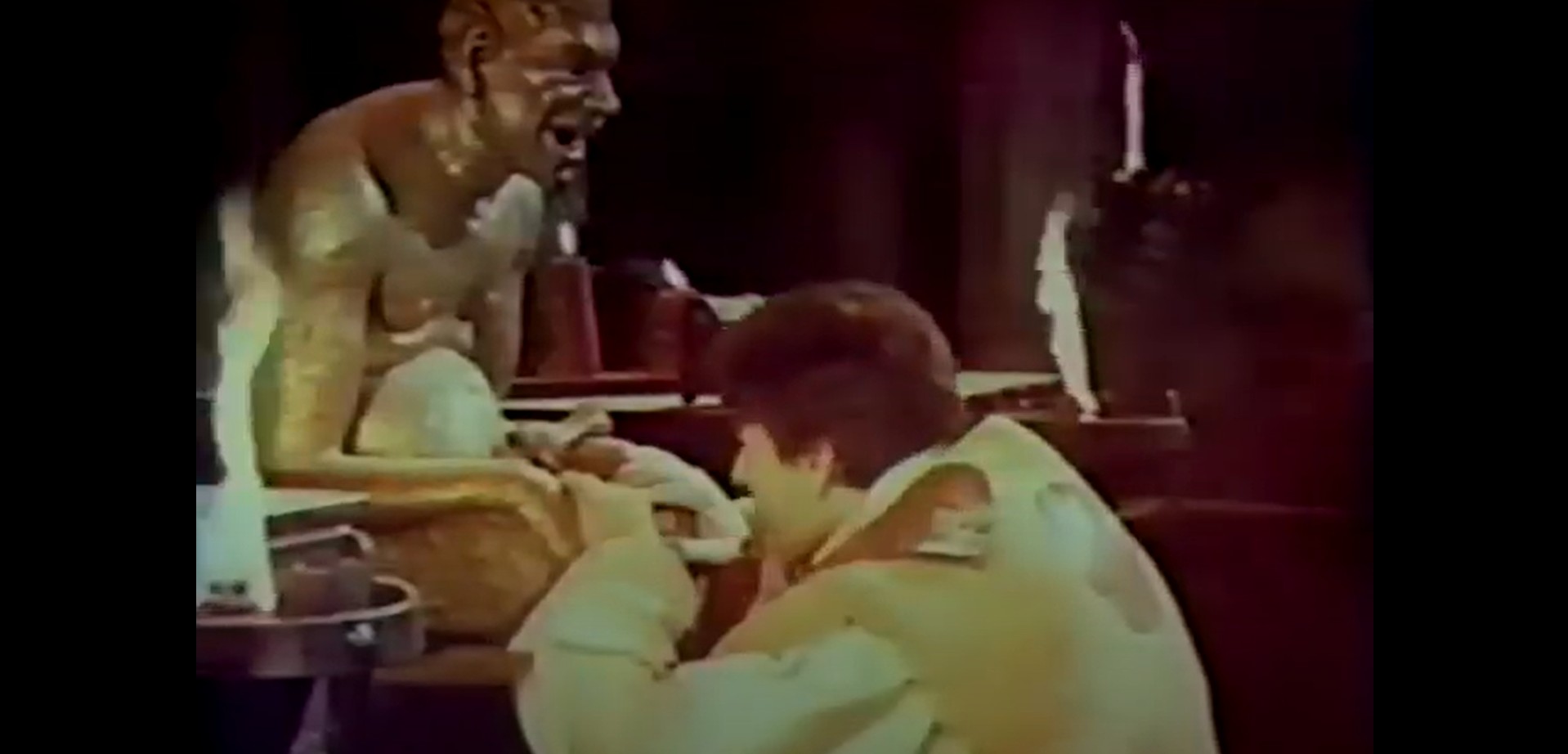
The Golden Ninja Warrior Turns Good Ninja Masters to EVIL! “Ninja Terminator” reviewed! (Neon Eagle Video / Blu-ray)

The Golden Ninja Warrior is the corrupt Ninja Empire’s most valued and powerful artifact with mystical powers to whomever posses it’s three pieces, granting them near invincibility against enemy attacks.  The Supreme Ninja leader displays the power of the golden bust, resembling a beastly torse and head wielding a katana, to three of the Empire’s Ninja Masters – Tamashi, Baron, and Harry.  The three Ninja Masters betray their supreme leader, each stealing a piece of the statue for their own intent and purposes.  With one piece back in the hands of the Supreme Ninja leader after Tamashi’s demise, the now crime boss Baron seeks Tamashi’s piece and will do anything, and kill anyone, to get it with the aid of his cruel right hand man Tiger Chan.  Meanwhile, Harry resigned from the Ninja Empire to reform the organization’s criminality but has been unearthed by the Empire’s Supreme leader with an ultimatum to return the pieces of the Golden Ninja Warrior.  With the help of his cocky and confident partner, Jaguar Wong, Harry and Jaguar investigate into Tamashi and his brother’s death, try and protect their surviving sister from those looking for Tamashi’s piece of the Golden Ninja warrior, and defeat any Baron or Empire warriors that stand in their way.

One of the numerous released Godfrey Ho productions in which the director shot new scenes with Caucasian, abroad actors and edited them into an pre-existing film his company owned the international rights.  “Ninja Terminator,” a bestowed title at the height of James Cameron’s highly popular cybernetic, time-travelling thriller “The Terminator,” is the 1986 Hong Kong feature that breathes new life into the South Korean,1984 released, martial arts gangster film “Uninvited Guest” as Ho splices new additional footage to create his own, half-cocked storyline for a cost-effective ninja themed film starring a recognizable white actor.  Ho writes and directs the IFD Films production that’s produced by Ho’s makeshift Ninja feature team of Betty Chan (“Ninja Strike Force”), Joseph Lai (“Full Metal Ninja”), and Steve Kam who regularly took popular U.S. tiltes and integrated them into their own for advantageous marketing.

Where to start with actors and actresses?  Two films shot in two completely different times with renamed characters and additional characters in a jumbled-up mesh of a ninja film.  Lets start with Richard Harrison, an American actor with muscles and good looks who couldn’t quite land the parts he wanted in his home country but found lead man success in other parts of the world, especially in the filmic industries of Italy (“Orgasmo Nero,” “One Hundred Thousand Dollars for Ringo”) earlier in his career and, in this case, Hong Kong (“Inferno Thunderbolt,” Diamond Ninja Force”) later in his career collaborating a handful of times with filmmaker Godfrey Ho.  For “Ninja Terminator,” Harrison isn’t a stealthy cybernetic ninja master but rather an idealistic, benevolent ninja master sporting a unique camo ninja-yoroi to, I guess, blend in around his home and urban environment…?  Still, the camouflaged attire has to be more clandestine than the hot red ninja-yorois of the Ninja Empire.  At least fellow western actor, Jonathan Wattis, as one of the three ninjas who stole a piece of the Golden Ninja Warrior statue and became a crime lord himself, donned a near traditional, black-dyed ninja garb.  Harrison and Wattis do the best they can being spliced into Jack Lam’s film “Uninvited Guest.”  Reconstructed or replayed to be named Jaguar Wong, for his character’s Jaguar fighting style, Jack Lam bests Wattis and levels with Harrison for screen time as a fellow principal lead despite the 2-3 year difference between principal photography but Jaguar fits in aptly enough into an inept chaos of a near nonsensical ninja narrative that jumps to inconclusive subplots with little connective tissue to the core plot.  Maria Francesca, Jeong-lee Hwang, James Chan, Simon Kim, Phillip Ko, Keith Mak, Tae-Joon Lee, Nancy Chan, Gerald Kim, Andrew Lee, and Eric Leung costar.

Cheaply made knockoffs and spirited, gung-ho capitalizing on popular film titles saw fists-of-fury in Hong Kong circa 1970s through the 1980s, much the same way the Italians also didn’t believe the copyright laws when they too took advantage with unofficial sequels, especially in the horror genre.  “Ninja Terminator” is obvious one of those projects and the sly Godfrey Ho manipulated the international market to garner new public interest in what is basically an old film with additional scene, a scheme done pretty much on the regular in various countries, even in the United States.  However, “Ninja Terminator” is not a good movie but rather a hilariously bad one weighed down by irrelevant offshoots to flesh out a scantily structured half-script.  With the additional scenes of Richard Harrison and the others spliced in, plus Jack Lam’s one-man army showdowns against henchmen and sub-bosses, the combat saves “Ninja Terminator” from full frontal embarrassment with competent choreographed fights, plenty of sword, ninja star, and ninja trickery play, and a fair amount of acrobatics, even if some of the scenes are just gratuitous cartwheels and flips in an ostentatious display of skill and of trying to raise the value of a low-budget production.  Granted, there are no cartwheels or flips in Jack Lam’s storyline, nor is there a single ninja, but Lam’s take-on-the-world scenes are confidently hip for the period and that is the jelly to the bold Ninja peanut butter that makes “Ninja Terminator” work on an amusingly bad level. 

Neon Eagle Video, a subsidiary label of Cauldron Films that focuses on the best of the worse of Asian cinema, scour the globe and deliver the best and authorized reproduction of “Ninja Terminator” on Blu-ray in North America, restored from a 4K scan of the original negative and presented in its proper anamorphic widescreen aspect ratio of CinemaScope 2.39:1. I must agree with Neon Video Eagle that this transfer renders the cleanest and clearest reproduction to date, likely ever, in this compilation of source materials to render a corrective, singular 4K scan. The AVC encoded, 1080p high-def resolution, BD50 offers ample storage to limit or squash any compression indelicacies on an already delicate Godfrey Ho production that’s been bootlegged to bastardization for decades. Corrected color timing sizes up the landscape, the mise-en-scene elements, and the characters too with a diffused scheme that holds firm vibrancy across an early 1980’s hip and preppy Japanese fashion. The audio is a forced English dub with an encoded LPCM 2.0 mono. The ADR definitely is seen and sounded as expected with total unsynchronized lips and dialogue, especially when the story is forged from splitting two films into one. What’s also evident amongst the three-prong, rough-and-ready sound design is the unrealistic fighting sounds, overzealous and overexerted to be more like the Hong Kong Kung-Fu movies of the decade before. The last element is the soundtrack that’s got some funk and groove in its ninja-yorois that likely borrowed and repurposed from another Godfrey Ho production to fit this particular need. Optional English subtitles are avaialble.. Special features include brand new material, including an audio commentary by Kenneth Brorsson and Phil Gillon of the Podcast on Fire Network, a second audio commentary by Asian film expert Arne Venema and Mike Leeder, an interview with director Godfrey Ho Ninja Master discussing the popularity of ninja films in the United States and the appropriation of the “Terminator” title as well as touching upon Richard Harrison and his onboarding onto the film, a second Godfrey Ho interview alongside separately dubber Simon Broad Golden Ninja Dubs discussing the quick and loose ADR of Hong Kong cinema, an interview with “These Fits Break Bricks” co-author Chris Poggiali Ninjamania, and the trailer. Neon Eagle Video’s standard release, showcased inside a clear Blu-ray Amaray, presents new artwork by graphic artist Justin Coffee. The reverse side of the cover holds the still capture composition of the original one-sheet. No insert material included, and the disc is pressed with the same Coffee illustration. The region free disc has a runtime of 90 minutes and though not listed as unrated, the film is surely such.

The First Authorized Blu-ray of “Ninja Terminator” Now Available!

A Young Man Has to Become Someone Else to Exact Revenge on EVIL! “The Adventurers” (Eureka Entertainment / Special Limited-Edition Blu-ray)

Limited Edition “The Adventurers” Now on Blu-ray from Eureka Entertainment!

A Cambodian boy’s family is brutally murdered by the family friend and covert colleague Ray Lui, in front of him.  Alone and distraught, Wai Lok-yan is taken under the wing of his Uncle Shang, a CIA operative living in Thailand, and grows up to be a military fighter pilot still haunted by the violent death of his family.  When a newspaper headline names the now wealthy-by-gun-smuggling Ray Lui is to attend a public event, Wai Lok-yan is hellbent to kill Ray Lui at any cost, despite his career and his life, but a horribly failed assassination attempt puts his life in danger.  Uncle Shang strikes a deal with the CIA, who also want Ray Liu dead, to allow Wai Lok-yan in the United Staes in exchange to be an undercover operative named Mandy Chan, a gang boss seeking to kidnap Liu’s estranged daughter Crystal to get closer to the murderous arms smuggler.  However, what Wai Lok-yan didn’t expect in his mission was to fall in love.

The 1995 Ringo Lam gun action-thriller “The Adventurers” starring Andy Lau is in no way related to the 2017 Stephen Fung gun action-thriller “The Adventurers” also starring Andy Lau.  I just wanted to get that out there and over with.  Moving on.  Ringo Lam, director of the Jean-Claude Van Damme films “Maximum Risk,” “Replicant,” and “In Hell,” cowrites what is known in Hong Kong as a heroic bloodshed feature with “Supercop 2’s” Sandy Shaw and Kwong-Yam Yip.  Heroic bloodshed is a popular subgenre stemmed and coined from the 1980s that surrounded themes of duty, honor, and violent gunplay while embroiled in a web of drama and plot complexities that make it seem almost impossible for the hero to come out alive.  The internationally filmed production, spearheaded between China Star Entertainment and Win’s Entertainment Ltd., is produced by “Black Mask’s” Tiffany Chan and Charles Heung.

As stated earlier, Andy Lau stars as the protagonist lead playing a dueled dual life as the orphaned Woai Lok-yan seeking vengeance through the pseudonym of Mandy Chan, criminal boss infiltrating as a spy and assassin against his family’s murderer Ray Lui, played by the longstanding actor Paul Chun (“In the Line of Duty III,” “Hong Kong 1941”).  The “Internal Affairs,” Hong Kong action star Lau seizes and harbors his character’s plotted difficult choice:  to do whatever it takes to get within arm’s length trust of the man who killed his family versus falling gradually in love with that same murderer’s innocent daughter.  There’s plenty of back and forth for Lau to engage in both footsteps that teeter a line between duty, responsibility, and the heart but one side does swallow the other and in a negative way as the romance with love interest Crystal (Chien-Lien Wu, “Beyond Hypothermia”) is sorely underplayed against the Ray Lui mission and a competing love interest in Lui’s arm candy flavor of the month Mona, played by Rosamund Kwan (“The Head Hunter”).  Mona’s desperation to leave or kill Ray Lui, and subsequently be with Wai Lok-yan, is to the point of letting the mission and the love between Mandy and Crystal burn to the ground and that greatly built up and infringes upon the lack of genuine connection provided to give Mandy and Crystal a sympathetic understanding, especially when Ringo Lam’s storytelling isn’t scene successive and time is basically nonexistent.  Less detrimental to story, Mona’s subplot also does take a bite out of the whole operative mission itself, as it creates more complexities for Mandy when a gun smuggler’s woman wants out and will reluctantly do anything to achieve that goal, even backstab the Mandy who she wants to be with.  As the zippy story hits all the highlights, one downside aspect is also zipping through interesting supporting roles from David Chiang (“Murder Plot”), Ben Ngai-Cheung Ng (“The Eternal Evil of Asia”), Victor Wong (“Big Trouble in Little China,” “Tremors”), George Cheung (“Robocop 2”), Van Darkholme, Ron Yuan (“Godzilla 2000”), Phillip Ko (“Cannibal Curse”) and Andy Tse (“Naked Ambition”).

A powerfully engaging opening, heighted for full empathetic effect and visceral distress, of little Wai Lok-yan’s family being mercilessly slaughtered right before his eyes immediately has audiences on his side, especially when the boy, whose no more than 6-8 years old, bawls and collapses right into the arms of Uncle Shang shortly after the bloody aftermath.  What ensues is a flash forward to years later with Wai Lok-yan, now a grown man and a Thai fighter pilot, haunted by his past when his family’s killer Ray Lui surfaces in the paper.  At this point is where the story begins to snowball downhill, gaining speed at an inconceivable rate and growing bigger and bigger by the scene.  The action is pleasingly palatable with excellent gunplay and hand-to-hand fight choreographies that’s squib-tastically bloody and hard-hitting.  Where the story struggles typically reside, perhaps on a more subjective level, is the pacing that’s aimed to fly through the Wai Lok-yan/Mandy Chan timeline at a breakneck speed in order to capture the loops and hoops the hero has to jump through to reach Ray Lui but the way he infiltrates the public ceremony to assassinate Ray Lui, being integrated into the San Francisco Asian street gang, and even his sudden marriage to Crystal without the imprinting buildup of romance shocks the critical thinking system, tricking the brain into a stagnant state by time lapsing forward not in days or in weeks but in months or in years of time passed without the ease of a better transition to work into the time and space in-between.  Also, “The Adventurers” severe lack the motorized mayhem in the land, air, and sea, and despite the film’s select advert one sheets of Wai Lok-yan in full fighter pilot gear and his soaring adult introduction, hurts the image the film portrays that’s more grounded in melee combat or in a barrage of bullets with only bookend combat jet and helicopter sequences and a brief car chase in the middle that impress just above the par bar. 

UK label Eureka Entertainment brings to North American shelves, and audiences, a special, limited-edition Blu-ray edition of “The Adventurers,” stored onto an AVC encoded, high-resolution, 1080p, BD50.  Visual aspects on the Eureka’s brand new 2k restoration release is impeccable with a clear delineation, a sharp detail-driven style, and a clean, desaturated color scheme that’s hard, gritty, and muted, catering extensively to the intense violence and fast-paced action themes of the heroic bloodshed subgenre film.  Lam’s Dutch angles are dramatically harnessed in the Hi-Def scan with additional pixels emphasizing every element in the frame that makes the scene that more dramatic and a concentrated actioner in the anamorphic widescreen 1.85:1 aspect ratio.  Even the jetfighters are clearer and distinct with the camera and object movements that render the plane as a fighter plane rather than the vague blur that maybe is a plane or could be bird.  There are three Cantonese audio tracks, including a restored LPCM stereo, a restored DTS-HD MA 5.1, and the original unrestored stereo.  The unrestored stereo is quite indelicate with plenty of flawed rudiments that have a hard time sustaining with “The Adventurer’s” range.  The restored stereo is an efficient, effective, and adequate exaltation of the original audio track but A/V enthusiast will definitely be pleased with the surround sound DTS-HD 5.1 that completely is immersive where it counts, such as the bookend aerials and channel diffused gunplay that brings the action’ to your ears rather than your ears trying to capture the action.  The 5.1 absolutely feels more robust without being artificially broached.  Newly translated English subtitles are optionally available for an inhouse dialogue that’s clear and present at all times throughout the story.  Special features include a new audio commentary by film critic David West, a new interview with Asian Journal’s editor-in-chief Gary Bettinson Two Adventurers, unearthed archive interview with writer and producer Sandy Shaw, and the theatrical trailer.  What’ makes Eureka Entertainment’s release a limited edition is the cardboard O-card slipcase overtop the clear Blu-ray Amaray case with new artwork by Time Tomorrow, which is a composition of stills bathed in yellow and shadowed in black.  The Amaray has the more egregiously misleading original poster art of the protagonist in jetfighter attire and the New York City’s twin towers in the background for the pre 9/11 film; however, Andy Lau is only briefly in the gear during his adult character’s introduction and his character does not end up in New York City, but rather San Francisco.  A collector’s 19-page booklet resides in the insert section with color photos, more misleading promotional stills, an essay by Hong Kong cinema scholar Aaron Han Joon Magnan-Park from the University of Hong Kong, film credits list, Blu-ray credits list, and tips and tricks for viewing the film properly according to your cinema setup settings.  The release is not rated, has a runtime of 110 minutes, and is encoded with a region A and B playback.

Last Rites: Eureka Entertainment brings Andy Lau back into the spotlight with a slick new transfer for “The Adventurers,” action-packed revenge bottled to be less romantic and more fervid in nature.

Limited Edition “The Adventurers” Now on Blu-ray from Eureka Entertainment!

EVIL Chews Through Its Own Loved Ones as “The Vourdalak” reviewed! (Oscilloscope Laboratories / Blu-ray)

“The Vourdalak” Available Now at Amazon.com!

The special emissary of the King of France is ambushed by Turks in an isolated Slovic countryside.  With his carriage and clothes stolen and his driver-servant dead, Monseigneur Marquis Jacques Antoine Saturnin d’Urfé has nothing more than the clothes on his back.  He finds himself in the home of Gorcha, an enemy of the Turks, who resides with his three adult children, a daughter in law, and a grandson, but Gorcha was not presently there to greet his hapless visitor until his returns later that day from fighting the Turkish raiders.  Yet, aside from the oldest son Jegor, the family’s superstitious beliefs lead them to doubt Gorcha returning home human and instead has returned as vourdalak, or a blood hungry vampiric creature who feeds on his own loving family to turn them all into the same unnatural ilk.  From an outsider’s point of view, what Marquis d’Urfé witnesses initially is a strange peasant family’s irritational fear turn into a harrowing horror as one-by-one the family members reach an unfortunate end after the return of Gorcha.

Based off the gothic novella “La Famille du Vourdalak. Fragment inedit des Memoires d’un inconnu” from Russian author Aleksey Konstantinovic Tolstoy, a story that plays on the etymology of the Slavic folklore word Wurdulac, or a vampire-like creature, that exacts a similar transpiring fate as described in the above plotline of Adrien Beau’s “The Vourdalak.”   The writer-director fleshes out the 1839 Tolstoy story, one that’s predates Bram Stoker’s “Dracula” by nearly 60 years, for his own period set rendition created for modern times almost two centuries later in 2023 as his debut feature-length film.  The French film is cowritten alongside Hadrien Bouvier who doesn’t depict the vampiric creature as a nobleman, or even a man of wealth, but rather as a likely lowly serf of the countryside under a noble or lord.  Yet, the script, very much like Tolstoy’s novella, is contained within the family and their home rather than expanding across continents and seas, as in Stoker’s “Dracula.”  “The Vourdalak” is produced by “Alone in Berlin’s” Marco and Lola Pacchnioni and Judith Lou Lévy (“Zombie Child”) under the production banners of Les Films du Ball, Master Movies and, in association with, Cinemage 17 and Amazon. 

A period piece with an intimate cast brings closer together the targeted era of late 18th century to early 19th century costuming, articles, and, to extent, performances that sell the monarchial times of French aristocracy and Slavic provincials living humbly on the fringes of an everlasting Russo-Turkish war that spanned decades.  Leading the charge is the only French aristocrat portrayed character in the story played by Kacey Mottet Klein (“The Suicide Shop”).  Dressed in traditional Empiric style high collar shirt, petty coat, and a white wig and garishly garnished with white pale-looking makeup with mouche, an adhesive mole, to reflect their wealth and status, Klein’s prim-and-proper, yet prudish and prissy, Marquis Jacques Antoine Saturnin d’Urfé is finely out of his element with a satisfiable character arc that has the Monseigneur go from a squeamish snob to finding compassion, sympathy, and courage amongst darkness aimed to swallow a family whole as d’Urfé’s high society and fantastical life clashes with the real world with war, necessity, death, natural beauty, unconventionalities, and consideration through another type of fantasy lens, a troubling, insidious darkness that plagues and feeds on the blood from within a domestic design that’s ruthless as it is unfathomable.  Jegor (Grégoire Colin, “Bastards”) is the loyal eldest son, Piotr (Vassili Schneider, “The Demons”) is the sexual orient ambiguous second son with external emotions unlike his other brother, Sdenka (Ariane Labed, “The Brutalist”) is the free-spirited but melancholic beauty, Anja (Claire Duburcq, “She is Conann”) as Jegor’s more than practical and realistic wife and young Vlad (Gabriel Pavie) is Jegor and Anje’s preadolescent boy.  The aforenoted characters are all embodied by a physical, living person to play the role but Gorcha is a horse of another color.  In fact, Gorcha’s not a living thing at all and is actually a puppet personified by two puppeteers and voiced by director Adrien Beau.  The puppet has an emaciated appearance, resembling closely to those used in “Return of the Living Dead, and with the power of green screen, the animating arms and bodies are overlayed out and Gorcha lives and breathes with an animatism spirit that’s creepy as all Hell with an underscoring tow of vampirism. 

In its essence, “The Vourdalak” embraces the simplicity with a less-is-more atmosphere, a self-assured reliance in the palpable and practical, and a confidence in its cast to extract the drama and horror of a longstanding folklore and deliver its poignant potency with eccentric diversity and steady anxiety.  Beau drenches dread into every crevice that sticks like humidity to its subdued black comedy attire.  Yes, “The Vourdalak,” though grim and dark, has a sliver of comedy course through its bloodlet and lapped up veins from the main character’s perspective who, at first, is quite out of his comfortable, aristocracy element being wiggled into a lower-class family’s unusual dysfunctionality.  There’s also the puppet aspect integrated into living, breathing actors as if one of their own and that certainly as a basic layer of absurd surrealism, the French know a thing or two about liberal arts absurdism.  Beau’s shooting style resembles a blend between the fixed camera and low-key lit silent films, also implementing throwback spyglass shots that were widely used in the early cinematic period, and the Euro-horror movement of the 1960s to early 1980s with an ominous romanticism, a dark and creepy-fog environment, and tinged to cooler shades of soft blues and greens all the while lightly touching upon themes of sexuality, homosexuality, and family structures that often collide with one another to stir the pot and overshadows the imminent danger in front of them. 

“The Vourdalak” is unpredictably grotesque in the most amusingly macabre way and is now on a region free Blu-ray release from our friends at Oscilloscope Laboratories.  AVC encoded onto the BD50, the high definition, 1080p resolution, might throw audiences and purveyors of physical media for a loop when the picture isn’t as fine as expected for a modern released picture.  That’s because Adrien Beau shot “The Dourdalak” in Super 16mm that enlivens a grainy and soft toned picture that can appear slightly blurry, resembling the ilk of European horror from the 1960s-1980s  Presented in an anamorphic widescreen 2.35:1 aspect ratio, Beau is very committed the coldness of bleak grays, blues, reds and the variant fused shades of purple, pink, and teals that sparingly envelope the entire frame with a lens tint in surreal moments, such as fever dreams or emulated night shots.  Though unfocused at times, plenty of distinction can still be rendered, such as the very stooge features and qualities of the Gorcha puppet.  The French DTS-HD Master Audio stereo track is an audio sensory mini-triumph.  In its modest sound design, minor qualitative sounds instill creepy atmospherics, especially the sound prominence of a raw chewing theme associated with the vourdalak creature’s folklore.  Adrien Beau also better animates and personifies his Gorcha puppet with a wheezy and struggling voice over for who is supposed to be a very elderly father-grandfather in an undernourished and skeletal appearance with sunken, bulging eyes and a near fully exposed teeth. The special features include two of Adrien Beau’s short films “Les Condiments Irreguliers” and “La Petite Sirene” as well as a behind-the-scenes featurette that’s more of the raw footage of animating and acting the Gorcha puppet without the visual effects removing the puppeteers. The Oscilloscope Laboratories Blu-ray comes in a clear Amaray case with soft, airbrushed quality composition artwork of a calm Marquis Jacques Antoine Saturnin d’Urfé being feasted upon around his neck by the vourdalak. The reverse side contains a still image of a medium-far shot of one of the more powerful images in the film of a graveyard d’Urfé passes through as if it was a revolving doorway in and out of death. A simple yellow title and label name are splayed across the disc, consistent and normal per the company’s design, and the film is not rated with a runtime of 90 minutes.

Last Rites: Rarely do I give a five-star review for a film but Adrien Beau’s “The Vourdalak” is a fascinating and frightening visualization of Aleksey Konstantinovic Tolstoy story that trades visceral images for palpable ones in a folkloric entrancement of unnatural beings disrupting the natural world, a concept worth chewing on the nape of the neck for.

“The Vourdalak” Available Now at Amazon.com!

Experimental, Recreational Drug Use in College has Killer, EVIL Effects! “Blue Suneshine” reviewed! (Synapse Films / 3-Disc 4K UHD, Blu-ray, and CD Limited Edition Set)

Trip Out on Synapse’s Limited Edition “Blue Sunshine”

A party between friends turns deadly when one of them goes into a violent frenzy after being reveled his loss of all his hair.  Blamed for the murders, floating through life Jerry Zipkin is evading police investigators while also trying to connect the pieces on why a good friend of his would suddenly turn into a madman with no body hair and with five times the strength of any ordinary man.  His own investigation leads him to Blue Sunshine, an LSD variant connected to every transgressive event similar to the party, and at the center of it all is congressional frontrunner Edward Flemming who peddled Blue Sunshine 10 years ago at Stanford.  The latent consequence is now slowly surfacing to a head and more people are starting to experience the aggressive, alopecia effects, all Zipkin has to do to prove his innocent and a major ticking timebomb is to take a sample from a living specimen to show aberrant chromosome damage caused by the designer drug. 

Before becoming outed and investigated that the U.S. government experimented LSD on human subjects and it’s unknown but possible dormant side effects of years later, writer-director Jeff Lieberman put theory into sensationalized practicality with his post-psychedelic horror “Blue Sunshine” that turned ordinary, friendly people into headache-induced phonophobia sufferers and hairless, homicidal maniacs with super strength.  Lieberman’s 1977 released film snugs in between his killer Earthworm creature feature “Squirm” and one of the better backwoods slashers titled “Just Before Dawn,” tackling with themes of adverse effects from manmade drugs, political corruption, and to never judge a book by its cover.  The film is produced by “Squirm’s” George Manasse with “He Knows Your Alone” and “The Clairvoyant” producers Edgar Lansbury and Joseph Beruh serving as executive producers on the Ellanby Films production.

While the plot point that pushes Jerry Zipkin in the direction of investigation of the sudden fury and death surrounding his friend treads a threadbare rope with little background to suggest Zipkin is characteristically dedicated, loyal, curious, or all of the above to find out what happened, Zalman King’s overall performance as the path unaffixed Zipkin overshadows those missing background pieces and motivations.  In more key precise terms, Lieberman’s misdirection toward King’s erratic and strange behavior puts a lot of the focus on Zipkin rather than obvious derangement of the latent LSD maniacs with corrupted chromosomes in what was meant to puzzle the audiences in believing Zipkin himself might be the loose cannon cause behind the murders or, even perhaps, another ignorant victim of blue sunshine, which the latter would have been more intriguing and powerfully motivating for the Zipkin character as what drives him to solve the mystery and save himself.  None of the relationship resolve any type of secure or genuine interactions, specifically with Alicia Sweeney (Deborah Winters, “Tarantulas:  The Deadly Cargo”) with an unrealistic strong undying love for Zipkin despite only knowing him for a couple of months and the entire Stanford contingent from a decade earlier who Zipkin was able to easily link together within a matter of seconds of either examining a bloody crime scene or meeting a pair of the blue sunshine fiends.  One of the better, solid bonds is between the will-do-what-it-takes congress candidate Ed Flemming (Mark Goddard, Lost in Space) and his towering former college football buddy Wayne Mulligan (Ray Young, “Blood of Dracula’s Castle”) who becomes Flemming’s 6’6” advisor and bodyguard.  While might not seem like a well-rounded bond, Flemming and Mulligan have something tangible one can grab and understand when compared to other dynamic relationships that float in arbitrary.   Robert Walden (“Rage”), Charles Siebert (“Tarantulas:  The Deadly Cargo”), Ann Cooper, and Stefan Gierasch (“Carrie”) costar. 

“Blue Sunshine’s” premise has long stood the test of time because its more relatable now than ever as scientists and medical experts are in a fluid state of studying the effects of drugs digested, snorted, injected, or smoked weeks, months, years, and decades ago.  This premise also translates over to contaminants that cause sicknesses, such as the link between asbestos and cancer were tumors form years after exposure.  Lieberman catches wind early of the dangerous latent effects and manipulates it for the basis his film that is more fact than fiction.  Lieberman’s ability to minimize assurances on who is transfiguring into a killer is all in his characterizing nuances, shading in gray areas with excellently crafted character profile vignettes in between the opening credits that instill suspicion, fear, and some unknown stemmed danger ahead.  The unique setup is the filmmaker’s only real unconventional course in the narrative that plays out mostly a routine hand in a natural style albeit the surrealism of extreme closeups and angles on bald headed balefulness when the rage takes over or the slow, insidious madness that seeps into Zipkin’s mind causing hallucinations to exact an audience experiencing disturbance in the envisaged air.  Engaging and self-security eviscerating, “Blue Sunshine” is carbonated madness in a bottle, shook up and ready to pop. 

Synapse continues to upgrade their catalogue with Blue Sunshine next on the augmentation block with a new and mighty 3-disc Blu-ray and 4K UHD restoration release.  Presented in Dolby Vision HDR10, the restoration of the original 35mm camera negative sees it’s 4K transfer compressed with a HEVC codec that produces 2160p and is stored onto a BD100 while the Blu-ray is a compressed AVC, 1080p resolution, on a BD50.  The restoration will blow you away with diffused color palette and organic details that by far are the best they’ve ever looked with a balanced, natural grain level that keeps the speckling down in darker portions of the film to retain inkiness while securing the authenticity of the film stock without any smoothing over and artificial enhancements.  Vivid coloring, immersive details, and natural skin tones, when not softly grayed by the drug’s effects, throughout are appreciatively stable with no qualitative loss between cuts, creating a pleasurable and seamless visual experience on both formats.  Each format comes with two English audio options, a lossless DTS-HD master audio 5.1 surround sound, supervised and approved by director Jeff Lieberman, and a lossless DTS-HD master audio original theatrical mono 2.0.  While the amplification of the same sound output through the dual channels is inviting for purist, I highly recommend the immersive 5.1 surround sound that retains the genuine article of audio fidelity.   Charlie Gross’s orchestral strings instruments, percussive gongs, and synthesizing score fully engrosses the characters and audiences alike into a fold of unnerving, lingering tingles that evoke the monstrous maniac effect possibilities beyond the Jerry Zipkin tale.  Dialogue renders over with fine precision that hangs on every word and sentence with no hissing and crackling to obstruct it’s sweeping clarity.  A bountiful amount of Mind-Altering special features that fill this limited to 4000 copies set that include a new feature prologue introduction with director Jeff Lieberman.  There are two audio commentaries, an archived 2003 interview with Lieberman, a Channel Z Fantasy Film Festival ”Lieberman on Lieberman” interview with the director hosted by “Sleepwalkers” Mick Garris, a Q&A video from the Fantasia Film Festival 4K premiere moderated by Michael Gingold and Lieberman, an anti-drug scare-film “LSD-25” from 1967 and “LSD:  Insight or Insanity?” From 1968 from the American Genre Film Archive, Jeff Leiberman’s first film “The Ringer” with two cuts of the film, the original uncut version from the projection print source and the final release from the remastered Synapse Films 4K transfer with audio commentary included on the uncut version by Jeff Leiberman and moderator Howard S. Berger, still gallery and theatrical trailers. Synapse’s limited-edition boxset is nothing you’ve ever seen before from the company with not only a rigid slipbox case but there’s also a cardboard O-slipcover, both housing the clear, inch-thick Blu-ray Amaray case and both showcasing new illustrative, compositional, air brushed artwork of some of the key character scenes and expressions by Wes Benscoter, which is a real thing of beauty. The Amaray cover art is the regular 70’s grade cover art seen on previous releases from DVD to Blu-ray with a reverse side an image of the tripped-out Ed Flemming icon photo of his drug peddling days at Stanford. Overlapping 4K and Blu-ray discs display graphic presses in story moment compositions, though I don’t recall a half-naked woman in the film yet is on the cover. Not quite yet done with the bonus material, the 3rd disc is a 13-track Soundtrack CD of the score and laid overtop is the 11-page liner note booklet from Jeff Lieberman’s 2020 memoir “Day of the Living Me: Adventures of a Subversive Cult Filmmaker From the Golden Age,” plus the CD track listing, production credits, and special thanks on the backside. A reproduction of the original one sheet poster is stored in the insert as a mini-folded poster along with Synapse’s 2024 catalogue for your perusing pleasure. The rated-R film has a runtime of 95 minutes, and the limited edition doesn’t limit itself to a confined playback with region free decoding.

Last Rites: In order to snag a copy of this stellar Synapse set, muscles are required as this heavy boxset feels like 5lbs of software and hardware special features regarding Jeff Leiberman’s drugs-are-bad thriller “Blue Sunshine” with chrome dome, blank-stare killers doing the dormant bidding of 10-years-old recessed LSD.

Trip Out on Synapse’s Limited Edition “Blue Sunshine”

Mesozoic Era EVIL and the Cavegirl Beauties! “Dinosaur Valley Girls” reviewed! (Visual Vengeance / Blu-ray)

“Dinosaur Valley Girls” Visual Vengeance Collector’s Set Available Here!

Action movie superstar Tony Markham’s relationships exploit him of his actor status as women will only surround him for even just a bit part in one of his films.  Tony continues to have reoccurring dreams of a prehistoric place where a beautiful cavewoman allures him with mysterious passion.  Unable to get the images out of his head, he visit’s a natural history museum that conjures familiarities within the dinosaur bones and cave drawings that look awfully similar to the cavewoman of his dreams.  When he wishes upon a supposed magically talisman, Tony is transported to prehistoric past where he encounters dangerous dinosaurs, brutish cavemen, and bosomy cavewomen looking for love, even Hea-Thor, the one from his nightly visions.  As Tony tries to figure out a way to return home, he finds Hea-Thor has become infatuated with the man from the future for not his movie stardom and seeks to reestablish relationships between the men and women tribes after years of loveless contention.

A time-travelling, dino-tastic romp with also a whole lot of rumps, “Dinosaur Valley Girls” is the voluptuous, velociraptor sex-comedy of the mid-1990s during the post-Jurassic Park Dinosaur craze.  Filmmaker and paleontology enthusiast Donald F. Glut combined his love for making practical movies and the inscrutable dinosaur biota together into one hairbrained comedy “Dinosaur Valley Girls.”   Glut, who established himself as a short film and television writer, especially in animation, had worked on “Spider-Man and His Amazing Friends,” “The Transformers, and even “Scooby-Doo” and “Captain America,” and then, after his feature length debut on “Dinosaur Valley Girls,” continued on to write and direct more sexploitation features, such as “The Erotic Rites of Countess Dracula” and “The Mummy’s Kiss.”  Film in mostly in the Bronson Canyon and Dinosaur Valley State Park of California and Texas, “Dinosaur Valley Girls” is produced by Kevin M. Glover (“Sisterhood of the Shewolf”) and is a production of the Donald F. Glut, Kevin M. Glover, and Executive Producer Daniel J. Mullen cohort company Glut Mullen Productions in association with Frontline Entertainment for distribution rights.

Jeff Rector, who has a classic look circa 50s or 60s in style and mannerisms, principally leads as Tony Markham, the hot flavor of the month actor within a franchise of martial arts films and is in the weeds of women yearning to be with him only in hope for a small role in one of his hit movies.  The “Hellmaster” and “Legion of the Night” actor hams up the humble, good-lookin’ good guy act with smooth as butter suaveness and silky speech that drives his dream cavegirl Hea-Thor up a Brachiosaurus neck.  Actress turned television and column journalist Denise Ames rocked out with her chest out for nearly all her filmic career before going into the celebrity news reporting profession with securing her only principal lead in Hea-Thor to head Glut’s “Dinosaur Valley Girls,” a gaggle of fed-up cavewomen who have separated from their male counterparts because of their abusive, brutish behavior.  Denise Ames (“Danger Zone III:  Steel Horse War,” “Slash Dance”) was typically typecasted as the sexy girl and as Hea-Thor, the role is no different with a big hair-don’t care, easy-on-the-eyes early woman whose half nude or topless for much of her scnees.  Glut’s comical pen plays as much into the satirist spirit as it does into the gratuitousness of a rather harmless sexploitation.  For instance, all the cavegirls have that play on stereotypical valley names like Hea-Thor with Bran-Dee (Staci B. Flood), Tor-Ree (S.G Ellison), Bar-Bee (Caree), Tam-Mee (Tammy Lee Jackson), Mee-Shell (Donna Spangler), Bam-Bee (Lauryn Vea), and Buf-Fee (Michelle Stanger).  There’s also Ro-Kell, played by the late cult actress Karen Black  (“Trilogy of Terror,” “House of a 1000 Corpses”), trying to keep her girls safe from a longing Ur-So, played by Ed Fury in a name homage role to his days playing the titular hero Ursus.  Black and Fury are fine apart but together they’re like two playful puppies enjoying each other company and making their characters be the catalyst for change Tony strives for amongst the long feuding cave people.  In the casting mix, Harrison Ray plays Beeg-Mak, leader of the semi-food monikered cavemen, the late “Blacula” actor William Marshall as a museum scientist, and softcore actress Griffin Drew (“Sex Files,” “The Blair Wench Project 2:  Scared Topless”) showing off her breast assets as Tony’s hand-and-foot, yet superficial, girlfriend.

“Dinosaur Valley Girls’ is not rocket science but it is science-fiction at its genre core with an ancient magical talisman transporting Tony to a bosomy, featherheaded, primordial time where stop motion and forced perspective dinosaurs roamed and the people population live simply in what is considered a primal culture that’s more creature than comfort.  You can see the fun Glut instills into the writing and the filming with little-to-no serious peril thrusted upon the characters in either facing off in a gender war or going toe-to-toe with an allosaurus.  Instead, Glut focuses more effort into the sexy and lighthearted campiness by theme of running gags and a love story plotline between a man and a woman from different time periods.  Does Glut explain why Tony is haunted by dreams of Hea-Thor and the prehistory.  No.  Do we need to care about that?  Nah.  Suggestive and silly sexploitation is genetically trimmed to be less tensioned and more stimulating with comedic relief and attractive nudity and “Dinosaur Valley Girls” delivers both commodities inside a lost world, fantasy-driven framework bred out of the mid-90s out from the wake of the mega blockbuster and special effects Tyrannosaur that was Steven Spielberg’s “Jurassic Park.” 

Visual Vengeance, masters of the ostentatious obscurity and understated SOV films, transport us to the past with “Dinosaur Valley Girls” on a New American debut Blu-ray collector’s release! The BD50 is AVC encoded, 1080i upconverted from 720p, transferred from the original standard definition tape elements, with the pre-film caveat of potential A/V issues to set the bar. Presented in a 1.33:1 aspect ratio, the image is a mix of 35mm and tape that produces a mixed bag of quality standard with some scenes harnessing the film grain while other scenes get a sense of the interlacing aspects of tape. The grading if often muted yellow or a warm greenish tint inside and outside caves that often indicates the yellowing effect caused by either an aging tape or poor record quality but “Dinosaur Valley Girls” is actually one of Visual Vengeance’s better looking products when considering the image. The English Dolby Digital 2.0 stereo mix offers front channel effects without seemingly too fixed. Instead, there’s plenty of distinct isolation between ambience, Foley (including non-diegetic sound effects), dialogue, and soundtrack. Ripping farts and boob-dropping boings take precedence in the layering scheme for the running gags unless there is dialogue than that’s untouched and unmolested with a clear and clean track that can take an anemic turn at times through the dual channels. Optional English subtitles are available for selection. Visual Vengeance supplies substantial supplementals with a new 2023 commentary with director Don F. Glut and director of “Lurking Fear” C. Courtney Joyner along with an archive commentary with same two. Extras continue with a 2023 interview with Dinosaur Valley Guy Don F. Glut, Don Glut: The Collection a look inside Don’s home that doubles as a dinosaur museum, deleted and alternate scenes, the Making of Dinosaur Valley Girls, a music video reel Dinosaur Tracks, Jurassic Punk film soundtrack with music and lyrics, Dinosaur Valley Girls soundtrack music and lyrics, the original storyboards, production stills, go-go dancer and model Mu Wang in Don F. Glut music videos Mu-Seum and Dance Prehistoric, original promotional trailer along with other Visual Vengeance trailers, and a PG-13 (boo) cut of the film. Visual Vengeance’s encoded animated loop menus are always a joy to just watch as well. If you want to talk about marketable physical media content, the limited o-slipcover on this collector’s set alone will turn head and catch eyes with illustrated, half-naked cavegirls running and following over as a monstrous, man-eating Dinosaur roars in the backdrop, credited to graphic artist Rick Melton. If you missed out on the slipcover, the same artwork is pressed on the Blu-ray disc and is on a mini-folded poster tucked in the insert. The clear Blu-ray Amaray case has additional, uncredited artwork that’s more sensationally adventurous than the actual film and the reverse side has the original cover art of a smiling Denise Ames as Hea-Thor pulled from previous releases. Inside is packed with the aforenoted poster plus a “Dinosaur Valley Girls” sticker, retro VHS sticker sheet, and a plotline, release acknowledgement, and Denise Ames image insert sheet. The unrated release is region free and has a runtime of 94-minutes.

Last Rites: Campy, schlocky, and plenty of T&A, “Dinosaur Valley Girls” beats out the Flintstones any day of the week with another Visual Vengeance awesomesaurus release.

“Dinosaur Valley Girls” Visual Vengeance Collector’s Set Available Here!