What EVILS Lie After Death? “We Go On” reviewed! (Lightyear Entertainment / Remastered Blu-ray)

Get Haunted as “We Go On” is now on Blu-ray!

Miles Grissom lives in fear every minute of his life.  What scares the editor of shoddily performed, midnight television infomercials the most is the unknown after death.  The question is Is there a life after you die or is there just a black void of nothingness?  To answer that existential question, Miles places a quarter page newspaper ad seeking an ounce of proof of the afterlife with a $30,000 reward attached for one single person who can show him that there is an existence beyond death.  With the unconditional support of his mother, he scours through hundreds of fakes, solicitors, crazies, and the like until he narrows down the advert answerers to a few possibilities that have real promise.    As Miles investigate the claims of each one, he finds himself closer to the truth than he ever wanted to be and now he’s forever trapped between existential planes for the rest of his life.  

One of the longstanding and biggest questions in the universe is what happens to us when we die?  Where does our immortal soul, the individualistic essence of our being, wander to after the corporeal shell is empty?  Or does it just poof vanish, like an extinguished candle flame?  While all of these questions can be up for philosophical debate amongst the various, and often contentiously stubborn, religious groups and cultures, filmmakers Jesse Holland and Andy Mitten use the idea for their 2016 drama-horror “We Go On” that gives one possible, uncontested and cinematically electric, explanation as well as imparting a somethings are better left unknown dread.  The duo behind “YellowBrickRoad” returned to write-and-direct their sophomore U.S. production with a principal photography location shoot in Los Angeles.  “We Go On” is produced by Logan Brown, Irina Popov (“Chilling Visions:  5 Senses of Fear”), and Richard W. King (“The Witch in the Window”) under the production banner Filmed Imagination.

Miles Grissom is a mild-mannered and scared into solitude individual.  His loneliness, though not conspicuous to any extent, extends to his profession of a video editor of infomercials and other overnight television programming.  Agoraphobia and thanatophobia keeps Miles securely isolated in his modest apartment building where a recurring dream of a car accident sends his heart racing, a side effect of a core, back history moment yet to be explored when we meet Grissom, who is played by a stiff, but gets the psychologically wounded character across, Clark Freeman who has worked previously with Holland and Mitten on “YellowBrickRoad.”  “Cat People” and “Superman III” actress Annette O’Toole fills in as Miles’s ride-or-die, overprotective mother with a deep, dark secret of her own coated with a thin film of backseat family drama that’s doesn’t make her character shine like it should, especially being an important piece and highly influential to Grissom’s character.   Instead, the exposure of the secret and the impact it’s supposed to have is left on the backburner for Nelson to come into play, a greasy airplane janitor with deadly drug problem in what can be described as the best Sean Whalen role he never played with Jay Dunn filling those janitorial coveralls.  Dunn, who would go on to have a role in Andy Miton’s solo project, “The Harbinger,” dons slicked over balding hair, grimy teeth, and a deep, sunken eyes to be a bane toward Grissom’s existence and while Dunn doesn’t have dialogue for half of his onscreen time, he makes for a perfect hang around the background, meanspirited glarer.  The rest of the “We Go On” cast pop in and out as Grissom dwindles down his list of fakes and phonies with appearances from Laura Heisler (“YellowBrickRoad”), Giovana Zacarías, and the always wonderful on screen, “Gremlins 2’s” actor, John Glover, as a scientist trying to scare Grissom into giving him the reward money.

“We Go On” encases more drama elements than horror but the circling horror imagery enclosed has a beautifully grim layout with the minor touches, such as the slow turn of a hanging corpse or the statement of a ripe smell of a long dead overdose victim, that add a palpability, reinforcing the horrific moments and increases the ghastly tension.  The further we journey with Miles Grissom in his obsessive search, the grislier the imagery gets in what is essentially a two-part tale that firstly puts us and Miles on the hunt for life after death that quickly nosedives into a leeching supernatural torment.  Oddly, Grissom takes his newfound nuisance almost instantly in stride with not a ton of obstacle or self-realization work to warrant an acute enlightenment of how to handle an orbiting ghost that flashes disturbing images every other minute inside his mind and allows him to see between the planes of other gruesome ghosts stuck in limbo.  There are other examples of these sudden reversals or improvements that work against the pacing and don’t invite reward through struggle or pain in what is a walk in the park for Miles Grissom to see and handle ghosts being introduced to audiences as a man emotionally crippled by a traumatic, underlying fear.

Via Lightyear Entertainment, an American coast-to-coast independent film distributor, “We Go On” receives the Blu-ray treatment with an AVC encoded, 1080p high-definition resolution, BD25.  There’s little information regarding the remastering of the film with the only kick up being a digital restoration and enhanced visual effects and touchups to provide a smoother, cleaner picture presented in the film’s original anamorphic widescreen aspect ratio of 1.78:1.  Having never watched the DVD or first Blu-ray version, I have to take Lightyear’s restoration at face value which does have a crisp, clear picture full of natural color and graded with brilliance that sometimes makes the picture look too digitally sterile with not a ton of contouring shadows that can make the picture look depthless at times.  The infused visual digital f/x add about the same flavor, but the images never linger on screen, turning brevity to the film’s effects advantage.  No apparent issues with compression on the 25gig BD; textures modestly tactile despite the bright and airy grading and blacks are deeply saturated with spectrum banding.  The English language audio options include a lossy Dolby Digital 5.1 and a lossy Dolby 2.0 Stereo.  Dialogue is clear and projecting over the other layers but lacks that full-bodied, full-channeled trait of lossless.  Supernatural effects find distinctive ground and synch greatly with the sudden scares in transition between reality and the ghost realm.  Range and depth are favored by the remastering in the scenes that warrant both, such as the LAX’s airstrip takeoffs that considers the jet plane’s positioning in the background or above, increasing steadily the jet noise volume whenever a plan is in the extreme background to a more overhead location.  Also added for the remastered release are three new, feature-length commentaries:  two with the individual directors in Andy Mitton and Jesse Holland with the third houses the two stars, Annette O’Toole and Clark Freeman. The clear Blu-ray Amaray arranges a darker composition cover art than what the movie actually entails with an interior disc pressed with the same cover and a reversible cover that has one of the more memorable scenes from the feature. There are no insert materials included. The region free, unrated release has a runtime of 89 minutes.

Last Rites: You get what you ask for is the moral of the story maxim in Andy Mitton and Jesse Holland’s “We Go On,” a commercially technique, light-weight thriller with a thin lining of grim imagery between drug overdoses and suicide and adequate performances by Annette O’Toole and Clark Freeman that drops the everlasting question of desire and extreme, emotional fear for instant peace of mind, even if experiencing the terrifying truth firsthand.

Get Haunted as “We Go On” is now on Blu-ray!

Is this EVIL Real or is it a “Deathdream” reviewed! “(Blue Underground / 4K UHD and Blu-ray Combo)

The Nightmare is Here. “Deathdream” on 4K UHD Blu-ray!

The Brooks family just sat down for dinner before receiving a personal house call by a military commander, conveying the tragic killed in action telegram of their son Andy during a Vietnam War skirmish.  Very early next morning, Andy inexplicably arrives at their doorstep and the whole family is elated with his return and relieved in the military’s gross error about his death.  But something isn’t right with Andy; he isn’t the same affable young man his family and friends knew.  All day, every day Andy sits in his room, gliding back and forth in his rocking chair, won’t eat or drink anything, and has the social personality of a slug.  While his father can’t grasp Andy’s bizarre behavior, his mother defends him, being overjoyed, comforted, and relieved by her son’s safe return.  Anybody who comes close to discovering what Andy has done or has become is preyed upon by Andy’s need for concealment and need for blood. 

If there was ever the quintessential anti-Vietnam War film, Bob Clark’s “Deathdream” is it.  The 1974, Alan Ormsby (“Cat People,” “The Substitute”) scribed grindhouse classic introduces combat shock to audiences through a macabre and ghoulish lens as the U.S. involvement in the Vietnam War came to an official end in 1973.  Before becoming one of the holidays’ household names with “A Christmas Story” and “Black Christmas,” Bob Clark sat in what would be one of his first films as a director, a film that wasn’t sold in taking just one title having also been bestowed “Dead of Night,” “The Veteran,” “Night Walk,” and “It Came from the Grave.”  The U.S.-based shot and crewed feature, filmed in and around Brooksville, Florida, is a production of Quadrant Films and Impact Films with United Kingdom producers Gerald Flint-Shipman, Peter James (“Children Shouldn’t Play with Dead Things”), and Geoffrey Nethercott (“Blue Blood”) with John Trent and Bob Clark coproducing.  

For the ambiguous terror of “Deathdream” to work without baffling audiences to a nonsensical death, the cast had to really give it their all and not only that but also sell the deteriorating dynamics of an American nuclear family when the son returns home strangely different from then when he left for war.   The debut film of Richard Backus, playing the reclusive and uncharacteristic Andy who has returned home from the battlefield, is complimented by the heart-wrenching performances miseries of his onscreen parents in John Marley (“The Dead Are Alive!”), as the distraught father over Andy’s peculiar behavior, and Lynn Carlin (“Superstition”), as the denialist mother who can’t or won’t see the issues with Andy, the gift of her little boy returning home. Not only does Andy’s return ignite a slow-burning divisive wedge between parents and child but it also exposes pre-war schisms that were long established years ago.  We’re initially introduced the family sitting around the dinner table filled with compassion, hope, and happiness but Andy’s return kicks the wasp’s nest and we can see their true nature.  The father is a crotchety, dogged man who can’t connect with a more sensitive son and the mother spoils his only boy the point where Andy must enlist himself voluntarily to prove something to toward his father’s disappointment.  Then, there’s sister Cathy.  Poor sister Cathy, the gentle, positive, and sweet daughter who is all buy nearly forgotten by her parents as they push her out of the way by her father stating to mind her own business or is exclaimed in so many words of her little worth in compared to her brother by her mother.  Yet, Cathy, played softly and attractively by Alan Ormsby’s then wife, Anya Ormsby (“Children Shouldn’t Play with Dead Things”), continues a cool and level head about her shoulders as the only true family member willing to give Andy time, to let him be himself, while acclimating back into society, let alone his family.  However, the family’s opposing forces is ultimately what destroys them in conjunction with Andy’s terrible, morbid secret.  Henderson Forsythe, Jane Daly, Arthur Anderson, Michael Mazes, and David Gawlikowski fill out the cast.

All of the costly signs of shell shock and PTSD are present within the context of “Deathdream,” blanketed under a sensationalized, representational guise, but the film’s cinematic façade of Tom Savini’s rot and decay special effects and the appalling imagery of living death doesn’t alleviate or even dilute the horror of the revenant in the actual disorder.  In fact, it pales in comparison if you ruminate on it for a while.  Andy’s withdrawn from the likes of acquaintances, friends, and family alike and is severely impassive at signs of cordiality.  Director Bob Clark emphasizes the effect even further in one scene where a World War II veteran anecdotally describes in nonchalant detail the death of a brother in arms and this flashes images in Andy’s mind of him and his friend’s own mortal wounds in the jungles of Nam, sending the young man into a minor fight or flight moment, two of the associated signs of shell shock:  fight and flight.  Within the sensationalized horror context, Andy requires blood to keep his body from decaying, like a reanimated corpse trying to hang on a little long before his skin and muscle tissue just seep and ooze off, and in one scene of attack, Andy shoots up his victim’s blood with a hypodermic needle in a reminiscent drug addiction scene of shooting up narcotics right into the vein of one’s arm, an experience afflicted on many PTSD vets. Ormsby’s script might be specific in the anti-Vietnam War propaganda but is not so detailed in the narrative’s whys and wherefores as much of Andy’s unlikely, and undead, return to his family falls into that inexplicable, ambiguous, “Twilight Zone,” and “Tales from the Crypt” category to foster a greater cloud of mysticism and darkness around the story, one in which has a hopeful, desperate mother conjure will and desire in order to see her son come home again.

In continuing to upgrade their catalogue to the best possible format currently available, “Blue Underground” pulls an Andy and returns “Deathdream” from the dead, heading home to the nearest ultra high-definition player. The 2-disc 4K Ultra HD and Blu-ray combo set arrives with a brand-new restoration, scanned in 4K 16-bit from the 35mm negative with Dolby Vision HDR in honor of its 50th anniversary. The UHD is HVEC encoded onto a 66GB Blu-ray with 2160p resolution while the Blu-ray is AVC encoded, 1080p resolution, on a BD50, both presented in a widescreen 1.85:1 aspect ratio. A grainy 35mm print is ingrained with superior color saturation and understanding of how to manage the perceptibility of image. Blue Underground’s previous restorations show a spectrum, step-by-step improvement to get to where the film is today in a higher, upgraded format. “Deathdream” can be a very dark film at times and often, but this release eliminates speculation of events without collapsing the contrast integrity, providing a clear and concise image for its spot in history. Blu-ray is a step down albeit only minorly and with some color stability shimmer, more notably in the finale with a less than standardized and wear-showing deleted scene that is integrated back into the story. A single, English DTS-HD master audio mono track is available. The lossless option doesn’t need any more or any less to effectively be the overlaid track. Distinction runs through the single channel with managed assurances that dialogue, ambience, and soundtrack divide and conquer their respective uniquities. English SDH, Spanish, and French subtitles are available. Due to space on 4K UHD disc, all of the package’s special features are encoded onto the standard Blu-ray. The UHD Blu-ray includes an archival commentary from director Bob Clark, a commentary by writer Alan Ormsby, and a brand-new commentary with a pair of film historians Troy Howarth and Nathaniel Thompson, plus the theatrical trailer. All that and a slew of previously recorded content, including a recollection featurette with Alan Ormsby and star Anya Liffey (Ormsby), an interview with composter Carl Zittrer Notes for A Homecoming, an interview with production manager John “Bud” Cardos Flying Down to Brooksville, an interview with star Richard Backus Deathdreaming, an interview with Tom Savini regarding his early years in special effects, a screen test of the original Andy actor Gary Swanson, an alternate opening title sequence, Alan Ormsby’s student film, theatrical trailer and still galleries. The only other new content is an interview with the original Andy actor Gary Swanson The First Andy. The same illustrated cover art composite from the 2017 Blue Underground Blu-ray is recycled for the 4K UHD Blu-ray with tactile elements of a raised title and taglines on the cardboard slipcover. The primary art also resides on the black UHD Amary but the reverse side has retro traits of the film’s starkly contrasted yellow and blue poster art and the “Dead of Night” title to which, once again, is preferrable for me to have diverging slipcover and case cover arts. The two discs reside on their respective sides of the interior with the 4K UHD pressed with the illustrated art and the Blu-ray going contrarily retro like the reverse cover art. There are no loose insert materials. With an 88-minute runtime, Blue Underground release comes region free and is rated R.

Last Rites: Andy didn’t destroy his family. He was only the last straw, a catalyst that tipped the boat over into a sea of slowly brewing tempest. Doesn’t help that he was also decaying right before their eyes as the embodiment of walking death and looked good doing it too with the help from Blue Underground’s sharp-edged and solidly sound 4K upgrade.

The Nightmare is Here. “Deathdream” on 4K UHD Blu-ray!

Prudish EVIL Takes on the Arcade in “Joysticks!” reviewed! (MVD Visual Rewind Collection / Blu-ray)

Get Your Herky-Jerkey Hands on “Joysticks’ on MVD Blu-ray!

Arcade manager Jefferson Bailey runs his grandfather’s business like a nonstop party lined with token-operated video game machines, stocked with a complete concession counter, and welcoming beautiful women to enjoy not only the endless entertainment of the arcade machines at all hours but also to gush over his handsome, easygoing demeanor. With an expert gamer and a newly hired dweeb helping to run the arcade, Bailey has a lot of free time to enjoy the perks of popularity until a wealthy businessman, Joseph Rutter, continues to have a hard time keeping his entitled daughter away from the arcade and Bailey which he considers both to be corrupting the town’s youth. Rutter, his two bumbling nephews, and a peevish gamer try everything in their power to shut down the arcade but Bailey, the employees, and the lucrative patronages won’t subside without a fight, even if that means settling everything on a single video game battle.

An obscure and forgotten teen sex comedy from the early 1980s, “Joysticks” is a celebration of the coin-operated video game at the height of the arcade’s heyday. Director Greydon Clark (“Satan’s Cheerleaders,” “Without Warning”) helms the Al Gomez, Mickey Epps, and Curtis Burch screenplay with ton of sex appeal, a display of 8-bit gaming graphics, and a cheesy, chunky storyline of big, bad entitlement versus the small, teen-run business of fun, sex, and videogames. The 1983 film was shot in Los Angeles and had introduced to the big screen not only a few of the more popular game titles – Pac-Man, Millipede, Pole Position, Naughty Boy, and Defender 2 – of the period but also introduced a new game with Midway’s Satan’s Hollow. “Joysticks” is a Greydon Park Production with associate producers in Curtis Burch, Daryl Kass (“Darkman”), and George Perkins (“Teen Wolf”) with also Clair Farley and Raylan D. Jensen serving as executive producers.

Headlining “Joysticks” is legendary, recognizable actor of “Walking Tall” and “The Shadow of Chikara,” Joe Don Baker, as the gruffly, arrogant suit Joseph Rutter going up against the then arcading-entrenched youth, represented primarily by actor-turned-director Scott McGinnis (“Last Gasp”) as the fun-loving arcade manager Jefferson Bailey. Baker fits into that stereotypical group of the out of touch older generation who doesn’t understand new and fascinating entertainment technology that attracts young people and, as he would understand it, these arcades are nothing more than the exterminating flame that attracts the unsuspecting moth. Bailey makes for a good fun while upholding certain convictions that doesn’t entail him being the villain of the story; those attributes fall not only into Baker’s lap but also Jonathan Gries as the eccentric gothic gang-leader King Vidiot. The “Fright Night 2” and “TerrorVision” actor, who outside the horror realm is well known for being Uncle Rico to the titular “Napolean Dynamite,” sports blue-red hair, cladded in leather, and has a hold over four equally garbed and dyed-colored women as his subjects to his peculiar behavior around the arcade. Initially Gries felt like an integrated part of the clientry until miffed by the arcade’s resident joystick and buttons master of gameplay, Dorfus (Jim Greenleaf, “Evil Speak”) in a one-on-one challenge. If “Joysticks” is a film about the joys of an arcade hall that’s precious to protect from overly concerned parents, the Dorfus character is pretty much the antithesis of that theme having once been the high school thin valedictorian now a sloppy, flatulating, and overweight gamer. Another character that doesn’t quite fit into the equation is the nerdy Eugene (Leif Green) whose character predates “Revenge of the Nerds” that released a year later but didn’t quite absorb into the fold of the only other companioning misfit in Dorfus. Where Eugene succeeds, with the help of Green’s performance, is the bumbling dumb-smart guy whose innocence instills more trouble for himself than anything else, especially with the braless women around him with Kym Malin (“Weird Science”), Kim G. Michel, Becky LeBleau (“School Spirit”), Lynda Wiesmeier (“Avenging Angel”), Morgan Lofting, and Corinne Bohrer (“Zapped!”). The supporting cast fills out with John Diehl (“Stargate”), John Voldstad (“Leprechaun”), and Logan Ramsey (“Doctor Hackenstein”).

As far as in the canon of 80’s teen sex comedies, “Joysticks” fits the bill as a nonpolitically correct cinematic lark with all the goofy and raunchy bells and whistles that come standard with these types of movies but there’s something missing from the ’83 feature that doesn’t quite put the categorical entry at the same quintessential high level as “Revenge of the Nerds,” “Private School,” or “Porky’s.” The narrative trajectory often stays in stagnant territory, or in more detailed terms a lopsidedness, instead of a back-and-forth, tit-for-tat jostling contest that hardly challenges the opposition to face dire straits. Also, too often does “Joysticks’s” jokes fall flat, perhaps the lost in flavor is due in part to the film’s 40-year-old comedic gags, that mostly reoccurs with Dorfus passing horrible gas or Eugene stumbling into an unlikely sexpot to his disadvantage. There is substance in a deeply rooted character arc with the once pro-level Jefferson Bailey unable to play his beloved coin-operated machines because of a traumatic event involving a past love of his life that results in him trembling, sweating, and getting into his own headspace but that, too, is obstructed by the warmed-over objective that generally has a loveless love-interest in a mostly male dominated principal cast, a short-fused motivation reasoning for most characters, and a rough patch polish, such as with that ear-throbbing main theme song, that tries to compensate with wacky situational and sexual archetypes which are not unpalatable to say the least but can’t keep “Joysticks” from respawning after all its lives have been used up.

Catalogued as number 58th on the MVD Rewind Collection banner, in conjunction with the Multicom Entertainment Group, “Joysticks” receives special package design that will surely please fans of older video game consoles and cartridges, but the packaging keeps with the Rewind Collection overall theme that is a testament to its label.  The AVC encoded, single-layer BD25 presents the fill in full 1080p HD and in an anamorphic widescreen aspect ratio of 1.78:1, based off a 2015 2K scan and restoration of the 25mm film elements.  This 2015 transfer is likely from the Scorpion Releasing limited number release from nearly a decade ago, licensed to MVD for broader and more easily accessible distribution.  Though an older transfer, the color saturation still pops albeit some heftier grainy frames that stumbles the overall consistency from time-to-time.  This ultimately also affects the details to an extent, especially on medium shots where the action is pulled away from the camera to get a wider view.  Closeups and extreme closeups look better with tighter detail and better contrast.  The English LPCM 2.0 mono is the only available audio track.  The lossless format provides ample volume and is a real pedigree of the original audio recording.  Dialogue has most a firm grasp on the layer design with no inaudible inadequacies but can often be anemic in more noisy settings, such as the arcade where bleeps, bloops, and other video game noises invade the audio field and dilute distinction and depth.  Legion’s “Joysticks” theme track also renders palely in his cheesy metaphorical lyrics that mix sex with video game playing, even if as appropriate as it may be to the context.  English subtitles are available for selection.  Special features include an archival feature length commentary and interview with director Greydon Clark but also has a brand-new roundtable commentary with MVD’s director of acquisition Eric D. Wilkinson, Cereal at Midnight host Heath Holland, and Diabolik DVD’s Jesse Nelson.  There’s a short film “Coin Slots” which is a faux “Joysticks” trailer that costars Eric D. Wilkinson and directed by Youtuber and producer Newt Wallen.  MVD’s physical presence of “Joysticks” is where the fun is at with an Atari themed orange slipcover with boxed in picture of sex-comedy appeal poster art, a more slimdown version design that’s more attuned to the MVD Rewind Collection look for the cover art in the clear Blu-ray Amaray case, and a Blu-ray disc pressed with the coloring and markings of an Atari game cartridge.  A more complete version of the cartridge look is on the reverse side of the reverse cover art, preferably for this reviewer to mix up the designs between slipcover and cover art.  A folded, back-and-front illustrated mini-poster of both cover arts is housed in the inside the case insert.  The region free release has a runtime of 88 minutes and is rated R. 

Last Rites: The packaging alone is worth the cost of this inexplicably obscure and quaintly waxen teen sex-comedy that now breathes new life on a more accessible high-definition Blu-ray release from MVD Visual!

Get Your Herky-Jerkey Hands on “Joysticks’ on MVD Blu-ray!

An EVIL Assassin Battle Royale! “Mean Guns” reviewed! (MVD Visual / Blu-ray)

“Mean Guns” on MVD Rewind Collection Blu-ray! Purchase Here!

A Crime syndicate mid-level enforcer named Vincent Moon invites professional hired killers and syndicate affiliates to a new, urban-centric prison constructed by the organization the day before grand opening.  The reason for this elaborate invitation is simple:  all those invited have betrayed the syndicate in one way or another and are brought into the locked down prison to battle royale to the death.  The rules of the competition clarify no one will leave the premises, unless being gunned down by a rooftop sniper is acceptable to them, and three contestants must survive the game to claim the prize, the prize being a three-way split of ten million in cash.  As guns, ammunition, and melee weapons are dumped onto the battle grounds, a scramble ensues, and factions are made with 6-hour clock to kill nearly everyone in sight to live and be rich or to be slaughtered by Vincent Moon.  However, there’s no honor amongst thieves and thugs and the rules bend in a rigged high-stakes game of kill-or-be-killed.

The late director Albert Pyun was an ambitious, fast-paced, and prolific director who dominated the late 1980s through much of the 1990s with eclectic, science-fiction action.  The “Cyborg” and “Nemesis” writer-director severed the line between reality and the alternate that brought science fiction to a more grounded realism, such as we see in the aforementioned films, mostly because Pyun was always short on funds and short on time to deliver a final, finished feature.  With his 1997 actioner “Mean Guns,” Pyun severed into another layer on the existential plane and took hold of different kind of alternative reality, one that is plagued by an all-powerful crime syndicate that has its insidious hands in everything, even in the personal and professional lives and secrets of its own employees and hired contracts.  Andrew Witham wrote the script that was produced by longtime Pyun collaborating producers Tom Karnowski (“The Sword and the Sorcerer,” “Cyborg”) and Gary Schmoeller (“Hong Kong 97,” “Omega Doom”), together the trio founded Filmwerks which became the production company under “Mean Guns.” 

Pre-“Law & Order: SVU,” which would define his career in the film and television industry, rapper Ice-T worked himself in from behind a mic to in front of a camera mostly beginning in the 1990s with “New Jack City,” an urban gangster film that matched his on stage musical presence and starred opposite Wesley Snipes (“Blade”), Chris Rock (“Jigsaw”), and Mario Van Peebles (“Jaws:  The Revenge”).  Ice-T found cult status in more pulpy thrillers with exploitation “Surviving the Game” as a homeless man hunted down by a group of rich sport hunters and playing a post-apocalypse beast in the graphic novel adapted “Tank Girl,” but his gangster persona had stuck with him, leaving him the legendary rapper seemingly encircled in the same kind of urban gangster films. This is the case with “Mean Guns” as he portrays a philosophical, upper-level syndicate criminal Vincent Moon spearheading a game of wetwork for the unscrupulous wetworkers associated with his organization.  Not the most prolifically dialogued or screen timed role, Ice-T does what he can to bring Vincent Moon into the fold of much more colorful characters.  “Highlander’s” Christopher Lambert receives co-top of the bill as a psychotic assassin looking to atone for a careless sin.  Lambert is wonderfully unhinged while calculating as he integrates his “Highlander” sword skills and maniacal grin into his character of Lou, who through flashbacks had accidently killed a child on one of his hits and retrieves his biological daughter for an abusive stepfather to start life anew.  More pragmatic is Lou’s rival Marcus, stoically portrayed by Albert Pyun regular Michael Hasley (“Dollman,” “Nemesis 2”).  Together, Lou and Marcus must team up, along with the coldhearted D. (Kimberly Warren, “Blast”) and syndicate accountant turned informant Cam (Deborah Van Valkenbugh, “The Warriors’), to survive against the fray of likeminded killers.  “Mean Guns” cast fills out with Tina Cote (“Nemesis 2”), Thom Mathews (“Return of the Living Dead”), Yuji Okumoto (“Robot Wars’), Jerry Rector (“Vampire’s Kiss”), James Wellington (“The Evil Inside Me”), and introducing Hunter Doughty.

Like many of Albert Pyun’s caffeinated action films, “Mean Guns” is the epitome of vehemently slick dipped in a 90’s glaze of an alternative, unchecked free-for-all of bad hairdos, trench coats, and guns.  Lots of guns in a pre-computer-generated muzzle flash with real recoil and really bad, but good, one-liners.  What’s more surprising about this Pyun is that, unlike his previously mentioned films, “Mean Guns” is virtually bloodless albeit the shoot’em up melee violently lays waste to nearly 100 bad guys.  Pyun integrated a liberal use of blood squibs in his other guns-blazing and contentious conflicts, but “Mean Guns” takes a step back to a less severe tile like “Unkind Guns” with a comically coated film pulled straight out of a cheesy graphic novel.   For example, a combatant, thinking they just scored the briefcase full of millions, finds their head aflame and their face covered in black powder loony toon style after the opened briefcase explodes offscreen.  These moments provide a reality check to the already outlandish, yet highly entertaining, every man for himself game of death made willingly subjectable by its limited principals and Pyun style action. 

Getting ready to kill for this new Blu-ray of Albert Pyun’s “Mean Guns.”  The MVDVisual release, a part of their MVD Rewind Collection, is presented in a 2.35:1 aspect ratio, AVC encoded onto a 1080p, high-definition BD50.  Pyun and director of photography George Mooradian, who collaborated on many of Pyun’s films, such as “Cyborg” and “Nemesis” as well as standalone projects with “Bats” and “K-911,” utilized a spherical lens with steep drop-offs around the edges of the frame, almost looks like everything around the left and right sides should be falling.  IMDB states anamorphic lens but judging from the complete focus of the background and the severe oval-like nature of the frame, I’m leaning toward a spherical lens. For vast landscapes where length is nearly limitless, a spherical lens would be ideal to unify depth and main focus but since confined to a prison interior, compact hallways are squeezed in beyond a reasonable limit and often side-stance characters are warped in frame.  Details are generally fine with the hi-def pixel count that translates skin tones naturally pleasing with a few moments of corrective coloring aside from the occasional red hot temperature flashbacks that bath everything in color-varied reversal exposure.  The transfer isn’t perfect either with a couple of noticeable damage blips on the 35mm print.  The uncompressed English LPCM 2.0 stereo is a mambo-ladened, bullet-whizzing, melee-skirmishing, and depth-exacting design that’s well balanced and layered.  Dialogue remains free of audible blights and courses prominent throughout.  Optional English and French subtitles are available.  Special features, including an Albert Pyun introduction that’s encoded into the Play Film as well as the bonus content and to which had to be shot well before his death judging by the appearance of his rather healthy person in the video, includes an audio commentary by the director, a new interview with producer Gary Schmoeller, a new interview with executive producer Paul Rosenblum, and a new interview with composter Anthony Riparetti..  The original theatrical trailer is also included. I’m always elated to see the MVD’s throwback package design and the 59th Rewind Collection release continues the theme with a cardboard slipcover in mock disrepair with a corner edged torn and exposing the corner of a VHS tape cassette. Not to forget to mention the designed rental stickers to heighten the effect. Underneath the slipcase is a clear Blu-ray Amaray case with reversible cover art, each side promoted with a scaled down poster art bordered and backgrounded with a similar coloring shade. Inside, the disc is smartly pressed with a VHS-façade while the insert side has a mini-folded poster of the primary cover art. The region free release comes rated R and has a runtime of 104 minutes, which when watching the feature one can see perhaps some cuts were made for timing. Perhaps, Pyun had a longer version and had to edit and cut down for time.

Last Rites: A romping mayhem, “Mean Guns” is ballistically ceaseless and entertaining, if not also the touchstone of 90’s cheesy action, and is presented well here with in the latest, and greatest, MVD Visual Rewind Collection Blu-ray.

“Mean Guns” on MVD Rewind Collection Blu-ray! Purchase Here!

Spiraling Vloggers Seal Their Fate When Face-to-Face with the “Woods Witch” reviewed! (SRS Cinema / DVD)

“Woods Witch” Available on DVD from SRS Cinema!

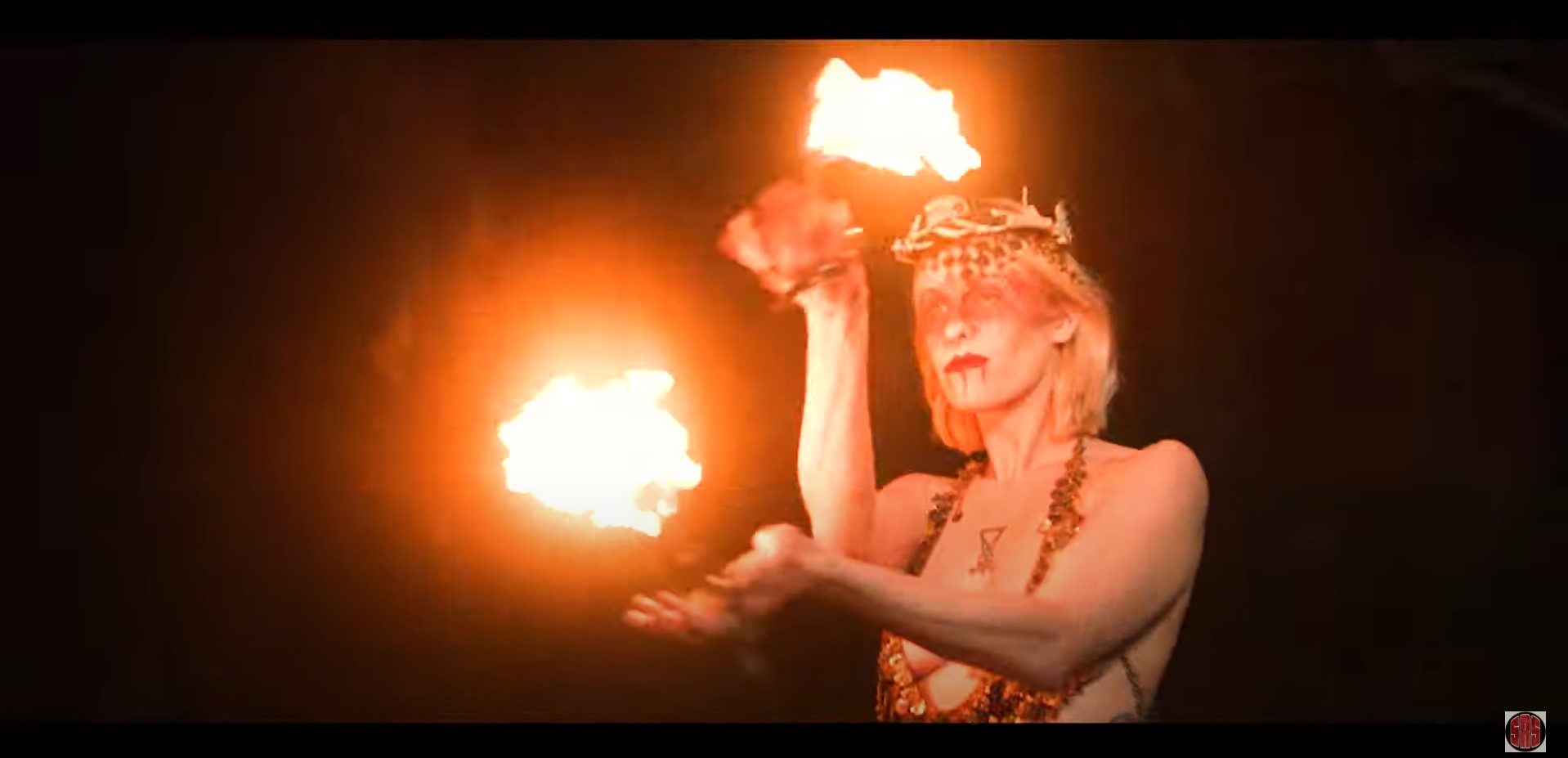
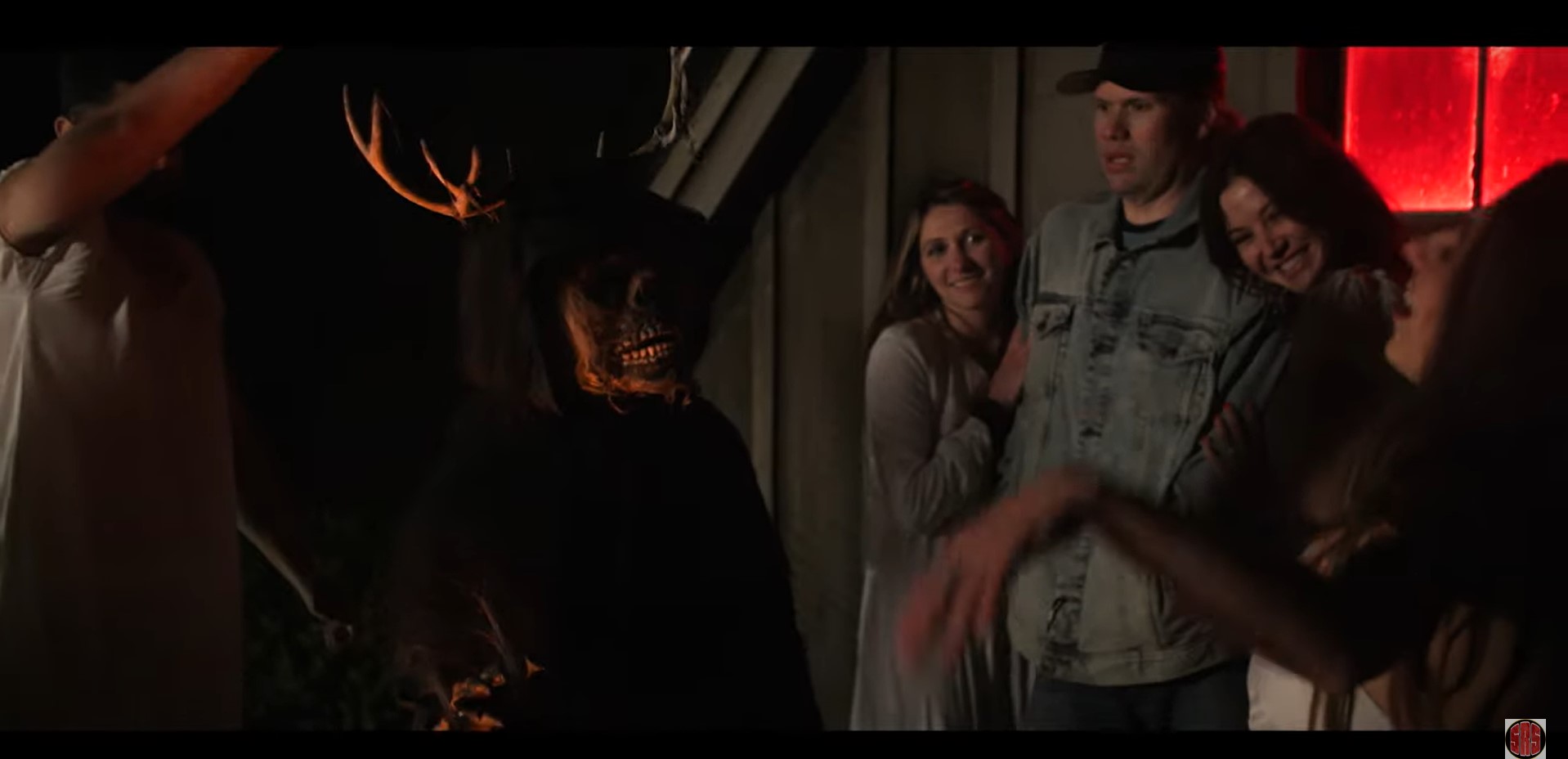
Vloggers Jonah and Jocelyn struggle to sustain a healthy dose of followers for their internet channel.  To spice things up and increase follow traffic, the two embark on a 48-hour challenge to stay in the nearby haunted woods of Allensville where a number of people have gone missing, even a fellow, more popular, vlogger named Garrett Gasper after he was self- recording and suddenly vanished when stumbling upon the blood tree, a tree that oozes a blood-like substance from the trunk.  Tagging along are vlogging, ambivalent friends Dacia and Eugene to help capture the spooky essence of what should be an easy, follower-increasing stunt for the impulsive influencers.  They’re also joined, reluctantly I might add, by a local cowboy, two bar patrons, and a father looking for his daughter who don’t know what they’re instore for as what ensues the unorganized, slapdash survey of the woods is far from being simple and safe when they stumble into the area of a seemingly hippie commune that’s actually a sex cult devoted to the woods witch Melora.

If you’re a diehard horror fan, or even just a physical media movie aficionado, you might have heard of the name Shawn C. Phillips.  The eccentric, high-energy, social media personality buys, watches, and reviews the latest and greatest on home video weekly on this Youtube channel under the handle Coolduder.  Aside from being also a movie actor with a range of roles in mostly low-budget, independent, B-to-Z grade horror films, such as “Girls Gone Dead,” “Blood Orgy at Beaver Lake,” and “WTF!,” Phillips’s social media presence further extends to an inspirational weight loss journey, shedding over 235 lbs.  Having been a longtime actor and producer, one of the Baltimore, Maryland native’s newest ventures is directing having shot mostly self-recorded videos to be inserted into other filmmakers’ movies.  Phillips’s latest is “Woods Witch,” a found footage comedy-horror that’s one-part “Blair Witch Project,” two-parts ADHD (Attention Deficit, Hyperactivity Disorder).  He codirects the film with costar and “Amityville Karen” actress Lauren Francesca in her debut directorial and cowrites with Julie Anne Prescott, writer of many more recent “Amityville” inspired budget horrors like “Amityville Karen,” “Amityville Shark House,” and “Amityville Bigfoot.”  DRAX Films (“Bae Wolf,” “Acorn”) is the production company behind feature that provided most of the funding in conjunction with crowdfunded portion.

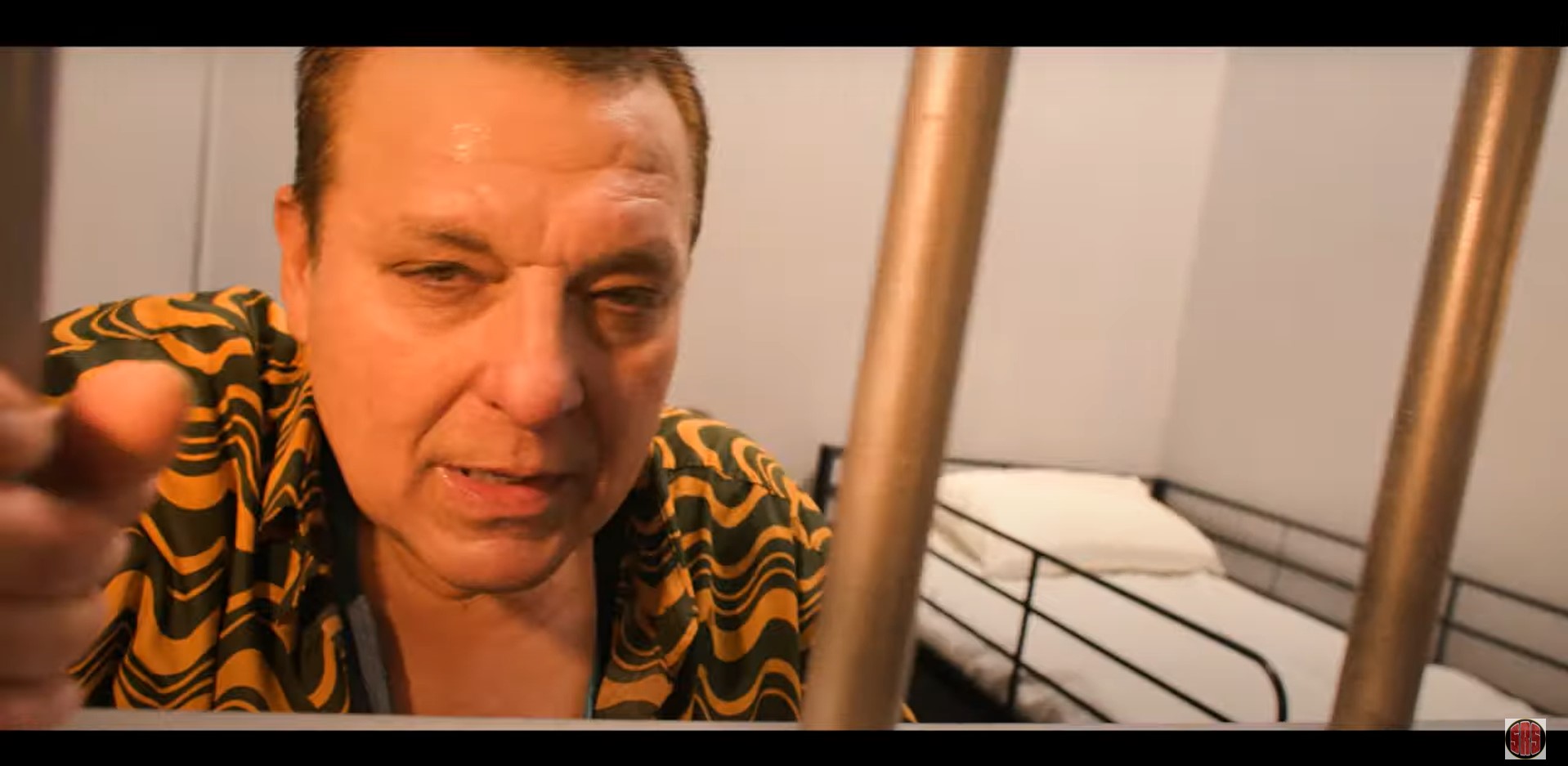
Obviously infatuated about being in front of the camera, taking a backseat to his own co-directed film wouldn’t be enough for the nearly 40-year-old personality who costars alongside Lauren Francesca as social media influencing boyfriend and girlfriend Jonah and Jocelyn.  Loud and opinionated, the couple struggle with maintaining viewership but, before that, they also they also struggle with the foulmouthed, death-threatening volley between Jonah and Jocelyn’s robbing-the-cradle by robbing-Jonah’s-cameraman mother, played by Sally Kirkland (“Fatal Games,” “Two Evil Eyes”).  And that sort of leads into a couple of themes “Woods Witch” harps on.  One theme is the constant bickering, shouting, and squabbling between anyone and everyone in a free-for-all of one-upping each other or to not take humility very well in front of others.  None of the characters side with one another, steadying a position of satellite attitudes and courses that lead the story into all different types of unhinged and unfocused directions.  The second theme connects with Sally Kirkland and the other in-and-outs of overripe star power for what crowdfunded money could afford and while there are some likeable and decent names in the cast, such as the late Tom Sizemore (“Relic,” “Saving Private Ryan”) in his last role before his death, James Duvall (“May,” “Donnie Darko”), Robert LaSardo (“Strangeland,” “Death Race”), and Lisa Wilcox (“A Nightmare on Elm Street 4:  The Dream Master”), they used to headline the attraction with only minutes to shine in their respective scenes.  The cast fills in with Kelly Lynn Reiter, David Perry, Carl Soloman, Bill Dawes, Lorelei Linklater, Nicole Butler, Ken Davitian, Bryant Smith, Eva Hamilton, G. Larry Butler, Mary Jones, Tom Harold Batchelder, Jake Pearlman, Brian Metcalf and Sadie Katz. 

“Woods Witch” uses multi-media found footage to tell the story where a bunch of egregiously entitled vloggers trek into infamously mysterious woods for hits, likes, subscribers, and e-revenue.  Not an original bone in its narrative body by any means, Antoine Le’s “Followed” comes to mind, but “Woods Witch” doesn’t hit where it should as a heavily improv comedy-horror that lampoons found footage horror in the woods and, instead, has undeniably become massively cacophonous of in all areas.  Going into the feature familiar with some of the cast and the distributing banner, expectations of a Shawn C. Phillips directed film were all fastened at the lower screwball level with horror elements tacked in here and there, aptly fitting the mold the social media influencer has established for himself with the eccentric personality of a physical media farceur who adores horror, but nothing can prepare audiences for how much confused noise is strewn about with the constant yelling, backbiting, and randomizing introduction of characters that turns what should have been an entertainingly crass and witchy film into just being a completely crass and witchy yawner.  Being completely flat and unfunny wouldn’t be a totally fair statement as “Woods Witch” does have its moments, such as the tree blood being rubbed all over Phillips’s naked torso and him, as Jonah, proclaiming naively Dascia’s kinkiness can be found humorous, but these funny bit moments are far and few in between and there’s just not enough new, fresh, or actor-driven comically-inclined wit and materially to feast on to support the lack of horror despite a few morsels of gore that are left in the dust, overshadowed by an immense pre-trip setup of interviews and infighting that ruins the rest of the reel. 

Enter the world wide web and wacky world of Shawn C. Phillips with his co-directed film with Lauren Francesca in “Woods Witch” on an SRS Cinema DVD. The MPEG2 encoded, 480i upscaled to 720p, DVD9 pulls the differing, clashing video qualities together, mostly earlier on and near the finale, for a coherent beginning, middle, and end narrative telling. If only I could say the same about the story, themes, and character roles. Anyway, not a lot of banding as there’s not a lot of dark scenes in what mostly is fill lighting that brightens up what’s in the scene. Details are okay enough when not implementing shaky cam’s in-and-out focusing found footage and lighting doesn’t completely washout the miniscule bits of texture. The coloring also has a naturally graded look as well as the objects’ organic color palette as budget doesn’t allow for too much fancy cinematography to also evoke a sense of realism. The English language PCM 2.0 stereo mix is consistent as it is coherent with the clarity and the dialogue. Even with pandemonium breaks out, which is often with the screaming and snappy conversations between each other, dialogue remains unscathed without audible squashing feedback or other interferences. English closed captioning is optionally available in the extras. Special features include a behind-the-scenes raw footage from fellow Youtuber Kenneth Ramone who has a small part in the film, a handful of cut scenes, theatrical trailer, funny trailer, an audio commentary by director/star Shawn C. Phillips going deep into the casting, locations, backstories, script and improv moments, etc., and there’s a Lisa Wilcox stinger in the post-credits as the mayor for an additional or extended scene with some improv. The SRS Cinema package comes in a standard DVD Amaray case with eye-catching illustrated artwork, disc pressed with the same artwork, and is an unrated, region free release with a 96-minute runtime.

Last Rites: Humor and horror underperform in the film “Woods Witch” that’s sole purpose is to be a comedy-horror. What the film does do is parody other found footage features and their filmmakers under a misguided sense that in-the-woods horror, from a camera lens point of view, is past its prime when in reality, the long-in-the-tooth subgenre is better than this parody by far.

“Woods Witch” Available on DVD from SRS Cinema!