EVIL Comes to Town to Extract Your Deadly, Dark Secret. “Peter Five Eight” reviewed! (Invincible Entertainment / DVD)

Check Out Kevin Spacey and “Peter Five Eight” on DVD!

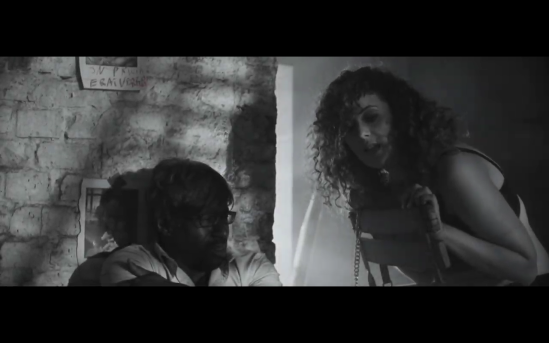
A dynamic real estate agent and her loafing husband drink themselves in an abusive back-and-forth most nights living in a small mountain town.  When a dapper new arrival observes her comings-and-goings about the community, he confronts her out of the blue with questions about a past life she’s desperate to forget.  Her dark secret remains isolated within her, even kept under wraps from her townie husband who is trying to make a change toward contributing to their relationship.  As she continues to heavily drink every night away, the stranger makes every effort to interactive with her, pushing the same questions for answers a faraway adversary seeks, as well as infiltrate the social bubble of her close friends and colleagues to try and obtain more information on the state of her mental anguish.  The closer he gets to her, the more she drinks, and her secrets become exposed toward a deadly end of the cat-and-mouse game he plays. 

Is it poor judgement to review a new film starring a blacklisted actor?  The internal struggle is real when pondering whether review consideration and shining a time-of-day spotlight on the stain considering the damage done by the main actor with sordid personal affairs made public.  This is the case with “Peter Five Eight,” a modern noir comedy-thriller that casted an ousted two-time academy award winner who we’ve really haven’t seen on the screen since 2017 after sexual battery allegations arose.  Yet, ever since this actor won the sexual battery lawsuit against his accuser, an attempt to recoup a career has bene placed in the slow cooker and writer-director Michael Zaiko Hall, a “Cloverfield” and “Planet Terror” visual effects artist turned director, adds another step toward a reel redemption and provides a curiosity to reviewers who like to be the devil’s advocate.  The 2024 released film was shot in Mount Shasta, California and is a productionally comprised of LTD Films, Ascent Films, Forever Safe and Mad Honey Productions with Hall, John Lerchen (“Vampirus”), Chavez Fred (“Hotel Dunsmuir”), and co-star Jet Jandreau producing.

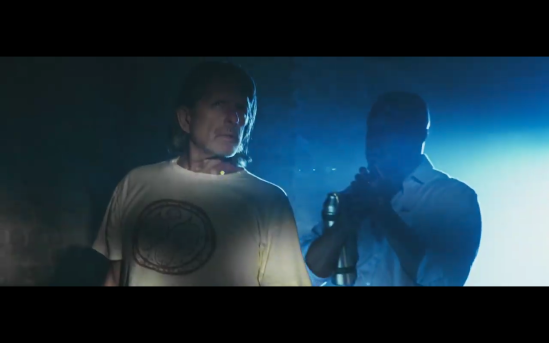
That actor mentioned above is none other than “L.A. Confidential” and “House of Cards” actor Kevin Spacey in the shoes of the titular hitman named Peter.  Now it’s unclear what the “Five Eight” exactly refers to, whether to be the explicitly noted Peter 5:8 verse in the bible which reads, “Be alert and of sober mind. Your enemy the devil prowls around like a roaring lion looking for someone to devour,” and that scripture is also voiced over by Spacey in film’ opening, or “Five Eight” could also refer to the Peter’s age which is noted almost inconspicuously in the dialogue when Peter is pseudo-flirting with a potential asset.  Now whether that age is in reference to his incognito, hitman persona of the passage is unclear, leaving the title more ambiguous than ever, but Spacey’s part is not so terribly vague as an expensive assassin willing to do whatever his employer requires of him.  Stacey’s rakish, twangy charm is quintessential to his more recent onscreen personas and the actor continues to enact it quite well even in a role that often feels more like a stage play than an homage to classic film noir as intended.  There’s a bit of tongue-and-cheek in every line and action cast, and not just in Spacey’s, that slips the tone of his “Peter Five Eight” into wafting black comedy and awkwardly dispositional encounters.  Michael Zaiko Hall perhaps contributes to the latter with his inability to find a way to make Stacey be suave when being suave is required, such as with his pool hall/bar dance where Stacey sings a jukebox tune with an accompanied dance on the pool table felt and imitate the actions of a trombone with a pool cue.   The scene just didn’t sit right and turned what should have been a crowd-pleasing spectacle of smooth coolness into this odd lump of Stacey peacocking around in order to attract a certain someone at the bar as part of his master plan.  Opposite Spacey is co-star and co-producer Jet Jandreau (“Next of Vampires”) as the alcoholic real estate agent Samantha, aka Sam, harboring a dark, past secret and her channeling of Bette Davis cadences and inflections denotes that noir tone they’re aiming for and sinks into melodramatics of the prosaic fashion, serving more of ear sore of lampoon the subgenre rather than resurrecting it out of antiquated techniques.  The character is built well in Sam’s overdrinking and over-paranoia the deeper into the Peter’s story of truth extraction and inevitable cleanup.  Michael Emery (“The Intrusion”), Garrett Smith (“The Gates”), Dale Dobson (“Don’t Get Eaten”), John Otrin (“Friday the 13th:  The New Blood”), and “Dawn of the Dead” remake’s “Jake Weber and “The Hand that Rocks the Cradle’s” Rebecca De Mornay play an affluent and ruthless, revenge seeker and the local real estate agent head close to Sam. 

“Peter Five Eight” likes to live in between layers and forces audiences to read in between the lines on multiple surfaces.  Sam’s escape to the mountains, to flee from her past’s problems, has little footing when husband Travis comes into play as Travis borders being a flake of a husband, a fellow alcoholic, who Sam shares her addiction by proxy or maybe uses as a crutch in an exploitative manner, but he becomes a throwaway character from never being fleshed out and same goes with Garrett Smith’s role as Sam’s ex-husband who enters the picture unwillingly but shows up a little too late to be of importance.  We also needed more from Jake Weber’s richer-the-God Lock who hires Peter to track down and punishing Sam for her past transgressions that, we assume, tragically hurt him.  Peter’s base price is a cool $50 million, and Lock even adds another $8 for Peter’s efficiency, but that egregious, astronomical figure is chased away by Lock’s mysterious career background.  A cryptocurrency motif is sprinkled into the fold, mentioned here and there by various characters in various situations, and that’s perhaps Lock’s key to success but, again, never fleshes out.  There was a real desire to enjoy “Peter Five Eight” and while Kevin Spacey doesn’t necessarily sully the film, and on the contrary entertains with flamboyant articulation, Hall has a hard time creating coherency with his wish-wash noir.

Though intrigued by the premise and Kevin Stacey’s resurrection out of being totally eclipsed from in front of the camera, “Peter Five Eight” arrives onto an Invincible Pictures DVD home release in what is a surprising dreary A/V folly.  The MPEG2 encoded DVD5 is every much the resolution of 720p with smoothed over details and you can see the outlined splotch patches on the RGB model.  Hall and director of photography Eric Liberacki (“The Pale Man”) use mostly natural lighting of the sunny mountainside community and the window-laden interiors.  Night scenes are often lightly misted with a drifting fog or smoke but the weird part of this is it’s mostly in interior sets, creating that noir illusion but mostly just plays havoc on the already suffering details.  No issues with aliasing or noise with the digital playback.  The audio oddly enough is an English Stereo 2.0.  Unsure why a surround sound mix was not in the mix, so to speak, as there’s gunplay, explosions, townsfolk chatter, car crashes, and other elements that add to the range and depth.  The compressed result is a flat, muted track that has zero vitality in its audio projection, and this is also reflected in the decoding kbps that retains a constant flatline rather than a dynamic decoding based off the action.  I have not seen this before on modern DVDs and was taken aback by its feebleness.  English subtitles are optionally available.  The only bonus feature, to which you access straight from the static menu, contains a Kevin Spacey helmed promotional featurette for the film as well as to give the audience a historical lecture on the film noir subgenre.   Invincible Entertainment’s release comes not rated, with a 100-minute return, and a region 1 playback.

Last Rites: Though weird to watch a blackballed actor back on top of the horse, but the black comedy noir that is “Peter Five Eight” is not totally sullied by his name, it’s tarnished by the aphonic character development and the poor A/V basics for the home release that continue to beat the horse with a sprained ankle.
Check Out Kevin Spacey and “Peter Five Eight” on DVD!

When EVIL Becomes Obsolete, Its Time for an…”Upgrade” reviewed!


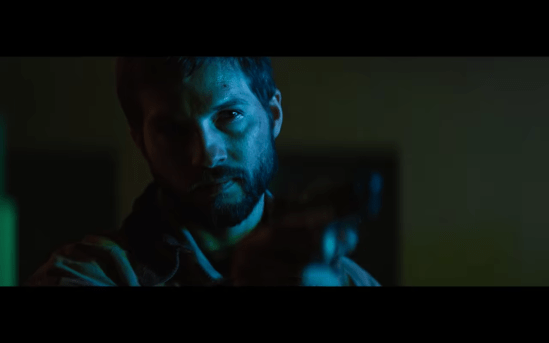
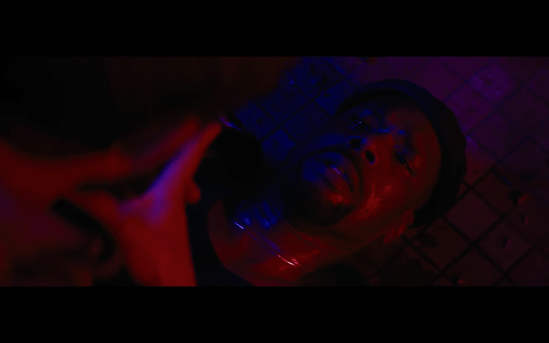
In the near future where assistive technology serves as the cultural way of life, a very manual Grey Trace still clings to being self-independent while his loving wife, Asha, laps up and embraces new and innovative tech. When an fatal shooting strikes down Asha and cripples Grey to an automated wheelchair, Grey is forced into a depressive world he no longer recognizes. Desperate to find his wife’s killers, he accepts experimental computer chip implant known as STEM to send the signals from his brain to his extremities; however, that is not all STEM can do. The smart technology can also scan, record, and reactive to all of Grey’s experiences, be a voice of knowledge, and enact super human abilities that will aid in Grey’s vengeance, but without much control over his own body, how much will Grey continue to use the smart device that becomes smarter every minute.

In a cinematic age when remakes, re-imaginings, and sequels really do rule supreme, a breath of innovation and compelling storytelling in Leigh Whannell’s 2018 science fiction, action-noir “Upgrade” is a technological advance that’s feels lightyears ahead in comparison. The “Saw” and “Insidious” writer, who indulges in all of horror’s gracious qualities, tackles the future with a synergetic and brutal vengeance film on indie-budget proportions; however, “Upgrade” feels no where near being low budget in a futuristic world that includes monochromatic self-driving cars, bio-weaponized forearms and hands, and a robotic protein shake slingers for those meal replacement pick-me-ups. With the assistance from Blumhouse Tilt, a Blumhouse production sublabel that seeks to release projects onto multi-platforms, Whannell gained freedom to script, in every sense of the world, his own vision of cyborg horror and crime thriller.

Logan Marshall-Green stars as Grey Trace, an analog man living comfortably in a digital world. Trace is a dying bred as the technology ecosystem slowly creeps into all that earned by hard work, even in his small classic car restoration business. The “Prometheus” star tackles a unique physicality aspect of an action film that involves the robotic responses of hand-to-hand combat while also being the emotional punching bag of pelted heartache and turmoil. Portraying his character as a man’s man, Marshall-Green has to find humility in not only unable to self-serve himself as a cripple, but then also rely on the one thing he withdrew himself from for help….a machine. “Upgrade” primarily focuses on Trace to even having the camera affix to his character during fight sequences, but though most of the narrative is through Trace’s vindictive narrative, a cascading effect of his destruction brings one of his nemesis’s into reactive defense. Fisk, Benedict Hardie from the upcoming remake of “The Invisible Man” that’s also directed by Whannell, is a mysterious soldier of fortune whose backstory, that salivates at the tip of the tongue to be told, is only sampled at best with his cybernetic implants or why he was even chosen to be a deadly, robotic killing machine. Perhaps Fisk’s backstory, and those of his fellow veteran comrades, are another misrepresentation or the maltreatment of veterans by conglomerate, privately owned tech and weapon companies that lean more toward involuntary experimentation rather over anything else that’s an allegory of owning a person, a piece of property, as we also see with STEM attached to Grey Trace’s spinal cord. “Upgrade” rounds out with performances from Melanie Vallejo, Harrison Gilbertson (“Haunt”), Betty Gabriel (“Get Out”), Kai Bradley, and Simon Maiden as the voice of STEM.

Shot in urban Melbourne that’s quasi-reflective of the gritty streets of Chicago, Leigh Whannell aimed for a fatalistic mystery that breaks down relationship barriers and sustains a punitive jurisdiction of grime. Whannell surely achieves the desired affect that goes from a classy futuristic society to the bottom barrel of human existences that have been tainted by the dark side of tech including addiction and dangers of being fully aware as a sanctioned being. “Upgrade” capitalizes on every inch of its capital to enlarge the quality of a miniature budget and utilizes local talent, who, aside from Logan Marshall-Green, never wane from their unnatural American English accents, to offer heartfelt human performances despite their mechanical transitions. “Upgrade” isn’t “Robocop” or “Nemesis,” but rather more “Terminator” where organic and inorganic don’t exactly coincide to benefit as a single entity. Unlike the autonomous killing machine portrayed by Arnold Schwarzenegger, “STEM” acts like a computer virus working off commands, coding, and complex algorithms to infiltrate and deploy executions to subverse the man over the machine and Whannell’s concept brilliantly contextualizes that dynamic without having too much exposition to divulge and is easily computed without having to be deciphered from binary code.

Coming November 18th is Second Sight Film’s limited edition Blu-ray release of “Upgrade” presented in full HD, 1080p, and clocks in at 100 minutes under a region B UK coding. Unfortunately, a screener disc was provided for review and so I will not be critiquing the video or audio quality at this time so this review is solely about the film only. A static menu including chapters were available on the disc as well as bonus features including a commentary by writer-director Leigh Whannell, a new Second Sights’ interview with the director about his envisioning and how it came to fruition, more new interviews with producer Kylie Du Fresne, cinematographer Stefan Duscio, editor Andy Canny, and fight choreographer Chris Weir. All the interviews showcase depth with the material to their respective roles and opinions about “Upgrade.” Don’t think it necessary to refer filmmaker Leigh Whannell as the “Saw” guy now that “Upgrade” has completely overshadowed the franchise in a single sitting entertained with action, gore, and a heart-rendering story. Surely to be Whannell’s break out film from the horror genre.

Buy your Limited Edition UK Blu-ray today! Click the cover to purchase!

Evil Loves a Good Plot Twist! “Open Wound” review!


In the moments before attending a pool party, apparent strangers-to-acquaintances, a distinguished, if not quirky man and a promiscuous, self-involved German woman, withdraw to a secluded building in order for the brazen woman to shave the bikini line exposed excess hairs before strapping on a suit. Their intricately deep discussions about desires, sex, and kinky foreplay fair nothing more but course, blunt banter between two familiarities, but when the woman pretends she must be tied up and punished for playfully biting the man’s ear until bleeding, the next few moments after fall into a state of obscurity of a he said, she said rape accusation. As confounding declarations are made and fingers are being pointed to decimate lives, a sack of deceptions and an abundance of threats accrue through a blackmail scheme and an abduction based vendetta. Nothing can be certain and no one can be trusted between the two, but one thing is definite, a third man watching from afar has nefarious plans of his own.

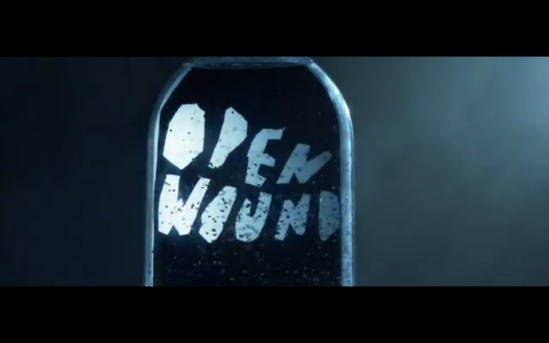
Like sitting front row at a bastardized version of an off-broadway show, “Open Wound” is an immaculate stage performance of battered psychologies and visceral deceptions from writer-director Jürgen Weber. The thriller, also known as “Time Is Up” or “Open Wound: The Über-Movie,” measures extreme lengths of human bitterness while constantly shapeshifting into plot twist after plot twist aggregated with clusters of popup violence. The Chinese born Weng Menghan, under her moniker Tau Tau, is the financial backer of “Open Wound. The globetrotting author makes her breakthrough imprint into the feature film business that modestly begins with an opening scene about anal sex among other verbal sexual references before man versus woman fisticuffs and a pivoting third act that rapidly alters character compositions into, essentially, a free for all. So metaphorically speaking, a Chinese producer walks into a bar, sits onto a stool next to a German director, and orders one of the more absorbingly chic cocktail thrillers in English. “Open Wound” is a melting pot of cultural influences and a display damaged egos that’s simply brilliant.

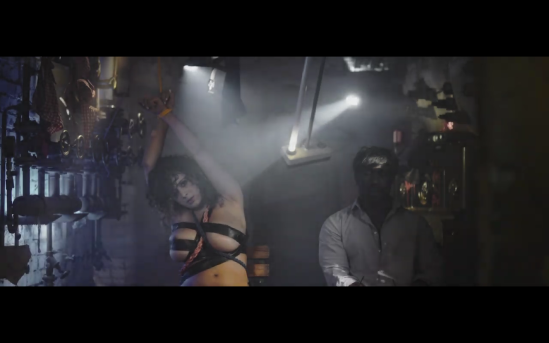
“Open Wound” has a short character list comprised of three characters. The first is woman who is introduced first, or rather her lips do when she declares her love anal sex and the parallel criteria for types of cars in one man’s garage, as she’s using a straight razor to trim the dark haired pubes from her bikini line. She oozes eroticism like a bodily fluid that gravitationally seeps from between the legs, spilling innermost desires, whims, and historical sex-capades with in a philosophical prose. #Nippelstatthetze advocate, German podcast expert, and stunning model, Leila Lowfire engrosses herself into the role of fierce, proud, confident, and strong woman. With an established vigorous sexual prowess, Lowfire culminates the femme fatales and breakneck show-stoppers female roles, notably similar in Quentin Tarantino movies, with high-brow tastes and a debasing reprove. Lowfire’s accent is low and thick and can be considered her weakness here as getting your brain to interpret the fluidity of the words, structures, and compositions is undeniable challenging at times, but acts upon fervor while in her lingerie or even topless throughout the film. The contrast against man is stark. His introduction paints him as unequipped, socially inept, and hopeless desperate. Man longs for Woman, but knows he doesn’t have a chance with her until she offers up a random game of role-play that inevitably leads to disarray. Jerry Kwarteng’s man performance is systematically peerless and a complete joy. Even if the character lacks depth, Kwarteng’s range is devilishly good with the only comparison coming to mind would be James McAvoy and his multiple personality disorder in “Glass.” Once Man and Woman comes to terms after a back and forth bout with dominance, the Suicide King’s grand appearance bestows upon the plot an even bigger, clunkier monkey wrench. The Suicide King’s an ex-con, looking for revenge in a small vat of acid, and his mark and him have a long, complicated history which parts personally shock the other. Erik Hanson’s raspy voice, feeble appearing physique, and lofty age has a second row seat to his character’s unwillingness to die, in a slick performance that’s part nihilist and part psychotic to which Hansen pulls off.

Weber’s choice toward “Open Wound’s” narrative layout conflicts with how the DVD release is specifically marketed. “Open Wound” rides the dark comedy pine that is peppered with black tongue-and-cheek dialogue and violence and as will be noted later in the review, the advertising depicts something far more extreme and graphic. On the shock value scale of one to ten, “Open Wound” hovers around a solid five and maybe a seven or eight for the casual popcorn viewer and, personally, I don’t believe “Open Wound” was intended to be a source of utter distress and visual barbarity. There’s brisk lighthearted comedy that softens the blunt force. For example, in the room with the Man and Woman, a record player will every so often, to comically assist in explaining the actions, play the cheesy tune of lounge background music with a singer narrating the character’s every move and also be the voice of between chapter contention or bewilderment. The singing is privy to only the audience just as the twelve chapter titles that offer a mixed bag of sequences that interchange between English, German, and Chinese title introductions, a toilet paper title card in reverse action, and an artistic rendering of chapters titles and just like his title card introductions, Weber also utilizes an assortment of styles to tell his story, whether be a 5 minute sepia, nitrate film burn effect, or day dream sequence, that peers the sudden twists and eruptive chaos between the characters. While the effects work to sensationalize the context, they tend to be equally be nauseating and annoying as a disruptive structure that seemingly doesn’t make sense to the naked eye.

MVDVisual and Wild Eye Releasing distributes Jürgen Weber’s “Open Wound” onto DVD home video as the the 11th spine feature under the Wild Eye Raw & Extreme sub-label. The DVD is presented in a widescreen format and the image quality holds up well, withstanding Weber’s bombardment of stylistic techniques of distortion, over exposure, sepia, and contrast. There’s a little softness around the skin, more noticeably during facial close ups, with a slightly lower bit rate in the compression but still very agreeable detail. The stereo two channel audio channel does the job, but has flaws with Weber’s score have an equal playing field with the dialogue tracks. The audience already has to manage Leila Lowfire’s thick German accent and their ears will also need to try and filter out the soundtrack that’s invasive upon the colloquy. Not much range to warrant mentioning, but the depth was well tweaked amongst Weber’s visual compliments. There are unfortunately no bonus material with the feature, but the DVD reversible insert is graced with a semi-naked and bound Leila Lowfire. “Open Wound” is dangerous, sexy, thrilling, and complicated to say the least, but stamped as a Raw & Extreme film it should not; however, see this film! Director Jürgen Weber’s visionary molotov cocktail of a story is an underground must for arthouse lovers and noir enthusiasts.

Evil Messes With the Wrong Family! “Pickings” review!


Ruthless mobsters crack down hard on barkeeps, strong arming their way into seizing every bar in town. When they mess with Jo Lee-Haywood, the too cocky gangsters messed with the wrong Southern gal as Jo turns out to be Jo Pickings, one of three dames of the notorious Pickings gang. Jo tries to abide by a straighten arrow inspired by her deceased husband and four kids, but crime tugs at her violent past, scraping the good from her clean off. With the help of her brother, Boone, and her sisters, Doris and May, Jo and her family of heavily armed outlaws aim to fight back against thugs and thieves in this modern day western.

“Pickings” is the freshman film of first time feature film producer, writer, and director Usher Morgan. The contemporary gritty western is a maelstrom of goliath turf wars that’s stylized with rotoscoping and other comic book fatigues to dress Morgan’s film as an aesthetically popping story with illustrative visuals, anomalies, and raw tooth violence. The clear cut message, a fairly popular thematic motif among westerns, is don’t mess with family, even if family has been through an estranged time, and though Morgan’s theme runs a fairly conventional line, the “Sin City”-esque overlay gives “Pickings” a strong double take. What’s an especially fun and unique concept is having one of the characters, Sam “Hollywood” Barone, be exhibited in black and white while everyone else is in color as if the character was pulled straight from a Humphrey Bogart classic.

Elyse Price headlines as Jo-Lee Haywood, a wife-mother scorned by notorious gangsters, but the tough as nails mother of four runs a tight-ship when it comes to her bar and to her family. Price doesn’t hold back, taking the gut-checking hits and delivering a twice as big response with a performance of contempt and revenge. Price is joined by Joel Bernard, the sole brother of the Pickens gang whose as tough as they come, especially when you’re the only boy with three sisters. Bernard does the job matching Price’s hard nose character with his own more subtle version. The two other sisters, Doris and May played by Michelle Holland and Lynne Jordan, barely scratch the surface in an appearance that makes their characters difficult to absorb. Aside from Jo Lee-Haywood, the only other character with a significant character arc is her daughter Scarlet Lee-Haywood filled in by Katie Vincent. Vincent’s softens up against her mother’s violence despite being a passive witness to her cornered brutality, but can adhere to the akin familiarities of her family’s long and violent history. The cast rounds out with Yaron Urbas, who in my opinion is a decent mobster, Michael Gentile, and Emil Ferzola.

“Pickings” doesn’t come without problems and one of the problems is is the story concludes on a really too clean note. The inner monologuing exposition of Jo Lee-Haywood conveying her start-to-finish tale of her involvement with the three dames, Doris, May, and Jo, is a good visual like the rest of the Morgan’s film, but is just that, a good visual, and doesn’t carry the weight of suspense and becomes even more diluted when Doris and May have little interaction with Jo and barely any screen time at all to put the oomph into conveying their badassness. Aside from being obvious and telling, the gun blazing finale is also a bit underwhelming and disappointing, chocking everything to a one sided victory without any, or the hope of any, dire loss to compensate just feels empty and, again, too clean for comfort.

Courtesy of Dark Passage Films comes “Pickings” onto DVD and Blu-ray home video. The DVD is presented in a widescreen 1.85:1 aspect ratio that capture the neo-noir facets of shadowing figures and haunting mysteries. Morgan’s film doesn’t necessary pop with color, but that’s particularly the nature of the genre. Aside from that, no real issue with the DVD transfer. The audio is a stereo option that has an ample dialogue track and a stocky ambient accompaniment. Katie Vincent’s bootlickin’ acoustical score never wavers, cracks, or looses range. Extras include deleted scenes, filmmakers’ commentary, “The Mop” a Pickings short, a behind the scenes featurette, and a spoof reel during the end credits. Loaded with female empowerment, “Pickings” is a violent crime drama with neo-noir battle garments of two warring clans ready to get along like the Hatfields and McCoys, but the undercutting finale puts a sharp spur in one’s couch melding backside, leaving much to be desired from a women scorned vendetta.

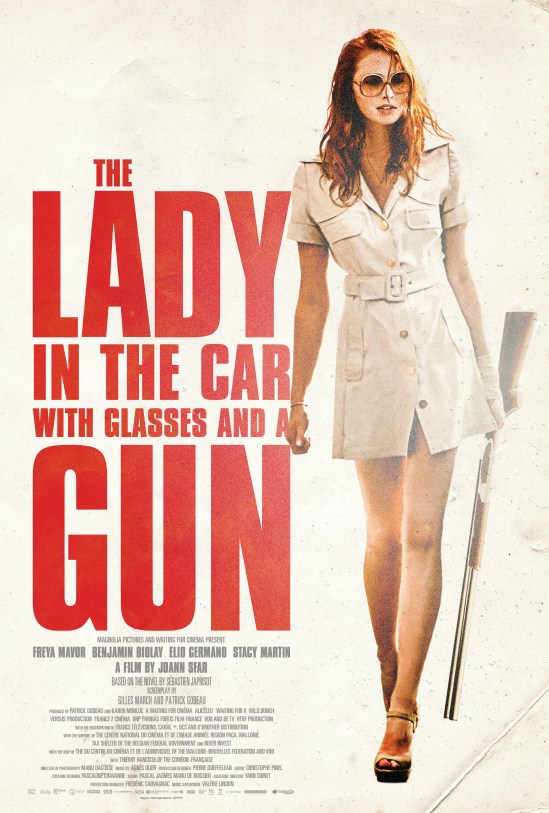
Evil Takes a Ride! “The Lady in the Car with Glasses and a Gun” review!

8
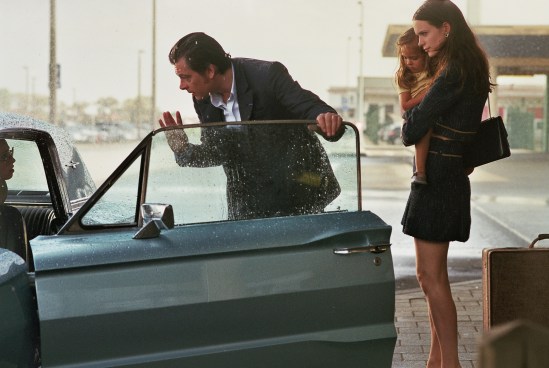
Dany Doremus, a lonely secretary roped in by her boss to work on a big project at his home, steals her boss’s car for a joyride to the sea as her boss and his family go away on holiday. When she makes numerous stops from town to town, the townsfolk approach her, claiming and swearing they know her even though she’s never been to this particular area before. If things couldn’t get weirder or even more suspenseful, a dead body is discovered in the car’s trunk. Dany wonders if she’s deranged and crazy or just a part of a some elaborate murder mystery conspired against her.
1
“The Lady in the Car with Glasses and a Gun” is a remake of the 1970 Anatole Litvak film of the same title. Though I’ve never seen the original Litvak film based off the award winning crime novel by Sebastien Japrisot, I’m sure director Joann Sfar’s film doesn’t stray much from the main artery that is the story, but Sfar spices up the tale through the addition of a young and feverishly heart-throbbing cast of actors and actresses. A murder mystery that sells sex more than thrills, Joann Sfar explicitly has Scottish born actress Freya Mavor and “Nymphomaniac’s” Stacy Martin do more than their fair share being sex symbol and straining the barrier of sexual tension, especially with a couple of highly eroticized topless scenes from both actresses. In a bombardment of thigh high mini skirts and tight at the waist dresses, the film setting is to reflect the 1960s to 1970s time period where if the story was in the technology age, “The Lady in the Car with Glasses and a Gun” might have had a totally different outcome.

Autosave-File vom d-lab2/3 der AgfaPhoto GmbH

Autosave-File vom d-lab2/3 der AgfaPhoto GmbH

Like any good crime novels or films, noir plays a bit part and with the Sfar remake, noir is ever present from beginning to end. Dany’s noir scenario has her being plagued by a retraced trip she’s never initially taken, being roughed up by a glove-wearing mystery person in a duo of giallo familiar scenes, and discovering a dead body in the trunk of her boss’s Thunderbird. All the pieces come together to form one big elaborate undertaking with the big twist at the end and while I’m not sure if the novel and the Litvak film do marvelous work in the detail to wrap Dany’s adventure, I feel Sfar’s missed the mark by not filing in the holes that construct a twist ending. Maybe Japrisot’s novel a bit vague too, but there’s certainly multiple voids that needed to be filled to plausibly and logically explain the ending.
2
As I said before, Freya Mavor’s sexiness couldn’t be any more potent. The relatively young in the industry actress has tons of potential outside the European film market. Stacy Martin has been on that fringe of the industry since her controversial breakout role in Lars von Trier’s “Nymphomaniac.” Both Mavor and Martin work well together, creating the tension between their characters while pulling off a lustrous vision. The male lead playing Michael, Benjamin Biolay, reminds me of a young Benicio del Toro with a very reserved demeanor and calculating coldness about him.

Autosave-File vom d-lab2/3 der AgfaPhoto GmbH

Autosave-File vom d-lab2/3 der AgfaPhoto GmbH

Magnolia Pictures proudly releases the remake of “The Lady in the Car with Glasses and a Gun” in limited theaters across the nation today, December 18th, and will also be available on demand. Another variation of an award winning story with modern actors set in a time period that has been long forgotten, “The Lady in the Car with Glasses and a Gun” stimulates the whodunit objective that keeps you on the edge of your seat for every second.