No EVIL Gets Left Behind! “P.O.W. The Escape” reviewed! (Ronin Flix / Blu-ray)

“P.O.W. The Escape” on Blu-ray at Amazon.com!

Colonel James Cooper’s moto is no one gets left behind.  The seasoned P.O.W. extraction officer volunteers for a politically spearheaded suicide mission to save Vietcong American captives before a cease fire treaty ends the war, effectively turning the P.O.W.’s into M.I.A. and possibly never heard from again.  As the U.S. Airborne Colonel expected, the mission of rescue results in a complete fiasco of resources and being empty handed of prisoners as the enemy suspected an imminent attack.  Cooper becomes a P.O.W. alongside the men who set to rescue but that doesn’t deter the determined officer to plan his escape, but before detailing out a route out, the camp’s warden Captain Vinh has alternative plans for his prized captive in all of North Vietnam.  Vietcong headquarters wants to retrieve the Colonel in two days for public execution but Capt. Ving seeks a better life outside his country and accumulates the K.I.A. and P.O.W.s valuables plus in addition to stealing gold bars form his country in order to relocate him and his family to the U.S. but on his terms with a perilous journey across enemy lines with all the P.O.W.s in order for no one to get left behind.

The Carradine name is one of the most recognizable names in Hollywood with David Carradine the most famous, behind his father John Carradine, with his highly successful television series from the mid-70s, “Kung Fu.”  A part of “Kung Fu’s” success was due in part of the decade itself where kung fu films were a peak popular with rising star Bruce Lee.  A decade later and still in the shadow of that breakout series with a made-for-television movie, Carradine breaks into another rising type of films that trades in hip-throws and round house kicks for M1 assault rifles, Huey helicopters, and the jungles of the Vietnam war.  And coincidently enough, Vietnam actioners were made popular by another martial artist with “Missing in Action” starring Chuck Norris.  Carradine’s venture into the America’s shame frame being exploited for personal gain is P.O.W. The Escape, a rip-roaring and explosive do-or-die war caper from first time director Gideon Amir and penned, and re-penned, by Jeremy Lipp (“The Hitchhiker” TV series), James Bruner (“Invasion USA”), and “Deadly Sins” co-writers Malcolm Barbour and John Langley.  Also known as “Attack Force ‘Nam” and “Behind Enemy Lines,” the Philippines doubling Vietnam production is produced by Yoram Globus and Menahem Golan as a Globus-Golan Production.

The Late Carradine epitomizes stone-faced patriotism as the exfiltration expert Colonel Cooper.  Showing hardly any emotion except for a handful of scenes that call for it, or else Cooper would be a full-scale unempathetic sociopath, Carradine gives his best harden American warrior as well as an indestructible combat commando where a barrage of bullets whizz around him, explosions don’t impede his health, and an army of Vietcong are no match for the Colonel’s American flag draped, M60 machine strapped fighting spirt in an uphill battle of certain death.  Its farcically funny to behold but that was the traditional one-man-army paradigm back then and, to an extent, still is even today to give audiences as gung-ho and impossibly invincible hero.  Cooper leads a bunch of weary P.O.W. troopers on the brink of becoming lost in wartime politics and only three out of the bunch are highlighted throughout the misadventure toward safety with those roles’ boots on the ground by Steve James (“McBain”), as the order-following Sgt. Johnston, Phillip Brock (“American Ninja”) as wise-cracking know-it-all, good soldier Adams, and Charles Grant (“Witchcraft”) as the maverick Sparks who initially goes against Cooper’s plan.  Sparks is likely the most interesting and complex character with an internal conflict having set into his own path of escape dedicated on selfishness and greed only to feel the tremendous weight of guilt and burden of his fellow soldier while on the bed of a half-naked, North Vietnamese prostitute.  The last major principal is actually a Captain, that is Captain Vinh, played by one of the most recognizable faces in Japanese cinema history, Mako, of Arnold Schwarzenegger “Conan” fame as the Akiro the Wizard.  Understanding Vinh’s motivation hardly musters conclusively on why he wishes to defect his country and why he needed Colonel Cooper to accomplish it.  Perhaps Vinh’s undergoing hate for his own country was lost in the editing room as the film is noted to have gone through multiple re-writes, edits, and additional post-production shoots.  “P.O.W. the Escape” fills out the cast with Daniel Demorest, Tony Pierce, Steve Freedman, James Acheson, Ken Metcalfe, Ken Glover, Rudy Daniels, and Irma Alegre.

For Gideon Amir’s first picture, this Vietnam vehicle is an action-packed romp.  Never letting up on the accelerating peddle, especially with Cooper’s blank determination to get all the men out of the arm struggle before a treaty wraps up the conflict and leaves his charge in casted away in the arms of the enemy, what Amir accomplishes at the behest of his influential producers wonders how this high-value production ever made it past post without being a completely incomprehensible mess.  There lies choppy moments of editing that puts into question it’s original concept even if one isn’t aware of the film’s narrative conflictions.  What ensues is not a traditional rally and escape from a torturous, inhuman enemy camp that one can’t abscond from so easily; instead, the narrative becomes an escapade of itinerant provides various difficult scenarios that split up the group, sees internal turmoil, and propels desperation to get to the friendly Huey’s with their very lives, but doesn’t see Cooper come under threatening fire as he spurts off short rifles rounds and takes out a handful of Vietcong at once with one scene reminiscent on a particular World War II hero charging up hill and taking out a whole German squadron alone with a machine gun.  Audie Murphy, If remembering accurately, but instead of sustaining any projectile wounds, Cooper thrusts forward unscathed while those G.I.s he’s trying to recover and rescue perish in an inescapable firefight.  Carradine’s stoicism throughout the life profit and loss campaign doesn’t match Cooper’s liberation maxim that forces “P.O.W. the Escape” into an impassive, often times comical, attitude with the story’s central character.

Director Gideon Amir and David Carradine tempt their hand at the Vietnam vamoose now on a Hi-Def Blu-ray forged by Ronin Flix through way of Scorpion Releasing’s 2019 HD transfer of the previous MGM print.  The widescreen 1.78:1 aspect ratio presented feature fails to capture impeccable clarity of acme perfection with approx. half the frames wilted away with artefact de-escalation of details. Half the scenes look great with a semi-serious saturation of color, a few of facial and foliage details come out, and textures have tactile range at times, but the film’s glass is only half full within a darker dilution of speckled splotches. The English DTS-HD 2.0 master audio mix relays a fair enough dialogue consignment with comprehensible clarity and is utterly clean but lacks punchiness with a flat as a David Carradine’s poker-face facade. With a robust range of gunfire, explosions, and modes of transportation, especially going through the mucky and miry jungles of war-torn Vietnam, the film definitely needed a stronger suit of sound but was ultimately discharged without dullness. English subtitles are available. Special features include three on-camera interviews with Director Gideon Amir, screenwriter James Bruner, and stunt man Steve Lambert discussing their particular involvement in pre-and-principal shoots, some of the process woes, and how exotic the opportunity was to work internationally and with David Carrine. The film’s original trailer rounding out the special features block. Physically, the Ronin Flix release comes in a standard Blu-ray snapper with an action-packed and commandoed David Carradine blasting off his rifle like in a Ghana-esque illustrated movie poster. Inside, the lack of insert and reversible cover art leads our eyes straight to the disc art that’s the same as the cover, cropped down to fit in the circumference. Rated PG, that is rated 1986 PG with strong war violence, strong language, and nudity, the release is region A locked in playback and has a runtime of 86 minutes. A campy commando campaign capitalizing on the success of the Vietnam prison camp subgenre, “P.O.W. the Escape” could be much worse for wear as a solid action flick fierce in delivery yet fickle in substance.



“P.O.W. The Escape” on Blu-ray at Amazon.com!

EVIL Embarks with Cons and Cops in “Project Wolf Hunting” reviewed! (Well Go USA Entertainment / Blu-ray)

“Project Wolf Hunting” on Blu-ray and Available for Purchase by Clicking the Cover Art!

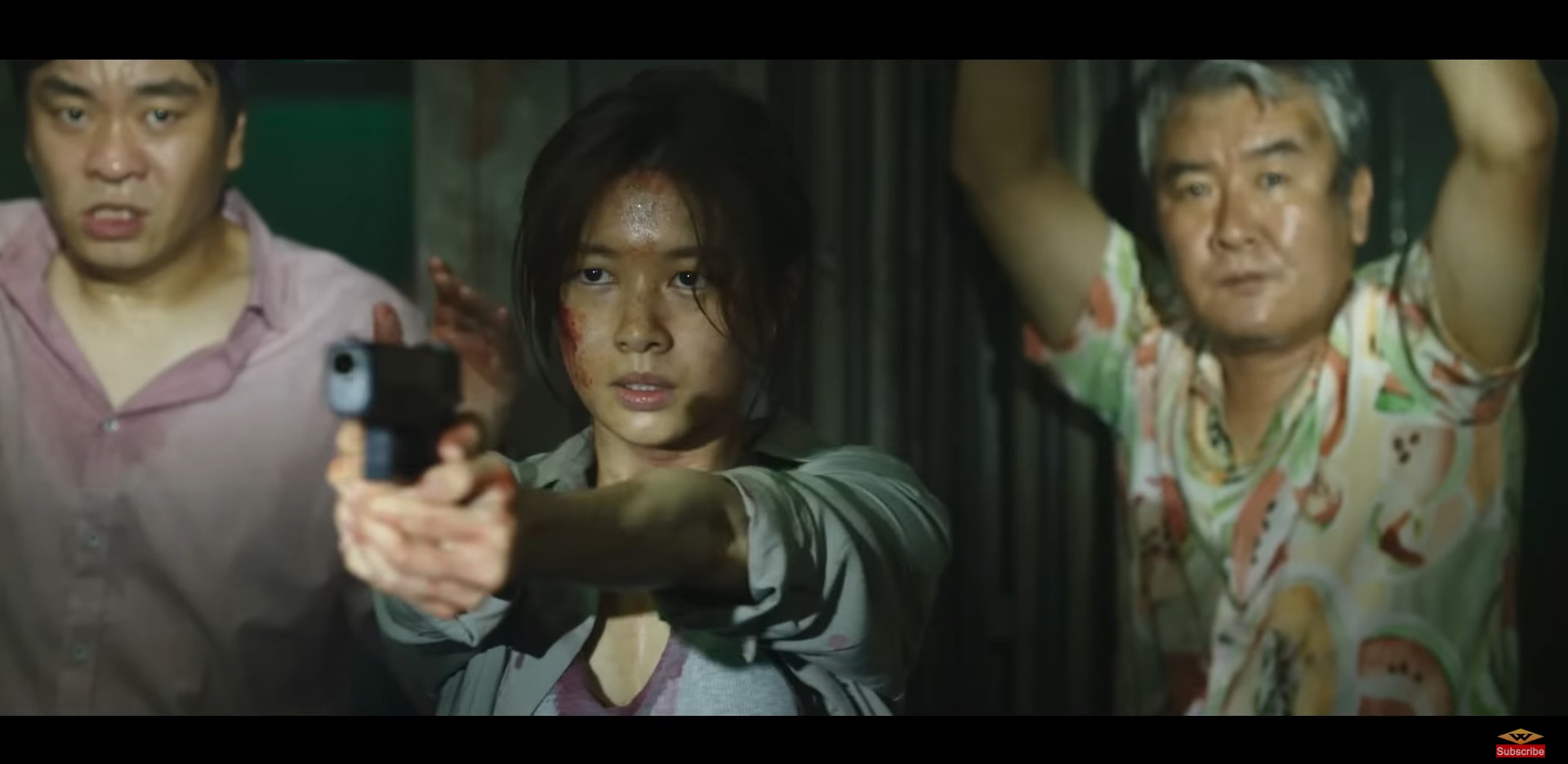
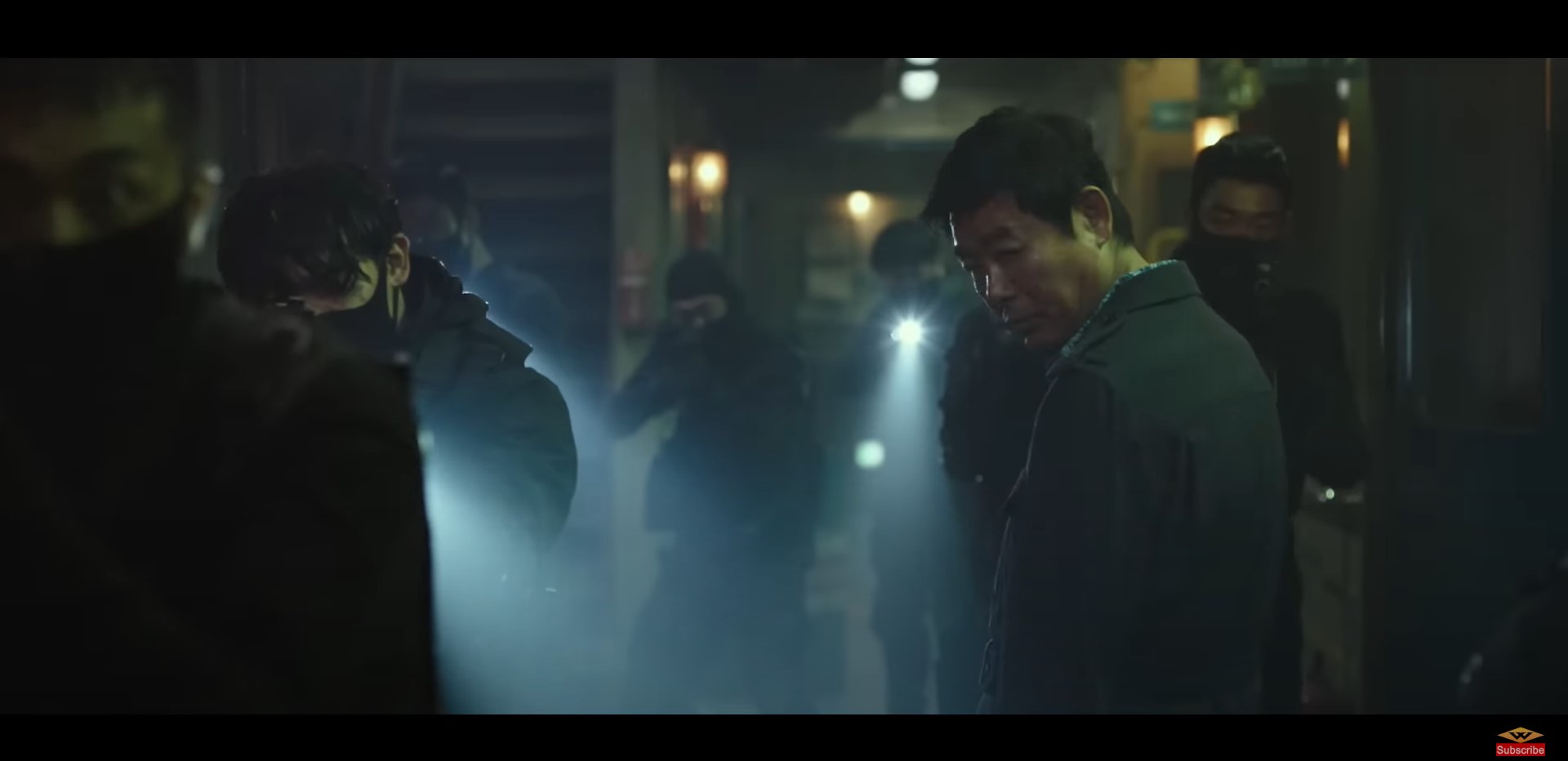
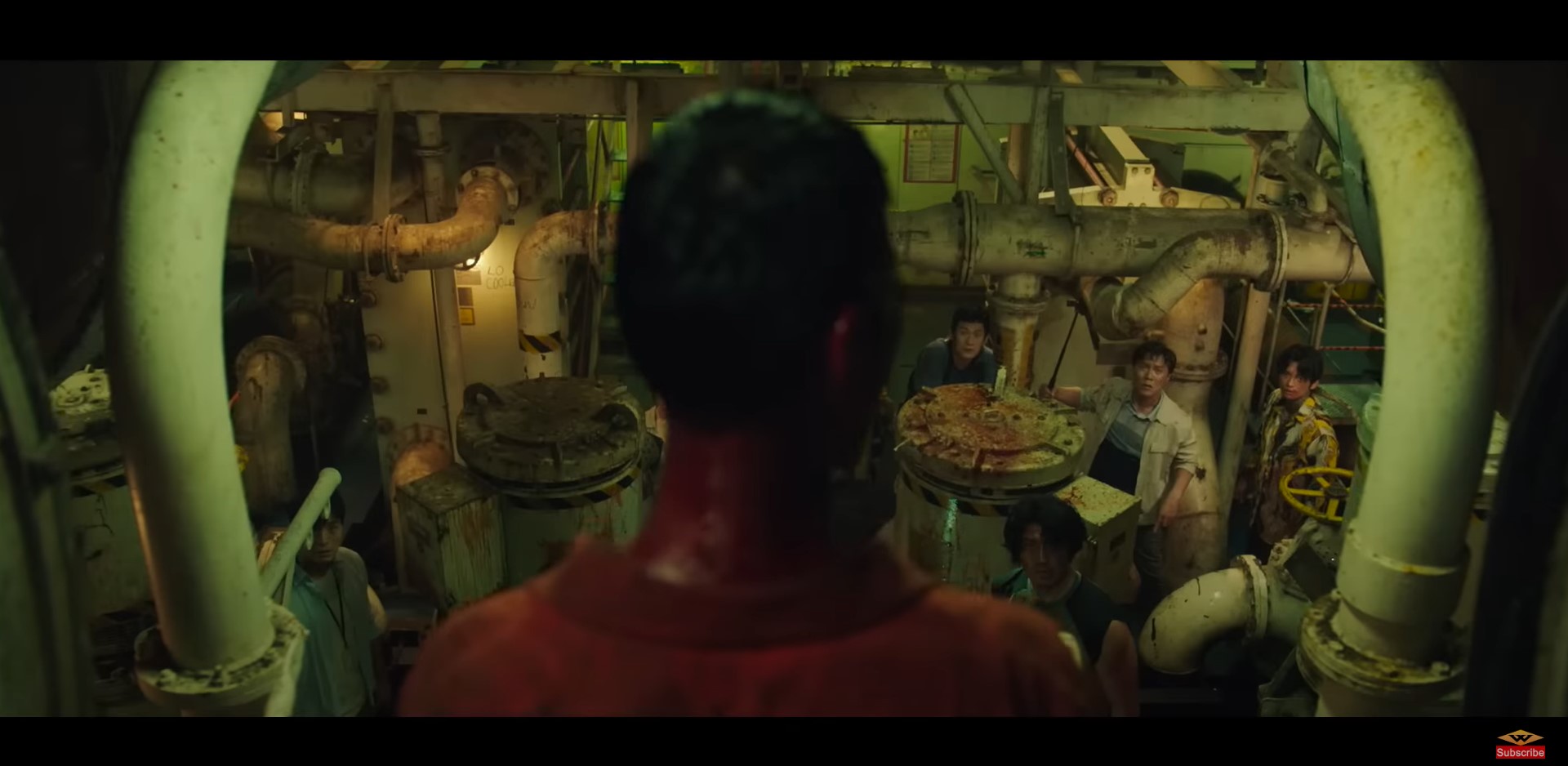
After a disastrous Philippines-to-Korea extradition processing of criminals that resulted in an airport suicidal bombing with multiple casualties, the procedure to transport dangerous criminals moves to a decommissioned Cargo ship known as the Frontier Titan.  The 3-day journey is expected to be a safer option to extradite Korea’s most wanted as highly trained and experienced detective accompany the criminals as armed escorts.  Every contingent has been covered except for what lies in the belly of the cargo ship.  Hidden in the bowel, underneath the engine room, a top secret biological weapon, involving an ancient wartime prisoner’s chromosomes commingled with the agility, strength, and prowess of a wolf, being transported across the sea.  When the criminals plan an elaborate seizing of the ship, the monstrous hybrid man known as Alpha is also inadvertently released and kills his caretakers, leaving him free to roam the ship and engage the good and bad guys alike as fair game to hunt.

Only a handful of times in my life have I’ve seen a film with so much blood.  “Project Wolf Hunting” is one of the bloodiest, most violent, Korean films to come out of 2022.  The hybrid action-horror with a genetically hybrid superhuman is the latest effort from writer-director Hongsun Kim, sticking with the horror genre after his positive reviewed 2019 evil spirit family drama “Byeonshin.”  The title, in reference to the operation of transporting Alpha through to East China Sea, into the Korean Strait, and dock at Busan, is the international marketing title for the Korean name “Neugdaesanyang” and is a film I can confidently and merely describe as “Predator” meets “Con Air” on a cargo ship.  Seasoned civic officers of the law, hardened criminals with sordid pasts, a special op consisted of superhuman soldiers are up against the odds to stop the Alpha, the original specimen.  Film between the ports of Busan, Korea and Manilla, Philippines, “Project Wolf Hunting” is the Korean venture production from Content G with Gu Seaon-mok serving as producer and is presented theatrical by The Contents On in association with CJ CGV.

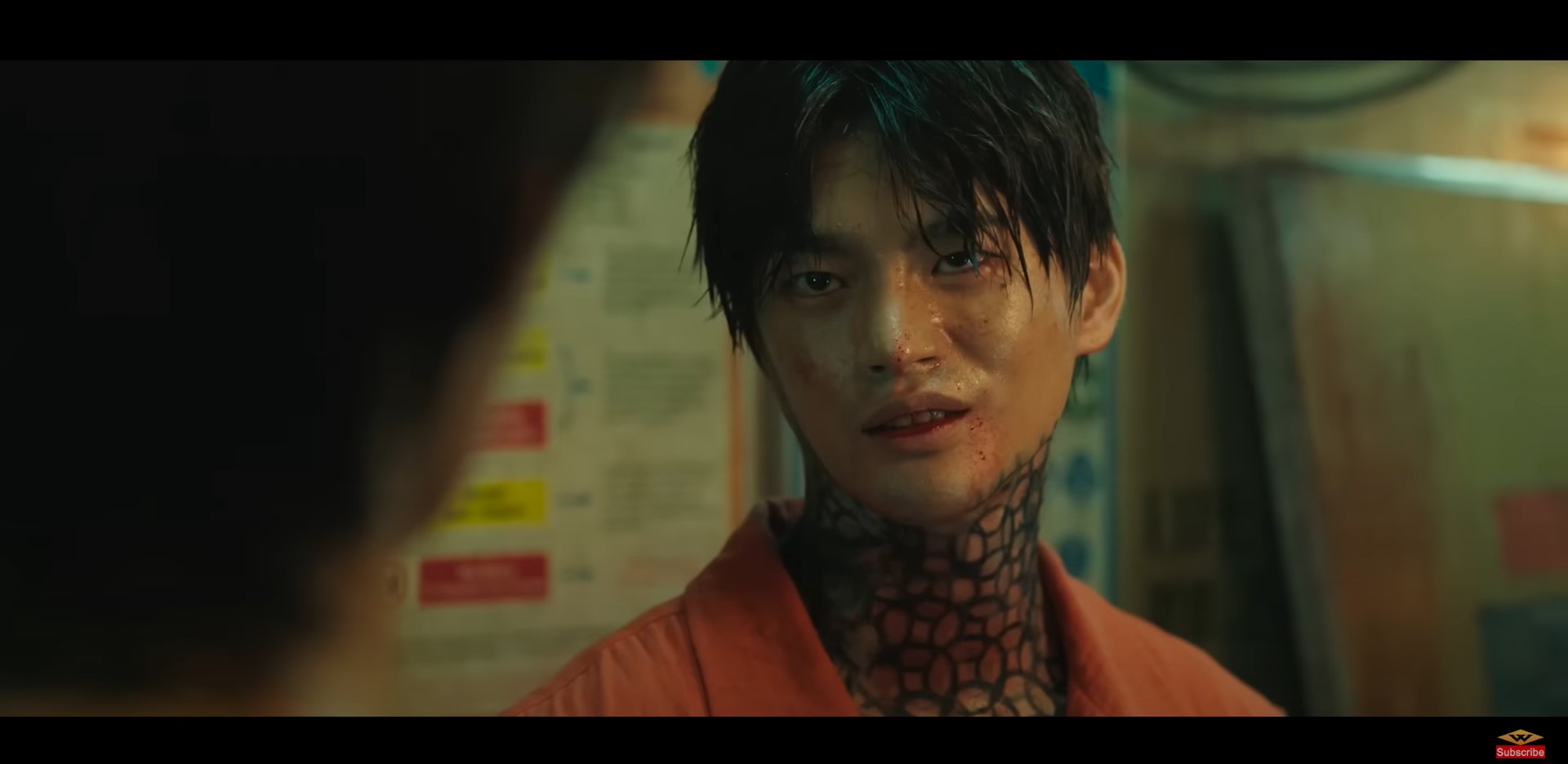
What’s interesting about Korean cinema is what you know what you’re getting with the characters who are greatly upfront, unpretentious, and full of attitude.  There are not a lot of false veneers with the cast of characters, something that can be said with most films spawned out from the Asia Pacific industry.  I might dangerously be overgeneralizing but from my viewings and writeups, but I’m fairly locked into my statement with confidence as “Project Wolf Hunting” paints a stark contrast of who’s who from the beginning without casting any doubt or even suspicion. Even with the some of the ship’s crew, Hongsun Kim clearly delineates their allegiances despite not coming right out with it initially and the cast immerse themselves into the appointed role with well-designed idiosyncrasies that seeing them out of character can be a bit of shock. Park Jong-doo perhaps is the most archetypical with Seo In-Guk, in his first feature performance, becoming the despot amongst the thieves. Guk transforms his appearance with full body tattoos to denote mafioso status and even takes that extra step with a few naked from the rear scenes to establish a conspicuous nonchalance for what anyone else has to think, say, or do. When many of the insurrectionary inmates take the ship, Jong-doo’s counterpart, Lee Do-il, isn’t so easily intimidated but is reserved and quiet in his strong posture. Dong-Yoon Jang offers a less violent option only to bide time for what’s ahead of them, the Alpha. Gwi-hwa Choi, who been hot right now in Korean cinema with having roles in “Train to Busan” and “The Wailing,” is the extraordinary and mysterious monster prowling to kill every single person on and off the ship’s manifest. With Alpha’s eyes stapled shut, maggots feeding off the festering tissue inside his mouth, and has a near spartan approach to liquidating, Choi completely transforms into the silent hunter with unstoppable and wild violent mode, but Alpha is only a name and the implicit meaning of the name does change hands throughout the course of the film that makes “Project Wolf Hunting” all that more the interesting. Female principals are not meek, weak, or helpless in his all-out brawl in a confined space with Jung So-Min as an eager cop with acumen and Jang Young-Nam as the dangerously uncouth companion to one of the mafia’s leadership and the fact that none of them are a love interest, or become even remotely involved romantically, sexually, or even innocently, speaks volumes on “Project Wolf Hunt’s” no room for romance rampage. The large cast lends to a high body and the acting pool rounds out with Dong-il Sung (“Byeonshin”), Park Ho-San (“The Call”), Chang-Seok Ko (“Lady Vengeance”), Lee Sung-wook (“Spiritwalker”), Jung Moon-sung (“The Cursed”), and Son Jong-hak (“Thirst”).

There’s so much blood. That statement was worth repeating. “Project Wolf Hunt” is reminiscent of the Japanese samurai films of yore or the absurd comedy gore film with geyser sprays of red with every blow.  Literally, tons of fake blood was used to coat the sets crimson in an impressive feat of movie magic carnage.  I’m also doubly impressed how the special effects team was able to achieve multiple sprays from out of the nostril cavities in what might seems small, insignificant, and simple looks amazingly palpable on screen that stopping to think about the difficulty in how that effect can be accomplished can be easily overlooked.  The blood sprays are only a fraction of the wide variety of violence and gore put on display and we’re treated to an abundance of slaughter and a superb, choreographed melee in each and every tightly confined skirmish that makes “Project Wolf Hunting” captivatingly adrenalized.  Production design creates the illusion of a cargo ship without question and the visuals, though soft in some scenes, sell the nautical voyage through clear skies and a storm rough patch.  Much of a part of “Project Wolf Hunting’s” success is cinematographer Ju-Hwan Yun’s framing.  The example I like to use is the post-elevator attack when the hoisting cord snaps that sends the lift plummeting down the chute with Alpha inside.  Yun then sends the shot from the top down the chute to the exposed opening of a mangled lift to see Alpha turn his eye-stapled face upward toward the narrowly escaping prey.  The shot gets the heart pumping and relays, in one sequence, the unkillable nature of Alpha.  If “Project Wolf Hunting” isn’t already thrilling enough with the brimming, cutthroat tensions spilling onto every deck between the police detectives and the criminals in their custody, the evolutionary plot twist that welds the age-old divide between the two frictions is a bloodbath you don’t see coming and one you’ll enjoy experiencing. 

Action, horror, human experimentations, and with a complemental nod to the hard-hitting Asian cop films of 90’s, “Project Wolf Hunting” has teeth and stamina for 123 minutes of knockaround bloodshed. A winning Blu-ray release for Well Go USA Entertainment, the film is presented in a widescreen 2.39:1 aspect ratio. The AVC encoded BD50 offers a topnotch 1080p resolution that translates well to the big screen with granular detail in the interior and exterior of the cargo ship set and displays the stylistic choice of a warm color scheme consisting of prominently yellows and greens, providing less shadowy, higher contrast areas to suggest there is nowhere survivors can hide. Though quite a bit of CGI throughout the film, the end result doesn’t appear half bad with more fleshed out textures built into the renders to make them less gummy-looking. The release offers four audio options – a Korean and dub English 5.1 DTS-HD Master Audio and a Korean and dub English 2.0 stereo. Obviously, you receive more bang for your buck with the amped up surround sound option and don’t have to contend with dubbing if you go the original Korean language route. A high velocity range sounds strong through the rear channels with gunshots, the ship’s indiscreet hum, and the overall ricochets, clinks, and skirmish shuffles submerge an enveloping blanket of directional sounds right in your ears. The Korean dialogue is clean, clear, and vociferous in Korean inflections. English subtitles are optional and available well synched and error-free. Like status quo with other Well Go USA Entertainment releases, bonus features are an ornately produced, one-sided interview vignettes with the cast and crew and of the behind-the-scenes making of the film as well as a making of Alpha which was more actor Gwi-hwa Choi’s excitement about this different kind of role per his usual. The trailer is also available in the bonus content. Physical features include a traditional Blu-ray snapper with latch with the grisly, dirty face of Alpha blended into a black background. The film is unrated and is coded region A for disc playback. Despite minor convoluted expounding, “Project Wolf Hunting” kept the attention at high alert with a high body count, an indomitable super soldier, and a cargo ship load of blood.

“Project Wolf Hunting” on Blu-ray and Available for Purchase by Clicking the Cover Art!

When EVIL Runs The Show, That’s When the Reality Sets In. “Funhouse” reviewed! (Magnet Releasing / Digital Screener)

Eight C-grade social media celebrities sign a contract for a new reality show, Furcas’s House of Fun.  The reality show streams worldwide on all electronic devices in an exhibition of different and standoffish personalities locked together in apartment-size living quarters.  Contestants will have to face challenges and weekly viewer voting to be the last one standing for a chance to win a 5 million dollars cash prize  Instead of sexy making out sessions, drunken brawls, and contestant melodrama to boost viewer ratings, Furcas’s House of Fun is in actuality a syndicated snuff reality show where a contestant is voted out is a contestant receiving a brutal death in front of the entire world.  Survivors watch behind paned glass as one-by-one their castmates are dispatched in the most gruesome way possible, directed by a screen animated panda bear helmed by a sadist eager for the show to go on.

Ready to have a little fun?  The “Funhouse” is open for what is a variety show of horrors in this 2019 shot, 2021 released reality show of encroaching aggravation and gore from writer-director Jason William Lee.  “The Evil In Us” filmmaker plays his hand at personifying internalized resentful rage for hack, do-nothing, inconsequential to society celebrities by feeding them gladly and enthusiastically to the bloodthirsty wolves.  “Funhouse” isn’t your typical social media or tech horror film as Lee dishes out a thought-provoking disgust covered in a powdery sugar and popcorn veneer that’s surely to please the broad range of horror fans.  The co-ventured Canadian-Swedish story of shallow fame nihilism is shot in the Providence of British Columbia and in Stockholm, home base of Ti Bonny Productions under executive producer Henrik Santesson, in collaboration with Lee and producer Michael Gyorl’s Sandcastle Pictures.

With the surname Skarsgård, acting is in certainly in the blood.  Valter Skarsgård, the youngest son of “Nymphomaniac” and “Deep Blue Sea’s” Stellan Skarsgård’s first marriage and the brother of terrifyingly frighteningly Pennywise actor, Bill Skarsgård (“It”), branches out following his ancestral destiny by headlining as the lovable and misjudged Swede, Kasper Nordin, who leeched fame by being the ex-husband to a renowned singer.  Nearly the spittin’ image of his older brother Bill, Valter brings his name and family looks to the table while showcasing his own talent amongst a motley crew of nationalities.  That’s one of “Funhouse’s” main messages about social media stardom as a plague that has spread to every corner of the world symbolically infecting each contestant from a different country:  Dayleigh Nelson (“Island of the Dolls”) of Britain, Khamisa Wilsher of America, Gigi Saul Guerrero (“Puppet Killer”) of Mexico, Amanda Howells of the Philippines, Mathias Retamal (“The Source of Shadows”) of Chile/Canada,  Karolina Benefield of Poland, and Christopher Gerard of Ireland.  The roles of wannabe celebrities is an ostentatious representation of click bait influencers who will sell essentially their soul and show their skin to be noticed and this turns the clear antagonist villain, a merciless gamester and contract abider with business dealings more vile than from the Devil himself, to be a subtle antihero of sorts as the cast rounds out with Jerome Velinsky’s wickedly sophisticated performance as Nero Alexander that is urbane nihilism at its best. 

Outrageous, fun, and gory – “Funhouse” has all the hallmarks of a 90’s horror on cruise control.  With a bedazzling rudimentary shell of a panda bear avatar animation and blend of practical and digital blood over the simplicity of a small location and indie production, Lee is able to fly through the narrative at whiplash speed and still drop animosity-awarding and empathetic traits to believe in the cast of characters.  In the middle of the chaos of axe splitting heads and being dunked into a barrel of highly corrosive acid, a topical theme of the detrimental social media and influencer stardom to society really positions “Funhouse” on the frontline for inflammatory and anti-social media messages, harping on the noncontributing and unbeneficial role of these money-generating, like-focusing, click baiters in culture and society other than selling to their audiences sex, gossip, and violence.  Speaking of violence, I was pleasantly surprised by the right amount of gore that didn’t shoot for extravagant levels despite some smoothing around the digitally added sinew and guts, keeping a modest amount of realism to the dystopian gameshow construct.  Initially, there are dubious first act moments that quickly shuttle hapless soon-to-be-casualties into the same location, much like in “Saw II” when characters all wake up in the room together and we have no idea who they are, where they come from, and what their backstory is, but as the film progresses we learn more about them and the roles they play in the maniacal puppeteer’s design.  The twist, almost meta-like, ending leaves “Funhouse” on a low note that doesn’t fulfill any void for its existence, but a good chunk of the story is really meaty with a revolving door of plights and a small, yet efficient, compassion outpouring spicket.

Not your traditional participatory surprise-laden and mirror maze attraction, “Funhouse” will still bring old-style thrills with some new blood spills in it’s grand opening release in theaters and on demand on May 28th courtesy of Magnet Releasing. Shawn Seifert (“Dead of Night”) lays out a smorgasbord of cinematography techniques that includes rich, un-matted color filters, isolating characters in darker, dim rooms in making them seem centerstage for their own grand demise, and cultivates stationary, handheld, tracking, and some drone shots for an extremely vibrant and glossy approach and feel for reality television version 2.0. Lee edits the digital reel himself and, honestly, the pacing wanders quickly to the overly rushed section like a quick-spit-it-out story wanting to be finished before it even begins and is compounded with another intrusive quality in the hyperactive back-and-forth of shots that aims to resemble the irksome flight in and out of reality shows that speed up and slow down like a nervous teenager behind the wheel of their parents and continuously presses down on the brake pedal. Stay tuned after credits for a gag bit scene that ties into the main story but promises nothing more. No more being voted off the island or nixed by expert judges, “Funhouse” cleans house with deadly eliminations and a message of the unyielding power granted to many so easily through a rapidly reshaping medium that has become too influential on a braindead scale.

Satan’s Evil Indestructible, Hairy Servant! “Beast of the Yellow Night” review!


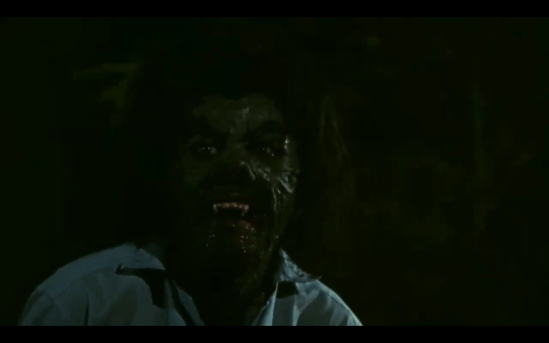
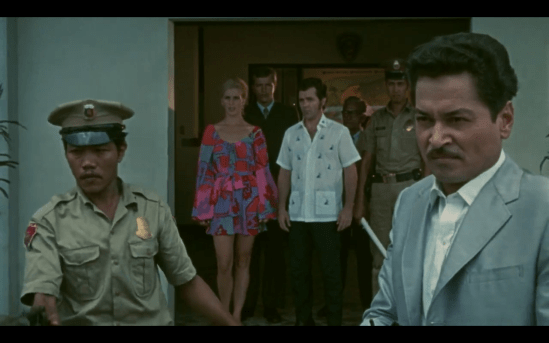
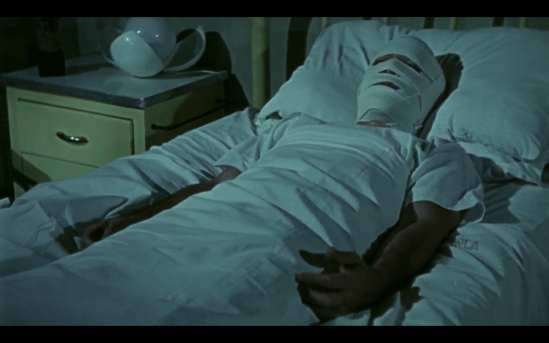
At the tail end of the second great war, Philippines based U.S. army deserter and Japanese sympathizer, Joseph Langdon, runs for his life as the Philippines police and guard track him down through the jungle for committed heinous acts that not only include treason, but also rape and murder. Exhausted and dying from his wounds, Langdon will do anything to stop the process of pain and death, including making a deal with Satan himself. In exchange for saving his life, Langdon commits himself to eternal servitude at the malevolent pleasures of Satan by inhabiting various souls and bodies through the decades and extracting the latent evil from his interactions with people, but Langdon finds himself again exhausted and exacts free thought and a rebellious stance against his master after inhabiting an American business man and given back his own face. The Dark Lord, as amusing as he wicked, bestows upon Langdon the ability to transform into a flesh hungry man-beast whenever his desires boil to the surface and he becomes the most wanted man in the Philippines, but how can they stop a monstrous fiend they can’t kill? The answer lies solely with the damned Langdon himself.

Rarely does a horror film birthed from the Philippines reach my critical virtual desk and, fortunately, “Beast of the Yellow Night” lands smack-dab in my lap as an absolute jewel from the early 1970’s from writer-director Eddie Romero. The 1969 “The Mad Doctor of Blood Island” director, who’s heritage is Pilipino, had visions of grandeur for his large scale features that stem from an infinitesimal budget, but with enthusiastic energy from former musician and beach party, teen heart throb John Ashley, the duo cofounded their theatrical finance company, Four Associates Ltd, to produce their very own horror feature films straight out of the Philippines which “Beast of the Yellow Night” was one of first to be released, if not the very first to be produced. Additional funding was provided by a little known distribution company, New World Pictures, jointly founded by the genre-setting Corman brothers, Roger and Gene, and thus forth “The Night of the Yellow Beast” was built upon a rich and solid cult foundation that began a Philipino-film circuit conversely well-known in the U.S. and put Eddie Romero on the proverbial map of relatively unknown and granular cult directors while providing a branching out of yet another successful credential façade for John Ashley that doesn’t involve country music or being just another pretty face in the beach party moviegoer crowd.

If you haven’t guessed by now or if you’re just as dense like myself, John Ashley also stars in his co-produced creature feature and Ashley, who goes without saying that he stands in his own rite, is also the Paul Naschy equivalent of the Philippine Islands with his all hands on deck attitude toward filmmaking and being the man behind the gnarly man-beast makeup that more than likely takes hours to apply. His performance as even tempered Joseph Langdon is a stark contrast from the wild and vicious beast with a flesh appetite and knack for mauling that herd this film into the werewolf category according many descriptive plots, summaries, and reviews, but “The Night of the Yellow Beast” actually resembles more of a Dr. Jekyll and Mr. Hyde familiarity as Langdon doesn’t transform when the full moon is high, but rather at the whims of his tormentor, in this case it’s Satan rather than an ill-fated elixir, and then he morphs more rapidly and explosively during exhilarating and endorphin stimulated moments like intimacy to further exacerbate his dreadful curse on Earth. Langdon and beast Langdon are befriended by a blind, long-tooth ex-con, Sabasas Nan, played by “The Big Bird Cage’s” Andreas Centenera and Centenera captures the gentle nature and extended wisdom of a man at the tail end of life and looking to right the wrong for his past mistakes. Sabasas Nan is similar to the blind man in the tale of Frankenstein that doesn’t judge, become frightened, or even shun the ugly shell of a monster, but though visionless, both blind men are able to clearly see into the soul of what used to be once a man. “Beast of the Yellow Night” also stars leading lady Mary Wilcox (“Love Me Deadly”), Leopoldo Salcedo, Eddie Garcia (“The Woman Hunt”), Ken Metcalfe (“TNT Jackson”), and labeled as the Filipino Peter Lorre, Vic Diaz (“Black Mama White Mama”) as the pot-belly Satan and Langdon’s mischievous master.

Eddie Romero’s deep and intellectual script sticks out amongst the fray of time lapse and post-skirmish makeup effects that teeters “Beast of the Yellow Night” on a B- to C- movie. Not that the special and makeup effects were completely awful or subpar by any means, but the directing filmmaker pushes the boundaries to scribe the pull strings of a man’s soul, really digging into the anguished flesh of redemption and mankind’s mortal coil, which puts a lightly coated dampening on Langdon’s transformations from man-to-beast that hasn’t yet reached the Paul Naschy level of editing and progressiveness toward his horror films. In fact, the “Yellow Beast’s” effects are merely one step below that aforementioned level. However, the beast is no wolf of any sorts, but nor it isn’t a man in a cheap leathery or latex rubber mask that materializes a rather mangled, mangy beheld fiend with razor sharp canine teeth shown through a ferociously hungry and breathy-snarling maw set below equally ravenous eyes that yearns for the blood of man. For 1971, the effects are exceptionally marvelous, but Romero’s script just blows the practicalities out of the water being ahead of its time and sorely overshadow the effects work.

MVDVisual and VCI Entertainment proudly gift to us “Beast of the Yellow Night” onto 2-disc all region DVD/Blu-ray home video. Produced from a 2K scan of the original 35mm negative, VCI Entertainment’s widescreen, 1.85:1 aspect ratio presentation in full Metrocolor is mondo cult cinema exhibited on a high level and despite some blotchy patches, the corrected coloring and cleaner picture are by far the best we’ll ever see while still sustaining a healthy amount of beneficial cinematic grain. The prologue has coloring issues with about 20% of the right side of the film strip in sepia harboring in sepia town, but becomes corrected after the title and credit sequence. The English and Tagalog, the national language of the Philippines, mono audio track has lossy bite that’s expected and yet, still maintains ample dialogue track and a solid and balanced in range ambient track. Optional English subtitles with SDH are also included. Bonus features include a 2018 commentary track by writer and filmmaker Howard S. Berger and the head of Mondo Digital, Nathaniel Thomspon, old and insightful video interviews about John Ashley and the Filipino films of the 19870’s with Eddie Romero, Sam Sherman, Patrick Wayne, Peter Tombs, Eddie Garcia, Gloria Hendry, Sig Haig, and Jan Martin, a Remembering John Ashley featurette that includes interviews with wife Jan Ashley, filmmaker Fred Olen Rey, Steve Stevens, and Andrew Stevens, original theatrical trailer and TV spots. Plus, a thorough inner liner essay from Howard S. Berger that goes examines “Beast of the Yellow Night” and the films of that era that are a metaphor for much, much more. “Beast of the Yellow Night” is a simple message cause and effect. If vileness becomes you, then villainy will forever run fluidly through your icy veins in this Eddie Romero and John Ashley monstrous picture that pulls at the tattered strings of a downtrodden soul.

Amazon has it on sale, now! Go Go Go!