This EVIL, Straight-Razor Killer Has a Novel Idea! “Tenebrae” reviewed! (Synapse / 4K-Blu-ray Combo Set)

2-Disc 4K UHD and Blu-ray Set Now Available of Dario Argento’s “Tenebrae”

While on a media book tour for his latest popular crime thriller novel, “Tenebrae,” American novelist Peter Neal is swiftly entangled in a killer’s puritanical wrath shortly after landing in Rome.  Using Neal’s story as an inspirational guideline to rid the world of what the fictional book labels as depraved people, the killer brutally murders women closely resembling characters in Neal’s book with a straight razor and sends Neal a deranged poetic message shortly after each death.  Police are on the case but always once step behind, even when the murders have seemingly stop connecting to the pages of Neal’s novel.  When the writer investigates by running through the list of possible suspects, the writer in him goes rogue by setting off to solve the case himself that would sensationalize and authenticate him as a crime writer, but the deeper Neal directly involves himself, the more the grislier the murders become and they’re starting to come closer to home than before. 

Dario Argento is unequivocally one of the best masters of horror for half a century, writing and directing not only some of the best Italian crime-mystery Giallos, splashed with hue vibrancy and caked in gruesome blood splatter, but also writing and directing those same films with major success internationally as his films connect with a global audience.  “The Bird with the Crystal Plumage,” “Deep Red,” and “Suspiria” have skyrocketed the filmmaker within the first decade of movie-crafting and Argento would not have been who is now without the guidance and the financial foundation constructed by father, Salvatore Argento.  Before his death in 1987, Salvatore produced one more of his son’s ventures in 1982 with “Tenebrae,” an emblematic mystery that brings Italian and American actors into the fold of Argento’s violent pulp puzzler.  Argento’s younger brother, Claudio, co-produced the feature under the Sigma Cinematografica Roma production company.

The Italiano-Americano production casts a pair of native New Yorkers in Anthony Franciosa (“Death Wish II,” “Curse of the Black Widow”) and John Saxon (“A Nightmare on Elm Street,” “Black Christmas”) who regularly crossed over the Atlantic for roles in international pictures.  Franciosa plays the novelist Peter Neal with Saxon as Neal’s newly hired agent Bullmer.  Their portrayed amicable relationship succeeds expectations of client and manager professionalism, but a good publicity campaign can be torpedoed by a sadistic killer with a throat cutting fetish and Roma’s best officers on the case intruding into the Neal’s personal promotion with Detective Germani, played by spaghetti western regular Giuiliano Gemma (“Day of Anger”), and his partner, Inspector Altieri, played by Carola Stagnaro (“Phantom of Death”).  The third English speaker is John Steiner (“Caligula”), a proper Englishman setup as an Italian television host on the docket to interview Peter Neal’s latest release success.  Steiner becomes an early favorite as the suspected killer with his odd pre-show questioning that falls in line with the Killer’s motives, but he isn’t the only person of interest as Neal’s estranged lover Jane (Veronica Lario) holds a lover’s quarrel with the writer who has seemingly become intimately close with his personal assistant Anne (Daria Nicolodi, “Deep Red”).  A conglomerate of characters gyrate Argento’s maelstrom mystery, each exhibiting profound performances that make each rich in their own right, and fill out with an assemblage of robust supporting characters diffusing through the story with Ania Pieroni (“The House by the Cemetery”), Lara Wendel (“Ghosthouse”), Eva Robins (“Eva man”), and Mirella Banti (“Scandal in Black”), the model most infamously on the front cover of most home video releases and poster one sheets with the iconic neck-sliced open and dripping blood along with her wavy hair suspended in a pose of vivid void and color.

“Tenebrae,” in Latin translates to darkness, describes Argento’s post-“Suspiria” feature intently.  Giallo lives within this time capsulated enigmatic madness, color-coated and visually complex to become an easy pill to swallow amongst all others in the Italian-reared niche.  Accompanying all the hallmarks of a Giallo construct – the killer’s gloved hands in POV, psychosexual tropes, mental instability exposures, violent and gory – Argento also impresses us with baroque mise-en-scene of lavish houses, detailed interiors, and extremely broad, emotionally phrenic individuals.  We also receive technical style wonders like a long boom shot that cranes up a house exterior to follow the idiosyncratic and opposing activities of two presently quarrelling lesbian lovers on a dark, stormy night in a tensely presage moment mixed with the synth-rock sounds of the “Goblin” theme track.  “Tenebrae” is chic in its ugliness and the patience Argento shows is formidably impenetrable without being flawed with lingering stagnancy.  While wallowing into what we’re led to believe, red herrings and other subterfuges to throw off audiences’ keen-to-solve sniffers, the story stirs a cauldron of coherent progression that is, more often than desired, lost in most gialli trying to weave through an intelligible punchy crime-mystery without becoming disoriented by the twists, turns, and topsy-turvy outcomes.   

“Tenebrae” hits 4K onto a 2-Disc, UHD and Blu-ray combo set from the genre-leading distributor, Synapse Films. The HEVC, mastered in Dolby Vision, encoding 2180p UHD and the AVC encoded 1080p high-definition Blu-ray are presented in a widescreen 1.85:1 aspect ratio in both the English and Italian versions of the feature.  One of the more gorgeously restored versions ever to be presented, with sharp delineation and organic popping colors within the narrow margins of infrequent gel lighting, the near flawless original negative is greatly elevated by Synapse’s ultra high-def facelift that resound the lavish textures of various sets, the expressional details of the characters’ face, and the glistening shine of the spraying blood.  There’s real balance between the colors in this presentation, offering not only a wide variety of hues but a great display of the mix.  Gels are not overly used and are more key lighting spotlights to heighten tension or introduce moods on an almost subconscious level.  Both English and Italian versions score a lossless DTS-HD Master Audio 2.0 mono.  This release caters to the very suspense Argento acoustically and phonically propounds that, in the same regard to the eyes, places viewers’ ears right in the middle of the action.  Every sound is distinct and unassuming during the throes of violence, a cleanly serrating effect that compounds killer consternation of being everything, everywhere, all at once.  Typical of the time and cost-efficient ADR usually retains some dubbing disharmony, but “Tenebra’s” tracks are neatly synchronous with Anthony Franciosa and John Saxon’s recordings timed exact and as if captured in the scene.   Some of the dubbing isn’t as in the bag, such as with Giuliano Gemma’s recording that’s does denote that space in between intensified by likely another voice actor’s reading overtop Gemma’s actual dialogue.  UHD offers English SDH on the English version while the Italian version has just regular English subtitles; the Blu-ray disc has the same.  Hours of bonus content, identical on both formats, begin with an audio commentary by Dario Argento: the Man, the Myths, the Magic author Alan Jones and film critic/historian Kim Newman, a second audio commentary by Dario Argento expert Thomas Rostock, and a third audio commentary by Maitland McDonagh, author of Broken Mirrors/Broken Minds:  The Dark Dreams of Dario Argento.  The fun doesn’t end there with a 2016 feature-length documentary “Yellow Fever:  The Rise and Fall of the Giallo” with interviews from Dario Argento, Umberto Lenzi, Luigi Cozzi, and Ruggero Deodato amongst the biggest names in film critic authoritarians, a newly edited archival interview with actor John Steiner, a newly edited archival interview with Maitland McDonagh, an archival featurette Voices of the Unsane with “”Tenebrae’s” Dario Argento, Daria Nicolodi, Eva Robins, Luciano Tovoli, Claudio Simonetti, and Lamberto Bava interviews, an archival interview with actress Daria Nicolodi, an archival interview with writer-director Dario Argento, an archival interview with composer Claudio Simonetti, an archival introduction from Daria Nicolodi, an international theatrical trailer, the Japanese Shadow trailer, an alternate opening credits sequence, “Unsane” end credits sequence, and an image gallery to wrap things up.  Inside the rigid O-slipcover, graced with a high quality and beautifully macabre illustration rendered by Nick Charge, is a Synapse Films’ black, 4K UHD labeled Amaray case with a double side disc lock and a reversible cover art with the Nick Charge graphic as default underneath the slipcover with the reverse side the Synapse Films’ standard Blu-ray cover art pulped with a famous death scene in pop art color. The insert houses a Synapse Films’ catalogue, and the discs are pressed with two notable kill scene frozen moments pulled in still image form. Feature runs at 101-minutes with an uncut presentation of the feature with a region free playback on both formats. ”Tenebrae” is Dario Argento in a cracked-up nutshell, paradoxically beautiful and horrible and burgeoning with suspense and color. The restored and remastered Synapse Films’ UHD and Blu-ray set is equally as such in its gorgeously grotesque packaging of film, its director, and its legacy that will outlive us all.
2-Disc 4K UHD and Blu-ray Set Now Available of Dario Argento’s “Tenebrae”

Never Trust a Script Written by an Egotistically EVIL “Scream Queen” reviewed! (Visual Vengeance / Blu-ray)

This Chainsaw’s Made for Cutting! “Scream Queen” on Blu-ray!

Malicia Tombs, an acclaimed horror actress known for B-movies and bad attitude, bursts into a wreckage of flames when her car sudden explodes after storming off the set of her new movie, “Scream Queen,” in which she wrote and starred as the titular character.  Part of the cast and crew were devastated by the accident that had cut their own career short while others were relieved the egotistical Tombs had perished despite publicly feigning grief over the loss of a genre fan-favorite.  Months later, the small cast and crew receive a mysterious invitation to gather at a creepy mansion butlered by Runyon.  When their host is unveiled as to be a very much alive Malicia Tombs, she offers them a lucrative sum of money to finish the film they’ve started but with a new script.  As the guests read through the new treatment, the cast and crew realize their present moments read just as their being played out in the script, even their deaths. 

If there was ever a single face deserving the representative distinction within an overpopulated categorized scream queen genus, Linnea Quigley would be that green-eyed, blonde-topped, beautiful face with an infectious smile.  Quigley worked with an array of filmmakers, ranging from some of the most renowned cult films of all times amidst reams of horror movies for nearly half a century (yes, we’re feeling old now) to the most independent of the independents films never having really receive the proper exhibition format or audience attention.  To what would be a delight to Quigley’s fanbase, one of those obscure features is Brad Sykes’ “Scream Queen,” a late 90’s filmed, 2002-released, SOV, U.S. slasher written-and-directed by the “Camp Blood” and low-budget filmmaker with Quigley in mind to play the scream queen character Malicia Tombs, now available, officially, on Blu-ray.  “Scream Queen” is the first major project for Brad Sykes in a collaborating effort in not only as a director but also as a co-producer alongside David Sterling of Sterling Entertainment.

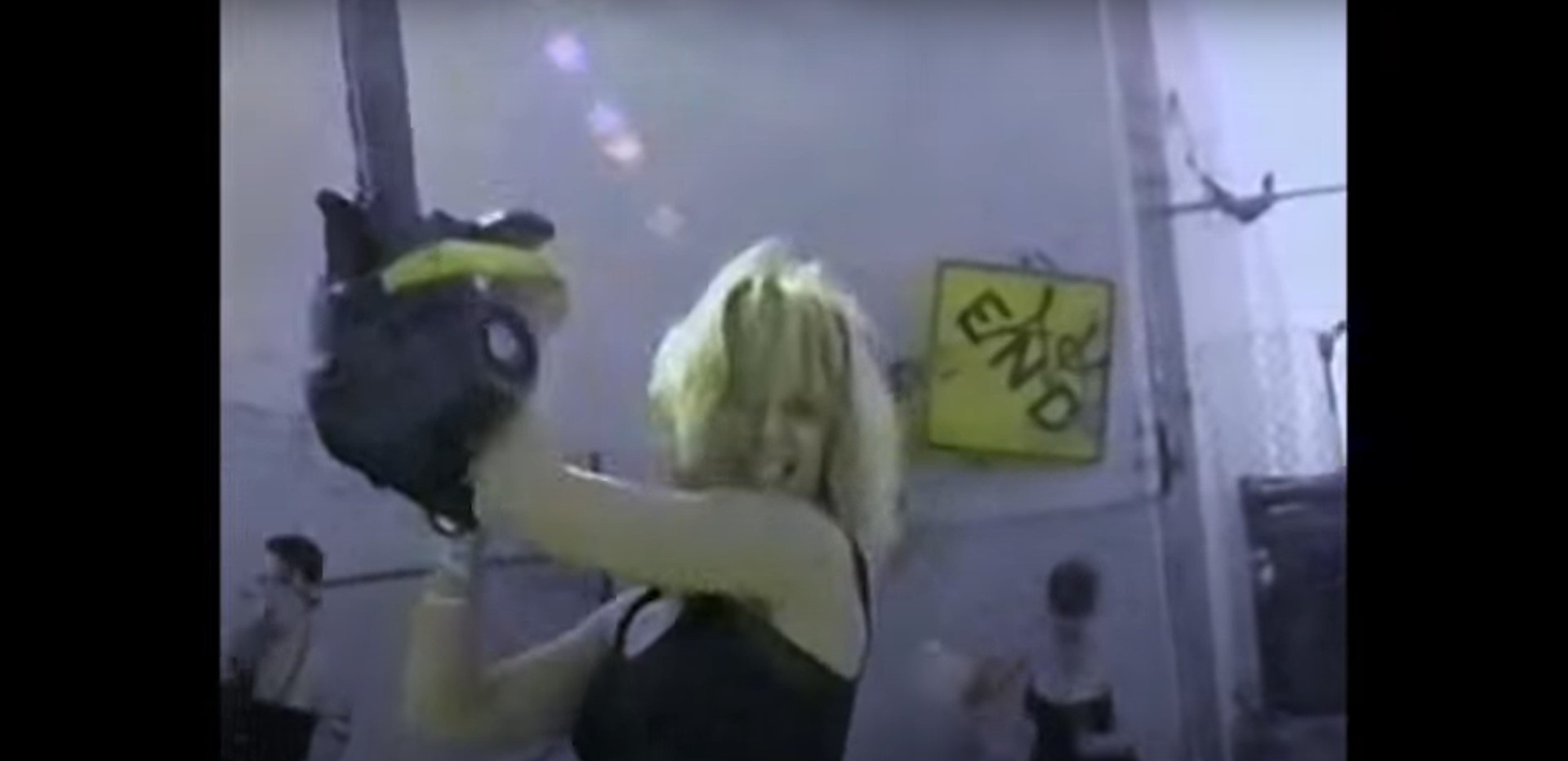
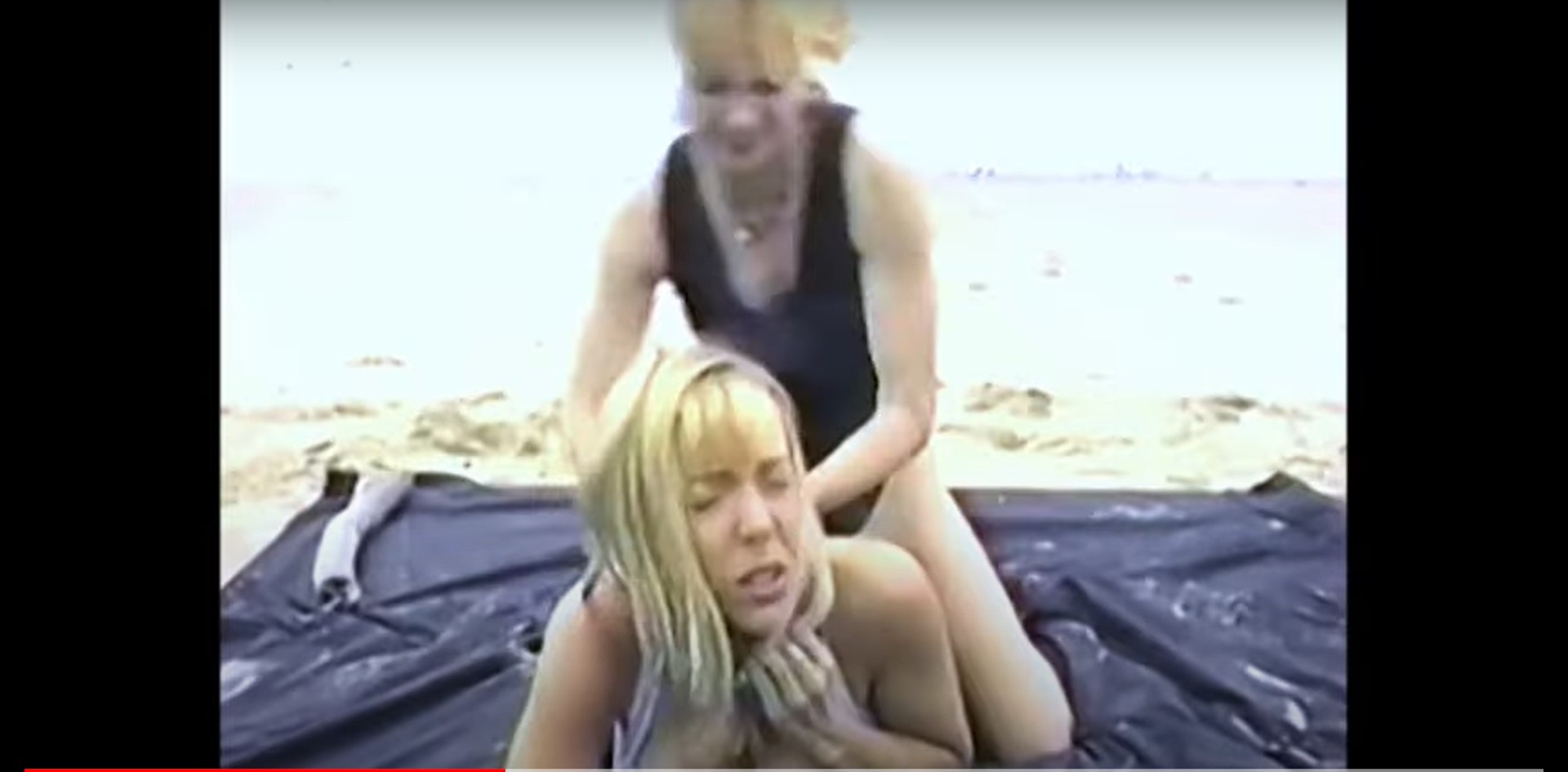
“The Return of the Living Dead” and “Night of the Demons” Quigley puts on another memorable and wickedly fiendish performance as the haughty genre scream queen Malicia Tombs who superiority has gone to her head as she embraces her designation to an exact mania, displayed early on when her character’s character attempts to choke-kill another actress despite the numbered scene not being a death scene and Malicia harps on wanting to continue with the resembling act of murder.  As much as Malicia Tombs embraces the killer instinct inside of her, Linnea Quigley very much embraces Malicia Tombs without having to take her top off and despite having less screen time than her costars.  While Quigley fades in and out of the linear story, the narrative progresses with livelihood hardships of the now out-of-work cast and crew who relied heavily on that small film to boost their acting and filmmaking careers.  That crop of characters falls short tipping into their expectations, aspirations, and even their relations to be just slasher fodder for the mysterious maniac roaming the house.  Jenni (Emilie Jo Tisdale,” Escape from Hell”) and Devon (Nova Sheppard) are inferred romantic roommates who sell clothes on the side of the street to make ends meet post failed film but don’t have surmountable direction to either be a full-fledged couple to sympathize or seem terribly concerned about opening their own clothing shop other than what would be a bad decision to reside at the mansion overnight.  Again, no sympathy there either.  The special effects goof Squib (Bryan Cooper churns chuckles relentlessly by relating more to his crafted effects dummy more than people, marking him conclusively comedy relief as well as fated for death that, like in life, no one takes him seriously when he shows up gruesomely mutilated.  The other principal actress across from Tombs is Christine (Nicole West, “Dimension in Fear”), a buxom blonde tired of secretary work succumbing to lead man flirtations in a dark and scary house where every shadowy corner is lodged with threat.  The pair fall into that horror character cliché of have sex, will die, quickly downgrading their pre-professional relationship into nothing more than dark house desire.  Director Eric Orloff (Jarrod Robbins, “Evil Sister 2”), a presumed spin on the Awful Dr. Orloff and perhaps hints at his motives, seems to be stuck in angsty avoidance and melancholy stemmed by what could have been with Scream Queen but that also peters to a gross negligence end of an arc waste.  Rounding out the cast are a couple of special bit parts played by prolific Full Moon Entertainment and overall horror movie screenwriter C. Courtney Joyner (“Puppet Masters III,” “From A Whisper to Scream”) as a televised homicide detective and Kurt Levee in a quasi-return of his character Runnion from “Evil Sister” but alternatively spelled “Runyon” in “Scream Queen.”  

Though obviously and definitely not the first to do this, “Scream Queen” humors metacinema measures built upon horror tropes and spherical plot points that redirects the story back upon itself for a killer effect.  The feature has no issues making and poking fun at itself within a campy context albeit the usually grave apprehensions of a true scary slasher movie that’s less campy of which a scream queen is born – think Jamie Lee Curtis in “Halloween” or Neve Campbell in “Scream.”  Bryan Cooper not only portrayed the foolish effects guy persona but also actually did a lot of the gore gags for the film, achieving very detailed inlaid gore prosthetics for a smalltime picture with an axe embedded into a chest and a mangled face to name a few.  The story itself feels a bit rough and ready as it slips into supernatural obscurity and, as aforementioned, character setups flounder to a stagnation, killing instantly the miniscule arcs that were structured prior to their mansion gathering in what becomes a slapdash of serial offing that wraps up the story post-haste without much cat-and-mouse tension.  With that said, “Scream Queen’s” unpolished plot had once mirrored its fallowed physical release until recently but now witnessing its birth out of twilight has been multitudinous worth the wait. 

Another of Linnea Quigley’s lost films has been resurrected from the format graveyard by Visual Vengeance with a new Blu-ray release of “Scream Queen.”  The Wild Eye Releasing sublabel release comes with an AVC encoded, high definition interlaced scanned and director approved 1080i transfer from the 480p tape elements on BD50 capacity and comes also with the qualitative joys of a standard definition shot on video experience.  SOV tape upconversion can never completely eradicate the imperfections associated with tape and we also know this going in courtesy of Visual Vengeance’s standard practice of a fair warning before the film, but the overall “Scream Queen” presentation passes as clear content despite some minor tracking blips, 1.33:1 aspect ratio, original lower resolution, and scan line visibility, which is smoothed out nicely by the 1080i conversion. Exteriors and brightly lit scenes take on more shape compared to darker and low-lit areas that become like a void in standard DEF, which also hits the natural grading into a washed-out drab.  The English Dolby Digital 2.0 stereo labors to maintain some form of auricular strength but often nearly goes dark to where certain Linnea Quigley monologues periodically go silent for a few seconds, so the dialogue isn’t entirely clear but when it is, it’s relatively clean. There’s no hardiness pop in the audio track, staying suppressed throughout, and having little-to-no range or depth to the compile contexture. Some electro-interference throughout but nothing to be bothered by considering the grade of the SOV. Optional English subtitles are available. Special features include a commentary with writer-director Brad Sykes, a new behind-the-scenes documentary Once Upon A Time Horrowood that’s mostly Brad Sykes going through the stages of making “Scream Queen” and his recollections of his first big time produced film, a new interview with star Linnea Quigley, a new interview with one of the three various editors Mark Polonia (director of “Splatter Farm”), an original full-length feature producer’s cut of “Scream Queen,” a behind-the-scenes image gallery, Linnea Quigley image gallery, snippets from the original script, original trailer, and other Visual Vengeance distribution trailers. Along with the hearty software special features, hardware physical features include a six-page trifold with behind-the-scenes color photos notes by Weng’s Chop Magazine’s Tony Strauss and beautifully illustrated with dripping blood, a chainsaw, and Linnea Quigley on the front cover, a folded up mini color poster of a scantily-leathered Linnea holding one of the film’s murderous weapons, retro stickers, and your very own Four Star Video plastic rental card. All of this great stuff is stuffed inside a clear Blu-ray Amary case with a pressed disc art of a bloody illustrated Linnea sawing some unknown guy’s face off. The same illustrated graces the front cover in an expanded form and under a different hue. If you don’t like it, which I would be hard-pressed if you don’t, the reverse side contains one of the original cover arts with, again, a scantily-leathered Linnea holding that murderous weapon. The entire package is sheathed inside a rigid O-slipcover with an extended view of that chainsaw scoring with a bloody spray the eyeball from some guy’s face. The 13th Visual Vengeance release comes region free, unrated, and has a runtime of 78-minutes. Lost vintage now found and digitally revived to give us even more Linnea Quigley than we knew we needed with a meta-film shows initiative and fit special effects but swerves off trajectory into a more-of-the-same pathway. 

This Chainsaw’s Made for Cutting! “Scream Queen” on Blu-ray!

EVIL is Ready to Administer Your Physikill! “Puppet Master: Doktor Death” reviewed! (Full Moon Features / Blu-ray)

The Doktor Will See You Now. See You in Hell!  Blu-ray Available on Amazon.com!

The sudden death of a World War II veteran leaves the employees and residents of Shady Oak retirement home to mourn his loss to their humble community.  April, new to the Shady Oak employee family and starting her very first day in the wake of resident’s death, is tasked to assist clean out the family-less resident’s leftover belongings.  Along with a couple of other orderlies, April discovers a trunk bound with a chain lock and breaking into it proves to be a creeper endeavor when the contents of the battered chest is a single doll, dressed in a blood-stained doctor’s gown with a hideously grinning skull upon it’s shoulders.  Soon after, the handful of residents and orderlies of Shady Oak are being hunted down and the maniac-looking doll with a scalpel is suspected to be cause of the grim reaper knocking early on the retirement home attendees’ doors.

One-by-one, and slowly and surely over the decades, Full Moon continues its campaign in broadening the “Puppet Master” universe.  For 34 years and an over three dozen films, including same universe and spinoffs, “Puppet Master” has been the porcelain, wood carved, and rubber-molded face of Charles Band’s Full Moon empire.  “Puppet Master’s” legacy continues to live on animating inanimate dolls into malevolent marionettes with their strings cut.  2020 saw the release of the company’s first character standalone with the more popular, if not the poster doll, Blade in “Blade:  The Iron Cross.”  Next, the span of a year between 2021 and 2022, Baby Oopsie from the “Demonic Toys” universe became the subject of a television series compiled until a three-part TV movie released by Full Moon on Blu-ray and DVD in the last six months.  Presently, Full Moon has ventured back to the “Puppet Master” universe with their release of “Doktor Death,” officially titled “Puppet Master:  Doktor Death,” that resurrects the miniature medical murderer last seen from “Retro Puppet Master” in 1999.  Helmed by the director of “The Dead Hate the Living!” and “The Hills Run Red,” Dave Parker chapters in a darker, gorier edge to the “Puppet Master” series that makes Dr. Kevorkian look like Florence Nightengale.  “Puppet Master:  Doktor Death” is a production of William Butler’s Candy Bar Productions, produced by Butler, who directed the “Baby Oopsie” television series/movies, Charles Band, representing Full Moon distributing powers, and alongside Josh Apple, Greg Lightner, and Mikey Stice.

The non-anthropomorphic cast is about as fresh faced as they come with young actors and actresses who likely weren’t even twinkle in their parents’ eyes yet when “Puppet Master” was released.  A new generation, integrated as victims and conspirators, are folded into this new line of a “Puppet Master” offshoot, beginning with Jenny Boswell in her sophomore feature film role as Shady Oaks’ new employee, April.  Having traversed from California to a small town in the middle of nowhere to work a retirement home, April mentions her strange choice of life-changing circumstances was due in part of searching for a lost relative.  This morsel of mystery puts an enigmatic taste swirling around in our mouths, but Boswell plays the statement casually enough to not throw up warning flags in a natural delivery of her character’s new girl innocence and candor with the rest of her Shady Oak counterparts, which include a perverse man-child Flynn (Zach Zebrowski), a pay for promiscuity Jennifer (Emily Sue Bengston, “Smiley Origins”), and all-around nice guy Ryan (Chad Patterson).  Intertwined by their occupational relation are the patients, clients, or residents, if you will, of Shady Oaks that are more of an interesting, eclectic bunch than the genre trope orderlies that become run of the mill victim fodder for Doktor Death.  Rick Montgomery Hr. (“Gore Orphanage”) plays the wealthy old perv with uncontrollable pinch fingers for the female bottom, John Capocci (“Praetorian”) is an unfiltered opinionate and avid golfer, Melissa Moore (“Sorority House Massacre II”) as a painter who whips up portraits embedded in her clairvoyant visions, and Tary Lyn Bergoine as a mute kleptomaniac living in fear off an oxygen tank.  See – much more interesting and with concrete performances to express who they are precisely as individuals.  “Puppet Master:  Doktor Death” fills the cast void with Erin Eva Butcher, Asthon Wolf, wrestler Jesse Guilmette, and Bill D. Russell.

Between “Demonic Toy’s” “Baby Oopsie” and “Puppet Master’s” “Doktor Death” spinoff projects, “Doktor Death” has a tighter story and more effective gore.  Granted, “Doktor Death” only has single under-an-hour film to its name but with completed and out in the world today, “Baby Oopsie” came off the rails as the series progressed with Oopsie’s look appearing different between the opening drive and the two latter parts, the story unhinges itself with the arbitrary introduction of a fembot, and doll kills that dwindled into dullness.  So, if you’re like me and was irked and turned off by “Baby Oopsie” when it was all said and done, you are likely hesitant to jump right into Full Moon’s next departure from the foremost franchise.  Don’t.  “Puppet Master: Doktor Death” may have the same aesthetic veneer but the guts of story are better compacted to keep audiences on track and the “Doktor Death’s” malevolent malpractice renders a far better disturbing slasher.  On the flip side of that coin, most of the deaths happen offscreen.  Out of “Doktor Death’s” personal 8-kill body count, only one is visually graphic within the scene.  I would say two but the character is later found not dead but just severely injured and we’re left unresolved with their life status.  The other deaths are done offscreen and are implied, denoting signs of demise with blood splatter against the wall or glass, a bloodied club repetitively bashing into a victim just out of the frame, or bodies are misappropriated post-mortem, posed in different discoveries of death, one in a very neat, very marionette, way.  The short runtime falls in sync with the nowadays Full Moon line of quick, cheap, and dirty modern movie, but what it also does is provide quick pacing into “Doktor Death’s” acrid atrocities against the elderly and their clueless caregivers and also opens up the potential for a sequel with a revelation, open ended finale that’ll surely see the return of psychotic puppet. 

Dave Parker brings his knowledge of blood-soaked carnage and maniacal macabre to a resurrected retro puppet for “Puppet Master:  Doktor Death!”  The Doktor is in and has arrived on Blu-ray home video from Full Moon Features with an AVC encoded BD25 presented in high-definition 1080p and a widescreen aspect ratio of 1.78:1.  From my last few previous views of Full Moon productions, there hasn’t been a whole lot of effort into creating an atmosphere but this latest entry levels out what’s been missing from contemporary Full Moon Features for some time, a dark and gloomy, evocatively tropey canvas that looks past the mundane sheen of digital recorded image and into another world of terror. In regard to storage format and compression, there was anything to note that stood out with artefact reproach. The Blu-ray comes with two audio options, an English Dolby Digital stereo 2.0 mix and an English Dolby Digital 5.1. Toggling between the two audio format, not a ton of variance between them, if any at all, that has to make you wonder about the credibility of the multi-channel mix. In any case, both formats offer a well-balanced diet of dialogue, ambience, and soundtrack with dialogue in front and prominent. Range is diverse with all the squishiness of Doktor Death’s puppeteering his golems inside an internal organ orchestra. The Full Moon release offers no subtitles for SDH. Bonus features only include a Full Moon Video Zone featurette of Retro Puppet Master with Charles Band, the original trailer, and other Full Moon trailers, including “Retro Puppet Master,” “Puppet Master 3,” “Don’t Let Her In,” “Piranha Women,” “Blade: The Iron Cross,” “Weedies: Halloweed Night,” and “The Resonator.” case physicality includes a traditional Blu-ray snapper with Doktor Death predominantly taking up the entire front cover with trademark maniacal grin, glowing eyes, and double fisting hypodermic instruments – a scalpel and syringe. The Disc art is pressed with the same front image. The film comes region free, uot rated, and has a runtime of 59 minutes, confirmed against IMDB.com’s listing of 75 minutes. So, either IMDB is incorrect, or the film is heavily edited down. “Puppet Master: Doktor Death” not only expands upon the legacy of the franchise but beefs up the ancillary side puppets that didn’t receive enough screen time and with a constructed filmic narrative worthy of Full Moon’s early canon of films, going back to the Doktor is a necessary follow up.

The Doktor Will See You Now. See You in Hell!  Blu-ray Available on Amazon.com!