When Trying to be Good, EVIL Will Always Pull You Back In! “Streets of Darkness” reviewed! (SRS Cinema / DVD)

Just Look at this “Streets of Darkness” Cover!  It’s a Must Own!  

After avenging the death of his friend and sister, Danny completed his prison stint and was released back into his Miami neighborhood to restart his life.  Looking to stay clean of violence, Danny doesn’t want to connect himself to any crime organization but when a cruel Cuban drug lord assaults his mother due to his father’s past transgressions, Danny’s seek for solitude drives him into the embracing arms of the Italian mafia who also has a grudge against their rival drug trader.  One hit leads to another and Danny finds himself back in the criminal world rising quickly to become one of the mafia’s profitable enforcers.  Danny has everything he’s ever wanted – money, respect, and the woman of his dreams – but when a pre-affiliation sexual tussle with one of the crime boss’s young vixens come to light, a division between the family turns the tide on Danny’s uncertain future when a target is placed on his back.

If you’re looking for that Miami Vice feel of a movie with hot locations, hot bods, and hot criminal action, look no further with “Streets of Darkness” having been rightly resurrected from video obscurity, lost to Father Time since the mid-1990s.  The 1995 crime thriller comes from director James Ingrassia who hasn’t cinematically published a movie since his double billed features of 1988 – a surfing themed sex comedy entitled “Hot Splash” and an island survival slasher in “Kiss of the Serpent.”  “Streets of Darkness,” paying titular tribute to and cashing in on perhaps the popular stage fighting game “Streets of Rage,” is also a direct sequel to “Just a Chance” of 1992, a semi-biographical story of Danny’s descent into the depths of criminal syndicates told anecdotally while in his incarceration  Both stories are the pen presentation of Creative Productions’ Vincent LaRusso, the creative wordsmith, producer, and star of both films trying to capitalize on the market’s desire for toned bodies and gang dramas with treachery and murder. 

Vincent LaRusso isn’t just the leading man of his own film, he’s also a workout enthusiast that helped his own cause in creating a chiseled mafioso who’s smooth with women and even smoother laying down criminal keystones to the way he runs operations.  Yet, LaRusso’s character Danny can often talk-the-talk but can’t seemingly walk-the-walk with his own principles as he quickly turns against his own rules of operations by joining the mafia with dollar signs in his eyes after repeating himself, at least three times, noting how he doesn’t want to be attached to anyone or anything.  Repeating himself also becomes a running motif, or maybe a running joke, as much of LaRusso’s script recycles a ton of aforementioned material.  You can even make “Streets of Darkness” a drinking game on how many times Danny, or any character in general, says, “you understand me?”  If you do make it a drinking game, the possibility of being drunk half-hour in is very possible.  You’ve been forewarned.  Commingle the script spiraling with LaRusso’s one note performance and what churns out only scratches the surface of potential in what could have been a lucrative gem of indie filmmaking.   Instead, what’s achieved is a lifeless centric character in the midst of decent supporting players, such as Armand Cassis as the ruthless Cuban Hector, Jerry Babij as a cuckold crime boss, and Christine Jackobi as the cuckolding and scorned Diabolique.  Speaking in regard to the latter’s veneer that LaRusso aims for, “Streets of Darkness” offers that sexy, supermodel, Andy Sidaris-type of female principals, including a Hawaiian Tropic contestant.  Monique Lis and Jennifer Cole (a Miss Hawaiian Tropic), along with Christine Jackobi, fit that busty and beautiful bill that solidifies that beach body and vice viscera.  “Streets of Darkness” fill out with Joseph Cappello, Peter Gaines, Stanley Miller, Frank Palanza, Gennaro Russilo, Louisette Geiss, Lou Rebino, Angelo Maldonado, and Patrick Berry.

LaRusso’s “Just a Chance” was a made for CTN, the Christian Television Network, to deliver a religious message of strength of endurance and overcoming the cause-and-effect in turning toward a life of violence and crime.  For the sequel, LaRusso wanted to embark on a more entertaining product for the public with edgier content, hence the naked women and graphic violence which most of the Christian community won’t understand, shy away, and definitely wouldn’t fund a financial base.  With a budget doubling “Just a Chance,” LaRusso is able to obtain through private funding a higher production value with areal cigarette boat footage in and around Miami and its waters, decent lighting in a broad and focal sense, camera movement work, variety of locations though many look like hotel rooms, and achieving the overall Miami mise-en-scene cinematography.  For a 90’s indie production, “Streets of Darkness” reaches that particular look of tropical turmoil and drug scene, the perfect beachy bodies, and the complex story of one man’s reluctant return to the savage, dark streets but the picture doesn’t take the elements to the next level beyond other Miami-based gang/cartel movies like “Scarface” or “Cocaine Cowboys” where there’s a continuous blanket of thick aired intensity and explosivity of big shootouts.  “Streets of Darkness” is more expositional and story driven, likely due to budget reasons, to integrate gangster Danny’s plight into our own understanding of this character’s vow to do the right thing but ultimately destines him in the opposite direction.  The editing starts off funky with a clunky fast forward scene that comes around later to then slowly but eventually, level out to a chin high in too deep path of no return from life of crime.

Due to some shady dealings with a corrupt distributor, the Beta SP master was lost but Ron Bonk and SRS Cinema was able to obtain the VHS master tapes for an Apple Hi-Def ProRes digital remastering of “Streets of Darkness” onto DVD.  What results is a beautifully slick and clean appearance of Vincent LaRusso’s vision, especially for a standard definition 480p, sourced almost impeccably from one of the best possible VHS format options, the Beta SP.  Though virtually wear free with no signs of VHS degradation issues, details are generally and expectedly soft presented in the letterbox 1.33:1 full frame but not overwhelming glossy smooth to the point of splotchy or granularly patchy.  Remastered coloring, along with the innate lighting, sell “Streets of Darkness’s” semigloss South Beach brushstroke and achieving LaRusso’s production value desire tenfold.  Audio options only include an English Dolby Digital 2.0 stereo mix has been augmented with additional score and soundtrack by Tim Ritter (“Truth or Dare?,” “Killing Spree”) and Toshiyuki Hiraoka (“Clownado,” “Cannibal Claus”).  From the commentary track, a few of original soundtracks had expired copyrights and so additional music was needed to rescore the film but, honestly, the additional pieces delved too much into Tim Ritter’s gore-and-shock territory with heavy low-frequency tones that rattle the eardrums and don’t necessarily scream Miami’s synth-beat rock or Latin flair.  I would have been interested to hear the original music and compare to the newly supplemented release.  However, dialogue protrudes into the forefront with lesser force than normal but still clean, clear, and prominent other than the heavy duty, reverberating bass notes.  There’s slight static feedback throughout but doesn’t hinder the audio senses.  The Brutal special features include a second film, the Vincent LaRusso’s “Just A Chance” along with video commentaries and interviews with both films featuring video discourse between LaRusso, Tim Ritter, and filmmaker Larry Joe Treadway and Ritter and LaRusso only on the audio commentaries.  The bonus content ends with theatrical trailers of both films.  While not chockablock with physical fixings, the SRS release has one of the more amazing cover arts sourced from the original poster elements of a shirtless and ripped Vincent LaRusso in between two model women for the front cover.  Immediately eye-fetching and intriguing, the image is accentuated by SRS’s mock retro designed DVD casing with a round ACTION and BE KIND REWIND stickers and an image bordering encompassment to make the appearance of a VHS cover.  Disc pressed art is the same image but cropped to focus on the three individuals on the front cover.  The not rated film has a runtime of 102 minutes and is region free.  “Streets of Darkness” is a win-win for SRS Cinema and Vincent LaRusso in its newly remastered form that revives the Miami mania even if it’s only for one more heat and beach encore.

Just Look at this “Streets of Darkness” Cover!  It’s a Must Own!  

Death Penalized EVIL Returns to Wreak Havoc on Young Women. “The Stay Awake” reviewed! (Cheezy Movies / DVD)

Can You Keep Your Eyes Open at “The Stay Awake?”  On DVD now!

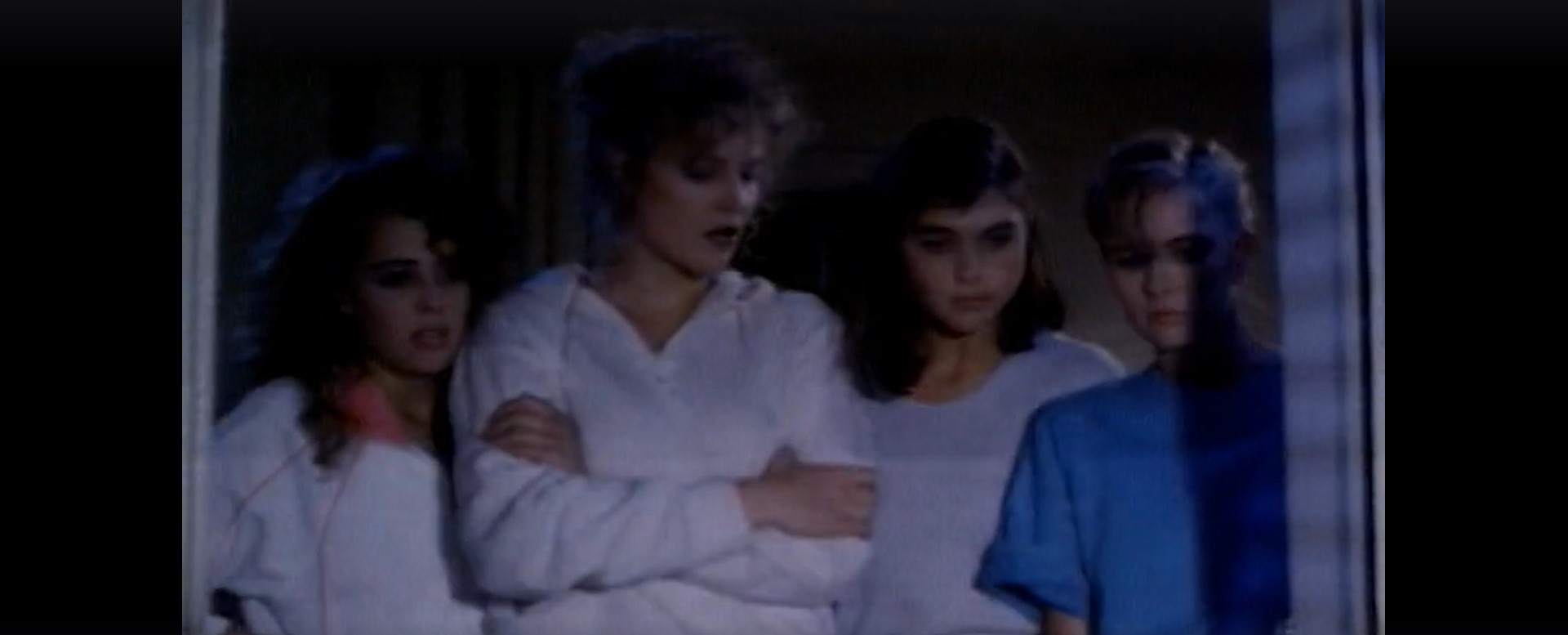
America, 1969. William John Brown brutally slays and sexually assaults 11 women. Before a judge, the serial killer is sentenced to death by gas chamber where his last words proclaim him as the Angel of Darkness sent Earthbound to ravage women. Nearly 20-years later in 1988, the St. Mary’s School for Girls in Europe is holding a stay awake event where a handful of students and one chaperone stay up the entire night as a fundraiser for their school. Dark and nearly vacant, the school basks in an eerie haven for the murderous William John Brown’s returning spirit seeking new souls of the softer sex. Determined to protect the girls at all costs, chaperone Trish Walton will not stop protecting the frightened girls until the entity is destroyed but when the ethereal malevolent spirit takes shape of a monstrous rodent with outstretching attack tentacles and psychokinetic glowing eyes, chances of survival are bleak.

Malevolent forces crossing oceans to death grip the innocent are films that are few and far in between as most transatlantic terror usually stays put, regionalized and localized to keep an authentic aural blend of superstition and history. Director John Bernard attempts to go against the grain with a small crowd of filmmakers who either overcame the parochial provenance and succeeded tenfold or became lost in foreign land narrative and failed miserably.  Bernard and, assumed brother, Johan Bernard co-write “The Stay Awake,” a South African mixed lot of horror elements brewed together into a supernatural schlocker that’s one-half dark and stormy night, gloomy Church Gothicism and one-half final girl survival slasher but equal parts outlandishly overexerted ghost thriller stretching across multiple continents.  “The Stay Awake” is a product of Heyns Film & Television Productions, produced by Thys Heyns of South African action-thriller flicks, as well as produced by Paul Raleigh, the producer of the “From Dusk Till Dawn” and the notable Millennium Films cofounder Avi Lerner, of “American Ninja” and “The Expendables” franchises, in one of his earliest credits from 1988.

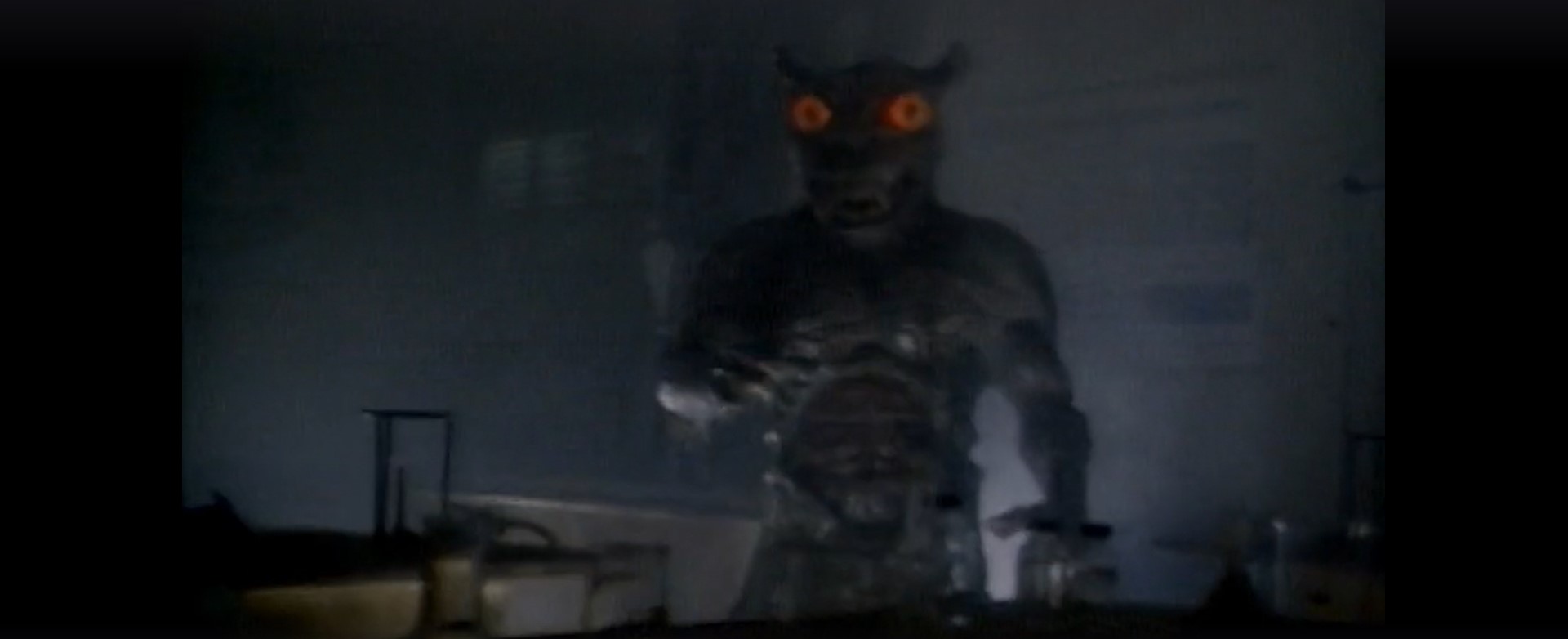
Though the story begins in America and mostly takes place in Europe, the cast is comprised of mostly South Africans trying to pass their accents for British English that is more like a rotating centrifuge of South African sub-accents.  Shirley Jane Harris (“The Most Dangerous Woman Alive”) spearheads the cast of principals with an extremely proclaiming protagonist, delivering lines with flatfeet and flat inflection that makes her one of the more forgettable final girls.  Her foe compares just as bland with a grunting, bodiless entity floating through corridors and hiding behind indoor plants (why would an imperceptible spirit need to hide behind anything at all?) before manifesting into what looks like a giant, big-eyed, and built on steroids rodent that then shows the William John Brown (Lindsay Reardon, “The Masque of the Red Death”) in side profile speaking in omnipresent and menacingly through the beast to taunt his prey.  The script allows just enough the group of young, private school girls to standout cliquishly, contain an ounce of contempt for each other, and underpin some form of individualism to make them retain some interest in their wellbeing.  However, most of the buildup that’s created to antagonize or unify between their personalities ultimately fizzle out into resembling something along the lines of kowtowing sheep or lemmings in more ways than one.  “The Stay Awake” caffeinates with a sizeable cast including Tanay Gordon (“Hellgate”), Jayne Hutton, Michelle Carey, Maxine John (“Howling IV: The Original Nightmare”), Hellie Oeschger, Joanna Rowlands (“Armageddon: The Final Challenge”) as the damsels, Bart Fouche (“Monster Hunter”), Clinton Ephron, Warren Du Preez, and Pierre Jacobs as the imposing boys, and Ken Marshall (“Return of the Family Man”) as the school’s night caretaker.

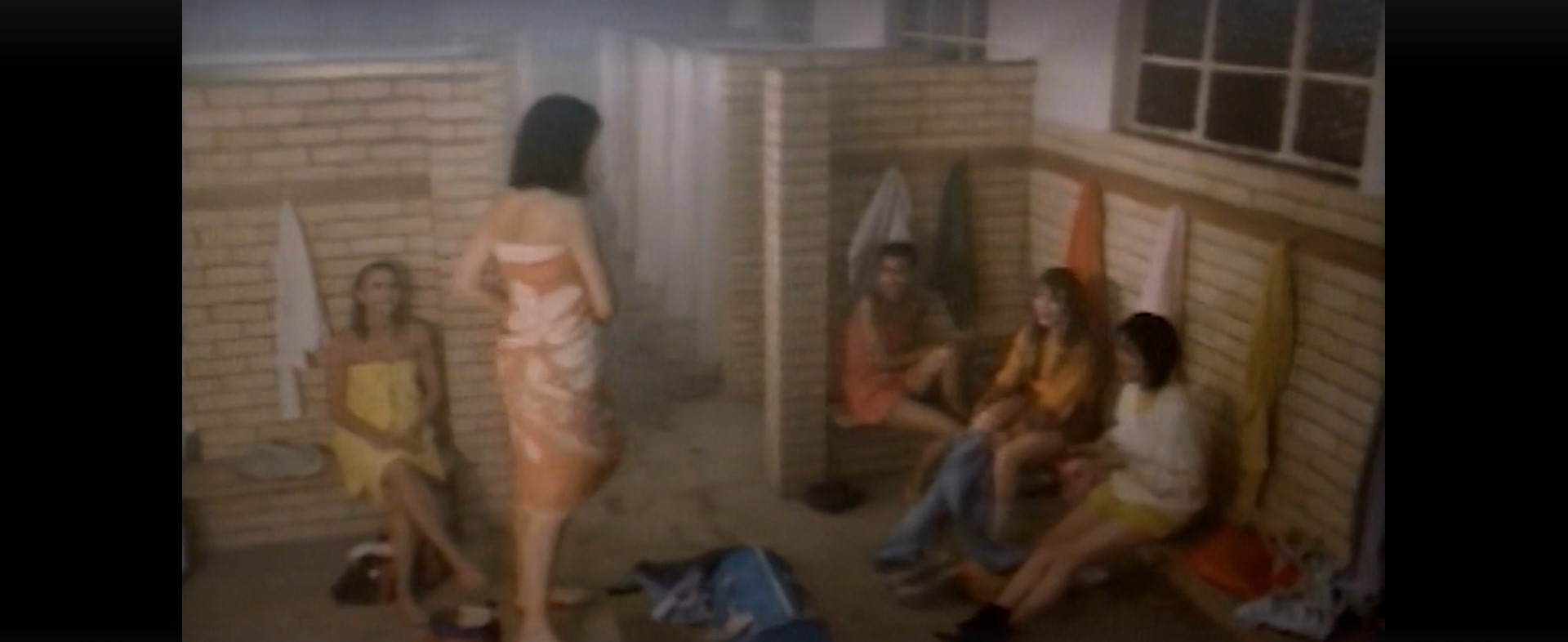
John and Johan Bernard’s logline for “The Stay Awake” likely looked appealing on paper but a full story treatment begs to differ with an inscrutable concept from start-to-finish.  “The Stay Awake” wades in generalities, oversimplifying locations and periods such as “America, 1969” and “Europe, 1988.”  The setup meat in between the disjointed times periods sets up a standard yet effective backstory for the killer, William John Brown, with a Judge’s voiceover of all his brutal transgressions, flashbacks of his victims at the death scene, and a slow walk down the corridor to the gas chamber that clearly denote him as the villain but then accentuates his supernatural supervillainy with a demonic voice screaming his return before the gas engulfs him.  However, why move from America to Europe and why in the span of 19 years does an unexplained possessed version of William John Brown return and select a group of religious school girls while his previous victims look to be a pact of randoms from off the street?  From the start, “The Stay Awake” has little to stay our fictional plausibility.  Couple the perplexation with dry performances, a possibly Hell originated monstrous, burning eyes rat creature, and the gratuitous horror nudity rug being pulled from under our feet as the schoolgirls tease with a shower scene only to be shown showering with towels wrapped around them and what has looked to be a promising possession of perpetual pandemonium  has quickly turned into a deflated disappointment with the only really good thing to come out of the film is the stationary man in a creature suit rat monster built like a bodybuilder.

“The Stay Awake” arrives onto DVD distributed by Cheezy Movies in a direct rip of the standard definitional 480i VHS transfer with a letterbox 1.33:1 aspect ratio.  Don’t expect a detailed transfer in a jittery and smoothed over standard definition that’s covered in a harsh blue tinted lens, but the condition of the interlaced video is surprisingly close to being damage free in a well-cared for print.  However, delph and range is difficult to determine due to the obvious lack of delineation but mostly because of the blue tint, poorly lit scenes, and contrast levels that make this presentation nearly pitch-black unwatchable in corridors, classrooms, and in the room of the like, but darkness is seriously enhanced and meshed together by Bernard stylistic choices of backlighting characters or using soft light to center the focus to offer a darkened horror picture. An English Dolby Digital 2.0 stereo serves as the only audio option which differentiates the soundtrack from the rest of the tracks.  Dialogue mostly separates itself to the top of the audio dogpile but is also well imbedded into the other track fighting to be heard that renders the dialogue dull and flat behind a wall of constant and diffused feedback static.  There’s also hissing at the tail end of sentences and faint crackling throughout.  Subtitles are not available.  The only extras on the static menu are back-to-back, quasi-grindhouse style trailers for two Cheezy Movies distributed titles of the blaxploitation “The Man from Harlem” and a “Dirty-Dozen”-esque “Commandoes.”  The physical aspects include a standard black DVD snapper with a rather enticing original title being sandwich with the demon’s glowing eyes on top and four schoolgirls ready to fight at the bottom.  The disk art is the same image except the four schoolgirls are cropped out and an unfortunate placement on the “The” from the title finds it punched out by the disc center/disc lock to just reveal “Stay Awake.”  The rated-R DVD has a region free playback and a runtime of 85 minutes.  “The Stay Awake” has all the indications of a cheap imitation on an established horror formula and this particular physical release doesn’t help the feature’s cause with an extremely dark and nebulous image to match its narrative.

Can You Keep Your Eyes Open at “The Stay Awake?”  On DVD now!

https://vimeo.com/814964711

Recalled to Nam is a Return Tour of EVIL! “Kill Zone” reviewed! (MVDVisual / Blu-ray)

Enter the “Kill Zone” on a New Blu-ray Home Video!

Combat POWs are captured by enemy forces, imprisoned in an outdoor internment camp.  Tortured for information, the prisoners are held without water in the scorching heat, strung up for hours on posts, beaten to a pulp, and stowed away in a hotbox if they do not cooperate with interrogators.  When Lt. Jason McKenna snaps and loses grip on reality, he breaks free from his confinement and kills four guards during the process when the soldier believes he’s back in Vietnam.  The only problem for McKenna is that the enemy imprisonment was a his own military’s roleplay training exercise for POW-survivalist.  The commanding officer, Colonel Crawford, had pushed McKenna too hard, making the exercise realistic as possible despite the warnings of fellow trainee and McKenna’s friend, Mitchell.  Now, the incensed Colonel is out for blood, covering his tracks with military leadership as he and the gung-ho soldiers seek to put an end to McKenna and it’s up to Mitchell to find his troubled friend first. 

The high-body count film that became the launching point for what would form Action International Pictures, 1985’s “Kill Zone,” an American-made, military actioner written and directed by the late David A. Prior (“Sledgehammer,” “Killer Workout”), opened the production door for a string of both action and horror ventures that spawned cult followings over the decades to come, especially when obscure titles such as “Kill Zone” never made it passed the release of its VHS format – until now.  John Saxon’s “Death House,” “Teenage Exorcist” with scream queen Brinke Stevens, and even the pint-sized creature feature “Elves” are just a few titles that owe “Kill Zone” some ounce of ground working thanks.  Prior cowrote the script with Jack Marino, who also produced the film under the limited formation of Spartan Films, and was shot in and around what is now Prado Regional Park in Chino, California.

Trekking from internment camp to civilization, aka the kill zone, and fighting and fleeing for their very lives from their own crooked military unit are McKenna and Mitchell, played correspondingly by “Killer Workout’s” Fritz Matthews and Ted Prior, younger brother of director David Prior.  Though Matthews has the emotional range of a tree stump, the leading man more or less fits the bill as a tall and stocky soldier protagonist while Mitchell does all the emotive heavy lifting of the pair, reflected in his large and muscular Stallone-sized biceps.  The comrades’ necks fall under the boot of Colonel Crawford from an aging David Campbell (“Scarecrows”) whose ridicule onslaught is dousing and his ruthlessness remains constant but can’t top the baseline he cemented early on into the story, diluting his villainy with not much formidableness, and becomes a feeble opposition.  Colonel Crawford is backed by his equally inadaqute military unit, former fellow trainees that divide themselves into a clique against the diverging outliers McKenna and Mitchell who separate themselves from the apathetic herd thinking either by post-traumatic mental illness or for concrete concern for a life-saving friend.  Either way, the rest of the unit bully their way into Crawford’s good graces albeit the Colonel’s lack of interest in the lives or death of his men in a nationally organized armed force that breathes the creed to keep the peace, but the Colonel’s men are just as complicit to their commanding officer’s callousness when they begin to rough up and snuff civilians in what is the most cold-blooded aspect of “Kill Zone’s” torrent.  Dennis Phun (“Surf Nazis Must Die”), Rick Massery, Richard Brailford, William Zipp (“Mankillers”), Richard Bravo (“Killer Workout”), and Larry Udy fill out the Colonel’s men while Ron Pace, Tom Baldwin, Jack Marino, and Sharon Young round out the civilian contingent.

On the surface, “Kill Zone” has the presentation of a direct-to-video, low-budget rip of “First Blood” but like the Sylvester Stallone John Rambo thriller, commentary undertones rise to the top with an additional few bobbing and freestanding from 1982 film.  Producer Jack Marino admits watching “First Blood” prior to writing the script that obviously become appropriated from the Ted Kotcheff picture in what is an underlining post-traumatic syndrome plagued individual in a dormant stage of the affliction then becomes pried open by aggressive, misapprehending authority with no time for a condition they’re ignorant too.  What follows is a deadly resistance against a barbaric enemy and the starkly different situations both characters John Rambo and Jason McKenna find themselves caught up in parallel their hellacious Nam tour in many synapse-snapping and physically scarring aspects to a point where the line blurs between being back in that Hell in reality and being back in that Hell in the mind.  What “Kill Zone” adds to its own version of the tale is no pedestrian anti-war pushback like we see with Brian Dennehy’s Podunk sheriff and his deputies but rather a shift in commentary toward the military’s once push harder and neglectful treatment on PTSD in what becomes an anti-military production to the extreme.  John Rambo had military sympathizers in Richard Crenna’s Colonel Trautmann but Jason McKenna’s Colonel spat flak with nothing but contempt for what he considers a weak soldier.  While military criticism is large and in charge, what negatively impacts “Kill Zone” is the no flare for technical military behavior or jargon.  The opening combat scene exemplifies the inexactitudes with Mitchell and his team storming through brush and across a river toward an unseen enemy’s stronghold guns blazing like little boys with popguns and mouthy explosions sounds of amateurism splayed all over as he and his team run wildly, hop like a bunny into fire stances, and point rifles with no line of sight.  Prior is able to achieve some nice shots of ammunition exchange with slow profile pans and aerial assaults filmed up from the ground, but there’s too much downplay to take this low-rung action film seriously and to really get a viewer the headspace of “Kill Zone’s” deathtrap montage that warrants more respect than what the rest of the presentation layout provides.

Missing in action from contemporary formats for over three decades, “Kill Zone” finally becomes rescued from inferior definition captivity and arrives onto DVD and Blu-ray (reviewed) courtesy of MVDVisual’s Rewind Collection series.  The Blu-ray is an AVC encoded, 1080p high-definition transfer scanned and restored in 4K from the 35mm interpositive print.  Presented in a widescreen 1.78:1 aspect ratio, the new transfer breathes new life into the lost but not forgotten feature with an enriched color grading and a sharpening of details, especially textures of the foliage and rocky terrains and assorted skin features.  Not entirely impeccable, contrast often teeters in the same frame and there’s an abundance of saturating grain, like large raindrop grain, in nighttime image that wash out details to great extent, but we’re always reeled back in with warm and pleasant color palette that flushes the previous VHS release quality down the core memory exiting drainpipe.  There’s one or two moments of vertical scratches, indelicately faint, and rough editing patches that distort to a blip that may be more problematic and age-related from the interpositive print than the dynamic restoration that was done.  The English language LPCM 2.0 mono track suffers from the low-quality sound recording equipment or placement that renders dialogue soft and nearly unintelligible as volume levels severely spike depending on how much the actors are projecting their voices.  There is some minor, unobtrusive popping throughout the fidelity faithful ambient and dialogue track, the latter, though softly wavering at times, does ultimately prevail to the forefront.  Optional subtitles are available.  Special features include a new audio (and optional video) commentary with producer Jack Marino, moderated by Cereal at Midnight host Heath Holland, a new Making-Of Kill Zone” featurette with clips interview with Jack Marino moderated by “Kill Zone” restoration project producer Steve Latshaw, the Vestron Video VHS version of the feature in standard definition, a photo gallery, and the original theatrical trailer redone with restoration elements.  The action-packed original poster art obtains a renewed look for the Blu-ray’s retro cardboard O-slip that resembles a torn, scuffed, and stickered VHS box art. Underneath the slipcover, the same poster art is on the front of the clear Blu-ray snapper case with latch and on the reverse side a back-the-scenes still images of Ted Prior and costars in character form.  The insert holds a folded mini-poster of the original poster art and the disc is pressed with the ridged gridlines of a VHS shell cassette with insert this side directions at the top.  Pretty neat design that further leans into “Kill Zone” VHS cult following purgatory.  MVD’s 50th release of the Rewind Collection is rated R feature has a runtime of 91 minutes and the Blu-ray is region unlocked for everyone’s viewing pleasure.  No longer destined to live out its shelf life on VHS, the wonderful contributors to obscure movie restoration brings “Kill Zone” back into action with a rejuvenated hi-def release that’ll blow you away. 

Enter the “Kill Zone” on a New Blu-ray Home Video!

Amongst the EVILs of Digital, Analog Rises from the Grave! “Night of the Zodiac” reviewed! (SRS Cinema / DVD)

A Mock VHS Retro on a Mock VHS Retro DVD!  “Night of the Zodiac” from SRS Cinema!

A bizarre and grotesque dream about the once notorious Zodiac killer inspires Richard Gantz to create a movie worthy of his idol’s praise.  With little income and having just lost his girlfriend and his job, Gantz is on the brink of being homeless and unable to materialize his dream into reality until he receives a mysterious, unexpected phone call.  The Zodiac killer got wind of his project and is offering support to finance and bestow guidance to Gantz’s film as long as the struggling, yet eager, filmmaker can crack Zodiac’s cipher and stomach the enigmatic task before him.  Gifted the Zodiac’s iconic mask and murder knife, Gantz sets out to record his first kills that pays homage to his aging idol but his mentor wants him to be creative with the new chapter worthy of the Zodiac name and gathering a whole new set of slaves for his paradisal afterlife.  When Gantz hits a barrier of inspiration, he solely becomes reliant on the Zodiac’s encouragement that has become few and a far in between. 

Susana Kapostasy is who I like to label a mad genius.  Many filmmakers have attempted to create antiquated formats of yore with watered down imitations, but for the Michigan-born videographer and editor-by-trade Kapostasy, what has been a challenge to most to faithfully recreate has simply become second nature for the video production enthusiast.  Scraping up any and all elderly video camcorders she could find, the “Metal Maniac” director wrote-and-directed her sophomore feature film “Night of the Zodiac,” pulling inspiration from one of the most notorious unsolved murder cases in America by the Zodiac Killer in San Francisco.  From the West Coast to the Midwest, “Night of the Zodiac” is filmed in and around the backdropped Detroit area for the Zodiac’s next round of sliced-up slaves – only in the creative, moviemaking sense, of course.  The 2022 film has the spitting image of a 1980s/1990s SOV with ghastly, gory effects, a killer hair metal soundtrack, and video characteristics that’ll have you trying to adjust the tracking setting on your DVD/Blu-ray player.  The Johnny Braineater Production is produced by star Philip Digby with Kapostasy serving as executive producer alongside co-cinematographer Apollo David Zimmerman.

Stepping into the shoes of the infamous serial killer to embark on a theoretical continuance of the real life mass murdering character is Philip Digby.  Channeling his best Jeffrey Dahmer vibe in looks alone with a crazed and obsessive personality suited for Charles Manson, Digby plays a hodgepodge of America’s most notorious killers, adding his own flare for film into the fold to make him a full-fledged psychopath, as he internally celebrates the moniker after his disparaging roommate/Landlord (Victor-Manuel Ruiz) labels him with an ear-to-ear grin and a nearly whoopie jump for joy.  Digby’s eccentric mania thrusts us beyond a threshold we didn’t even realized we had crossed from the very first opening dream sequences of a rotting, coffin-thronged corpse oozing maggots and putrid viscera and, believe it not, my opinion is this thrust doesn’t do justice to Gantz’s character because of the lack of foundation of setting up viewers with an inbred psychosis that puts into question, how did he survive this long without killing someone before?  Dreams are power but are they powerful enough to twist a seeming normal film lover into a frantic frenzy of vile fates and videotapes?  I think only Freddy Krueger can answer that.  Gantz goes around town slaughtering people in parks, in their driveways, and even makes one very bad magician (Derek Dibella) wish he requested to hire Gantz as a videographer for a promotional video disappear as Gantz strangles him to death.  “Night of the Zodiac” completes the cast with Logan O’Donnell, Mark Polonia (director of “Splatter Farm”), Tim Ritter (director of “Truth or Dare?”), and Benjamin Linn as the voice of the Zodiac.

From the video production veneer to the set decorations and locations to the characters themselves, “Night of the Zodiac” perfectly captures SOV horror in this modern day time capsule.  Not until the credits, when I see master craftsman of SOV horror filmming, Tim Ritter and Mark Polonia, appear in the cast credits did it dawn on me that what Susana Kapostasy had accomplished was a labor of love for the niche market, resurrected four decades later and revered by horror fans who were likely still in diapers or weren’t even born yet – maybe to go as far as not even a twinkle in their parents’ eyes.  Yet, there were clues to “Night of the Zodiac’s” contemporary construction, such as the opening title which had a clean, well-polished illustration and Kapostasy’s film is very self-aware by slathering horror in every recessed corner with mountainous stacks of VHS tapes, posters, and  and often, perhaps every other scene, displayed tribute to filmmakers, like Ritter and Polonia, who were still counterparts and establishing themselves as independent videotape artists during the 80s-90s.  This self-awareness harnesses more comedic relief than horror, accentuated by Gantz’s matter-of-fact imbalance, and the humor loosens the reins on “Night of the Zodiac’s” cold cruelty a tad but what the gore spools back in audiences by spilling lots of blood. 

SRS Cinema releases “Night of the Zodiac” onto DVD with a single layer encoding and presented in a throwback letterbox 1:33:1 aspect ratio.  Kapostasy uses a slew of equipment – Cannon XL2, Sony Video 8 AF, Panasonic AG 450, JVC GY X2BU, JVC GY X3, Panasonic AG 456, Panasonic AG 196, Sony CCD FX 330, and a Sony VO 4800 U-Matic S VTR – with some be more present-time cams run through U-matic VHS playback to degrade for SOV quality.  The intentional SOV has a variety of distinct looks with distinct quirks that flexes higher magenta levels in earlier scenes as well as tracking lines and aliasing artefacts.  Detail levels also vary but the overall VHS brands generally remain the same with soft, indistinguishable contours with also a surprising amount of depth and hue range.  The English Dolby Digital 2-channel (2.0) mix can sound boxy at times and come accompanied with a piercing, underlining interference.   Telephone conversations have no distortion depth so the other person on other line sounds present in the room.   The soundtrack from Anguish, Locust Point, and the brunt of it provided by Stoker is metal madness but does overshadow the dialogue when shredding through the scenes.  Dialogue is often clear, but again, no depth and echoey.  There are no subtitles available for this release.  Bonus Features include an audio commentary by director Susana Kapostasy, star Philip Digby, and costar Victor-Manuel Ruiz that goes over a lot of technical aspects of “Night of the Zodiac’s” look and how they obtained the gore and blood for the film, a Tim Ritter conversation about how he became involved with Kapostasy’s video enthusiasm and provided analog input, a blood cannon showcase that’s instructionally descriptive as well as you’ll see Kapostasy’s foot accidently go into the 5 gallon Homer bucket, a gore score Ouija board gag, recreating the Zodiac cipher, and the trailer.  SRS Cinema’s release dons a retro VHS design front cover with an exact and beautiful illustration of Gantz’s copycat Zodiac attire with a cropped version of the front cover on the disc art inside the traditional black snapper case.  “Night of the Zodiac” has a runtime of 86 minutes, is not rated, and has an all-region NTSC playback. Difficult to immerse oneself into a half-a-century old unsolved murder while sticking to glorifying merely the guts and gore, “Night of the Zodiac” stuns more qualitatively with video techniques thought archaic and obsolete but Susana Kapostasy steadfast proves otherwise in her undying love for the flawed, yet nostalgic format.

A Mock VHS Retro on a Mock VHS Retro DVD!  “Night of the Zodiac” from SRS Cinema!

On the Verge of a New Millennium, New Faces and Stories Tell Their Terror on the Same Old EVIL Video Format! “V/H/S/99” reviewed! (Acorn Media International / Blu-ray)

Found Footage is all the 90’s Craze These Days! “V/H/S/99” Available at Amazon!

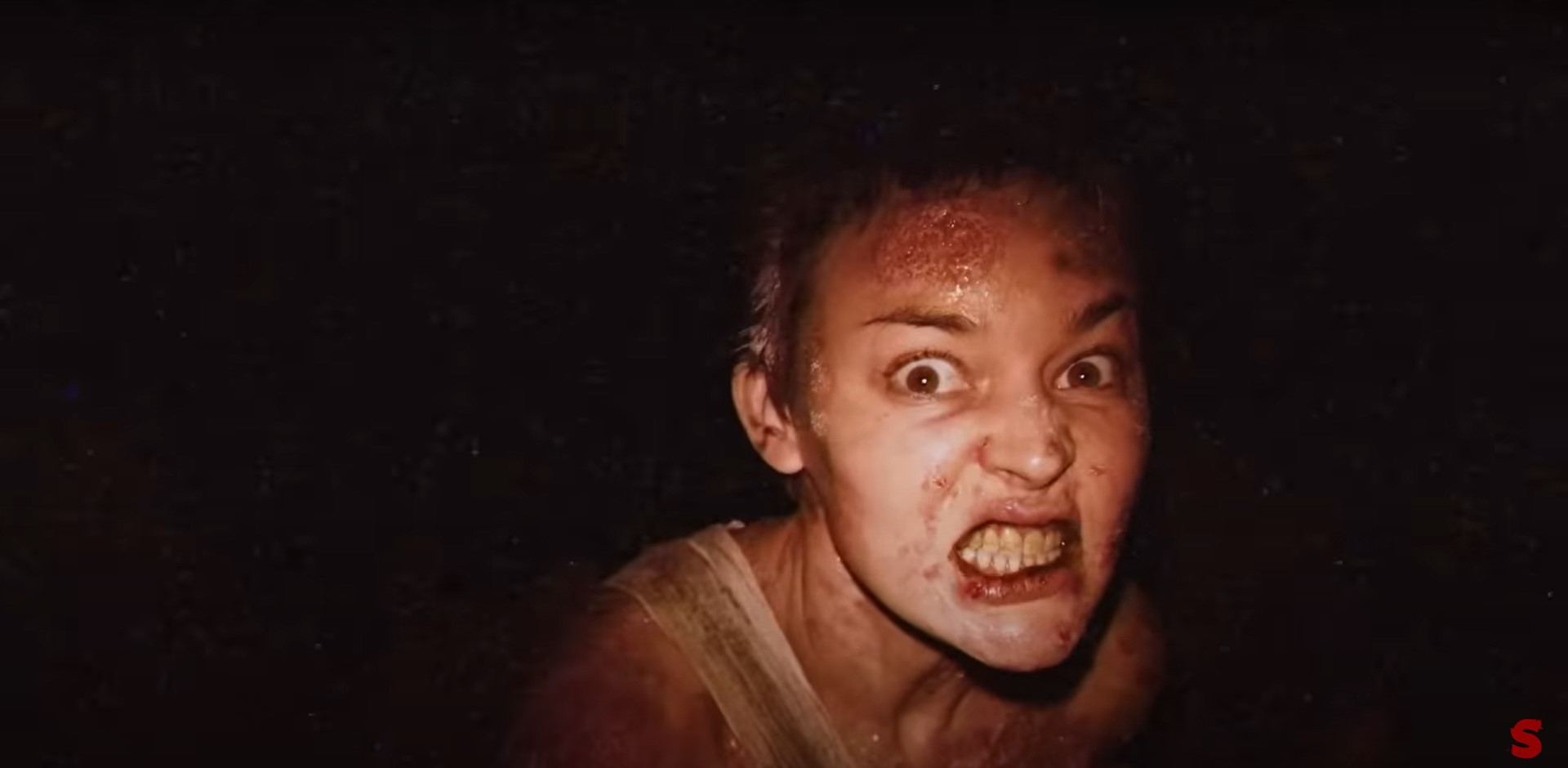
The year:  1999.  The format:  VHS.  The theme:  The most horrifying experiences caught on found footage camera.  A horror anthology for the turn of the century puts together five of the most terror-drenched short films that resurrects the punk-rock dead, turns urban legends into vindictive playthings, televises Lovecraftian game show frights, peers into the stone-cold eyes of a Gorgon neighbor, and goes to Hell and back!  All caught on camera from a first-person view as VHS vicariously relives the glory days through a digital world, capsulated by the horror realm and all its fanatical acolytes for the analogue video format to live undead forever. 

Living in the age of a VHS comeback is admittedly kind of weird.  VHS has become a hot collectible, especially and obvious the rate and obscure that mostly resides in the horror and cult genre.  Most recently, a discovery on a Brazilian VHS cut of Jaws 2 has a couple of minutes of shot footage that no other release holds to this day.  That, being just one example, is sought after power of VHS that saw various versions of one film be disperse far and wide across continents, which the same could be said about DVD that too saw a variety of different cuts due to the diversity of playback formats, distribute cuts, and numerous levels of censorship between countries.  VHS is also making a comeback in format style with gritty, faded, flat colored image veneer and tracking lines and the absent transmission signal of snow statically adorning the screen with beautifully hypnotical and flickering white dots.  So, it’s now surprise that on the heels of 2021’s “V/H/S/94,” another analog anthology is greenlit in 94’s wake with “V/H/S/99” for 2022, written and helmed by newcomers to the series but not necessarily newcomers to the horror scene.  The movie’s sequential lineup Is as follows:  Short filmmaker Maggie Levin writes-and-directors “Shredding,” taking a break from killer sharks is Johannes Roberts to oversee his “Suicide Bid” entry, musician Flying Lotus directs and co-writes with Zoe Cooper with “Ozzy’s Dungeon,” “Tragedy Girls’” director Tyler Macintyre writes-directs “The Gawkers” along with co-writer and fellow “Tragedy Girls’” screenwriter Chris Lee Hill, and the husband and wife tag team of Joseph and Vanessa Winter, filmmakers of “Deadstream,” helms-and-pens “To Hell And Back.”  The Shudder exclusive series latest is produced by Josh Goldbloom (“V/H/S/94”), David Bruckner (director of “Hellraiser” ‘22), Chad Villella (producer of the of 2022’s “Scream”), Bloody Disgusting’s Brad Miska, and “Scream” ’22 and “Scream VI” director Matt Bettinelli-Olpin under the production banner of Studio 71 and presented by Cinepocalypse Productions and Bloody Disgusting.

A new set of five tales of analog rendered terror invoke a new set of actors in each short film that carrier with them a broad range of experience. While a couple of the stories shred the narrative with hectic editing (I’m looking at you “Shredding”), performances throughout come over with blistering consternation and definitely a late 90’s grunge attitude with “Shredding” and “The Gawkers” delivering the full blunt force of period, heckling away in their baggy clothing, bohemian hairstyles, and a penchant for skateboard thrashing. The other films are merely timeless with only mere mentions of date, or their timestamped on the video tape recording, or are just a thematical proverbial nod to the specific point in time, lacking the keep it real essence that is quite idiosyncratic to the hop from a phasing out decade and into a whole new other. The cast of these shorts play their roles with exuberance and wackiness, which if you have lived in or can look back to the converging decades/millennium and see some of the gameshows or cultural shenanigans that defined America as people or, if you want to go smaller, just the pop culture, wacky is a pinpoint descriptor. The short films’ of “V/H/S/99” are comprised of a cast including, selectively, Steven Ogg (“The Walking Dead”), Ally Ioannides (“Synchronic”), Keanush Tafreshi, Jesse LaTourette (“There’s Someone In Your House”), Dashiell Derrickson, Isabelle Hahn, Sonya Eddy (“Blast”), Emily Sweet (“Castle Freak” ’20), Melanie Stone (“Deadstream”), Archelaus Crisanto, Luke Mullen, and Ethan Pogue.

Anthologies have been around for decades and are a great medium to showcase a multitude of individual storytelling from a variety of filmmakers walking different paths in life.  Fans can often salivate over these types of jump-the-shark formats that can start off with the zombie undead, transition 10 minutes later into a supernatural spooky, and then segue into a creature feature with a wraparound bonus story that may or may not connect them all and squeeze each episodic terror vision in a full-length feature runtime.  Though I enjoy a good collection of short and sheer frightful films, anthologies are not my cup of sanguinary tea.  Hopefully, no partisan takes seep out of this review as I attempt to examine “V/H/S/99” objectively.  Out of the five segments, three have landed strong with a right amount combination of style, gore, performance, narrative logic, and, of course, terror, and if you like comedic sugar in your black cup of horror then “To Hell And Back” is a perfect Venti-sized, well-blended mulatto of choice that thrusts two dimwitted demonic ritual documentarians into the pits of dark, gloomy, and malformed creature Hell and fight their way back to their own plane of existence.  Though one flaw some make catch when watching the caboose film of the anthology is that it doesn’t particularly reflect 1999 other than the small caveat, which is pivotal to the story, that at the turn of the millennia is when the veil between our world and Hell is as it’s thinnest.  The other two better entries capture more infinitesimally in detail of the late 90s, early 2000s clothing and discourse.  “The Gawkers” taps hard into the weird aggressive hormones of a teenage boy while exploring the newfound ways to use technology as spyware.   Webcams aboard big boxy desktops chauffeur in a whole new way to be creepy that lands them in hot water not by the law but by the wrath of ancient femme fatale of Greek mythology.  Johannes Roberts rounds out the better half with a sorority haze gone wrong that evokes an urban legend to become more than just a story and Roberts “Suicide Bid” offers, again, that period presence that feels like a tribute throwback to the 1998 “Urban Legend” film itself, but adds a supernatural surprise that utterly creepy and not as deep with only 6 feet underground rather than a 47 meters down, the director is slowing raising his fear to the surface.  The shorts left hanging below the bar are “Shredding” and “Ozzy’s Dungeon” and for reasons that have to do with their style and story. “Shredding” promising premise is plagued not by punk phantasms back from the dead but simply pilfered of focus with a hectic, if not severely chaotic, VHS-graded editing scheme that shocks the perception senses while “Ozzy’s Dungeon” is inspired by Nickelodeon’s Legends of the Hidden Temple gameshow where kids have to compete in toned down ancient society games to race up the temple to win the big prize. “Ozzy’s Dungeon” definitely is weird, sadistic, and Lovecraftian-inspired for sure but its story design loses motivation and often cheats rounding the bases in order to reach the shocking climatic finale.

Acorn Media International brings tape to the United Kingdom with a Blu-ray home entertainment release of “V/H/S/99.” Presented in a widescreen 1.78:1 aspect ratio, though doesn’t cater to the standard 4:3 ratio of video tape, the provided image quality purposefully varies to give audiences the titular analog experience. Faded grading, tracking lines, static and that jittery playback is all part of the visual environmental experience and even a few of the filmmakers shoot the film digitally to then run it through VHS to garnish with unnatural base video turbulence. The English DTS-HD 5.1 surround sound mix heightens the exposure and familiarity to of being that person behind the camera as all of these shorts of short POV. Intense and, often, cacophonous, the audio tracks still manage to level out, be discerned, and manage to relay the chaos no matter how much bedlam is thrown at the screen. From the zoom in-and-outs of the video tape recorder, there’s a clean sense of depth and the range is bountiful as the ambient track runs the gamut of omnifarious sounds that give each episode an individualized stamp. English SHD is optional. Bonus content includes an exclusive panel from New York’s Comic Con with guests producer Josh Goldbloom, “The Gawkers'” Tyler Macintyre, and “To Hell And Back’s” Joseph and Vanessa Winter as well as a total arc gag reel. After that encompassing project feature, the girth of the bonus content breaks down into the individual shorts with “Shredding” having a deleted scene and the complete fictious band BitchCat music video, “Ozzy Dungeon” has two deleted scenes, “The Gawkers” has a deleted scene as well as bloopers, camera tests, and The Making of Medusa, and “To Hell And Back” rounds out the features with a hefty look at the raw footage, scouted location, and a storyboard and blocking rehearsals. There are no bonus features for Johannes Roberts’ “Suicide Bid.” Physical features include a slightly thicker traditional Blu-ray snapper, a Europe standard, with a cover art that matches the North American RLJE release, a city being loomed over by skull made out of colorful galactic stars and a pair of video lenses for blank eyes. The disc art is pressed with the same front cover image. Though no mention of a region playback on the back cover, I suspect a region B encoded release as per usual with Acorn Media Interntional. “V/H/S/99” has a total runtime of 109 minutes and is UK certified 18 for strong blood violence/gore. “V/H/S/99” is not my kind of off the heasy subgenre, but the latest series anthology packs a punch and I would never discourage anyone from not experiencing firsthand an homage trip through terror.

Found Footage is all the 90’s Craze These Days! “V/H/S/99” Available at Amazon!