A sadistic carny ringmaster and his troupe of malicious clowns put on a traveling circus act through the America midwest. When an unfaithful lover challenges the powerful lout, he and his painted-face company exact a punitive act against her for all the crowd to see and enjoy and in bitter return, the scorned woman invokes a witch’s spell to summons evil forces to pluck the ringmaster and his clown lackeys up into an unordinary whirlwind. Trapped inside a super storm, the clowns use their newfound and unintentional given powers to funnel a tornado for spreading massive destruction through their cyclonic path of vengeance, terrifying a handful of ensemble midwestern survivors to fight back against the merciless and murderous clowns.

Clowns are so hot right now. From the success of Stephen King’s “It” remake and the subsequent sequel to the re-emergence of Batman’s notorious foe, “Joker”, in a controversial origin film, the carnivalesque buffoons are at the height of their inhuman malevolency since the late 1980’s saw Jack Nicholson donned the makeup as a crazed lunatic with a penchant for nerve gas and extraterrestrial clowns invaded Earth to harvest people and snack on their blood. Adding director Todd Sheets into this era of clown renaissance and outcomes the carny carnage gore fest, “Clownado,” straight from the big top. As an obvious pun on the “Sharknado” franchise, the “Dreaming Purple Neon” and “Sorority Babes in the Dance-A-Thon of Death” director pens and helms another blood drenched, apocalyptic, cine-schlock of callous proportions and unparalleled in content funded by Sheet’s production company, Extreme Entertainment. With a production company tagline of Movies with Guts, Sheets makes good on his delivery with an up close and personal spew of geysering blood sprays, severed gushing limbs, and guts, lots of guts, that’ll run any clown’s makeup red while dousing each feature with action and fun.

How do you hire a cast to garb themselves as maniacal clowns, have them portray being supernaturally charged with meteorological phenomena, and wreak havoc down from the heavens with a tornado vessel just to rip people to shreds all the while laughing their heads off? Easy. You employ the entourage familiar with your brand of Mccobb! John O’Hara, Antwoine Steele, Dilynn Fawn Harvey, Rachel Lagen, Jeremy Todd, Millie Milan, Nate Karny Cole, Douglas Epps, and others have worked previously with Sheets in these flicks, but not limited to: “Sleepless Nights,” “Dreaming Purple Neon”,” “Bonehill Road,” and “House of Forbidden Secrets.” Mix to blend some well churned budget horror talent, such as “Return of the Living Dead’s” Linea Quigley as an angst-y bar/strip club owner and “Brainjacked’s” Joel D. Wynkoop as a fearless flyboy, an already colossal cast becomes an gargantuan cogency of tacit talent and to top it off, how about an former porn star amputee? Jeanne Silver, or better known in the industry as Long Jeanne Silver of “Debbie Does Dallas Part II”, bewitches the screen as the spellbound caster and she didn’t even have to penetrate anyone with your missing fibula of a leg. The one actor that really sought the affable nature in us all is Bobby Westrick with the charming redneck Hunter Fedelis. Westrick, who hasn’t been in a movie since Todd Sheets’ “Goblin” back in 1993, returns in 2019 to be one-time alcoholic lowlife to a world savior from clown devastation; Hunter’s an overall gentlemen despite his straggly, rough appearance and beat up old straw cowboy hat and doesn’t live one person behind while also befriend a black man impersonating Elvis Presley in town has unexpressed racial prejudice. The cast also includes Sierra Stodden, Eileen Dietz, and a Cayt Feinics who seemed to just love caressing her blood soused breasts more than the next woman.
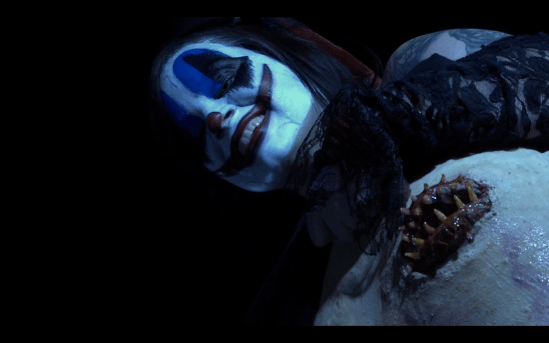
I get what Todd Sheets has erected here being the ringmaster of a dementedly dissension in the circus of blood. The capitalizing idea of clowns twirling and terrorizing through a maelstrom flash of fluorescent, like of SyFy sharks in that popular six installment franchise, is indie kitschiness at it’s finest and couldn’t be more perfectly timed after the release of Joaquin Phoenix’s “Joker.” “Clownado” is a fun windstorm of gore and carnival surrealism. Sheets continues to deliver as promised per his production company and is still able to sustain relationships with his usual clowns – such as my stoic favorite, Antwoine Steele, and his role dressed arbitrarily as the King of Rock and Roll – while providing chuckles, sparks, and bimbos galore and, no, I don’t mean clown names. With any Todd Sheets production, the practical effects are innovative and dastardly with highlights including breasts with teeth instead of nipples, heart replacement surgery with a block of ice, and head explosions!
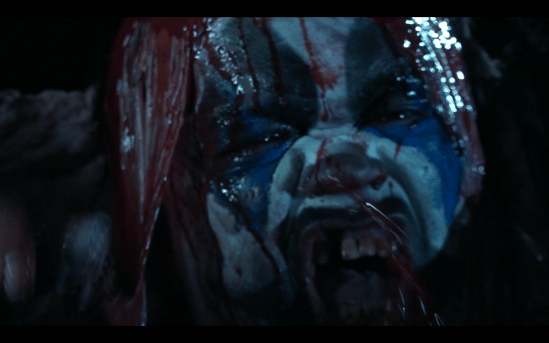
MVDVisual and Wild Eye Releasing doesn’t clown around with Todd Sheets’ “Clownado” that lands onto DVD home video in a widescreen, 1.78:1 aspect ratio. In light of microbudget limits, the digitally shot film has some issues, such as color banding, and then there’s also the visual effects that come straight out of the stock footage file and then matted over with assertion on the first run; however, Todd Sheets been doing this for decades and I’m sure if the director wanted his production and post-production to be first rate, he’d be like Picard and make it so. Yet, disappointments are a part of life and the biggest disappointment by far is the over saturation of purple tint to lay down an ominous killer vibe throughout the night scenes of the 99minute run and the tint completely dilutes the vivid face paint, or in the clowns’ case war paint, and also turns blood into a black and magenta farcical gas. The English language audio 2.0 stereo track, complete with closed captioning available, has great clarity and often doesn’t seem as tumultuous as would be expected. The mic had on point placement to hone in on every wisecrack and pun known to clown-kind. Bonus features include a commentary track with Todd Sheets, behind the scenes, a featurette entitled “The Human Hurricane, and Wild Eye Releasing trailers. From a meteorologist standpoint, weathering through “Clownado” might be a downpour of rubbish, but for those who live vicariously through Todd Sheets’ repertoire of campy, no-budget, gore films, “Clownado” is a beautiful black-comedy day for a stroll.
Author Archives: Steven Lewis
The Scene Isn’t Over Until EVIL Yells Cut! “Incredible Violence” reviewed!

After squandering a shady investment group’s money, a struggling filmmaker stages a last attempt effort in writing and directing an all-out and profitable horror movie. Isolated on a stretch of private land sits a house which his movie will be set. The director installs camera monitors, archaic printers in each room, and fashions a room for himself in the confining attic space, turning the house into a platform for five young actors to perform at his instructional, omnipotent influence without having to ever personally interact with the actors, a group he strongly loathes. His despise for actors and the financial pickle he finds himself in with shark investors places him at the centerpiece of his slasher film as the masked killer. With the stage set and the actors all in place, the directing maestro helms unsuspecting actors to their violent deaths in the name of art, self-preservation, and actor genocide.

As a film that turns the slasher mythology on its head, G. Patrick Condon’s “Incredible Violence” is a serrated vision of bleak, dark comedy too sharp to really fully digest and that’s okay. Filmed in Canada of 2018 and released this year on SVOD from The Hunting Party Inc., production studio, “Incredible Violence” strays away from the young, naive victims points of perspective and opens the path up for a nihilistic killer to control the narrative around his desperate motives. Though having complete control over most of the factors and planning ahead of time, “Incredible Violence,” as a partial comedy, folds miscreant mishaps and caricatured flaws on top of, indeed, incredible violence and while that vehemence is focused primarily on actors as a while, a good portion pivots and breaks down even further to the individual level that can be personal and can be insensitive for women who have to best themselves, sometimes together and sometimes separately, against two different antagonistic foes of the opposite sex.

The largely based Canadian cast begins with Stephen Oates playing the hack director and self-imposed killer, named after director G. Patrick Condon, of the titular film and though that might seem egotistical of the Condon, enough humiliation smothers the self-assuring and struggling character to the point of utter satire with even going as far as poking fun at his last name in a brief quip of dialogue. Oates, who has starred alongside Jason Mamoa on the historical Canadian action Netflix series, “Frontier,” is an intriguingly no-shame filmmaker who hustles together a plan schemed to save his life. Sporting a wife beater, long fur coat, and an unadorned mask, Oates exhibits Condon perfectly as a hack artist in filmmaking and in being a badass serial killer. Then there’s Grace, the lead character bound for stardom as an untrained actor taking a role in, what she considers, a performance art film and naively goes into the project with such gusto that she blatantly ignores all warning flags from the beginning, a role very well suited by the striking eyes of M.J. Kehler. Grace endures shots left and right, from friends and foes alike, as a hopeful artist, but like “Incredible Violence” shows, a true inclination comes out of people when push comes to shove and Grace, through Kahler’s physical bombarding of a final girl trope, doesn’t need acting school or any other doubters to trump her will, passion, and ferocity. One scene to note is between Foster, Kahler, and Kimberly Drake and Kahler’s Grace is just stricken by fear over being ask to kill someone, she’s screaming and is essentially rooted to her spot. The moment is grippy and terrible empathetic to know that true fear does freeze one’s fundamental functions of survival and of morality. “Incredible Violence” co-stars Michael Wotherman, Kimberly Drake, Erin Mick, Meghan Hancock, and Allison Moira Kelly.

“Incredible Violence” bursts with a talented cast with deserving of a curtain call performances and lives up to the title with incredible, if not whole heartily gratuitous, violence and some brief macabre nudity, but Condon’s story has a lot of zeal that doesn’t properly switch tracks when characters break under their obscure tormentor’s direction. Condon, the director, builds the tension more through the repetition of violence with a slight tweak every time rather than crafting a breaking point, a catalyst that dissembles sanity and refigures patchwork insanity, making characters alliances difficult to place that ultimately crumbles the dynamics into just a bunch of people beating each other to a pulp. The same kind pivoting told differently can be said about the strange, public television show Celebrity Autopsy paralleling as intra-story that often feels disconnected to Oates and his film. I guess with a film entitled “Incredible Violence,” a substance merit to the narrative would be a long shot, but as an exploitive, self-described meta-horror centerpiece, “Incredible Violence” is made up of all sorts of gut-checking goodness with torture, madness, and cynicism helmed by sadism without the presence of slasher-esque, blank evil.

1091 Films, in partnership with G. Patrick Condon’s The Hunting Party Inc., presents “Incredible Violence” that runs 89 minutes onto a plethora of media streaming platforms, such as Amazon Instant Video, iTunes, Google Play and Vudu, and on-demand cable services. Unfortunately, “Incredible Violence” is a streaming only feature so image and audio qualities will vary across streaming devices. There were also no bonus material or special features present, but as an extra tidbit about production, the film took approx. 2 years to complete with the unpleasant misfortunate of one of the original cast members passed away during rehearsal. This forced the script to be re-written, delayed, and ultimately triggered G. Patrick Condon to write himself, as a character, into the script. Futhurmore, the cast and crew had agreed to stay in the house set location until filming wrapped which resulted in some actual anxiety and stress to spill out into the performances. Contextually sound in the confines of violence, “Incredible Violence” finds footing staggering abroad the cascading carnage of horror-comedy with a single character arch involving making it big in the acting world only to just make it out alive and in one piece of this film.
Necrophilia EVIL Will Love You Beyond Death! “Nekromantik” and “Nekromantik 2” reviewed!

Husband and wife, Rob and Betty, enjoy the company of other people in their bedroom. Those other people are corpses. With Rob’s profession being a street cleaner after grisly accidents, he’s able to bring home bits and pieces of deceased individuals: eyeballs, hearts, hand, etc. When Rob is left in charge to dispose of half decomposed corpse fished out of a lake, the necrophiliac husband brings home a third party to his necrophiliac wife for play time, but when tensions between them rise with the loss of Rob’s position, Betty doesn’t want to waste her life with a deadbeat husband when she can have a dead man give her all the pleasures she desires. Feeling lost without the company of the corpse, Rob struggles to find his place in life and resorts to murdering animals and prostitutes to get his rocks off, leading to an extraordinary life alternating conclusion.

Necrophilia. Necrophilism. Necrolagnia. Necrocoitus. Necrochlesis. Thanatophilia. The act goes by many terms and divides into many segments, but the end result concludes to the same sexual attraction and acts, involving intercourse, with a lifeless corpse and writer-director, Jörg Buttgereit, aimed to exploit the exploits of grave robbers and murderers to stand against the strict censorship that was presently structured around German cinema in 1987. As Buttgereit’s first full length directorial filmed in West Germany and co-written by Franz Rodenkirchen, their censorship battling film, “Nekromantik,” is tinged heavily in necrophilia that, while obviously gross and illegal in the conventions of society, intertwines with the unwavering romantic gesture; a sensual disposition of tenderness and love for the other whether or not their eyeball is hanging out of a decaying socket or their covered in a think layer of body purging mucus. “Nekromantik’s” tragedy isn’t so much in the appalling acts, but in the defining human directions of grief and destruction that ultimately still make us human even if our acts are inhumanity.

In “Nekromantik 2,” a female nurse named Monika digs up a freshly buried male corpse to be her sexual play thing, but as she questions her feelings for necrophilia, Monika tries to suppress those deviant desires by befriending-to-date a young man, Mark, whole also keeping limited parts of the body while cutting up and disposing the remaining pieces. Seemingly going well with her boyfriend, Monika’s relationship resembles a stint of normalcy, but her desires bubble to the surface as she fantasizes about the corpse and goes to great lengths to keep Mark lifeless as possible during their lovemaking. Mark’s suspicions about her girlfriend does deter him from beauty or his desires for her, but how long can Monika go without her beloved bloated and discolored carcass? What lengths will show go to secure her happiness while taking advantage of Mark warm body?

As an extension of Buttgereit’s “Nekromantik,” “Nekromantik 2,” also known subtitled as “The Return of the Loving Dead,” is a direct sequel in limited fashion with only the corpse being the connecting factor. However, the 1991, East Germany filmed “Nekromantik 2” aggregates and compounds the unsavory lust for the dead that depicts a stronger sense of violence at an explosive carnality in the final act. Along with Franz Rodenkirchen as co-writing, Buttgereit returns to co-write and direct the sequel of considerable unlawful content, according to German authorities that arrested and trialed Buttgereit for poisonous material that could affect the youth of Germany. However, Buttgereit comes unscathed by the tribunal in a justified win against censorship. “Nekromantik” and the sequel aren’t necessarily set in a platonically set society, but held within the confines of an invented world chockfull of ignorance and drenched in biodegradable bliss.

Daktari Lorenz stars as the hopeless romantic for putrid partners. Lorenz is a good look for the Joe’s Street Cleaning Agency employed Rob as Lorenz is a scrappy man with thinning wild hair set on top of a receding hair line and has a feral soul behind his wide eyes, fitting for a fellow who did a short stint in porn in later years, but starring as Rob, however inglorious he might portray the role, wasn’t Lorenz only contribution to Buttgereit’s “Nekromantic” as he became the special effects guru behind the corpse’s fruition – the corpse that would be Rob’s character’s rotten rival. Rob’s tragedy situation is a plight of villainy against villainy, leaving the role unsympathetic to audiences but still leaving a residue impression of sordid anxiety. Rob’s only rival to necrophilia is within Monika, played by Monika M., from “Nekromantic 2” who goes through a different kind of internal struggle. Whereas Rob struggles with loss of two companions, one living and one dead, Monika struggles oppositely with one living and one dead and the choice she must make between the two. Monika doesn’t long for a cold, slimy, dead body and she choices to dispose the one that was held firm in her embracing grasp; yet she has an inkling for normalcy, a urge to undercut her deviancy, and acts upon the reformation despite the addictive callings for necrophilism. There’s not much in terms of a supporting cast in his low-budget shock horror, but the few co-stars include Beatrice Manowski, Harald Lundt, and Mark Reeder.

Overall, the “Nekromantik” films can still produce shock systemically despite being antiqued from the ye ole days of Video Nasties from the 80’s. Director Jörg Buttgereit might be thought perverse or mental to pinch body parts or dead bodies for tales of romance, but no matter his intentions to bring to the cinematic table, Buttgereit could be considered a far-fetched genius delivering the very definition of necrophilia to the screen and hoisting up a narrative around a taboo and illegal stricken act in the name of anti-censorship. Both films are nearly dialogue-less and, perhaps, wouldn’t have been highly accepted in the cult world if the score wasn’t as poignant or powerful as it was. Composed by Hermann Kopp, John Boy Walton, and, again another hat, Dakari Lorenz, as well as Monika M. in the sequel, they compose a classical and new age soundtrack that’s neither obtrusive to the ears nor not necessarily out of bounds of being parallel with the explicit material, marking the tracks as much as a character and being the quintessential dialogue much needed for a virtual silent, and extremely graphic, social commentary piece.

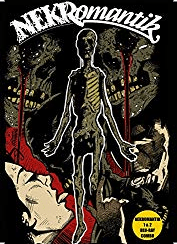
Cult Epics has really outdone themselves with a fantastic re-release of their previous issues of the “Nekromantik” films, releasing a limited edition, only 500 copies, Blu-ray release of both films, sheathed not only in their individual slipcase with original artwork, but also housed fully in a larger, double-sided slipcase bundle with artwork by Martin Trafford whose been a long time collaborator with director Jörg Buttgereit. The two films are presented in their original aspect ratio, 1:33:1, with two cuts available of “Nekromantik”: a director approved, super 8mm restored transfer, blown up to 35mm, that’s of a relatively washed image, but is vastly superior and clean look with hardly any blemishes upon the reconstructed coloring, which looks great considering. The second cut, a 35mm “Grindhouse version,” is a HD untouched version that keeps in the burns and blemishes and emits a warmer image in comparison. The 16mm, director approved transfer of “Nekromantik 2” is also neat, clean, and infraction free with a more natural color scheme overlaying and not as stylized as Buttgereit’s first film. The German language Dolby Digital 5.1 surround sound with re-transcribed English subtitles puts the vigorous soundtrack on a pedestal in the midst of previous releases that saw lossy audio compositions. With hardly any dialogue and next to none excitable action in both films, the burden lies truly on the back of the score that’s riveting and powerful and the right call to improve amongst the options for tinkering. There are also German language 2.0 stereo mixes available. A wealth of new and old bonus material includes the new transfers mentioned above, plus introductions by director Jörg Buttgereit, Q and A with the director at the American Cinematheque, audio commentary on both films by Buttergereit and co-author Franz Rodenkirchen with Monika M. and Mark Reeder included in “Nerkomantik 2,” the making-of for both films, “Nekromantik” featurette, still galleries of both features, two isolated versions the films’ soundtracks plus a live version of “Nekromantik 2,” “Nekromantik 2” post cards, and a couple of Buttgereit short films entitled “Hot Love” and “A Moment of Silence at the Grave of Ed Gein,” plus music videos and live concerts from the director, Monika M., more. Cult Epics’ wrote the definition on the definitive release for “Nekromantik” and “Nekromantik 2” and if you thought the content couldn’t get any gooier, grosser, dissident, and vile, Cult Epics said hold my beer and went to grave and back with a phenomenal package bundle that’ll be a necrophiliac’s delight as well as a gory gem in the collection of any horror film enthusiast.
Plus, the holidays are right around the corner and at http://www.cultepics.com you can gift yourself or gift to others their very own Messed Up Puzzles’ 1000 piece jigsaw set inspired by both “Nekromantik” and “Nekromantik 2!” These NSFW puzzles are a limited run, with 50 out of the 300 signed by director, Jörg Buttgereit! (Selected randomly through distribution).
EVIL Doesn’t Care For Your Fame and Fortune! “The Lingering” review!

Young Dawa Wang and his mother live in a rundown mansion in 1980’s China. Dawa’s father labored in a wood factory over the course of a year, away from his family, and was supposed to return to celebrate in the New Year, but when he didn’t arrive, Dawa’s mother phones the factory to only find out that there was a landslide at the factory that drowned many of the workers. Not only does Dawa’s mother fear his father is dead, she suspects the house is haunted by his spirit on that very New Year’s Eve night. However, the presence was much more malevolent. Years later, Dawa, a young man, leaves home against his mother’s desperate wishes as their life of poverty drives him to seek solace in wealth, but when the news of his estranged mother’s demise, the now upcoming restaurant entrepreneur returns home to identify her body and to collect on a wealthy realtor offer on his childhood home. Dawa again comes face-to-face with the baleful presence, sparking the unravelling of a 30 year mystery.

Derrick Tao and Mak Ho Pong’s “The Lingering” is a Cantonese Hong Kong ghost story written by Edmond Wong {“Ip Man” franchise screenwriter) and the first penned worked by Zheng Dong. Originally titled “Ku Zak,” “The Lingering” marks a freshman film under the directorial duo of Pong and Tao who manage to scare up a rich atmospheric supernatural fright. Laced with Chinese traditions and catered to retain a more modernized kitsch, Tao and Pong have rendered great fluidity through the decades without the realization of a massive time gap between the two first and second acts; a relatively tough obstacle for any first time directors and the filmmakers manage to pull it off seemingly with ease and poise under Mandarin Motion Pictures productions, the company behind the money aggregating “Ip Man” flicks so there was money to toss at the ambitious auteurs.

“Keeper of Darkness” star Kai-Chung Cheung stars as the grown up and successful Dawa who salivates at the prospect of fame and with a lucrative restaurant franchise as his finger tips, Dawa will go as low to ignore his mother and sell her willed estate to further his prosperous image. Perfect for his role, Cheung challenges himself to be the arrogant and thoughtless whippersnapper many elderly quip about while they throw an angry fist in the air in some kind of protest. The character arch feels deserved with Dawa, going from a young innocent boy, to a bratty teen and young adult, to a successful and negligent son, and then reverting back to being the loving boy he once was; the stages were pleasant to behold and both performances, Cheung and the young child actor, did an excellent job at their respective roles. Cheung’s love interest counterpart is played by Anthena Chu, whose previous films included a couple of sequels, that must be mentioned here, were in the series realm of “Raped by an Angel.” Chu, a complete angel in “The Lingering” dons the role of Dawa’s well-off wife with well-off friends who offer well-off contracts to fund a well-off life for Dawa. While Anthena’s role is rather complimentary to Dawa that symbolizes poor and wealthy children can unite as one, her character flounders the rest of the way and becomes a hapless, if not second string, catalyst in Dawa’s rediscovery of love for his mother. Completing the cast around Cheung and Chu is Bob Yin-Pok Cheung, Fung Lee, Yao Tong, and Terry Zou.

From out the gate, “The Lingering” amps up the shadowy, spine-tingling specter action with an ominous roaming presence, a creepy kid, and a surplus of jump scares complete with an equal amount of braised pork dishes. The first act, set 30 years prior, is all about the pseudo scare with mounting music to, low-and-behind, nothing actually there to frighten the Cantonese out of you Westerners and, to give credit to Edmond Wong and Zheng Dong, a developing mystery enshrouds this mother and son of who exactly looms around the rustic Wang mansion. However, as the narrative progresses into Dawa’s older self, a man desperate to forget his roots, the mystery becomes a mystery more so when his family home becomes haunted by his own mother. At this point in the second act, “The Lingering” is up to two different spooks circulating the grounds like illuminating ghosts in Pac Man. By the third act, the whole haunt falls to pieces and an overwhelmingly forced theme is stuff down our throats about how us children should never forget about the sacrifices of our parents and how their love sustains them despite our affectionate inadequacies and equal rights – Dawa’s equal right to be rich – yeah, it’s a stretch, I know. The philosophy is sound but the execution irreverently chokes out the ghostly atmospherics in baffling fashion and a, for a comical effect, blue balls moment.

Sticking around on Blu-ray home video is “The Lingering” courtesy of Well Go USA Entertainment. The region A and widescreen, 16:9 aspect ratio, release teeters heavily on the tint scale with a over-saturating bluish hue, especially during night scenes or darker moments of plight, making defining the object in the mirror or in a brief photo capture difficult to define. Blue for sad as it’s saddening to lose a chunk of that goose bump atmosphere to over tinging. The Cantonese language 5.1 DTS-HD Master Audio is by far the reigning attribute of unfiltered bite tracks including a sparkly clear dialogue track, a formidable LFE score that’ll get the blood pressure up, and simple, yet effective, range and depth with the ghost house antics. Available are English subtitles that sync well, yet are more on the kindergarten-ish side of interpretation; almost as if audiences couldn’t comprehend comprehensive and/or complex sentence structures. Bonus features include the trailer and other Well Go USA Entertainment preview trailers. Clocking in at 87 minutes and more of an ode to parental sacrifices, “The Lingering” doesn’t stick around to neatly gift package to it’s audience an eloquent evil apparition feature as promised in the beginning that saw a 100 meter sprint into a tormenting zone that harrows a mother and son by a bloodied soul aimless in disposition, yet compelled to crucify the family.
[YOUTUBE=https://www.youtube.com/watch?v=AJhtkX0AyZI]
EVIL Expressionism in “The House That Jack Built” reviewed!

Over the span of 12 years from the 1970’s to the 1980’s, wannabe architect Jack is an accomplished engineer living in serene of the Pacific Northwest and with a lack of empathy and an internal repository of compulsive and narcissistic traits, Jack is able to be a highly successful and intelligent serial killer who seeks mastering his craft as highly artistic and divine. Over the same period of time while butchering nearly countless people, including his own family, Jack obsessive compulsive disorder not only assists his longevity of his creative expression, but also dwindles down another social expected goal of designing and engineering his own home isolated at the edge of a lake. As the body count rises, Jack compulsive restrictions loosen and he begins taking greater and greater risks of being caught. Jack narrates his voyage of viscera and macabre to a literary listener in a back-and-forth to explain and justify his murderous methods and craft.

Unlike anything you’ve ever seen before, auteur writer-director Lars Von Trier (“Antichrist” and Nymphomaniac Vol. 1 and 2″) crafts his very own artistic expression delineation with the 2018 “The House That Jack Built,” a two and half hour venture into the deconstruction of a serial killer’s personality traits as well as the flourishing experience of murder through years of repetitive brush stroke practice and self-preservation knowledge done in a self-portrait form. Graphically violent and supercharged with coarse and visually stimulating visual effects and editing, all the hallmarks of a Von Trier film, “The House That Jack Built” blends an abundance of fine arts with religion and mythology that develops into a soaring renaissance piece of art in the modern times and would inspire the most closeted psychopath to revel themselves in a heap of aesthetic and picturesque horror.

As if Matt Dillion isn’t already an entertaining and diverse actor, the “Wild Things” and “Crash” star excavates a vile and dumb luck Jack from deep within, crafting the character as so smart, he’s sometimes stupid, but with each murder subsequently gone scot-free, the confidence builds, the trade becomes tangible, and the narcism washes over ever so slightly. Dillion arcs Jack so well that the character no longer becomes the villain but an anti-hero of sorts as rooting for the slaughtering of innocents becomes a painful necessity rather than an empty desire. The titular character converses with a mysterious companion named Vergel in a way as if Jack was anecdotally telling his own biopic. Vergel symbols multiple conceptual and tangible beings, from Jack’s moral conscious to Vergil, the Augustan period Roman poet, Vergel, or Verge as Jack simple calls him, crudely interviews and thoroughly analyzes Jack’s so-called art. Verge’s off-screen presence is heartily brought to life by Bruno Ganz, an actor who once portrayed Adolf Hitler in 2004’s Academy Award nominated film, “Downfall.” Ganz takes an expected backseat to the title carrying Jack, but doesn’t succumb to being underneath’s Jack’s critical and narcissistic viewpoints, making Verge a level playing field character alongside Jack. Ganz, who passed earlier this year, is equally masterful under a relatively underwhelming role paired with pure evil and while the contrast’s magnitude should be starkly poignant, Jack and Verge are equals in the eye of the viewers and that’s how powerful Lars Von Trier’s filmmaking can really be. Jack’s chaptering stories include co-stars such as “Kill Bill’s” Uma Thurman, Siobhan Fallon Hogan (“Men in Black”), Sofie Gråbøl (“Nightwatch”), Riley Keough (“It Comes At Night”), Jeremy Davies (“Ravenous”), and David Bailie of “Pirates of the Caribbean” franchise.

In my experience with film from Lars Von Trier is that those who patron his films have polarizing affections; you either love his work or you absolutely loath his style of film. My experience consists of only one, yes one, of projects and that being “Antichrist,” and while I was not entirely enthralled with the film’s sexual themes, “The House That Jack Built” provided a plethora of philosophies to pick apart and to continue to digest even way after viewing. For those who might forego themes, philosophies, and theologies, many will bore themselves through the filmmaker’s American serial killer thriller for over two hours long, clocking in a 153 minutes, and finding themselves disoriented in a segmented tale that’s chaptered by five incidents and an epilogue over a 12 year span. Others will bang their hands over Trier’s use of repeat scenes, purposefully rolling them slow and in a calm disposition, allowing Jack to deliberate how and why he does what he does in his discussions with Verge, but these soft touches are nice pillow talk touches to the main, punchy action of Jack’s self imposed duresses under his murdering moniker, Mr. Sophistication, that palpably places the narcissistic cherry on top of misanthropic persona. The devil in the details are punchy themselves and a keystone to Trier’s overall narrative to explore the impulses of a killer’s mind. “The House That Jack Built” is a great accompaniment to shows like “Mindhunter” on Netflix or other films like “Silence of the Lambs” where serial killers vocalizes intricacies of their niche trade is very fascinating for morbid loving sympathizers.

Umbrella Entertainment releases “The House That Jack Built” onto Blu-ray home video. The full HD, 1080p, region B, uncut disc is presented in a widescreen, 2.35:1 aspect ratio, and is fully operational in all sense of the phrase with a generous color palate lacing through more natural lighting than assumed there would be in comparison to “Antichrist,” but the raw tone by Manuel Alberto Claro debases the stylized techniques of “Antichrist’s” Anthony Dod Mantle to virtually a hardline and graphic depiction of reality in the 1970’s. The English language 5.1 DTS-HD Master Audio is respectfully verbose and robust. Trier’s loquacious exposition is actually great exposition of the crystal clear kind and the director shows off his depth and range, splicing edits together like a madman that still convey the overall theme without disregarding audio accounts. While technically sound, the Umbrella release comes regretfully with no bonus features. Brilliant, musing, and intense, “The House That Jack Built” is a Lars Von Trier legacy film breathed with unadulterated violence and sharp with superb writing potent that’s potent on every level. Trier just gets better and better with every film and look forward to his next project!