God Hatin’ MMA Fighter Still Has The Power in Him to Fight EVIL! “The Divine Fury” reviewed!


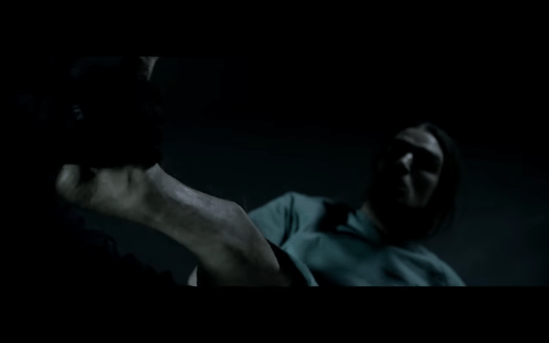
After the sudden and violent death of his police officer father, mixed martial arts champion, Yong-hoo, has a complete disdain for God from a young age now that both his parents have perished. Growing up angry and swarmed with negative thoughts, Yong-hoo goes through life without much of a purpose until he awakes from vivid dream with the wound of stigmata on his hand. Unable to stop the bleeding by means of conventional medicine, he resorts to a shaman who convinces him to seek out Father Ahn, an elder priest experienced at practicing the rite of exorcism, and learns that the wound and Father’s once unwavering benevolence provide a divine weapon against a growing covenant of demons under the black magic of a Dark Bishop. Together, Yong-hoo and Father Ahn combat the forces of evil before the possession runs rampant in the city.

South Korea packs a punch with an action-packed take on possession and exorcism with Kim Joo-hwan’s “The Divine Fury.” The 2019 released film that blends horror with the cinematic formulas of the comic book universe films is written and directed by Joo-hwan and produced by Studio 706, KeyEast, and Lotte Entertainment, the latter being a subsidiary of one of the largest Asia conglomerates and a leader in the Asian film industry. “The Divine Fury” isn’t low-rent horror, providing fans with salt of the earth martial arts, a range of diverse set locations, and a decent grade of special effects that range from stunt men quality to visual monstrosities, including a giant hell worm bristled with millions of arms and hands, and also gives a chance for Joo-hwan to showcase his junior horror-action that succeeds a 2017 buddy-comedy in “Midnight Runners” and a coming to terms drama in his 2013 film, Koala. One motif, and perhaps trademark, that runs through all of Joo-hwan’s written and directed films is the coupling of protagonists element and “The Divine Fury” is not an exception and follows the same coupling, if not slightly altered, mechanism.

A pair of actors from Bong Joon-ho’s award nomination buzzing “Parasite” also have a role “The Divine Fury,” one of them, Seo-joon Park, being the lead star of the Joo-hwan film as the MMA Godsend, Yong-hoo, with hate in his heart for the Lord Almighty. Yong-hoo’s a joy to watch on the screen as a character with an arch’s beginning as a young man, a mindless fighter, being verbally influenced over his shoulders by demon puppeteers to finding his lost father figure in a man who has an unflinching amount of faith. Seo-joon captures the defined struggle Yong-hoo has with God even in the face of pure demonic evil before him. An evil battled by Father Ahn, dolefully portrayed by “Sector 7’s” Sung-Ki Ahn. Sung-Ki fatherly performance places Yong-hoo into a role of humility, not only as a mentor, but with experience and patiences that resigns to trust rather than action. However, the dynamic goes both ways. Seo-joon shows lot of physical strength becoming unwittingly the “divine” warrior to thwart an insidious malevolency when Father Ahn is taken out of action due to Yong-hoo’s haste. Seo-joon had to quickly and naturally grow up his character to be the leading, brute force of experience and physicality and did just that as character faces off with the Dark Bishop, Ji-sin. Ji-sin invokes demons to inhabit those in a weak state of mind. This devilishness wouldn’t have been made possible without Do-Hwan Woo’s stoically sly and slimy confidence behind the character. The remaining cast rounds out with another “Parasite” actor, Woo-sik Choi, and Seung-Joon Lee.

“The Divine Fury” is fundamentally an essential oil extracted from the widely popular comic book universe money-making machines, that are sometimes also called movies from time-to-time, but “The Divine Fury” doesn’t have that monstrous platform of a narrative pulled directly from the illustrated pages of comic book franchise. Yet, the story builds a downtrodden, seeking-answers Seo-Joon with a tragic past and an ability to pulverize people – a winningly similar combination to any pre-defined hero in the Marvel character evolution. There’s also this theme of fatherhood and mentorship, like seen in “X-Men” with Professor X or “Blade” with Abraham Whistler. The latter of those two examples perhaps more closely resembles Father Ahn as the relation to the horror-action genre is similar in nature, but instead of abstaining from blood thirst, Seo-Joon is abstaining from letting God into his heart. Of course, “Blade” was ultra-violent and bloody and “The Divine Fury” is grossly more toned down with the exception of a few key moments of blood regurgitation. Speaking of effects, the visual effects waned from expectation and teetered more toward a rushed and unpolished look. They weren’t terrible, but not the best looking visual effects demons in the industry.

Well Go USA Entertainment brings the action of exorcism to Blu-ray and DVD home video with a dual format, two-disc release of “The Divine Fury.” Presented in a 1080p widescreen, 16:9 aspect ratio and sheathed in a slipcover, “The Divine Fury” feels necessarily gritty in comparison to the subject material with a clean, almost sterile image that defines the blacks and colors, despite a short range of vivid hues the hues that are dominant are profoundly thick and dark. The limited color palette won’t be a problem as demons hide in the shadows and that’s where the story takes domain in scaffolding-laden churches, orphanage basements, and even a swanky neon-glowing club with a well of damnation beneath in the dungeon. The skin tones have a natural feel about them, but going against the grain of naturalism is the visual effects as aforementioned as they don’t render properly to exude the right viewer reaction. The Korean language 5.1 DTS-HD Master Audio has ample weight. Whispering shadows of slithering speak and the bubbling of the, again, well of damnation emit the right kind of range and depth needed to descent into doom and gloom atmospherics. Dialogue is crystal clear and in prominent. An English dub is available, as well as English subtitles that errorless and well synced to the Korean dialogue track. There is some English during a MMA fight on the Korean track. Bonus material includes a rather generally spiced together making of featurette that includes mini segments such as prop commentary, special effects, behind-the-scenes look, and the construction of the antagonist world in “The Divine Fury. There are also a couple of trailer variants and a U.S. trailer for the film. Ultimately, “The Divine Fury” intrigues on the fray, desiring more into the backstory of Father Ahn and delving further into Seo-Joon’s weaponized stigmata and director Joo-hwan Kim teases just that with a taste of things to come with a short pre-credit scene that sets up “The Divine Fury” for more themes, perhaps, on a love-hate relationship with God, more, perhaps, finding suitable father figures, but, of course, there will be for sure more exorcizing ass-kicking of demons.

Purchase the dual format release by clicking the above image! “The Divine Fury”

When Evil Calls, Don’t Pick Up! “Close Calls” reviewed!


Spoiled brat Morgan MacKenzie indulges in the good life under the roof of her wealthy father; perhaps, the party girl indulges a little too much when her father catches her and her boyfriend in a sexual act by the backyard pool. Her continuos snarking, cantankerous attitude, and sexual delights force her father to ground her before going out on a date night. With a box full of miscellaneous hard drugs and a house all to herself, her sole responsibility is to supply her deteriorating grandmother imperative medication, but when obscene phone calls place Morgan on edge, paranoia rocks Morgan’s lucid tate of mind through occurrences with her horny, drug pushing boyfriend, a vile and deranged grandma, and a stranger at the doorstep on a rainy night that instigates nebulous effects, rendering her trapped, scared, and questioning everything about life as she knows it.

A visually colorful feast of mind-warping fear is Richard Stringham’s psychological horror-thriller, “Close Calls.” The 2017 feature that bares a undeniable resemblance to the 1970’s Italian giallo films with stark, dreamlike color lighting keenly favors an admiring homage of a bygone genre. Writer-director Richard Stringham, contributing product of “10/31” and it’s sequel, shepherds the film through S and Drive Cinema on a production that’s near entirely shot on one set location and in a handful of built sets to purposefully thrust an empathetic viewer trapped alongside, hip-to-hip, the snooty,scared, and smack-tripping Morgan and the script, which has been a work in progress for some time prior to release, finally saw completion when, supposedly, Stringham was tripping on drugs himself – that backstory alone should ensue a viewership.

“Close Calls” introduces horror fans to Jordan Phipps as Morgan MacKenzie, the tortured receptor of the obscene calls and whose nerves are buckling under a bombardment of uppers, downers, and many, many hallucinogens. To really stomp hard on the fact that “Close Calls” is indeed a horror film and to add upon the slight separation of the normal circumstances, the unearthly busty Phipps performs in her underwear and bare feet through the entire film and its comically written against the character to undress Morgan in not a literal sense, but works toward a natural teen prerogative that Phipps courageously pulls off dutifully. Because of the very fact that “Close Calls” is the actress’s debut feature told in her character’s entire point of view, I expect Phipps to be on the casting radar as an array of talent and as one who can go unscathed in the daunting course of leading lady. Morgan has exchanges with a couple of interesting characters to note from “10/31’s” Greg Fallon as Barry Cone, a colleague of Morgan’s father with sexual deviancies and callous intentions, and “The Phone in the Attic’s” Janis Duley portraying Morgan’s mentally unstable grandmother with takes dumps in the closet. Fallon and Duley hone in on their respective roles with uninhibited momentum that viciously contributes to Morgan’s spiraling home alone situation and creepily loom a visceral presence under a disturbing guise. Carmen Patterson (“The Boo”), Kristof Waltermire, and Landen Matt round out the cast.

On a parallel plane with the losing one’s mind from a heavy dose of drugs, trauma, and spoiled entitlement, the psycho-sexual narrative of “Close Calls” shouldn’t be ignored and is fringed with totalitarian perversion. The extremely saturated provocative and mainly lewd discourse calls an uneasiness to the moral senses that undercuts the congenial desires for Morgan. Like aforesaid, Morgan struts in her underwear thoroughly through the story and Stringham elaborately showcases her assets with some fine tuned camera work and angles, but Morgan’s drug use topples her sexual stability, leaving her vulnerable against predators that also include her douchy boyfriend, but it’s co-star Greg Fallon that takes the sexual deviance to misogynistic heights as a blunt force object with a high-level stalker obsession toward Morgan. Fallon exacts a persona that’s explained to have watched Morgan from afar in the shadows and schemed plots to infiltrate her by any means necessary, even if that means killing her when he’s done. As Barry Cone, Fallon manufactures to perfection a middle aged man’s grimy malaise toward young teen women and Cone is so vile that he can even starkly contrast Morgan in a better light despite her explicable flaws.

S and Drive Cinema production of Richard Stringham’s “Close Calls” dials up onto DVD home video from Scream Team Releasing presenting the film in a widescreen, 16:9 aspect ratio, full of colorfully vibrant lighting familiar to the old Italian thriller while sustaining a complimentary cinematography with a flat vintage definition image. The stimulating combinational pops of color and lighting were the collaborative efforts of the director of photography Graig Wynn and the late colorist, Omar Godinez (“I Spit On Your Grave” remake), who died of heart failure before the film was finished. The English language PCM DTS-HD Master Audio mix has little to fear with a robust, slasheresque-score by “The Barn’s” Rocky Gray, but the dialogue track can be soft at times where the score overpowers and nearly drowns out the actors. There are also gag-like foley effects, such as when Morgan rubs cocaine onto her gums and the squeegee sound effect sounds more like something out of a Leslie Nielsen parody. With the exception of a static menu, only a single DVD bonus feature included with an audio commentary by writer, director, and produce, Richard Stringham. Loaded with psycho-sexual themes and psychedelic-contorting deconstructs, “Close Calls” is not only a 128 minutes of rabid affections for Jordan Phipps, but also a trip down the uninviting rabbit hole of collusion, murder, and an endless supply of suspense.

Purchase “Close Calls” on DVD! Click the DVD cover!

The Lord Examines the Righteous, but the EVIL, Those Who Love Violence, He Hates with a Passion! “Holy Hell” reviewed!


Father Augustus Bane is a go-by-the-book type priest and through his unlimited optimism and passion, grudgingly turns the other cheek when life’s bitterly cold callousness bends him over a barrel and pulls his hair until bruised and raw on that very same turned cheek. When the God dedicated man of the cloth is pushed too far after the merciless slaughter of God worshipping parishioners and he is left for dead by a gang of demented family members, the surviving Father Bane is reborn and becomes destined to a vindictive life path with a six-shooting revolver he baptizes as The Lord. Hell hath no wrath like a priest scorned to obliterate all sinners from every walk of life in a blaze of the almighty glory (and gory) of The Lord and those explicitly responsible for the death of his congregational followers and much of the city’s crime and corruption will have nowhere to hide from their lethal penance.

What could be considered as the pious Punisher on steroids, Ryan LaPlante’s offensive-laden, satirical grindhouse exploitation feature, “Holy Hell,” is a confirmation of that films like LaPlante’s are sorely needed and pleasingly free in speech inside the dominion of today’s sensitive and politically correct cultural society. Surely not a product of the U.S. and will certainly piss some viewers off (especially zealots), this Canadian made production could only exist outside a conservative dome, looking inward for a weakness to seep and taint the sometimes too wholesome American cinema market that’s tiptoeing around what should expressively blunt and in your face. Let’s face it, folks, it’s a movie! LaPlante writes, directs, and stars in this movie of comedy, action, and exploitation that’s even too controversial for some of the supporting cast who used pseudonyms, such as punned Yennifer Lawrence and Zooey Deschansmell, as their stage names because of the deviant material.

The man with many hats, Ryan LaPlante stars as Father Augustus Bane, a cheerful priest with a firm belief of charity instead of violence, and as LaPlante’s first and only feature as a writer and director, “Holy Hell” snuggly fits the filmmaker’s contemning, vindictive, “autistic rage monger,” as another character described accurately. Satirically stoic, Bane reminisces the days of yore when severely slighted protagonist broke and the endured trauma became a journey of eye for an eye, tooth for a tooth. LaPlante, whose career pivoted to the video game world and could so seamlessly, understood the mentality of once was with harden, good men turned relentlessly anti-heroic. Father Bane’s opposition had parallel penchants of aggressive stamina, but in a more deplorable and deviant calling. The MacFarlane family is about as coarse and as ruthless as they come ran unflinchingly by Dokes, the head of the family, with his wild eyes and skull earring atop his fishnet undershirt and open Hawaiian button down. Dokes is truly satanic as a ravishing villain from in co-producer’s Michael Rawley’s in his sardonic performance of the father of three. The “Disco Pigs” actor revels as Dokes in not only being the kingpin, but also a special daddy to his three rotten and just as maniacal kids – Trisha (Rachel Ann Little), Buddy (“Red Spring’s” Reece Presley), and, the more flagrant of the trio, Sissy, a labeled sadistic he/she of boundless perversion and a flair for the theatric played vivaciously by Shane Patrick McClurg and McClurg’s Sissy MacFarlane is difficult to dislike and is favorably one of the best and best portrayed characters alongside Father Bane and Dokes MacFarlane. The entire “Holy Hell” cast amazes as deviant delectation and round out with love interest Amy Bonner played by Alysa King (“Slasher” television series), Luke LaPlante, and Austin Schaefer.

While “Holy Hell” trails the established trope about a vindictive good man, a thrilling theme consisting inside half the grindhouse genre films of 70’s to 80’s, Ryan LaPlante doesn’t really offer much new to audiences whom are well versed; however, since “Holy Hell” is one big punch-to-the-face nod toward grindhouse and the filmmaker constructs a complete caricature picture, the shocking, the disgusting, and the hilarity mold almost an entirely new brand of grindhouse or, as I’ve coined, mockhouse. A mock-grindhouse film have natural degrading quality where filmmakers remain on the fray of getting the right look and feel of a grindhouse film, but LaPlante accomplishes the task, echoing the effect while adding his own brand of comedy. Also LaPlante’s bludgeoning of taboo is no holds barred comedy, especially on surface level narratives such as with Father Bane who has a tremendous arch to hurdle as a priest fueled with guilt and rage against an army of inhuman and derange psychopaths, plus all the other miscellaneous miscreants roaming the streets at all hours of the day, but the script is penned like the Divine retribution as the priest endures, almost in a supernaturally reborn or resurrected kind of way, after being shot six times in the form of a cross by Dokes that, ironically, acts as a blessing for Bane to declare war on evil.

Indican Pictures presents a Rogus Gallery production with “Holy Hell” onto a not rated DVD home video. The widescreen, 16:9 aspect ratio, has a warm toned coloring grading from digital grader Defiant and also embellishes the natural grain and blemishes to assimilate into the grindhouse collective. “Holy Hell” is intent only appealing to a comic book illustration that makes definition fuzzy, but not totally cleared from the playing field. The closes up of the gore is nicely displayed with a drenching and gruesome effect. I couldn’t detect a lot of girth from the Englih language 2.0 stereo track which makes me think LaPlante intended on suppressing much of the ambiance and up the soundtrack quality from composer Adrian Ellis, whose upbeat, synch-rock has killer intentions whenever the MacFarlane’s are rolling heads. DVD extras include a director’s commentary and a blooper reel. Chockfull with affronting one liners, “Holy Hell” is utterly sound being well-rounded with the best intentions paved in hooker blood and indecent exposure, as well as being highly entertaining, in one holy redeemable package of horror exploitation blessed by Ryan LaPlante himself.

When EVIL Becomes Obsolete, Its Time for an…”Upgrade” reviewed!


In the near future where assistive technology serves as the cultural way of life, a very manual Grey Trace still clings to being self-independent while his loving wife, Asha, laps up and embraces new and innovative tech. When an fatal shooting strikes down Asha and cripples Grey to an automated wheelchair, Grey is forced into a depressive world he no longer recognizes. Desperate to find his wife’s killers, he accepts experimental computer chip implant known as STEM to send the signals from his brain to his extremities; however, that is not all STEM can do. The smart technology can also scan, record, and reactive to all of Grey’s experiences, be a voice of knowledge, and enact super human abilities that will aid in Grey’s vengeance, but without much control over his own body, how much will Grey continue to use the smart device that becomes smarter every minute.

In a cinematic age when remakes, re-imaginings, and sequels really do rule supreme, a breath of innovation and compelling storytelling in Leigh Whannell’s 2018 science fiction, action-noir “Upgrade” is a technological advance that’s feels lightyears ahead in comparison. The “Saw” and “Insidious” writer, who indulges in all of horror’s gracious qualities, tackles the future with a synergetic and brutal vengeance film on indie-budget proportions; however, “Upgrade” feels no where near being low budget in a futuristic world that includes monochromatic self-driving cars, bio-weaponized forearms and hands, and a robotic protein shake slingers for those meal replacement pick-me-ups. With the assistance from Blumhouse Tilt, a Blumhouse production sublabel that seeks to release projects onto multi-platforms, Whannell gained freedom to script, in every sense of the world, his own vision of cyborg horror and crime thriller.

Logan Marshall-Green stars as Grey Trace, an analog man living comfortably in a digital world. Trace is a dying bred as the technology ecosystem slowly creeps into all that earned by hard work, even in his small classic car restoration business. The “Prometheus” star tackles a unique physicality aspect of an action film that involves the robotic responses of hand-to-hand combat while also being the emotional punching bag of pelted heartache and turmoil. Portraying his character as a man’s man, Marshall-Green has to find humility in not only unable to self-serve himself as a cripple, but then also rely on the one thing he withdrew himself from for help….a machine. “Upgrade” primarily focuses on Trace to even having the camera affix to his character during fight sequences, but though most of the narrative is through Trace’s vindictive narrative, a cascading effect of his destruction brings one of his nemesis’s into reactive defense. Fisk, Benedict Hardie from the upcoming remake of “The Invisible Man” that’s also directed by Whannell, is a mysterious soldier of fortune whose backstory, that salivates at the tip of the tongue to be told, is only sampled at best with his cybernetic implants or why he was even chosen to be a deadly, robotic killing machine. Perhaps Fisk’s backstory, and those of his fellow veteran comrades, are another misrepresentation or the maltreatment of veterans by conglomerate, privately owned tech and weapon companies that lean more toward involuntary experimentation rather over anything else that’s an allegory of owning a person, a piece of property, as we also see with STEM attached to Grey Trace’s spinal cord. “Upgrade” rounds out with performances from Melanie Vallejo, Harrison Gilbertson (“Haunt”), Betty Gabriel (“Get Out”), Kai Bradley, and Simon Maiden as the voice of STEM.

Shot in urban Melbourne that’s quasi-reflective of the gritty streets of Chicago, Leigh Whannell aimed for a fatalistic mystery that breaks down relationship barriers and sustains a punitive jurisdiction of grime. Whannell surely achieves the desired affect that goes from a classy futuristic society to the bottom barrel of human existences that have been tainted by the dark side of tech including addiction and dangers of being fully aware as a sanctioned being. “Upgrade” capitalizes on every inch of its capital to enlarge the quality of a miniature budget and utilizes local talent, who, aside from Logan Marshall-Green, never wane from their unnatural American English accents, to offer heartfelt human performances despite their mechanical transitions. “Upgrade” isn’t “Robocop” or “Nemesis,” but rather more “Terminator” where organic and inorganic don’t exactly coincide to benefit as a single entity. Unlike the autonomous killing machine portrayed by Arnold Schwarzenegger, “STEM” acts like a computer virus working off commands, coding, and complex algorithms to infiltrate and deploy executions to subverse the man over the machine and Whannell’s concept brilliantly contextualizes that dynamic without having too much exposition to divulge and is easily computed without having to be deciphered from binary code.

Coming November 18th is Second Sight Film’s limited edition Blu-ray release of “Upgrade” presented in full HD, 1080p, and clocks in at 100 minutes under a region B UK coding. Unfortunately, a screener disc was provided for review and so I will not be critiquing the video or audio quality at this time so this review is solely about the film only. A static menu including chapters were available on the disc as well as bonus features including a commentary by writer-director Leigh Whannell, a new Second Sights’ interview with the director about his envisioning and how it came to fruition, more new interviews with producer Kylie Du Fresne, cinematographer Stefan Duscio, editor Andy Canny, and fight choreographer Chris Weir. All the interviews showcase depth with the material to their respective roles and opinions about “Upgrade.” Don’t think it necessary to refer filmmaker Leigh Whannell as the “Saw” guy now that “Upgrade” has completely overshadowed the franchise in a single sitting entertained with action, gore, and a heart-rendering story. Surely to be Whannell’s break out film from the horror genre.

Buy your Limited Edition UK Blu-ray today! Click the cover to purchase!

EVIL Drugs Zap the Sanity Out of Ya! “Dry Blood” reviewed!


Struggling drug addict, Brian Barnes, travels to his and his estranged wife’s cabin in a rural mountain community to force himself into isolated detox. He calls upon his friend Anna to assist with keeping him focused to sobriety. As soon as Brian arrives, temptation to score rears an ugly head and in his battle with withdrawal, Brian is frightened by his experiences with grisly, ominous phantoms in the cabin, a unhinged sheriff perversely following him, and the disassociation of linear time. He unwittingly falls into a mystery he doesn’t want to unravel as the occurrences of death and hallucinations intensify every minute within withdrawal and Anna doesn’t believe his frantic hysteria with ghostly encounters, but scared and unwell, Brian is at the brink of snapping, the edge of reality, and on the cusp of reliving his nightmare over and over again.

A harrowing insight into mental illness and abstaining from illicit drug use exaggerated by the overlapping of paranormal wedges of weird into the fold and Kelton Jones’s “Dry Blood” renders shape as a detoxing detrimental peak into exclusively being afraid and relapsing that also touches upon the idea of being afraid repeating relapse without consciousness. Under the Epic Pictures’ Dread Central Presents distribution banner, the Bloody Knuckles Entertainment production is of a few original horror films from a media leader in the horror community, leading an exposure campaign that might not have otherwise been possible. Not to say “Dry Blood” wouldn’t have metamorphosed from idea to realty by any means, but the DREAD line opens up films to a broader market, a bloodthirsty bandstand section of sometimes divisive and opinionated fans, who have seen, under the DREAD banner, an innovative horror lineup including “The Golem,” “Book of Monsters,” and “Terrifier.” “Dry Blood” fits right into the mix that’s sure to be a favorable side of judgements.

Clint Carney sits front seat as not only screenwriter but also the star of the film with Brian Barnes who tries to reclaim his self-worth and life from long time substance abuse. At the slight entreatment from director Kelton Jones, Carney has a better understanding of downtrodden Barnes character more than anyone and having some experience acting in short films, the writer naturally finds himself ahead of the pack on a short list of talent. However, though Carney has a modestly okay performance, the overall quality in selling Barnes as desperate, duplicitous, and genuine misses the mark, exacting a clunky out of step disposition as the character tries to figure the mystery that enshrouds him. Jones also has a role as the deranged sheriff who stalks Barnes like an overbearing, power monger cop who smells blood in the water. In his feature debut, like Barnes, Jones’ splashes a friendly, yet simultaneously devilish smirk spreading wide under a thick caterpillar mustache that adds another psychological layer in caressing Barnes’ madness. Barnes love interest, Anna, is found in Jayme Valentine and, much in the same regards to Carney, there were issues with her performance as the willing friend to be the support beam to Barnes. Valentine just didn’t have the emotional range and was nearly too automaton to pull Anna off as a person whose romantically unable to resist the addict but can manage to keep a safe distance away in order for both of them to benefit in his sobriety journey. “Dry Blood’s” casts out with some solid supporting performances by Graham Sheldon, Rin Ehlers, Robert Galluzzo (director of “The Psycho Legacy” documentary), and Macy Johnson.

“Dry Blood” is certainly an allegorical move toward the severe effects of withdrawal, even with the title that’s a play on words of a former addict staying dry during their difficult abstaining campaign, and with that symbolism, that ambitious ambiguity, to question whether or not Barnes is actually seeing these horrific images of disfigured bodies becomes open to audience interpretation of their own experience with substance abuse or their empathetic knowledge of it. Combine that individual experience aspect with some out-and-out, gritty moments of bloody violence, especially in the final sequences of Barnes careening reality, and “Dry Blood’s” simmering storyline ignites a volcanic eruption of unhinged blood lava that spews without forbearance. Those responsible for acute effects are Chad Engel and Sioux Sinclair with Clint and Travis Carney rocking out of the visual effects to amplify the scenes already raw and gore-ifying moments.

Epic Pictures and Dread Central Presents a paranoia, paranormal, psychological bloodbath of a production in “Dry Blood” and lands onto a hi-definiton, region free Blu-ray home video in a widescreen, 16:9 aspect ratio, distributed by MVDVisual. The 83 minute presentation has a consistent, natural adequacy that delivers strong enough textures to get a tactile sense of the wood paneling of the rural mountain cabin and also the various materials in clothing and skin surface for easy to flag definition. Hues are potent when necessary, especially when the blood runs in a viscous red-black consistency. Darker, black portions have a tendency to be lossy and flickery at times, but nothing to focus on that’ll interrupt viewing service. The English language 5.1 Dolby Digital surround sound has little to offer without inlaying a full size candy bar of action; instead, “Dry Blood” has bite-size appeal that would render okay without audio channel overkill. With that being said, dialogue doesn’t falter and there maintains an ample range and depth of sounds. Surprisingly, the build up of notating the soundtrack composed by System Syn left a disappointed aftertaste as the expectations of an industrial electronic, upbeat score was met only with a casual fling of the group’s spirit. Still, the soundtrack is a brooding horror melody which isn’t unpleasant…just not what was to be expected. Bonus material includes an audio commentary with Clint Carney and Kelton Jones, the making of “Dry Blood,” and teaser and theatrical trailer. Don’t be fooled by “Dry Blood’s” initial crawl approach as when the tide turns, addiction roles into hallucinogenic despondency and mayhem, and the blood splatters on a dime bag detox, “Dry Blood” will factor into being one of the better sleeper horror films of the year.

Dry Blood on Blu-ray! Purchase It By Clicking Here!