A CIA Plan is Being Sidelined by EVIL’s Rooftop Terrace Sniping! “Goodbye & Amen” reviewed! (Radiance Films / Blu-ray)

Own a Copy of “Goodbye & Amen” from Radiance Films. Click here to Purchase.

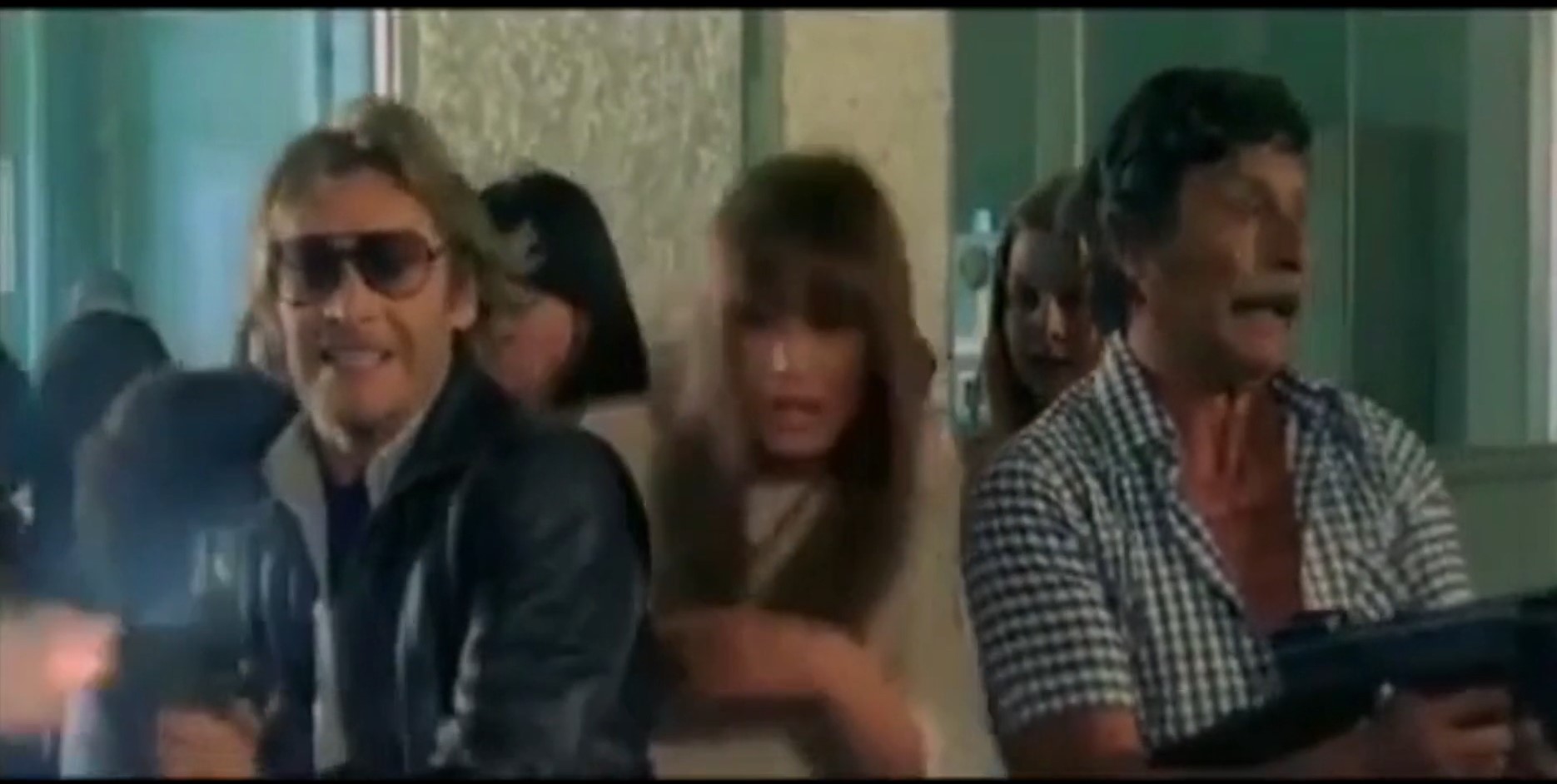
Ambitiously confident CIA agent John Dannahay eagerly wants to begin his plan for an African nation coup.  Based in Italy, Dannahay runs through his team the stage of events when suddenly a current administrative African agent, known for sniffing and snuffing out power-overthrowing schemes, suddenly arrives in town, Dannahay’s friend Harry Lambert up-and-leaves his wife and child and takes a rifle with him, and a gunman, supposedly Lambert, is at the top of a hotel terrace sniping down pedestrians.  Whatever surgical strike Dannahay had plan is now in jeopardy as a hostage situation occurs in one of the hotel rooms and agent Dannahay and Italian inspector Moreno must piece together why a longtime compliant and clean nosed American embassy worker has suddenly gone murderously berserk.  A public stir amidst a shrewd madman with a high-powered rifle creates a confounding panic of national security and for fear of what will happen next in the moment of mayhem.

Italian filmmaker Damiano Damiani, known for his crime thrillers, such as “Mafia” and “Confessions of a Police Captain,” and his small footprint in horror with the sequel “Amityville II:  The Possession,” had cowrite and directed an intense espionage thriller outside the confines of actual cloak-and-dagger activities with a multi-national cast.  The 1977 film titled “Goodbye & Amen”  is first and foremost an Italian production, cowritten by Damiani alongside “Wanted:  Babysitter” screenwriter Nicola Badalucco and is based off the novel “The Grosvenor Square Goodbye” by British writer Francis Clifford.   The gripping story draws upon multi-layered themes and twists to keep the narratively recycling on fresh and to never become stale with its intriguing mystery and taut tension, shot right in the heart of Rome, Italy at the Cavalieri Waldorf Astoria hotel.  “Goodbye & Amen” is a product of Capital Film and Rizzoli Film and produced by the profound producer Mario Cecchi Gori of Michele Soavi’s “The Sect” and Dino Risi’s “The Tiger and the Pussycat.”

Italians.  Americans.  British.  “Goodbye & Amen” has an all-star international cast that lines up and knocks down the perfectly scripted and beguilingly complex roles that warrant nothing less than the utmost praise for their personal performances. What starts off as a CIA caper to overthrow an African nation regime pivots acutely into a hostage standoff with many unanswered questions pelting down almost simultaneously in mass confusion and uproar in what translates to a very relatable, real moment.  Introductions begin with the CIA’s operational leader John Dannahay (Tony Musante, “The Bird with the Crystal Plumage”) spearheading the preparation meeting when suddenly his operational plans become under jeopardy.  Musante’s strongheaded approach to not lose control of the situation is fierce against the challenge his character faces – a lone gunman, a man Dannahay calls a friend played by “Tenebrae’s” John Steiner, holding hostage an actor (Gianrico Tondinelli, “Enter the Devil”) and his illicit mistress (Claudia Cardinale, “8 ½”).  Steiner delivers a sophisticated, twangy-accented killer hellbent on making a statement with a M1 Carbine rifle and a thought-out plan being a step ahead of Dannahay and Italian Inspector Moreno (Fabrizio Jovine, “The Psycho”).  The dynamic between Dannahay and Moreno, in my opinion, is rather lite for a fast and loose Dannahay and a by-the-book Moreno being two stags vying over how to handle an American mess on Italian land.  Other supporting characters add their creative two cents to “Goodbye & Amen’s” already swelling storyline with great additional principals from Renzo Palmer (“The Eroticist”), Wolfango Soldati (“The House at the Edge of the Lake”), John Forsythe (“Scrooged”), and Anna Zinnemann (“My Sister of Ursula”) that fillet down the mystery to reveal its coldblooded nature.

Not lately have I’ve impressed with a crime thriller and said to myself, wow, that was really engaging and unexpectedly good.  With confidence, “Goodbye and Amen” hit that satisfying note, a note thought to have strayed into an obscure black void never to be seen again, but the story coupled by Damiani perceptive big-world direction and some great camera work and angles by cinematographer Luigi Kuveiller, that shimmers hints of Kuveiller’s work on previous films like “Deep Red” and “A Lizard in a Woman’s Skin,” and “Goodbye and Amen” is one of the better Italian crime thrillers to come out of the country that isn’t in the giallo subgenre.  Incorporating wide shots with depth and a seriously oversaturation of characters and extras, plus not to forget to mention helicopters and shoot outs, create the illusion of a bigger film without manufacturing too many atmospherics to hoist suspense.  Plenty of red herrings and blunt force action, peppered with bare flesh sensuality, and heedful acting provides the film with an incredibly firm bite that sinks its teeth in and never releases.  Compelling and always one step ahead, “Goodbye & Amen’s” layers of excitement keep viewers simultaneously abreast and in the dark and with the seesaw suspense, which never falters with an overly opaque complex ingenuity, there’s a pleasant rollercoaster effective of up and downs between penetrating thrills and just enough down to Earth exposition in order to catch one’s breath.   

In a new limited edition Blu-ray release from UK distributor Radiance Films on their North American lineup, “Goodbye & Amen” receives a 2023 2K restoration scan from the original camera 35mm negative and presented on an AVC encoded, high-definition 1080p, BD50 in an anamorphic 1.85:1 aspect ratio. Certainly, a smooth image with no enhancement fluff or over-corrective, off-tilted coloring, the restoration brings out the best parts of Damniano Damiani’s natural approach with key lighting supporting exteriors and some intensely lit interiors without a smidgen of banding or posterization to complicate it. Details are razor sharp and the hue saturation is full-bodied and deep even along the line of a sunny Italian coastline where contours are a nice edge drop-off and shape. The English version has three exclusive shots pulled and scanned from the 16 reversal elements that create a slight grain difference that manages to nearly go unnoticed. Audio options come with the original Italian DTS-HD Master Audio 2.0 mono and, for the first time on home video, the English export in a DTS-HD Master Audio 2.0 mono. The English export’s audio track does come with a proclaimed statement right on the main menu about its unresolved damage. Like being pushed through a filter of interference, the English track is intelligible if not entirely clear and free from static and squelch. The Italian track offers a cleaner ordonnance albeit a few in-and-out moments of faint distortion of unrestorable audio ribbon snippets. New and approved English subtitles on both lossless, uncompressed tracks help alleviate some of the technical pain audio aficionados may suffer but, in my honest opinion, the Italian meets the bar whereas the English is under the bar by just a few clicks. Radiance’s special features include a new audio commentary track by Eurocrime experts Nathaniel Thompson and Howard S. Berger, a new interview with editor Antonio Siciliano, and an archival interview with actor Wolfango Soldati. Both interviews are in Italian with burned in English subtitles. Radiance’s physical approach to their releases is highly unique in format by using obscure poster elements, and sometimes often new illustrated art and compositions, to exact a striking front cover image. With “Goodbye & Amen,” the rendition of Italian’s finest in their version of S.W.A.T. body armor within the sites of a crosshair is clever and engaging to know more. The reverse cover offers more of the common language poster art. A 19-page color booklet, that contents the cast and crew information, transfer notes and credits, and a new essay from Lucio Rinaldi entitled “The American Connection: Damiano Damiani’s Goodbye & Amen,” accompanies a reserved blue background and yellow font disc art that befits Radiance’s retro-classy style. Being a UK distributor releasing in the North American market lends the title to have a region A and B playback for two varied runtimes, for the Italian and English version tracks, of 110 (Italian) and 102 (English) minutes. Radiance’s 38th release is also not rated.

Last Rites: “Goodbye & Amen” is a collaborative triumph, an arresting story anchored by monolithic performances, and imparted by director Daminano Damiani with attention, detail, and substance that makes the film a pillar amongst the Eurocrime narrative.

Own a Copy of “Goodbye & Amen” from Radiance Films. Click here to Purchase.

Getting Revenge on EVIL is a 6-Year Plan! “Kill Butterfly Kill” reviewed! (Neon Eagle Video / Blu-ray)

“Kill Butterfly Kill” – Both Films Available on Blu-ray!

Caught on the wrong side of the tracks during  a torrential downpour one dark and stormy night, a soaked Mei-Ling seeks shelter in a haybarn where a group of drunk men are playing cards.  Through an intoxicated lens of brash confidence, the men rape Mei-Ling as if the whole ordeal was nothing more than a game, like them playing cards.  For Mei-Ling, the night that changed everything ate at her for six long years as she worked her way up into a nightclub business as she sought the names and faces of her attackers.  When one of the men, a crime boss, stiffs a hitman after taking out leaders of a rival gang, Mei-Ling and the assassin form a mutual business and romantic relationship, pledging to help one another’s revenge. Together, along with Mei-Ling’s most trusted female accomplices, they plot, seduce, and lure each man out of hiding and take them out one-by-one in different ways.   

“Hei shi fu ren,” aka “Underground Wife,” aka “Kill Butterfly Kill,” is the 1982 rape-revenge Taiwanese thriller from director Yu-Lung Hsu, a fast-paced crime-action filmmaker with credits “The Boy from Dark Street” and the more fantastical, kaiju picture “King of Snakes” under his belt later in his career.  The script is penned by a compeer of such genres in Ching-Kang Yao who wrote “One-Armed Swordsman vs Nine Killers” and “Superdragon vs. Superman,” starring Bruce Lee imitator, Bruce Li.  Yu-Lung and Ching-King would collaborate often, making the film one of those efforts right at the height of their joined forces; yet, the film has gone through various titles and edits, even recut and edited in new scenes into what would become “American Commando 6:  Kill Butterfly Kill” five years later from director Godfrey Ho (as Charles Lee), and trying to get a sense of the original intention has proved nothing but difficult.  “Official Exterminator 2:  Heaven’s Hell” executive producer Wu-Tung Yet produces the film what we’ll refer to as “Kill Butterfly Kill” for the sake of his review and Fortuna Film Company is the production firm and presented by International Film Distributors (IFD).

Li-Yun Chen stars as the nightclub madam Mei-Ling hellbent on lethal revenge.  Chen, who continued her career in a few other sexy femme fatale roles in “Commando Fury” and “The Vampire Dominator,” plays the damsel in distress, forced into romping in the hay with a few baboonish male drunkards.  The rape scene is nothing to be overly wrought about as the close-ripping pursuit through the barn is violently toned down and the rape is more implied than explicit.  There isn’t even any nudity of the private parts with just Chen in ripped attire and the men baring their sweaty chests.  Chen never really receives the sympathetic tone one is supposed to receive after going through harrowing humiliation and assault.  Not because of the less intense attack, perhaps more so with how jovial and goofy the intoxicated men are, but Mei-Ling is never lit in a low-point light.  Even after the rape, Mei-Ling is standing strong, glaring, and with a look of determination to get payback while still having straw hang from her disheveled hair, segueing seamlessly right into her powerful businesswoman persona six years later.  This is the point in time where, as an exclusive call girl for a powerful crime boss (Paul Chang Chung, “Vengeance of a Snowgirl”) in a variant subplot, she meets cheated assassin Shiu Ping (Sha Ma, “The Nude Body Case in Tokyo”) who becomes a kindred spirit in seeking revenge.  Their intertwining falls on a fated sword and too serendipitous to make a lot of sense but their run-in to each other makes for good buddy action, an assassin and a high-end prostitute going full tilt on some really bad men who have dispersed into their own idiosyncratic corruption paths that makes them all the more detestable when Mei-Ling and Shiu Ping come for them.  “Kill Butterfly Kill” rounds out the cast with Sing Chen, Hung-Lieh Chen, Fu-Cheng Chen, Yaun Chuan, Li Hsu, Shao Hua Chu, Ti-Men Kan, Chen-Peng Kao, Yun Lan, Fei Lung, Wen-Tseng Liu, Kuan-Wu Lung and Ta-Chuan Chang.

“Kill Butterfly Kill” is inarguably a cult film from Taiwan with sordid themes coursing through its cinematic circulatory system.  Conjoined with the rape-revenge aspect, one of the staple themes of the genre, society corruption, gang wars, assassination attempts, prostitution and martial art skirmishes and brawls run rampant and serve “Kill Butterfly Kill” as Eastern grindhouse ambrosia.  Yet, the seemingly positive film style paraphernalia can also be detrimental.  In the case of “Kill Butterfly Kill,” there’s not a clear cut profile from Yu-Lung Hsu with lot to ingest but not a ton targeted nourishment.  The rape-revenge aspect, which feels like the keynote, foundational plot, careens into awkward comedy and the swindled assassin territory a little too much or invests heavily into the sudden and unexplained relationship between the two protagonists without much background or backstory. There’s no phoenix moment of rising from the ashes with a quick cut from the rape to the revenge without delving into the nitty-gritty details needed to satisfy an important sympathetic and empathetic resurrection.  Sha Ma’s assassin feels like a threadbare connection serving mostly for patriarchal palaver because, surely, a woman couldn’t undermine five influential men by herself, right?  In any case, what’s filmed is filmed, and the fight coordination doesn’t displease with fast-paced action and quick-striking movements.  There’s also a lean cinematographer stylistic palette that fashions surreal moments to coincide with fast action, offering unique methods in tracking down, seducing, luring, and inevitably dispatching the scum.

The film having been through multiple remixes, edits, and being obscure to begin with, the Neon Eagle Video’s 2-Disc Blu-ray release restore what’s feasibly possible in effort to showcase the best possible elements.  In return, the quality on the AVC encoded, high-definition BD50 houses a variable image that never falls terribly below par. The best surviving print is a burned-in English audio export now scanned in 4K and restored to the best possible extent that still sees vertical scratches, frame damage, splicing, and possible print decay. Yet, that doesn’t halt the fast-acting, slow-motion, and tripping visual lenses from being savored. Coloring’s limited saturation offers a flat, little-to-no, pop but there’s quite a bit of exterior light coming through the lens, creating a vivid lens flare effect that makes print have designer appeal. Aforementioned, the burned-in English DTS-HD 2.0 mono dub is the only audio track available and is about as gum-flapping as the next dub track over the likely original Mandarin, the native language track that’s presented on the standard definition presentation of “Underground Wife” in the special features. Foley’s fine with timely inclusions in the fight sequences and other naturally prescribed milieu audio bytes important for the story. English SDH subtitle are optionally available. On the first disc, “Underground Wife,” the feature’s original title and as I already mentioned available in the special features in standard definition, is a bonus version of the film in the original language audio. Also included an audio commentary by Podcast on Fire Network’s Kenneth Brorsson and Paul Fox as well as the “Kill Butterfly Kill” trailer. The second disc contains the remix of the 1982 film with the release of a 1987 “American Commando 6: Kill Butterfly Kill” with more-or-less the same premise except with the newly shot and edited in scenes of International Film Distributor (IFD Films and Arts Ltd.) regulars Mike Abbott and Mark Miller intercut to fit into the narrative that’s expanded by bringing in a powerful crime boss syndicate and his endless Rolodex of assassins. Also scanned and restored in 4K, “American Command 6: Kill Butterfly Kill” has a little more color in the cheeks and is in much healthier celluloid shape. I actually like the bastardized, Frankenstein cut better because of not only the image quality but because the fights show more intensity, but this isn’t to say “Kill Butterfly Kill” scrapes are poorly orchestrated – just different. The second disc also comes with the trailer and an IFD trailer compilation. The non-slipcovered release is housed in a clear Blu-ray Amaray with reversible cover art – one for each of the features. Inside, there’s a disc on either side of the cast featuring composite and illustration art for the respective features. Both films are region free and are not rated with “Kill Butterfly Kill” clocking in at 87-minutes and “American Commando 6: Kill Butterfly Kill” done in 90-minutes.

Last Rites: IFD had procured the rights to “Underground Wife” and mercilessly re-edited and re-mixed the storyline through the meatgrinder, producing two English exports for quick cash, and while intelligible to extent, each version carries a volatile variation that leads to a problematic personality disorder that loses sight of the story’s initial purpose. In the end, the differences denote diversity within the same framework, like facelifting a building with its original good steel bones, and shows how fluid and flexible the editing room can be as long as possibilities and creativity can prevail.

“Kill Butterfly Kill” – Both Films Available on Blu-ray!

This Spy’s Sex Serum Will Drive Men EVILLY Mad! “Blue Rita” reviewed! (Full Moon Features / Blu-ray – DVD)

Own “Blue Rita” on Blu-ray and DVD Combo Set Today!

Misandrist Blue Rita owns a high-end gentlemen’s cabaret.  Her renowned nightclub is also a front for espionage activities.  With the help of a Bergen, her handling, and her right-hand club manager Gina, she’s fed male targets that are affluent and powerful to kidnap and torture to extract sensitive intelligence information.  As a side hustle, a perk that comes with exploiting the naked and chained up men in her underground boxed cells, Blue Rita uses her chemical powers of seduction to sexually torture her captives into withdrawing their bank accounts dry.  When new girl Sun is hired in to not only titillate the nightclub client with her erotic Pippi Longstocking performances, the Blue Rita pledger works her first mission to reel in a wealthy, international boxer as the next target but Sun’s own conflictions collide with Rita’s sworn hate for all men, cracking the door open ajar just enough for Interpol and the Russian intelligence agencies to try and undermine Blue Rita’s confrontational spy operations. 

What’s renowned most about eurotrash filmmaker Jesus (Jess) Franco is his diverse contributions to the European and American movie-making markets.  Though most of his work is regarded as schlocky, beneath the sleaze and sordidness is a carefully calculating psychotronic director.  True, Franco may not be famously esteemed as, let’s say Martin Scorsese or Steven Spielberg, but his infamy should not be ignored amongst the present company of similar filmmakers like Tinto Brass or even Roman Polanski.  One of the late Franco’s few spy game theme films, “Blue Rita” is a hot house of sleaze and deceit, written by the director.  Filmed in Germany with German actors and actresses, the film went under the original title “Das Frauenhaus” translated as “The House of Women,” referring to the Blue Rita’s distaste for men and keeping an all-femme fatale, and mostly nude, workforce for her clandestine affairs.  Elite Film is the production company with Erwin C. Deitrich (“Love Letters of a Portuguese Nun,” “Swedish Nympho Slaves”) producing.

Much like Franco’s diverse dips into a variety of subgenres, “Blue Rita’s” cast is also quite an assorted lot in talent from sexploitation, horror, and the XXX industry.  The German production also garnered not just homefield advantage with German actors but also lured into the fold some of the French cast cuisine to spice up the affair.  Martine Fléty is one of those French foreigners, embodying the lead role of Blue Rita.  An adult actress of primarily the 70s, “Blue Rita” became Fléty only titular role but wasn’t her last Jess Franco feature, having continued her X-rated run with the director in “Elles Font Tout,” “I Burn All Over,” and “Claire.”  Either half or entirely naked for the entire narrative, Fléty’s comfortability bare-bottom relays power in her performance as an unwavering femme fatale agent that has men begging for sex and begging for their very lives.  Back then, the lines blurred between porn and sexploitation, often times melding into European coalescence hitting the same marquee theaters until it’s eventual separation.  Esther Moser (“Around the World in 80 Beds,” “Ilsa, The Wicked Warden”), Angela Ritschard (“Jack the Ripper,” “Bangkok Connection”), Vicky Mesmin (“Dancers for Tangier,” “Love Inferno”), Roman Huber (“Girls in the Night Traffic,” “Sex Swedish Girls in a Boarding School”), Olivier Mathot (“Diamonds of Kilimandjaro,” “French Erection”) and Pamela Stanford (“Sexy Sisters,” “Furies sexuelles”) rode, among other things, that fine line between grindhouse gauche and the taboo and certainly do well to incorporate both traits in Franco’s equally indeterminate genre film.  German actor and one of the principal leads Eric Falk (“Caged Women,” Secrets of a French Maid”) too dappled between crowds as a tall, dark, and chiseled chin but the actor chiefly sought limelight in sexploitation and as the haughty boxer Janosch Lassard, who karate chops at lightning speed, Falk adds to “Blue Rita’s” sexy-spy thriller.  Opposite the titular vixen is “Wicked Women’s” Dagmar Bürger who, like the rest of the cast, have crossed paths in a handful of exploitation exciters.  Bürger has perhaps the least built-up character Sun as she’s subtly folded into Blue Rite’s innermost circle without as much as a single ounce of doubt in her character, perhaps due in part to Bergen, Blue Rita’s handler, was once Sun’s direct-to, but Sun becomes the impetus key to everything falling apart at the seams and her role’s framework feels unsatisfactory just as her crumbling infatuation that’s more arbitrary than motivationally centric.

“Blue Rita” doesn’t necessarily broach as a film by Jess Franco whose typical undertakings are coated with sleazy gothic and historical context.  The 1979 feature, set around the extraction of international intelligence data by way of chemical approach, not terribly farfetched considering how the CIA once used LSD as a truth serum, is about as sordid and sexually graphic as any Jess Franco film gets but brings about a futuristic air laced with not just super cool spy gadgets and weaponry, to which there are really none to speak of as an example, there lies a more ultramodern verge upon unseen in much of the earlier, Spanish-born director’s work.  A futuristic holding pen with a capacity no bigger than an industrial-sized washing machine with a descending spiked barred ceiling, a hyper-aphrodisiac goo that makes men so horny it puts them on the edge of insanity and death, and the sleek, contemporary sex room with translucent furniture and stark white walls all in the routine hustle and bustle of Paris, France. “Blue Rita’s” contrarian patinas add to the film’s colorful charisma of avant-garde stripteases and a black operations nightclub, two of which combined play more into the “Austin Powers” funky 1970s ecosphere rather than in the high-powered espionage world of James Bond, the Roger Moore years.

For the first time on Blu-ray in the North American market, Full Moon Features puts out into the world a fully remastered, high-definition, 2-disc Blu-ray and DVD set. The AVC encoded, 1080p, BD25 entails picture perfect image quality that sharpen “Blue Rita” with greater resolution in comparison to previous DVD versions with full-bodied color, in setting tones and in body tones, and a contour-creating delineation that establishes depth and texture better, presented in a widescreen 1.85:1 aspect ratio. Not flawless mind you with soft spots rearing up every so often in the variety of interior and exterior, organically and inorganically lit scenes but there’s distinct contrast that delivers a recognizing lighting scheme that deepens the shadows in the right places without signs of an inadequate compression, especially on a single layer Blu-ray, and the Full Moon release retains natural grain with no DNR or other image enhancements. The release comes with two audio options, a lossy Dolby Digital 5.1 and a French Dolby Digital 2.0 Stereo, both of which have a horrendously acted burned-in English dub of not the original actors’ voices. Banal dub does take the quality of Franco’s dialogue down a good peg or two, which the original dub track was likely spoken in native German and some French judging by the cast list nationalities and where the bigger distribution market was for the planned; yet, though the dialogue is verbose and ploddingly straightforward to make do, losing some of the depth in the process, the quality is voluminous to ensure no mistake is made in underemphasizing the story’s outline when necessary. Ambience and other design markers hit more than well enough to sell the surroundings and the action to make those qualities palpable. English subtitles are option but not available on the setup; they will have to added in per your setup’s options. The Blu-ray extras come with a rare photo gallery, an archived interview with Chris Alexander with Peter Strickland discussing Franco circa 2013, and a vintage Jess Franco Trailer Reel. The DVD houses a different set of special features, separate from the Blu-ray’s, with Slave in the Women’s House interview with Eric’s Falk plus the DVD also offers Eurocine trailers. Those interested in supplementary content will be forced to pop in both discs to fully abreast of all bonus material. What’s eye-catching about the Full Moon Feature’s release is the erotic front cover on the cardboard O-slipcover, sleekly illustrated for your kink and perversive pleasure. The Blu-ray Amary inside has a NSFW story still of Dagmar Bürger walking down a spiral staircase in the buff. The same Dagmar Bürger image graces the DVD cover while a new illustrated luscious lips are pressed on the Blu-ray disc opposite side. There is no insert or booklet included. The region free release has a runtime of 78 minutes and is not rated.

Last Rites: The late Jess Franco may have a cache full of sleaze in his repertoire, but the director had a sense of panache and intensity that’s sorely underrated outside his fanbase. “Blue Rita” shows Franco’s range, stylistically and genre, and Full Moon’s sultry release is now high-definition gold in the color blue.

Own “Blue Rita” on Blu-ray and DVD Combo Set Today!

Killed by Your Monstrous, EVIL Twin Set on Repeat. “Island Escape” reviewed! (Dread / Blu-ray)

“Island Escape” Available Here at Amazon.com

Chase, a washed up mercenary with touch of amnesia regarding his past, is hired to round out a six-person team for a rescue mission on the Isle of Grand Manan where a top secret TSL research facility has gone dark and a high-level CEO’s daughter has gone missing.  Ordered to retrieve the daughter inside a 48-hour window, the team arrives on the seemingly deserted island to find multiple dead scientists having been torn to shreds.  The team soon learns they’re not alone when attacked by bigger, aggressive, monstrous versions of themselves.  Unable to believe their eyes, the one scientist left on the island has determined they’ve been trapped inside an encircling wormhole that resets the island and it’s inhabitants every 3 days, turning those left alive after the third day into these humongous, blood-hungry creatures.  With the mission quickly dissolution, it’s quickly being pieced together that the rescuing mercenaries are the ones who actually need rescuing and their only way to escape would nearly destroy them all.

I’ve said this once before and I’ll say it again.  Weaving wormholes, time loops, time travel, and the like into a narrative is a tricky, tricky business.  Bending time and space can calamitously collapse a story so bad that every internet warrior and science fiction nerd, including myself, will pick apart and ridicule the film until the end of time, but if the portent collapse can be averted and little-to-no complaints with the time travel aspect of the story can go unscathed for a better part of the runtime, then the power of the multi-dimensional space time continuum can be magical and enthralling.  Writer-director Bruce Wemple (“Altered Hours,” “My Best Friend’s Dead”) wraps his hand around a wormhole-driven action-horror “Island Escape” to grasp ahold of the unruly concept of time.   The Traverse Terror production, a division of producers Cole Payne and Mason Dwinell’s Traverse Media in association with Wemple’s 377 Films, and presented and produced by Patrick Ewald’s Dread Central, “Island Escape” rounds out the producer set with Vincent Conroy.

Bruce Wemple carries with him a cast entourage, a staple of actors who have worked years with the filmmaker through a number of project.  “Island Escape” is no different as Wemple signs aboard his trusted troupe to tackle the terror on TLS island with a rescue gone wormhole wrong.  The story has a trifold focus Chase (James Liddell, “Hell House LLC Origins:  The Carmichael Manor”) as the washed up gun for hire with memory loss, Addison (Ariella Mastroianni, “My Best Friend’s Dead”) as team lead and recruit of the Isle of Gran Manan mission, and Russ (Grant Schumacher, “My Best Friend’s Dead”) as the dithery team member not in Chase’s good graces based of fragmented memories of a failed mission.  Between the three characters there lies a fleeting tautness that’s not tremendous carried out as expected from initial introductions.  Instances such as Chase expressing his distrust for Russ never has the tension reach open air in any time they’re together or in the case of Addison as a melancholic memory for Chase that eventually evolves into mid-misison romance that’s more spontaneous than building momentum to in the first and second act.  The undercooked characters fail to establish boundaries, positions, and progressing or regressing dynamics and arcs.  There’s more headway with supporting staff in Tag, a self-penancing father doing dirty, dangerous work to support his young daughter and this consistently shows throughout his screen span, hitting upon the nerve of a father trying his best for the sake of his child.  The cast rounds out with a handful more of mercenaries and scientists to become minced meat by their devilish doppelgangers with Chris Cimperman (“First Contact”), Michael L. Parker (“First Contact”), Andrew Gombas (“The Tomorrow Job”), William Champion (“The Tomorrow Job”), and the feature length debut of Renee Gagner filling those roles. 

Wormholes.  The suspended openings in space let the Dominion race invade Star Fleet in the Alpha Quadrant of “Deep Space Nine,” dropped a fiery plane engine on top of the titular character “Donnie Darko,” and brought back something alien and terribly evil in the titular ship “Event Horizon.”  For Bruce Wemple and his “Island Escape,” wormholes have become more earthbound thanks to a shady research corporation delving into dangerous methods and unscrupulous science practices for the go-to cover up slogan of a better world tomorrow.  While Wemple spins an intriguing yarn needled quick to be full of cankerous clones coming from all corners of the island to attack their uncorrupted selves while trying to survive and flee, the filmmaker skip stitches during his knitting of a tight narrative, fashioning an uneven story that can’t quite get the pattern right for in some of the more restlessly difficult areas of trouble island.  Fleshing out Chase’s blank slate produces no reason to light, Russ’s lack of motivation in divulging life-and-death information, the deep dive into Island experiments fall to the wayside, the CEO’s daughter seemingly dead to all of a sudden be alive, and I could go on with all the loose ends that kneecap the better parts of story, such as the creature action and the wormhole aspect, but the fact won’t escape that there’s a mishandling of the island’s treacherous overgrowth that’s severely underplayed and the epic scale Wemple tries to impress is torpedoed by omitted small cogs that turn the bigger, weight-bearing gears. 

Dread presents Island Escape onto a high-definition Blu-ray distributed by Epic Pictures.  The AVC encoded, 1080pm, BD25, presenting the film in an anamorphic 2.35:1 aspect ratio, is a slurry of personal style and cinematography issues.  Capacity-wise, not a ton of wall-bearing issues that would make the visuals crumble; a few fleeting areas of dark side banding and quick movement aliasing pop up occasionally.  Where most of the issues stem are stylistically with poor VFX compositions that stymie any high-action utile climaxes.  The light pink/fuchsia grading replaces much of the island’s, or island-like setting’s, innate green foliage for a broad one-tone that has an adverse effect of unnaturally darkening the characters.  Two English audio options are available to select:  a Dolby Digital 5.1 and a Dolby Stereo 2.0.  Both lossy formats offer what this particular films needs, a fast and loose sufficient mix that gets the job done without causing too many waves.  Most of the dialogue has a ADR pretense that I would take a wild guess and say is more a sound design issue of not creating space in the depth field.  Each character sound to be on the same audio plane that forces a full-on push of dialogue right to the front of the audio layering that makes ever channel in the 5.1 the same.  Ambience Foley is harshly isolated from other tracks so if a character is walking through the forest, you hear nothing else but the lonely crunching the tree litter that doesn’t mesh with onscreen movements.  With most digital recording, no interference and damage flaws are present.  Optional English SDH and Spanish subtitles are available.  Special features include a roundtable commentary with writer-director Bruce Wemple at the helm with most of the cast speaking through Zoom or some kind of video chat program.  In addition, the commentary is greatly colorful with more jokes and jabs at one another and at themselves that reflect how much of a good time they have working with each other on this film and previous Wemple credits.  Also included in the special features are a few deleted scenes, the making of “Island Escape,” feature trailer, and other Dread presented film trailers.  Like most Epic Releasing products, a standard Blu-ray Amaray case displays an intriguing cover art for Dread’s 47th at-home title with a wormhole opening to an skull-faced Island and a helicopter and four soldiers walking toward it.  Disc art renders the same image and there’s no insert included opposite side of the case.  With a region free playback, “Island Escape” has a runtime of 86-minutes and is not rated. 

Last Rites:  The haphazardly executed science-fictional survival film “Island Escape” has good plot bones underneath the shambled edifice of an ambitious façade with only decent monster mayhem and creature effects dwelling inside. 

“Island Escape” Available Here at Amazon.com

Re-Electrifying a Dead Cop to Stop EVIL! “The Blue Jean Monster” reviewed! (88 Films / Blu-ray)

Click Here to Purchase “The Blue Jean Monster” available on Blu-ray!

Soon-to-be first-time dad Tsu Hsiang can’t wait to meet his son.  Often times, his cop vocation intrudes on being there for his wife during her pregnancy as his torn between work and family, trying to be a good man in both regards, but when a tip comes through of a suspected bank robbery, Hsiang can’t neglect his duty and pursues the thieves in a high speed and gun-blazing chase that ends in his death as a construction site pile of steel rebar crushes him during the arrest.  His corpse left under the rebar overnight, a storm causes a transformer to fall on top of him and a cat providing a mystical lifeforce.  The electrical currents course through his dead body, reanimating him with the superhuman strength and invulnerable to pain, but with a cost as Tsiang is slowly rotting away, unable to heal or enjoy any of his senses.  Tsiang also has to recharge his body with electrical volts direct to body in order to continue being reanimated.  With time running out, the cop’s two goals are to meet his unborn child and to capture the gang responsible for him becoming an undead monster. 

While “The Blue Jean Monster” is not the eminent representation of comedy-action with elements of science fictional horror to come out of the Hong Kong movie industry, the early 90’s Category III film does rank high marshalling an entertaining “Dead Heat” (1988) interpretation for Eastern audiences.  The sophomore film of director Ivan Lai, aka Kai-Ming Lai, (“Daughter of Darkness,” “The Peeping Tom”) and the last script credit for Kam-Hung Ng emerges as a bucket list imbroglio of the inexplicable mysticisms at play as well as the good die young but win in the end.  The Jonathan Chow (“Haunted Jail House”) produced film is a coproduction of Golden Harvest Films, Diagonal Pictures, and Paragon Films. 

Not just a mindless killing machine resurrected like an electrified phoenix for revenge and murderous rout, Tsu Hsiang’s rebirth out of death arouses complications around fleeting special moments.  Playing exactly his profile of a mid-30-year-old is the late “Her Vengeance” and “The Killer” actor Fui-on Shing as a cop torn between life and death, literally.  Struggling to comprehend what’s happened to him, Tsu Hsiang has no time to explore the root cause; instead, Hsiang instantly moves forward, learning on the fly, his newfound postmortem powers of invulnerability, immense strength, and to be exasperated right into a pale-eyed version of the angry Hulk.  Shing’s duality on levity and fierce cleaves “The Blue Jean Monster” into its well-intended multifaceted of genres with soft buttery ease.  Shing’s square jaw and large frame doesn’t quell the lighter touch he brings an even softer side to Tsu Hsiang with his intake of Power Steering (Wai-Kit Tse, “Mr. Vampire 1992”), a street nickname for a former hooligan took under Hsiang’s wing after killing his father, in a supposed criminal altercation gone awry.  Power Steering best friend Gucci (“Gloria Yip, “Riki-Oh: The Story of Ricky”) becomes the primary target for the gang as she inadvertently becomes a hostage and winds up with the thieves’ hard stolen loot.  The circular, trifold connection between Hsiang, the troublesome young acquaintances, and the gang, helmed by Japanese actor Jun Kunimura (“Audition”) creates double edged complications Hsiang has to juggle and manage while being undead and a soon-to-be father.  Mei-yee Wu, Bei-Dak Lai, and “Mr. Vampire’s” Siu-Fung Wong playing Fui-on Shing’s wife Chu along with “Sex and Zen” star Amy Yip as the lustfully bosomed Death Ray, a gay man conversion therapy seductress, fill out the cast. 

The 1991 film has fast-paced action, politically incorrect humor, and spectacular physical and hand-drawn visual effects.   “The Blue Jean Monster” relied heavily on the skill of the cast and crew to elevate a staggering, fast-and-loose story that barely bridges gaps of its presaged plot holes.  There’s also some fast-and-loose editing slips that expose oversights, such as reused unmasking scene of Jun Kunimura’s head robber and showing five members of a five-member gang huddled behind a flipped van in a scene that was supposed to be sans Kunimura as his character was chasing after Gucci and the money through a construction zone.  Yet, “The Blue Jean Monster” is too enjoyable, too funny, and too drop-dead neat that any and all flaws can be written off as negligible.  Heedless humor encapsulates an antiquated way of thinking that shapes “The Blue Jean Monster” into a time bygone novelty.  When Tsu and Power Steering are suspected gay lovers, as they’re physically intertwined in electrocution to recharge Tsu undeadness, and AIDs becomes the center of the joke, casually tossed in a handful of times even by the brief portrayal of two colorfully sweater-wearing, feminine-displayed men wanting nothing to do with Tsu and Power Steering’s misperceived actions for fear of the deadly virus.  That just epitomizes the slapstick wackiness this not typical but warranted Cat III feature that transfixes with a lot of borderline insensitive satire kneaded into the modish action and special effects of every other Hong Kong film in a saturated market. 

“The Blue Jean Monster” takes over United States and North America courtesy of the UK distributor 88 Films, through MVD Visual from the Fortune Star Media Limited catalogue, with a new AVC encoded, 1080p high definition, Blu-ray.  The BD50 comes top of the line within the limits of the format with a bitrate decoding the original aspect ratioed widescreen 1.85:1 presented and newly restored 2K scanned film an average of at or just under 35Mbps.  Nearly being a non-issue coinciding with a pristine original print, the dual layer disc offers plenty of breathing room to display “The Blue Jean Monster’s’ range of motion, sufferable color palette, painted composite effects, and masterstrokes in lighting a fast-paced pressing without the blight of artefacts.  A few darker scenes are not as rich because of compositional effects but still render significantly with detail under a slightly more penetrating grain.  The overall grain naturally infuses with the 35mm print and translates nicely to a transferred digital scan.   The original, uncompressed Cantonese LPCM 2.0 mono track is the sole offering that, in truth, is all this comical, cosmic caper needs with agreeable action Foley and ambience and some looney absurdity tacked on for good measure.  None of the assortment ever sounds pressed and squished through the single channel suggesting a pretty clean, well-kempt sound design from over the years.  ADR dialogue favors less spatial position but that’s expected with 90’s Hong Kong cinema and is also well-preserved in its fidelity with a clear and damage free recording.  English subtitles are optionally available.  This special edition includes a new interview with assistant director Sam Leong Man Made Monster, the original Hong Kong trailer, and image gallery.  The limited-edition set comes with reflective and glistening slipcase sheathing the same but lusterless composite illustration, artwork created by James Neal.  Inside the green Amaray Blu-ray case, the reverse side of the cover art sports the original Hong Kong one sheet illustration stretching both ends, inferring nearly all the action and characters in the story, along with a doubled-sided cardboard poster of the reversible cover art.  The not rated release comes region locked on A and B and has a runtime of 96 minutes.

Last Rites: If a fan of “Dead Heat,” “The Blue Jean Monster” can prolong the action-caffeinated, narcotized high with supercharged unrest, necropsy humor, and the walking, talking, inexplicable undead in another stellar package and quality release from 88 Films!

Click Here to Purchase “The Blue Jean Monster” available on Blu-ray!