Under an Urban Club Scene, EVIL Horrors Connect Us All. “Flesh City” reviewed! (Wild Eye Releasing / DVD)

“Flesh City” Yearns for Connection on DVD!

An insomnious city pulsates with an industrial soundtrack and claws cantankerously at denizens without pity. Under one of the raging night club scenes, enamored raver Vyren follows the beautifully alluring Loquette, an inspiring electronic DJ, down into the club’s labyrinth of old stone corridors. Their coquettish play becomes the monitored study of Professor Yagov, a glowingly cadent and mad experimenter of anthropology. The two lovers are drugged and abducted by the Yogav with the intent of genetic mutating the couple’s anatomy that renders Vyren’s hand displaced with a bulbous nub and Loquette impregnated with an ingestible sludge. What becomes of their affliction insidiously infects the entire city population with a flesh tentacle curling through the city’s underground sewer and drainpipe infrastructure in what amasses to a single connection of brain-invading techno-horror.
“Flesh City” annexes our individuality for the sake of connective solidarity conveyed in an electronically infused and alternatively aesthetic experimental film from Germany’s own jack of all independent media and artistic trades, Thorsten Fleisch. The 2019 released feature is Fleisch’s first and only written-and-directed full-length film depicting his feverish analog avant-garde, reflecting the filmmaker’s menagerie of orthodox-shredding short films, video art, and written and produced music. Overseeing “Flesh City’s” cinematography and special effects, Fleisch has complete and utter autonomy of the visuals to obtain a harshly discordant image melody edited together, which Fleisch also manages, into an agglomerate of acetic aesthetics to shock and stress the audio and visual cortexes. Once under the working titles of “Berlin Blood” and “Zyntrax: Symphony of Flesh,” “Flesh City” is entirely shot in Berlin, Germany, produced by the director and United Kingdom producers Arthur Patching and Christian Serritiello, and is a feature of Fleischfilm and Tropical Grey Features.

One of the film’s coproducers and musical artists, Christian Serritiello (“Streets of East L.A.”), is at the front lines of “Flesh City’s” afterthought cast of characters with Vryen as essentially the naïve and lured-in Alice chasing the white rabbit Loquette, played by Eva Ferox (“Love Songs for Scumbags”), down the twisted rabbit hole of a cellar dwelling doctor.  I say afterthought because the characters take a backseat to Fleisch’s contortion of reality and the analogical subtext generated by Fleisch’s love for analog anomalies, using them as supporting pawns to carry out his visceral vision of vitality.  Music videos, psychedelic montages, and grotesques images of beetles absorb screen time like formless or arthropodal principals.  Even Professor Yagov (Arthur Patching”) is obscured by a rainbow shimmer, never visually seeing his face as an individual seemingly between two dimensions.  “Flesh City” is a very multiverse, multidimensional nightmare-scape of unconventional color that has culminated from Fleisch’s imaginative idiosyncrasies over the years and that’s what being intently showcased here with more evident display of a less-character driven, shapeless story within the technical aspects of the DVD release where the soundtrack drowns the dialogue into a muffled deaf tone, like any good loud music venue would subdue.  “Flesh City’s” urbanites fill out with Marilena Netzker (“Love Songs for Scumbags”), Shaun Lawton (“Possession”), Denis Lyons (“German Angst”), Anthony Straeger (“Call of the Hunter”), Maria Hengge (“Love Songs for Scumbags”), Helena Prince (“12 Theses”), and Thorsten Fleisch in a Max Headroom meets Total Request Live-like host role of Quantum 1337.

“Flesh City” will not be everyone’s approx. 90 minutes of how to spend their time choice.  The experimental film will only speak to a few select souls with a filmic affinity for Lynchian peculiarities, Terry Gilliam’s bold fantasy, David Cronenberg’s body horror, and a hellish capriccio along with an eclectic music palate for noise rock, henpecking alternative, and strident industrial bass.  I wouldn’t go as far as saying Fleisch’s film is akin to nails on a chalkboard but can be boisterously unpleasant to the ears at times while, in the same breadth, be stimulating visually, even if that stimulation may induce a photosensitive epileptic seizure.  Fleisch’s non-traditional narrative design splices in music videos from various underground and indie artists with him providing introduction as an illusionary host in a virtual world, breaking up the Vyren and Loquette’s post-punk-adelic core quandary with a teetering melodic cacophony of feedback rock electronic, a hostile rhythm, and bizarre lyrics and visuals.  Fleisch pushes the taboo envelope with not only liberal nudity, to which Germans are very at ease with their body image, but also within the unconfined stylistic creativity of multi-formats that razzle-dazzles like the innards of radiant plasma globe; the Tesla coil electrons that’s drawn to your conductive flesh won’t hurt you but provide a feeling of captivated wonder.  Yet, don’t expect to be thrilled in a traditional predator-and-prey sense as “Flesh City” appeals more to our disconnect from each other and how to reconnect must be through some kind of inclemency. 

Likely to transmit under the radar, “Flesh City’s” biomorphic body horror arrives onto unrated director’s cut DVD home video courtesy of cult and independent distributing label Wild Eye Releasing in association with Tomcat Films.  The DVD5 presents the transfer in a widescreen 2.35:1 aspect ratio with varying levels of image quality due to different types of equipment and methods used to create Fleisch’s tripped out vision that contains, but isn’t limited to, black and white, color, stylistic lighting, analog equipment, digital equipment, stock footage, and so forth.  This mishmash movie makes for divisible degrees of signal quality that can be look crystal clear in one scene and then heavy noise interference the next, but the overall clarity is remains stable without any scenes being rifted because of visual vagueness.  The audio comes in two formats:  a English Dolby Digital 5.1 surround sound and a English Dolby Digital 2.0.  Frankly, the original English dialogue track is feeble under the tremendously potent soundtrack and sound design that makes comprehending Vyren and Loquette subterranean exchanges under the industrial rumble of the score virtually impossible to discern.  Even Quantum 1337’s cyber-stutter chat softly introduces us into his world, essentially leading the blind into a mound of musical mania. Bonus features only include other Wild Eye Releasing trailers with the physical aspects of the DVD come with a misconception cover art that has a terrifying gaunt and fleshy, humanoid creature front and center, but that creature doesn’t exist in the film until maybe at the climax that’s nebulously discernible at best what viewers are supposed to see. Inside the standard DVD snapper, the disc art is pressed with the same front cover image but with no accompanying insert. The region free disc features the unrated film with a runtime of 84 minutes. “Flesh City” is a delicacy of distortion, but the Thorsten Fleisch film is an acquired taste that general audiences won’t have taste for but, then again, general audiences are not Wild Eye Releasing’s target audience, now are they?

“Flesh City” Yearns for Connection on DVD!

Cicadas’ EVIL Song Will Test Your Sanity! “The Sound of Summer” reviewed! (Unearthed Films / Blu-ray)

If You Can’t Take The Heat, Watch “The Sound of Summer” instead!  

A coffee shop employee is over the Summer’s relentless heat.  She’s also over Summer’s Cicada call of vibrational chorusing when the winged insects glide their tymbals across their abdomens to attract the season’s female sex.  In working one shift, a strange local man patrons her shop, bringing in his Cicada nets and enclosures, feeding his snared insects right in the middle of his hot coffee break.  Revolted by who she dubs The Cicada Man, and by cicadas themselves, insidious nightmare dreams and an intense itching sensation drives the girl into scratching and terrified fit.  The obsession to scratch the itch wears out spots on her skin to the point of creating open wounds to excavate the bugs she believes have burrowed their way into her body because a dream of The Cicada Man planting them inside her.  Reality begins to crumble  and delusions set in as her and The Cicada man have unfinished business that begin a downward spiral of Summertime insanity. 

The Summer season isn’t for everybody.  The oppressive heat, the swarming insects, the uncomfortable stickiness of sweat-inducing humidity, and the very essence of an overwhelming nature that can be engulfing toward a devolved transfiguration.  That’s the premise behind the 2022 Japanese extreme shock and gore horror “The Sound of Summer,” the first feature length film by a United Kingdom-born writer-director known only as Guy (aka Guy Fragments) who has lived and worked in Japanese since 2016.  Influenced prolifically by Japanese underground filmmaker Shozin Fukui (“Rubber’s Love,” “964 Pinocchio”), Guy follows Fukui’s extreme experimental horror with his own tastes and experiences built into the framework of what becomes an antithetical liking to the widely popular season that usually provides outdoor fun and sun.  In “The Sound of Summer,” the sun is the enemy and the cicadas are the siren song humming foot soldiers that infest the mind.  The body horror is a production of the director’s indie production company Sculpting Fragments, the same company used to produce the Guy’s shorts, “The Rope Maiden” and “Difficulty Breathing.”

“The Sound of Summer” runs a cast of nameless characters and at the center of the cicada madness, we’re individually tailgating one of the two women who work at the coffee shop.   Kaori Hoshino enacts the young woman’s displeasure for the Summer with constant vocal grouchiness of the heat and her visible disgust and detest of the surrounding cacophonous cicada chirping.  Hoshino works lathering loathsome into the character’s routine as a single working woman, living alone, with a daily schedule.  There’s never ostentatious gesticulation that overplays her hot hating hand.  Intermittent with seemingly mundane tasks provides a more down to earth and normal person, juxtaposed greatly with more contrast in the later extremely disturbed version of herself.  Her delusional disorder stalks her in the physical form of The Cicada Man, a rather odd, older man involved in what she considers to be childish bug-catching activities, and his presence, or maybe just the image of him, invades her mental space coinciding with everything else she dislikes about the Summertime.  The Cicada Man becomes the epitome of everything she finds repulsive yet every element of his being and the Summer sink underneath her skin, in a literal figurative combination.  In the metamorphizing macabre role of The Cicada Man is Shinya Hankawa who also has a tangent sub-story of feeding his precious insects, as well as himself, blood from the sickle opened young women he has hidden away in a derelict building.  This expresses The Cicada Man as morosely deranged but the narrative has up until now been latched onto the young woman from the coffee shop, which begs the question, is this how the young woman perceives The Cicada Man, even as far as labeling him with a slasher-esque moniker to further demonize him into being a part of a culmination toward her worst nightmare?  “The Sound of Summer’s” cast comprises of Kiyomi Kametani, Shiori Kawai, Kuromi Kirishima, Keita Kusaka, and Yuina Nagai.

Like renowned painters Edvard Munch or Vincent van Gogh, a madness quality lies within every stroke of Guy’s ‘The Sound of Summer.”  Guy pulls inspiration from his own experiences of a moderately pleasant English Summer being eradicated by the same season in Japan and it’s Hellish temperatures become a reconfiguration of the psyche when the once comfortable becomes oppressed by the uncomfortable surroundings of sensory overload.  A cultural physical representation of the season in Japan is the cicada, like the recognizable and sought after Cherry Blossoms of the insect world.  Guy uses the spellbinding cicada song with a fear-inducing frequency that vessels in psychological harm or delusional parasitosis with a visual goad of an enigmatic old man having them as pets that mixes the brain’s signals into a freefall into madness.  Yet, the audience is never outrightly explained what’s happening to the young coffee shop barista as a limited number of The Cicada Man’s spliced in scenes chauffeur in a more supernatural and macabre side separate from the woman’s narrative preponderance.  Are we supposed to be inside the barista’s disordered brain that’s going mad or is The Cicada Man offshoot sub-narrative an inside look at his bizarre insect consumed little world that slowly seeps under the Barista’s skin?   “The Sound of Summer” might be open for one’s own personal interpretation, but it’s clear in message as an anti-Summer film, an anti-bug film, and an anti-sane film with a prosthetic effects edge and a hyper-sensitive gore impact that’ll leave you scratching the most insignificant itch – just in case.

Ring in the approaching Summer season with “The Sound of Summer” on Blu-ray from extreme horror label Unearthed Films.  The AVC encoded single layer BD25 presents the film in a 1080p, high-definition resolution with a widescreen 1.78:1 aspect ratio.  Image quality is relatively stable throughout with spot areas of compression concern, such as splotching, around the darker, grittier scenes inside The Cicada Man’s rundown squat.  Details maintain their sharpness as we receive some gooey bits and pieces of unidentifiable flesh and muscular tissue.  Plus, the prosthetic applications display a coarse texture comes through the decoding well, despite a jumpy Mbps.  Guy’s approach to the cinematography takes a steady devolutionary downfall from the brightly lit and sterile to the darkly embracing and infested as if the two contrasting elements are linked by the psychological supporting wall between safety and danger, easily to crumble under natural pressures with the simple prod of gentle persuasion.  The Japanese language PCM 2.0 track distributes a fine dual channel mix that favors the sound design with cicada chorusing and the constant scratching and open wound tissue removal churning out an audible force of discord.  Dialogue is the other suitable track that’s remains clear, clean and in the forefront of the action, soundtrack, and robust sound design.  No signs of hissing, popping, or strength with the digital recording.  The optional English subtitles synch well with error free translation.  Extras include a behind-the-scenes that’s more of a blooper reel of the cast and crew making faces and messing around during principal photography, the Tokyo live-stream premiere after screening interview with director Guy and cyberpunk horror director Shozin Fukui, the Japanese premier with director and cast, and the film’s trailer.  Front cover is a grainy look at The Cicada Man in full metamorphic bloom slipped into a traditional Blu-ray snapper case with a disc art pressed with the illustrative, flesh-wounded flesh of the young victim.  The Unearthed Films release is not rated, has gore-friendly pacing at 75 minutes, and is locked with region A coding.  Special effects by “Versus’s” Susumu Nakatani and an original soundtrack by the Singaporean electronic-experimenter, Microchip Terror, “The Sound of Summer” buzzes with body horror boudoir in Guy’s directorial feature length extremity. 

If You Can’t Take The Heat, Watch “The Sound of Summer” instead!  

On the Verge of a New Millennium, New Faces and Stories Tell Their Terror on the Same Old EVIL Video Format! “V/H/S/99” reviewed! (Acorn Media International / Blu-ray)

Found Footage is all the 90’s Craze These Days! “V/H/S/99” Available at Amazon!

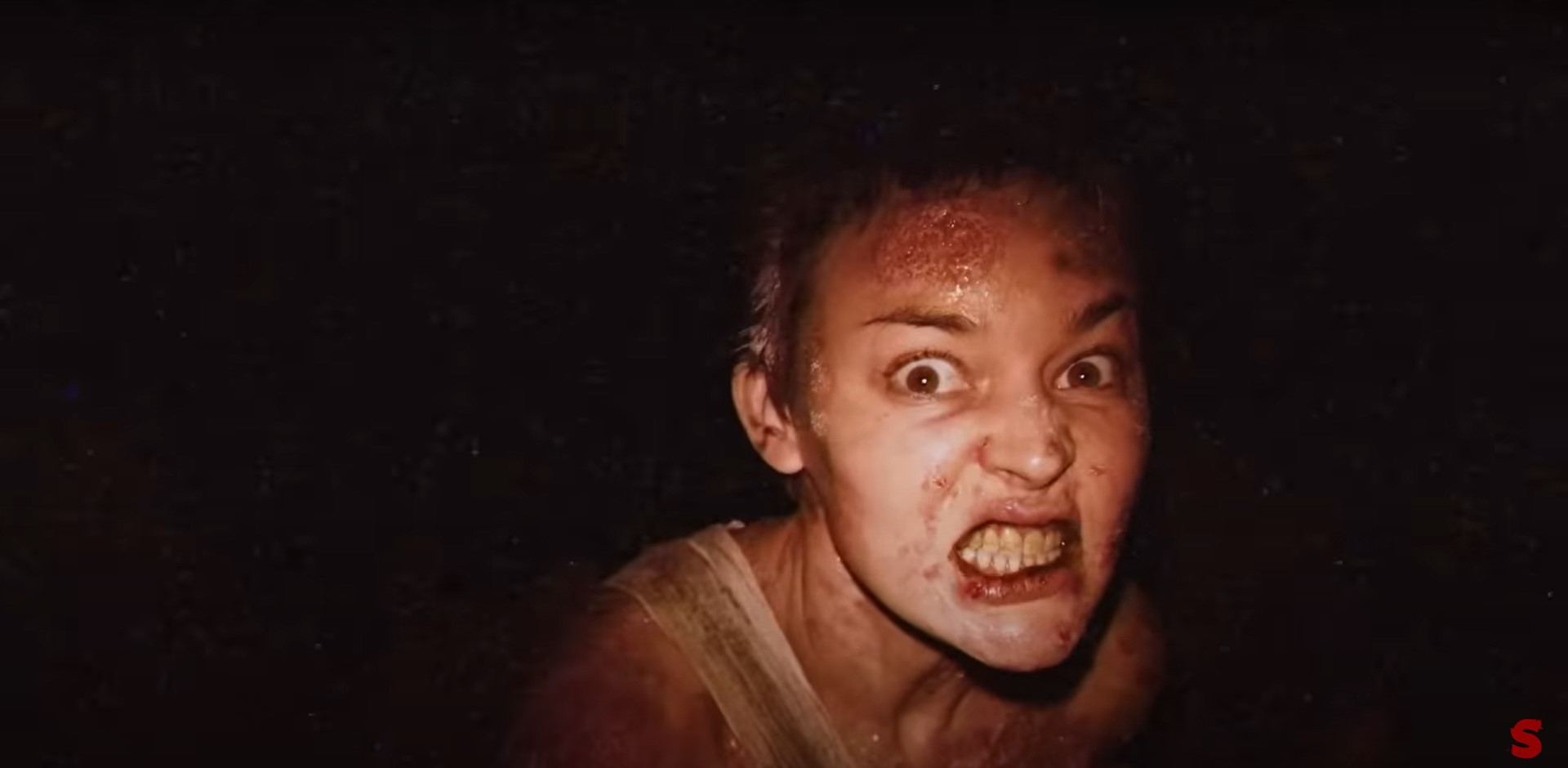
The year:  1999.  The format:  VHS.  The theme:  The most horrifying experiences caught on found footage camera.  A horror anthology for the turn of the century puts together five of the most terror-drenched short films that resurrects the punk-rock dead, turns urban legends into vindictive playthings, televises Lovecraftian game show frights, peers into the stone-cold eyes of a Gorgon neighbor, and goes to Hell and back!  All caught on camera from a first-person view as VHS vicariously relives the glory days through a digital world, capsulated by the horror realm and all its fanatical acolytes for the analogue video format to live undead forever. 

Living in the age of a VHS comeback is admittedly kind of weird.  VHS has become a hot collectible, especially and obvious the rate and obscure that mostly resides in the horror and cult genre.  Most recently, a discovery on a Brazilian VHS cut of Jaws 2 has a couple of minutes of shot footage that no other release holds to this day.  That, being just one example, is sought after power of VHS that saw various versions of one film be disperse far and wide across continents, which the same could be said about DVD that too saw a variety of different cuts due to the diversity of playback formats, distribute cuts, and numerous levels of censorship between countries.  VHS is also making a comeback in format style with gritty, faded, flat colored image veneer and tracking lines and the absent transmission signal of snow statically adorning the screen with beautifully hypnotical and flickering white dots.  So, it’s now surprise that on the heels of 2021’s “V/H/S/94,” another analog anthology is greenlit in 94’s wake with “V/H/S/99” for 2022, written and helmed by newcomers to the series but not necessarily newcomers to the horror scene.  The movie’s sequential lineup Is as follows:  Short filmmaker Maggie Levin writes-and-directors “Shredding,” taking a break from killer sharks is Johannes Roberts to oversee his “Suicide Bid” entry, musician Flying Lotus directs and co-writes with Zoe Cooper with “Ozzy’s Dungeon,” “Tragedy Girls’” director Tyler Macintyre writes-directs “The Gawkers” along with co-writer and fellow “Tragedy Girls’” screenwriter Chris Lee Hill, and the husband and wife tag team of Joseph and Vanessa Winter, filmmakers of “Deadstream,” helms-and-pens “To Hell And Back.”  The Shudder exclusive series latest is produced by Josh Goldbloom (“V/H/S/94”), David Bruckner (director of “Hellraiser” ‘22), Chad Villella (producer of the of 2022’s “Scream”), Bloody Disgusting’s Brad Miska, and “Scream” ’22 and “Scream VI” director Matt Bettinelli-Olpin under the production banner of Studio 71 and presented by Cinepocalypse Productions and Bloody Disgusting.

A new set of five tales of analog rendered terror invoke a new set of actors in each short film that carrier with them a broad range of experience. While a couple of the stories shred the narrative with hectic editing (I’m looking at you “Shredding”), performances throughout come over with blistering consternation and definitely a late 90’s grunge attitude with “Shredding” and “The Gawkers” delivering the full blunt force of period, heckling away in their baggy clothing, bohemian hairstyles, and a penchant for skateboard thrashing. The other films are merely timeless with only mere mentions of date, or their timestamped on the video tape recording, or are just a thematical proverbial nod to the specific point in time, lacking the keep it real essence that is quite idiosyncratic to the hop from a phasing out decade and into a whole new other. The cast of these shorts play their roles with exuberance and wackiness, which if you have lived in or can look back to the converging decades/millennium and see some of the gameshows or cultural shenanigans that defined America as people or, if you want to go smaller, just the pop culture, wacky is a pinpoint descriptor. The short films’ of “V/H/S/99” are comprised of a cast including, selectively, Steven Ogg (“The Walking Dead”), Ally Ioannides (“Synchronic”), Keanush Tafreshi, Jesse LaTourette (“There’s Someone In Your House”), Dashiell Derrickson, Isabelle Hahn, Sonya Eddy (“Blast”), Emily Sweet (“Castle Freak” ’20), Melanie Stone (“Deadstream”), Archelaus Crisanto, Luke Mullen, and Ethan Pogue.

Anthologies have been around for decades and are a great medium to showcase a multitude of individual storytelling from a variety of filmmakers walking different paths in life.  Fans can often salivate over these types of jump-the-shark formats that can start off with the zombie undead, transition 10 minutes later into a supernatural spooky, and then segue into a creature feature with a wraparound bonus story that may or may not connect them all and squeeze each episodic terror vision in a full-length feature runtime.  Though I enjoy a good collection of short and sheer frightful films, anthologies are not my cup of sanguinary tea.  Hopefully, no partisan takes seep out of this review as I attempt to examine “V/H/S/99” objectively.  Out of the five segments, three have landed strong with a right amount combination of style, gore, performance, narrative logic, and, of course, terror, and if you like comedic sugar in your black cup of horror then “To Hell And Back” is a perfect Venti-sized, well-blended mulatto of choice that thrusts two dimwitted demonic ritual documentarians into the pits of dark, gloomy, and malformed creature Hell and fight their way back to their own plane of existence.  Though one flaw some make catch when watching the caboose film of the anthology is that it doesn’t particularly reflect 1999 other than the small caveat, which is pivotal to the story, that at the turn of the millennia is when the veil between our world and Hell is as it’s thinnest.  The other two better entries capture more infinitesimally in detail of the late 90s, early 2000s clothing and discourse.  “The Gawkers” taps hard into the weird aggressive hormones of a teenage boy while exploring the newfound ways to use technology as spyware.   Webcams aboard big boxy desktops chauffeur in a whole new way to be creepy that lands them in hot water not by the law but by the wrath of ancient femme fatale of Greek mythology.  Johannes Roberts rounds out the better half with a sorority haze gone wrong that evokes an urban legend to become more than just a story and Roberts “Suicide Bid” offers, again, that period presence that feels like a tribute throwback to the 1998 “Urban Legend” film itself, but adds a supernatural surprise that utterly creepy and not as deep with only 6 feet underground rather than a 47 meters down, the director is slowing raising his fear to the surface.  The shorts left hanging below the bar are “Shredding” and “Ozzy’s Dungeon” and for reasons that have to do with their style and story. “Shredding” promising premise is plagued not by punk phantasms back from the dead but simply pilfered of focus with a hectic, if not severely chaotic, VHS-graded editing scheme that shocks the perception senses while “Ozzy’s Dungeon” is inspired by Nickelodeon’s Legends of the Hidden Temple gameshow where kids have to compete in toned down ancient society games to race up the temple to win the big prize. “Ozzy’s Dungeon” definitely is weird, sadistic, and Lovecraftian-inspired for sure but its story design loses motivation and often cheats rounding the bases in order to reach the shocking climatic finale.

Acorn Media International brings tape to the United Kingdom with a Blu-ray home entertainment release of “V/H/S/99.” Presented in a widescreen 1.78:1 aspect ratio, though doesn’t cater to the standard 4:3 ratio of video tape, the provided image quality purposefully varies to give audiences the titular analog experience. Faded grading, tracking lines, static and that jittery playback is all part of the visual environmental experience and even a few of the filmmakers shoot the film digitally to then run it through VHS to garnish with unnatural base video turbulence. The English DTS-HD 5.1 surround sound mix heightens the exposure and familiarity to of being that person behind the camera as all of these shorts of short POV. Intense and, often, cacophonous, the audio tracks still manage to level out, be discerned, and manage to relay the chaos no matter how much bedlam is thrown at the screen. From the zoom in-and-outs of the video tape recorder, there’s a clean sense of depth and the range is bountiful as the ambient track runs the gamut of omnifarious sounds that give each episode an individualized stamp. English SHD is optional. Bonus content includes an exclusive panel from New York’s Comic Con with guests producer Josh Goldbloom, “The Gawkers'” Tyler Macintyre, and “To Hell And Back’s” Joseph and Vanessa Winter as well as a total arc gag reel. After that encompassing project feature, the girth of the bonus content breaks down into the individual shorts with “Shredding” having a deleted scene and the complete fictious band BitchCat music video, “Ozzy Dungeon” has two deleted scenes, “The Gawkers” has a deleted scene as well as bloopers, camera tests, and The Making of Medusa, and “To Hell And Back” rounds out the features with a hefty look at the raw footage, scouted location, and a storyboard and blocking rehearsals. There are no bonus features for Johannes Roberts’ “Suicide Bid.” Physical features include a slightly thicker traditional Blu-ray snapper, a Europe standard, with a cover art that matches the North American RLJE release, a city being loomed over by skull made out of colorful galactic stars and a pair of video lenses for blank eyes. The disc art is pressed with the same front cover image. Though no mention of a region playback on the back cover, I suspect a region B encoded release as per usual with Acorn Media Interntional. “V/H/S/99” has a total runtime of 109 minutes and is UK certified 18 for strong blood violence/gore. “V/H/S/99” is not my kind of off the heasy subgenre, but the latest series anthology packs a punch and I would never discourage anyone from not experiencing firsthand an homage trip through terror.

Found Footage is all the 90’s Craze These Days! “V/H/S/99” Available at Amazon!

Fresh-Water Fatalities of the EVIL Female Kind! “Piranha Women” reviewed! (Full Moon Features / Blu-ray)

Awesome Cover for “Piranha Women!”  Check Out the Reversible Cover Art by Purchasing Your Copy Today!  Click Below.

At the seaside dive bar of Antonio Bay, flesh hungry creatures dressed in high heels and lowcut blouses circle around unsuspecting male prey gawking into their female gaze and their female bosoms.  Lured back to the woman’s indoor pool lair, the lured men are nibbled-to-death with tiny, sharp teeth bred by a science gone mad.  The normal, everyday guy Richard understands the dangers of his coining of the Piranha Women all too well as his cancer-stricken girlfriend desperately enrolls in an experiment drug program led by a Dr. Sinclair who binds the magically healing properties of the Piranha chromosome to his patients to build a sexy, sharp-teethed army.  With his colleague dead after being enticed by one of the beautiful and fish-spliced femme fatales and his girlfriend disappearing soon after seeing Dr. Sinclair, Richard must evade the murder suspicions from the police and battle through a pair of sexually aggressive, bikini-cladded chompers to save his endangered girlfriend from becoming one of the Piranha Women!

From the bizarre brain of Charles Band, who delivered devilishly cult pictures like “Puppet Master” and “Trancers” under the Full Moon empire for 40 years (if you’re counting Band’s defunct Empire Pictures) , and from the eccentric and erotica-charged touch of Fred Olen Ray, the writer-director of “Evil Toons” and “Hollywood Chainsaw Hookers”, comes the next freeform and fishy Full Moon feature, “Piranha Women.”  The 2022 film has all the assurances of a contemporary Full Moon production with a slapdash story structure, a handful of willing women to go topless, a hale and hearty use of a familiar carnivalesque score, and, of course, blood and lots of it, discharged by freaks and fiends of mad science.  Charles Band produces the venture, alongside associate producer, the former Playboy model and under-the-radar scream queen, Cody Renee Cameron, with Fred Olen Rey having penned the script treatment and sitting in the director’s chair.

For to recognize any of the “Piranha Women” cast, one would need reach down to the far depts of the fish tank where the bottom feeders roam.  Now, I’m not stating that performances are poor but to call the principals household names at any caliber level in film.  If you’ve established a residing foot on the internet, like me, or maybe have a photogenic keen eye, “Piranha Women’s” slender cast might blip on your brain’s recollection radar.  For instance, Bobby Quinn Rice, the story’s male lead trying to save his girlfriend Lexi (Sof Puchley, “Gatham”) from the clutches of killer fish with hot bods, had swimmingly integrated into the web series Star Trek universe in multiple series.  The “Super Shark” finds a solid lead performance in the adulthood reasonable and morally incorruptible Richard in what is Rice and Olen Ray’s fifth collaboration together as actor and director. If you’re not a Trekkie and have a more salacious sense of knowledge, the two actresses playing the genetically spliced, serrated teeth villainesses are former Playboy models in Keep Chambers and Carrie Overgaard and, yes, they do show plenty of skin if you were wondering.  Chambers debuts herself as an actress with a tight curve on how to hook men to their death with an extremely attractive lure while Overgaard’s off-and-on working relationship with producer Cory Renee Cameron scores the Michigan native a Los Angeles shoot, her first dive into the horror genre.  Chambers and Overgaard do as well as expected in roles where their nipples morph into bite-sized piranha teeth in conjunction with their mouths also modulating into larger razor teeth.  In all honesty, the film could have benefited for more nipple dentata carnage much the same way vagina-dentata did for Mitchell Lichtenstein “Teeth.” “Piranha Women” fills the cast pool with B-movie actors Jon Briddell (“Hot Wax Zombies on Wheels”), Richard Gabai (“Demon Wind”), Michael Gaglio (“College Coeds vs. Zombie Housewives”), Nathaniel Moore, Jonathan Nation (“Mega Piranha”), Houston Rhines (“Angels Fallen”), and Shary Nassimi as the fishy Dr. Sinclair.

Sharks, the apex predators of the ocean, may have their own patented subgenre with Sharksploitation, but Piranha are predominately pack hunters also hungry from meat and deserve their own categorical moniker (perhaps Piranhasploitation?) as these little carnivorous creatures will eat a little of your flesh one morsel at a time until the masticated body looks like chewed bubblegum. Joe Dante knew this with his Roger Corman cult classic “Piranha” and even The Asylum gets into the action with their “Mega Piranha” schlocker. Fred Olen Ray, who once raised his own personal piranha fish, takes a stab at a new angle involving our rather ravenous ankle biters by not making them the main antagonists of the story. In fact, the fish itself is not the villain as “The Attack of the 60 Foot Centerfolds” and “Bikini Jones and the Temple of Eros” filmmaker splices female erotic genome into the fold with body horror elements. The science behind the genetic sequence isn’t necessarily important, as Dr. Sinclar mentions in the film, it’s all little complicated, but there’s a lackadaisical air with the barebones narrative. With a film titled “Piranha Women”, we’re not looking for Academy Award substance or an auteur aiming to reach the depths of our soul with a powerfully visceral, visual tale and there’s a genre fan understanding in what to expect from Film Moon Features and director Fred Olen Ray, but after being pleasantly surprised with Full Moon’s more contemporary projects, like “Don’t Let Her In” and “Baby Oopsie,” I found “Piranha Women” falling apart at the seams. Pivotal scenes of transformation of the desperate, ill-stricken women at the hands of Dr. Sinclair are boiled down to one moment their normal, the next their nips have gnashing nibblers. Plus, and I know I’m asking a stupid question in relation to the director, but why is Dr. Sinclair only genetically modifying beautiful women? And why are the women enacting siren ways by only seducing men? Perhaps men are easy prey when against a hot, female bod but isn’t meat meat? The climatic ending is the weakest link of the entire chain as Richard searches out his beloved Lexi at the “Piranha Womens'” indoor pool lair only to become with the last of the piranha mutants. Richard’s weapon? Ethylene glycol. Yup, antifreeze in the pool water kills piranha and before his showdown with the shifty seductress, he unloads a quart into a fairly large pool, which in my opinion would be diluted to the point of non-affect, but when the piranha woman hits the water, apparently antifreeze electrocutes piranhas and, apparently, for a brief glimpse, the bolts of voltage unveil their monstrous, animalistic side of a humanoid piranha. There’s also another instance of rain melting another creature and, again, the pieces of the puzzle of how this is happening isn’t adding up. A flat, crestfallen ending nearly drowns its interestingly ludicrous premise into forgotten oblivion as the lasting episodic memory continues to battle for legacy between a plunged ending of perplexity and the sharp-teethed piranha women with sharp-teethed areolas.

Piranhasploitation might be an insignificant right now, but the pygmy pack hunters are fiercely swimming upstream to be a household name in terror as Full Moon Features adds their entry “Piranha Women” to the exclusive ranks. Full Moon’s AVC encoded, 1080p, high-definition Blu-ray is presented in a widescreen 1.78:1 aspect ratio. This particular release has strayed from Full Moon’s indiscriminate use of dark and gloomy lighting gels, tints, and high contrast shadow work that heighten the horror tone for a more natural lit preserve that has become baselessly bland. Compression looks pretty good as I wasn’t catching major instances of banding or artefact blocking but there are softer details around skin textures. However, pixel resolution frequently waves up and down from mid-teens to low-30ss because of the interlaced composite shots with the Antonio Bay dive bar or the floor-to-ceiling piranha tank when layered with characters. The release defaults to an English Dolby Digital 2.0 Stereo but there is an English Dolby Digital 5.0 mix option that’ll you’ll have to toggle to during the feature. Both mixes are clean and clear with the surround sound option providing a slightly plusher but not by much more. No subtitles are available. More so with the post-production itself rather than issues with the Blu-ray is the stock ambient background noise doesn’t overpower the dialogue at all but is unfitting, especially when we only see a small cast in the scene but can hear a bustling office or bar. There is even one moment where the background clamor completely cuts out for an important part of the conversation and then never comes back despite being in the same room. Other ambience including poured drinks, popped corks, and high-heeled footsteps is right up front with the dialogue at times. Bonus features include a behind-the-scenes with one-sided discussions by the principal cast and director Fred Olen Ray as well as other Full Moon trailers that not only included “Piranha Women” but also “The Resonator,” “Baby Oopsie,” “Don’t Let Her In,” Evil Bong 888 – Infinity High,” “Weedjies: Halloweed Night,” and “The Gingerweed Man.” The physical features include a snazzy illustrated cover art of one of the piranha women with teeth bared, ready to bite; however, the release includes reversible cover art that reveals more of same said posed piranha women in a NSFW option which is a far better display cover for the standard Blu-ray snapper. As mentioned before, “Piranha Women’s” ending drops steep like going off over the Mariana Trench shelf and part of that reason might be the film’s 58-minute, under an hour, runtime which some will not consider a full-length feature that comes unrated and region free. Plenty to like about Fred Olen Ray’s “Piranha Women,” but there is equally plenty to dislike too with the absurd take on the raptorial fish’s transgenic titty-twisting body horror.

Awesome Cover for “Piranha Women!”  Check Out the Reversible Cover Art by Purchasing Your Copy Today!  Click Below.

Never Tour Mistakenly into an EVIL Murder Bar! “La Petite Mort” reviewed! (Unearthed Films / Blu-ray)

“La Petite Mort” is Orgasmically Gory and on Blu-ray!

Vacationing to Mallorca should have been a relaxing getaway for Simon, his blind girlfriend Nina, and their longtime friend, Dodo, but their flight layover in Frankfurt leaves down idle town to explore the city that’s only a mere two hours from home. Tension between them begin to bubble to the surface when uncertain emotional steps to take relationships to the next level arise and they become inadvertently scammed by a local grifter. Exhaustion sets in and forces them to take refuge in a local dive bar with a specialty for S&M play. The bar is actually a front for the Maison de la Petite Mort, an underground snuff house owned a sadistic woman named Maman who livestreams kink-murders and sells hapless victims to wealthy businessmen with whimsical and perverse deviancies. The flight to Mallorca will be indefinitely delayed as the three friends are now a part of the bloody basement decor awaiting the horrors before them.

“La Petite Mort,” translated from French as literally the little death, is also known as the post-orgasmic sensation, such as a weakness or loss of conscious, that serves as an analogy to death. The phrase is also the title of the 2009 torture-gore film written-and-directed by the German-born Marcel Walz more than a decade before the formation of his now Neon Noir production company. Walz, who later in his career went on to remake the Herschel Gordon Lewis 1963 film, “Blood Feast,” blossoms as a torture porn filmmaker as Walz’s directorial catalogue contains more blood than a blood bank and often stretches the subgenre range of plot machinations from cannibals to dark web to snuff. Made on a few thousand-dollar budget and shot in a real sex club in Mannheim, Germany, “La Petite Mort” touches upon all three plot devices to create a dungeon of splatter and sadism using elements of an unsolved true crime case of a couple gruesomely murdered in an underground murder house as the narrative base. Before Neon Noir, Walz and filmmaker Michael Effenberger, director of “Tortua,” formed Matador Films that became the company behind “La Petite Mort” with Thomas Buresch (“Unrated: The Movie”) and feature actor and director of photography, Andreas Pape (“Toxic Lullaby”) producing.

Films like “La Petite Mort” is a special breed not because of the torture and gore-porn element, which can be an acquired taste for consumers with dark thoughts, fantasies, and morbid curiosities (I fall into the latter category if you’re wondering), but rather the story caters to no singular principal lead nor does is the focus on an ensemble cast.  “La Petite Mort” transitions from one group, the naïve backpacking travelers, to the S&M snuff-makers in a flip-flop of point of view and storytelling.  All the relationship complexities between the out of concern love from Simon (Andreas Pape) to his even keeled blind girlfriend, Nina (Inés Zahmoul, “La Isla”) as well as the insignificant tiffs and spats between Simon and friend Dodo (Anna Habeck, “Popular”) to see who is in Nina’s favor are quickly swept aside when the trio is trapped and tethered to the S&M spider web of Maman’s Maison de la Petite Mort.  While the three travelers produce a mild interest spun out of frivolous dramatics to the like of the normal human population and very much up played by Walz for that very purpose to produce stark contrast against what’s normal for sadomastic pleasure-seekers, Maman, the orchestrator of pain and profit, is the most earnest of principals with a crone-like presence, played inexorably and ruthless by French punk-goth singer Manoush.  The certified gypsy and former bodybuilder has made a name for herself in a plethora of extreme, Germanic horror pictures over the last decade, but “La Petite Mort” came early in Manoush’s career and is exhibits why she’s so good at horror, especially at the sadism brand.  Maman’s schadenfreude business employs two lesbian dominatrixes, Dominique and Angélique, with strong-stomachs and a healthy bloodthirst.  The beautiful femme fatales serve Maman’s unquestionably, almost mindlessly, that only glimpses into possibilities of how the two women became betrothed to do Maman’s bidding.  Annika Strauss, who’s been in the screen queen business about as long as and has starred alongside with Manoush on a number of films, is also a Marcel Walz regular casted actress who fits and transforms into just about every character under the black sun of ghoulish and macabre material thrown her way.  As Dominique, Strauss is provided more depth to why and how the brunette basket case has come under Maman’s greedy and depraved thumb as the actress shows some slither of concern for the captives while explaining she had no choice just they like them and exhibiting more reserve than her blonde counterpart Angélique (Magdalèna Kalley, “Violent Shit 4”) when the cameras are rolling.  Conversations rooted into provocative thought, sympathy, or reason are often few and far in between the constant pleas for help and the screaming matches of pelting threats.  “La Petite Mort” finalizes the cast with Martin Hentschel (“Zombie Reanimation”), Tanja Karius (“Necronos”), and Thomas Kercmar (“Space Wolf”) as Klaus der Kobold, a Napoleon-sized elitist wealthy enough to buy people’s lives and enjoy seeing them horrifically mutilated.

One scene overwhelms the diagnostic side of my brain and that is why Maman is torturing Dodo with needles as Manoush delivers a surprising genuine villainous monologue about sadomasochists being judged by normal people and how her character has a liberated, uninhibited sexuality in a moment that is a powerful argument in favor for sadomasochism to exist without shame.  Thinking about this, I’m not aware of any publicized S&M clubs, especially those that aren’t criticized for being deviant, perverse, and secular.  After that one moment of vulnerability, “La Petite Mort” turns into a choke-down bloodbath with some great and some not-so-great special effects by one of Germany’s gore film greats, Olaf Ittenbach, director and F/X artist of “Premutos:  The Fallen Angel” and “Legion of the Dead.”  Ittenbach brings me to another overwhelming scene, one that churns the contents of your stomach, involving a meat grinder, a hand, and a chalice.   “La Petite Mort” has other notable grisly moments of scalping, castrating, eye-plucking, and disemboweling, all of which are in great gooey-gory detail.  What takes away from the gore scenes is Walz fluttering effect or grindhouse-esque edited framed overlay that, in my wildest guess, is supposed to enhance the extreme acts of violence, torture, and death in conjunction with composer Michael Donner’s industrial rumble and pulsing synth score. Instead, the effect becomes nothing more than a cinematic nuisance, an eyesore that dilutes Ittenbach’s best handywork because that scalping scene is the chef’s kiss of tactual realism. Based on a true story that I can’t seem to find any record of, “La Petite Mort,” for a brief few minutes, becomes a promulgating champion for alternate sexualities and is also a showcase for Olaf Ittenbach to shock and disgust but for what the feature is worth, “La Petite Mort” offers only emptiness in both character conviction and story narrative.

A fitting entry into the shockingly weird and grotesque “Unearthed Films'” independent film catalogue, “La Petite Mort” arrives onto a high definition, 1080p Blu-ray home video. Presented in a 2.35:1 widescreen aspect ratio, Walz bookends his callous-cladded cult film with a yellowish-tan tint while the girth of the story is laced with more gel coloring under no hinderance of tint. Low lighting with low contrast markers, mixed with tropical-warm gel coloring and strobe flashing fabricates the sunless and dank murder basement but any exterior shots, even the bookend act one and act three are rendered with poor resolution for digital recording. Only a single audio track is available with a German LPCM 2.0 with burned-in English subtitles and what’s rendered is likely the best quality to get from the masters from the lossy format. Dialogue is often unrefined, and the levels vary, but for the most part clean and free from obstruction. The track has limited ambience and harps heavily on the gory moments while Michael Donner’s dark industrial score takes the brunt of the overall soundtrack. Subtitle synchronization varies as well with millisecond flashes of translations that are impossible to read or even pause perfectly on, but the translations appear flawless and consolidated from the dialect for easy reading. The Unearthed Films’ bonus content is aplenty with a new commentary and interview with director Marcel Walz. Also included is a feature-length making of “La Petite Mort” with raw handheld camcorder footage, shot by The Bad Boy character in the film, behind-the-scenes footage, and even some 16mm footage that go reel deep into the effects and life of independent filmmakers. An archived interview with special effects artist Olaf Ittenbach, deleted scenes, photo gallery, teaser trailer, official trailer, “La Petite Mort 2” trailer, and the VHS intro that’s essentially a Marcel Walz introduction of the VHS home video release round out the bonus content. The physical attributes are a clear, Blu-ray snapper case with reversible cover art with the inside sleeve containing a more graphic torture not suited for retail shelves. The region A encoded, 77-minute feature is not rated. If invested for the kills, “La Petite Mort” pleases to overindulge the desire and is a solid first torture-porn effort from a then young Marcel Walz who continues to rise in the niche market.

“La Petite Mort” is Orgasmically Gory and on Blu-ray!