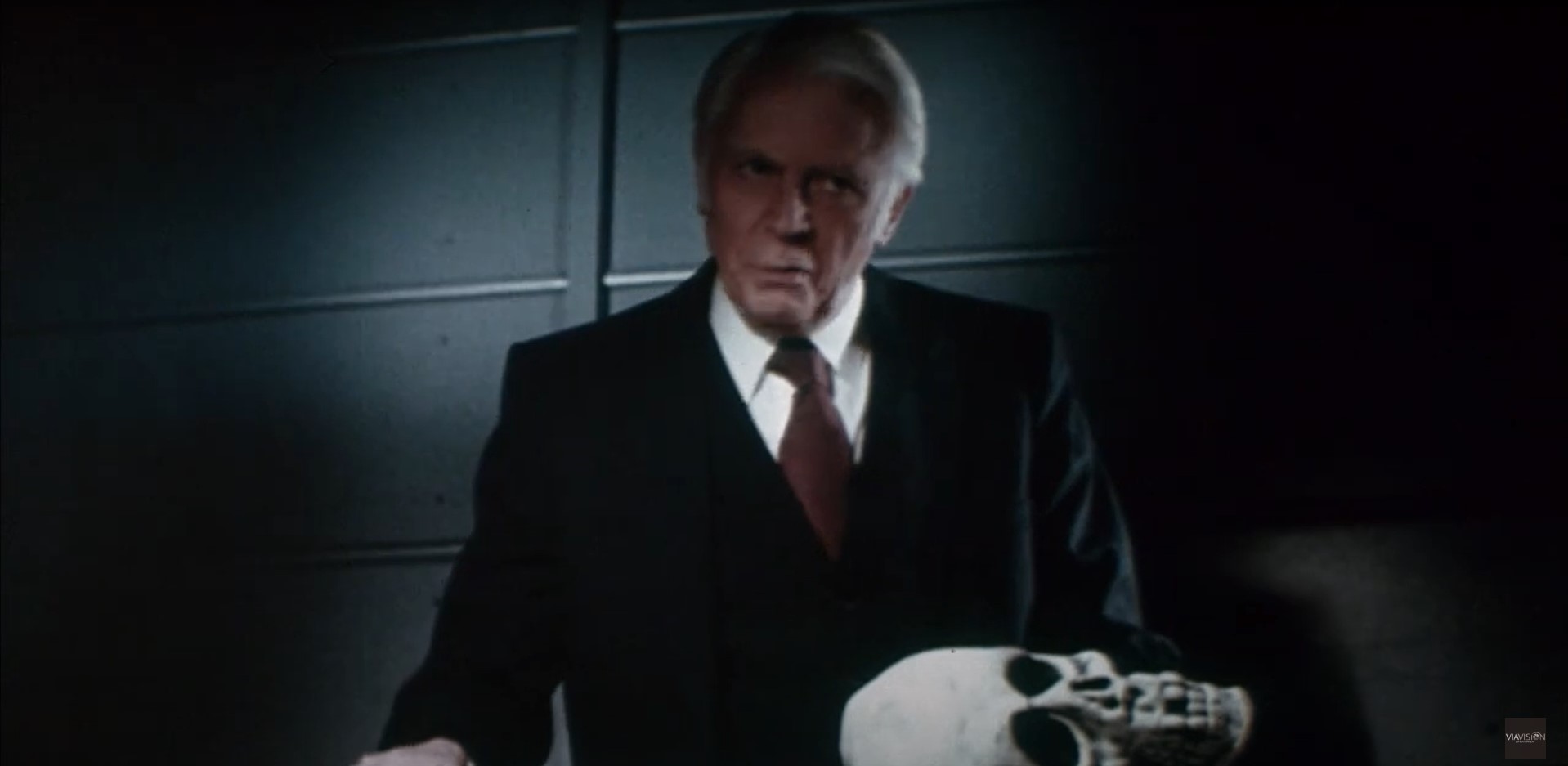
Classic Sequel Gets a Lenticularly EVIL! “Halloween II” reviewed! (Via Vision / Limited Edition Blu-ray)

“Halloween II” Limited Edition Blu-ray + 6 Photo Lobby Cards! Order here!

The horrific Halloween night massacre in Haddonfield where a masked escaped mental patient named Michael Myers murdered the close friends of Laurie Strode has not yet ended.  Hurt and in shock after narrowly escape Michael’s relentless pursuit, Laurie is rushed to Haddonfield Memorial Hospital to receive treatment from a skeleton shift while Dr. Loomis, who shot Michael six times, continues his hunt for the hard-to-catch, hard-to-kill killer.  Frantic about the evil inside his former patient, Dr. Loomis will not stop at nothing to track him down with police assistant and try to puzzle together just why Michael had returned to his hometown in the first place.  As Laurie recovers from her injuries and copes with her friends’ deaths, The Shape arrives at the hospital, continuing his emotionless killing spree of hospital staff in order to get to Laurie, and with nowhere to run, Laurie’s only hope is in the hands of a determined Dr. Loomis. 

Picking up where the highly successful independent horror, John Carpenter’s “Halloween,” that changed the slasher genre to what we know it as today, “Halloween II” provides more illumination on The Shape, Laurie, and shuts the door on the significant open-ended and fear-inducing mystery at the finale of Carpenter’s masterpiece.   The 1981 sequel, released three years after the first film, was not helmed by Carpenter whose success skyrocketed post-“Halloween.”  Instead, Carpenter and creative producer Debra Hill agreed to the executive producer title with some creative control in penning the script that would be a what-happens-immediately-next continuation with newcomer Rick Rosenthal sitting in the director’s chair.  The director who would helm later the follow year’s “Bad Boys” with Sean Penn had a goal to retain the same Carpenter stylistic choices to make the sequel seemingly seamless.  Alongside Carpenter and Hill in the melting pot of producers, the more narratively opinionated Moustapha Akkad and Dino De Laurentiis served as executive producers along with Joseph Wolf (“A Nightmare on Elm Street”) and Irwin Yablans (“Tourist Trap”) in what became a coproduction between Universal Studios and Dino De Laurentiis’s production company.

“Halloween” converted the then unknown Jamie Lee Curtis into a couple of things.  She instantly became a household name that at the same time also made Laurie Strode a household icon.  Curtis also became what was a relatively new coined term at the time of a scream queen, propelling her career in the horror genre with “Halloween” subsequent films such as “The Fog,” “Prom Night,” “Terror Train” and, of course, the more recent titular television series “Scream Queens” and the contemporary “Halloween” sequels.  What also emerged post Lee’s performance is the actress was eager for the role and effortless to work with making the 23-year-old daughter of Janet Leigh and Tony Curtis a treat to work with, malleable toward her role, and enthusiastic about returning as Laurie Strode for the sequel.  Curtis falls right back into the role as if filming didn’t stop rolling with Strode in a confounding state of shock and injury from her the relatively short scuffle with Michael Myers until Dr. Loomis intervenes with six gunshots into The Shape at the key and climatic moment, saving Strode from being strangled.  The difference in the sequel is Curtis’s instilled knowledge for her frightened character.  It’s that kind of touch that doesn’t hesitate to react to a force of evil.  Returning as Dr. Loomis, and again as if he never stopped performing as the paranoid and fervent good psychiatric doctor, is the iconic and late Donald Pleasence tracking down his former patient with trench coat sagacity, an understanding that no one else shares except for maybe Myers’ ultimate prey, Laurie Strode.  A new cast of relegated kill fodder magnifies part two’s grislier death count with Lance Guest (“Jaws: The Revenge”), Pamela Susan Shoop (“The One Man Jury”), Leo Rossi (“Maniac Cop 2”), Tawny Moyer (“Looker”), Ana Alicia (“Romero”), Gloria Gifford (“Virgin Paradise’), Hunter Von Leer (“Trancers III”), Cliff Emmich (“Hellhole”), Ford Rainey (“The Cellar”), and Dick Warlock putting on the mask as The Shape with Charles Cyphers and Nancy Stephens returning in their respective roles as Sheriff Brackett and Marion Chambers.

What new can be said about “Halloween II” that hasn’t been already said?  Dichotomously, “Halloween” and its sequel share a single narrative that emanates the same stylistic tone; however, both films couldn’t be more different in their surface level and underlying intentions and that gnaws raggedly on the connective tissue that binds them.  Carpenter’s original embraces the mystery enshrouding Michael Myers motivations with a merciless, yet nearly bloodless, killing spree of horny hopped-up teenagers who wiggle themselves out of responsibility for a little trick-or-treat fun under the sheets or for just being alone in their house.  Myers unneeded and unheeded explanation formed The Shape as evil personified, an incarnate force compelled to return home where the light switch was flipped to an expressionless compassion for human life.  Rosenthal’s part two subverted the unknown by providing Michael reason and that reason being Laurie Strode, anyone else who gets in his way, could foil his plans, or are just in the vicinity of the hunt are eliminated with extreme prejudice, and that leads into the ramped-up gore with large pools of blood and other gratuitous displays of damage to unsuspecting soon-to-be stiffs.  Despite the different strokes, the sequel is not bad by a longshot.  In fact, “Halloween II” is just an extension spiraling in intensity and terror, a product of its time when everyone and their brother had directed gore-ladened slashers during the steep beginnings of the slasher renaissance. 

Though a many number of “Halloween II” video media exists between the current formats, the collaboration of Via Vision and Lionsgate release from Australia is beyond reproach for any kind of transfer print woes, lackluster bonus features, and drab packaging.  The limited edition and numbered 2-Dsic Blu-ray set is a physical media thing of beauty with an AVC encoded, full high-definition 1080p, BD50 on both discs.  Disc one houses the theatrical cut of film, presented in a widescreen 2.35:1 aspect ratio, from pristine print, likely the original negative licensed through Universal Pictures for this very release, with the Via Vision caveat of every effort has been made to produce the highest quality on the back cover.  Not a single reason comes to mind on that statement being false as the Dean Cundey’s cinematography retains an undiluted facsimile of the original “Halloween,” represented here with phenomenally suitable contrast that can presumably hide Micheal Myers in every shadow and create the apprehension in every darkly lit scene with minimal key lighting in various, sometimes neon, shades of red, yellow, and white.  The 35mm film grain has a pleasant consistency of a low-to-medium low visual viscosity that never reaches levels of blotting out picture quality, presenting no issues with zoomed in images or any other touchup enhancements to note for that matter.  Perceptible details sanction The Shape’s tactile and weathered look of a rough night in Haddonfield.  Colorfully warranted scenes, such as the Nurse Alves on a gurney in the middle of a pool of her blood, are robust to display the carnage whereas other, more minimalistic approaches detail just enough for the imagination to take over.  Disc two contains the standard-definition, upscaled to 1080p, television cut of the film, presented in a made-for-TV 1.33:1 aspect ratio, that omits some of the gorier moments, suitable for broadcast viewers.  Audio options include two lossless English language selections with a DTS-HD Master Audio 5.1 and a DTS-HD Master Audio 2.0.  The audio codec distributes punchier ambiences of Myers’s rhythmic breathing through the mask, the jarring alert of a hospital room buzzer, and the impactful moments of Myers slamming his fist-loaded weapon into the skull, back, and….a pillow with the cringe-worthy associated crunch and thud.  No impediments on the dialogue track that’s free of crackling, hissing, and popping and is consistently prominent and mixed well within more chaotic, milieu-mania scenes, such as with the finale with hissing air tanks and scalpel swoops.  Optional English subtitles are available.  Special features are consolidated to the theatrical cut disc only with Shout Factory’s inaugurated 2012 documentaries – The Nightmare Isn’t Over:  The Making of Halloween II and Horror’s Hallowed Grounds:  The Locations of Halloween II – featuring cast and crew interviews with director Dean Cundey, Tommy Lee Wallace, Dick warlock, Leo Rossi, and more as well as visiting locations in a modern time with host Sean Clark, and two commentaries featuring director Rick Rosenthal and Leo Rossi in one and stunt man/The Shape Dick Warlock in the other.  There’s a brand new 2024 commentary with author Dustin McNeill, co-author of Taking Shape:  Developing Halloween from Script to Scream.  The encoded features round out with the alternate ending with more explanation on the fate of a certain left ambiguous character, deleted scenes, a theatrical trailer, TV and radio spots, and a still gallery.  What makes the Via Vision a limited, numbered set is the neat package and physical goodies inside.  The rigid lenticular cardboard sleeve of the skull pumpkin has eyes that follow you at every angle.  Inside is a slightly thicker Blu-ray Amaray casing with reversible cover art displaying notable stills from the feature.  The extra disc, disc 1 likely, is in a clear push-lock, page-turner disc holder.  Six photo lobby cards featuring stills from the movie come alongside the Blu-ray.  Via Vision’s release has a region B playback encoding, a runtime of 93 minutes on both cuts, and rated R.

Last Rites: Michael Myers has been slashing away in the cinema for nearly half a century and “Halloween II” has been a staple entry that, to this day, is a memorable fan-favorite in the grand scheme of most of the franchise’s sequels. Via Vision’s limited edition, lenticular Blu-ray packaging just sweetens the deal with a crystal clear and top-tier quality release worthy in any physical media collection.

“Halloween II” Limited Edition Blu-ray + 6 Photo Lobby Cards! Order here!

Headstrong EVIL Bedeviled by the Past and the Younger Generation. “Peacock” reviewed! (Indiepix Unlimited / Blu-ray)

“Peacock” on Indieflix Unlimited Blu-ray!

Unable to fit into The Foundation’s draconian conducts of an in-home professional caregiver, the organization decides to place Anna into the isolated home of Sarel Cilliers, a once prominent South African theologist aged into a feeble old man with prim and proper, religious convictions and living on the edge of a psychotic break.  Anna finds her hands are full with the demanding and stubborn Sarel and his almighty morality but his life’s work and past, strewn about his house as Sarel ceaselessly reopens boxes upon boxes of old files to study, draws in Anna as it strangely feels familiar to her as well as raising internal concerns about Sarel’s esteemed history.  The deeper she digs the more Anna falls into a psychosexual fixation that parallel and merge into Sarel’s own delusional state, soon the two share common afflictions of masked followers and surreal, terrifying imagery of a subjugated past that hasn’t loosened its traumatizing grip on them yet.

A psychological thriller that aims to suppress and shame youthful desire while simultaneously manifesting guilt as ghosts from an older generation’s sordid past at the behest of righteous expectations and a patriarchal society, “Peacock” is a strangely transfixing mental and sexual tug-a-war horror-thriller full of emblematic evocations and provocations from director Jaco Minaar.  Minaar’s debut 2022 feature film, under the native title of “Pou” from South Africa, is cowritten alongside David Cornwell in what has become the duo’s third collaborative project and is the first South African film to employ an intimacy coordinator for the strong sexual content scenes crucial to Anna’s storyline as well as perhaps a few bathing scenes with the older Sarel.  The Gothically-charged horror is a financial production of The Ergo Company with the organization’s Dumi Gumbi and Catharina Weinek, who produced “The Tokoloshe,” serving as co-producers alongside David Cornwell. Fever Dream Pictures, Monolith Film, and Indigenous Film Distribution are co-productions of the picture.

The principal pair of Anna and Sarel, played by South Africa Television actress, “Dam’s” Tarryn Wyngaard, and longtime actor Johan Botha, are representational characters in numerous ways.  Sarel is the established, iron-fisted patriarchy of yore having come to the end of his rope in life with his past transgressions, ones that represent heavily in the socio-political air of South Africa in decades ago, finally catching up to him in the form of a sort of indeterminable dementia.  Anna, on the other hand, is symbolic of youth, desire, and itching for liberty from a repressive system, such as The Foundation that houses young women, supposedly orphans, to be raised subservient and attentive but Anna’s regarded taboo lifestyle clashes with The Foundation’s, as well as the theologian Sarel’s, archaic belief system and so Anna then goes on this obstacle-laden journey of self-discovery that’s historically painful as well as excitingly new on the horizon as she meets Jean Basson (Ruan Wessels), son of Sarel’s house call doctor (Alida Theron), and whom both are virtually a mirror of Anna and Sarel on a lesser intense level.  Wyngaard and Botha earnestly stand firm as individualistic, idealistic characters butting heads to a culminating point of surreal transition of power.  Liza Van Deventer and Nicola Hanekom costar. 

“Peacock” isn’t a knock-your-socks off, popcorn thriller with edge of your seat terror and special effects nor does it claim to be.  Instead, “Peacock’s” fable tale is fashioned delicately out of South Africa’s rough transitioning between conflicting oppositions from, and set as the period in the film, of the 1980s dealing with Apartheid.  From Anna’s atypical of the times perspective, as an outcast young woman growing and maturing in an era in which the old, patriarchal ways of doing things are quickly dwindling, much like the deteriorating mind of Sarel, the young woman tussles externally and internally in trying to conform to the brittle status quo while that’s not subsiding without a fight, yet the desires inside of her are eager to express themselves in a sexual way.  The contrasting phasing out rigidity and the phasing in tolerance courses through a single conduit of uneasy, shared surrealism that frightening and confusing to them both but affects them differently; the ghastly images forces Anna to face her past while those same images torment Sarel like a type of Hell he has to relive over-and-over and that is what the house represents to Sarel, being caged in a purgatory state that parallels the actual peacock living encaged and screeching just outside of the house.  The peacock itself embodies Sarel’s daughter, an image kindred to that of Anne’s illicit lover at The Foundation, who he locked away in the attic for having an improper relationship with a young, black man, an archaic and unfounded taboo from South Afrikaners shamefully stubborn history of the racially segregating Apartheid akin to the historical racism of American culture.  In the end, it’s the overwhelming guilt that plagues us all in “Peacock’s” thematical version of Hell.

Streaming service Indiepix Unlimited is slowly, but surely, releasing their repertoire onto physical media venue.  Granted, these DVD and Blu-ray releases are not top-notch quality, being mostly encoded onto DVD-R and BD-R with very little special features to accompany, but still better suited for viewing than the inconsistent determinants of steaming. The AVC encoded, high-definition 1080p, 25 gigabyte BD-R has sufficient storage to render a decently detailed feature that suffers little-to-no compression issues, presented in a widescreen 1.78:1 aspect ratio. Graded on a darker, bluer scale, “Peacock” does often have color reduction aspects that either is part of the story’s period approach or is a reproachable side effect of the writable disc, losing a richness to the black levels and leaning slightly more on a higher contrast. Details, too, appear smoother to a lesser degree but there are enough texture and tactile elements, such as the cracked leather of dusty old books, Sarel’s haggard and loosely wrinkled skin, or Anna’s striking dark features, to become swirled into its morose mixture of metaphors and surreal horror cerebralism. The Afrikaans language LPCM stereo 2.0 has lossless appeal that fills in the dual channel output quite substantially and with equipoise. Finding depth in a psychological thriller can be a tad be tricky to isolate the terrorizing trepidation trimmings of what’s beleaguering the mind and that can subdue the intended effect on the viewers. Dialogue is strongly delivered in the foreground of all other audio layers with the optional English subtitles available. The English subtitles are of European English translation and are without grammatical error; however, the pacing is at a breakneck speed. Other than the film’s theatrical trailer, the region A encoded, not rated, 89-minute Indiepix Unlimited release does not contain any bonus content. The traditional Blu-ray Amaray houses a lifeless in a monochrome-purple colored print out of Anna and a peacock feather over her eye. Inside is an advert of Peacock with a QR code and a disc pressed with a plain white circular sticker with the title in a font close to American Horror Story.

Last Rites: Noted having inspiration from Francisco Goya’s Black Paintings, the soul-swallowing torment of “Peacock’s” sundering, secluding visuals plays into the deteriorating psyche of forced solitude and the iniquitous guilt that eats away at our being, like an inhabiting demon, recognized in redux of South African sins that sees a trial by fire with a turning in the country’s tide.

“Peacock” on Indieflix Unlimited Blu-ray!

Psychological and Psychotic EVIL Descend Upon a High School Boy! “Butcher, Baker, Nightmare Maker” reviewed! (Severin Films / 2-Disc 4K UHD and Blu-ray)

The 2-Disc UHD and Blu-ray Available for Pre-Order. Due to Release 5/28!

Orphaned Billy Lynch has raised by his Aunt Cheryl after his parents are tragically killed in a motor vehicle accident.  On the verge of his 17th birthday, Billy is ready to move on from his old life living under the overly caring Aunt to building a relationship with girlfriend Julia and possibly moving to Denver on a basketball scholarship, but the threatened Aunt Cheryl will do anything to keep Billy home, even if that means murder.  A brutal, stabbing incident of a local television repair man in their home leads to Detective Joe Carlson to suspect Billy as the main culprit and begins digging into the young man’s life that, coincidently, unearths the dead repair man had a homosexual relationship with Billy’s basketball coach.  Bigotry and intimidate course through Detective Carlson being as he prejudicially hounds and interrogatingly paints Billy as a gay, jealous lover without an ounce of hesitation.  Between his crazy Aunt and an intolerant cop, Billy’s life spirals dangerously out of his control. 

‘Butcher, Baker, Nightmare Maker,” also known as “Momma’s Boy,” “Night Warning,” or just “Nightmare Maker,” is the 1981 queer awareness and maturing suppression horror-thriller from “Bewitched” TV-series director William Asher.  Trying his hand at an edgier storyline with plenty of graphic violence and subversive themes, Asher helms the picture working off a script by a trio of debuting writers in Steven Breimer, Alan Jay Glueckman (“The Fear Inside”), and Boon Collins (“The Abducted”).  The American-made production brought considered taboo topics to the table when homosexuality was becoming more prominent in American culture in light of the AIDs epidemic and while the sexually transmitted disease has no part in this story, the derogatory fear of same-sex coupling is mercilessly present.  “Butcher, Baker, Nightmare Maker” is a Royal American Pictures production, distributed theatrically under Comworld Pictures, and is produced by screenwriter Steve Breimer and “Class of 1999” producer Eugene Mazzola.

Hardly does any film ever made have the perfect cast.  “Butcher, Baker, Nightmare Maker” does not reside in that genus of imperfection.  Every performance is spot on and fitting for this early 80’s video nasty, each actor playing the singular part ingrained into their act that deciphering if their behavior is actually like that in real life can be tremendously difficult and a completely disorienting.  The story focuses on Jimmy McNichol’s 17-year-old high schooler Billy Lynch who, until recently, has been living moderately comfortable under his Aunt Cheryl’s roof.  That is until school sis nearly over and the prospect of college and girls sows the seeds of springing him from his childhood home.  Though the story is supposed to be centrically Billy Lynch, it’s the quirky and unusuality of Susan Tyrrell as the undefined obsessed Aunt Cheryl with a thick undertone of sexual tension toward her nephew that just makes McNichol and Tyrrell’s scenes enormously uncomfortable.  The late actress, who starred in Richard Elfman’s “Forbidden Zone” and would later have roles in “Flesh+Blood” and “From a Whisper to a Scream,” could charm audiences with perky provocativeness and scare into submission with the ability to pivot to a crazed madwoman.  And while we’re slightly turned on and also frightened by Tyrrell, we’re completely in disgust of “The Delta Force’s” Bo Svenson’s one-train-thought, homophobic detective strongarming high school teens, coaches, and even his sergeant (Britt Leach, “Weird Science”) into being cocksure of his own short-sighted homicide theory driven by hate for homosexuality.  Marcia Lewis (“The Ice Pirates”), Steve Eastin (“Killers of the Flower Moon”), Julia Duffy (“Camp X-Ray”), and before he was a big superstar, a young Bill Paxton (“Aliens,” “Predator 2”) bring up the supporting cast rear.

For an early 80s video nasty, “Butcher, Baker, Nightmare Maker” is without a doubt intense and provocative with timeless themes that nearly table the trenchant violence for corrosive mental issues, systematic homophobia, and pressures of maturity.  The two prong antagonistic sides bear down on Billy Lynch and the one principal who still technically a child and learning all the facets of adulthood has his own good being thwarted by conventional adult role models of family and law enforcement.  Director William Asher, through the script, inlays a pro-queer avenue where the gay basketball coach displays immensely more wit, sense, and compassion than that of Aunt Cheryl and Detective Carlson, awarding the coach with more likeability and favor to come out of this ugly business unscathed.  Asher’s very intent on defining the personalities and the actors deliver tenfold under a surly environment of not only the brusque characters but also Cheryl’s home that is a tomb for one of Aunt Cheryl’s past lovers and is becoming a tomb for Billy who will either bend to Aunt Cheryl’s sexually-toned obsessiveness or die a terrible a death.  “Butcher, Baker, Nightmare Maker” also predates the infamous “Final Destination 2” log truck scene with its own that’s equally hard hitting and macabre, the latter also being expressed thoroughly throughout the entire narrative with a morose overhang that’s simmering to explode. 

Arriving onto a 2-disc UHD and Blu-ray set, “Butcher, Bake, Nightmare” is Severin’s latest title to go ultra-high definition, first for the William Asher film, with an HVEC encoded, 2160p 4K resolution, BD100 and an AVC encoded, 1080p high definition, BD50 for the Blu-ray.  Presented in an anamorphic widescreen 1.85:1 aspect ratio, “Butcher, Baker, Nightmare Maker” favors a stark and naturally vibrant color scheme with low profile compression issues on a pristine transfer, scanned in 4K from the original camera negative.  I could not detect any compression artefacts with the dark spots retaining their inky cohesion and the details retain superior depth in a slightly more saturated contrast of a healthy-looking, grain-appropriate picture quality, even elevated more definitively with the extra pixels.  The English uncompressed PCM mom track has lossless appeal with some foremostly faint dialogue hissing and crackling that’s more of given with age rather than a flaw in the mix.  The mix also doesn’t establish depth all too well with one channel doing all the heavy lifting, but the layers are well-balanced in proportional volume that make the audio composition effective and scary.  English subtitles are available. Encoded special features include 6 hours of content. On the UHD in lies three audio commentaries: one with star Jimmy McNichol, one with cowriters Steve Breimer and Alan Jay Glueckman, moderated by Mondo Digital’s Nathaniel Thompson, and the last one with co-producer and unit production manager Eugene Mazzola. The theatrical trailer cabooses the UHD special features. All of the above are also on the Blu-ray special features with additional content that includes a new interview with Bo Svenson Extreme Prejudice, a new interview with director of photography Robbie Greenberg Point and Shoot, a new interview with editor Ted Nicolaou (“Don’t Let Her In”) Family Dynamics, archival cast and crew interviews with Susan Tyrrell, Jimmy McNichol, Steve Eastin, make-up artist Allan A. Apone and producer Steve Breimer, and a TV spot as the cherry on top of some sweet special features. However plentiful and well-curated the special features are, my favorite attribute of this Severin release is the exterior with a dual-sided cardboard slipcover that has new illustrated compositional art and tactile features. Underneath, a reversable cover art featuring the film’s one-sheet poster art with a more Severin Film’s retro constructed “Nightmare Maker” arrangement that’s more red-blood heated. Inside does not contain any insert goodies or booklets and a disc on either side of the interior featuring the slipcase and black UHD Amaray case cover art. Both formats are region free, have a runtime of 93 minutes, and are not rated.

Last Rites: Seriously messed up on so many levels, if being a teenage boy isn’t pressurized enough right before manhood, becoming an adult can be arrantly deadly in this superbly packaged shocker “Butcher, Baker, Nightmare Maker” now on 4K UHD for the first time ever on May 28th!

The 2-Disc UHD and Blu-ray Available for Pre-Order. Due to Release 5/28!

Return Home to Discover Dad’s An EVIL SOB! “The Abandoned” reviewed! (Unearthed Films / Limited-Edition Blu-ray)

Don’t Be Left Behind. Get Your LE Blu-ray Copy of “The Abandoned” from Unearthed Films

Marie Jones never knew her parents.  Born in Russian, raised in the London, and now lives in the U.S., the low-budget movie producer receives news from a Russian estate notary providing her details on her murdered mother back in 1966 and her existence entitles her to the isolated family farm.  Unable to resist the urge to find out about her mysterious past, Marie travels to her parents’ dilapidated farm settled on an island encircled by a river.  There she meets Nicolai claiming to be her twin brother and that he also, after a similar call from the notary, felt pulled to their family home on the verge of their upcoming birthday, but they’re not totally alone.  Trapped on land that won’t allow them to leave, Marie and Nicolai run into their undead doppelgangers that impel them to dig into their family history and uncover the gruesome truth to what happened to their mother.  All the while, the house around them rewinds back in time before age and weather have taken a toll and the souls living in what was once a home return to bring the family back together again.

A past drawing near story stretching from 1966 and 2008, “The Abandoned” is a haunted house, supernatural, and circular tale that bears down a forlorn ancestry nightmare onto ensnared curious lineage wanderers, bringing them back into a vicious cycle of a family history that should have been left alone.  “Aftermath” and “Genesis” short film director Nacho Cerdá tries his hand at less necrophilia and gore for more daring, open-to-interpretation horror with the Karim Hussain (“Subconscious Cruelty”) original script with some rewrites and sprucing done by “Dust Devil” and “Hardware’s” Richard Stanley.  Filmed in Bulgaria to double as the scenic landscapes and to use the country’s looming, enveloping trees as another margining aspect of being trapped, “The Abandoned,” initially title as “The Bleeding Compass” on Hussain’s original script, is produced by Julio and Carlols Fernández, Kwesi Dickson, Stephen Margolis, and Alexander Metodiev under Castelao Producciones, Filmax International, and Filmstudio Bojana with Future Films’ Carola Ash and Albert Martinez Martin serving as associate producers.

“The Abandoned’s” modest budget regulates casting to, at that time, relative unknowns for the U.S. market but certainly not an experienced lot between English actress Anastasia Hille (“Snow White and the Huntsman,” “Martyrs Lane”) and Karel Roden (“Orphan,” “Hellboy’) playing reunited brother and sister Marie and Nicolai who have not been together since infancy.  Separated at the demise of their mother, Marie and Nicolai have undoubted hesitation to their relation, especially both are met by grisly versions of themselves in the old family homestead.  The double versions of themselves represent a dual life, one connected to their current path, and one connected to their past, and Hille and Roden play into that theme with fortitude and fear in how the past haunts their characters connected to a shadow world in a very “Silent Hill” way.   Hille brings complexity to Marie’s own troubled relation with her daughter, a character we don’t necessarily see physically on screen, but we understand through phone conversations and brief interactions with Uncle Nicolai that the foundation the mother-daughter relationship stands on is shaky and that pushes Marie to pursue the truth about her own mother to avoid that disconnection with her daughter.  For Nicolai, Roden instills a more tragically inclined façade without overcompensating with tremendous evidence in the loss of a woman he loved, aside from their matching tattoos, and his melancholic state is staid by the newfound opportunity to discover his past until unless it also becomes his downfall.  Again, we’re back to the past should stay dead, or in the past.  Hille and Roden underpin “The Abandoned” and its ghostly enigma with brief interjections of supporting ancillaries in Valentin Ganev, Carlos Reig-Plaza, Paraskeva Djukelova, and Marta Yaneva. 

“The Abandoned” is one of those circular narrative stories working toward a revelational end, one that likely won’t be pleasant.  An endless loop of trying to leave Marie and Nicolai’s childhood home only for them to be brought right back into the same room from which they started lend into a couple of preconceived notions of their ringlet wretchedness, both in circumstance and in life, and that being either they’re already dead and in a purgatory or their grieved existence has warped them into a psychological break when returning to a decaying land left in the memories of the heinous death of their mother.  Both theories incorporate a supernatural element where time reverses and, coinciding with the twins’ upcoming birthday, a clock ticks down that will bring the family whole again, this time in the afterlife if the unnatural powers to be have anything to say about it.  That’s the definitive beauty of “The Abandoned’s” open air forbidding allegories with the more than one interpretational rivulets spreading in different directions, shaped idiosyncratically by Marie or Nicolai’s life.  What helps the impervious fate outcome of the principals is that “The Abandoned” also has strong, poignant visuals as a foothold into keeping audiences intrigued on what could be a slippery slope of symbolism.  A mix of practical and composite effects, done amazingly through the editing process, sell duality on every layer as if we’re experiencing two worlds during a collision and waiting with anticipation for one to engulf the other. 

Unearthed Films brings “The Abandoned” home on a limited-edition Blu-ray home video. The AVC encoded, 1080p high-definition, BD50 capacity houses plenty of breathing room for the claustrophobia details to writhe within. Middle-to-higher contrast levels that throw out good shadows without being extremely inky, there’s spectrum discoloration from blotchy-banding, suggesting a good encoded transfer that deciphers more details rather than squeezing everything in under a lossy codec. Range of the darker graded feature does favor a generous bluish green for the interiors while natural light swarms and illuminates into the exteriors, brighten up Anatasia Hille’s already blonde enough hair to almost pure yellow. Fine details pervade over much of the duration, only relinquishing details for dark, cavernous moments to scare up apprehension levels. The English DTS-HD 5.1 and the PCM 2.0 give viewers lossless fidelity and flexibility with audio setups. I preferred the stereo with robust dual channel dialogue; however, the 5.1 showed signs of directional awareness – rustling of leaves, ghostly voices, etc. – through the back and side channels. Dialogue is prominent and clear on both audio options and free of intrusion and interference. English and Spanish subtitles are optionally available. Special features include an abundant of new material exclusively produced by and curated from Unearthed Films, including new, individual interviews with director Nacho Cerdá, screenwriter Karim Hussain, and screenwriter Richard Stanley; there are also new furnished for this release alternate endings that more so involve Marie’s daughter, deleted and extended scenes cut for timing and flow, and outtakes. Archived bonus content has a Making of featurette, location vision in “The Abandoned’s” den, a featurette of Nacho Cerdá: The Trail of Death that looks at the director’s earlier horror inspirations of his trilogy of death shorts, The Little Secrets of Nacho Cerdá goes further into the director’s insights for his varied take on “The Abandoned” story, Nacho Cerdá has a conversational horror discussion with friend Douglas Buck, director of 2006’s “Sisters,” promotional and storyboards gallery, trailers, and a BD-ROM storyboard collection. The limited-edition release has a lissome cardboard slipcover with original poster art of the blood-crying doll from “The Abandoned” on the front. Inside, a standard Blu-ray Amary case has the same cover art image that’s also pressed on the disc. There are no inserts included. The rated-R release has region A playback only and a runtime of 99 minutes.

Last Rites: A step back from the gore and revulsion, Nacho Cerdá is able to scare stiff with “The Abandoned,” a dead and buried family abstrusity squaring the score for lost time by reversing time to welcome back those left living, and Unearthed Films’ limited-edition release is the best version to date that deserves a warm homecoming for its icy, taciturn atmosphere.

Don’t Be Left Behind. Get Your LE Blu-ray Copy of “The Abandoned” from Unearthed Films

Blind, EVIL, Undead Templar Knights Hunt for a Bite to Eat! “Tombs of the Blind Dead” reviewed! (Synapse / Special Edition 2-DiscBlu-ray)

“Tombs of the Blind Dead” 2-Disc Blu-ray Available for Purchase Here!

Maria, Betty and Roger take a train across the Spanish countryside to see the landscape sights.  When Maria feels like a third wheel stuck in between Betty and Roger’s flirtations, she jumps off the moving train, leaving her friends aboard, and camping out under the ruins of an old countryside Church.  There’s only one problem, the Church was home to the ancient order of the Knights of Templar who took a blood oath for Satan by sacrificing young virgins by drinking their blood and lynched by the Church for their crimes against man and God.  The Cursed Knights, reduced to rags, bones, and without eyes, rise from underneath their graves every night and roam the countryside on the hunt for anybody in proximity they can feast upon.  Betty and Roger learn of Maria’s strange demise without knowing the details and form a four-person search party only to step into the same dangerous den of the Knights of Templar. 

“Tombs of the Blind Dead,” or as known as the U.S. as just “The Blind Dead,” is the first in a series of four undead Templar Knights films that would come to be known as The Blind Dead collection by Spanish filmmaker Amando de Ossorio.  Natively titled “La noche del terror ciego” was released in 1971 and penned by Ossorio who laid a new path of Spanish horror that didn’t involve Paul Naschy or Jess Franco with undoubtedly slow dread of the undead that resembled more of the Italian-bred beyond the grave films where ghouls and ghosts return to life and wreak bloody havoc on the living, a guise for social context and for political dictatorship.  Themes of rebellions, rape, and bisexuality course through the feature’s necrotic veins as the film receives Spanish and Portugal co-production support from Plata Films and Interfilme with executive producer Salvadore Romero (“The Werewolf Versus the Vampire Woman”) spearheading pre-production and behind the scenes.   

Following of a newly formed trio of friends traveling the countryside to take in the sights, an underlying green-eyed trouble brews right from the moment when an enchanted Roger, the debut film and character of 1973’s “Green Inferno’s” César Burner, meets gorgeous red head Betty, “It Happened at Nightmare Inn’s” Lone Fleming,” and Roger’s travel companion and Betty’s Catholic boarding school roommate/best friend, Virginia, “The House that Screamed’s Maria Elena Arpón, feels the twinges of jealousy as her amorous covets for Roger never materializes and she sees her future with relationship with roger forever in the friend zone.  Virginia becomes so intolerant of Roger and Betty’s innocent flirtations that she’s willing to hop off a not-so-speeding train and camp inside the creepy, ruined structures at centerstage of a burial ground.  Arpón’s passive aggressive behavior is quite convincing, even the part where she tucks and rolls off a moving train in what stupid things do when people are frustrated, especially in the gray territory of love.  The love triangle is so simplistically arranged, each behavioral component goes without being farfetched.  From Virginia’s first sexual experience at the caressive, soft hands of her roommate/best friend Betty while at boarding school to Roger and Betty’s blameless attraction to one another that spurs Virginia’s irrational, self-serving behavior, Ossorio’s characters are written very well when homogeneously compared to other outside of cinema love triangles.  José Thelman (“Night of the Sorcerers”) indulges as the smuggler swine Pedro who’s roped into the reconning of the Templar tomb to clear his name with authorities by proving someone else had murdered Roger and Betty’s friend.  Joined by his floosy sidepiece María, played by another María in the iconic Spanish B-horror actress.  María Silva (“The Awful Dr. Orlof”), Pedro brutishly flaunts arrogance and confidence, taking what he wants, especially with the women uncharmed by the male sex, and that’s curious, fluid attribute when he attacks Betty but in the wake of the moment, the two of them are silently surfeited as they share the scene and that’s severely different from what anyone other filmmaker was doing at that time.  Andrés Isbert (“The Kovak Box”), Antonio Orengo (“Love Letters of a Nun”), Francisco Sanz (“Django Kill… If You Live, Shoot!”), Rufino Inglés, and Verónica Llimerá (“Hatchet for the Honeymoon”) round out the cast.

Performances give “Tombs of the Blind Dead” credibility in anxiety-riddled survival and turbulent human interactions but where those performances start to give way coincides with Ossorio’s building of dread.  No doubt the use of slow-motion sets the ghoulish, harrowing tone of the depraved, unabating, skeletally-cursed Templar Knights giving chase on horseback as they track down their flailing fresh meat, but in the process of that spinetingling, in between the Knights self-unearthing and the eventual snare and snack of their human victims, Ossorio doesn’t quite know how to flesh out formidable trepidation.  Pursued, screaming characters stand in the face of danger as if their feet are hardened in cement, stopping at every brief moment when out of sight of the hooded decaying bones and rags with dusty swords, and absentmindedly run right into the exposed radius and ulnas of the slow-moving and blind medieval damned maniacs in sequences that run out too long to be wholly gratifying.  Ossorio better pedestals the ingrained Spanish themes of never escaping your gruesome, haunting past, as seen with the circular narrative of always return back to the Knight’s ruins, and the sexual taboos of bisexuality and rape that lead to destruction.  These course through a more classically presented gothic horror. Perhaps explaining the fervent melodramatics of flamboyant fear, under the dictatorship regime of Francisco Franco and his cult-like ritualization in fascism oversight of Spain.

The sightless, flesh-feasting Templar Knights have found a new home in the Synapse Films’ tomb of terror with a new restoration transfer on a 2-Disc Blu-ray. Refurbished from the uncut original camera negative, the AVC encoded, 1080p high-definition, BD50 capacity suppresses any compression issues to display polychromatic decadence in front of a backdrop of steely graded blues. Plenty of a darker scenes to be affected by artefact corruption but the blacks are greatly dyed-in-the-wood saturated and not delineated or in spectrum of lesser decoding. Scenes never approach being flat, in color tone and in field depth, as beads of glistening sweat can be visually elaborated on and the distinction between color, shadow, and scale discern wonderfully. Two audio option tracks are available: a lossless Spanish PCM 2.0 mono track and a lossless hybrid of Spanish-English (Spanglish?) PCM 2.0 mono track. Both tracks are of a post-production dub with the Spanish option having greater synchrony with the articulating native Spanish actors of this Spanish coproduction. Audibly clean with little-to-no hissing, popping, or crackling, Synapse’s singular restoration is in good company with a high impact, high clarity, and low distortion dialogue track that meets eye-to-eye with the visual components as well as the film’s ambience cluster and Antón García Abril’s breathy and discordant, Gothically canticle score. Option subtitles are available in English on both tracks. Special features on the first disc contains individual audio commentaries by horror film historian Troy Howarth, Betty actress Lone Fleming, and the NaschyCast podcasters Troy Guinn and Rod Barnett. A feature-length documentary Marauders from the Mediterranean go from head-to-toe on not just detail Ossorio’s “Tombs of the Blind Dead” as the Spanish stamp in the juggernauting zombie genre of the times but also going in depth with the Spanish laid in horror from the 1960s to 1980s, featuring interviews with Lone Fleming, John Russo (“Night of the Living Dead”), director Jorge Grau (“The Living Dead at Manchester Morgue”), Sitges Film Festival director Mike Hostench, critics Kim Newman and John Martin, film academics Steve Jones and Calum Waddell, actors Helge Line, Manuel de Blas, Antonio Mayans, and Jack Taylor, and even Paul Naschy’s son, Sergio Molina. An alternate U.S. opening sequence Revenge of Planet Ape gives expositional insight on how the success of “The Plant of the Apes” films influenced the American distribution market to rebrand “Tombs of the Blind Dead” as an ape rebellion piece to ride the coattails of the series’ success on a lower, foreign budget. Rounding out the special features is a featurette Awakening of Spanish Horror Cinema, Salem Pop’s “Templar Tears” music video, the original theatrical trailer, and a still gallery. While Synapse has 3-Disc limited-edition set of only 4000 copies made with all the bells-and-whistles of the visual elements of new artwork, a slipcover, and a 3rd disc audio CD, the 2-Disc standard edition comes with all the same special features and all three versions of the film inside the black Amaray Blu-ray case and classic “Tombs of the Blind Dead” poster for cover art. Inside, you’ll get Synapse’s physical media catalogue and a disc on each side of the Amaray’s interior with disc 1 “Tombs of the Blind Dead” and disc 2 “The Blind Dead,” housing the shortened 83-minute U.S. re-edit on a BD25, that sport their own pressed artworks. The uncut disc 1 has a runtime of 101-minutes and has region free playback.

Last Rites: “Tombs of the Blind Dead” is Spain’s answer to “Night of the Living Dead” with discerning individualities ingrained by director Amando de Ossorio to include his country’s own social and political subtext and while Blue Underground’s The Blind Dead DVD collection is an impressive physical media crown jewel of upscaled 720p, the Blu-ray gods favor Synapse with an impressive hi-def A/V release with stellar bonus features.

“Tombs of the Blind Dead” 2-Disc Blu-ray Available for Purchase Here!