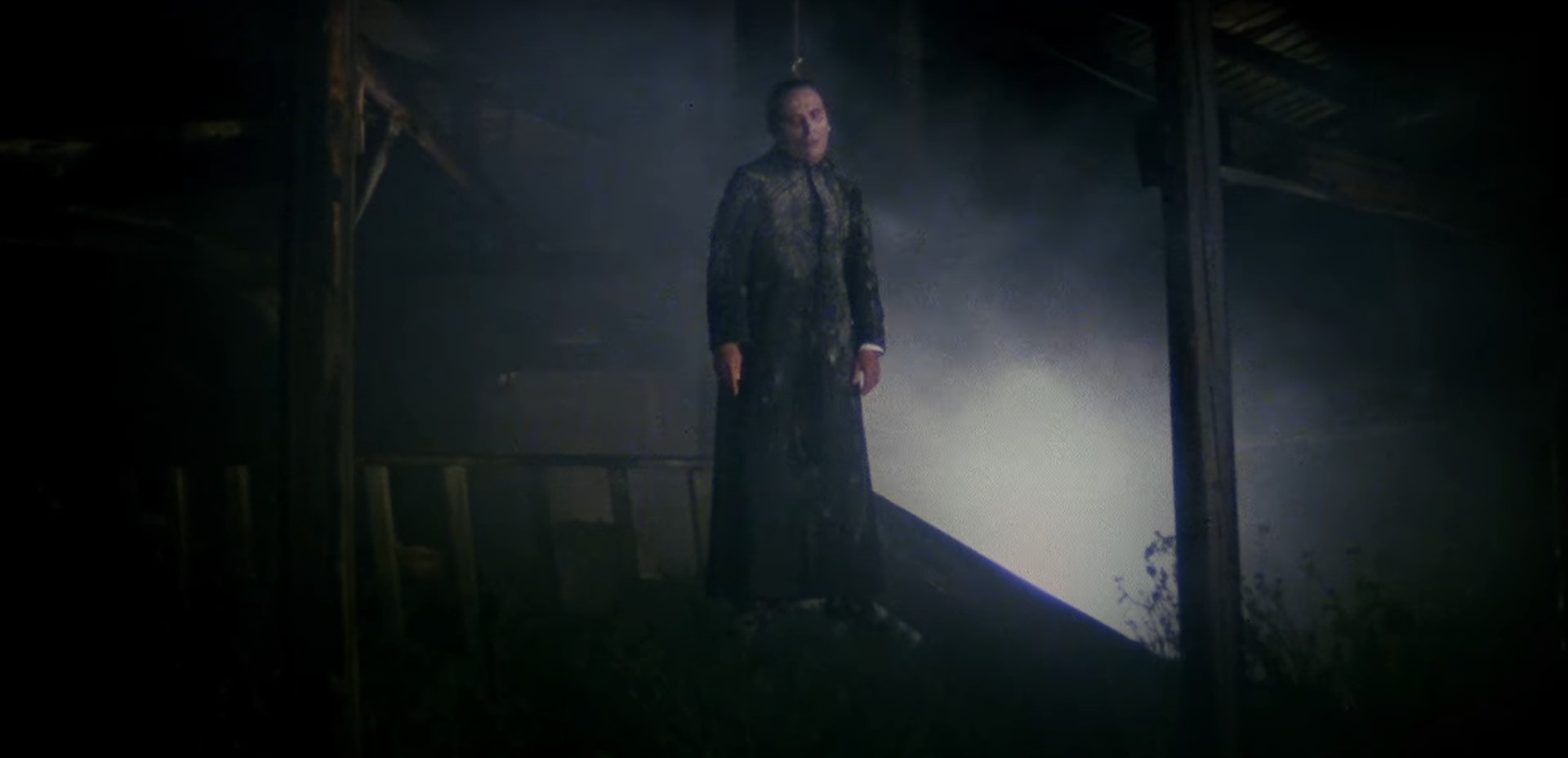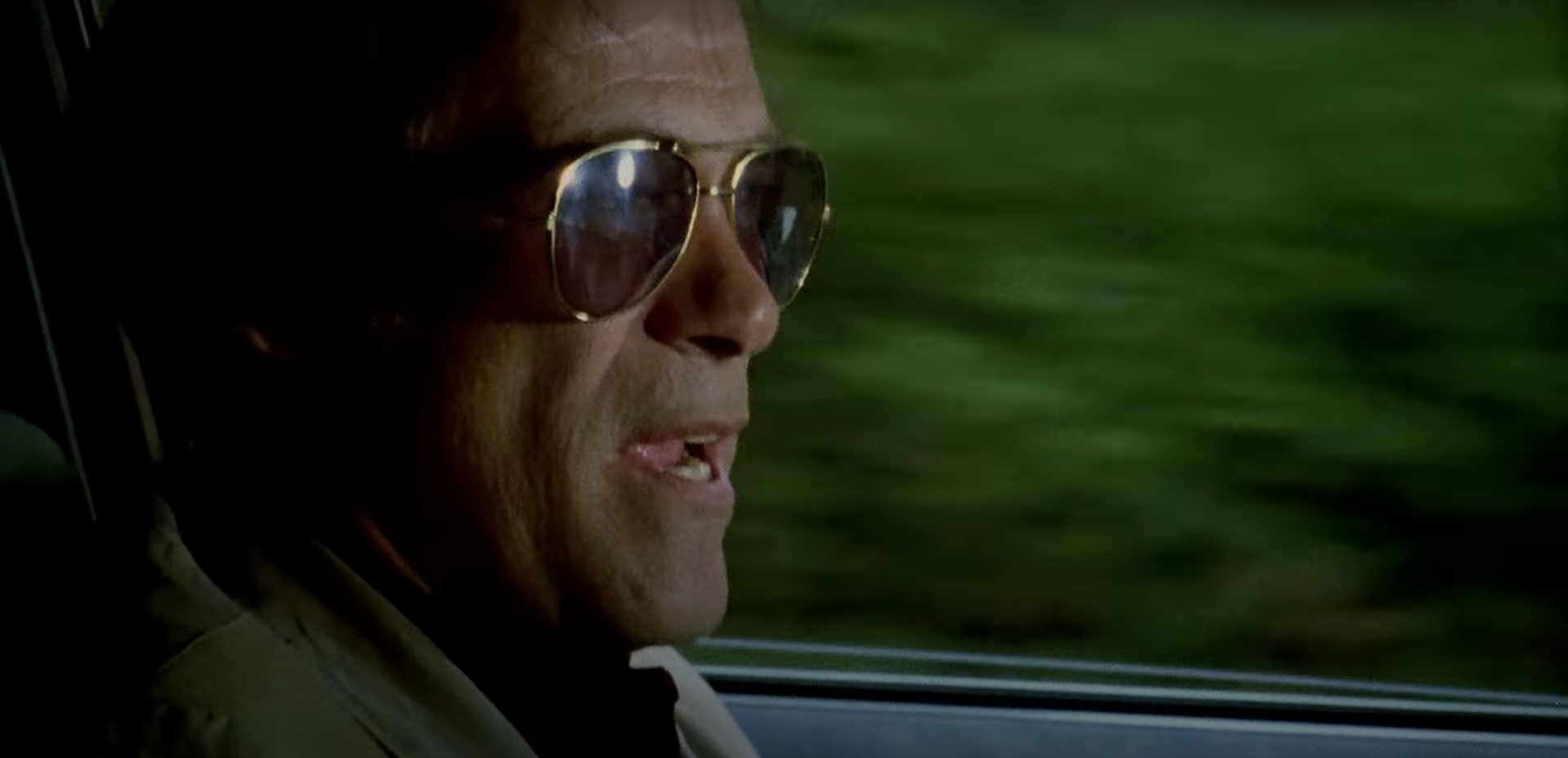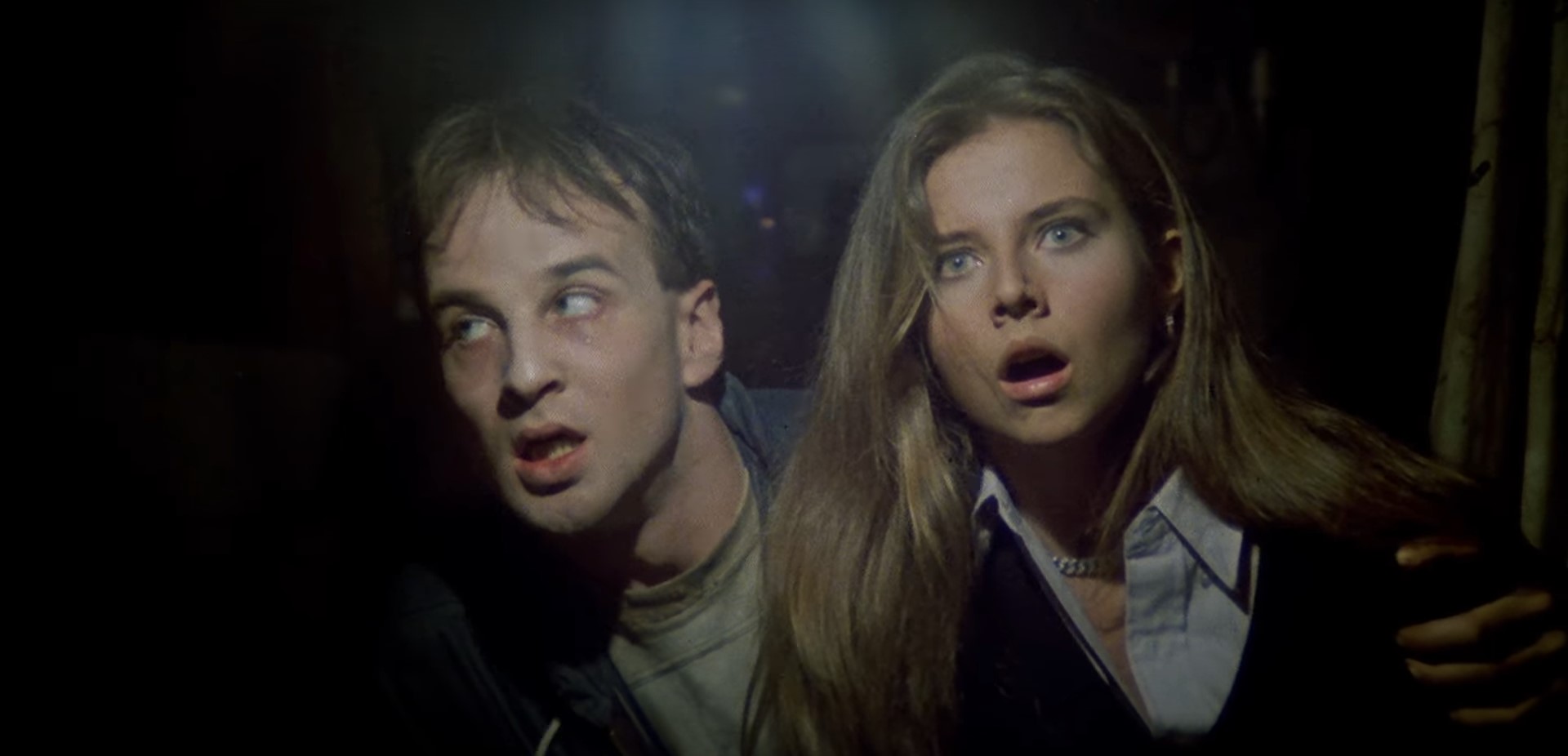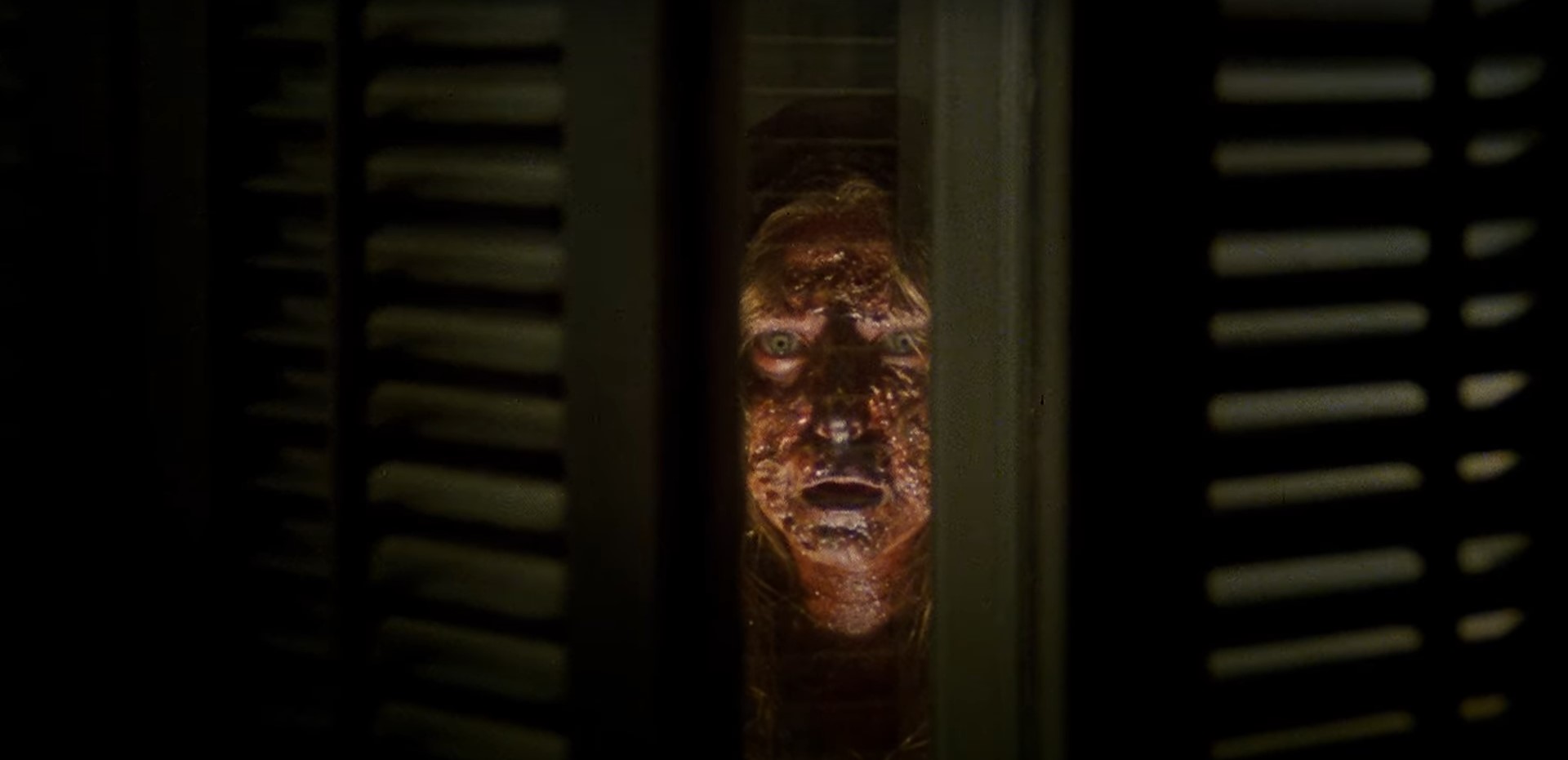
Magnetism Will Separate the EVIL from the Rest of You! “Black Circle” reviewed! (Synapse Films / Blu-ray)

Cosmic horror is the “Black Circle.”  2-Disc Blu-ray/CD on Amazon!

After Isa manages to clean up her life and obtain a upper management job, she’s eager to share her tremendous focus secret with sister Celeste, a university student hitting a mental wall with an important term paper.  Isa says the key to her success came after cleaning out the belongings of their grandmother’s deceased cousin, where she unearthed a record LP on magnetism produced decades ago by a master of the craft.  Celeste is instructed to listen to the LP’s backside right before going to sleep with the promise of her life changing for the better.  After setting the needle, Celeste wakes up next morning feeling unburdened by the challenges ahead and is able to knock out her paper in one day, but she senses another presence following her, watching her, and having vivid dreams of a monstrous double of herself from being inside what the LP calls the black circle.  Shortly after, Isa has disappeared, exiting her new job with erratic and paranoid behavior, only to resurface on Celeste’s doorstop ranting about LP’s frighteningly powerful suggestion and that she’s being followed by someone driving her car.  The sisters track down Lena, creator of the LP and master of magnetism, where they also meet a pair of young psychics who explain the unforeseen, accidental harmful side effects of the LP she thought were all destroyed.  Lena agrees to save the sisters who are faced with losing themselves from themselves. 

Hypnotism has diminutively entranced storytelling, scratching only a limited surface of films with only a few being widely known, such has “Office Space,” “Stir of Echoes,” or “The Cabinet of Dr. Caligari” to name a select few recognizable titles.  To further hypnotism into obscurity, a similar spellbinding field is introduced by filmmaker Adrian Garcia Bogliano.  The Spanish writer-and-director of “Here Comes the Devil” and “Come Play with Me” chills us with a cosmically laced and existentialism albatross with his 2018 “Black Circle.”  The Swedish production, natively titled “Svart cirkel,” pulls loose inspiration from the often-controversial works of German physician Franz Anton Mesmer, as in mesmerize, who first coined animal magnetism as an invisible force within the human body that can be manipulated by skilled magnetizer.  “Black Circle” is produced by Bo and Rickard Gramfors and Bogliano’s longtime collaborator Andrea Quiroz within a conglomerate of production companies that include Klubb Super 8, Njuta Films, Salto de Fe Films, and Evilinski Productions.

Felice Jankell (“The Bunker Game”) and Erica Midfjäll play the two sisters, Celeste and Isa, embroiled in magnetism bad luck happening up on an old of circ 1970s-1980s LP in today’s age.  There’s quite a bit of tension between the two sisters who are not conjoined at the hip like most close-in-age siblings as they battle their own personal demons that are only talked about rather than exhibited.  Yet, we get the sense of their daily struggles through Jankell’s body language for Celeste and the recollecting conversations both sisters have regarding Isa’s troubles keeping glued together and those existential problems are what connects them, or rather what connect us all as sentient beings, making the characters relatable.  Isa exposes Celeste to the LP in hopes to help Celese regain control over her life but what ensues is not only a weight lifted off her capacity to overcome but also an underlining fear of being followed, watched, and frightened by grotesque dreams of herself in a monstrous form.  At this point, Isa and Celeste are experience parallel psychosis spurred by the record that leads them, and us, to the headliner of film, genre icon Christina Lindberg   The once sweet-faced Swedish brunette, who once donned an eyepatch and took a shotgun to her rapists in the role of Madeleine in “Thriller:  A Cruel Picture” and who once debuted as a 16-year-old virginial maiden in the sexploitation “Maid in Sweden,” has now grown up to become a woman basking in the essence of power and control at all times with Lena, a magnetism expert attempting to rectify unintended mistakes distributing a soul separating, charmed-grooved vinyl from decades earlier.  Lena has rich history that’s dropped in segments from the moment she’s introduced on screen, almost immediately displaying her limitless power on two young, intrusive psychics (Johan Palm and Hanna Asp) who enter her home by the summoning Supreme, an exterior planed creature who supervises the psychic realm.  Performances are incredible skintight as actor brings an elevated show for their individual role, including the rest of the supporting cast in Hans Sandqvist, Iwa Boman, Inger Nilsson, and Erica Midfjäll’s twin sister, Hanna, to sell the “Black Circle’s” premise and promise more convincingly terrifying.

If you were forced to only see one indie contemporary release this year, “Black Circle’ should be it.  Bogliano’s “Black Circle” doesn’t dazzle with a ton of effects nor is production value or exotic and grand set locations applied to lure in viewers, but what Bogliano does do well, and what ultimately instills a fascinating story, is the well-written script, character developments, and the subtle effects that bore a fear of the unknown dread persistently and consistently throughout.  Bogliano delivers a unique story sold on the rarity of proto-hypnosis with a premise fashioned around the development of his own mythos of psychic realm rules and beings. Best part about Bogliano’s piece of the macrocosmos is the way he chapters the narrative, ushering viewers gently and with explanation inside a context construction that uses phantasmagorical visuals and voice over narration to interpret magnetism jargon or to provide inside to setup the next chapter. This processing style of breaking up the acts accentuates, or offsets, the rather raw Dario Goldgel cinematography of the reality story, turning “Black Circle” in pedagogic inside into the basis of the wildly scrutinized, often criticized, hypnosis. What’s also neat about “Black Circle’s” story is the lack of a clearcut antagonist. Neither Lena, the two psychics, or even the monolithic, fazing Supreme serve as opposition against the two sisters but, in a twist of the tale, the sisters are actually their own worst enemies with doppelganger trouble in what afflicts us all at one point or another – existence. Yes, “Black Circle” is about the existential encounter that relates to good and evil, a theme of duality done without a tale of twins (or if you want to get technical, “Black Circle” was casted with a set of twins) and involves more with a separation of, what the story calls, an ethereal double that will eventually absorb itself into being the stronger, dominant replacement if the magnetism vinyl continues to be listened to in enough times it will weaken the original, strengthen the evil carbon copy, and there will be no going back.

Become entranced by Adrian Garcia Bagliano’s “Black Circle” now available on a Synapse high-definition Bluray release. The AVC encoded, 1080p, dual-layered BD50, presented in a 2.40:1 to really grab the space of tighter quarters and lengthen the berth, has less transfer complications than let’s say most of Synapse’s catalogue. The digitally recorded video doesn’t require as much remastering as a decades old production on celluloid or videotape, but the narrative does feign video degradation or aging in the more elucidation scenes on magnetism 101. Details are fine and textured, blacks are especially inky and void-encompassing, and no signs of compressions issues with a bitrate average around low-to-mid 30s. The light sepia grading envelopes a welcoming, steely coldness around the characters and their astral plight. The Blu-ray comes with a Swedish DTS-HD 5.1 surround sound mix and an English dub Dolby Digital 2.0. With being reliant on pulsing waves to match the hypnotic scheme, the backdropped soundtrack adds to the unsettling pensiveness, like the metallic hum of a tuning fork, that never protrudes outright and even into the character’s dialogue space. Not a ton of spacing depth between dialogue and ambient but enough to sate directional awareness and atmosphere. English subtitles are optionally available. Bonus features include an audio commentary with the director, two individual interviews with director Andrea Garcia Bogliano and star Christina Lindberg, both in fluid English, an Inside Black Circle behind the scenes featurette, a still gallery, and the original teaser trailer. Synapse’s release is actually a 2-disc set containing a CD of producer Rickard Gamfors score. Inside the black Blu-ray casing, a red and black insert card with the three faces of main principal characters, the sisters and Lena, in linear composition overtop the black circle with the title underneath. On the backside, the complete 18-piece CD track list complete with instrument and mixing acknowledgements. Also in the insert liner is a 2023 Synapse product catalogue. Front cover art has retro appeal with a black background emphasizing the perfect spiral red and black circle being touched by disembodied and flat matted red hands. The disc itself mirrors the front cover’s spiral but sheens like a vinyl LP but in red and black alternate rings. Dread the duplication, fear the far-side of yourself, when becoming magnetized by magnetism of the underutilized genre that knows no limits and has a plethora of petrifying possibilities inside the “Black Circle.”

Cosmic horror is the “Black Circle.”  2-Disc Blu-ray/CD on Amazon!

Staying in the Closet Can Lead to an EVIL Series of Events! “The Latent Image” reviewed! (Cinephobia Releasing / DVD)

Out today on DVD “The Latent Image” from Cinesphobia Releasing!

An aspiring novelist isolates himself in a secluded cabin to write his work-on-progress thriller without distractions, especially avoiding he contentious ones with his longtime boyfriend. Working through the night hours on the precipice of a storm, a mystery man drifts into the cabin, injured and claiming car trouble. After letting him stay the night on the couch and knowing he should ask the drifter to leave, the man’s rough allure instills deep desiring dark fantasies to bubble up to the surface that result in keeping his lingering presence around while also the experience doubles as subject inspiration for his novel. Yet, there’s something off about his unexpected and unusual visitor that lends to curiosity into what’s being hidden or being unsaid. The drifter’s trunk becomes an object of obsession that turns into wild speculation. Fear and fantasy collide into an explosive and destructive cat-and-mouse game of downlow and deadly secrets.

Based on the 2019 short film of the same title, writer-director Alexander McGregor Birrell (“Braincell,” “Sleepaway Slasher”), alongside co-writer and star Joshua Tonks, return to “The Latent Image” for a 2022 full script treatment to flesh out a fleshy grass isn’t always greener on the other side homoerotic thriller.  “The Latent Image” is Birrell’s third feature length film of essentially is Joshua Tonks inaugural writing and producing credit into the United Kingdom production that clashes tantalizing and dangerous one-time temptations with the safety and security of routine and longevity woven out of being inside a complicated gay relationship that stings with old systematic-induced worries and consequences.  Latent Image defines as an exposed picture or film not yet developed and Birrell and Tonks use that to purposely shield viewers from the utmost truth until the petrifying picture is clear.  Latent Image LLC in association with the queer community storytelling serving June Gloom Productions are the picture’s production handlers with the latter company’s Brandon Kirby and Michael Varrati as executive producers and Tonks and Birrell co-producing their debut feature collaboration.

Being Joshua Tonks’s grandstand into his first feature production and as the lead character, the British-born, Vancouver film school-trained actor reprises his short film part with only two significant differences:  one being a principal name change from Robert to Ben and the other in providing Ben with more substantial backstory in the form of reveries or creative abstractions of a linear trickster narrative.  Ben’s old school, a reflection seen through his love for old photography without a display screen, his typewriting of the novel, and filming on celluloid film stock with a Super 8 camera.  This affinity for the antiquated matches his sexual stigmas, a flaw that shepherds in more harm than good.  Tonks readily handles Ben’s technological quirks as well as deepen his character’s philandering fantasy life with sexual daydream and night terror trances of being pursued, abused, and enjoying it.  Tonks works off the more indelicate stranger-danger of fellow Vancouver film school graduate Jay Clift.  Long hair, leather jacket, rugged approach, Clift in the role simply known as The Man portrays patience as weapon to wield to win over the quasi confidence and trust of the lonely and relationship confused novelist with an active imagination, a deadly combination to be caught with your pants down.  Clift becomes the character interloper in Ben’s life in more ways than one, some more subtle than others, and equivocally provides baited lure to either seduce the novelists or setup him for a fate far worse.  To complicate matters, Ben’s boyfriend, who he has a current agitated relationship with and viewers will initially think is safe and cozy back at their abode, will eventually enter the picture with newcomer William Tippery in the role to complete the all-male, three-man cast.

“The Latent Image” plotline doesn’t justify Birrell’s picture as anything else but another stranger showing up at cabin in the woods thriller.  However, beyond the shallows of the film’s surface level tension are deeper waters surrounding Ben’s parting of pathways.  The novelist not only struggles to conjure up a decent spinetingling narrative, but he also struggles personally with an uncertainty of where he fits into his relationship with at-home boyfriend Jamie and with this new, dark fella wandering into the cabin in rake portance.  From the beginning, Birrell and Tonks often visits Ben’s unconscious chimera but also often feels very real in its merge of reality and fantasy of what Ben’s sometimes wishes would happen, but don’t expect this thriller to be a based in psychosis.  “The Latent Image” is not a mental health movie of one man’s isolation snaps his baseline reality.  That would have overdone, overcooked, and overserved with stale bread and flat soda.  What “The Latent Image” taps into is not the age-old tale of a drifter’s in doubt motivations but rather a fear of being found out or fear of oneself when they themselves are unsure of who they are as a person and that can be a scary thought to let the imagination run wild. 

“The Latent Image” lands a debut distribution deal with the Philadelphia based Cinephobia Releasing.  The single layer DVD, arriving on retail shelves September 12th, is a compressed MPEG presented in anamorphic widescreen 2.39:1 aspect ratio.  Between the use of anamorphic lens, split lens, Super 8 reverse stock, and a ton of mood lighting, “The Latent Image” really pops cinematically with a variety of visuals and looks that can induce a breadth of emotions.  For a DVD presentation in an age where Hi-Def continues to the upward climb, the Cinephobia Releasing has tremendous sharpness and detail inside and out of the fuzzy warmth and often the vividly brilliant, focused lighting that induce back and front shadowing, decoding at average of 8 to 9 Mbps that eliminates any prospect of compression complications.  The English audio options include a Dolby Digital 5.1 surround sound and a Dolby Digital 2.0.  The 5.1 trumps the 2.0 In offering much environmental elements of rustled foliage and depth of character actions.  Dialogue conveys strongly, securing its spot Infront of the other tracks where depth allows.  English optional closed caption subtitles are available in the setup menu.  Special features include an audio commentary with director Alexander McGregor Birrell and stars Joshua Tonks and William Tippery going over their mindset of the characters, background, and visual and stylistic choices in an enlightening discourse, the 2019 short film “The Latent Image,” the audio commentary for the short featuring just Birrell, and other Cinephobia Releasing trailers.  The 83-minute film is released not rated and has region 1 layback, untested for other regions.  Well executed indie suspenser with a subtext clout to one’s essential nature and a smartly planned story has exposed “The Latent Image” as impressively top-notch and worth seeing. 

Out today on DVD “The Latent Image” from Cinesphobia Releasing!

Only EVIL Can Be Constructive Therapy for EVIL! “Dark Nature” reviewed! (Dread / Blu-ray)

Battle Your Inner Demons By Battle The Exterior Ones in “Dark Nature” now on Blu-ray!

Joy walks on eggshells around hot-headed and explosive boyfriend Derek.  Almost having been killed by Derek’s eruption into anger one night, Joy manages to flee his wrath for six months.  Long time good friend and weary ally Carmen convinces the haunted Joy to join a therapy group overseen by a psychologist with unconventional healing methods.  One of those methods is backpacking into the mountain wilderness for a therapeutic getaway to face personal fear with three other women who also experience the familiar paralyzing and manifesting symptoms of towering trauma.  Miles away from civilization, the group treks for two days until an unsettling feeling of being watched and their supplies being stolen forces them into a face-to-face with a mysterious influence that reconjures their individual terror through sight and sound, leaving them incapacitated with anxiety.  When realizing the amount of danger mounding against them, the fear-facing trip through the wilderness will put that aspiration to the survivalist test.

“Dark Nature” is a women-led psychological creature feature surrounded by themes of abuse, trauma, and the handling of the psychosomatic stress when at rock bottom and faced with internal, or external, demons figuratively for traditional storytelling and literally for cinematic storytelling.  Calgary filmmaker Berkley Brady writes and helms her first feature length film in 2022 from a storyteller’s collaboration with Tim Cairo, screenwriter of “Lowlife.”  Shot in the copious thicket of the picturesque and idyllic Canadian Rockies that stretch the provinces of British Columbia and Alberta, Brady’s scenic beauty parallels a skin deep exterior amongst a character group seemingly okay in the open-air while within the wayward withholding of crises becomes too burdensome to bear alone.  Brady and Michael Peterson co-produce “Dark Nature” under Nika Productions and Peterson Polaris in association with the Indigenous Screen Office and Telefilm Canada in this this Dread presentation, the production company subsidiary of Dread Central, and Tim Cairo, Kalani Dreimanis (“Polaris”), Jason R. Ellis (“Mother, May I?”), Patrick Ewald (“Turbo Kid”), and Katie Page (“The Man Who Killed Hitler and Then the Bigfoot”) serving as executive producers.

The cast comprises of five women at the core and one man hovering around the peripheral like a lingering, festering open sore.  At centerstage is Hannah Emily Anderson (“Jigsaw,” “What Keeps You Alive”) in character throes of relationship lamentation and a cracking psyche over the tumultuously violent and rarely passionate ex-boyfriend Derek, played convincingly cynical of his partner by Daniel Arnold (“Even Lambs Have Teeth”).  First meeting Joy, over a stove of a steaming dish and on the phone in an exchange of concerns and pseudo-comforts, audiences will already be in bed with the young woman’s nervous fraught when a sullen Derek steps into the apartment as she tries to appease him with his favorite food and positive inquisitively around his day.  A tense exchange of words turns into a lust entanglement of pre-sex kisses and touches that spirals into a physical aggression that has nothing to do with foreplay or sex.  The abusive opening act sets the tone for Joy’s edgy mindset into the early and middle acts as she’s standoffish and verbally combative and questioning everything about the group’s choice to venture into the wild under the unconventional means of one Dr. Carol Dunnley, casted by an over the years, well-versed television and movie doctor, or authoritative mentoring figure, Kyra Harper (“Hellmington”), with others continuing to rake over an unpleasant past.   Métis raised actress Roseanne Supernault (“Rhymes for Young Ghouls”) joins Helen Belay and “Don’t Say his Name’s” Madison Walsh as the other nature walking companions seeking a renewed lease on life.  While Belay broods in secrecy with a jaggedly defined backstory of a possible abduction or maybe something worse with Tara, Supernault adds a coping comedy mechanism with her former military background that has caused Shaina intense flashbacks.  “Dark Nature” might not be their characters’ exclusive story but certainly they’re components serve a pieces of the psychology behind it as well as fodder for the forest-dwelling fiend as the narrative aims to fragmentally unfold more of Joy’s affliction that not only cull reasons why this trip may or may not be a good idea but also challenges the friendship strength between her and Carmen until Joy can face down and take responsibility for her unprincipled stance on the seared in fear that renders her powerless and controls her.

“Dark Nature’s” adianoeta works excellently to service both the reclusive avoidance in seeking desperately needed help and the sinister presence lurking and stalking through the lush mountain weald.  Yet, audiences will identify more with the latter because like the principal Joy people tend to avoid their own problems and redirect to another pressing issue that has really nothing to do with them or affects those as a whole, turning a person’s dark nature into not a generally relatable theme no matter how intrinsically installed it is into the incorporated picture.  While seemingly sweeping with Joy’s entire circumstances, we’re led to believe the anxious woman remains haunted by her past, her abuser having this hold over her akin to Stockholm syndrome, as while on the trek through the mountainside she can hear his voice, hear the repetitive clicks of his Zippo lighter, and even experience his tight grip around her throat but Brady winds up the narrative with a few vacillating curveballs that pull toward difference directions to swing-and-miss from being squarely hit until the grand reveal of explanation.  Even then, the explanation retains some purposeful vagueness with an antecedent anecdote of an ancient indigenous people once offering sacrifices to a spirit on the very land the group is treading on.  The tale doesn’t offer much detail and certainly isn’t a full-proof explanation of what ensues but adds that comforting layer of setup into what becomes madness erupted from a furtive, cave-dwelling creature shellacked in a black muck and with supernatural abilities of emerging a person’s most personal fear.

A psychological creature feature that offers worse things in the world than one’s own personal demons comes to Blu-ray home video from Dread’s physical distribution partner, Epic Pictures.  The AVC encoded, high-definition 1080p, BD25, presented in a widescreen 2.39:1 aspect ratio, of “Dark Nature” looks undoubted sharp with details even if the color graded is somewhat desaturated.  The decoding of data details nicely around the foliage, skin features, and even in darker scenes with black levels not succumbing to any compression artefacts.  “Dark Nature” has two English audio options with a Dolby Digital 5.1 surround and a Dolby Digital 2.0 stereo of crisp sound design with a surround the wagon barrage of audio cues casting out through the back channels to denote an autonomic attack when alone in the woods.  Dialogue is clean, clear, and sorted out through the chaos with a perfect depth and reverberation from outside-to-cave-to-cave-to-outside.  An eclectic range is spread-out through the tale from the flashbacks adding explosions and whizzing gunfire to the guttural roars and bush movements of the creature that resemble an enclosing chill of being watched.  “Dark Nature” marks the debut score for the Canadian band Ghostkeeper and while the additional of delicate broodiness sweeps over the images, creating an ominous overhang for much of the picture, I wouldn’t say the score adds to the film’s soul in the subtilty of the low, whispery tones. English subtitles are available.  Special features include an audio commentary track, also hidden within the audio setup, with director Berkley Brady, makeup artist Kyra Macpherson (“Red Letter Day”), and costume designer Jennifer Crighton, a handful of deleted scenes cut for timing, Ghostkeeper stop-motion music video (1.33:1), and an oddly incorporated short film from “Dark Nature’s” editor David Hiatt (“Bloodthirsty”) entitled “Peanut Butter Pals,” a Scooby-Doo mystery solving trio comically and melodramatically tracking down a cave monster, “Dark Nature” trailers with a countdown list of a theatrical, 30-second, and 15-second trailer, and Epic Pictures trailers including “Colonial,” “Satanic Hispanics,” “Tomorrow Job,” “The Lake,” and “Woman of the Photographs.” Physical features are slimmer with a traditional snapper and a rather generic cover art of Joy and Carmen covered in blood superimposed in the foreground of a forest. Disc pressing has the two actresses, still covered in blood, reappear but this time within the jaws of a creature. The region free Blu-ray clocks in at 86 minutes and is not rated. Berkley Brady’s woodland set neurosis knot never says die in the face of adversity no matter the form in the filmmaker’s female-driven debut.

Battle Your Inner Demons By Battle The Exterior Ones in “Dark Nature” now on Blu-ray!

Death Penalized EVIL Returns to Wreak Havoc on Young Women. “The Stay Awake” reviewed! (Cheezy Movies / DVD)

Can You Keep Your Eyes Open at “The Stay Awake?”  On DVD now!

America, 1969. William John Brown brutally slays and sexually assaults 11 women. Before a judge, the serial killer is sentenced to death by gas chamber where his last words proclaim him as the Angel of Darkness sent Earthbound to ravage women. Nearly 20-years later in 1988, the St. Mary’s School for Girls in Europe is holding a stay awake event where a handful of students and one chaperone stay up the entire night as a fundraiser for their school. Dark and nearly vacant, the school basks in an eerie haven for the murderous William John Brown’s returning spirit seeking new souls of the softer sex. Determined to protect the girls at all costs, chaperone Trish Walton will not stop protecting the frightened girls until the entity is destroyed but when the ethereal malevolent spirit takes shape of a monstrous rodent with outstretching attack tentacles and psychokinetic glowing eyes, chances of survival are bleak.

Malevolent forces crossing oceans to death grip the innocent are films that are few and far in between as most transatlantic terror usually stays put, regionalized and localized to keep an authentic aural blend of superstition and history. Director John Bernard attempts to go against the grain with a small crowd of filmmakers who either overcame the parochial provenance and succeeded tenfold or became lost in foreign land narrative and failed miserably.  Bernard and, assumed brother, Johan Bernard co-write “The Stay Awake,” a South African mixed lot of horror elements brewed together into a supernatural schlocker that’s one-half dark and stormy night, gloomy Church Gothicism and one-half final girl survival slasher but equal parts outlandishly overexerted ghost thriller stretching across multiple continents.  “The Stay Awake” is a product of Heyns Film & Television Productions, produced by Thys Heyns of South African action-thriller flicks, as well as produced by Paul Raleigh, the producer of the “From Dusk Till Dawn” and the notable Millennium Films cofounder Avi Lerner, of “American Ninja” and “The Expendables” franchises, in one of his earliest credits from 1988.

Though the story begins in America and mostly takes place in Europe, the cast is comprised of mostly South Africans trying to pass their accents for British English that is more like a rotating centrifuge of South African sub-accents.  Shirley Jane Harris (“The Most Dangerous Woman Alive”) spearheads the cast of principals with an extremely proclaiming protagonist, delivering lines with flatfeet and flat inflection that makes her one of the more forgettable final girls.  Her foe compares just as bland with a grunting, bodiless entity floating through corridors and hiding behind indoor plants (why would an imperceptible spirit need to hide behind anything at all?) before manifesting into what looks like a giant, big-eyed, and built on steroids rodent that then shows the William John Brown (Lindsay Reardon, “The Masque of the Red Death”) in side profile speaking in omnipresent and menacingly through the beast to taunt his prey.  The script allows just enough the group of young, private school girls to standout cliquishly, contain an ounce of contempt for each other, and underpin some form of individualism to make them retain some interest in their wellbeing.  However, most of the buildup that’s created to antagonize or unify between their personalities ultimately fizzle out into resembling something along the lines of kowtowing sheep or lemmings in more ways than one.  “The Stay Awake” caffeinates with a sizeable cast including Tanay Gordon (“Hellgate”), Jayne Hutton, Michelle Carey, Maxine John (“Howling IV: The Original Nightmare”), Hellie Oeschger, Joanna Rowlands (“Armageddon: The Final Challenge”) as the damsels, Bart Fouche (“Monster Hunter”), Clinton Ephron, Warren Du Preez, and Pierre Jacobs as the imposing boys, and Ken Marshall (“Return of the Family Man”) as the school’s night caretaker.

John and Johan Bernard’s logline for “The Stay Awake” likely looked appealing on paper but a full story treatment begs to differ with an inscrutable concept from start-to-finish.  “The Stay Awake” wades in generalities, oversimplifying locations and periods such as “America, 1969” and “Europe, 1988.”  The setup meat in between the disjointed times periods sets up a standard yet effective backstory for the killer, William John Brown, with a Judge’s voiceover of all his brutal transgressions, flashbacks of his victims at the death scene, and a slow walk down the corridor to the gas chamber that clearly denote him as the villain but then accentuates his supernatural supervillainy with a demonic voice screaming his return before the gas engulfs him.  However, why move from America to Europe and why in the span of 19 years does an unexplained possessed version of William John Brown return and select a group of religious school girls while his previous victims look to be a pact of randoms from off the street?  From the start, “The Stay Awake” has little to stay our fictional plausibility.  Couple the perplexation with dry performances, a possibly Hell originated monstrous, burning eyes rat creature, and the gratuitous horror nudity rug being pulled from under our feet as the schoolgirls tease with a shower scene only to be shown showering with towels wrapped around them and what has looked to be a promising possession of perpetual pandemonium  has quickly turned into a deflated disappointment with the only really good thing to come out of the film is the stationary man in a creature suit rat monster built like a bodybuilder.

“The Stay Awake” arrives onto DVD distributed by Cheezy Movies in a direct rip of the standard definitional 480i VHS transfer with a letterbox 1.33:1 aspect ratio.  Don’t expect a detailed transfer in a jittery and smoothed over standard definition that’s covered in a harsh blue tinted lens, but the condition of the interlaced video is surprisingly close to being damage free in a well-cared for print.  However, delph and range is difficult to determine due to the obvious lack of delineation but mostly because of the blue tint, poorly lit scenes, and contrast levels that make this presentation nearly pitch-black unwatchable in corridors, classrooms, and in the room of the like, but darkness is seriously enhanced and meshed together by Bernard stylistic choices of backlighting characters or using soft light to center the focus to offer a darkened horror picture. An English Dolby Digital 2.0 stereo serves as the only audio option which differentiates the soundtrack from the rest of the tracks.  Dialogue mostly separates itself to the top of the audio dogpile but is also well imbedded into the other track fighting to be heard that renders the dialogue dull and flat behind a wall of constant and diffused feedback static.  There’s also hissing at the tail end of sentences and faint crackling throughout.  Subtitles are not available.  The only extras on the static menu are back-to-back, quasi-grindhouse style trailers for two Cheezy Movies distributed titles of the blaxploitation “The Man from Harlem” and a “Dirty-Dozen”-esque “Commandoes.”  The physical aspects include a standard black DVD snapper with a rather enticing original title being sandwich with the demon’s glowing eyes on top and four schoolgirls ready to fight at the bottom.  The disk art is the same image except the four schoolgirls are cropped out and an unfortunate placement on the “The” from the title finds it punched out by the disc center/disc lock to just reveal “Stay Awake.”  The rated-R DVD has a region free playback and a runtime of 85 minutes.  “The Stay Awake” has all the indications of a cheap imitation on an established horror formula and this particular physical release doesn’t help the feature’s cause with an extremely dark and nebulous image to match its narrative.

Can You Keep Your Eyes Open at “The Stay Awake?”  On DVD now!

https://vimeo.com/814964711

Ever Get the Feeling that Your Downhill Relationship is an Endless EVIL Loop? “Brightwood” reviewed! (Cinephobia Releasing / DVD)

“Brightwood” available on DVD August 22nd!  

Jen and Dan have been a couple for a long time.  A stupid long time.  Such a long time, Jen has come to loathe Dan for everything he is worth.  On the other hand, Dan self-deprecates himself into submission despite his love for Jen, even a loveless, spit firing Jen.  When the two go for a run, hashing out the contentious night before, Jen heads for the pond to run laps around Dan in avoidance.  Having circled around a few times, Jen realizes the once exit trail from the pond, the trail she run through to the pond, is now no longer visible.  Perplexed, she voices her concern to Dan who also can’t seem to find the exit trail and every attempt to navigate through the surrounding forest reverts in them being brought back to the pond.  With no way to escape a dead cell service zone, the couple realize their not alone when they come across different versions of themselves stuck on a time loop from the very beginning moment the quarreling couple first ran onto the pond circuit to the future, disheveled versions that no longer have humanity.

Strained relationships and cosmic horror go hand-in-hand.  Or, at least, sometimes they feel like they do with an endless and revolving stagnation of being one with another as the hatred for the other and the fear of being alone cancel out any promise of an amiable or favorable solution.  Instead, staying put seems safe albeit the loop around effect of revising old and reoccurring snags that keep the relationship stale and hopeless instead of moving forward.  That’s possibly how writer-director Dane Elcar sees the suffocating time warping scenario playout symbolized in his debut cosmic horror feature “Brightwood.”  Based off and remade from Elcar’s 2018 20-minute short film entitled “The Pond,” anxiety riddles an already one-sided contempt couple who can’t find the path out of not only the pond but also their relationship in the thriller that’s peppered with dark comedy.  The 2022 feature, filmed around Egbert Lake in New Jersey, is produced by the director as well as star Max Woertendyke under Noble Gas Media productions presented by Media Moove and the LLC, Pond Pictures. 

“Brightwood” has a whopping cast of two and, honestly, the story doesn’t require the need for more and the principals, who may be better described as neutral characters or possibly as far as anti-protagonists, run the gamut of moral principles depending on which in-time version of them we’re witnessing.  Dana Berger and Max Woertendyke play the beleaguered and one-sided cantankerous couple Jen and Dan who are unable to escape the mysterious circumstances of being trapped around and forced to endured permanent residence at the trail that encircles a nearby pond.   The couple’s relationship dilemma relates irreconciled differences once adoring lovers cross beyond into when the romance goes stale.  Jen notes this by saying how she hates Dan’s smell as if it just lingers in her nasal cavity.  Hate is sowed deep after years of living with the person she has come to despise because of Dan’s lack of gumption to be anything but mediocre.  Like a puppy trying to keep up with an odiously pissed off owner, Dan mostly fears losing the one woman who likely puts up with his inadequacies.  Berger and Woertendyke really do nail the exposition history while feeding into these dynamics to setup their characters’ climatic, life-altering stuck in an invisible cosmic cage.  Stuck, the word that best describes both a worn-out relationship and the unnatural situation they’re in.  Jen and Dan are stuck together, possibly forever, to work out couple complications or to give up and just terminate it all.  The actors tap into that cathartic back-and-forth by giving a range of therapeutic emotion performances that purges truth and guilt from their characters, like any relationship would in order to grow and/or move forward.

“Brightwood” is one diabolical tale of torment of being indefinitely stuck in relationship Hell.  Analogies and metaphors compile along the way in a parallel stream of unfavorable situations.  To add more layers, Dane Elcar throws them for a loop, literally.  Jen and Dan are copied over-and-over again in a replay of moments and time and each time they’re copied, new developments emerge in the time loop that were different from before, ascertained by previous versions of themselves.  Conceptionally, the idea has it’s convoluted moments in trying to make the characters appear derived from a particular staring point and interact with each other in various behavioral outcomes, but this particular subtenant, niche layer of the cosmic horror genre is innately difficult to represent but a moderate degree of success can be conveyed or extracted depending on how much you’re willing to be opened minded, or stretched the limits of reasonability, or just don’t plain give a damn about it making sense.  Films like Justin Benson and Aaron Moorhead’s saturated cosmic horror “The Endless” or not-so-cosmic but tantamount to the concept is George Moïse’s “Counter Clockwise” are examples that work and work well to entertain a coherency and a consistency of repeated time.  If expecting a flashy and full-fledged effects driven feature, “Brightwood” is the opposite with a low-key approach that relies on staggering scenes to eventually overlap them, keeping the common core element of the pond as a center focus and turning it instantly in our minds as an undercurrent source of evil despite’s its serenity and idyllic nature.  Little do we know, our instincts might be more on point than lead to believe.

Psychotic endlessness is synonymous with loveless relationships in Dan Elcar’s “Brightwood” available on the 3rd DVD distributed by Cinephobia Releasing come August 22nd.  The single layer, interlaced DVD is presented in a widescreen 2.35:1 aspect ratio.  Image quality on the release displays a subtle overexposure, shot mostly with natural daylight, and desaturated video image not terribly rich with coloring.  Basic detail renders over nicely, exhibiting fair delineating and depth within a nature coloring scheme that micro blends characters into the foliage and mirror pond landscape.  Minor aliasing shows within the frame but the overall compression artefacts end there, decoding data at the higher end of where DVD’s can perform around 7-8 Mbps. “Brightwood” comes equipped with two English audio options – Dolby Digital Stereo 2.0 and a Dolby Digital 5.1 Surround Sound.   Between the tracks, dialogue transcends the others in a very line heavy narrative to push the small cast along but there’s a suffice amount of leaf rustling and trail running ambience and range to expand the sound into the back channels.  Jason Cooks composed score a lightly melodious score mixed with harsh tones to keep viewers edgy with suspense.  English subtitles are available.  Bonus features include a feature commentary from director Dane Elcar and stars Max Woertendyke and Dana Berger, 11-minutes of deleted scenes, the original 17-minute short “The Pond,” and Cinephobia Releasing trailers.  The standard DVD sports “Brightwood” poster art with no insert on the inside and the disc art the same as the poster with release spec, which are a not rated feature and a runtime of 84 minutes with an unlisted regionality of region 1 playback.  “Brightwood” endures the subgenre’s stumbling blocks with concentrated acting stability and synergy between the 100% invested Dana Berger and Max Woertendyke who could literally perpetuate Dane Elcar’s vision endlessly.

“Brightwood” available on DVD August 22nd!