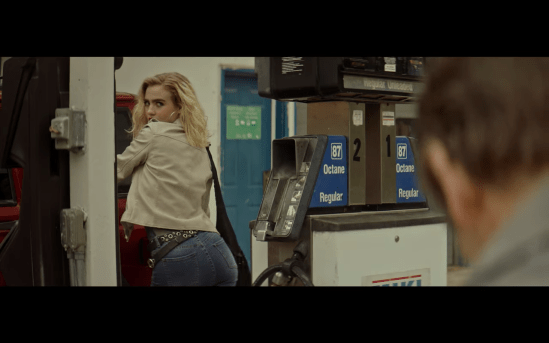
Father and Son Bring EVIL Down Upon a Tormented Detective in “Darkness Falls” reviewed! (Vertical Entertainment / Digital Screener)


Los Angeles detective Jeff Anderson has his perfect world turned upside down upon discovering his beloved wife dead of suicide in their apartment bathtub. Losing his bid for Captain and having his life be in utter shambles, Anderson becomes obsessed with lurking around incoming suicide calls on the CB radio, trying to make sense of his wife’s sudden reasoning to end it all. When a similar case produces a survivor from a familiar fate as his wife’s, Anderson learns two men are behind similar forged suicides stretched out over the past ten years against prominent women figures in and around the L.A. area. The detective spins a wild theory that has him following every lead to track down and stop the father and son serial killers without any backup from his local precinct, forcing his hand to choose whether to be a cop and uphold the law or seek lethal retribution for the woman he loved.

From French director Julien Seri comes “Darkness Falls,” a crime thriller released in 2020 that is entirely shot in English, a first for the French filmmaker who helms a script from the executive producer on “Starry Eyes” and “The Man Who Killed Hitler and Then the Bigfoot,” the Belgium native, Giles Daoust. Also produced by the Belgium, the film, that was formerly titled “Anderson Falls,” gorges on the detective exemplar of the prodigal crime fighter stripped down to next to nothing before regaining footing against the two experienced serial killers out to reduce the highly professional woman population with one bottle full of sleeping bills and one razorblade at a time. “Darkness Falls” is an exaggerated piece of nurture versus nature on systemic toxic masculinity seething under the guise of one man’s oppressed childhood from the abusive women in his life and then enlightening his son to his ways while the open minded, Renaissance man climbs back up the mountain toward redemption, not only for himself or his wife, but for all women being forced in a dual parental role. “Darkness Falls” is released under the production companies Koji Productions, Lone Suspect, and Giles Daoust’s Title Media.

Despite the international production and filmmakers, the solid cast is compromised of familiar faces from respectable actors, starting with not-the-Elsa-“Frozen’s” Shawn Ashmore. Ashmore, who I considered to a steady part of any project – he’s phenomenal in Fox’s “The Following” with co-star Kevin Bacon, – finds himself in the shoes of a L.A. detective who has fallen by no cause of his own, but as consumed as detective Jeff Anderson is with proving his wife’s murder, Ashmore doesn’t sell Anderson’s convictions and doesn’t properly apply Anderson’s super sleuth talents to wade through the sea of angst and torment. Anderson’s also written poorly as a man who consistently lingers around suicide call-ins and has constantly has numerous visions and memories of his wife that serve little to her importance to him, serving more toward just being story fillers instead of providing a little more value to Anderson’s character. What attracted me more to “Darkness Falls” was Gary Cole as one-half of the father-and-son serial killer team. Cole takes a break from the Mike Judge and Seth McFarland humor to stretch his legs amongst the thriller genre, playing an unnamed dark toned character derived from hate, abuse, and the thrill of seeing women die. Cole’s performance is a step above Ashmore’s lead role, but still flat, flat to the point of almost monotonic pointlessness that doesn’t exalt his need to kill high profile women. “Darkness Falls” rounds out the cast with Danielle Alonso (“The Hills Have Eyes 2”) as a Anderson’s former partner turned police captain, Richard Harmon (“Grave Encounters 2”) as Gary Cole’s accomplice son, and the legendary Lin Shaye (“Insidious”) as Anderson’s mother.

While “Darkness Falls” conveys a strong, if unintentional, message that grossly sheds light on the overstepping male view toward the idea of a successful woman, director Julien Seri missteps multiple times through the dramatics of a cop on the edge of the law and on the brink of despair while also not completely rigging out Gary Cole and Richard Harmon with more conniving wit, especially when their kindred reign of terror is well versed throughout the years. What fleshes out from Ashmore’s rolling on the floor and spitting shade performance at pictures of women on his crime wall trying to get into the head of the killers and Cole’s character who relinquishes freedom in sacrifice, even after a daring great escape from a botched crime scene that involved killing two cops in the process, is this weirdly uncharismatic collapse of a story from within the parameters of a well-established cast and premise. “Darkness Falls” barely pulls out a believable crime thriller that can only be described as vanilla, a term that stakes the heart terribly knowing that Shawn Ashmore and Gary Cole deserve so much better just from their lustrous careers and polar acting styles that don’t counterbalance the dynamics at all in this film. The original title, “Anderson Falls,” is fresher salt than the stale, rehashed title change of “Darkness Falls” to, perhaps, gain traction in a fruitless action of selling more tickets, adding even more vanilla flavor.

Releasing on VOD and Digital this month is “Darkness Falls,” an unrated release, courtesy of Vertical Entertainment. Streaming services such as iTunes, Amazon, Apple TV, Google Play, FandangoNow will carry Shawn Ashmore’s 84 minute sordid themed detective thriller as well as all major cable and satellite companies. Since this is a digital screener, the audio and video aspects will not be reviewed, but if running on digital and VOD, the presentation should be excellent provided that your internet’s not sluggish and a good connection is established. I will say that the score by Sacha Chaban is against the grain with a brawny anti-brooding soundtrack more suitable for intense action than stylish poignancy than ends in uninspired ca’canny. That’s also not to say it wasn’t a good score. There were no bonus material included with the digital screener and no bonus scenes during or after the credits. Sitting through “Darkness Falls” was tough to sit through as the anticipation for the morbidity level to increase with due pressure onto detective’s Anderson’s browbeaten shoulders for a hellish ride solving his wife’s untimely death was never sated, sputtering along as a halfcocked story with performances to match.

“Darkness Falls” available for rent on Prime Video!

Subscribe to EVIL’s Vlog! “Followed” reviewed! (Global View Entertainment / Digital Screener)


Unable to entertain that ghosts actually exist and to be one of the best social media influencers he can be on the world wide web, influencer “DropTheMike” vlogs locations’ ghastly back stories that are now presumably haunted by the very souls the locations consumed. When offered a once in a lifetime opportunity, worth a small fortune in the sum of a quarter of a million dollars and set start up his family with his recently pregnant fiancé, “DropTheMike” quickly challenges his followers to scout out the next paranormal investigation on the cusp of Halloween in 2016. With the results in, an overwhelming number of responses held one of the most notoriously haunted hotels in America, The Lennox, as his and his video crew’s next targeted exploration from the tops of the roof to the dank, dark basement. Ecstatic and eager in a pool of mixed emotions amongst his crew, “DropTheMike” pushes forward despite the forewarning counsel from a hotel historian and his friends, booking rooms for a three day stay that turns horribly frightening when the social media influencer’s greed for followers and fortune provokes the damned souls and the spirit of an infamous serial killer who once hacked up his victims in the very same room “DropTheMike” is staying in.

Us bloggers always try to use our social media platform powers to not only gain internet popularity amongst the ever growing, or continuously exploding, tsunami of 24/7 news, reviews, and inspirational muses for instant, impactful transmission to billions of users, but also to express the things we, the bloggers/vloggers, express what we’re passionate about. Sometimes, what we’re blindly passionate about undertaking can haunt and consume our very being, and also destroy our souls and that’s the epitomic baseline for Antoine Le’s 2020 supernatural cyber-horror “Followed” that’ll feed into select drive-in theaters Friday the 19th. “Followed” is Le’s debut full-length feature film penned by the self-help screenwriting guru, Todd Klick. Shot on location in Los Angeles, Le and his crew use a number of different hotels give the illusion of being inside the fictitious Hotel Lennox, including Hayward Manor Hotel for the lobby scenes and Hotel Normandie for the interior rooms, re-working the rest digitally to effectively pull off the faux location without issue. Branded Pictures Entertainment and Le’s own co-founded Viscape Arts, along with co-producers Greg Berlant and Matthew Ryan Brewbaker, server as the production studios that pushes cyber-horror virtually toward to the forefront of found footage and dark web terror.

In front of the camera, the main attraction, the host with the most is “DropTheMike,” played enthusiastically by Matthew Solomon in his sophomore feature film and handling the pressures of a demanding social influencer position with pizazz to generate subscriptions with the utmost vigor. Personally, I’m familiar with too many influencers that cast a pendulum energy to the akin of a zany children’s educator personality known as Blippie. Google Blippie and have you’ll be able to paint a picture of a less morbid version of “DropTheMike” but with the same kind of body and facial expressions. Solomon’s counterpart is Tim Drier as Mike’s director of photography, Chris. Reversed within the confines of his Christian faith, Chris has serious reservations about The Lennox stunt, opposing Mike at every plea for him to shoot what could be the influencer’s biggest achievement and turning point of his mediocre career. If it wasn’t for being sweet on Danni, a fellow DP, Chris would snuff out any venture into the what Mike thinks is the one big publicity stunt. Played by “The Incantation’s” Sam Valentine, Danni’s a bit of an instigator or, perhaps, shares Mike’s agnostic views on the spirt world, but communes with the film crew in order to reach out to her former fling in Chris and see what materializes from the questions that have been plaguing her. The story primarily focuses on the trio and their friendship dynamics, but there are interesting key support roles that provide a well timed and deserving boost to keep “Followed” grippingly tense and violently rough-hewn toward the path of the malevolent specter plane, including performances by Caitlin Grace, Kelsey Griswold, Christopher Ross Martin (“American Horror Story: 1984), and veteran actor of “Deer Hunter” and “Carnisaur 2,” John Savage.

What makes “Followed” different from other cyber-horror genre films, such as “Unfriended,” “iLived,” or “Like.Share.Follow?” Cyber-horror looks a lot different now than 20 years ago when the genre viewed the mechanics of machine was bedeviling autonomy and people were slave to the machine in one way or another. “Death Machine,” “Lawnmower Man,” and “Evil Speak” are the quintessential ghost in the machine with each plot platters different variations of to subordinate mankind. Now, these films might seem low-tech and more tangible instead of the trying to grasp the idea of cyberspace. Aside from the dark web snuff premises, cyber-horror nowadays, such as “Followed,” is bound by the original influencer, the devil, who has strewn his watermark through the many conduits of streaming services, infecting at will the dark powers to beguile and besiege the barrier of rationality, and deconstruct human morality to the most primitive and primary sin. “Followed” doesn’t break the mold of cyber-horror, but exploits the mold to the max to deliver a terrifying hotel with a ghastly black past. Based perhaps on a number of personal grim accounts and then chained together like an all-in-one anthology, “Followed” jazzes up with the second act with myths, visions, and theories between the rather ordinary bookend beginning and end, always stepping up evil’s game to the point where you never know what to expect and that’s what’s enjoyable about the found footage aspect because nothing is certain, especially when each floor has a history of violence.

Book your reservation to hell and subscribe to the nerve-racking black magic of Antoine Le’s “Followed” hitting the drive-in theaters on June 19th, insidiously expanding into more drive-in theaters on June 26, and eventually landing onto VOD later summer 2020 courtesy of the new kid on the film distributor block, Global View Entertainment. Since “Followed” was viewed as a digital screener, the video and audio aspects will not be critiqued, but the official specs include a presentation in a widescreen format, aspect ratio 1.85:1 with an English language 5.1 surround sound audio mix inside a 96 minute runtime. “Followed” is a visual feast that apply a number of different kind of filming techniques from handheld, spy cams, and security footage and brush the hue spectrum from the ominously vibrant reds to the forlorn splay of sterile metal and steel. With tactics that include a pluralistic phantom ecosystem all living together at the Lennox Hotel, the varied soundscapes and ambient bytes spookily outfit the multi-headed apparition commune existing just on the threshold of the reality plane and seeping in when poked, like a sleeping bear with a stick. There were no bonus material included or any additional scenes during or after the credits. “Followed” is a cherub of the cyber-horror junkets before it’s time that indulges itself into the destructive and careless path of a social influencer, ignoring the sinister forces amongst the other things, like personal property, public safety, or personal safety, real influences tend to disregard when climbing the social media latter to the 15 minutes of fame of internet stardom.

Find a Drive-In near you by clicking on “Followed” official website : https://followedhorrormovie.com/

[youutube=https://www.youtube.com/watch?v=VduFOTzm8DI]

Hard Bodies, Hot Vixens, Civil War Gold, and an Evil Bolivian Druglord in “Enemy Gold” reviewed! (Mill Creek Entertainment / Blu-ray)


Agents Chris Cannon, Mark Austin, and Becky Midnite go in guns blazing on a drug smuggling operation operated by the goons of a Bolivian drug lord and club owner named Santiago. Furious with their meddling that cost him a hefty dividend, Santiago employs the crooked agency director, Dickson, to do something about his rogue operatives, but with his bureaucratic hands tied, Dickson can only get the agents suspended until further investigation clears them of any wrongdoing. During their leave, the three go on a gold finding expedition based off the tale of a legendary suicide mission conducted by a Confederate Lieutenant during the American Civil War that involved infiltrating behind enemies lines and stealing Union gold to fund the rebellion cause. The gold is believed to be hidden deep within the woods, a secluded area Santiago just happens to learn about while eavesdropping on the agents movements. Deciding take matters into his own hands, Santiago hires an exotic hitwoman, Jewel Panther, to hunt them down for elimination.

Perhaps the Tinto Brass of action films, Andy Sidaris wrote, directed, and produced an extensive filmography of weaponry-packed James Bond-esque films crammed with robust eroticism from the late 1980’s to the heart of the 1990s under his, and his wife’s, own independent banner and though “Enemy Gold” has all the markings of a Sidaris’ productions, including many, many female assets and rock hard abs, his son, Christian Drew Sidaris is handed the sovereignties of the 1993 bodacious hot-body, action-comedy in which he co-writes with Wess Rahn. The cult film showcases the best parts of the most beautiful people who have less-than-stellar thespian chops, hiring outside the conventional casting agencies to lure the attractive attributes of what Playboy and Penthouse have to offer, and sticking them into the tightest and skimpiest clothes that would put Miami’s South beach flamboyantly wild atmosphere to shame. Let me not bring in East Coast flavor to a production that stretches from California to Louisiana under Sidaris’ economically savvy Skyhawks Films company, in association with MBP and Starlight Films.

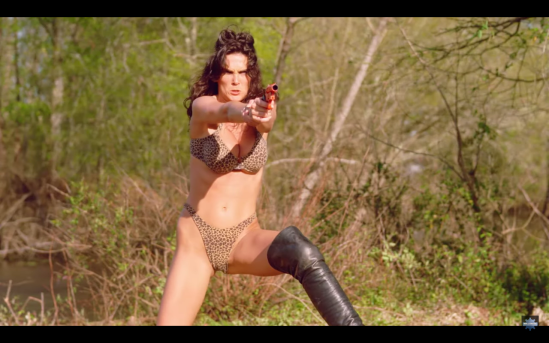
I wasn’t joking when I said Sidaris scouted out Playboy and Penthouse centerfolds that sizzle with sex appeal when strapped with an automatic weapon. The concept is every gun-toting redneck’s wet dream when the producing Sidaris’ employ the well-endowed to be the center of the action. Penthouse Pet and cult horror icon, Julie Strain, certainly fits the description. The voluptuous 6ft 1in actress has the best role in the house as Jewel Panther, the scantily-cladded assassin with a pugnacious attitude that can turn a quarrelsome skirmish into an oddly erotic babes and bombs moment as she whacks a couple of clueless park rangers in nothing more than her thong bikini. Not only does Strain play the best monikered character in the flick, but is a tantalizing, Amazonian lioness of a personality on screen. Suzi Simpson is another centerfold working for truth, justice, and the lethal way as Becky Midnite. The blonde bombshell Playmate does a little dirty work in her cut-off, daisy duke jeans, wriggling in and out of tight situations, and tight clothes, when being eyed up and down by Santiago’s thugs. Midnite’s not as interesting as Jewel Panther and Simpson acting mirror’s than par level posture with rigid aesthetics, even during her sex scenes with Bruce Penhall (“Body Count”). The last Playboy centerfold is Tai Collins, aka Taquil Lisa Collins, and before she was a renowned philanthropist, founding multiple foundations, and spearheading charities for children, Collins was a D.C. suit, an agency head that oversees operative missions, who saw fit to be in a romantic relationship with a subordinate (“Fit to Kill’s” Mark Barriere”) and underneath that suit, you guessed it, was dressed-to-kill lingerie. Then, of course, you have the Bolivian drug lord, Santiago. The role was awarded to one of Andy Sidaris’ casted actors, the late Rodrigo Obregon. The square jaw and poofy-haired Obregon quarterbacked all of Santiago’s antagonism toward the extermination of all the beautiful people aka the agents, but was in reality, or at least in character, was a big softy compared to Jewel Panther who ended up being more despicable in her foxy iniquity. “Enemy Gold” rounds out with Alan Alabew (“Bulletface”), and “Day of the Warrior’s” Ron Browning and Tom Abbott.

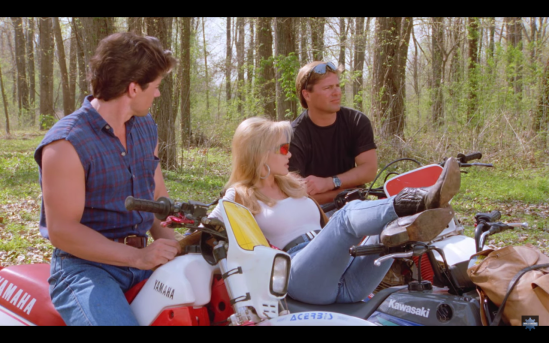
Though saturated with plenty of T&A, the Sidaris team keeps scenes classy, sexy, and elegant without stepping a foot into pornographic territory that would ultimate undermine and reclassify “Enemy Gold” as another Axel Braun flesh-flick. Granted, the acting is as cheesy as a cheeseball growing on a cheesy-cheeseball tree and every fit bod sports a cut off T-shirt and vest while pretending their early 1990’s Lenny Dykstra by wearing his baseball shades and fitting a mini-mullet, but for the value, “Enemy Gold” is a goldmine of cut-price epic action providing a variety of numerous explosions and marginal Michael Mann style gun fights. Throw in lengthy scenes of nudity, such as thorough shower scenes and a primal topless with a sword around a firepit, and you have “Bullets, Bombs, and Babes!” so says the tagline. It ain’t lying! Rahn and Drew Sidaris’ script fairs as the weaker link to the entire package that setups a really good criminal retaliation premise that recoils back to one half of the titular element, gold. The film opens up during CIvil War time with a narrative prologue of a Confederate suicide mission in attempting to steal union gold and burying it deep within the forest. The preface only becomes relevant when Christ and Mark decide to use their sudden suspension leave to go on their annual treasure hunt for the buried gold. Santiago’s reprisal of his drug bust forces the Civil War backstory and the gold to be subservient, debasing the story to an unbalanced point that it can’t seem to recover from the absurdity of events.

“Enemy Gold” is worth it’s weight in buxom gratification with a well-endowed Blu-ray plus digital release from Mill Creek Entertainment. The transfer hits Blu-ray for the first via a 4k restoration presented in 1080p, high definition widescreen with an aspect ratio of 1.78:1. The immense details is exquisite when regarding the show of excessive skin in nearly every segment. Exterior scenes look and feel lush within the trees, bushes, and lakeside landscape. Some of the grain is inconsistent, leaving exposed some fluctuations of blockiness to hurtle over. The transfer did suffer some irreparable minor damage, such as some deep scratches that are noticeable in editing and a moment of reel flare that pops up briefly. The English language 2.0 DTS-HD Master Audio offers a respectable mix helmed by the clearly prominent dialogue though, at times, renders a bit soft. Explosions are nicely discernable even in the dual channel. “Repligator’s” Ron Di Iulio’s “Night Court” meets “Red Shoe Diaries” score dips into a monotonous swanky-funk, but is an appeasing instrumental. English SDH are optional/ Bonus features include an introduction by director Andy Sidaris and, if you didn’t get enough boob action, a flirtatious Julie Strain that build up what to expect in a dated DVD launch intro. If you want even more Julie Strain topless, the behind the scenes featurette offers a little more of that DVD launch promo plus a gag of Sidaris guide to filmmaker, plus some interviews with wife Arlene and Drew Sidaris, an interview with Joe Bob Briggs, and some a brief history into the Sidaris legacy. There’s also an audio commentary and trailers. “Enemy Gold” is a prime example of the best erotica action before the turn of the century, fearlessly proud and independent to be perfectly content in the content that’s centerfold perfect. Recommended.

EVIL Metal vs EVILER Zealot! “We Summon the Darkness” reviewed! (Lionsgate / Digital Screener)


Set in the Midwest of the late 1980’s when a satanic cult has killed upwards of 18 people, slain in groups of threes, across the United States, three good girlfriends set forth on a road trip to a heavy metal concert. The girls bump into and befriend three aspiring musicians and fellow metal heads at the venue, inviting them to beers and some company while rocking out to killer show. The after show party moves to one of the girl’s father’s pastoral home for some late night boozing around the firepit, reminiscing about their favorite bands, and whatever else the dark night has in store for them, but the night of hedonism turns quickly into a night of terror when that satanic cult comes calling for three more souls. Some of the group isn’t truthful about their intentions and dead bodies pile up as the ritual killings aim to continue to spread.

Harking back to that killer trope oddity, a setup very keen in the 1980s, of a mysterious killer hiding behind a friendly façade, “We Summon the Darkness” is a modern day remembrance of such a subgenre in the slasher-survival field set along the drab bible belt of Indiana landscape, though, in actually, filmed in Winnipeg, Canada. At the helm is “My Friend DahmerMy Friend DahmerMy Friend Dahmer” director Marc Meyers from a script by Alan Trezza, who is the creative mind behind the short and feature film versions of another Alexandra Daddario comedy horror, “Burying the ExBurying the ExBurying the Ex,” that co-starred the late Anton Yelchin. May he rest in peace. Meyers moves his hand from the somber and inquisitive mutilations to murder of the Jeffrey Dahmer biopic origins story to the fanatical whims of pious psychopaths, daggering the crux of the issue into the misperceptions of stigmatic cultures and beliefs while at the same time being an extension of the dark comedy tone that worked charmingly with the tale of zombified ex-girlfriend hellbent on revenge. “We Summon the Darkness” is a product from a conglomerate of production companies, highlighting The Fyzz Facility,= (“47 Meters Down: Uncaged47 Meters Down: Uncaged47 Meters Down: Uncaged”), Grey Hawk Productions, Nightshade Entertainment, MEP Capital, and Common Enemy as well as Daddario, herself, pitching in into the producer pool that isn’t her first rodeo in that role.

If you haven’t guessed already, Alexandra Daddario (“Burying the Ex,” “True Detective”) stars as Alexis Butler, one of the three metalhead girlfriends cruising to the show, and sequestering herself the ringleader of the road tripping trio as a level headed, parental type with an edge to keep her ostentatious blond friend, Val, played to the fine tune of being uninhibited crazy well by Maddie Hasson, and the timidly sharp Beverly, a role docile to the point of uncertainty and shepherd well by “Hell Fest’s” Amy Forsyth. The three very attractive concert goers bump into another trio of friends, more haplessly hazardous, if not hopeless, band mates who try their hardest to be as metal as they can be, even if that meals throwing a chocolate milkshake out of the window of their speeding van onto the gals’ Jeep. Austin Swift, Logan Miller (“Scouts Guide to the Zombie Apocalypse”), and Keenan Johnson (“Alita: Battle Angel”) make up the group caught red handed in a stroke of coincidence that the girls find them at the very same concert. As much as the two groups mirror each other in personalities, matching up almost perfectly in the varying degrees of state, one group holds a darker secret that could cost the other their very lives. That level-headedness Daddario portrays onto Alexis’ mindset becomes ravaged with wild fires in her eyes and her laid back amount of patience becomes threadbare frazzled when the bodies start to drop in a satanic twist of murder and mayhem, frenzied with extreme ideology founded on multiple levels of greed. Daddario wears crazed well in a very different side to her usually starry eyed and elegant approaches, making all the others seem abhorrently normal in comparison. “We Summon the Darkness” rounds out with Allison McAtee, Tanner Beard, Harry Nelken, and that “Jackass” Johnny Knoxville as Pastor John Henry Butler.

Despite Daddario’s rising stardom and luminous performance, “We Summon the Darkness” falls hard into a mosh pit of despair. The concept is sound and promising, but the execution couldn’t rise to the occasion with limited secretion of the murderous evil that has spread like a pandemic across the nation that’s has sorely downgraded and diluting the nature of the news and media’s role in beyond hammering in the deaths. When story turns dark, the effect feels whiffed and not as jarring as hoped as little is then diagramed to help assist the viewer grasp just what these satanic cultist wish to accomplish. Also, Trezza’s script is highly predictable as the twist is unfolded fairly early on even before the catalyst transition to a darker tone, spoiling the unveil with too many gnomic sidebar conversations and a slew of obvious character tells that don’t exactly shield the truth of their true wolf in spiked studded, black jacketed, metal band patched sheep’s attire. Also, the film pulled too many punches, teetering on the balancing beam whether it’s an edgy killer comedy or a killer comedy with that’s soft around the belly area. Plus, I’m still trying to figure out why a walk-in pantry has a lock on the inside…?

Metal posers rule while the victims haplessly mewl in this Marc Meyers’ film, “We Summon the Darkness,” hitting retain and digital shelves this week on DVD, Blu-ray, and Digital courtesy of Lionsgate and Saban Films. Since the screener provided was a digital streamer, the video and audio aspects will not be covered; however, the Blu-ray specs will feature a 1080p High Definition, 16X9 (2.39:1) widescreen presentation with an English 5.1 Dolby True HD mix while the DVD is presented in the same aspect ratio and will sport an English 5.1 Dolby Digital Audio. Both releases with have optional English, Spanish, and English SDH subtitles. Special features will include a featurette entitled “Envisioning Darkness” and an audio commentary with director Marc Meyers and writer Alan Trezza. “We Summon the Darkness’s” cheekiness is fresh for an 80’s maniac homage armored with solid performances by Alexandra Daddario and an uncharacteristically stoic Johnny Knoxville as a devout pastor against metal music, but seizes up, derails off the tracks, and fizzles to a reduced version of the greater version it could have been.

“We Summon the Darkness” out now on Blu-ray / DVD/ Digital! Click the cover!

It Takes Evil to Write Evil. “Shirley” reviewed! (Neon / Digital Screener)


Backdropped inside the mid-1960’s of Bennington, Vermont, famed horror fiction writer, Shirley Jackson, and her husband, Stanley Hyman, a folk literary professor at the Bennington College, welcome a young newlywed couple, Fred & Rose, in their home, but the stay isn’t for social purposes as Fred stands to be the assistant professor aiming to achieve greater success under professor Hyman and Rose becomes the happy wife whose reluctantly willing to help with household chores as the surly Shirley flounders in a writer’s rut, sour around polite company, lethargic for most of the day, and at war with her cheating husband, but Shirley finds inspiration when taking a fascination to Rose, merging her with a news story of a missing local girl that leaves Shirley entranced, catatonic, and inhibited from writing her novel. Once disdained by Rose’s very presence, Shirley exploits Rose’s eager ambitions and trustworthy attributes by befriending her as an endless flood of literary muse offerings that breathe life into Shirley’s next masterpiece.

“Shirley” is a biopic allegory of half-truths and a tale of a grim waltz between common civility and the yearning, paralyzing pursuit of opus mastering from the “Madeline’s Madeline” director, Josephine Decker. From the creator of the “I Love Dick” television series, writer, Sarah Gubbins, who adapted the screenplay from the author of “Shirley: A Novel,” Susan Scarf Merrell, provides a textural interpretation of renowned horror and mystery fiction writer Shirley Jackson during the bitter final years of her and Stanley Hyman’s unusual, yet threadbare functional, relationship. “Shirley,” in itself, is like one of Jackson’s terrifically terrifying horror stories woven together with anecdotal fragments of Shirley’s flailing existence with the new energy of a fictional young couple to drain the life from for her own benefit and is cinematically arranged the story like a perverse thriller of intellectual capitalism. The Los Angeles Media Fund (“Dark Crimes,” “The Bye Bye Man”) and the biographical drama producing powerhouse, Killer Films (“Notorious Bettie Page,” “Infamous”) serve as the production companies behind “Shirley.”

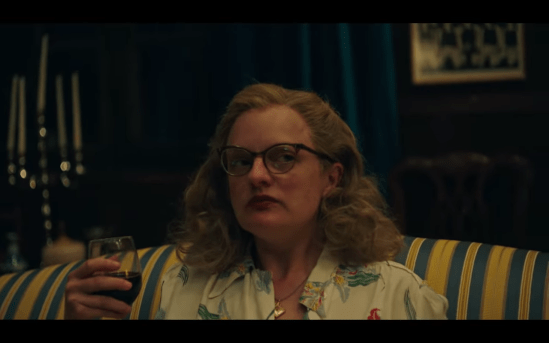
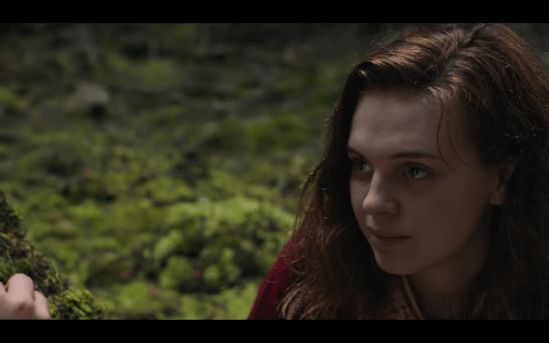
Hot off her success in the gender-dystopian television series, “The Handmaid’s Tale,” and in Leigh Whannell’s vision of a Universal monster classic, “The Invisible Man,” Elisabeth Moss embodies the titular role of Shirley Jackson with a fluid performance of a corkscrew soul. Moss aims to make Shirley as a detestable gorgon with nihilistic and agoraphobic intellect and a narcissistic view of her work she considers to be the holy grail. Moss is methodic and calculating in her character’s icy social skill set and floats half-seen above the water’s surface like an alligator hunting, ready to snap when a warm blooded meal doesn’t expect a thing. Shirley Jackson is only as interesting as her philandering other half, Stanley Hyman, who has a whole separate cache of quirks and callous intentions, though parading in a much more vibrant, lively, and gregarious manner. “The Shape of Water’s” Michael Sthulbarg has pitch perfect execution of Hyman’s managing tugboat who pulls and escorts this cruise liner-sized ego to port with an unorthodox show of a manipulation and affable disingenuous blend working tirelessly that ship to anchor after a long voyage on rough, stagnant seas. Fred and Rose enter like a parallelogram, a four-side rectangular where two sides pair together equally in length, of innocents wondering into a den of a pair of hungry lions. Then, the parallelogram flips and skews to form an twisted mirror of itself that has turned the sweet and loving Fred and Rose into a pair of awaken fragments of Shirley and Stanley. We don’t get to experience much of Logan Lerman as the assistant professor who shadows in Hyman’s overshadowing dominance, but we’re rather engrossed by Odessa Young’s onscreen reciprocity with Elizabeth Moss. Rose falls short of being the epitome of youthful innocence with a fast and loose shotgun marriage to Fred because of her pregnancy and her rendezvousing sexual appetite with Fred, but Rose’s delicate curiosity and naïve gives way for Shirley, Stanley, and even Fred to tread all over her. Young fully grasps Rose’s disadvantage in the viper’s pit that sizes her up for a great fall.

“Shirley” doesn’t bask in the spotlight of the biopic-ee’s celebrated work, like “The Lottery” or “The Haunting of Hill House,” even if it name drops the former; instead, Josephine Decker’s film is cut from the Susan Scarf Merrell cloth that disconnects and desensitizes intellect from moral conduct. Distinct lines are drawn between the couples Shirley and Stanley, whose dynamic teeters on alcohol, smokes, and a banter based on a fraction of love less, and Fred and Rose, who are teased with the taste of the good life, bow and scrape for the attention of their hosts. As the scrupulous infatuations begin to blur the lines and Fred and Rose become infected by Shirley and Stanley’s inceptive wicked cynicism, a metamorphosis occurs as the naïve newlyweds are now the bitterly tireless unable to cop with their shortcoming whereas Shirley and Stanley remain unaffected, if not, better off than from when they started, leeching the purity from the impressionable youngsters like a pair of scholarly vampires. Decker’s airy, dreamlike touch evokes another level of the already Freudian bombarded “Shirley” that’s laden with heavily schemed psychoanalytic foreplay and undercurrent human reaction to a string of unconventional occurrences.

Become the fly trapped in a web of deceits with “Shirley” heading to Hulu, VOD, virtual cinemas, and select drive-in movie theaters come June 5th, 2020 distributed from Neon. The rated R, 107 minutes quasi-biopic is presented a widescreen 1.78:1 aspect ratio. Unfortunately, a digital screener doesn’t allow me to critique the A/V quality. However, composer Tamar-kali’s subdued score lingers on the right side of brooding without feeling overly dreadful and with feeling more horrifically intrusive, complimenting Shirley’s aggressive mind rape of Rose’s psyche. There were no bonus features included with the digital screener nor was there any bonus scenes during or after the credits. Unlike the sullen, reality bending state as the titular persona, “Shirley” is an entertainingly cathartic glimpse into the worst side of erudition plagued upon those lesser informed that builds lustrous works of horror on the backs of perfidy.

Purchase the poster with Elizabeth Moss!