Nothing Will Stop Detective Belli from Bringing Down EVIL Heroin Traffickers!

Perhaps the Best Itali-Crime Film Ever!

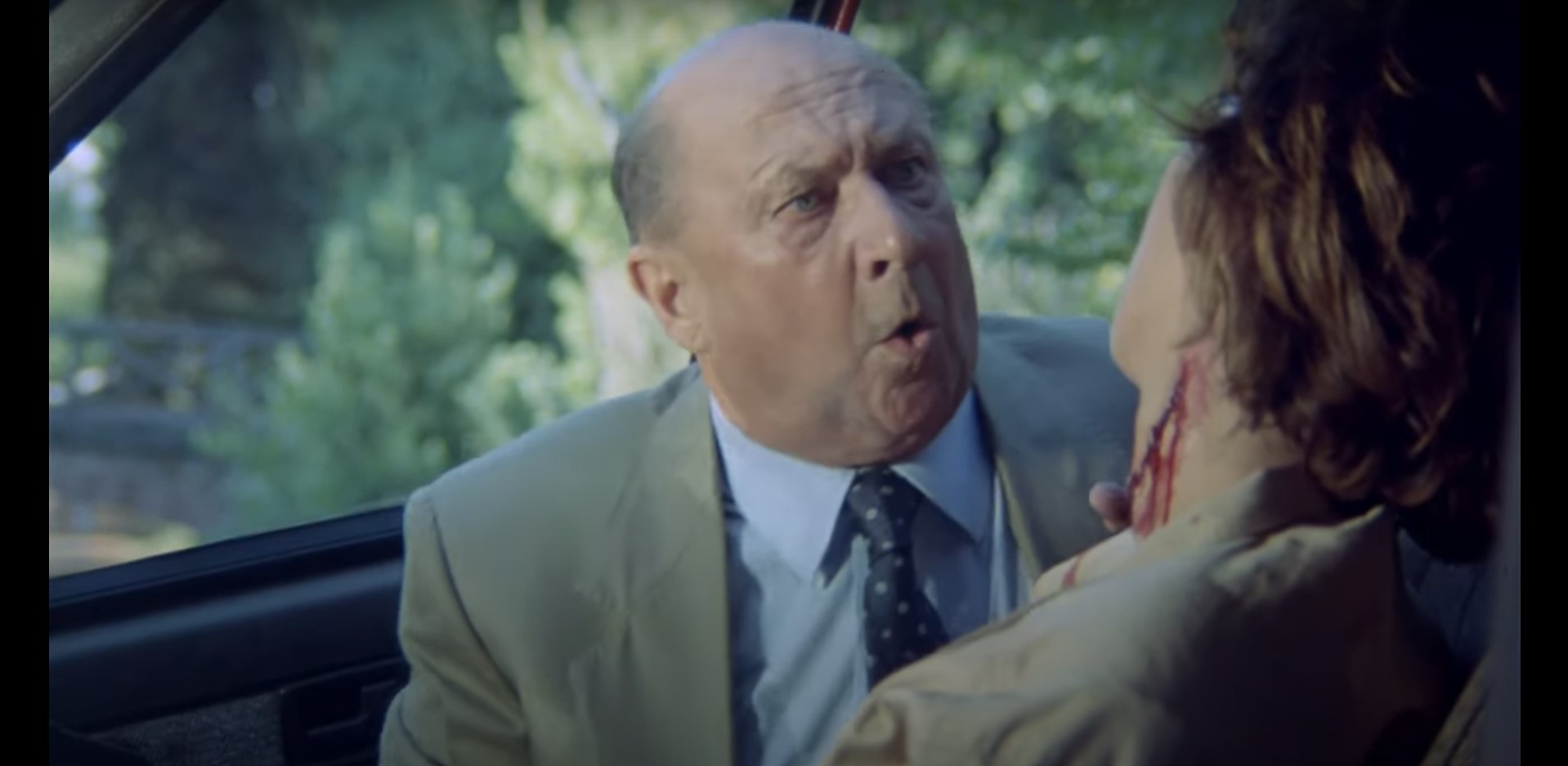
A hot-headed and determined police commissioner will not stop his pursuit until all the drug trafficking in Genoa is annihilated but the insidiousness of the crime’s reach within society is proving to be difficult to root out.  With the help of one of Genoa’s long-in-the-tooth drug kingpins, living out the last of days before terminal illness overcomes him, the commissioner is able to put a dent into a rival organization’s trafficking schemes.  When a case-building chief commissioner, aiming to get the very head of the organization’s snake, is brutally gunned down in the middle of the street and his evidence files stolen, more pressure is placed upon the criminal syndicate with more arrests, more drugs seized, and a bigger impact is made by one resolute cop while attempting to build a more damning case file his predecessor had worked on for years but the drug traffickers will not be deterred and mercilessly go after the commissioner’s loved ones.

Enzo G. Castellari’s “High Crime” is quintessential poliziotteschi.  “The Inglorious Bastards” and “Keoma” director’s 1973 Italo-crime feature is about as fast-paced as it’s energetically loose-cannon of a principal protagonist.  The screenplay, under the original Italian title of “La Polizia Incrimina, La Legge Assolve,” is treated by a conglomerate of Italian writers in Tito Carpi (“The Shark Hunter”), Leonard Martin (“Tragic Ceremony”), Gianfranco Clerici (“Off Balance”), and Castellari himself based off a story by producer Maurizio Amati (“The Eroticist”) and shot on and near the story locations of Genoa, Italy and the French city of Marseille.  “High Crime” is actually a sequel to Romolo Guerrieri’s 1969 “Detective Belli” in which that titular character reappears in “High Crime” but more righteous and justice-prone compared to the corrupt background of Belli in antecedent film.  Both movies star the same actor in the main role but have little connective elements.  The feature is a production of Star Films and Capitolina Produzioni Cinematografiche and is coproduced by Edmondo Amati, father of Maurizio. 

The blue-eyed “Django” actor Franco Nero is that actor portraying Commissioner Belli in both films.  In “High Crime,” Nero is an exuberantly moral cop to the point he looks to be almost throwing a temper tantrum when in the face of his superior Chief Commissioner Aldo Scavino, played by American actor James Whitmore of “Them!” and “The Shawshank Redemption.”  The two characters resemble night and day of how they handle crime; Scavino’s reserved nature evokes a cautionary tale to run down crime slowly but surely in building a case that would settle everything all at once whereas Belli’s take is to chase with wild abandonment that’ll risk all that he holds dear as he chips away toward a heavily fortified crime lord.  Nero and Whitmore exact the personas down to the letter, nailing in the thematic message from Scavino that that the chair he sits in is hot, heavy, and full of responsibility, much the way Uncle Ben tells Peter Parker about great power carries great responsibility.  In Belli’s ear, working his way into the mind of a gung-ho lawman, is drug kingpin is Cafiero by Fernando Rey, who two years prior played in a similar story of William Friedkin’s American, lone-wolf cop story “The French Connection.”  Rey adds sophisticated demure to his really bad guy character to appear like an ally in not only the eyes of Belli, who really puts his trust in Cafiero, but also the audiences who will forget he’s an equal in the drug game.  What’s interesting and dynamic about “High Crime” is the woven character arcs and fats that quickly develop and quickly diminish through Belli’s investigation.  In the mix of this unsafe space for any character is Della Boccardo (“Tentacles”), Silvano Tranquilli (“The Bloodstained Butterfly), Duilio Del Prete (“The Nun and the Devil”), Mario Erpichini (“Spasmo”), Ely Galleani (“A Lizard in a Woman’s Skin”), Stefania Castellari (“1990:  The Bronx Warriors”), Bruno Corazzari (“Necorpolis”), and Luigi Diberti (“The Stendhal Syndrome”).

“High Crime” deals in high impact.  Car chases, shoot outs, foot pursuits, murder hits, and more that genetically makeup Castellari’s film with a centralized hero destined for tragedy spurred by his own ambition, texturing the character with an anti-hero wallpaper as he can’t see past his own objective and the direct danger that blind ambition poses.  Kneaded into this notion is Caastellari’s fantastic use of editing and scene transition that provides a seamless continuity as also misleading truths.  Editor Vincenzo Tomassi (“Zombie”) cuts and splices with great continuity care to arrange multiple shoots of one scene, such as the opening car chase between Belli’s squad car pursing a Lebanese drug supplier, to match every angle without losing track or bewildering audiences with implausibility.  The transition scenes also stun with zoom-in and zoom-outs that segue different scenes, a previous moment may bleed into another with deceptive infiltration of the next scene, and Castellari uses sounds too to transition to the next shots.  These on-your-toes transitions commingling with the ever-dynamic, fast-paced crime story with a high mortality rate, high character development, and high emotional roller coaster loop-the-loops whirling around the abundant and impressively rounded characters solidify “High Crime” as the holy grail of highly valued and highly entertaining poliziotteschi!

If you’ve ever wanted more out of Enzo G. Castellari’s “High Crime,” Blue Underground has you covered with a limited edition 3-Disc, UHD HD Blu-ray, Standard Blu-ray, and soundtrack CD set packed with content in the HVEC and AVC encoded double layers of the 2160p 4K UHD BD66 and 1080p Blu-ray BD50.  The brand-new 2024 Dolby Vision HDR 4K master stuns.  Image resolution connected with balanced contrast results in a vibrant, crisp-sharp quality rendered from a stellar original 35mm print, presented in the original aspect ratio of a widescreen 1.85:1.  There’s not an arresting softness to be had as details emerge in the various Genoa and Marseilles ship ports, manufacturing parks, and concrete city landscapes bursting with infrastructural texture.  There’s also plenty of minute detail on skin textures with a touch of technicolor process for a dash of properly installed pigmentation.  This sort of scrutinizing care translates also to the post-ADR English 1.0 DTS-HD audio mix with an uncompressed, lossless fidelity.  Dialogue is post-recorded with the original actor’s voices providing better authenticity in comparison to other voice actors, especially over the gruff American voice of James Whitmore.  Environmental ambience doesn’t miss an action with a complete and broad line of virtual city sounds coupled with in-scene ambient sound, all converted and individualistic defined through the single channel, supported by Oliver Onions brothers Guido and Maurizio De Angelis providing a catchy copper beat whether be car chase or foot pursuit.  There also an Italian dub 1.0 DTS-HD.  English subtitles for the deaf and hard of hearing are optionally available as well as French, Spanish, and English for the Italian audio feature.  Hours of bonus materials lined the encoded BDs, more so on the second disc, the Standard Blu-ray, due to capacity.   Disc 1, the 4K UHD, houses an audio commentary with director Enzo G. Castellari, a second audio commentary with star Franco Nero, a third audio commentary with film history Troy Howarth, Nathaniel Thompson, and Eugenio Ercolani, an alternate ending that fades to black rather than the original freeze frame, and the theatrical trailer.  Disc 2, the standard Blu-ray,, has all of the above plus interviews with Castellari and Nero The Genoa Connection, an separate interview with Castellari From Dus to Asphalt, an interview with stuntman Massimo Vanni Hard Stunts for High Crimes, an interview with camera operator Roberto Girometti Framing Crime, an interview with soundtrack composers Guido and Maurizio De Angelis The Sound of Onions, a Mike Malley directed featurette The Connection Connection featured in EUROCRIME!, and a poster with still gallery.  The double wide Amaray case also comes with its own special attributes, such as a rigid O-slipcover with compositional illustration of pretty much all the action you’ll see in the film.  The slipcover also contains embossed textile elements for a junior-sized 3D effect.  The set has a reversible front cover with the primary art the same as the slipcover’s while the inside contains an original poster art replica.  The insert side contains a dual-sided cardboard track list and soundtrack info on top of the back and red original motion picture soundtrack CD.  The 4K UHD and Blu-ray on the opposite side are staggered in individual push locks where you have to remove the top disc in order to get the bottom disc and they’re too pressed with the same art from the reversible front cover.  Blue Underground outdid themselves with “High Crime’s” first Blu-ray release, curated to perfection, in the U.S.  The Not Rated Blue Underground set is playable on all regions and has an uncensored, uncut runtime of 103 minutes.

Last Rites: To simply write positively about “High Crime” and Blue Underground’s merit 3-disc set is simply not enough. Fans of William Friedkin’s “The French Connection” and other moviegoing fans can find this Eurocrime thriller to be captivating from start to finish.

Grab this Limited Edition Set of “High Crime” Before Its Gone!

If Highschool Didn’t Already Have Enough EVIL In It! “Homework” reviewed! (Unearthed Films / Blu-ray)

Purchase “Homework” Blu-ray Here!

Highschooler Tommy can’t take it anymore.  His friends all talk about their sexual experiences and he’s still a virgin.  Talking to a therapist to help redirect his sexual energy into something else, Tommy becomes inspired with the idea to form a rock band with best friend Ralph.  The eager students secure three classmates from the student body to round out the band, one not being the obsessed competitive swimmer Sheila whom Tommy has strong feelings.  Each band member’s lives revolve around their own sexual activities from sneaking around from their God-fearing, prudent parents, embellishing fantasy from late night tutoring sessions gestured by a hot, young French teacher, or contracting a venereal disease from a rockstar idol.  As Tommy continues to plead with Sheila to attend just playing session, he becomes sorely frustrated by not only her lack of reciprocated affection but also lack of friendship towards the rest of the group, resulting in him finding his sexual prowess in the arms of a classmate’s mother who also recounts fondly her sexualized youth. 

Not just another teen sex comedy from the 1980s, “Homework” is the provocative, controversial, and obscure teenage comedy-drama from James Beshears, his one-and-only director credit behind his day jobs of being a film sound editor on such a range of films from “True Lies,” to “Day of the Dead,” to “Porky’s Revenge.”  The script is the debut feature from cowriters Maurice Peterson and Don Safran that carves out story subdivisions from Tommy’s friend and denotes Tommy as the as the epicenter of sexual hangups.  The late, legendary producer Max Rosenberg, producer of many B-reels such as “Dr. Terror’s House of Horrors,” “And Now the Screaming Starts!,” and “Perdita Durango,” secured funding for the feature alongside Robert Fenton (“The Incredible Melting Man”) with Beshears and Safran producing under the production and distribution label of Jensen Farley Pictures. 

The top bill was denominated to actress Joan Collins of the television series “Dynasty” fame, but the once voluptuous English brunette, who starred in “Fear of the Night” and “Sharon’s Baby,” sizzles in a more mature role in early 80s production with a screen time of about a third of “Homework’s” runtime.  Much of the story focuses on Tommy, played by the late Michael Morgan (“Midnight Offerings”), who succumbs to Collins’ character’s subtly and sudden sultry desires for her daughter’s school friend when helping her hang a picture.  The building up to this moment isn’t as plain on it’s face as it would seem with audiences subjugated to teenage fantasy and mature women’s reminiscence that doesn’t even hint cougar encounters.  Collins, unfortunately for you sleazoids out there, had a body double for the character’s topless scene and romantic entanglements but the then late 40s actress had plenty of curves and sex appeal to make any man, no matter than carbon-date, sweat with arousal anticipation.  “Homework” spreads the love, literally, as each band member goes through a totality of teenage sexcapades, individualized and customized to their own story’s arc, and there’s not a path of sexual conquest to be had but rather a variety situational scenarios where teens either learn the hard way, face the consequences, or leave their hearts at the door to avoid disappointment because at that age, the youth are the most impressionable and angsty with mixed up emotions.  A young cast of Lanny Horn (“Tarantulas:  The Deadly Cargo”), Erin Donovan (“Mack the Knife”), Renee Harris, Shell Kepler (“The Great American Girl Robbery”), Mark Brown, and John Romano (“Dandy”) act toe-to-toe with Lee Purcell (“Necromancy”), Carrie Snodgress (“The Attic”), Ernestine Jackson (“Aaron Loves Angela”), Bill Knight, Rosemary Alexander (“Madhouse”), Howard Storm, and Wings Hauser (“Vice Squad”) in this eclectic casting. 

What’s most memorable about the little-known production is not the sex-driven antics and mischievousness of high school boys but rather the day-in-a-life of touch choices and toucher consequences interlaced with regular adolescent customs, such as missing the cut for the swim team and beating yourself up for it, smoking dope in the school locker room, have the fantastical hots for the new young teacher, starting a garage band, etc.  “Homework” has comparable, lighter traits to the 1995, Larry Clark coming-of-age film “Kids.”  While not as crass or violent, “Homework” has high-impact themes like sexual transmitted diseases accompanied with visits to the women’s health clinic, a misunderstanding of sexual education, and, even to go as far as, the exploitation of minors to an extent and a spiral of obsession as we see with Shelia is won’t leave the pool in order to shave time off her laps, neglecting friendships, and even romantic relationship with Tommy whom ends up in the arms of her equally emotionally irresolute mother reminiscing a past of first time and exciting sexual encounters.  While the story manages to stay afloat with multiple sub-stories, technically, “Homework” falls below the conventional quality standard of the period with visible boom mics, a deficient picture quality, and lack of artistical knowhow from a new director in James Beshears.  Luckily for viewers of obscurity, lovers of the long-forgotten, and retro-adventurers, there are boutique labels salivating for the chance to revive and resuscitate these titles back into our field of vision. 

That boutique label is for those who are in the know wouldn’t expect “Homework” to be released on.  Unearthed Films brings the James Beshears film to Special Edition Blu-ray, the first time on the format, with a new 2K scan a part of their Unearthed Classics banner, numbered at 15.  The AVC encoded, 1080p high definition, BD25 presents to date the best image quality possible from the original 35mm negative shot on an Arriflex camera.  There’s slightly more grain presented on this transfer that stems from Paul Goldsmiths’ cinematography and with that there’s a loss of detail in darker scenes that become victims of black crush where delineation bleeds into the environment and darker clothing no longer renders outstanding with the proper shades.  Better lit scenes have more distinction coherency, but the color diffusion is limited and the original image retains a lower resolution akin to 720p and seldomly increases an upscaled 1080p in the 1.85:1 widescreen aspect ratio.  What’s notable about this release, and despite the visible equipment gaffs, is the uncompressed LPCM 2.0 mono audio mix that doesn’t reflect any kind of hissing, popping, or damage to the track.  There’s not a ton of range or depth representation with mostly interior shots containing dialogue, which is prominent and clear under the lossless compression.  English subtitles are available.  With the obscure nature of “Homework” comes with it not a lot of special features but what’s included is an archived interview producer Max Rosenberg going into detail of the film’s genesis and controversies, a promotional gallery, and the trailer along with other Unearthed Classic prevues.  Unearthed Classics’s illustrated, cardboard O-slipcover of the prefacing sex scene between boy and woman covers the same image on the standard Amaray’s front cover.  There are no inserts or other physical contents.  The rated R release has a runtime of 89 minutes and is listed as region A for playback; however, I did have my player set to region B during play and so the release is tested for A and B regions.

Last Rites:  Plenty of nudity and surrounding controversy keeps “Homework” relevant in today’s every-stimulating, ever-producing retro-release market but it’s the film’s pertinent application of teenage troubles that tips the scales to seeking this unconventional Unearthed Film’s Blu-ray release.

Get an A on this “Homework” Blu-ray Release!

Second Sight Delivers the EVIL Goods Yet Again! “You’re Next” reviewed! (Second Sight Films / Blu-ray)

Limited Edition and Standard Edition Sets of “You’re Next” Available At Amazon!

Celebrating 35 years of marriage, Paul and Aubrey Davison invite their four children – Drake, Crispian, Aimee, and Felix – to their rural weekend manor along with their respective spouses for the occasion.  Tensions amongst strained family ties begin to boil over as siblings quarrel before they even share the first meal all together.  Yet, that’s the least of the family’s problems when animal masked intruders shoot crossbow arrows through the windows and are found hiding, waiting under the bed with machetes.  The surprising attack sends a surge of shock through them but not Crispian’s girlfriend Erin who intends on fighting back and defending herself with survival knowhow.  As the night carries on, the family is being brutally executed one-by-one in what is seemingly random acts of violence.  Unsure how many assailants are outside and the cell service not working, Erin and the rest of survivors attempt to survive the night until help arrives. 

Before being the directorial face behind the recent string of mega blockbusters, literally, in the “Godzilla vs. Kong” films, Adam Wingard had more humbling beginnings as an original horror storyteller.  From working with “Texas Chainsaw Massacre: Part II’s” Bill Moseley as a demented door-to-door salesman in “Home Sick,” to interlacing themes of drug addiction and haunting visions in “Pop Skull,” to thrill with an abusive pursuit of an escaped convict tracking down his ex-girlfriend in “A Horrible Way to Die,” Adam Wingard had a knack for extracting small time horror in a big way.  Although all three of those examples saw success at some level, the glass ceiling never really broke until a juncture point just after the turn of the decade in 2010 with “You’re Next.”  Screenwriter Simon Barret, who also before writing “Godzilla x Kong:  The New Empire,” wrote the U.S. home invasion and slasheresque horror-comedy as the fourth film under Wingard’s direction, following “A Horrible Way to Die,” “Autoerotic,” and “What Fun We Are Having;” however, Barrett has found moderate success of his own with “Frankenfish” and, one of my personal favorites, “Dead Birds,” with an early performance from Michael Shannon.  Barrett, alongside Jess Wu and Keith Calder of Snoot Entertainment, Chris Harding, Kim Sherman, and Brock Williams produce the Snoot Entertainment in association with HanWay Films production.

“You’re Next” reunites a cast of Wingard regulars, interchanged with good friend and fellow horror filmmaker Ti West (“The House of the Devil”) that has all but nearly faded the higher the filmmaker climbs the Hollywood latter.  The entourage includes “Hatchet II” and “The House of the Devil’s” A.J. Bowen as the pacifist academic Crispian, “Alien:  Covenant” and “Pet Semetary’s” Amy Seimetz as Crispian’s starving filmic sister Aimie, “The Sacrament” and Autoerotic’s” Joe Swanberg as the pompous older brother Drake, and “Pop Skull,” and “V/H/S’s” Lane Hughes as the Fox masked killer all of whom were in Wingard’s “A Horrible Way to Die” a year earlier.  Plus “Home Sick” and “Pop Skull’s” L.C. Holt dons a killer’s mask and director and friend Ti West of the highly popular X film series also has a brief role that plays into their whole dark nature of storytelling.  The inner circle of friends and usual casting smooths out to fills voids by adding a couple of marketable and genre renowned names to add a solidifying agent to “You’re Next’s” magnetism with “Habit” and “The Last Winter” actor-director Larry Fessenden as well as un-retiring one of the genre’s more respected and timeless scream queens and final girls in Barbara Crampton (“Re-Animator,” “Frome Beyond”) to be playing matriarch and host of the family being invaded upon.  Though marking her return back to horror, Crampton relinquishes her reins on the final girl trope, swallows her stardom by moving aside, and letting have that particular subcategory role to Australian actress Sharni Vinson (“Bait”) in one of her first handful of roles in a feature film.  Vinson will send shockwaves through audiences on her quick turn of character from a lovely, liberal oblique woman to a complete cutthroat badass that not only turns the tables on the attackers but also shepherds in a new fear or thrill – a worriment encompasses over the sociopathic bad guys.  “You’re Next” puts up a high body count with the rest of the cast body including the late Nicholas Tucci (“Choose”), Wendy Glenn (“11-11-11”), Margaret Laney (“Absence”), Rob Moran (“There’s Something About Mary”), and Kate Lyn Sheil (“She Dies Tomorrow”).

Before the film’s release in 2011, the home invasion genre saw an explosion of examples from class that wasn’t exceeding in quantity but rather rocketing skyward in quality.  The French had a good handle on concept with a bleak, ultra-violent coating that completely engrossed viewers as well as rocked their core with how nihilistic and cynical characters could become without a heroic, saves-the-day, or survival outcome, such as is the cast with 2007’s “Inside” and 2008’s “Martyrs.”  The American industry also attempts to capitalize on the niche market with “Funny Games” released in 2007 but that too is based off a European script from Austrian filmmaker Michael Haneke’s original film a decade earlier of the same title.  In all fairness, Haneke also helmed the remake starring Tim Roth and Naomi Watts.  Yet, American audiences adored their own success with Bryan Bertino’s “The Strangers” in 2008 and a remake of Wes Craven’s “The Last House on the Left” by director Dennis Iliadis in 2009 that conveyed that sort of callous violence and anarchial analogies.   Then in steps Adam Wingard and Simon Barrett’s entry of “You’re Next” of shared sadism and pessimism but sprinkles it gallows humor through the dialogue exchanges and impressions of character attitudes to make a hybrid that pulls inspiration from the likes of “Funny Games,” “The Strangers,” and “The Last House on the Left” and still finding individuality amongst the like without suffering from an identity crisis.   Protagonists and antagonists swerve through an interchangeable junction, flipping the script just when you think you’ve plotted the course of the storyline, and yet, a found sense of cold cock shock lands squarely when all is said and done and bits and pieces of the royale rumble characters are strewn about the battled ground mansion. 

“You’re Next” arrives at the UK label and friend to physical media Second Sight Films.  Second Sight’s single disc Blu-ray comes AVC encoded with 1080p hi-def resolution and dual layered with a BD50, projecting a consistent 24FPS.  There’s not much to terribly note about Second Sight’s quality release of Adam Wingard’s over 20-year-old, 4K shot film as digital stock hasn’t necessarily changed significantly for the better over the last two decades.  Presented in a widescreen 2.39: aspect ratio, Wingard and cinematographer Andrew Droz Palermo (“The Green Knight”) choose a warmer color pallet of mustard yellows and burgundies, accentuated by enveloping three-point lighting and the tweed dinner jackets and turtlenecks, to give it a retro 70s or 80s veneer in a modern time.  No banding issues or digital compression anomalies with the ample disc space.  Range is fine but limited to mostly the aforementioned color scheme.  Depth is almost limited in what is mostly a series of medium to closeup shots in an interior setting, but we’re treated to a mixed melee of close-up violence that sees splatter scatter the dark syrupy blood.  A DTS-HD 5.1 Master Audio mix layers a lossless fidelity consistency.  Dialogue has no issues with obstructions, favoring a clean and clear presentation of exchanges without losing inflection, tone, and vitality during the chaos, calmer moments, and tensioned exchanges.  A fugitive depth doesn’t sustain any kind of depth; again, with the close quarters action, we tend to forget Larry Fessenden’s blaring music left on repeat and noted to have at least three layers of depth from within the stereo’s room, between rooms, and outside the house.  Organic and inorganic ambience and action have seamlessly admixed without a sense of artificial notice.   A compilation of artist soundtrack isn’t invasive or intrusive with the assailants and that kind of dampens the effect but it’s an overall workable mix from Mads Heldtberg, Jasper Justice Lee, Kyle McKinnon, and Wingard himself.  Optional English subtitles are available.  Second Sight Films reliability to earn the right to re-release another modern production stands through again another special features laden release that includes a brand-new audio commentary with director Adam Wingard and writer Simon Barrett as well as archive audio commentary with Wingard, Barrett, and actresses Sharni Vinson and Barbara Crampton.   Another new feature is an approx. hour long interview Children of the 80s with Wingard and Barrett recollecting and going through the details for the genesis of the story and film.  Other new interviews include producers Keith and Jess Wu Calder the Most of Us, actor AJ Bowen Script is a Blueprint, actor Joe Swanberg Down in the Basement, actor Amy Seimetz Be Funny or Die, and production designer Tom Hammock Falling into Place.  Animated storyboards, an archival making of What’s Next?, and a video essay from Tim Coleman Slashers Don’t Die fill out the immensely packed second layer.  House in the standard Second Sight green Blu-ray Amaray for their standard lot, the front cover is gruesomely beautiful with a blood illustration of Sarni Vinson in character that’s also very telling of the film’s tone.  Like all their standard releases, this one comes with no inserts inside or other tangible bonus content.  The disc is pressed with another illustration of one of the masked killers.  The UK certified 18 release contains strong bloody violence, as well as language and brief nudity for those of us Americans wondering at home, in a 95-minute duration to which is encoded with a region B playback. 

Last Rites:  “You’re Next” denounces the helpless and the defensive character topes aimed to be slaughter like cattle in an abattoir.  Instead, this final girl and ferocious slasher and home invasion thriller goes against the grain and has gruesomely fun with its kills and thrills.   

Limited Edition and Standard Edition Sets of “You’re Next” Available At Amazon!

Wake Up and Get Lost in the EVIL Flowers. “Terror Firma” reviewed! (Dark Arts Entertainment / Blu-ray)

“Terror Firma.” The First Dark Arts Entertainment TItle Now Available!

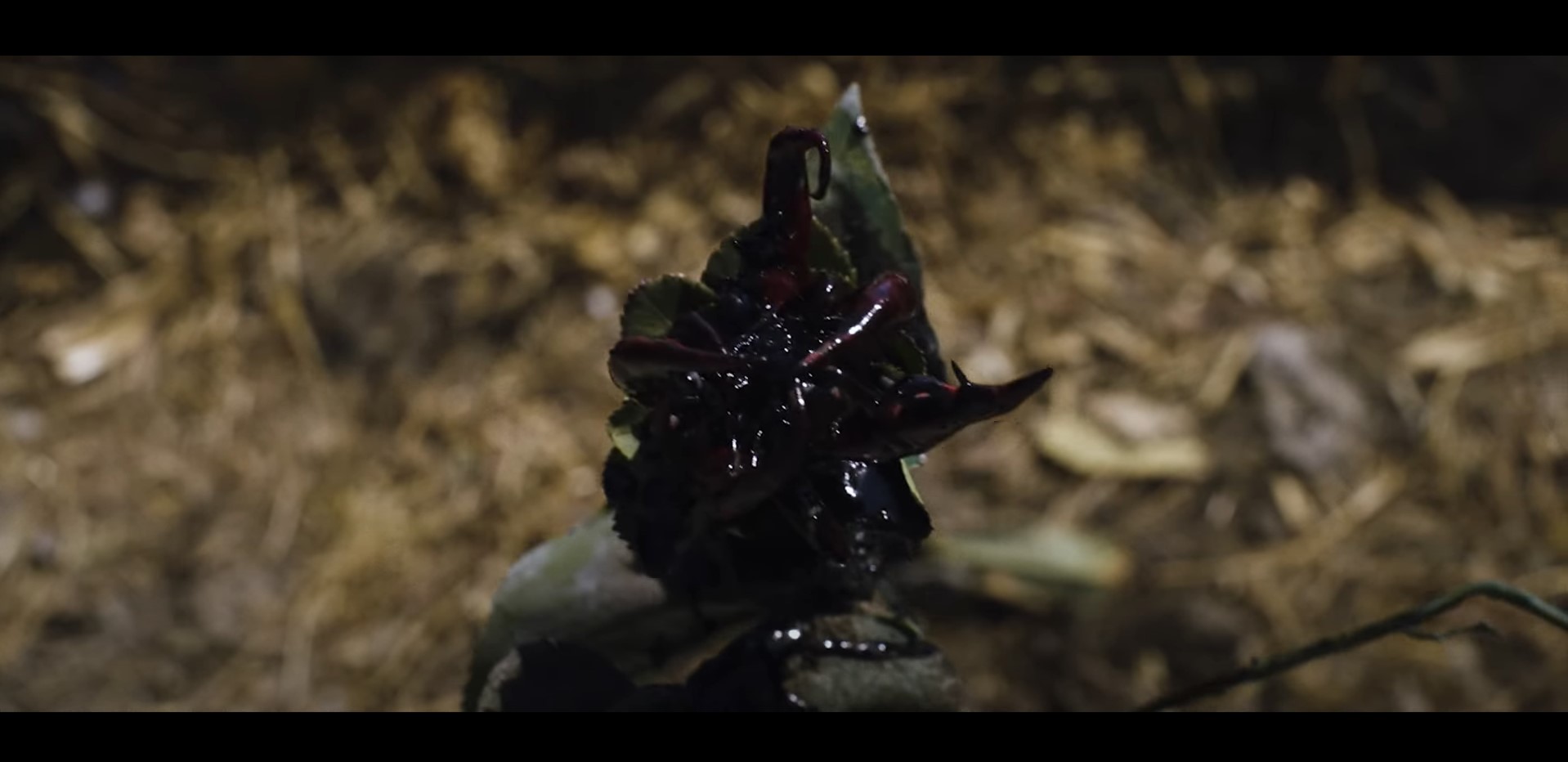
Having no place to go during the middle of an unexplained, national Marshall Law event where citizens must remain indoors or else face imprisonment, Lola bunks in with her fellow adopted brother Louis and his bizarre tenant Cage. Though Lola and Louis have not seen each other in years, they quickly bond to deflect Cage’s peculiar persona that has honed in on Lola. After receiving a government issued drop shipment of food, Lola discovers a seed packet wedged in between the boxes. Her curiosity sows a single seed that results a hole in the ground next day, a hole that produces a jelly that conforms to their individualized favorite flavors, and they become addicted to its intoxication, but when Louis disappears, seemingly trapped between dimensions and communicating underneath an alien flower where the hole use to be, Lola is stuck alone with Cage who’s more and more becoming twisted by the transcendental jelly.

A pun play on the idea of terra firma, defined as the Earth’s ground or surface, “Terror Firma” is a prismatic and cosmic hell hole of a psychological and interdimensional thriller from writer-director Jake Macpherson. Macpherson, a regular music video director of photography and a short film filmmaker, debuts his 2023 feature film with a broader, elephantine story under a bantam budget, reduced to a singular location, and uses the idea of terra firma as the basic premise for natural Earth horror blended with the pandemic confinement of COVID-19 in which the story was conceived and how that isolation acceptance, thralldom from authoritarian instruction, and broken family bridges originate the internal dysfunctions outward toward a destructive, maddening outcome. “Terror Firma” is a production of the Los Angeles based Capture Theory company with Macpherson, John Angeli, Forrest Clark, Theo Linder, Katie Mamie, and Bryan Wilson serving as mostly first-time producers.

Keeping in line with a low-cost production, the story takes root at mostly one location, Lou’s rundown, multi-story house with creaky old floors and compact rooms, extending the location beyond the walls and into the house’s minute front yard where a pile of dirt with a strange jelly hole metamorphizing into an even stranger looking flower becomes the catalyst of weirdness.  Thai-American actress Faye Tamasa is Lola, the weary sister of Louis, played by Burt Thakur, who invites her to come stay with him during the beginning of a nationwide shutdown of unexplained purpose.  Lola and Louis, both once orphans and adopted by the same parents, haven’t seen each other in years and have rarely spoke.  Repeated motifs of isolation, such as the extension of their orphanage, and an awkward disconnect between them display their relationship instable without having an obvious clash to outright scream incompatibility between the two who don’t share bloodline but grew up together.  There’s still an affection quality between them but it is damaged.  And, then, in comes the third wheel that becomes the wedge between Lola and Louis’s relationship rekindling.  Cage, a dodgy spiritual pseud and played with monotonic sleaziness by Robert Brettenaugh (“Strange Blood”), interjects his numinous nonsense as a façade to impress Lola but as Lola sees right through him, Cage diverts his attention to the Jelly that drops the façade and unleashes his true spirit, a sociopath with an obsession.  The trio works to relay a significance in loneliness and isolating desperation in a sensationalized, supernatural way in finding a pathway through the lockdown blues.   Rounding out the cast with a small role that wouldn’t even be considered turning the trio into a quartet is Max Carpenter as a former love interest to Lola.

Not to be confused with or have any similarities to Lloyd Kaufman’s 1999 burlesque slasher titled “Terror Firmer,” Macpherson’s debut is born and bred out of the woes of a global pandemic by formulating a fantastical escape from the reality as we knew it before everything went into an abrupt lockdown.  The sudden stoppage of the world and social gatherings certainly began a snowball effect of emotional distress, some more external than internal that gradually drew to head an uneasy amount of stir crazy.  For the trio of roommates, and like most of us during the beginning of the lockdown, we’re excited and thrill for a break in the norm but as time marches on, those you’re stuck with without anywhere to go is an unusual alienating feeling.  “Terror Firma” expediates the sullied sensation to cosmic proportions with gateways to upside down worlds that mirror our own and develop cultish acolytes to the Jelly’s mystical powers.  Granted, no much of Jake Macpherson’s story makes a whole ton of sense and is very open to interpretation, but one possible avenue I’ve concluded is that the Jelly is a convenient, sweet-tasting poison that one can easily fall for its pseudo-tranquility and limitless euphoria to solve all our immediate problems as a quick fix but ultimately it’s our will and the power within ourselves to reconnect, re-establish, and revitalize what’s missing from ourselves.  Macpherson’s hallucinogenic rabbit hole of a thriller is an abstract course on preservation of relationship and connections while overwhelmed with obstacles.

Prominent genre filmmaker Brian Yuzna, well-known for his behind-the-camera roles on Stuart Gordon’s “Re-Animator” and “Dolls,” as well as his own directorial credits “Society” and “Beyond Re-Animator” to revolutionize the way we see horror in the 80s and 90s, teams up with John Penney, writer of staple cult classic “The Kindred” and “Return of the Living Dead III,” to form a new at-home physical media label known as Dark Arts Entertainment.  “Terror Firma” is the first title to be released by the joint partnership with MVD Visual for distribution.  The AVC encoded, 1080p high definition, BD50 houses the widescreen, 2.39:1, aspect ratio presented blossoming madness.  Picture image varies with the refracting coloring within the polychromatic lenses and in contrast to the post grading of a slightly coarse tone.   Yet, that isn’t to say quality is subpar and we’re treated to a fine digital image compressed without compromising the encoding on a double layered disc.  The English LPCM Stereo 2.0 offers a lossless reproduction of true audio fidelity and while not be a powerful mix course isolated layers through individualized channel outputs, “Terror Firma” isn’t necessarily powerful in range.  There’s only a handful of psychedelic moments of discord tunes and notes to emphasizes the crossing between dimensions and a few minor key moments to evoke fear out of Cage’s madness but other than that, “Terror Firma” specializes mostly in exposition and silently witnessed moments.  Dialogue is clean, clear, and prominently placed with depth dialed in where needed, especially when Lou begins to speak beyond the plane.  English subtitles are available for the feature only.  Inside the bonus material, a second version, an extended director’s cut, of the film is available and does not have the subtitle option.  Also included is Jake Macpherson’s commentary with main feature, a behind the scenes gallery, and the theatrical trailer.  The maiden Dark Arts release package is standard fare with a traditional Blu-ray casing containing no inserts or other tangible material ride alongs.  Release cover art leaves enough to the imagination to be lured in with Faye Tamasa crawling through a dirt hole and coming upon the alien flower.  The not rated feature has a runtime of 84 minutes and is encoded region free.

Last Rites:  “Terror Firma” is a bold first impression for not only writer-director Jake Macpherson as his debut full-length feature film but also for Brian Yuzna and John Penney inaugurating their distribution label with a film that might not strike a likeable chord with most but will certainly leave a relatable lasting impression on us all. 

“Terror Firma.” The First Dark Arts Entertainment TItle Now Available!