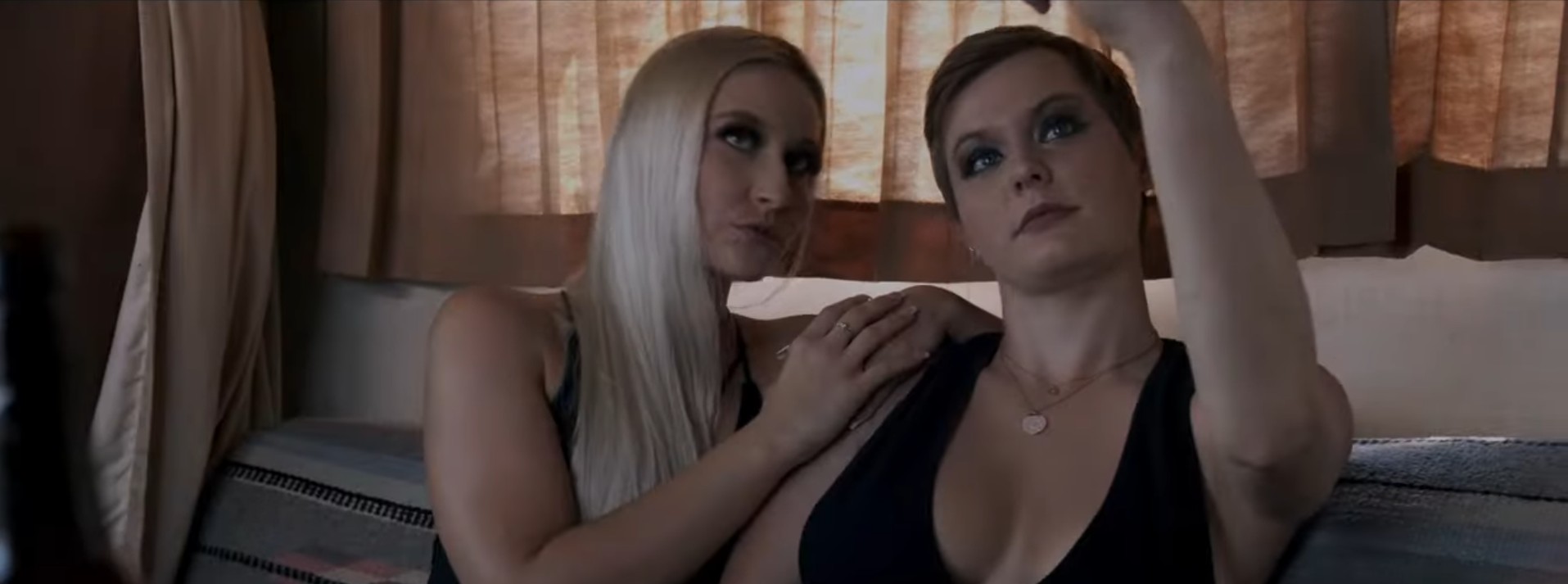
EVIL’s Beauty is in Her Catwalk Madness! “Nothing Underneath” reviewed! (Rustblade / Blu-ray)

“Nothing Underneath” 40th Anniversary Blu-ray Available Here!

Bob Crane, a Wyoming park ranger, suddenly sees visions of gloved hands wielding long, sharp shears entering his supermodel, twin sister’s hotel room in Milan, Italy.  His  psychic experience with his sister sends him packing frantically to Italy, specifically to the Hotel Scala, where his sister, amongst many other gorgeous supermodels, reside when working in Milan.  Unable to locate her and without a sign of disturbance in her hotel room, her disappearance is seemingly nothing more than that – a disappearance – but an aging police detective, Commissario Danesi, is willing to investigate the disappearance which will be his very last case before retirement.  Without any leads, Crane and Danesi don’t have much evidence to go off of until another supermodel is brutally murdered in the same hotel and a pair of scissors is the forensically determined cause of death.  The once case of disappearance now turns into a murder investigation and goes deeper into the ugliness of the fashion world with a deranged killer targeting supermodels. 

Considered to be a prominent gem of the giallo genre but not entirely considered to be a full-fledged horror by the filmmakers is Carlo Vanzina’s “Nothing Underneath.”  Known natively as  “Sotto il vestito niente,” inspired by the title only written by Marco Parma, a pseudonym for journalist Paolo Pietroni, Vanzina cowrote the novel extraneous story alongside brother Enrico Vanzina (“Call Girl”), who are siblings more suited in the measures of comedic premises initially, and the prolific horror writer Franco Ferrini’s, whose screenplays of Dario Argento’s “Phenomena,” “Opera,” “The Card Player,” and amongst others, as well as Lamberta Bava’s “Demons”, gave the writer formidable cult status and creditability amongst the international horror fan base, not to forget to mention regular work and collaboration with a master of horror, Dario Argento.  “Nothing Underneath” is shot on location in Milan under the Faso Film productions with executive producer Raffaello Saragò (“The Witches’ Sabbath”) and producer Achille Manzotti (“Beyond Darkness”).

What’s interesting and more infrequent for this Italian production is that it’s entirely shot in English and not dubbed in post-production ADR.  Reason for this was for “Nothing Underneath” to be a synch-sound production with the image and to market it better internationally because of the main cast comprised of American and English actors.  The American actor, starring in his debut feature film, is Tom Schanley (“Savage”) as Wyomning park ranger Bob Crane and the way the story is structure really homes in Crane as the principal lead with a complete credit setup and character follow-through of the Yellowstone National Park.  Schanley’s blonde hair and muscular toned good looks embodies a likeness to his on-screen supermodel sister, played by Nicola Perring, who, as the story displays her, is not in the business of acting with very little dialogue and is only used for her short platinum blonde hair and thin figure for narrative form fitting.   The other native English speaker in a cooperative lead role is “Halloween’s” Donald Pleasence as an investigator on the verge of retirement.  Pleasence is no stranger to Italian cinema, seeing his fair share in the 1980’s psychotronic pictures, including Dario Argento’s “Phenomena” released prior.  The prolific British actor still manages to produce mountains of charm even in his most rubbish Italian accent as the long in the tooth comminssario eager to solve one more exciting, mysterious case and buddying up with young, handsome, and outdoorsy Bob Crane with twintuition.   The love interest falls upon real life model and Denmark native, then 19-year-old Renée Simonsen who is absolutely stunning with her looks and with her debut into acting in what is a significant role that involves a lot of screentime, a lot of dynamic and interactive dialogue, and does show some brief nudity with intimate sexual situations with Schanley.  “Nothing Underneath” has a roster that fills out with Catherine Noyes and Maria McDonald as Milan models, Paolo Tomei as a coke-head jeweler and model philanderer, Cyrus Elias as Comminssario’s Danesi’s assistant, and Phillip Wong as the peculiar fashion photographer Keno Masayuki.

“Nothing Underneath” isn’t a skimpy, loose garment with nothing going for it.  Instead, Carlo Vanzina offers more with his giallo by making it less giallo in terms of its cinematic style and with Pino Donaggio’s score which is in the style of, much like the rest of the filmed and narrative structure, a Brian De Palma erotic thriller.  With plenty of sexy sashaying from beautiful models, a balance between sex and sadism teeters as the alluring aspects of a promiscuously titled are dissected and interspersed with a long sheer psycho engrossed by a theme rarely explored and depicted, but certainly skimmed, during those times of 1980’s Europe and completely disconnected from Paolo Pietroni’s story with keeping only the fashion world and the murder mystery as core elements and adding a supernatural flavoring with the brother and sister telepathy.  Donaggio’s suspenseful brass orchestration and conduit synth-infusion score separate itself others in the subcategory that deploy synth-rock, haunting discord, and, perhaps, even a late 70’s swanky cop thriller piece typically layered alongside.  The composition, coinciding with the temporary expat cast as most giallo’s permit, often feels more westernized while still striking notes of unnerving tension and having collaborated with De Palma on “Dressed to Kill” and “Body Double” years prior, Donaggio imports those arrangement qualities for the Italian market and reaping success amongst the rest of the frayed giallo conventions. 

Italian boutique label Rustblade extends their release of “Sotto il Vestito Niente,” aka “Nothing Underneath” to the North American market with a new region free, 40th anniversary special edition Blu-ray release as well as releasing deluxe releases that come with accompanying limited edition lobby cards postcards, a polaroid, a poster, a colored vinyl, a book, CD soundtrack, a tote bag, and even, yes you’re going to read this correctly, underwear.  The standard release isn’t that supplementally sexy but does have great standalone supplementals in its AVC encoded, 1080p full hi-def, BD50.  The newly restored version stems from the original 35mm negative and presented in 1.85:1 widescreen aspect ratio.  The negative print looks to have been in pristine condition that rendered an impeccable transfer that fully provides depth and detail accentuated by well-adjusted and put together color grading that elevates the pop of the natural hues.  No signs of compression issues or smoothing over with sharp detail textures on skin and fabrics alike as well as the metallic shears having reflective qualities as it sheens and shines in mirrored property.  Two audio options are available, an Italian DTS Master Audio 2.0 Mono and an English DTS Master Audio 2.0 Stereo, the latter comes from the English living synch recording mixed in Dolby Stereo.  The English track is preferred here as its natural with innate reflections and tones of the actors on screen.  I noticed brief moments of Italian actors being English dubbed as a mismatch in the A/V synchronization as well as a disturbance in the aural consistency.  The dialogue track has prominence but has intermittent hissing and crackling, likely from the video-synch recording.  English, Italian, Spanish, and German subtitle are available.  Special features include interviews with co-writer Enrico Vanzina and composer Pino Donaggio, plus a film analysis by Francesco Lomuscio, the theatrical trailer, and a still image gallery.  For the standard packaging, the clear Amaray encasement has the supermodel in sheer and blood artwork used in previous DVD and Blu-ray versions and the reverse side as a still image with the opposite a black and red silhouette of shears and blood drop splatters.  The disc is pressed with the same cover art image.  Rustblade’s release is not rated and has a total runtime of 94 minutes.

Last Rites: Rustblade’s 40th Anniversary Edition Blu-ray of Carlo Vanzina’s “Nothing Underneath” is a great leap toward a go-to less giallo that’s tragically overlooked and underappreciated but ranks high above the bar and near the top sure to please in seduction and in murder.

“Nothing Underneath” 40th Anniversary Blu-ray Available Here!

Rash Decisions Permeate EVIL’s Presence. “When Evil Lurks” reviewed! (Second Sight Films / 4K UHD Blu-ray)

“When Evil Lurks” 4K UHD Blu-ray for Purchase!

Two brothers in a small, remote community discover a neighboring man infested and rotting with a demon inside the body.  Fearing evil will spread once the birthed demon is free from the bloated and pus-oozing human host, they move the body miles out of town with the help of an impatient and bellicose farmer, but when they lose the body, a dark violent force spreads across their rural outlook, beginning with the horrendous death of the farmer and his pregnant wife.  Escaping to the city, the two brothers hightail out of town, picking up family along the way, only to unintentionally spread evil from contamination by the rotting body.  Local folklore has a set of established rules, seven rules in fact, when face-to-face with a demon and they enlist a reclusive woman, a proper cleaner of the rotten, to help them against the clinging evil determined to never let their family go unscathed. 

The 2023 released, heavy demonic and folkloric horror from Argentina, entitled “When Evil Lurks,” tells the whole story of a family’s past regrets, the road-splitting life choices they make, and the consequences that follow using graphic, unabashed violence and a campiness that’s corrosive to the soul.  Demián Rugna writes-and-directs “When Evil Lurks,” aka “Cuando acecha la maldad,” after his breakout hit “Terrified” from 2017.  The Buenos Aires filmmaker continues to push a singular amalgamate of wide-range tradition and horror to the extent the world has never seen, and he continues to shoot on location from his own country, mostly in or around his home municipality.  Fernando Díaz of Machaco Films alongside Roxana Ramos under her founded production company Aramos Cine with the support of the national cinema institute, the Instituto Nacional de Cine y Artes Audiovisuales or the INCAA, and the streaming horror service and productions, Shudder.

“When Evil Lurks” primarily follows Pedro and Jimi, two brothers living on the outs of their own lives stagnantly inside their rural family home.  Ezequiel Rodríguez (“Legions”) sports a grizzly beard as the lead, older brother Pedro who frantically and desperately needs to get his family away from the spreading evil while returning to collaborate with Rugna “Terrified” actor Demián Salomón tracks as a more youthful footloose, Jimi, not tied down by a family or even a girlfriend but rather is dialogued as free lover amongst women.  Every character they encounter exposes them to the evils that lie ahead, or generally around the vicinity, as the this rotten, as they label the formless rotten presence that is solely an inhabitant of people and animals alike, can jump to another host if the rules are not followed, with the most common rule being broken is using gun powder to kill the possessed rotten.  Up for to be demonic fodder is Pedro’s estranged family who have alienated him because of his ambiguities’ surrounding possible unforgivable crimes and family abandonment.  The latter speaks more specifically to his severely autistic son Jair (“Emilio Vodanovich, “Fever Dream”) Pedro once hated himself for spawning, per his ex-wife and restraining order enacting Sabrina (Virginia Garófalo, “La Vagancia”), but his Pedro’s pre-narrative occurred change of heart sends him frantically into the fire to save his children Jair and younger brother Santino (Marcelo Michinaux, “Fever Dream”).  Also demonically targeted is Jimi’s once city affair now turned socially isolated former cowwoman-turned-rotten cleaner Mirta (“Silvina Sabater, “The Wrath of God”).  Mirta pivotally provides audiences insight by solidifying what other characters only know by hearsay or try to understand intuitively about the rottens, or the possessed, and how it spreads and what rules to follow.  Without Mirta, a lot of the supernatural circumstances involving children, the insidiousness, and the mindset of evil.  Other cast members interlocked with the gruesome violence and gut-wrenched storytelling is Luis Ziembrowski (“The Rotten Link”), Paul Rubinstesztein (“Portraits of the Apocalypse”), Isabel Quinteros (“High Heels”), Lucrecia Nirón Talazac, Ricardo Velázquez, Desirée Salgueiro (“Luciferina”), Federico Liss (“Portraits of the Apocalypse”), and Berta Muñiz (“Plaga Zombie”) as the voice of the bloated rotten Uriel.

“When Evil Lurks” accompanies with it a strong theme of children replacing their parents or adults in a metaphorical, supernatural demon enriched context.  Children are drawn to the demon as the demon is drawn to children, a verbatim more-or-less statement said by Mirta about the rotten, or demon, that shows children as it’s bewitched devoted servants and protectors, like little underage Renfields, who try and trick adults off the rotten’s hidden location or carry out for more sinister acts.  One of those acts is literally devouring adults which becomes a regular theme throughout seen with Jair and Eduardo, and even in anecdote told by Mirta about a previous witness to a rotten’s case of regurgitation.  In a way, the demon is a child itself being birthed into the world under a swelling and oozing Uriel’s sinew and viscera and indulges in childish acts of fibbing, mischievous tricks, and playful portents that happen right under our noses and can be shocking to the system as we want to believe what our children, our flesh and blood, have to say but there’s always that inkling of untruthfulness in our minds. Rugna couples the manipulation with bold, visceral violence, even some on children, and a grotesque folklore inflamed by poor and naïve choices by those who don’t understand or are unwilling to fully comprehend the extent of consequences that follow because of their hastiness to act, solve, and be rid of a threat.  “When Evil Lurks” clearly points out our innate flawed existence and makes abundantly clear our mortality with our progeny to dominate the world. 

Second Sight Films emerges “When Evil Lurks” onto a 4K UHD Blu-ray.  The BD66 is HVEC encoded with an ultra high-definition, 2160p resolution and presented in the original widescreen aspect ratio 2.39:1.  Second Sight Films produce the high dynamic range with Dolby Vision, approved by director Demián Rugna.  The result is immense image immersion that inarguably has the wherewithal for a fluently stable color timing, a range of depth, and phenomenal detail.  Every aspect of what is on screen is crisp to the bone and Rugna’s violence, under Mariano Suárez’s eclectic cinematographer eye that builds toward suspense, benefits from the grisly faced display.   Audio fidelity through a Spanish DTS-HD 5.1 Master Audio holds and delivers exact reproduction.  Plenty of back and side channel clinks and clunks to establish a presence created coincidingly with the image.  Dialogue is unobstructed, confidently paced, and above the layers whenever appropriate with Pablo Fuu’s score sneaking int folkloric tones and a despairing timbre and tempo there in the mix but subconsciously eats away the soul of the viewer.  Optional English subtitles are available and accurate but in moments of great hasty dialogue, the rhythm of display can be quick.  Special features include a new audio commentary by cinematic academic Gabriel Eljaick-Rodriguez, four new interviews with director Demián Rugna It Was Always There, actor Ezequiel Rodríguez Tragedy is Inevitable, actor Demián Salomón We Made a Movie, and actress Virginia Garófalo Stripped to the Bone, and a video essay by UK film podcaster Mike Muncer Terror and the Unknown in When Evil Lurks.  There are no during or after credit scenes.  The 4K UHD Blu-ray release comes in a black UHD Amaray with a new monochromatic art rendition of young Vicky holding the leach of the French Mastiff, same as the pre-release promo still for the film.  There are no internal supplements with the region free release that has a runtime of 100 minutes and is UK certified 15 for Strong Horror, Bloody Violence, Gore, and Language.

Last Rites: There’s no stopping death. Our children will replace us no matter how hard we try. A seemingly evil accursed death will come for us all and the choices that are made will be the design to our destruction. Director Demián Rugna sees the path and knows “When Evil Lurks” it has us completely encircled with no escape, no hope, and no compassion. How soon we choose to parish depends on how rash and unwise our decisions are in the grand scheme of life.

“When Evil Lurks” 4K UHD Blu-ray for Purchase!

20-Years or More Incarcerated is No Match for Tenacious EVIL! “The Rapacious Jailbreaker” reviewed! (Radiance / Limited Edition Blu-ray)

Break From Your Cage With This New LE Blu-ray of “The Rapacious Jailbreaker”

Masayuki Ueda is nabbed after murdering a drug dealer’s girlfriend during a botched meeting.  Ueda faces a 20-year prison sentence for his crime but after being processed, nothing can change his mind nor his determination to escape.  Willing to sacrifice blood for freedom, Ueda escapes and visits his lover in Kobe for a quick conjugal stop and money only to be caught again when he returns, tacking on additional years to his sentence.  His next escape plan joins forces with two other inmates and, again, his route to freedom is cut short when a brothel visit, while laying low in his sister’s village, turns into a violent brawl with another patron and the authorities round him up in the aftermath, adding more years to his sentence.  While incarcerated, Ueda must kill rival gang bosses who threaten him.  By now, Ueda’s sentence is up to 40-years, and not to be defeated by the prospect of a long term sentence, Ueda has one more desperate attempt for freedom, putting his life on the line.

“The Rapacious Jailbreaker,” aka “Escaped Murderer from Hiroshima Prison” or “脱獄広島殺人囚,”is the crime black comedy from one of the Toei Company’s aggressively eclectic and paced directors Sadao Nakajima (“The Kyoto Connection,” “Female Ninja Magic”).  The prolific yakuza and exploitation filmmaker takes the Tatsuo Nogami (“Father of the Kamikaze”) script, centered on an incessant career criminal hellbent on not spending his days in prison, and runs with it, fashioning the smidgen stitchwork of a nonfictional individual into the post-War World II, American occupation of Japan and adds inner teetering and play-by-play thought narration and the always welcoming gallows humor amongst the exploits of a stubborn felon.  Gorô Kusakabe (“Hell,” “The Red Silk Gambler”) produces the production, which is part of an unofficial Sadao Nakajima trilogy along with “Shimane Prison Riot” and “The Man Who Shot the Don.

Hiroki Matsukata, a prolific yakuza actor from the 1960s to the 1980s with such credits as “Survivor of the Massacre,” “Dangerous Trade in Kobe,” and “Battles Without Honor and Chivalry,” breaks intermittently through the gang wars and boss-laden wall of tattooed violence and varying levels of respect that’s inked the individualized stories’ skin with “The Rapacious Jailbreaker” as the titular lead character under the character’s God-given name of Masayuki Ueda, a tenacious criminal personality type with yakuza-like transgressions of drug peddling and black market trade.  However, Ueda is not a criminal without honor, even if he’s a little rough around the edges, as his loyalties lie with those who are loyal to him: a fellow partner in crime he didn’t rat out, his suffering wife (Yōko Koizumi ), his sister Kazuko (Naoko Ohtani, “Apartment 1303”), and also those who help him escape, such as  Tatsuo Umemiya’s (“Spoils of the Night”) brazen law challenger Yuji.  Yuji and Ueda match well in traits, both eager to test and take risks going against a rather lax authority grain.  Aside from the opening montage of prison routines depicting minor torture from the guards, you don’t get the sense the prison guards have much domination or enough aggressiveness to match the kind of zeal the inmates have to either run a sneaky scheme or take them on toe-to-toe to get what they want, as we see with Yuji’s disgracing efforts against the warden in order to obtain rights that are quickly dismantled by the warden’s reneging, but at the cost of his humiliation.  Matsukata never wavers or deviates from Ueda’s singular drive, layering intensity overtop his thin film of civility with every additional time added to his sentence that eventually goes beyond four decades, but you can see it not only in Ueda’s resolute eyes but in Matsukata’s as well that nothing will stop him from escaping.  The film fills out with Hiroshi Nawa, Gorô Ibuki, Tatsuo Endô, Shigeru Kôyama, Hideo Murota, Harumi Sone, and Akira Shioji in various rolls of yakuza, fellow inmates, and those crossing Ueda’s path in the outside world.

Staying on the theme of Ueda’s loyalty, which is incredibly beyond reproach given his heinous crimes, there’s something to be said for his commitment to be free as a bird but also to the people who do right by him, no matter the circumstances. His wife pledges endless loyalty despite his flaws and felonies, his estranged sister welcomes him with food and shelter, and his opening criminal accomplice provides him a weapon before thanking him for not ratting when Ueda was apprehended by police. There’s an underlining code of respect and duty intertwining the utter most wicked and those blood relations in the field of collateral damage. Ueda’s responsibility for his actions never wanes, never deflects, and never becomes a weight of guilt as the only object, or maybe even obsession perhaps, on his mind is to escape prison and make quick, easy money. His loyalty does come at a fault when his trust reaches into the weeds, especially amongst those he’s already collided head-vs-head against, such as the former head of the black market beef butchers who turns on Ueda for false promises, but it’s in that one and only instance that everything becomes clear, much more to the audience than perhaps Ueda himself, is that in order to remain just out of arms’ length of the law, he must walk his path alone as depicted at the finale moments. The post-World War II American occupation time period has an interest facade to “The Rapacious Jailbreaker’s” context. In fact, the American presence is rarely present at all with Ueda feeling the squeeze mostly in-house within the Japanese penal system with the Americans only rearing their heads in obstacle of his escape attempts in a negative light: Ueda’s standoff against Japanese officers, who won’t shoot him surrounded by a crowd in fear and respect of bystanders, comes to a quick surrender when the Americans, who are perceived to shoot on sight no matter the circumstances arrive on the scene or when his fellow escapee tries attempts to befriend American forces in a military truck only to be runover and killed without remorse or even a slow down. These seemingly insignificant instances spoke volumes against the American occupation as a non-character in Ueda’s tale of total resistance that, one that either represents the American cold passive care of the Japanese under their rule or switch the ironfisted from Japan to America to favor a more lenient system of control.

Radiance Films’ transatlantic “The Rapacious Jailbreaker” lands in the U.S. for the first time on any format, and first on this particular format globally, with a new limited-edition, AVC encoded, 1080p high definition, 50-gigabyte Blu-ray. The dual layer allows for steady color timing and pristine picture quality image that’s leans into its attractively grained 35mm stock and presented in its original widescreen aspect ratio 2.35:1. The original print, transferred into HD from the Toei Company, is nearly faultless with only minor instances of vertical scratching around the theater scene in an otherwise near clean and clear element print. Nakajima’s lower contrast allows for softer coloring and the touch points on Radiance’s treatment showcase a more relaxed but harsh grayish blue with surrounding aspects from the prison’s hoary cement floors and walls to the prison’s steely cell bars and the prisoner’s blue attire. The uncompressed Japanese language PCM mono track offers clearcut dialogue and ambient markers with a clarity on both fronts that render an intelligible layered track without any compromising issue. Kenjirô Hirose (“The Last Dinosaur”) brings a 70’s cop-and-crime swanky score with undertones of traditional Japanese Hyōshigi, the striking of sticks to create that brief and stark crack sound. New translated English subtitles are available, pacing well and are error-free. Encoded special features include a visual essay by film critic Tom Mes and an audio commentary by yakuza film expert and Sadao Nakajima historian, Nathan Stuart. Radiance’s limited-edition set comes in a clear Amaray case with a reversible cover with original and new artwork, the latter commissioned by layout designer Filippo Di Battista (primary). Also included is an obi stirp with the release’s contents, technical specs, and film plot. Limited to 3000 copies, the release comes with a 23-page black and white booklet with stills, an essay Escape as Vocation by Earl Jackson, and a 1974 review by Masaharu. The 97 minute feature comes region A-B locked and unrated from the UK label.

Last Rites: “The Rapacious Jailbreaker” is hardboiled tough as nails while being a series of comedic follies that make this tenaciously titled story of one man’s pursuit of freedom a breakout hit.

Break From Your Cage With This New LE Blu-ray of “The Rapacious Jailbreaker”

Put a Quarter in the Slot to Play EVIL’s Game! “Arcade” reviewed! (Full Moon / Blu-ray)

Insert Coin for “Arcade” on Blu-ray!

Arcade, the future of advanced, virtual reality-based video games, piques the interest of a group of teenagers eager to beta test the system in an underground arcade.  Vertigo, who engineered and programmed the game, sends the project manager to also hand out at-home editions of the game for continued testing.  When Arcade sucks in Alex’s boyfriend, Greg, into the game, she pleads to video game aficionado and good friend Nick about the game’s sentient dangers.  Nick experiences firsthand the horrors as their friend Laurie becomes entranced by its manipulative power and disappears during Arcade’s reach into reality.  Alex and Nick must venture into Arcade’s world to save Greg and their friends from a malicious machine seeking to invade and takeover the world, but they must find the hidden keys in all seven stages to reach Arcade’s soul and that’s no easy task when the game becomes very real when dying in the game will not grant respawn in the game or reality.

A movie ahead of its time but not ahead of the game, the Full Moon production “Arcade” is a live-action in a CGI-world thriller that’s one part “Tron” and one part “Virtuosity” for independent cinema, directed by the cybernetic and dystopian familiar filmmaker Albert Pyun (“Nemesis,” “Cyborg”).  Charles Band, founder of Full Moon and of a number of low-budget hit franchises, such as “Puppet Master” and “Demonic Toys,” light bulbs “Arcade’s” concept while David S. Goyer, the same David S. Goyer behind “Dark City,” “The Dark Knight,” and the 2022 “Hellraiser,” penned the script, marking the second collaborative production between Pyun and Goyer (“Kickboxer II”) as well as between Band and Goyer (“Demonic Toys”).  Band serves as executive producer alongside Michael Catalano and is show running produced by Cathy Gesualdo, all of whom were involved in the back-to-back productions with Albert Pyun with “Arcade” and “Dollman.”

Early Full Moon films always had an interest cast mix of known and unknown actors and “Arcade” is no exception with the tragically inclined Alex, a teen with nightmares about her mother’s year ago gruesome suicide and her father’s inability to cope since, played by an early 90’s recognizable beauty and then Full Moon regular Megan Ward (“Crash and Burn,” “Trancers II,”), coming off her success costarring alongside Brendan Fraser, Polly Shore, and Sean Astin as the love interest in “Encino Man.”  Ward role isn’t a damsel in distress one as Alex isn’t afraid to take and dive into a game of certain death to be the lone riser up against all odds.  An interesting piece of casting is Peter Billingsley, a name and face that might be familiar as Ralphie from Bob Clark’s “The Christmas Story.”  Instead of pining over a Red Ryder BB Gun that will undoubtedly shoot his eye out, Billingsley embodies the serious gamer amongst his group of friends who pines for the next level of gaming but also pines secretly for Alex, a subplot that’s not explored as well as it was technically setup.  The lone survivors of Arcade’s acute takeover embark into virtual reality to save the rest of their friends, under the cast of Bryan Dattilo as boyfriend Greg, Brandon Rane, A.J. Langer (“The People Under the Stairs”), and Seth Green (“Idle Hands”) in his early years, all of whom either disappear at moment’s notice of the game’s turn to complete evil or have a moment to stand out with dialogue or a pyshical scene.  John de Lancie’s role is small in comparison to his costars but the Q actor for “Star Trek:  The Next Generation” and “Picard” has the gift to protrude positively amongst the cast with Lancie’s quick-wit and timed deliveries as the Vertigo gaming production representative Difford unaware of the game’s conscious, dark design.   Norbert Weisser (“The Thing”), Don Stark (“Evilspeak”), Sharon Farrell (“Night of the Comet), and the voice of Jonathan Fuller (“The Pit and the Pendulum”) as Arcade’s voice round out the film’s amazingly cult chic cast.

In terms of computer-generated graphics of the early 1990s just eking out of the last decade, “Arcade’s” virtual world is of a clunky, chunky enterprise that epitomizes the era’s current technology.  One could argue “Tron” had that same boxiness only forgiven by its award-winning cast.  “Arcade” may not have an accolade-laden cast but the Band and Pyun production does, too, receive a pass for its eclectic and curious cast of well-rounded and peculiar-implanted actors and actresses, and also crew, that gives “Arcade” not only a reason to subdue the heavily-contrasted and bulky CGI but also rises it up to be larger than life, more than perhaps it deserved to be in regard to the story’s influences.  However, this poor man’s version still has a gimmick coating and the third act editing is atrociously choppy to a point where nowhere could possibly know what’s going on as Alex flies through the seven-level pyramid, easily unearthing the hidden keys, and ending in the summit of Arcade’s human brain wave laced soul.  Pieces of the reel were left on the cutting room floor, pieces that would have depicted more rigorous opposition to thwart Alex’s climb in the levels and would explains a whole lot more why she appears bangs up by the end.  Albert Pyun resurfaces some of his best directional work to create unsettling moments of possession or of being unhinged as well as using smoke to diffuse the primary hue vibrance starkly contrasted against the computerized gaming world.

Newly remastered in high-definition with touched up color and detail refinement, “Arcade” now has a new Blu-ray release from the Full Moon Feature catalogue.  Compounding and restoring various elements, the Full Moon team pulls together the best pieces for the best, up-to-date version available encoded on a MPEG-2 AVC, 1080p, BD25 disc.  Honestly, a BD50 would have been better suited for the compression as “Arcade” runs the gamut of effects, coloring, and dark scenes in which, those scenes outside of virtual reality, aka green screen, Albert Pyun’s infuses smoke for the underground arcade to diffuse the colors, spreading them amongst the crowd and the room to create that dive bar atmosphere.  However, there’s a bit of artificial banding surrounding the natural banding that delineates the colors within the darkness.  Details are also impossible to gauge with the choice styles of hazy and CGI but there are moments of clarity that gives “Arcade” a clean bill of image health around the skin textures. “Arcade” must have been made from televisions as the label remasters the ’93 feature inside it’s full screen 4:3 aspect ratio. Full Moon offers two audio formats: an English PCM 5.1 surround sound and a Stereo 2.0. Dialogue has clear projection without any damage or interference for an independent, 30+ year old film from the early 90’s, but the track isn’t as hardy as desired, especially in the multi-channel that doesn’t diffuse anemically through the side and back channels. Separation also can’t decipher between reality and virtual reality with the layers melding together on a level playing field. Range decently plays a wide berth of tonal shades in computerized, “Tron”-like synth-cycling and in-game explosions and distortions. There are no English subtitles available. Special features include an audio commentary with Full Moon found and producer Charles Band and Alex star Megan Ward in a good one-on-one conversational piece about the past production and a little insight rom Ward’s thoughts and Band’s history as a child to a movie mogul but there’s also a lot of Band flirting with Megan Ward. There’s an archival interview with John De Lancie, a rare VFX reel that extends a few scenes plus displays the scrapped original CGI, the typical accompanying Videozone marketing of Full Moon’s streaming catalogue, other Full Moon trailers, and the original film trailer. Inside the blue Amaray case, the cover art features the original VHS composition artwork and a disc concentratedly pressed with one version of “Arcade’s” virtual villains. The region free release is rated R and has a runtime of 101 minutes.

Last Rites: “Arcade” respawns in a newly remastered high-definition transfer that’s greatly cleaned up the flecked rough patches in front of the computer-generated engine but doesn’t smooth out the rocky terrain of the last act that suffers erratic editing for quick pinch pacing instead of really fleshing out the story flow.

Insert Coin for “Arcade” on Blu-ray!

EVIL Just Wants Their Heads Back! “The House of Lost Souls” reviewed! (Cauldron Films / Standard Edition Blu-ray)

Don’t Lose Your Head in “The House of Lost Souls” on Blu-ray!

A group of geological fossil hunters spend their time researching in what is supposed to be the ideal climate of the Italian mountains but inclement, rainy weather has produced all kinds of inconvenient havoc and challenges that have slowed down their darting research.  Mudslides caused by the constant rain makes mountain roads impassable.  They encounter such a mudslide impasse on the way to their next research grounds and do an emergency detour to a remote, vacant hotel to spend the night out of the cold damp night.  Greeted without a single word from their unusual host, they’re given room keys get some rest before the next day’s hike up the cleared mountain road, resuming course toward the fossil hunt, but the geologists quickly discover something isn’t right with the hotel that has a dark history.  Trapped inside the abandoned hotel, murderous spirits appear and aggressively seek more souls to fill the hotel’s vacancy.

The fourth and final entry in The Houses of Doom series produced from Italian television in 1989, “The House of Lost Souls” is the second Umberto Lenzi (“Nightmare City,” “Ghosthouse”) film of the Lucio Fucli and Lenzi stint from the coproduction of Dania Film and Reteitalia with producers Massimo Manasee and Marco Grillo Spina, behind Lenzi’s “The House of Witchcraft” and Fucli’s “The House of Clocks” and “The Sweet House of Horrors.”  Lenzi also created the story concept and wrote the script that feels like a blend of the American-produced, supernatural thrillers “House on Haunted Hill” and “13 Ghosts” but with more bloodshed, color encoded and has that Italian violence flair too graphic for public television.  Italian-titled “La casa delle anime errant,” the film is also a production of the National Cinematografica that produced other Italian Umberto Lenzi cult classics “Seven Bloodstained Orchids,” “Eaten Alive,” and “Cannibal Ferox.” 

Trapped inside the gruesome lore of the hotel’s deadly history and as the focus of the overall dilemma is the group of geology students and friends, plus one adolescent boy tagging along with his older brother.  Further more concentrated on inside the group is Carla who’s been diagnosed, yes – medically identified, as having clairvoyancy with her psychic nightmare visions, sporadic and jumbled frightening images that yet don’t make sense, but guess what?  To no surprise, they will soon! Stefania Orsola Garello, who went on to have a role in the Antoine Fuqua’s period epic “King Arthur,” played the third eye sensorial Carla investigating the hotel’s sordid past along with quasi-boyfriend Kevin, donned by “The Slumber Party Massacre” American actor Joseph Alan Johnson.  Johnson is the extent of international casting, unless you count the hotel host, or rather head ghost who we’ll touch upon later, and the distinct facial features and the significant height of Japan-born Hal Yamanouchi (“2019:  After the Fall of New York,” “The Wolverine”) as a zombified Hare Krishna ghost, one of his many Italian roles while residing within the country since mid-1970s.  The remaining fill out with Garello countrymen counterparts with Matteo Gazzolo (“Specters”) as the group leader, Constantino Melon (“Who Killed Pasolin?”i as the leader’s little brother Giancarlo, and young lovers Guido and Mary, played by Gianluigi Fogacci and Laurentina Guidotti (“Dark Glasses”), as the victimized geologists being hunted down and tricked into slaughter by, too, victims of a hotel proprietor madman, the key perpetrator to all this madness but reduced to only a reflected role through Carla’s flashbacks.  Aside from Yamanochi, there are a handful of former guests and voiceless ghosts, some stuck in a bloodied stasis at the time of their death, some pristine as if nothing happened at all, haunting and hunting down the warm bodies, including Scottish actor Charles Borromel (“Absurd”), Marina Reiner, Dino Jaksic (“Little Flames”), and Beni Cardoso (“Barbed Wire Dolls”).

A different ghost house picture than Lucio Fulci’s “The Sweet House of Horrors’ but still contributes the same inhuman intensity of one person (or one ghost person) can against another person.  Yet, for Umberto Lenzi, his story thrives through the house’s, or rather hotel’s, ability to dispatch the innocent with household items.  Decapitating dumbbell waiters, a cabinet with a ripping chainsaw blade, a head-eating washing machine, and almost even a walk-in freezer become the tools of fatal terror.  Lenzi depicts little in the way of person-on-person violence with only implied deaths at the hands of another person; instead, the personification of ghost house miscellany is definitely more exciting, very unexpected, and a lot of fun to watch the hapless have their heads fall prey to household items that are supposed to be helpful, not hurtful.  Perhaps, Lenzi’s intentions were to explore the negative dependency of gadgets or appliances and how easily we’re allured by their safe nature marketing and profound assistance to our daily lives that it makes us easy targets with our guard down.  Lenzi also doesn’t believe in nepotism when casting young actors as the two child characters become fair game for the house’s thirst for slaughtered souls, dooming them with an equal risk to a brutal death.  The storied hotel’s notoriety serves as the vessel that drives ghosts to go berserk but the story’s miss is bringing back to the killer hotel owner who chopped the heads off of his guests to rob them, stowing them away to hide his transgressions, only for them to be the root of the ghosts’ reason for revenge against any and all who trespass through the lobby.  As the origin of the ordeal, the omitted owner serves as just flashback fodder that fuels the floor-by-floor fiends. 

Spiders, skeletons, and severed heads make up, but are not limited to, Umbero Lenzi’s “The House of Lost Souls” now on Blu-ray as the last The Houses of Doom release from Cauldron Films.  Presented in the European widescreen aspect ratio 1.66:1, the new 2K scan was restored and released uncut from the original film negative, inviting a clean and beautifully vibrant pictures for a dark, haunted hotel feature.  However, like with many Lenzi pictures of the time, the final product has softer image detail that’s brilliant for producing color but relaxes the stringent textures to a still better than mild palpability that’s more than enough beyond the bar of image quality.  There are no compression anomalies to speak of as Cauldron Films, again, produces an excellent high-definition encoding, much like with the other three Houses of Doom installments.  Audio setup includes an encoded English and Italian 2.0 mono with optional English subtitles for the English track and forced English subtitles on the Italian.  The ADR hits and misses the mark with vocal ranges seemingly too mismatch with the actors, such as with Massimo who looks like a tenor but has a bass voice, or the boy Giancarlo with an unsettling falsetto and you can lipread those who are actually speaking English compared to those who are not native English speakers.  The overall track has no compression issues with a powerful dialogue projection and an adequate ambience that hits every keynote to bring the composition together.  “Demons” and “Tenebrae” composer Claudio Simonetti produces a charming little synch rock trap-threat and of a score that becomes essential to “The House of Lost Souls” snare and stalk of the geologists caught in the wrong place at the wrong time.  Special features include Cauldron Films’ exclusive interviews with FX artist Elio Terribili Working with Umberto and composer Claudio Simonetti The House of Rock along with two audio commentaries, one with Samm Deighan and the second with Rod Barnett and Adrian Smith, and bringing up the rear is a 2001 interview with Lenzi going through points in his lustrous independent career of exploitation, poliziotteschi, and giallo contributions to Italian cinema in The Criminal Cinema of Umberto Lenzi.  The not rated, region free Cauldron Films standard Blu-ray release, encased in a clear Scanova Blu-ray case with original Matthew Therrien and Eric Lee illustration cover art and logo design, has a runtime of 87 minutes.

Last Rites: That’s a wrap on the fourth and last film on The Houses of Doom collection from Cauldron Films and it’s a beauty scanned onto a new high-definition transfer that brings doomed television features back to life, to live again, to breathe its hot breath of death all over a new generation of viewer unfamiliar to Lucio Fulci, Umberto Lenzi, and even Italian horror!

Don’t Lose Your Head in “The House of Lost Souls” on Blu-ray!