Michelle Yeoh Versus the EVIL Japanese Imperial Army! “Magnificent Warriors” reviewed! (88 Films / Blu-ray)

“Magnificent Warriors” Now on an Amazing Blu-ray from 88 Films!   Click The Poster to Purchase!

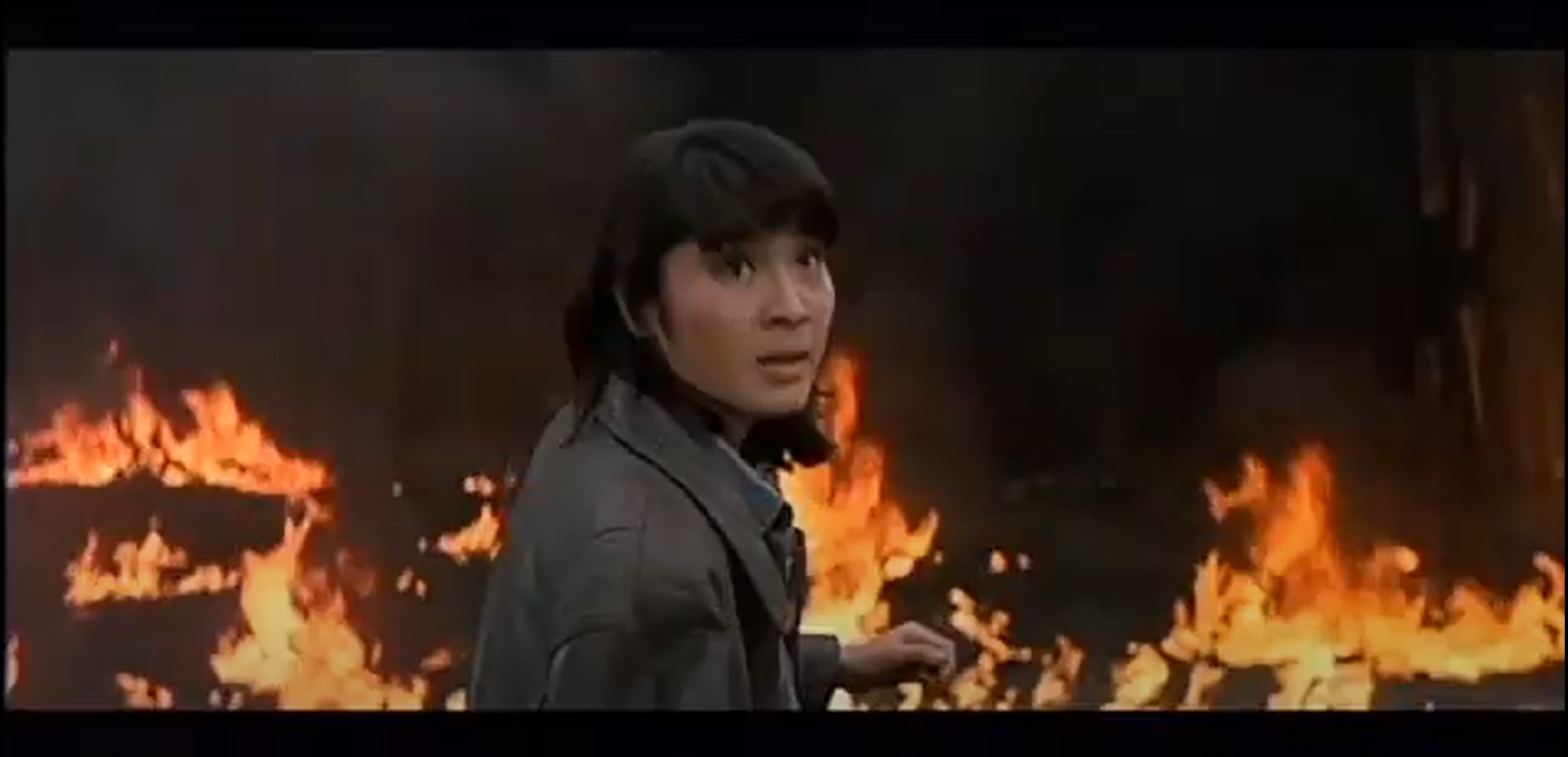
Ming-Ming is an adventurous, mercenary pilot unafraid to herself mixed up in the worst of trouble and against the tremendous odds.  When her patriotic grandfather and military uncle present Ming-Ming a mission of resistance against the Japanese Imperial Army during World War II, the odds, again, will be stacked up against her as she must track down China’s top-secret agent to extract the City Lord of Kayi City, a fortified Chinese city on the outskirts under Japanese control with ambitions to build a strategic, poisonous gas plant.  When Ming-Ming’s is shot down by a Japanese fighter pilot and the mission proves to be more difficult than expected, a small band of unlikely heroes become resistance fighters that inspire Kayi City to rise up against an oppressive, super nation threat to take back their home.  The city of spears and arrows must defend its people from an overwhelming army of rifles, mortars, and tanks in a fight to the death.

Michelle Yeoh is so hot right now.  The Malaysian-born, long-time actress has been under the U.S. mainstream radar for decades up until recently.  Before now, she was well enough for her roles in Ang Lee’s four-time Academy Award winner “Crouching Tiger, Hidden Dragon” without Yeoh receiving a nomination.  Twenty-two years later, Yeoh receives her first Academy Award nomination for “Everything Everywhere All at Once,” but we all knew she deserved the coveted U.S. award well before now.  U.S. audience never got to experience Yeoh earlier in her career as an Asian action star that rivals the likes of male counterparts Jackie Chan and Chow Yun-Fat.  In “Magnificent Warriors,” Yeoh’s diligence to the demanding workload foretells a superstar in the making.  The David Chung directed Hong Kong picture is relentless and action-packed with stunning and intense choreographed martial arts and having a large-scale showmanship of numerous grand explosions and a vast production pocket that include countless background actors.  The script is penned by frequent Stephen Chow collaborator Kan-Cheung Tsang who has wrote many of Chow’s directorial films, such as “Kung Fu Hustle,” “Shaolin Soccer,” and “The Mermaid.”  “Munificent Warriors,” also known as “Dynamite Warriors” is produced by Linda Kuk (“Hard Boiled”) and David Chung’s “Royal Warriors” producer John Sham and executive producer Dickson Poon under the D&B Films banner.

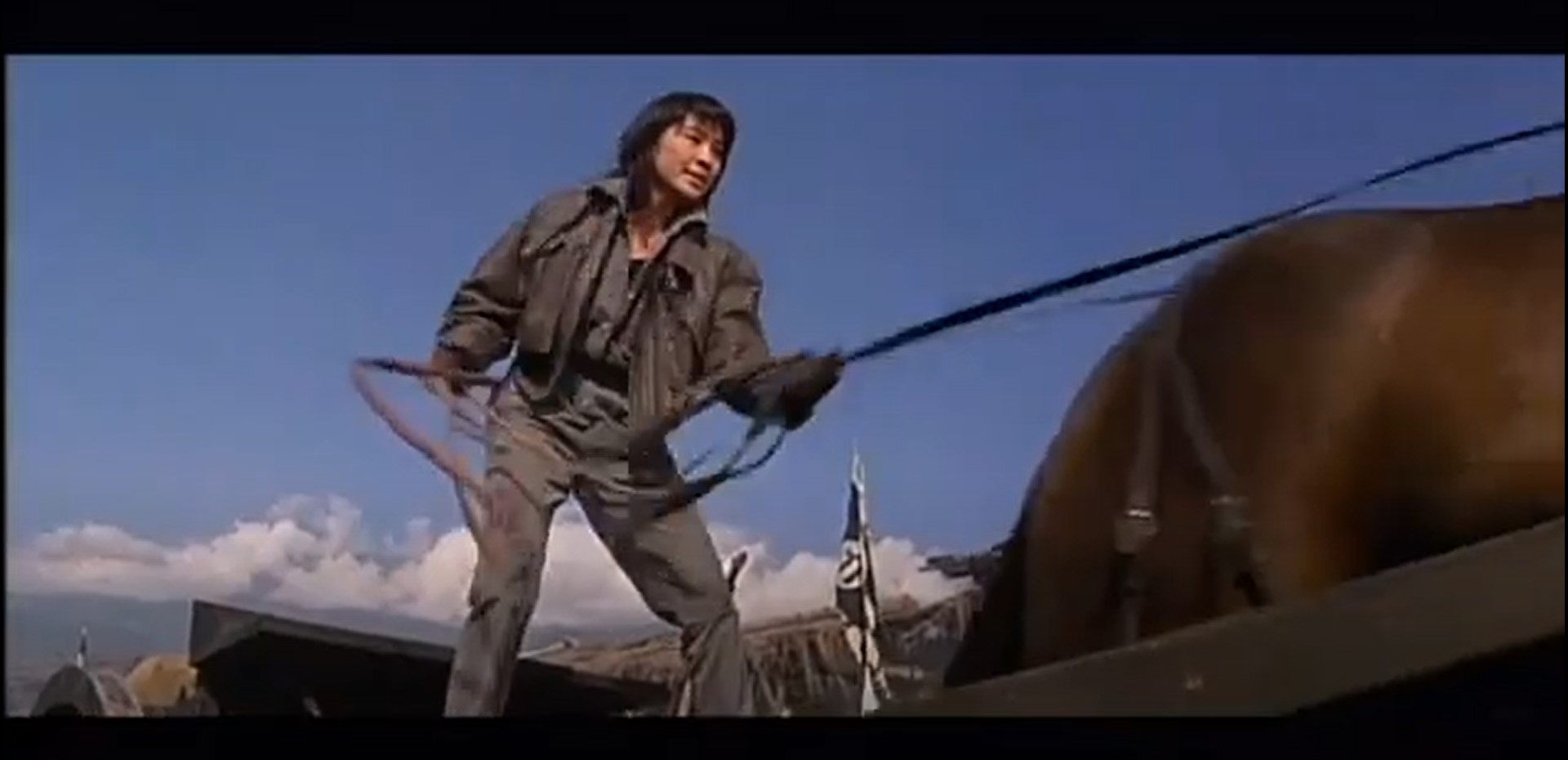
In a career that spans decades plotted by a number of strong female characters, Michelle Yeoh has embodied strength, intelligence, and beauty for this generation.  Under her early credited name of Michelle Kahn, the actress, who in the last five years has entered the Marvel Universe, the Star Trek Universe, and is slated to be in the upcoming James Cameron “Avatar” sequels,” is the driving force behind what makes “Magnificent Warriors” so engrossingly magnetic.  Trained to use a bullwhip and able to accomplish major stunts, unsafely I might add, on her own, Yeoh pulls off the demanding role with sheer confidence radiating from her performance.  So much confidence that the quality beams from her eyes to the point that her gaze nearly appears to be a sadistic grin of her own masochism.  Yeoh seizes Ming-Ming’s adventurous spirit, fully embraces it even, and stands out, but meshes well, amongst the mix of characters, including a hapless and bumbling drifter played by Richard Ng.  The “Mr. Vampire Part 3” star has a recognizable and distinguishable face as a well-known Hong Kong actor from China.  In “Magnificent Warriors,” Ng’s character is clearly the odd man out with zero ambitions and zero fighting skills, providing roughhouse comedic relief with lucky escapes with his life, but as far as character arcs go, the drifter, who cheats and scams gamblers for money and thinks about saving his own skin, succumbs to the resistance call of helping China and becomes one of the leaders of the core Kayi City defenders.  There are three others in this band of five with the City Lord (Lowell Lo, “Spider Woman”) who has a similar character arc as the drifter in being a bit of a scaredy-cat as a traitor against the Japanese Imperial Army but sees the light of his people needing his boiled down bravery and leadership, and his involvement with Shin-Shin (Cindy Lau), a daughter of a Japan loyalist who is obsessed romantically with the City Lord and can kick ass as well that surmises a feminism theme that women are just as strong as men and can have a better moral compass, especially compared to the bumbling man in power, the City Lord, and the drifter con artist.   The weakest fifth character, with an equally weak performance, in the group is Secret Agent No.1, as he’s described in the subtitles, played by Derek Yee (“Black Lizard”).  Though pivotal to the resistance operations to succeed, Secret Agent No. 1 fails to make his impact like the others, character divulging a vague history of his climbing to be China’s best secret agent and also teetering on the supposedly feelings for Ming-Ming that doesn’t ever come despite blatant suggestions to the contrary.    Matsui Tetsuya, Hwang Jan Lee (“The Drunken Master”), Meng Lo, Fung Hak-on, Jing Chen, and Ku Feng round out the “Magnificent Warrior’s” cast.

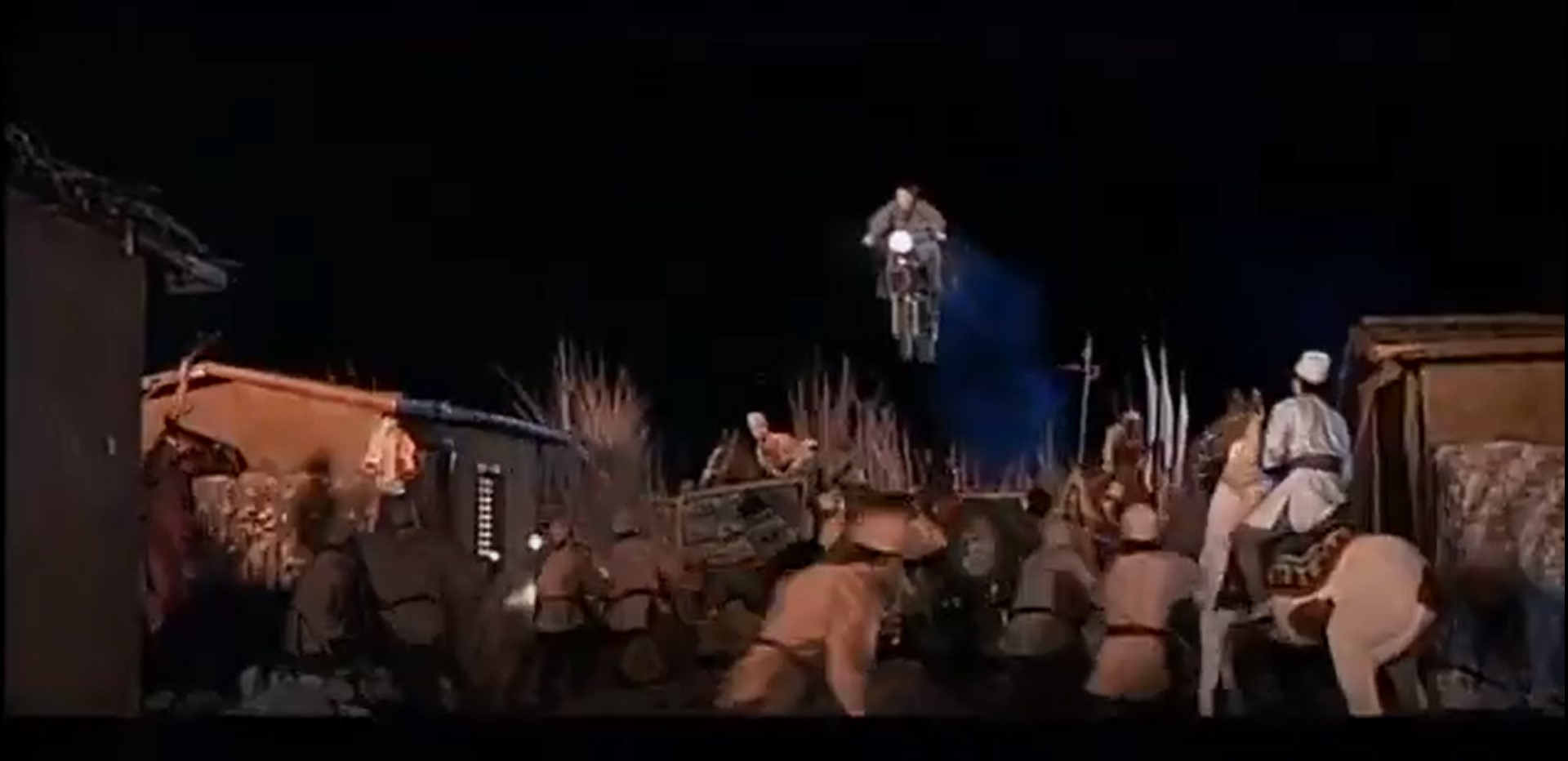
With extraordinary martial arts choreography, the impossible become possible in what can be experienced as an epic ballet of fists, kicks, and dueling weapons.  Every battling moment translates perfectly on screen without the flinch of error, though I’m sure many takes were took.  Back when outside Hollywood film studios relied on their determination and skill, with a pinch of luck, to get them through tough and rigorous stunts without the aid of wire, pads, or any union approved safety measures for that matter in what feels remarkably alien, like being on a whole other world where the rules of physics and safety do not apply.  “Magnificent Warriors” is truly a magnificent stunt-driven, wartime story revolving around revolutionism, a contemplation of the relationship between a home and its people, and a principled life of standing up for what’s right.  Director David Chung manages to massage out the numerous themes under the façade of a great thrust of nonstop action.  The set pieces, locations, and wardrobe are all fitting for the late 1930s-1940s era, especially with the Japanese uniforms that extend into their armored vehicles, such as in the brief, for show, scenes of its war plane and handful of Type 95 Ha-Go tanks. It’s refreshing to see an older film have a different angle on the overplayed World War II narrative; instead of the typical European or Asian Pacific campaigns involving American troops, “Magnificent Warriors” goes granular into The Second Sino-Japanese War during the Second Great War the world has ever experienced. Japanese implemented chemical warfare into their strategy of expanding their dominating military advances and establishing a footprint in China. “Magnificent Warriors” embellishes the poisonous gas narrative with the imperial army seeking to use Kayi City as a chemical producing plant, steering the film’s epic grapple over the city from out of underlying truth of the actual conflict. Every stage of story progresses into a larger scale of the previous skirmish which bottles up the grossing pressure between the imperial army, the resistance fighters, and the collateral damaged city folk caught in the middle. Sprinkled with comedy and charisma, and an ever so delicate dark tone, “Magnificent Warriors” is impeccable Hong Kong cinema and exposes the world to an underrated performance by Michelle Yeoh who kicked ass then in this film and still kicks ass today.

UK distributor 88 Films releases the “Magnificent Warriors” onto an AVE encoded, 1080p, high-definition Blu-ray, presented in a 2K restored transfer of the original theatrical cut on the company’s USA line. Exhibited in the original 2.39:1 aspect ratio, the anamorphic picture can appear globular at times, resulting in a packed image but more on so on pan shots than anything else. The overall picture quality suggests a pristine original print of the theatrical cut with a clean presentation from start-to-finish. Mostly warm with a flaxen degree of a desert background within a Mongolian Mountain valley, when the story does transition to a night shot or to interiors, the grain roughly sustains the change to keep a unified picture consistency that lives in a low contrast field without any deep shadow work or hard lined delineation. Compression issues are non-existent and there’s not obvious, unwanted touchups here to note. The release comes with two audio options: A Cantonese DTS-HD Mono and an English dub DTS-HD Mono. Preferrable choice is always the original intended language; however, this film’s audio options are both dubs but the Cantonese synchs better with grammatically suitable English subtitles albeit their breakneck speed to keep pace. Dialogue is clean, clear, and the action sound design is audibly potent with pinpoint precision on the homogenous strike. There are moments I thought the quick editing, especially during the plane chase, would hinder the ambient effects to keep up but I was pleasantly surprised, and the prop and gunfire intensity presents a nice exchange of open aired depth, range, and dynamisms. Software bonus features an archive interview with Michelle Yeoh (circa early 2000s), an archive interview with stunt coordinator Tung Wai, an English credits opener, the Hong Kong and International trailer, and still gallery. The hardware features are a tad better with a double-sided A3 poster, a 35-page color picture booklet with historical and filmic essay by Matthew Edwards, a limited cardboard slipcase featuring new art by Sean Longmore, and a reversible cover art in which shares its illustration with the booklet. The case isn’t the traditional slim Blu-ray snapper as it’s thicker to handle the booklet and poster. The release comes not rated, region A coded, and has a runtime of 92 minutes. Drawn into a big war shieled and overlooked by a bigger war, “Magnificent Warriors” not only time capsules a piece of Asian history but does it with fantastical fight and character that delivers one Hell of a timeless film with Michelle Yeoh at the helm.

“Magnificent Warriors” Now on an Amazing Blu-ray from 88 Films!   Click The Poster to Purchase!

Write Down Your EVILEST Desire and Have It Become Reality. “Invitation Only” reviewed! (Unearthed Films / Blu-ray)

Have the “Invitation Only” Blu-ray Stapled to Your Face!  Purchase by Clicking the Cover Art Below!

Chauffeur driver Wade Chen wasn’t born with a silver spoon in his mouth.  The humble, low-on-the-totem pole young man has dreams and aspirations of super models and sports cars but can’t even afford a new suit.  When Wade’s accidently catches his wealthy construction tycoon passenger, Mr. Yang, sexually engaged with the beautiful model of his dreams in the backseat of the limousine, the nice guy in him didn’t think too much of it, but Mr. Yang surprises Wade with an invitation to an exclusive, high-brow party.  Unable to attend the party himself, Mr. Yang sends Wade under the pretense of being the tycoon’s cousin and hooks him up with nice clothes and money for gambling.  At the party, Wade is joined by four others who are also first timers amongst the high-class guests and are greeted with welcoming arms by the host, Mr. Warren, who offers them their wildest dreams, whatever they desire, by manifesting them into reality, but their reality turns quickly into a nightmare when the party is a façade for the opulent to put on a stage show of hunting down, torturing, and gruesomely murder the poor who believe envying the rich degrades their lives.

A class dividing social commentary where the disillusioned rich continue to believe the lower-class are exploiting their pedestaled luxuries when, in reality, the wealthy continue to take an unfair advantage for their own benefit and whimsical desires!  Labeled as Taiwan’s very first slasher, Kevin Ko’s debut pecking order demarcating film specializes in serrating into the other half a sort of social class justice.  Ko, who continues to work in and around the East Asian market having just released last year his written and directed Chinese folkloric thriller “Incantation,” helms the gore heavy script from the screenwriting duo Sung In and Carolyn Lin as their only credited treatment.  Shot near entirely inside a dilapidated converted warehouse in Taipei City, “Invitation Only” becomes the entrapment and last straw abattoir for all classes looking up and salivating over the greedy greener grass separated by that invisible, money-driven, societal line.  Maxx Tsai (“Memoria”) and Michelle Yeh (“The Heirloom”) produce what some critics and fans might denote as torture porn and, truth be told, “Invitation Only” is very “Hostel”-esque with its plot revolving around deep pockets getting away with murder, literally.  The 2009 released film is a production of principal producer Michelle Yeh’s Three Dots Entertainment company.

What’s admirable about Kevin Ko’s “Invitation Only” is its hyper local aplomb. From Taipei City location to the mostly local cast from Taiwan, Ko’s feature is a celebration of Taiwan’s filmmaking life despite the plot being about taking lives. In the lead role, Bryant (Ray) Chang (“The Perfect Girl”) plays the passive doormat that is Wade Chen, a nice and principled guy but has no gumption to claw himself out of just scraping by in life. Chang’s no confidence spell over Chen is just want the doctor ordered when casting a bumbling nobody lost in the crowd and touching elbows with plutocrats eating escargot Tapas and drinking champagne. Chen immediately meets the sweetly awestruck Hitomi with a provided backbone persona by “The Ghost Tales” Julianne Chu. At this point you’re thinking Chen and Hitomi will hit it off, become love interests, and be the Formulaic heroes of the story at stemming from this connection.  Partially, that’s true, but then Chen quickly becomes beguiled by that very same supermodel of his dreams, the same supermodel he stumbled upon in the car with Mr. Yang (Jerry Huang, “49 Days”), who is now eating from his lucky-streaked hand at the roulette table.  Former JAV starlet Maria Ozawa is the delicate tigress who beds Chens in an offshoot room of the party to bring the on cloud nine chauffeur a taste of high society to a culminating head.  Ozawa, who left the adult industry and went on to have a modest genre film career to this day with principal roles in “Erotibot” and “Geisha of Death,” is intoxicating on screen in her debut mainstream feature, but the actress doesn’t speak a lick of Mandarin and forces English to the dialect conversation to which then Bryant Chang has forced the dynamics with poor English reciprocation.  In bed, Chang and Ozawa connect charismatically, but other than that, the dialogue exchanges can be painful to get through.  Other invitees on the “Invitation Only” casting list include Joseph Ma, Ying-Hsuan Kao, Vivi Ho, and another English speaker Kristian Brodie in the mix to balance out with Ozawa to make the film a Mandarin-English hybrid.

Being a product of the early 2000’s, at the backend of the first decade after the turn of the millennium, “Invitation Only,” with Kevin Ko’s quick, erratic editing style, very much epitomizes the era of time as a party-hardy, balls-to-the-wall, slasher with a survivalist edge. “Invitation Only’s” social commentary all but surely smacks you in the face with the fairly common theme of social class division, but the story twists the biding inner dark thoughts of the one percent upper class. The story evokes this justifiable fear amongst them where those willing to cheat, scam, and steal to obtain wealth from off the back of the wealthy deserve an unmerciful, unrelenting, and unpardoning execution with an affluent audience clapping and cheering their horrible mutilation and demise. With an unlimited cash at their disposal, to them, there are an unlimited number of ways to die, and Ko certainly illuminates that ragbag of weapons of bodily destruction every chance he gets. The annual gathering of denotes a “Purge” like affect that for once a year, for the last five years as the host, the English-speaking Mr. Warren, states, the Rich handpick lowly schemers for excruciating extermination. This year, however, a simple misjudgment of character foils a night of brain bashing and staple facing into the downfall of the Rich’s unscrupulous principles and steadfast convictions as Wade is a humble nice guy at the wrong place, wrong time blundering into Mr. Yang giving Ms. Supermodel the wang. The whole annual affair is the rich cathartically getting their hands dirty, purging their distaste with a medieval axe or with jumper cable attached to a car battery. Ko invites not only the wealthy getting away with murder but being utterly brutal about it without shame or guilt as if they are truly on top of the world. The kill scenes are gorgeously horrific with the Hollywood trained special effects artists to provide that it-factor when considering blood, guts, and dismemberments.

“Invitation Only” is exclusive extreme horror not for just for anyone. Gore genre distributor “Unearthed Films” knows this and rejoices in the niche market of everything that would usually make one squeamish. “Invitation Only” is the survival horror that refuses to be a party-pooper as the Kevin Ko film arrives onto a high definition, 1080p, AVC encoded Blu-ray. Presented in a widescreen aspect ratio of 1.78:1, this particular Unearthed Films product doesn’t convey my favorite transfer quality. The codec bitrate for a high-definition release is all over the place as there are severe dips in the Mbps that can be as high as mid-to-low 30Mbps to upper DVD quality around 9-13Mpbs. With that breadth of range, the transfer supplies an inconsistent quality in waves; some scenes are sharp and very delineated while when in the dip, the scenes fall from grace into a sea of pixel blocks in low-lit scenes that nearly wash out the image entirely. Color graded virtually nonexistent as Ko keeps the scheme along the lines of neutral coloring. There are three audio options for selection: a Mandarin, with some English, 5.1 DTS-HD, a Mandarin, with some English, 2.0 PCM, and an English 2.0 PCM. Discerning between the pair of Mandarin options proves less distinctive compared to the distinct dub, for oblivious reasons, but there’s an edge more deepening into the surround sound mix with an intensity richer soundtrack. The lossy dialogue tracks often sound flat and muted as the screams and frantic getaways never pierce the ear’s soul, but for the most part, dialogue is clear and clean. There’s also an issue with the release’s coding on the in-feature audio selection as I toggle between the three audio options, they’re all listed as English with their respective format and channel output. Bonus features include behind the scenes discussions from select cast, such as Bryant Chang, Maria Ozawa, and Jerry Huang, a photo gallery, and theatrical trailers. Unearthed Films’ release comes in a clear Blu-ray snapper case with latch and reversible cover art in which both art styles reflect the dark and grim brutality of the film’s thematic nature. With a runtime of 95 minutes, the unrated and region A coded release does have an evolving story to tell unlike its likeminded brethren that usually gets in and through the dirty, ugly business in just above an hour’s time to keep the gore porn from getting stale. For a feature debut, Kevin Ko goes all in on the knife’s edge with commentary-laden “Invitation Only,” a viciously cold take on the extreme cruelty genre when money, the root of all evil, divides our common sense against one another.

Have the “Invitation Only” Blu-ray Stapled to Your Face!  Purchase by Clicking the Cover Art Below!

EVIL Inspires a New Concert. “Nightmare Symphony” reviewed! (Reel Gore Releasing / Blu-ray)

“Nightmare Symphony” is a Falsetto of Praise for Lucio Fulci.  Purchase the Blu-ray Below!

Unable to cope with another large box-office failure, the American indie horror director, Frank LaLoggia, is in the travails of a make-or-break psychological thriller overseas in Kosovo.  With an executive producer forcibly pulling LaLoggia’s creative marionette strings and the film’s screenwriter displeased and disapproving LaLoggia’s arm-twisted version of the story, the struggling director finds himself frantic and in the middle of a breakdown caught between a rock and a hard place with a postproduction from Hell.  Those around him, the conceited producer, the upset screenwriter, the pushy wannabe actor, and more, are being hunted down and brutally murdered by a masked killer and the imaginary line between Frank’s reality and paranoia grows in intensity coming down the wire of completing his career-saving, or rather lifesaving, film.

Long time since I’ve heard the name Frank LaLoggia enter the dark corners of my brain as it relates to the horror genre.  The director of 1981’s “Fear No Evil” and 1995’s “Mother” had seemingly vanished from the director’s chair spotlight and more-or-less, or rather more so than less so, vanished from the broader film industry altogether.  Then, Domiziano Cristopharo’s “Nightmare Symphony” suddenly drops on the doorstep and there’s Frank LaLoggia, starring in the lead role of an Italian horror production.  Domiziano, known from his entries of extreme horror, such as with “Red Krokodil,” “Doll Syndrome,” and “Xpiation,” engages LaLoggia to act in an unusual role, as himself, and turns away from the acuteness depths of uber-violence and acrid allegories to a toned down, more conventionally structured, narrative inspired by the Lucio Fulci psychological slasher “Nightmare Concert,” aka “A Cat in the Brain.” Co-directed with first time feature director Daniele Trani, who also edited and provided the cinematography, and penned by the original screenwriter of “A Cat in the Brain,” Antonio Tentori, “Nightmare Sympathy” plays into questioning reality, the external pressures that drive sanities, and weaves it with a meta thread and needle. The 2020 release is produced by Coulson Rutter (“Your Flesh, Your Curse”) and is an Italian film from Cristopharo’s The Enchanted Architect production company as well as companies Ulkûrzu (“Cold Ground”) and HH Kosova (“The Mad MacBeth”).

Much like “A Cat in the Brain,” Frank LaLoggia depicts his best Lucio Fulci representation as a horror filmmaker whose storyline production mirrors the individual slayings surrounding him. As a character, LaLoggia is not entirely aware of the murders as the peacock headed slasher’s string of sadism runs parallel to LaLoggia’s post-productional workload. Cristopharo pays a simultaneous tribute to not only Fulci but also LaLoggia with a built-in brief, off-plot moment of the editor, Isabella, a good friend and longtime partner of LaLoggia, running a reel of “Fear No Evil” to reminisce over his debut picture. Antonella Salvucci (“Dark Waves,” “The Torturer”) plays Isabella but also LaLoggia’s pseudo film lead actress Catherine in a dual role performance with the latter marking Salvucci’s topless kill scene that hits and sets up the giallo notes. Isabella denotes the director’s only real friend with everyone else, from the screenwriter to the executive producer, push their own self-gratifying wants onto the American filmmaker from all angles. A vulgar herd of personalities descend upon LaLoggia to exact their strong-willed ideas on how the film should appear and be marketed. From the screenwriter Antonio (Antonio Tentori, ‘Symphony in Blood Red”), the imposing desperate actor David (Halil Budakova, “Virus: Extreme Contamination”), to the uncultured and pushy executive producer Fernando Lola (Lumi Budakova) and his aspiring actress Debbie (Poison Rouge, “House of the Flesh Mannequins”), they all look to exploit LaLoggia’s modest career for their own benefit. Performances vary with a range of experience, and we receive more noticeably rigid recites and acts from the Kosovo cast in a clashing pattern with the Italy cast that has worked with Cristopharo previously. Ilmi Hajzeri (“Reaction Killers”), Pietro Cinieri, and Merita Budakova as a chain-smoking lady stalker that has glaring eyes for Frank LaLoggia.

While not necessarily thought of as a remake, “Nightmare Symphony” is certainly a re-envision of the Fulci’s “Cat in the Brain.” What Cristapharo and Trani don’t quite well connect on is connecting all the pieces of the psychotronic puzzle together into what is meant to be expressed. The giallo imagery is quite good, a praise of the golden era period in itself, with a mask and glove killer, the closeup of gratuitous violence, most of the score, and the stylistic visuals imparted with ominous shadow work, foggy and violent dream sequences, and with congruous cinematography and editing of earlier giallo. Plus, audiences are treated to not only the aforementioned Antonio Tentori, screenwriter of “Cat in the Brain,” but also have composer Fabio Frizzi score the opening title. Frizzi, who has orchestrated a score of Lucio Fulci films, such as “Zombie,” “The Beyond,” “Manhattan Baby,” and even “Cat in the Brain” just to select a few notable titles, adds that proverbial cherry on top to evoke Fulci directing “Nightmare Symphony” vicariously through Cristapharo and Trani. There are some questionable portions to reimagining’s take on the original work that are more the brand of the contemporary filmmakers. The presence of death metal prior to one of the kill moments puts the overall giallo at odds with itself in a fish out of water aspectual scene composition. Another out of place component are the external characters that are not directly involved with LaLoggia’s peacock-head themed slasher; the ironical venatic of an animal hunting down people is the reversal of a Darwinism theory that instead of sexual selection, the beautiful and elegant peacock forgoes using grace to attract and aims to survive by natural selection and thus the killer kills to remain alive. However, the story and the directors never reach that summit of summation and with the oddball characters adrift from the core story – such as the stalking woman and the eager actor – “Nightmare Symphony” flounders at the revealing end with its severe case of blinding mental delirium.

With a cover art of an upside skull overfilled with film reels and unfurling celluloid through the soft tissue cavities, “Cat in the Brain” continues to be reflected in “Nightmare Symphony” up to the release’s physical attributes on the Reel Gore Releasing’s Blu-ray. Presented in on a AVC encoded BD25, with a high definition 1080p resolution, and in a widescreen 2.35:1 aspect ratio, the Reel Gore Releasing espouses the Germany 8-Films’ Blu-ray transfer for a North American emanation, which might explain some of the complications with the bonus features that’ll I’ll cover in a bit. Situated in a low contrast and often set in a softer detail light, “Nightmare Symphony” doesn’t pop in any sense of term with a hazy air appearance and a muted color grading that goes against the giallo characteristics, especially when the clothing and set designs have the same desaturation or are colors inherent of low light intensity. Despite appearing like a slightly degraded transfer on a lower BD storage format, compression issues are slim-to-none with artefacts, banding, or blocking and this results in no tampering edge enhancements or digital noise reduction. The release comes with three audio options: A German DTS-HD 5.1, German DTS-HD 2.0 Master Audio and an English and Italian DTS-HD Stereo 2.0 all of which are Master Audio. The German audio tracks are a dub from the 8-Film Blu-ray and the 5.1 offers an amplified dynamics of the eclectic soundtrack and limited environment ambience. Dialogue remains outside the dynamics on a monotone course but is clean and clear with good mic placement and a neat, fidelity fine, digital recording. The German dub has a distinct detachment from the video because of its own layer environment, sounding a little sterile than the natural English or Italian, but works well enough as expected with the supplement multi-channel surround sound. English SDH and German subtitles are optional. Bonus contents feature a behind-the-scenes which is entirely just a blooper reel, an English language interview with co-director Domiziano Cristopharo whose secondary language is English, the original soundtrack playlist, and the teaser and theatrical trailer. I mentioned an 8-Films’ transfer complication with the bonus content because there’s is also an interview with Italian screenwriter Antonio Tentori that’s only in German dubbed and subtitled with no option for English subtitles or dub. When you insert “Nightmare Symphony” into your player, an introductory option displays to either pick German or English and I considered this to be the issue for the German only interview with Tentori; however, that is not the case as both country options are encoded in German for the interview, so at the beginning option display, I would recommend the German selection because the setup will have contain all audio options for the feature whereas the English selection will only contain the English 2.0. Reel Gore Releasing’s Blu-ray comes housed in a red snapper case, the same as the company’s release of “Maniac Driver,” and has a less tributing reversible cover art with more revealing and illustrated aspects of the narrative. The release is region free, unrated, and has a runtime of 78 minutes. Another little fun fact about the release is the incorrect spelling of the director’s name on the back cover that credits his surname as Christopharo instead of Cristopharo. Influenced by Lucio Fulci beyond a shadow of a doubt, “Nightmare Symphony” proffers the Horror Maestro’s less notable credit with a companion piece that punctuates both films love for the giallo genre, love for the violence, and love for the morbidly unhinged human condition.

“Nightmare Symphony” is a Falsetto of Praise for Lucio Fulci.  Purchase the Blu-ray Below!

EVIL Embarks with Cons and Cops in “Project Wolf Hunting” reviewed! (Well Go USA Entertainment / Blu-ray)

“Project Wolf Hunting” on Blu-ray and Available for Purchase by Clicking the Cover Art!

After a disastrous Philippines-to-Korea extradition processing of criminals that resulted in an airport suicidal bombing with multiple casualties, the procedure to transport dangerous criminals moves to a decommissioned Cargo ship known as the Frontier Titan.  The 3-day journey is expected to be a safer option to extradite Korea’s most wanted as highly trained and experienced detective accompany the criminals as armed escorts.  Every contingent has been covered except for what lies in the belly of the cargo ship.  Hidden in the bowel, underneath the engine room, a top secret biological weapon, involving an ancient wartime prisoner’s chromosomes commingled with the agility, strength, and prowess of a wolf, being transported across the sea.  When the criminals plan an elaborate seizing of the ship, the monstrous hybrid man known as Alpha is also inadvertently released and kills his caretakers, leaving him free to roam the ship and engage the good and bad guys alike as fair game to hunt.

Only a handful of times in my life have I’ve seen a film with so much blood.  “Project Wolf Hunting” is one of the bloodiest, most violent, Korean films to come out of 2022.  The hybrid action-horror with a genetically hybrid superhuman is the latest effort from writer-director Hongsun Kim, sticking with the horror genre after his positive reviewed 2019 evil spirit family drama “Byeonshin.”  The title, in reference to the operation of transporting Alpha through to East China Sea, into the Korean Strait, and dock at Busan, is the international marketing title for the Korean name “Neugdaesanyang” and is a film I can confidently and merely describe as “Predator” meets “Con Air” on a cargo ship.  Seasoned civic officers of the law, hardened criminals with sordid pasts, a special op consisted of superhuman soldiers are up against the odds to stop the Alpha, the original specimen.  Film between the ports of Busan, Korea and Manilla, Philippines, “Project Wolf Hunting” is the Korean venture production from Content G with Gu Seaon-mok serving as producer and is presented theatrical by The Contents On in association with CJ CGV.

What’s interesting about Korean cinema is what you know what you’re getting with the characters who are greatly upfront, unpretentious, and full of attitude.  There are not a lot of false veneers with the cast of characters, something that can be said with most films spawned out from the Asia Pacific industry.  I might dangerously be overgeneralizing but from my viewings and writeups, but I’m fairly locked into my statement with confidence as “Project Wolf Hunting” paints a stark contrast of who’s who from the beginning without casting any doubt or even suspicion. Even with the some of the ship’s crew, Hongsun Kim clearly delineates their allegiances despite not coming right out with it initially and the cast immerse themselves into the appointed role with well-designed idiosyncrasies that seeing them out of character can be a bit of shock. Park Jong-doo perhaps is the most archetypical with Seo In-Guk, in his first feature performance, becoming the despot amongst the thieves. Guk transforms his appearance with full body tattoos to denote mafioso status and even takes that extra step with a few naked from the rear scenes to establish a conspicuous nonchalance for what anyone else has to think, say, or do. When many of the insurrectionary inmates take the ship, Jong-doo’s counterpart, Lee Do-il, isn’t so easily intimidated but is reserved and quiet in his strong posture. Dong-Yoon Jang offers a less violent option only to bide time for what’s ahead of them, the Alpha. Gwi-hwa Choi, who been hot right now in Korean cinema with having roles in “Train to Busan” and “The Wailing,” is the extraordinary and mysterious monster prowling to kill every single person on and off the ship’s manifest. With Alpha’s eyes stapled shut, maggots feeding off the festering tissue inside his mouth, and has a near spartan approach to liquidating, Choi completely transforms into the silent hunter with unstoppable and wild violent mode, but Alpha is only a name and the implicit meaning of the name does change hands throughout the course of the film that makes “Project Wolf Hunting” all that more the interesting. Female principals are not meek, weak, or helpless in his all-out brawl in a confined space with Jung So-Min as an eager cop with acumen and Jang Young-Nam as the dangerously uncouth companion to one of the mafia’s leadership and the fact that none of them are a love interest, or become even remotely involved romantically, sexually, or even innocently, speaks volumes on “Project Wolf Hunt’s” no room for romance rampage. The large cast lends to a high body and the acting pool rounds out with Dong-il Sung (“Byeonshin”), Park Ho-San (“The Call”), Chang-Seok Ko (“Lady Vengeance”), Lee Sung-wook (“Spiritwalker”), Jung Moon-sung (“The Cursed”), and Son Jong-hak (“Thirst”).

There’s so much blood. That statement was worth repeating. “Project Wolf Hunt” is reminiscent of the Japanese samurai films of yore or the absurd comedy gore film with geyser sprays of red with every blow.  Literally, tons of fake blood was used to coat the sets crimson in an impressive feat of movie magic carnage.  I’m also doubly impressed how the special effects team was able to achieve multiple sprays from out of the nostril cavities in what might seems small, insignificant, and simple looks amazingly palpable on screen that stopping to think about the difficulty in how that effect can be accomplished can be easily overlooked.  The blood sprays are only a fraction of the wide variety of violence and gore put on display and we’re treated to an abundance of slaughter and a superb, choreographed melee in each and every tightly confined skirmish that makes “Project Wolf Hunting” captivatingly adrenalized.  Production design creates the illusion of a cargo ship without question and the visuals, though soft in some scenes, sell the nautical voyage through clear skies and a storm rough patch.  Much of a part of “Project Wolf Hunting’s” success is cinematographer Ju-Hwan Yun’s framing.  The example I like to use is the post-elevator attack when the hoisting cord snaps that sends the lift plummeting down the chute with Alpha inside.  Yun then sends the shot from the top down the chute to the exposed opening of a mangled lift to see Alpha turn his eye-stapled face upward toward the narrowly escaping prey.  The shot gets the heart pumping and relays, in one sequence, the unkillable nature of Alpha.  If “Project Wolf Hunting” isn’t already thrilling enough with the brimming, cutthroat tensions spilling onto every deck between the police detectives and the criminals in their custody, the evolutionary plot twist that welds the age-old divide between the two frictions is a bloodbath you don’t see coming and one you’ll enjoy experiencing. 

Action, horror, human experimentations, and with a complemental nod to the hard-hitting Asian cop films of 90’s, “Project Wolf Hunting” has teeth and stamina for 123 minutes of knockaround bloodshed. A winning Blu-ray release for Well Go USA Entertainment, the film is presented in a widescreen 2.39:1 aspect ratio. The AVC encoded BD50 offers a topnotch 1080p resolution that translates well to the big screen with granular detail in the interior and exterior of the cargo ship set and displays the stylistic choice of a warm color scheme consisting of prominently yellows and greens, providing less shadowy, higher contrast areas to suggest there is nowhere survivors can hide. Though quite a bit of CGI throughout the film, the end result doesn’t appear half bad with more fleshed out textures built into the renders to make them less gummy-looking. The release offers four audio options – a Korean and dub English 5.1 DTS-HD Master Audio and a Korean and dub English 2.0 stereo. Obviously, you receive more bang for your buck with the amped up surround sound option and don’t have to contend with dubbing if you go the original Korean language route. A high velocity range sounds strong through the rear channels with gunshots, the ship’s indiscreet hum, and the overall ricochets, clinks, and skirmish shuffles submerge an enveloping blanket of directional sounds right in your ears. The Korean dialogue is clean, clear, and vociferous in Korean inflections. English subtitles are optional and available well synched and error-free. Like status quo with other Well Go USA Entertainment releases, bonus features are an ornately produced, one-sided interview vignettes with the cast and crew and of the behind-the-scenes making of the film as well as a making of Alpha which was more actor Gwi-hwa Choi’s excitement about this different kind of role per his usual. The trailer is also available in the bonus content. Physical features include a traditional Blu-ray snapper with latch with the grisly, dirty face of Alpha blended into a black background. The film is unrated and is coded region A for disc playback. Despite minor convoluted expounding, “Project Wolf Hunting” kept the attention at high alert with a high body count, an indomitable super soldier, and a cargo ship load of blood.

“Project Wolf Hunting” on Blu-ray and Available for Purchase by Clicking the Cover Art!

Sometimes, You Can Feel EVIL Tightening Around Your Throat. “Death Knot” reviewed! (Well Go USA / Blu-ray)

“Death Knot” Hangs Loose on Blu-ray! Purchase Your Copy Here!

Hari and his sister Eka receive the tragic news of their mother’s suicide.  They return to their rural childhood village home to attend her funeral and prepare arrangements for the family home, but the siblings are met with a cold shoulder as the locals have shunned their mother, fearing her as a black magic practitioner who made a pact with the Devil himself.  The suicide and the village distress illicit different responses in both children – Eka wants to put everything behind her and live her life in the city of Jakarta. While Hari drowns himself of guilt over his mother’s death as he hasn’t visited his mother in years and wants to cherish the time left of his mother’s house, despite the not so pleasant childhood memories of his mother’s descent into mental instability.  When a upcoming storm makes leaving the village impossible, in what the superstitious locals note as The Harvest to claim souls, Hari, Ek, and Eka’s husband, Aldi, are forced to stay the night and that’s when strange visions and odd behaviors evoke the presence malevolent entity, an ancient deity, to beleaguer Hari and Eka into submitting to its will.   

Not too many Indonesian horror films see the light of day, buried beneath the massive manufacturing machine from the West, such as North America and Europe, that churns out films about every 8 seconds, the same rate in which babies are born at in the U.S, but that doesn’t mean the country known for its idyllic 17,000 islands and Buddha temples doesn’t have a repertoire of horror. In fact, obscure cult celluloids like “Lady Terminator” and “Satan Slaves,” known to those with indie horror running through their veins like crack cocaine, are the exemplar of the scarcely noticed Indo-horror collective and now that modern technology provides streaming servies far and wide from every corner of the world and advances in filmmaking make accessibility and recording film considerably cheaper and easier to complete, getting exposure becomes greater to other titles mostly hidden gems from the rest of the narrowed focused general population. Point in case, Cornelio Sunny’s “Death Knot” debuts his occult thriller that incorporated the grimly prophesized myth known as the pulung gantung that speaks of a great, fiery meteor being a harbinger of suicide and in Indonesia, the most common suicide method is by gantung aka hanging. “Death Knot,” also known as “Tali Mati,” isn’t the only film based on the myth, but what separates this film from other myth-based works is that the pulung gantung is still relevant today with highly resolute belief amongst the underprivileged and poorer neighborhoods. Sunny co-wrote the script with Ike Klose and is produced by Ismail Basbeth under Sunny’s company banner Matta Cinema in association with Kathanika Entertainment, SRN, and Umbara Brothers.

To ensure his debut directorial goes without a hitch, Sunny slides into the lead role of Hari and how Sunny and Klose write the character counterintuitively to screenplay 101 by not building him up, providing background, or instill preconceived notions through the acts. Hari’s a clean slate from start to near finish from scene one that involves him waking out of a horrible dream about his mother after briefly texting his sister. Written to have no depth in existing or having interests in anything, Hari’s hyper-focus is his mother’s legacy and commorancy, leaving his current mundane left in Jakarta to worry about his decease mother he hasn’t seen or talk to in years. Sunny is swarthy handsome, strong in subdued stubbornness, and limits his range toward his character in being the nondescript nonbeliever of occultism that innately scares the dickens out the poor village people. Hari and sister Eka (model/actress Widika Sidmore, “May the Devil Take You Too”) toss crumbs of background about growing up with an absent father and a community abhorred mother but appear unruffled by a broken home and, for the most part, shrug much of that rich backstory from their tabled history. Sidmore does a better job bottling Eka’ fear and loathing of a place that dejects her existence as villagers shun them for their devil pact bloodline and, eventually, the ooze of unwantedness seeps out of her to the point of being an emotional mess. Only when her loveable and amenable goofball husband, Adi (Morgan Oey, “The Deadly Love Poetry”), suddenly grows an obstinate backbone and refuses to leave the village, acting strange with an uncomfortably warped smile on his face as he fixates his glare deep into the forest, does Eka’s emotions pour toward a direction and hone in on a purpose until she, herself, falls into the same possessed-like predicament that befits her more than Adi but would be two perfectly ear-to-ear, Chesire cat-grinning candidates for Parker Finn’s horror-hit, “Smile.” The entity that has dominion over them isn’t so subtle, but Oey and Sidmore’s performances are, in a good way, awkwardly creepy and perfectly executed. Oey’s mimicking of a twist on the Balinese dance Hari’s mother performed in the opening scene before her demise and with what looks to be Hari’s mother silhouette impelling the dance in the shadows is “Death Knot’s” eeriest moment that lands traditionalism and supernaturalism into a single scene of shadows and visitants.

“Death Knot” is a slow burn, dread building, culture integrating, ambitious debut feature from actor-turned-director Cornelio Sunny.  Performance driven with little-to-no special effects, the surrounding morose atmospherics of “Death Knot” relies on the cast and it’s portentous, jump scare score to deliver a palpable fear without a perceptible villain, keeping very much in tune with one of Indonesia’s notorious folklores.  The limited budget constrains Sunny to character exposition and pursuance of self-selling the concept of an entity inhabiting friends and family with only their God-given talents and appearances to construct ominous opposition.  Descriptively, the notion sounds monotonous in tone, substandard in achieving a certain level of jitters, and gridlocked from a story perspective, but Sunny and his counterparts are able to feed the idle monster with energetic enthusiasm that turns the notion on its head with menacing and foreboding results, amplifying to one of the story’s other themes of paralyzing guilt that affects Hari from moving forward in life because of that equivocal estrangement between him and his mother.  However, one of the biggest problems to come out of “Death Knot” is the ambiguously fated ending for Hari, surrounded by a 50-yard radio of melee weapon-holding villagers like he’s been suddenly dropped in the middle of the Resident Evil 4 video game.  Perhaps not making the connection more evident, Sunny and Klose do faintly paint the picture of social class tensions with big city Hari, Eka, and Adi being met with aversion by the lower-class, rural village who have a strong belief system in the supernatural but is not a major clash or even an apprised motif represented only by a few aloof moments.  I was also hoping to see the myth’s harbinger of death with a great fireball in the sky to signify the beginning of The Harvest, aka hangings to usurp soul energies to feed the devilish deity, but that didn’t happen considering the budget for limited-to-no visual effects. 

“Death Knot” has this somber quality in its characters who are dropped into an unwelcoming village on a dark and stormy night scenario that puts a very Plutonian stamp on what kind Hell-crafted mark an ancient, malevolent God has left on forgotten land.  Well Go USA Entertainment picks up and distributes the home video rights to Cornelio Sunny’s debut hair-raising feature with a Blu-ray release. Presented in a widescreen 1.78:1 aspect ratio, the cinematography by Gunna Nimpuno captures the elemental beauty of rural Indonesia with rolling fields as far as the eye can see and the integrated towns built into hills becomes one seamless graft of spartan man living humbling on nature. Night shot continuity is Nimpuno’s weakest link in the arrangements of shots between the house at night and the forest at night. Outside the house is a natural pitch black with little lighting other than a green gel or another warm color in the house exterior but the forest scenes, every single one, are glazed with blue tint during day shooting to fabricate night sequences. The reproduction compression on this AVE encoded BD25 is rather good with little-to-no signs of banding, artefacts, or other lossy content issues. The Indonesian DTS-HD 5.0 Master Audio is digitally a solid track with a lamentably fine, back of the mind, sound design harmonized with an intense summitting score. There are also no issues with the digital tracks, any audio compression, and each track plays its role in sundered channels, creating an omnidirectional biodome that immerses you into the Sunny’s intimate family curse. English subtitles are option and are well-synched with grammatical accuracy. Aside from the opening previews of other Well Go USA titles, there are no other bonus features with this release. The physical features include the traditional Blu-ray latching snapper with a creepy enough illustrated cover art of a small smiling evil figure standing and surrounded by an engulfing forest. Inside is a leaf insert advertising other new Well Go USA distributed films. The film is not rated with a region A coded playback and has a runtime of 101-minutes. Cornelio Sunny first efforts don’t go unnoticed as “Death Knot” hooks with a mystery that slowly unravels the ugly truth of material myth and renders a stagnant guilt out of a powerfully, paralyzing combination of estrangement and loss.

“Death Knot” Hangs Loose on Blu-ray! Purchase Your Copy Here!